Posts Tagged ‘light rail transit’

h1

City-funded 2008 Downtown Austin Plan explained why urban rail better choice than bus

23 January 2014
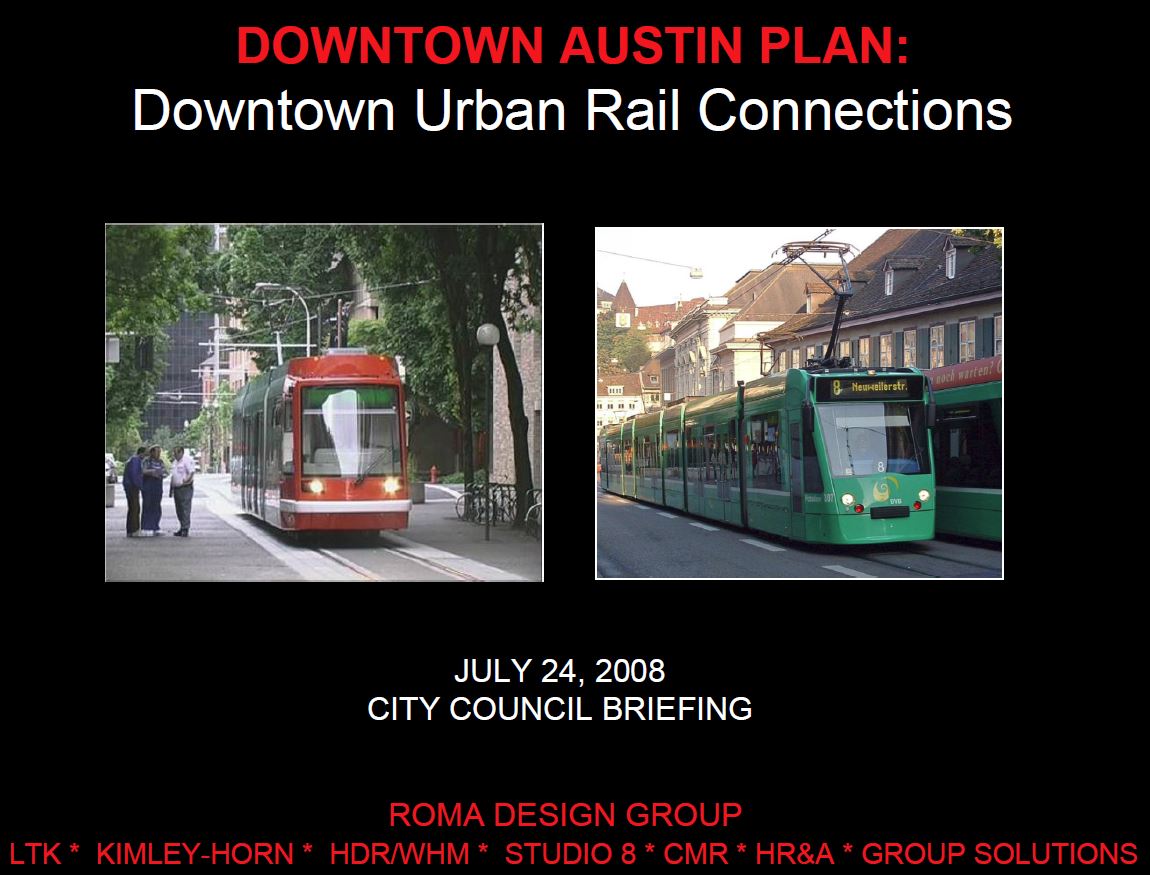
Back in 2008, City of Austin hired Roma Design Group as lead consultant to design urban rail starter system plan and promote benefits of light rail over bus services. PPT title page screenshot: L. Henry.

Back in 2008, City of Austin hired Roma Design Group as lead consultant to design urban rail starter system plan and promote benefits of light rail over bus services. PPT title page screenshot: L. Henry.

Are Project Connect, the City of Austin (COA), and Capital Metro all starting to get cold feet over advancing an urban rail project?

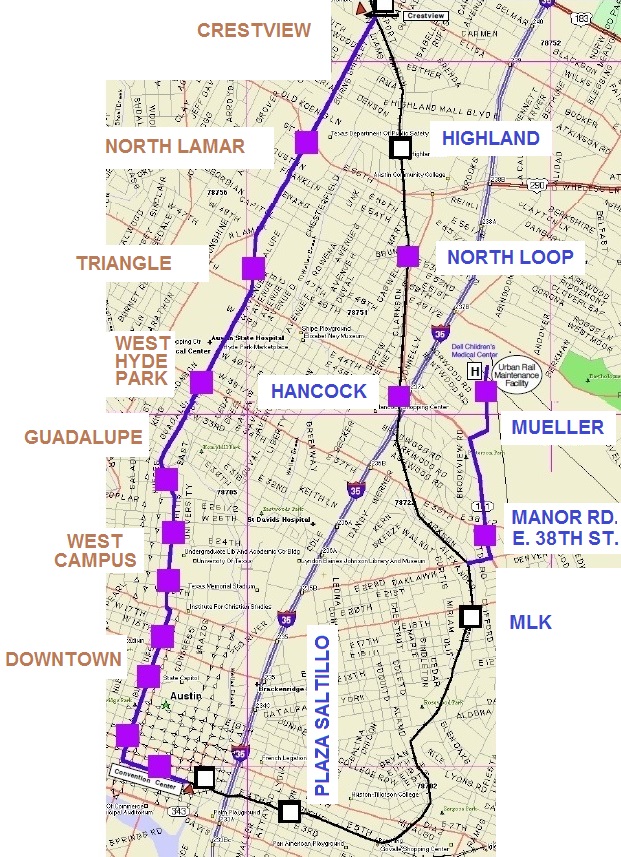
The first suggestion of this came a few months back, as Project Connect’s Urban Rail Project (with Kyle Keahey designated the Urban Rail Lead) morphed into a so-called “High-Capacity Transit” project.

Then, more recently, there have been more frequent and persistent hints and hedging statements by local officials and transit planners referring to vague “high-capacity transit” … plus a sudden, more emphatic shift into extolling the bountiful benefits of so-called “bus rapid transit” (“BRT”). And now there are all these sudden cautions from various City and Project Connect personnel that maybe, possibly, urban rail may be off the table for much of the “East Riverside to Highland” route now in official favor.

Particularly significant is the intensified emphasis with which Project Connect’s Urban Rail Lead (should he now be re-designated “High-Capacity Transit Lead”?) Kyle Keahey — and Mayor Lee Leffingwell — have been suddenly brandishing “BRT” (as applied to the rather mundane MetroRapid upgraded-bus service) as an exciting “high-capacity transit” possibility for East Riverside and even the so-called “Highland” route. Along with this, there’s been repeated lecturing to Central Austin neighborhoods along the West Campus-Guadalupe-Lamar corridor as to how fortunate they are to have the MetroRapid service.

And of this all in the context of recent revelations that Urban Rail Lead Keahey has, on record, apparently favored “BRT” over rail transit for at least several years. See: Kyle Keahey, Urban Rail Lead, hypes “BRT” as “more affordable…more flexible investment” than rail.

This sudden switch, from the promotion of rail over the past eight years, to disparaging rail and exalting bus transit, stands in stark contrast to arguments repeatedly presented in City-sponsored presentations for most of the past decade. This case for rail per previous policy is exemplified in a 24 July 2008 Austin City council briefing under the Downtown Austin Plan (DAP) delivered by a consultant team under contract to the City, led by ROMA Design Group in a consortium also including LTK Engineering, Kimley-Horn, HDR/WHM, Studio 8, CMR, HR&A, and Group Solutions.

The PPT presentation, titled “Why Rail, and How Can it Work in Austin?” not only explained the background of the DAP and the team’s latest findings, but also addressed the usual questions over why the team were recommending a rail transit system (envisioned as a streetcar at that point) plus how and why it would be superior to simply running bus service.

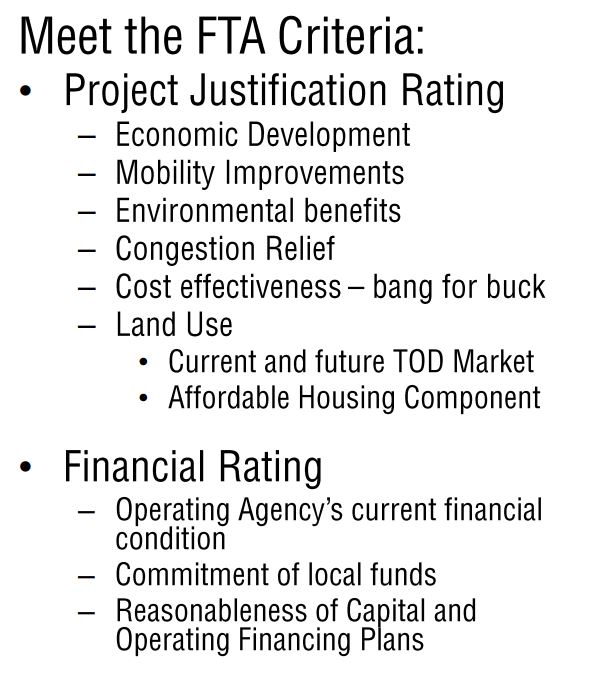
In the second major section of the presentation, “Why Rail, and How Can it Work in Austin?” this case is made in a slide headed “Passengers prefer rail because of increased comfort and greater capacity.” As you can see in the screenshot below, the ROMA team noted that rail transit has shown a “Proven increase in ridership over bus-only cities”, has influenced the “Most significant decrease in automobile trips and parking”, is associated with a “Reduction in operating cost per passenger”, and is “More sustainable”, and in addition, “Fixed routes influence land use patterns and promote density” and are “Best suited to corridors where destinations are concentrated”.

Screenshot of slide from ROMA team's Austin City Council briefing.

Screenshot of slide from ROMA team’s Austin City Council briefing.

These same arguments, disseminated by City and Project Connect representatives in many community presentations over the intervening years, are now abruptly being discarded as official planners have apparently begun to distance themselves from urban rail.

The ROMA team’s PPT presentation unfortunately is no longer available on the City’s website, but we’ve uploaded it and you can access the full version here:

Why Rail, and How Can it Work in Austin?

h1

Kyle Keahey, Urban Rail Lead, hypes “BRT” as “more affordable…more flexible investment” than rail

20 January 2014
Kyle Keahey promoting "high-capacity transit" route selected by Project Connect, Nov. 2013. Photo: YouTube screengrab.

Kyle Keahey promoting “high-capacity transit” route selected by Project Connect, Nov. 2013. Photo: YouTube screengrab.

Perhaps Kyle Keahey, Project Connect’s designated Urban Rail Lead, might better qualify as “Urban Bus Lead”?

It turns out that, for some time, Keahey and his consulting firm HNTB have been blowing the horn of the “back to buses” movement. In HNTB “white papers” (for which he’s listed as a “resource” and apparent co-author), Keahey enthusiastically disparages rail transit and promotes “bus rapid transit” (BRT) as purportedly “Faster to implement, less expensive than rail” and a “more affordable … more flexible investment.”

Title page of Kyle Keahey's 2011 HNTB paper on BRT (PDF version).

Title page of Kyle Keahey’s 2010 HNTB paper on BRT (PDF version).

These arguments are very similar, even in wording, to the attacks on rail transit — especially light rail transit (LRT) — from major rail opponents such as Randal O’Toole and Wendell Cox. See: Rail Public Transport Opponents. It should also be noted that Keahey’s BRT “white papers” aren’t just informational, they’re promotional — hyping the supposed superiority of upgraded bus services over rail transit.

As is typical with so many forays in rail-bashing, the fallacy starts with a sleight-of-hand trick over the basic concept of what, exactly, BRT is. According to Keahey & Co., “BRT” can apply to almost any bus service above an ordinary local operation: “The term bus rapid transit actually covers a broad array of applications, ranging from enhanced bus service on arterial streets to operations on exclusive bus-only roadways and other dedicated rights-of-way….”

In effect, cosmetically enhanced ordinary limited-stop bus service (which might more accurately be called “bus upgraded transit”) is conceptually re-branded as “bus rapid transit”. This verbal legerdemain allows the practitioner to portray visions of relatively rapid buses on exclusive paveways and rapid-transit-style stations while simultaneously touting the much lower costs and faster implementation times of moderately upgraded limited-stop buses, running in mixed general traffic, with cheap bus stops conventionally located at curbside. See: Why MetroRapid bus service is NOT “bus rapid transit”.

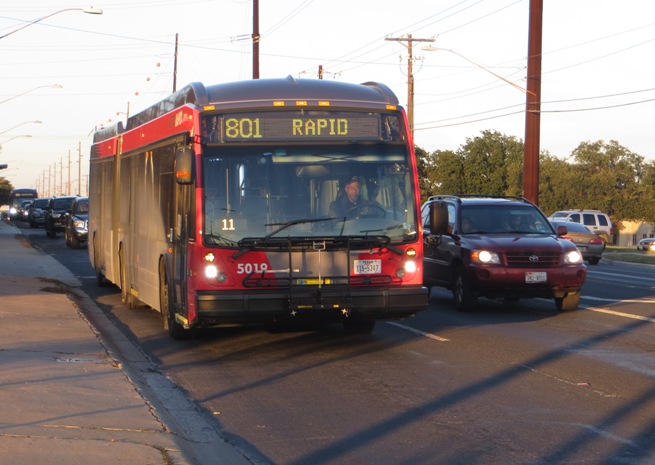
Capital Metro MetroRapid bus in test operation on North Lamar, Dec. 2010. Photo: L. Henry.

Capital Metro MetroRapid bus in test operation on North Lamar, Dec. 2013. Photo: L. Henry.

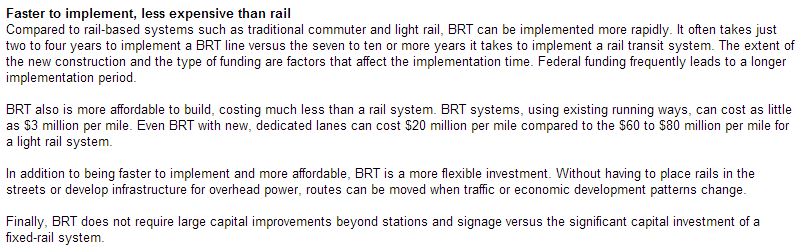
Keahey’s bait-and-switch tactics are exemplified in a 2010 HNTB paper, titled A new take on an old standard — The changing image of bus rapid transit, which claims that “For the commuter, BRT is similar to rail in its ability to provide predictable scheduling, clear and simple routing and speed” … and then steps up the attack in a section sub-headed “Faster to implement, less expensive than rail”:

Compared to rail-based systems such as traditional commuter and light rail, BRT can be implemented more rapidly. It often takes just two to four years to implement a BRT line versus the seven to ten or more years it takes to implement a rail transit system. …

In addition to being faster to implement and more affordable, BRT is a more flexible investment. Without having to place rails in the streets or develop infrastructure for overhead power, routes can be moved when traffic or economic development patterns change.

Finally, BRT does not require large capital improvements beyond stations and signage versus the significant capital investment of a fixed-rail system.

Snippet from Kyle Keahey's 2011 HNTB paper promoting BRT over rail transit (webpage version).

Snippet from Kyle Keahey’s 2010 HNTB paper promoting BRT over rail transit (webpage version).

These themes are further elaborated in a more recent (January 2014) HNTB paper, titled How buses are becoming “cool” again, in which Keahey (listed among other HNTB “resource contacts”) mounts a number of arguments for eschewing rail in favor of an upgraded bus-based system, “An affordable alternative to fixed-guideway, rail-based systems” which “combines the flexibility and cost savings of buses with the efficiency, speed, reliability and amenities of a rail system – often without the expense of adding significant infrastructure.”

“By choosing BRT over rail,” claims Keahey’s paper, transit agencies can achieve a number of advantages. Furthermore, “BRT system capital costs are a fraction of the cost of a rail-based system and can be implemented in a fraction of the time.” Thus, “many cash-strapped municipalities will be more likely to seriously consider BRT.”

Snippet from Kyle Keahey's 2014 HNTB paper promoting BRT over rail transit (webpage version).

Snippet from Kyle Keahey’s 2014 HNTB paper promoting BRT over rail transit (webpage version).

These kinds of claims and arguments, long disseminated by rail adversaries claiming “BRT” is “just like rail, but cheaper”, have consistently been exposed as exercises that are dubious at best and generally fraudulent, playing fast and loose with facts.

Buses running in limited-stop and express mode, even with spiffied-up stations, have been around since the 1930s (when General Motors first branded them as “bus rapid transit”). If they’re “as good as rail, but cheaper”, why are so many cities, in the USA, North America, and around the globe, hustling to install new light rail transit (LRT) and other rail transit lines? Here are some issues to consider that are typically ignored by “BRT” promoters:

Actual rapid-transit-style BRT typically has capital costs that equal or exceed those of LRT, and tend to be significantly higher when annualized, with lower bus system lifecycle costs factored in.

Bus operating & maintenance (O&M) costs tend to be higher than those of rail transit. Thus, cities that operate both rail and bus transit have on average lower total costs per passenger-mile than cities operating only buses.

• LRT systems have demonstrated significantly greater success than BRT and “bus upgraded transit” systems in attracting and retaining ridership.

• Electric LRT is not dependent on increasingly expensive petroleum fuels, and produces fewer carbon emissions per passenger-mile than buses.

• LRT continues to have significantly greater influence in attracting transit-oriented development than bus-based alternatives.

• LRT excels in supporting urban livability and a pedestrian-friendly, bike-friendly urban environment.

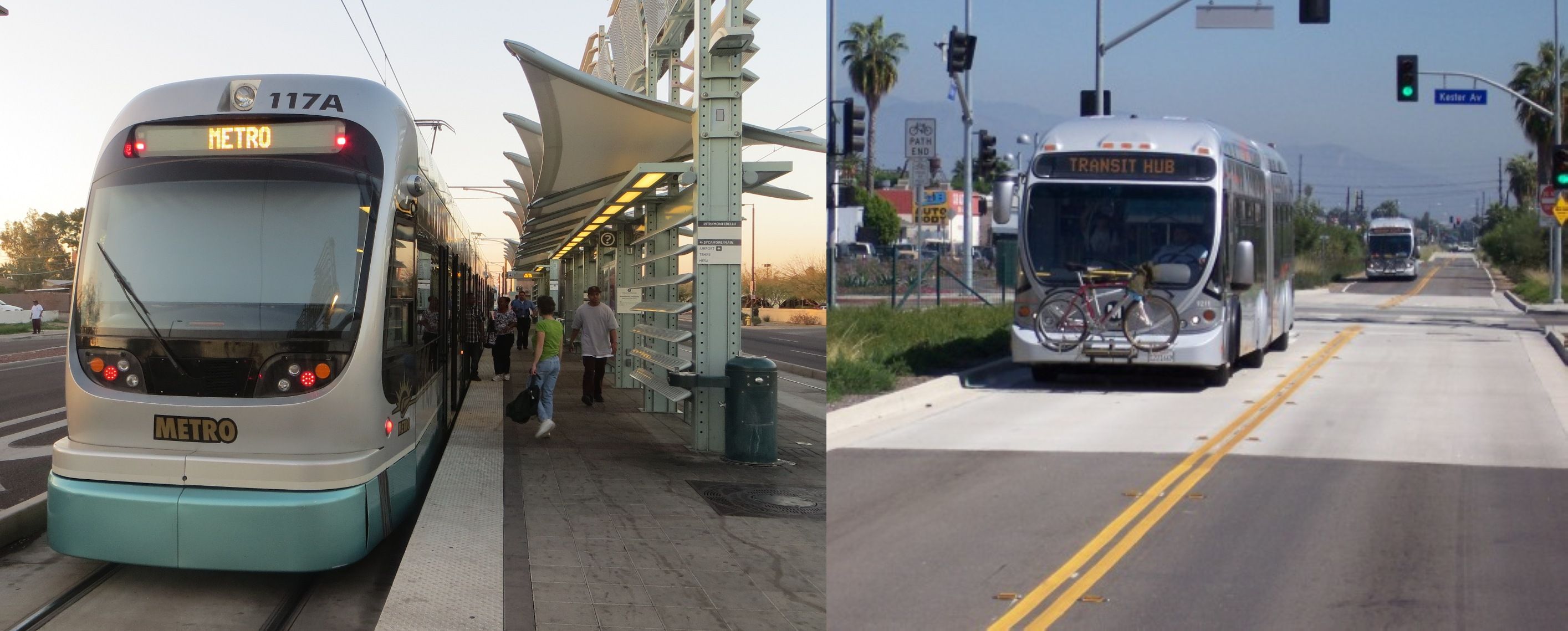
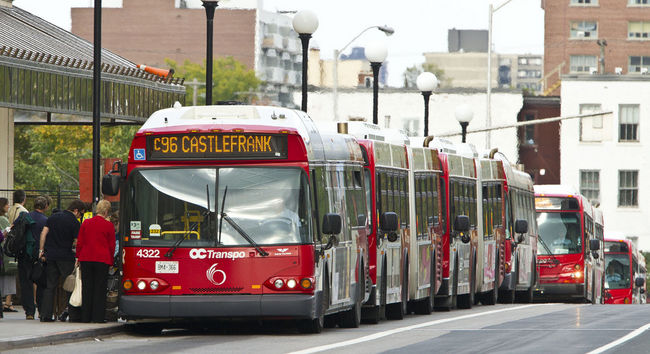
Phoenix light rail transit (LRT, left); Los Angeles Orange Line “bus rapid transit” (BRT, right). Photos: L. Henry.

Phoenix light rail transit (LRT, left); Los Angeles Orange Line “bus rapid transit” (BRT, right). Photos: L. Henry.

The following analyses provide data and further information:

Comparative examination of New Start light rail transit, light railway, and bus rapid transit services opened from 2000

Research study: New LRT projects beat BRT

Research: BRT can truly be pricier than LRT

Study: LRT ridership gains are spectacular

Evaluating New Start Transit Program Performance: Comparing Rail And Bus

Rail Transit vs. “Bus Rapid Transit”: Comparative Success and Potential in Attracting Ridership

“Free” buses vs. “expensive” rail?

“Bus Rapid Transit” Analyses and Articles

Energy Efficiency of Light Rail Versus Motor Vehicles

But while all this back-and-forth over BRT vs. LRT certainly is an important debate within the transit industry, let’s conclude by returning to the main focus, and a controversy that raises two critical questions:

• Why has an individual who clearly believes that upgraded bus services are a better alternative to rail transit been selected as Urban Rail Lead and placed in charge of Austin’s major urban rail study?

• Did this disdain for rail, and preference for bus operations, play any role in leading Project Connect’s rail study away from a fair, impartial, and technically accurate evaluation of Guadalupe-Lamar, the city’s overall highest-performing and best travel corridor?

h1

University Area Partners’ endorsement of Guadalupe-Lamar corridor underscores West Campus support for “backbone” urban rail

13 January 2014
West Campus neighborhood, primarily represented by University Area Partners. Map: The Galileo, rev. by ARN.

West Campus neighborhood, primarily represented by University Area Partners. Map: The Galileo, rev. by ARN.

Back in November, in the midst of all the uproar over problems with Project Connect’s “Central Corridor” study and forthcoming route “recommendation”, this blog missed reporting that yet another major neighborhood association had jumped on board the effort to designate the Guadalupe-Lamar (G-L) corridor as the preferred starter-line route for urban rail (light rail transit).

On Nov. 12th, the University Area Partners (UAP) neighborhood association voted to express its belief “that any first investment in light rail must serve as an expandable backbone of rapid transit, and such an alignment is most suited along North Lamar Blvd. and Guadalupe Street and terminated at or near the North Lamar Transit Center ….”

The University Area Partners is a neighborhood organization representing business, institutions, and property owners in the University of Texas area, encompassing most of West Campus, UT-Austin, and The Drag area.

According to UAP member John Lawler, reasons the UAP board decided to support the G-L alignment include:

• Prioritizing urban rail along the G/L corridor would better serve the steadily growing and already dense West Campus neighborhood
• UAP wants to support the UT Student Government position, as students are the primary residents in the area
• CANPAC, the planning area UAP is an original member of, has endorsed the plan
• BRT is not a solution for the Drag’s traffic congestion and the neighborhood has repeatedly encouraged rail development for the past several decades

The endorsement of this influential neighborhood organization is especially important because, in terms of residential density, the West Campus ranks as the third or fourth-highest neighborhood among major Texas cities.

Yet, while Project Connect’s recent “Central Corridor” study used the metrics of Guadalupe and the West Campus area in its justification and analysis, its proposed “sub-corridor” configuration would effectively bypass this crucial area, instead planning an alignment on San Jacinto, one-half to three-quarters of a mile east of the Drag and West Campus neighborhood.

h1

Here’s what a REAL urban rail public involvement planning meeting looks like

10 January 2014
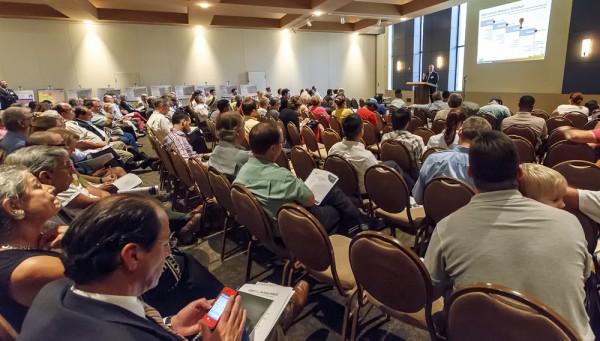
Minneapolis-area community meeting on proposed Southwest light rail project. Photo: Karen Boros.

Minneapolis-area community meeting on proposed Southwest light rail project. Photo: Karen Boros.

While Project Connect has been doubling down in its determination to squelch true public involvement (and substituting a process of rigidly controlled public manipulation portrayed as “community input”), a recent community meeting in the Minneapolis area gives an idea of what bona fide public involvement should look like (see lead photo, above).

The focus was the Southwest Light Rail Transit plan proposed by Minneapolis’s Metropolitan Council. About 14 miles long, connecting downtown Minneapolis and St. Paul with the suburban community of Eden Prairie, the line would be (after the Central Corridor project now under way) the next major extension of the metro area’s highly successful Hiawatha light rail line (named after a major highway corridor it uses for much of its route).

On January 8th, as reported by an article in the mostly online MinnPost, over 200 people filled the gym of a large recreation center (as shown above) to discuss and debate the project. Unlike Project Connect’s charade of “public participation” (where “meetings” consist of either personal one-on-one conversations with official representatives, or “opportunities” to approve predetermined choices with clickers), the Minneapolis event provides an example of a real community meeting, where participants were actually able to ask questions, voice comments, raise alternative approaches, and maybe come up with ideas and options the official planners hadn’t considered.

That’s the kind of robust community involvement process that in the past was typical here in Austin, until roughly a decade ago.

Project Connect, keeping its advisory committees in a kind of bell jar, and keeping itself in a virtual underground bunker, isolated from authentic public oversight, has been making extremely dubious decisions — including rigging a phony “Central Corridor” plan for “high-capacity transit” based in part on fantasy data.

In continuing to isolate and insulate itself from bona fide community involvement and oversight, it’s highly likely that Project Connect will continue to fashion plans that ignore authentic community needs, misplace resources, and squander taxpayers’ money. Provoking public disgust and anger — even among strong public transportation supporters — is surely not a prudent strategy for building a voting constituency for major rail transit projects.

“Stakeholders” cannot feel they have much “stake” when they’re excluded and manipulated. Will some members within Austin’s civic leadership have the strength and fortitude to recognize this, and demand an open, fully democratic, and authentic community involvement process?

Revision: 2014/01/12 — The second paragraph of this posting has been revised to clarify information about Minneapolis’s proposed Southwest light rail project.
h1

Dobbs: “Why are we squandering our best asset?”

22 December 2013
North Lamar traffic (several blocks north of the Triangle). Guadalupe-Lamar travel corridor carries heaviest traffic flow of any local Central Austin arterial, serves residential concentration ranking among highest density in Texas, serves 31% of all Austin jobs — yet corridor was "dismembered" by Project Connect and excluded from "Central Corridor" study! Photo: L. Henry.

North Lamar traffic (several blocks north of the Triangle). Guadalupe-Lamar travel corridor carries heaviest traffic flow of any local Central Austin arterial, serves residential concentration ranking among highest density in Texas, serves 31% of all Austin jobs — yet corridor was “dismembered” by Project Connect and excluded from “Central Corridor” study! Photo: L. Henry.

By Dave Dobbs

The following post has been slightly adapted and edited from a letter posted by the author to members of the Central Corridor Advisory Group (CCAG) on December 6th. Later that day, CCAG voted 14-1 to endorse Project Connect’s official “ERC-Highland” recommendation.

Dear CCAG members,

Eighteen months ago The Texas Association for Public Transportation (TAPT) offered a comprehensive urban rail plan to the Transit Working Group and to CAMPO that largely fulfilled most of the goals public officials said they wanted from a phase one project.  During the last two years of TWG meetings, it became clear that phase one urban rail would need to meet a constrained budget between $275 and $400 million locally that aimed at a 50% federal match for a total project cost of $800 million or less that included Mueller.

The most important elements to reach that goal are summarized on page 42 of the Urban Land Institute’s Daniel Rose Fellowship presentation made at Austin City Hall, Friday February 22, 2011.

Excerpt from ULI  presentation.

Excerpt from ULI presentation.

Rather than take a presumptive speculative sketch-planning approach to what might be 17 years from now, somehow somewhere in the city, TAPT’s plan relied on reality, decades and tens of millions of dollars of past rail planning that culminated in the comprehensive detailed 18-month long Federal Transit Administration (FTA) sanctioned and funded 2000 Preliminary Engineering/Environmental Impact Study (PE/EIS) that forecast 37,400 riders on the Guadalupe-Lamar corridor in the year 2025.

Compare that number to Project Connect’s year 2030 forecast of 2.9 million daily [transit] riders in the East Riverside Corridor (ERC).  This is more daily [transit] riders than [in] any US city except New York.  Even the low 2030 ERC forecast of 492,682 riders daily is 17% more daily riders than San Francisco’s 104-mile BART heavy rail system, one of the best rail systems in America.

As Mr. Keahey explained at last Wednesday’s [Dec. 4th] Alliance for Public Transportation meeting, a PE/EIS goes way beyond and is far more detailed than the kind of planning his team is currently engaged in, and as a transit [professional], I concur completely.

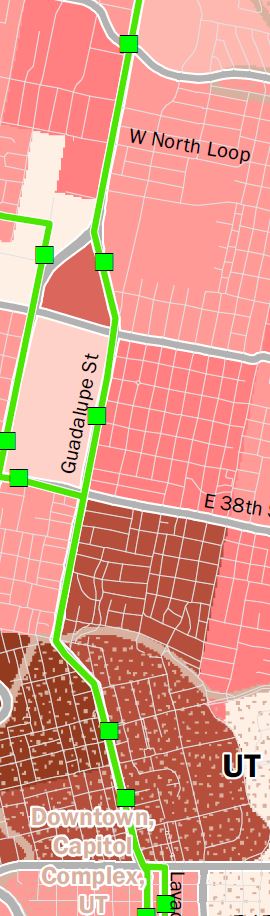
2_ARN_aus-urb-map-pop-density-G-L-corridor_ProCon-Mapbookv5

Excerpt from infographic in Project Connect’s Map Book v. 5. Data presented shows Austin’s highest population density clustered around West Campus-Guadalupe-Lamar corridor — but this travel corridor was omitted from Project Connect’s study! Green line on Lamar-Guadalupe represents MetroRapid bus route 801, green squares represent MetroRapid stations. In upper left of map, note that MetroRapid route 803 (primarily serving Burnet Rd. corridor) joins Guadalupe at E. 38th St. and shares route with #801 into core area.

The 2000 PE/EIS recognized that most of Austin’s growth has been North and Northwest and that’s likely to continue well into the future because that is where we’ve made most of the regional infrastructure and transportation investments for decades; e.g., IH-35, Loop 1, US 183, US 183A, SH45, etc.  For a host of reasons, future growth will almost surely be more clustered, more village-like with less single-family dwellings on detached lots and it will be located with access to frequent high capacity transit if (and only if) we provide for it.

When I moved here in 1969 the population of Leander was about 300 people, while today it is over 30,000.  Cedar Park, same story. In 1970 it had a population of 125; today Cedar Park is 58,000 plus.  These twin towns combined are only 17% smaller than Round Rock (107,000) and have been growing many times faster.  Bus ridership and MetroRail ridership reflect this reality, and if we want the most “bang for the buck”, we will put our first phase urban rail where the greatest employment is, where the congestion is, and where the people are, and are constrained to use alternatives because, in that corridor, urban rail is a more competitive choice than their automobile.  As former Capital Metro board chairman Lee Walker put it when he led the 2000 rail referendum, “We’ve got a meltdown in the core and we’ve got to fix it.”

Though we lost that election by a half percent, the situation hasn’t changed.  We still have a highly constricted, congested core fed by three main north/south arteries, only one of which is practical and affordable to meaningfully [expand] within the likely funds we can muster at this point in time.  And its name is not “Highland”, it’s North Lamar.  (Highland is a neighborhood bounded by North Lamar, US183, IH35 and Denson Drive and it has endorsed rail on Guadalupe/Lamar.)  Even “sliced and diced”, Project Connect’s own mapbook data shows that Guadalupe/Lamar is the highest density travel corridor in Austin.  Reconnecting America’s Jeff Wood, former Austinite with a UT Master’s degree on Austin’s rail history and leading authority on urban rail impacts says, “Rail line(s) extend existing market gravities, but do not create new ones … development corresponds with proximity to major employment. Ultimately, what matters is proximity to employment as to whether denser transit oriented development will happen. The major employment is along Guadalupe Lamar.”  Wood bases his remarks on “Rails to Real Estate Development Patterns along Three New Transit Lines”.

So Guadalupe-Lamar is the bird in our hand, so why strangle it hoping for two birds in the bush 17 years in the future?  Why are we squandering our best asset based on fantasy data derived by misusing a growth model from Portland, a city with the strongest land-use laws in the country?  Reinforcing what we have with a well-designed cost-effective “most bang for the buck” first phase rail line is the only way to provide the driving synergism necessary to build future support for extensions.  As Moody’s recent SH130 credit downgrade so dramatically illustrates, just because you build it doesn’t mean they will come.

And, please, let’s dispense with the fiction that MetroRapid is a substitute for rail, because, in fact. it’s just a nicer bigger bright red replacement for bus 101; no faster unless we tear up the street and install expensive dedicated concrete bus lanes, which is, in fact, the proposed plan, but the Project Connect team doesn’t talk about that unless they are specifically asked. (See “No urban rail on Guadalupe-Lamar? Then get ready for bus lanes…”)

Which brings me back to where I started. Why have those in charge of the process never given TAPT’s urban rail loop plan the same hearing opportunity before decision-makers that, say, Gateway Planning received in the spring of 2012 before the TWG?  We, after all, are the oldest urban rail stakeholders in the city, a Texas non-profit corporation, dedicated to promoting public transit and rail transit since 1973, drafting Austin’s first rail proposals in the early seventies, instrumental in the creation of Capital Metro in the 1980’s, playing a major role in formulating CMTA’s original service plan and whose leaders are widely recognized and known in the rail transit industry.  Lyndon is a former data analyst and planner with Capital Metro and served 4 years as a board member in the early 1990’s.  He was the first person (in 1975) to recognize the value and promote acquisition of the current MetroRail line from Southern Pacific in the mid 1980’s.

Both Lyndon and I have served on the APTA Streetcar Subcommittee for the last seven years and we have spent countless hours researching, riding, evaluating, photographing and writing about and promoting rail transit here and abroad for last 35-40 years.  Our transit professional list-serve is a constant daily source of transportation information from around the world and we know from traffic analysis that our website, www.lightrailnow.org, is heavily used by transit professionals and advocates and is highly regarded for the accuracy of its content, approximately ten thousand pages in size.

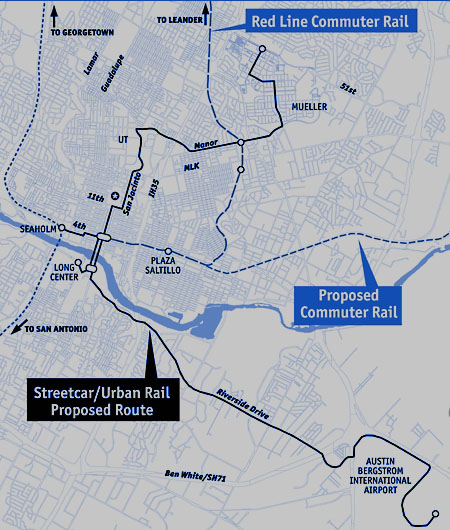
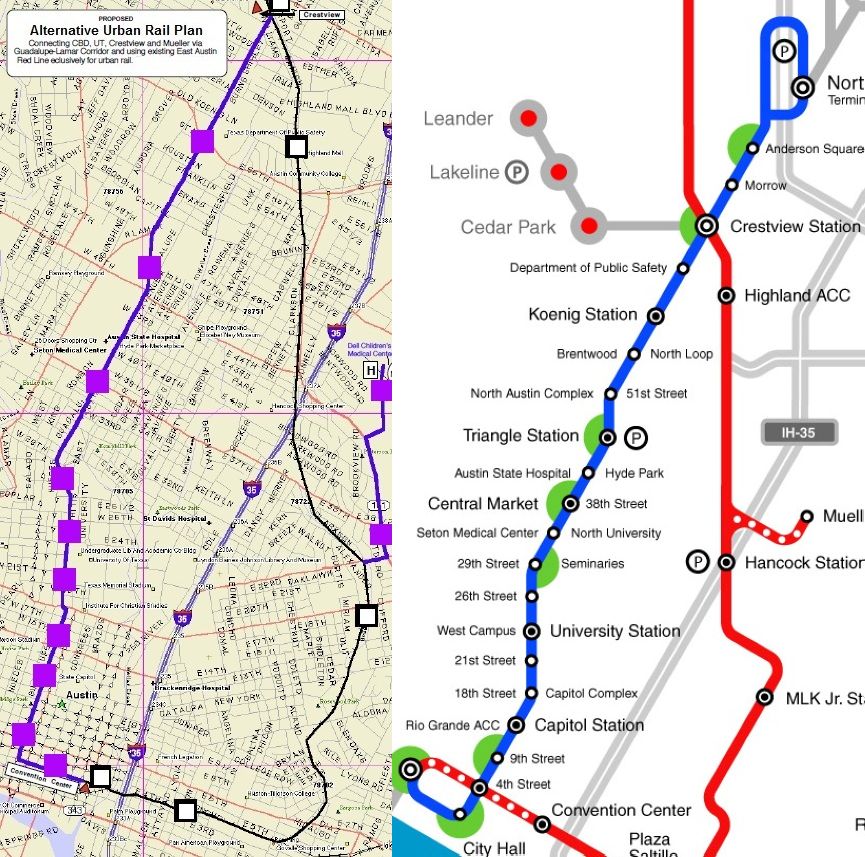
So why has this valuable free local resource been neglected for so long by those in charge of the process?  Perhaps the attached image from ROMA’s downtown planning circa 2008 says it all.  Note that Austin’s proposed (Project Connect) urban rail plan, despite hundreds of thousands of dollars spent since then, has not changed significantly at all.  It’s still Downtown to Mueller past DKR Memorial Stadium and an East Riverside Corridor line. Amazing!  But please note the Mueller-only line is now called “Highland.”

Original urban rail "circulator" system in 2008 map of ROMA consulting team plan, contracted by City of Austin.

Original urban rail “circulator” system in 2008 map of ROMA consulting team plan, contracted by City of Austin.

Attached, is TAPT’s urban rail loop plan in a one-page pdf that you may have seen in a simpler format on our Austin Rail Now blog.  Just like the City’s plan above (Project Connect) our plan was peer-reviewed by transit professionals, people who have actually worked here in Austin on light rail projects in the past.

TAPT proposes "loop" line, with routes on both Guadalupe-Lamar and eastide through converting the MetroRail line to electric light rail — plus a spur to Mueller.

TAPT proposes “loop” line, with routes on both Guadalupe-Lamar and eastside through converting the MetroRail line to electric light rail — plus a spur to Mueller.

Thank you for your service to the community.

Sincerely,

Dave Dobbs

Executive Director, TAPT
Publisher,  LightRailNow!
Texas Association for Public Transportation

h1

Bus paveways on Guadalupe-Lamar — Project Connect’s “elephant in the room”

17 December 2013
MetroRapid bus, southbound on N. Lamar, nears Koenig Lane during testing on Dec. 10th. By dumping urban rail for this corridor, Project Connect would be free to proceed with plan to install specially paved bus lanes instead of rails. Photo: L. Henry.

MetroRapid bus, southbound on N. Lamar, nears Koenig Lane during testing on Dec. 10th. By dumping urban rail for this corridor, Project Connect would be free to proceed with plan to install specially paved bus lanes instead of rails. Photo: L. Henry.

By Dave Dobbs

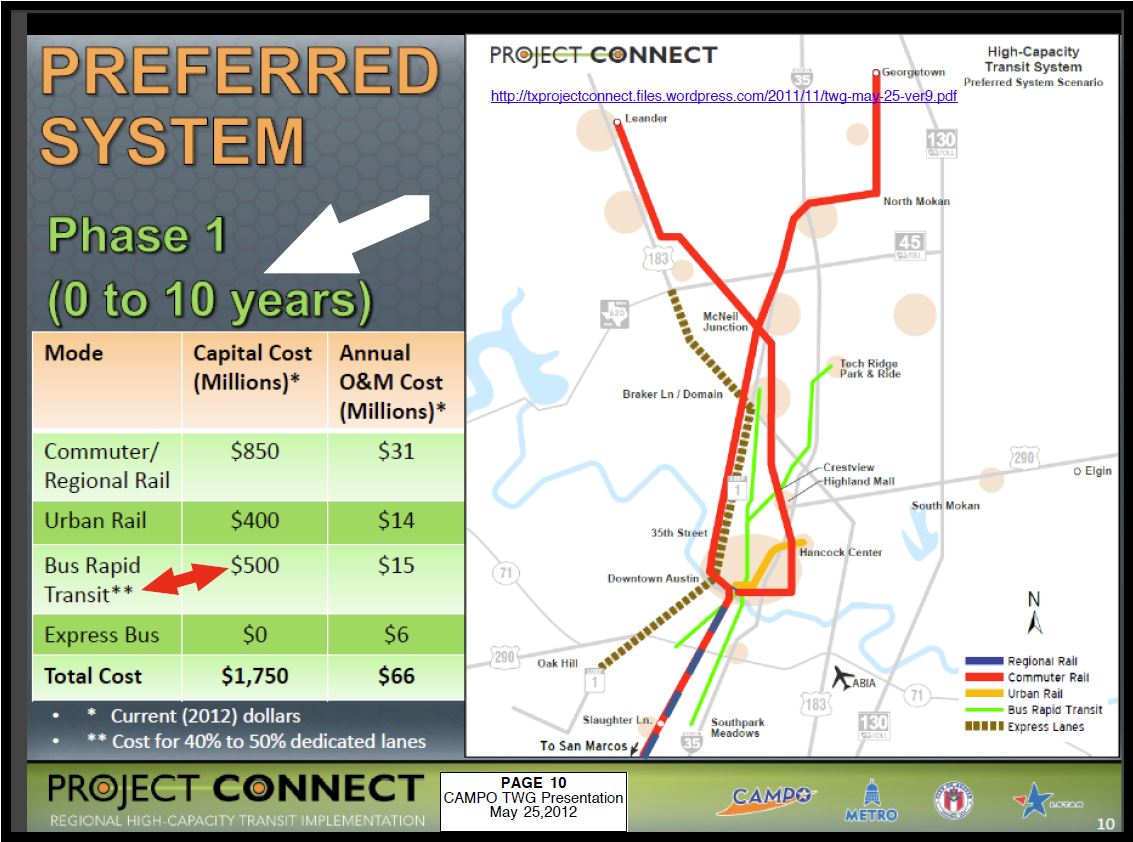
The Elephant in the Room within the Project Connect (COA) urban rail plan (first to Mueller via East Campus, etc. and then out the East Riverside Corridor) is the official proposal to build 40% to 50% dedicated bus lanes, roughly 15-18 miles, within the 37-mile MetroRapid system. This $500 million expenditure appears as a near-term (within 10 years) investment, 80% of which would come from the Federal Transit Administration. Lyndon Henry and I have documented this and explained how it might work in an October 18th article entitled No urban rail on Guadalupe-Lamar? Then get ready for bus lanes….

When I spoke with Project Connect’s Scott Gross about the nature of this a few weeks ago, he said that the dedicated bus lane plan was one that included both right-of-way acquisition and exclusive bus lanes. The math here says that these lanes would be far more extensive than paint-on-paving such as we are about to see on Guadalupe and Lavaca between MLK and Cesar Chavez, 1.4 miles at a cost of $370,000.

Here’s the math …

$500,000,000 ÷ 18 miles = $27.8 million ÷ 2 lanes = $13.9 million per lane-mile

This figure points to a heavy-duty reinforced concrete bus lane in each direction, 18 inches thick, similar to the bus pads at bus stops we see along major bus routes. This would require tearing up the street as severely as a light rail installation would, with all the other utility improvements therein that might be accomplished at the same time.

While my cost-per-lane mile is a simple mathematical one, the result is consistent with what Ben Wear reports for building SH-130, 90 miles from Georgetown to Sequin, for $2.9 billion, or about $8 million a lane-mile. Construction costs in the middle of a very congested street, e.g., South Congress or North Lamar, would be significantly higher than a highway over farmland. That and ROW acquisition costs could easily account for $5.9 million dollars of difference.

These bus lanes, planned in the next decade, would definitely be an obstacle to further FTA investment for 20 to 30 years wherever they are installed. The question we ought to be asking is: What kind of “high capacity transit” do we want on our heaviest-traveled streets?

h1

TILT! Project Connect’s gerrymandering and data fiddling ignite public skepticism, pushback

30 November 2013
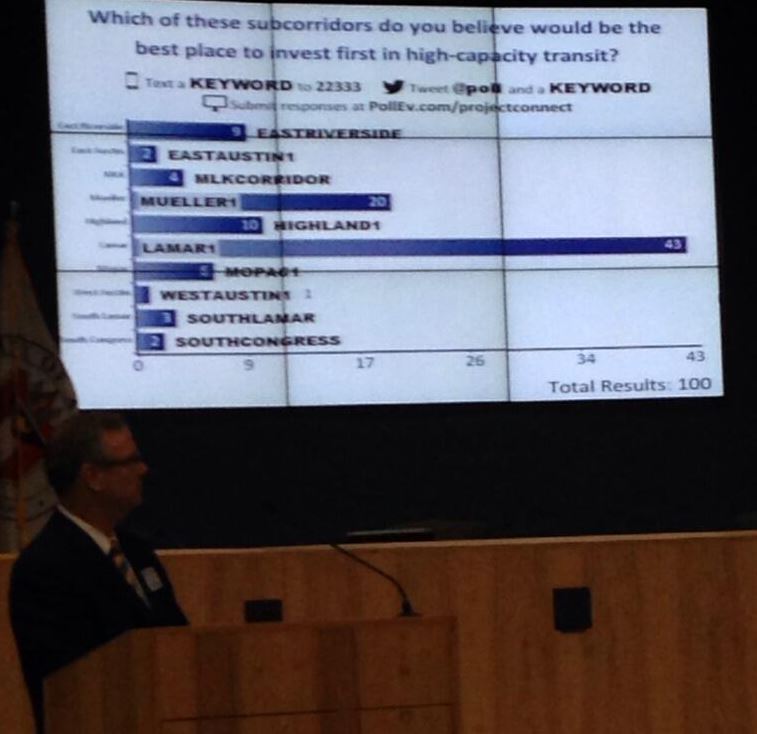
"Don't believe your lying eyes." At Nov. 26th "Community Conversation", Project Connect study director Kyle Keahey shows bar chart indicating overwhelming public support for "Lamar" sector, yet proceeded to justify study team's selection of "ERC" and "Highland". Photo: Julie Montgomery.

“Don’t believe your lying eyes.” At Nov. 26th “Community Conversation”, Project Connect study director Kyle Keahey showed bar chart indicating overwhelming public support for “Lamar” sector, yet proceeded to justify study team’s selection of “ERC” and “Highland”. Photo: Julie Montgomery.

Suddenly, the leadership of Project Connect’s urban rail study have scheduled, out of the blue, a “Public Data Dig”. On Tuesday, Dec. 3rd, from 11:30 am to 1:30 pm in the Capital Metro boardroom, the agency promises to provide “an interactive review of the approach, process, methodology, data, and evaluation results.”

And it’s not for the faint-hearted or the techno-wimpish: “WARNING: this will not be a layman’s discussion; this is an in-depth data-dig and technical review.” It’s hard to tell whether that’s a warning to intimidate the public and scare off the masses, or an effort to impress potential attendees with the daunting and immutable rectitude of Project Connect’s study efforts and final product.

But why have the study team suddenly decided to start publicly “digging into the data” now, setting a date 2.5 weeks after they made their decision (Nov. 15th) about where they wanted to put urban rail? Why didn’t they open these kinds of critical assumptions and methodological decisions to public discussion months ago?

Maybe they sense the mounting community outrage and anger at being treated like yokels by a flim-flam artist? And perhaps they’re starting to realize how seriously their credibility (and that of public officialdom generally) are being impugned by the barrage of savvy, insightful critical scrutiny of their shenanigans that has emerged, bolstering that community pushback.

That scrutiny has materialized in a veritable barrage of technically competent and even wonkish analyses that have been dissecting all the basic pillars of Project Connect’s wobbly “approach, process, methodology, data, and evaluation results”. From apparent gerrymandering of the study sectors (“sub-corridors”) to cherry-picking of data to peculiar fiddling of calculations, the agency’s procedures have deepened skepticism. For example, here’s a selection of community-generated analyses:

Project Connect’s “corridor” study — without corridors!
https://austinrailnow.wordpress.com/2013/11/11/project-connects-corridor-study-without-corridors/

Surprise! Mayor and Project Connect select same routes they wanted in the first place
https://austinrailnow.wordpress.com/2013/11/17/surprise-mayor-and-project-connect-select-same-routes-they-wanted-in-the-first-place/

A little oddity in Project Connect Evaluation Criteria
http://austinonyourfeet.wordpress.com/2013/11/21/a-little-oddity-in-project-connect-evaluation-criteria/

Project Connect’s Sub-Corridor Recommendation
http://jacedeloney.wordpress.com/2013/11/20/project-connects-sub-corridor-recommendation/

Highland Score
http://keepaustinwonky.wordpress.com/2013/11/25/highland-score/

A quick thought for tonight’s exercise
http://m1ek.dahmus.org/?p=914

Project Connect Reality Check: “Lamar” vs. “Highland” sector ridership comparison FAILS
https://austinrailnow.wordpress.com/2013/11/24/project-connect-reality-check-lamar-vs-highland-sector-ridership-comparison-fails/

“Highland” sector favored by Project Connect — but where’s the travel demand?
https://austinrailnow.wordpress.com/2013/11/19/highland-sector-favored-by-project-connect-but-wheres-the-travel-demand/

Lying with Maps
http://yarak.org/2013/11/lying-with-maps/

Welcome to Project Dis-connect!
http://www.icontact-archive.com/gV8wd5ityKfvqoWQQdiDT8IG1WNL1sIh?w=3

Huge problems cited with Project Connect’s urban rail study data
https://austinrailnow.wordpress.com/2013/11/03/huge-problems-cited-with-project-connects-urban-rail-study-data/

Another Rail Petition worth signing
http://highlandneighborhood.com/another-rail-petition-worth-signing/

Austin Rail Now encourages everyone interested in this crucial study and the need for urban rail (electric light rail transit) in Austin to attend this crucial event on Dec. 3rd. Project Connect’s announcement assures “We really want to take the time to answer all of your detailed questions….”

That sounds a bit like they’re approaching this as an exercise in explaining the complexities of their arcane brilliance to us benighted peons. After all, that’s pretty much the way they’ve conducted their so-called “public participation” process. Despite all their assurances of “transparency”, they’ve conducted this study with about the transparency of peat moss, keeping their most critical deliberations virtually locked within a reinforced bunker.

Let’s hope community participants at Tuesday’s meeting will be able to drill somewhat into that bunker.

Even more importantly, Project Connect’s urban rail program needs to be put on Pause. It took the wrong track back there, and has not only some explaining to do, but some reversing as well.

h1

City’s 2010 urban rail study actually examined corridors! But botched the analysis…

26 November 2013
Closeup of City's Central Austin Transit Study map, showing core, potential rail corridors, and City's version of route to "North Central Austin" (Hyde Park via Speedway). Guadalupe-Lamar was avoided. Map: Snip from COA document.

Closeup of City’s Central Austin Transit Study map, showing core, potential rail corridors, and City’s version of route to “North Central Austin” (Hyde Park via Speedway). Guadalupe-Lamar was avoided. Map: Snip from COA document.

By Lyndon Henry

In this blog and other forums, for months I’ve been making the case that Project Connect’s urban rail study has not been considering actual travel corridors, but rather large tracts of urban land more aptly described as sectors. Actual travel corridors haven’t just been ignored, they’ve been severed and segmented, so that effective evaluation of them for rail transit routes has been impossible. (The best example is Guadalupe-Lamar, for which Project Connect cut off the head — the core area — and then severed the legs — any extensions north of Crestview.)

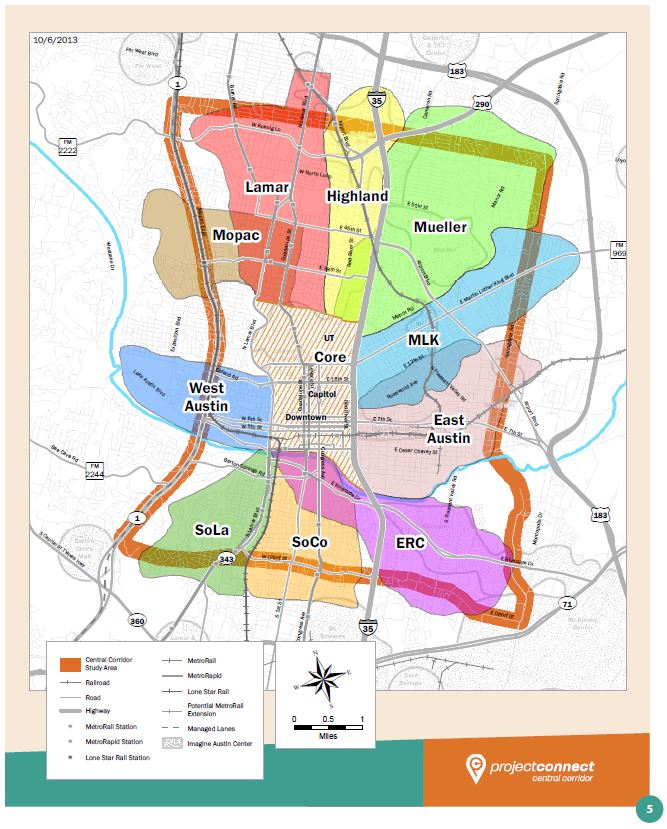
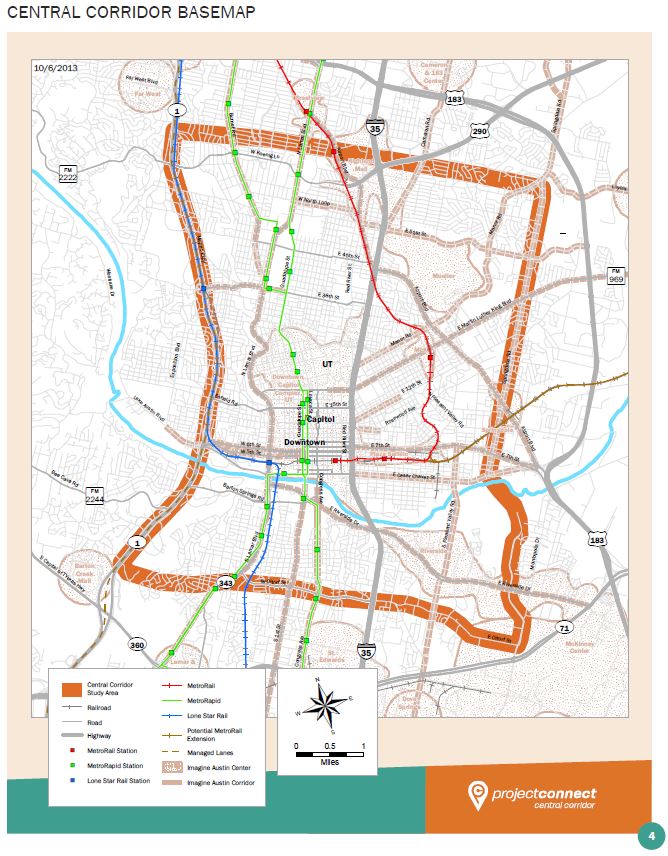
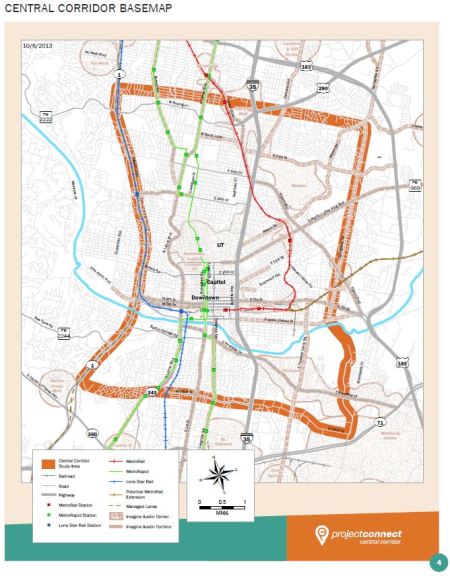
Project Connect has supposedly been focusing on possible urban rail routes in the center of the city, so it designated a huge central-city study area — implausibly calling it the “Central Corridor”, although it had none of the characteristics of an actual urban travel corridor. (See Project Connect’s “corridor” study ­ without corridors!)

Project Connect's "Central Corridor" (study area) with "sub-corridors" (i.e., sectors). (Click to enlarge.)

Project Connect’s “Central Corridor” (study area) with “sub-corridors” (i.e., sectors). (Click to enlarge.)

As one can see in the map above, within this huge central study area, Project Connect then carved up a number of major study districts — which it then labeled “sub-corridors” (since the entire center of the city was now labeled a “corridor”). Rather than actual travel corridors — which are what you’d need to study fixed transit facilities like urban rail — these subdivisions are, in effect, huge, sprawling sectors of the center-city, mostly comprising several square miles. “Mueller”, for example, reaches out of the Mueller development site to reach central neighborhoods west of I-35, and north to gulp up most of Northeast Austin.

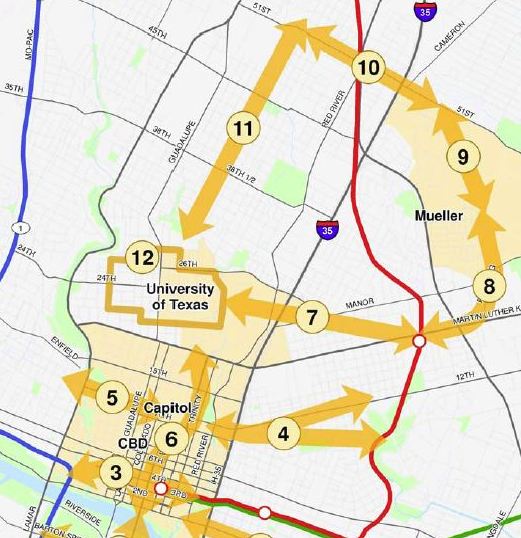
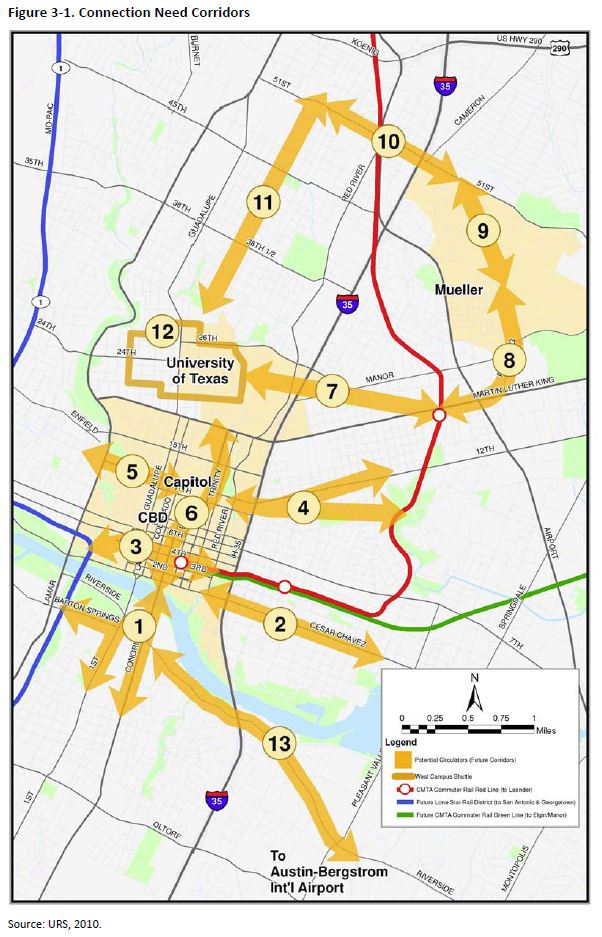
But local officials definitely know what real corridors are. As recently as 2010, the City of Austin, in collaboration with its consultant URS Corporation, produced the Central Austin Transit Study (CATS) — the pre-eminent initial feasibility study for a central Austin urban rail system. And, as the map below shows, they didn’t dither around with huge, arbitrary, misnamed blobs of urban land … they examined actual corridors:

CATS map of actual potential rail corridors studied. Map: COA and URS.

CATS map of actual potential rail corridors studied. Map: COA and URS.

However, then, as now, the basic aim was to justify a Phase 1 urban rail route through the east side of the UT campus and on out to the Mueller redevelopment site. So the study and the map of selected corridors were cleverly contrived to confine and steer the study in the “proper” direction.

In particular, notice how the City planning team studiously avoided the most obvious route going north from the campus — up Guadalupe and North Lamar. Instead, Corridor #11 is fashioned as “University of Texas (UT) to North Central Austin (Hyde Park)”, and directed up Speedway (a minor arterial that’s almost a neighborhood street) as far as 51st St. And of course, it’s purpose is to make a connection to … Mueller!

But manipulating the routes was only half the game. The other half was manipulating the evaluatory methodology.

For the 2010 study, that was a lot simpler than now. Instead of “gerrymandering” data, playing with projections and hypothetical growth rates, and assigning heavy freeway traffic to relatively quiet neighborhoods, the City and URS team in 2010 just devised a simple, subjective 1-2-3 rating system that allowed them to assign a subjective “score” at whim to the various corridors. And whaddaya know … Mueller won!

But the point is that more or less real travel corridors were studied in 2010, although they were shaped and located to fit the outcome desired by top officials. So local planners do know what real corridors should look like.

And it’s real travel corridors that Project Connect’s urban rail study should have been scrutinizing and evaluating all along. That’s what the Austin community deserves. Instead, what Austin has gotten so far is another exercise in smoke-and-mirrors “planning” intended again to achieve a desired outcome.

h1

Project Connect Reality Check: “Lamar” vs. “Highland” sector ridership comparison FAILS

24 November 2013
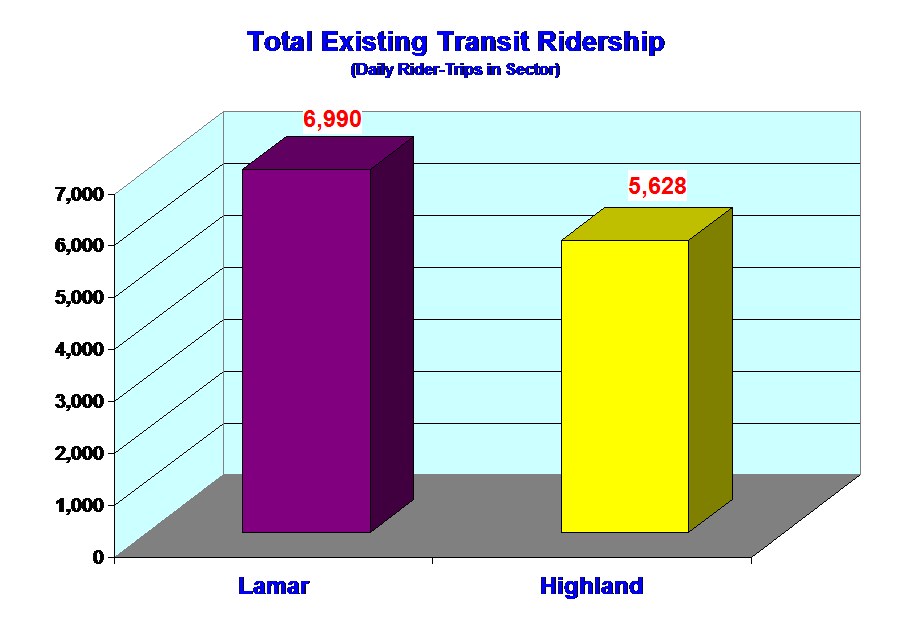
Despite Project Connect's startling claim, "Lamar" sector has significantly higher ridership than "Highland". Graph: ARN, from Project Connect data matrix.

Despite Project Connect’s startling claim, “Lamar” sector (left) has significantly higher ridership than “Highland” (right). Graph: ARN, from Project Connect data matrix.

During Project Connect’s somewhat eyebrow-raising rollout of the urban rail study team’s much-vaunted route decision at the Central Corridor Advisory Group meeting of November 15th, study director Kyle Keahey valiantly was attempting to combat considerable skepticism surrounding the project by highlighting some of the team’s supposed “findings”.

Perhaps in an effort to demonstrate even-handedness, Keahey had already shown a bar chart illustrating overwhelming popular support for the “Lamar” sector (“sub-corridor” in Project Connect parlance), totaled from public input, but he undoubtedly realized he needed to reveal the team’s “evidence” for their contrary decision. So, trying to justify the selection of the “ERC” (East Riverside) and “Highland” sectors, Keahey assured the audience that “Lamar” (a huge sector of over 4.5 square miles, stretching from east of North Lamar west to Shoal Creek) just didn’t have the desired characteristics.

The Guadalupe-Lamar corridor is well-known for its relatively high transit ridership (after all, it was the top choice for the MetroRapid special bus service planned to open in 2014), so apparently the study team has been hard-pressed to disparage the “Lamar” sector on its strongest points.

So Keahey unveiled a jaw-dropping claim — “Lamar” really doesn’t have the strongest ridership at all, but instead, “actual ridership is highest in East Riverside and Highland ….”

There are several problems with this comparison, starting with the fact that Project Connect has utterly failed to evaluate actual travel corridor ridership (and any other data, for that matter). Instead, the ridership figures (apparently obtained from Capital Metro) apply to all transit ridership, going in all directions. But wasn’t this a study of travel from these sectors to the core area?

One of the problems with this is that those sectors (which include “Highland” and “ERC”) that happen to encompass major transit route interchange hubs suddenly seem to have far more ridership than a sector (like “Lamar”) distinguished for its heavy corridor ridership. This is almost certainly a clear advantage of the “ERC” sector, with clusters of crosstown routes interchanging with UT shuttlebus routes serving student housing and other general routes linking to the core area.

While higher ridership is tallied for “ERC”, this does seem to correlate somewhat with the service level. Altogether, the “ERC” sector has a total of 37 routes, according to Project Connect’s evaluation matrix, compared with 26 for the “Lamar” sector — a ratio of 1.42. This is close to the ratio in “Total Existing Transit Ridership”: “ERC” with 9,648, “Lamar” with 6,990 — a ratio of 1.35. This suggests that ridership may be driven somewhat by the level of service (i.e., number of routes) provided to the sector.

But what about the “Highland” sector? Keahey’s claim that “Highland” currently exhibits higher ridership than the “Lamar” sector was quite shocking, even leaving aside the major interchange at the ACC Highland hub.

And it turns out this claim simply isn’t true — by Project Connect’s own evaluation data matrix.

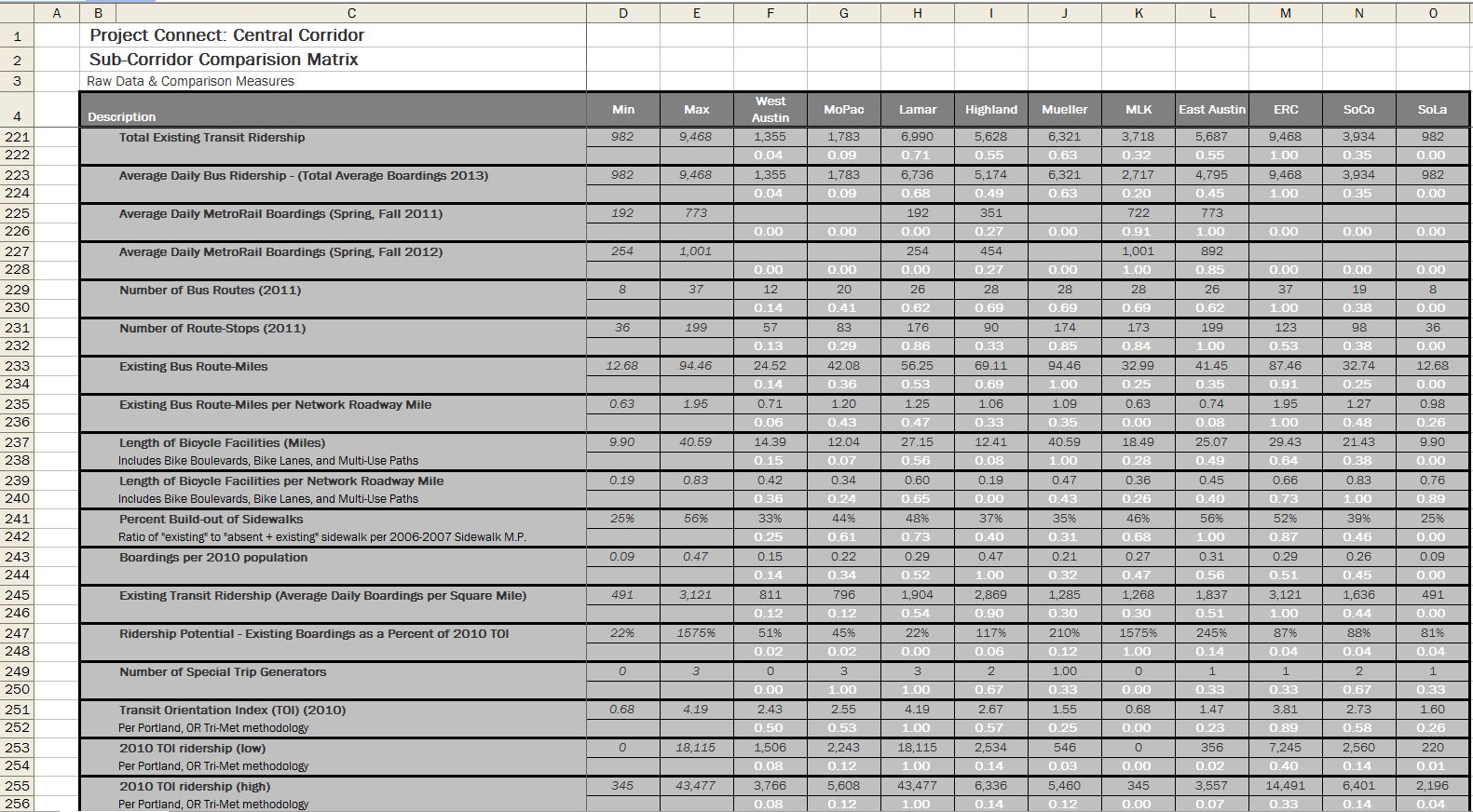
Project Connect: Central Corridor Sub-Corridor Comparison Matrix

Here’s a screenshot of the page with the transit ridership data:


Project Connect Evaluation Data Table page with ridership data.

Project Connect Evaluation Data Table page with ridership data.


This screenshot zooms in on the ridership data cells for the “Lamar” and “Highland” sectors:


Closeup of matrix data for "Lamar" and "Highland" sectors.

Closeup of matrix data for “Lamar” and “Highland” sectors.


The actual data, above, seem clearly to contradict and refute Keahey’s “bombshell” claim that transit ridership in “Highland” beats that in the “Lamar” sector. By the “Total Existing Transit Ridership” metric, “Lamar” has 6,990, vs. “Highland” with 5,628 — leaving “Lamar” 24% higher (see bar graph at top of post). By the “Average Daily Bus Ridership” metric, Lamar” has 6,736, vs. “Highland” with 5,174 — leaving “Lamar” 30% higher.

Thus, this would seem to be a “bombshell” claim that fizzles

h1

Crestview Neighborhood Association endorses Guadalupe-Lamar for urban rail

20 November 2013
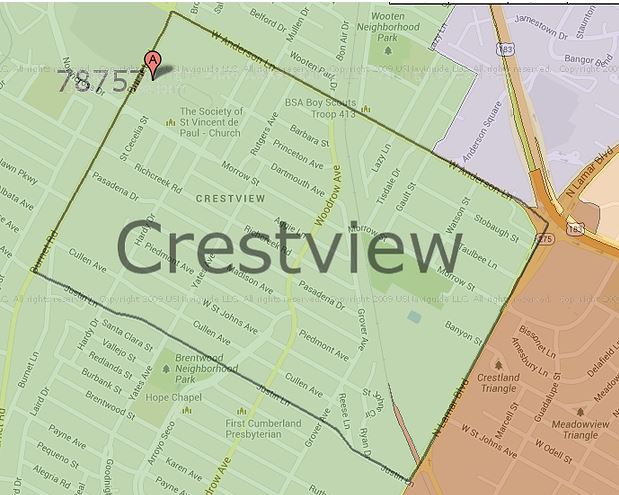
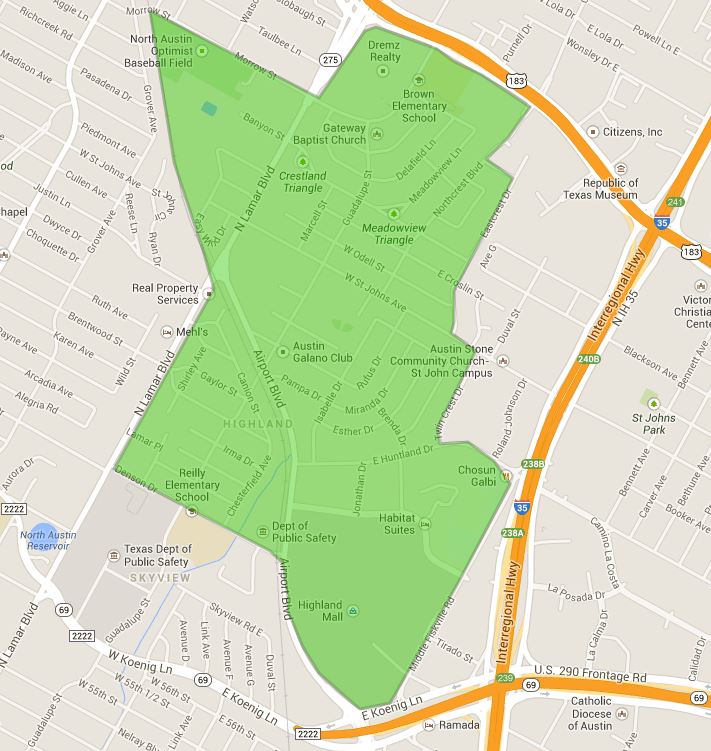
Crestview Neighborhood Association's eastern boundary lies along North Lamar Blvd. Map: CNA.

Crestview Neighborhood Association’s eastern boundary lies along North Lamar Blvd. Map: CNA.

Still another major neighborhood association has jumped on board the effort to designate the Guadalupe-Lamar (G-L) corridor as its preferred route for urban rail (light rail transit).

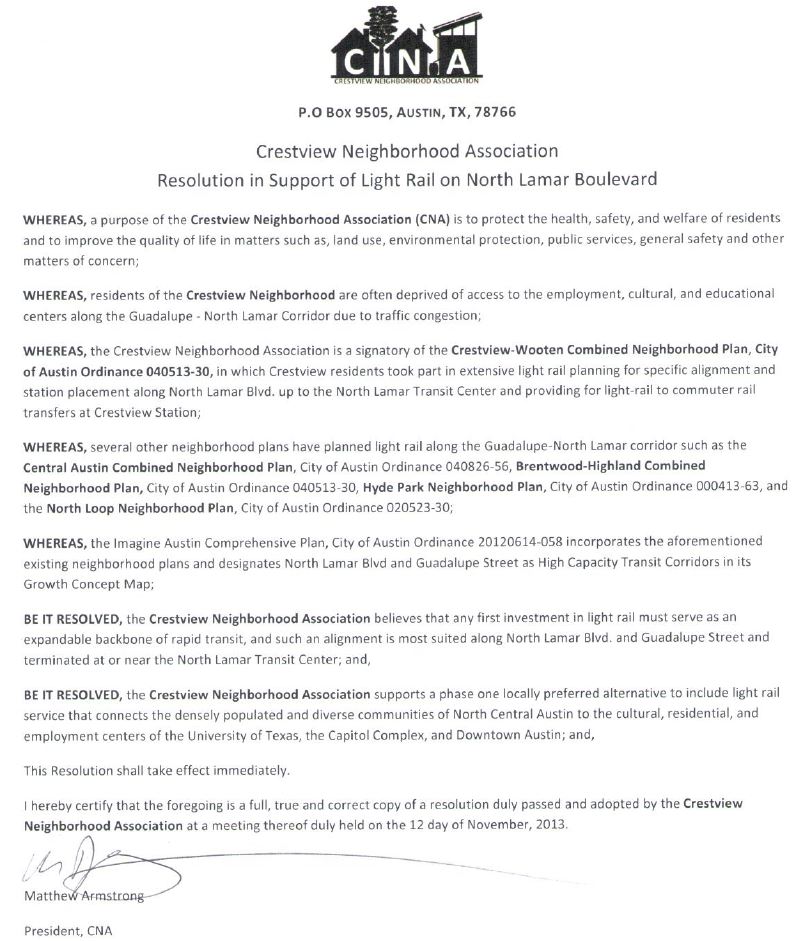
On Nov. 12th, the Crestview Neighborhood Association (CNA) voted to express its belief “that any first investment in light rail must serve as an expandable backbone of rapid transit, and such an alignment is most suited along North Lamar Blvd. and Guadalupe Street and terminated at or near the North Lamar Transit Center ….”

As indicated in the map at the top of this post, Crestview is a basically rectangular neighborhood bordered on the east by North Lamar Blvd., west by Burnet Rd., north by Anderson Lane, and south by Justin Lane. Encompassing the Crestview MetroRail station near Airport Blvd., the neighborhood touches the intersection of Lamar and U.S. 183 at its northeast corner, near the North Lamar Transit Center.

Like other neighborhoods in the corridor, the Crestview Neighborhood Association in its resolution underscores its participation in and ratification of the intensive planning for light rail that has already occurred in the corridor. In particular, the resolution notes that Crestview was “a signatory of the Crestview-Wooten Combined Neighborhood Plan, City of Austin Ordinance 040513-30, in which Crestview residents took part in extensive light rail planning for specific alignment and station placement along North Lamar Blvd. up to the North Lamar Transit Center and providing for light-rail to commuter rail transfers at Crestview station …

It goes on to point out that “several other neighborhood plans have planned light rail along the Guadalupe-North Lamar corridor such as the Central Austin Combined Neighborhood Plan, City of Austin Ordinance 040826-56, Brentwood-Highland Combined Neighborhood Plan, City of Austin Ordinance 040513-30, Hyde Park Neighborhood Plan, City of Austin Ordinance 000413-63, and the North Loop Neighborhood Plan, City of Austin Ordinance 020523-30 ….”

Furthermore, “… the Imagine Austin Comprehensive Plan, City of Austin Ordinance 20120614-058 incorporates the aforementioned existing neighborhood plans and designates North Lamar Blvd and Guadalupe Street as High Capacity Transit Corridors in its Growth Concept Map .…”

In addition to the previously noted endorsement of light rail as “an expandable backbone of rapid transit”, the Crestview measure also affirmed that the neighborhood association “supports a phase one locally preferred alternative to include light rail service that connects the densely populated and diverse communities of North Central Austin to the cultural, residential, and employment centers of the University of Texas, the Capitol Complex, and Downtown Austin ….”

Image of Crestview Neighborhood Association resolution supporting urban rail in Guadalupe-Lamar corridor.

Image of Crestview Neighborhood Association resolution supporting urban rail in Guadalupe-Lamar corridor (click to enlarge).

The full resolution in PDF format can be accessed here:

Crestview Neighborhood Association — Resolution in Support of Light Rail on North Lamar Boulevard

The Crestview endorsement is an especially noteworthy action because many Crestview residents had generally weighed in as opponents of light rail during both the initial presentation of a Guadalupe-Lamar urban rail plan in the early 1990s, and also during the campaign for a ballot measure to authorize a light rail system that narrowly failed in 2000. This new emergence of strong support is an indicator of the powerful community momentum for an urban rail alignment that has been building among neighborhoods in this corridor.

h1

Highland Neighborhood Association endorses Guadalupe-Lamar for urban rail

15 November 2013
Highland Neighborhood Association bundaries. Map: HNA.

Highland Neighborhood Association bundaries. Map: HNA.

On November 4th, the effort to designate the Guadalupe-Lamar (G-L) corridor as the preferred route for urban rail (light rail transit, LRT) received yet another powerful surge of support with the endorsement of the Highland Neighborhood Association (HNA). As the map at top shows, the western boundary of the Highland Neighborhood is mostly North Lamar Boulevard and Midtown Commons; its northern boundary is U.S. 183; and its southern boundary includes both Denson Drive and a segment of Airport Boulevard encompassing the Highland campus of Austin Community College.

Highland is an important component of the ridership “watershed” for public transportation on the east side of North Lamar, and this would include the Guadalupe-Lamar (G-L) route proposed for urban rail (light rail transit). The Highland neighborhood should not be confused with Project Connect’s “Highland” sector (“sub-corridor”), which usurps the name but has only a very minimal geographical relationship.


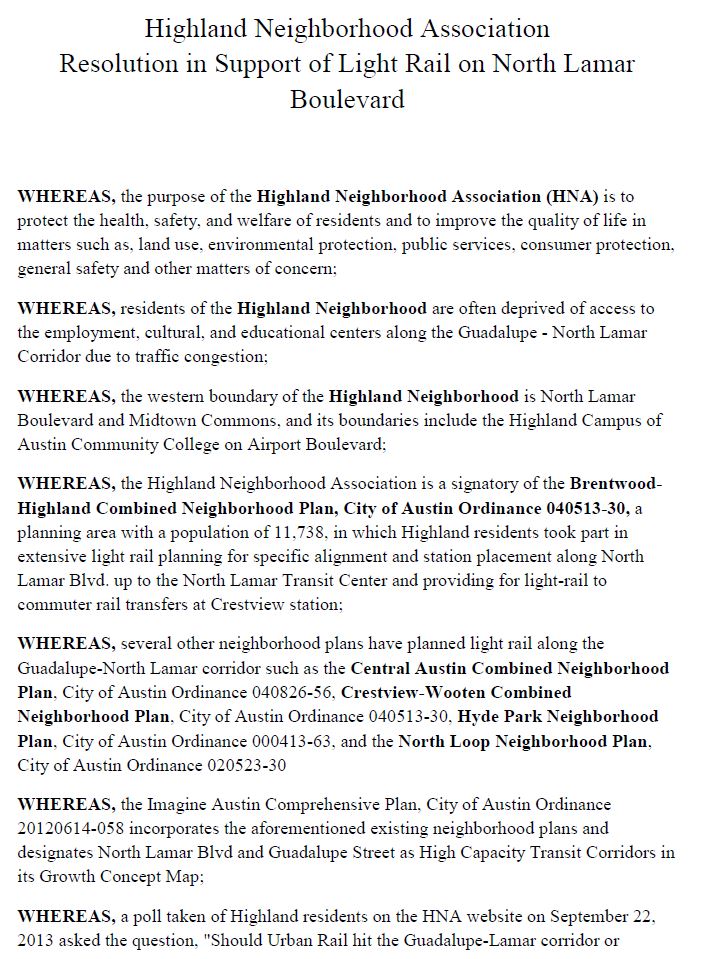
1_ARN_Highland-NA-G-L-endorsement-p1

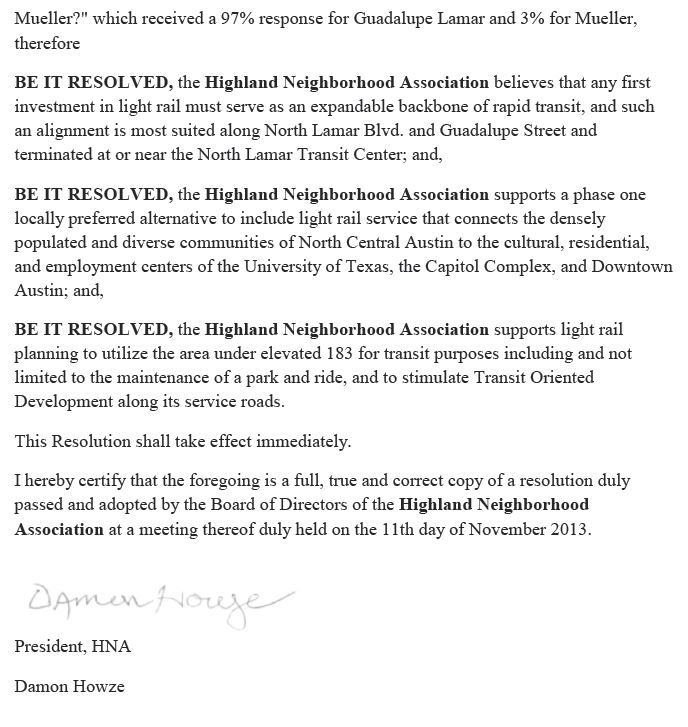
Images of HNA resolution endorsing Guadalupe-Lamar corridor for urban rail.

Images of HNA resolution endorsing Guadalupe-Lamar corridor for urban rail.


The HNA’s endorsement resolution includes a number of “whereas” clauses that spell out the case for endorsing the G-L corridor as the priority route for urban rail. For example, it states, “residents of the Highland Neighborhood are often deprived of access to the employment, cultural, and educational centers along the Guadalupe – North Lamar Corridor due to traffic congestion ….”

The resolution goes on to document the HNA’s legal and regulatory authority for taking its position on urban rail:

… the Highland Neighborhood Association is a signatory of the Brentwood-Highland Combined Neighborhood Plan, City of Austin Ordinance 040513-30, a planning area with a population of 11,738, in which Highland residents took part in extensive light rail planning for specific alignment and station placement along North Lamar Blvd. up to the North Lamar Transit Center and providing for light-rail to commuter rail transfers at Crestview station;

… several other neighborhood plans have planned light rail along the Guadalupe-North Lamar corridor such as the Central Austin Combined Neighborhood Plan, City of Austin Ordinance 040826-56, Crestview-Wooten Combined Neighborhood Plan, City of Austin Ordinance 040513-30, Hyde Park Neighborhood Plan, City of Austin Ordinance 000413-63, and the North Loop Neighborhood Plan,
City of Austin Ordinance 020523-30

… the Imagine Austin Comprehensive Plan, City of Austin Ordinance 20120614-058 incorporates the aforementioned existing neighborhood plans and designates North Lamar Blvd and Guadalupe Street as High Capacity Transit Corridors in its Growth Concept Map …

HNA presents as its justification for officially endorsing Guadalupe-Lamar “a poll taken of Highland residents on the HNA website on September 22…” posing the question, “Should Urban Rail hit the Guadalupe-Lamar corridor or Mueller?” The resolution notes that the results were “a 97% response for Guadalupe Lamar and 3% for Mueller ….”

With this background of procedural and factual substantiation, the HNA board comes down irmly on the side of a “first investment in light rail” that “must serve as an expandable backbone of rapid transit”, which means “an alignment is most suited along North Lamar Blvd. and Guadalupe Street” with a northern terminus “terminated at or near the North Lamar Transit Center….” This, the resolution makes clear, definitely means “a phase one locally preferred alternative” with light rail service connecting “the densely populated and diverse communities of North Central Austin to the cultural, residential, and employment centers of the University of Texas, the Capitol Complex, and Downtown Austin”:

BE IT RESOLVED, the Highland Neighborhood Association believes that any first investment in light rail must serve as an expandable backbone of rapid transit, and such an alignment is most suited along North Lamar Blvd. and Guadalupe Street and terminated at or near the North Lamar Transit Center; and,

BE IT RESOLVED, the Highland Neighborhood Association supports a phase one locally preferred alternative to include light rail service that connects the densely populated and diverse communities of North Central Austin to the cultural, residential, and employment centers of the University of Texas, the Capitol Complex, and Downtown Austin; and,

BE IT RESOLVED, the Highland Neighborhood Association supports light rail planning to utilize the area under elevated 183 for transit purposes including and not limited to the maintenance of a park and ride, and to stimulate Transit Oriented Development along its service roads.

This extremely significant endorsement of central Austin’s most important potential corridor for urban rail by one of the city’s most important neighborhood associations also has political implications that hopefully will not go unnoticed by local officials and decisionmakers.

The full resolution can be found here:

Highland Neighborhood Association Resolution in Support of Light Rail on North Lamar Boulevard

Related endorsements:

Central Austin Combined Neighborhoods Planning Team endorses Guadalupe-Lamar for urban rail

UT Student Government backs West Campus, Guadalupe-Lamar route for first phase of urban rail

h1

Project Connect’s “corridor” study — without corridors!

11 November 2013
Project Connect's central Austin study area (so-called "Central Corridor")

Project Connect’s central Austin study area (so-called “Central Corridor”)

Coming soon, on November 15th, is the momentous day when the Project Connect (ProCon) “team” (however that’s defined) is scheduled to make its recommendation for an inner-city sector (“sub-corridor”) for urban rail — i.e., a light rail transit (LRT) starter line. This is supposed to be the result of a study purportedly aimed at identifying just the right “corridor” for an urban rail line connecting to the core area of the city. However that recommendation may go, the fact remains that ProCon’s urban rail study has been fundamentally flawed by disastrous faults, weaknesses, and errors.

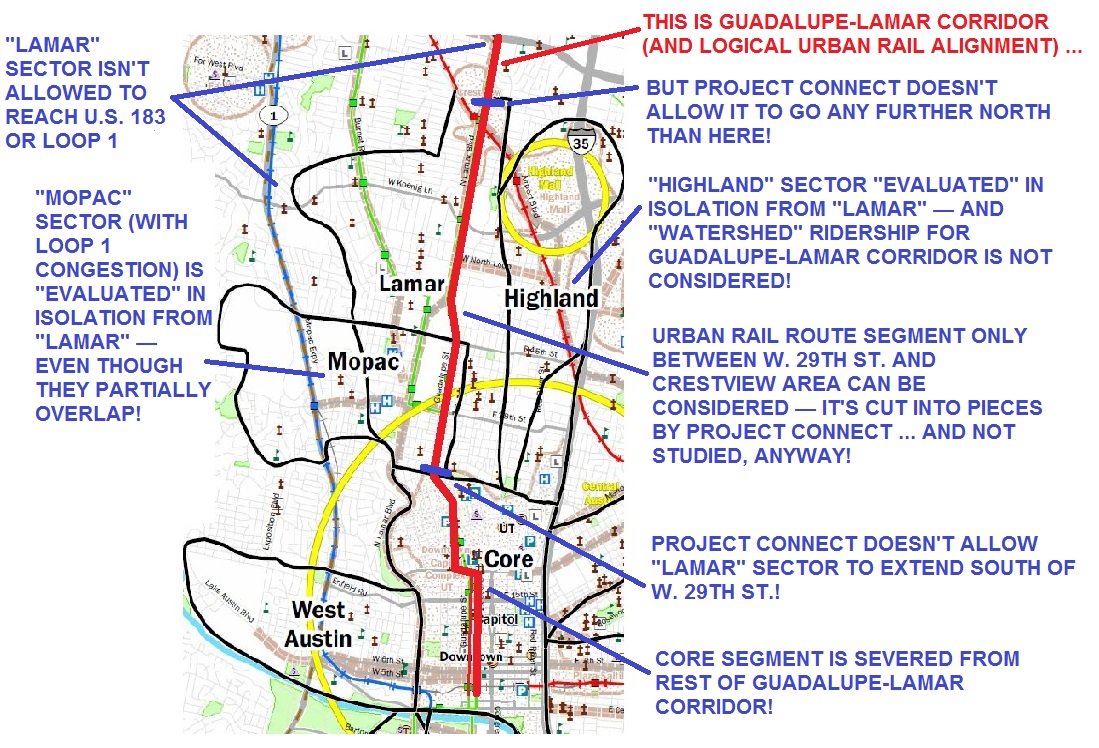
Even leaving aside all the data errors and anomalies (see Huge problems cited with Project Connect’s urban rail study data), what seems to be the program’s really catastrophic conceptual fault is its approach in (1) defining a huge Central study area (“Central Corridor” — see map above) and then (2) because this huge “Central Corridor” is so unwieldy, subdividing it into sectors (which they must call “sub-corridors”) that are effectively treated in isolation from one another.

Project Connect's "Central Corridor" (study area) with "sub-corridors" (i.e., sectors). (Click to enlarge.)

Project Connect’s “Central Corridor” (study area) with “sub-corridors” (i.e., sectors). (Click to enlarge.)

In effect, this subdivision of the study area has created an array of balkanized sectors that are analyzed more as autonomous geographic-demographic “islands” than as components essential to work together as a whole. As a result, actual, realistic, workable travel corridors have been obscured by all this.

What’s a travel corridor, anyway?

So, what exactly is an urban travel corridor? Until now, there’s usually been no dispute in Austin — as per widely accepted transportation planning practice, travel corridors in Austin (and virtually all other metro areas) have typically been laid out as fairly narrow swaths following travel patterns (and, almost always, some kind of existing transportation right-of-way) and encompassing population and employment in fairly long, narrow strips of the urban area. Wikipedia provides a particularly succinct and useful definition:

A transportation corridor is a generally linear tract of land that contains lines of transportation like highways, railroads, or canals. Often, new transport lines are built alongside existing ones to minimize pollution.

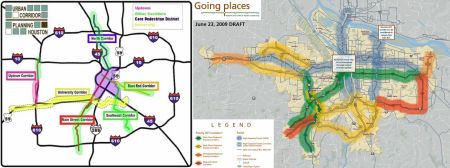
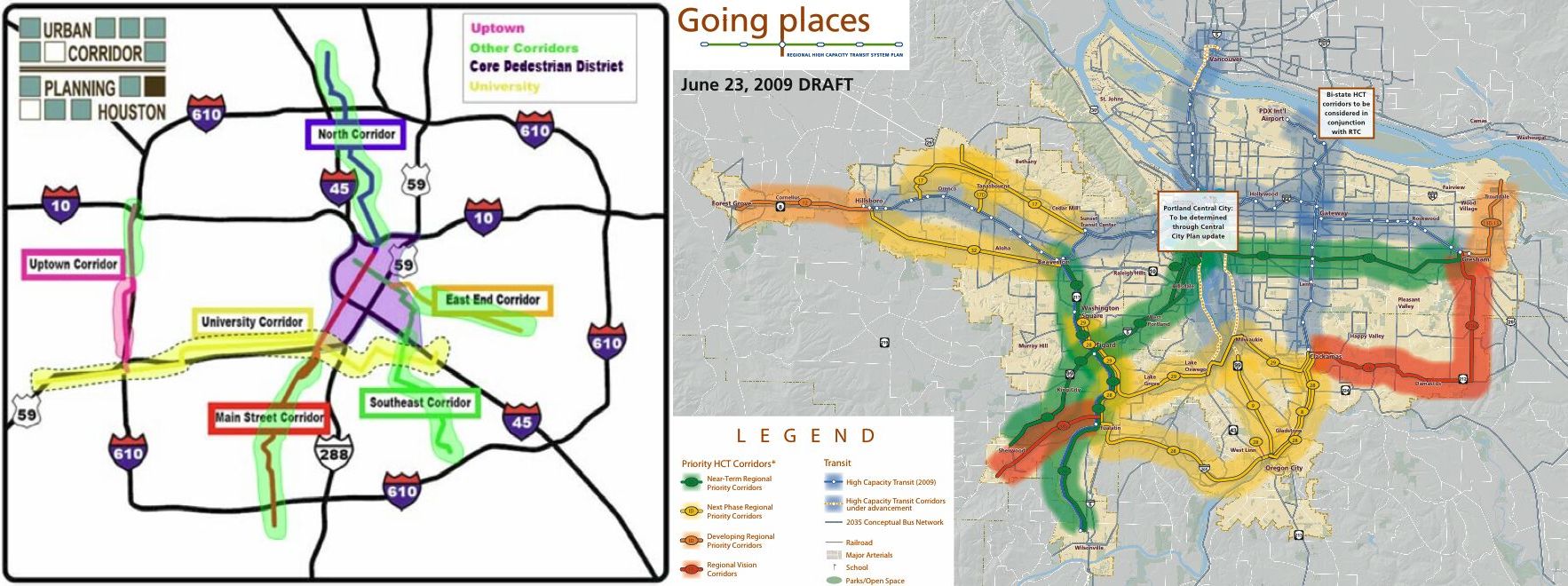
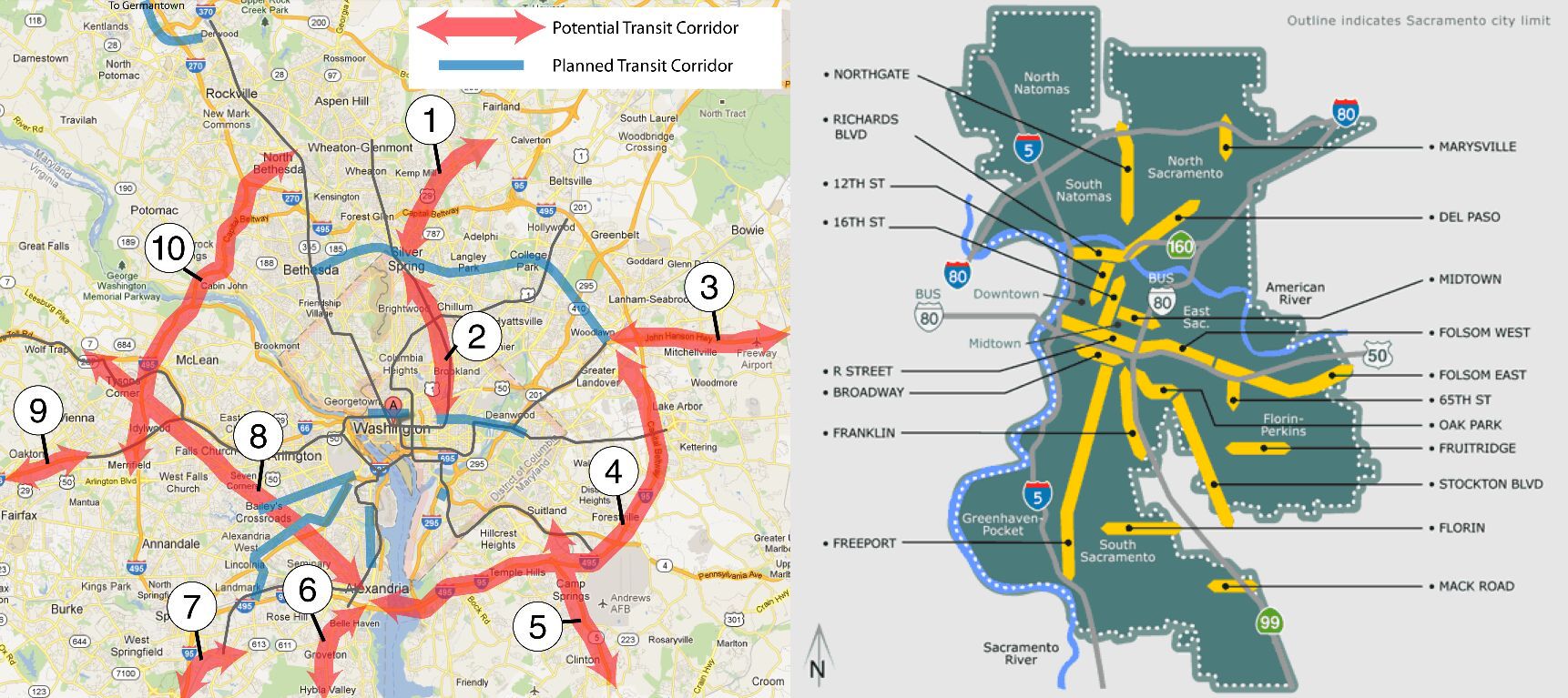
A possibly even better idea of urban travel corridors can be derived from how they’re depicted in maps. Below are several examples of corridor planning maps from several other communities.


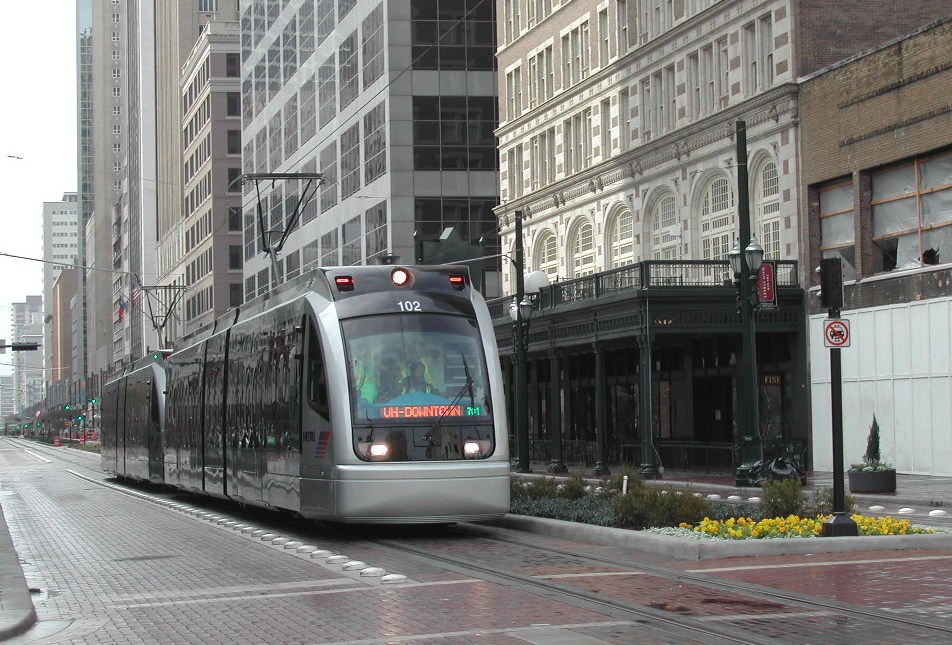
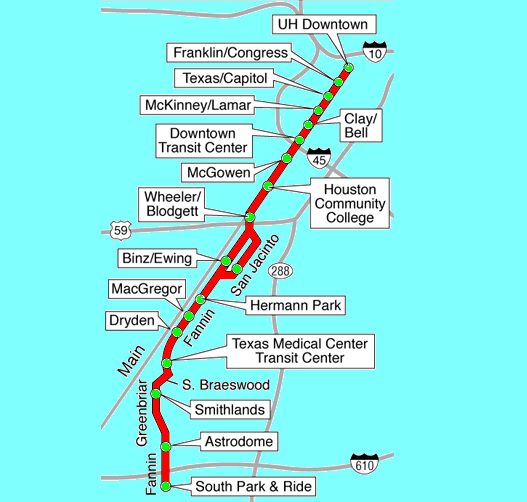
LEFT: Houston urban corridor planning map (City of Houston). RIGHT: Portland high-capacity transit (HCT) planning map (Transport Politic).

LEFT: Houston urban corridor planning map (City of Houston). RIGHT: Portland high-capacity transit (HCT) planning map (Transport Politic).

Both of these maps (Houston left, Portland right) show urban travel corridors as very elongated bands following major transportation features such as arterials and rail lines.

Note that in each case, the core is not designated as a “corridor” — in Houston, it’s the Core Pedestrian District; in Portland it’s simply the Central City.


LEFT: Travel corridor in Cleveland (FHWA). RIGHT: Travel corridor in Loveland, Colorado (City of Loveland).

LEFT: Travel corridor in Cleveland (FHWA). RIGHT: Travel corridor in Loveland, Colorado (City of Loveland).

Multiple urban corridors can be designated for study, or the focus can be on individual corridors. In these cases, individual corridors have been selected for more intensive study — one in Cleveland, left, and one in Loveland, Colorado, right. But note that these corridors are still elongated, narrow, and shaped to comform to predominant travel flow patterns.


LEFT: Denver — planned transit corridors (RTD). RIGHT: Kansas City — Proposed streetcar expansion corridors (NextRail-KC).

LEFT: Denver — planned transit corridors (RTD). RIGHT: Kansas City — Proposed streetcar expansion corridors (NextRail-KC).

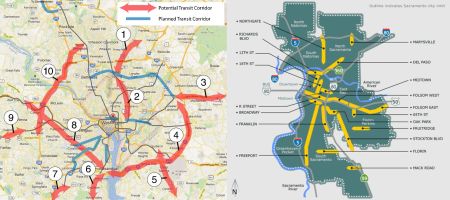
Once again, transit corridors are typically designated as fairly narrow, often shaped around existing travel facilities (roadways or railways). They do this because they are designed to designate travel movement patterns, i.e., traffic flows. The adjacent areas are often regarded as “watershed” for ridership, i.e., the “travel market” from which ridership to the proposed transit services could be attracted. It’s the demographics and other characteristics in these corridors that are important, not areas of huge urban sectors remote from these corridors.


LEFT: Washington — potential transit study corridors (WMATA). RIGHT: Sacramento — Designated commercial corridors (City of Sacramento).

LEFT: Washington — potential transit study corridors (WMATA). RIGHT: Sacramento — Designated commercial corridors (City of Sacramento).

What’s significant in these cases (Washington, DC left, Sacramento right) is the addition of arrows to the corridor designations on the maps to emphasize that these are travel corridors.


ProCon’s “sub-corridors” = isolated enclaves

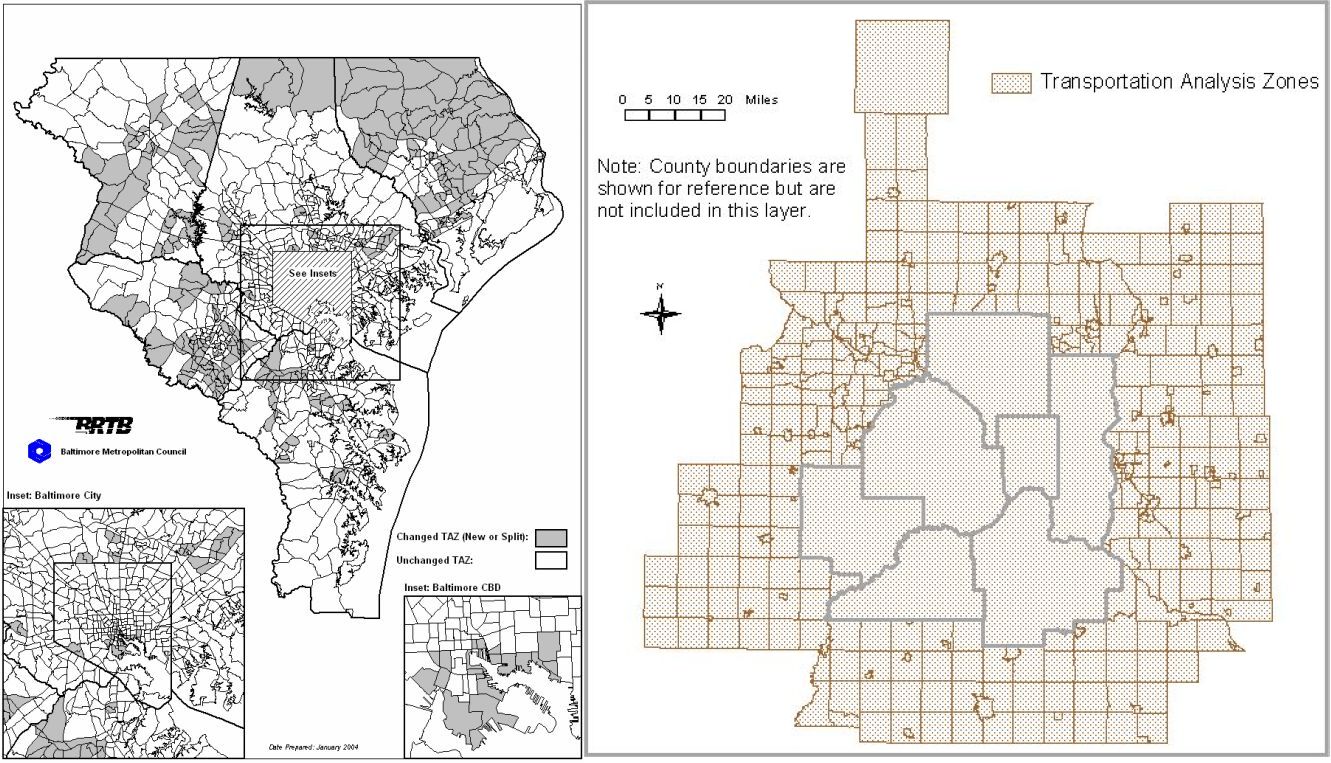
Yet Project Connect’s “sub-corridors” resemble none of these actual case examples — maybe because they’re actually urban districts or sectors, not true travel corridors. Indeed, these sectors have virtually nothing to do with actual travel corridors following traffic patterns. Instead, in the way they’re used by ProCon, they resemble, to some extent, rather large travel analysis zones (TAZs, also called traffic analysis zones or transportation analysis zones).
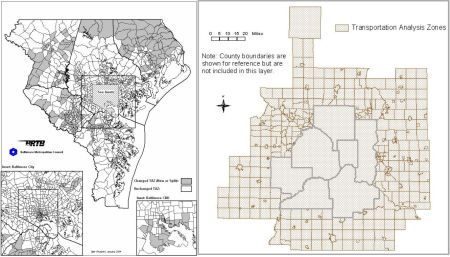
LEFT: Baltimore TAZ map (Baltimore Metropolitan Council). RIGHT: Minneapolis TAZ map (Metropolitan Council).

LEFT: Baltimore TAZ map (Baltimore Metropolitan Council). RIGHT: Minneapolis TAZ map (Metropolitan Council).

But ProCon’s sectors (“sub-corridors” — see map at beginning of post) weren’t intended to be TAZs, and they don’t function that way at all. TAZs (typically based on small geographic units such as census tracts or electoral precincts) are designed to be the basic geographic components to provide data inputs for a coordinated, integrated, metro-area-wide transportation network.

Project Connect’s sectors, in contrast, seem more designed to pit one part of the city against another — to function more as neighborhood enclaves to be assessed for their isolated demographics and “level of misery” (poverty, congestion, etc.) in a competitive showdown within a game of “Which sector deserves the urban rail prize?” It’s astounding that this charade is presented as a form of officially sponsored urban transportation planning.

Rather than tracking existing, logical corridors, almost all of these sectors sprawl over vast stretches of the inner city. The “Lamar” sector, for example, extends westward as far as Shoal Creek — approximately 1.5 miles from the Guadalupe-Lamar (G-L) corridor, and up to two miles wide — and encompasses over 2,900 acres, about 4.6 square miles. It includes both Shoal Creek Blvd. and Burnet Rd. as well as Guadalupe-Lamar. Yet, curiously, despite all this stretching of the corridor, ProCon planners have stopped the boundaries of the “Lamar” sector short of Loop 1 (MoPac Freeway) and, even worse, they’ve ruled out a logical extension as far as U.S. 183.

The “Mueller” sector, widening to approximately 2.5 miles in girth, sprawls even further, encompassing a chunk of the Hancock neighborhood, north of UT, and then most of northeast Austin, as well as the relatively small Mueller development site, in almost 4,000 acres, more than 6.2 square miles.

Not only have the sectors been gerrymandered, the data Project Connect is attributing to them has been gerrymandered as well. The “study” purports to be focused on getting the proper routes (through the proper sectors, of course) to the “Core” sector (from which all other sectors are banned) … yet in not one single sector have the actual travel-related conditions of a major potential transit route corridor been even mentioned, much less tallied, examined, or analyzed.

The existence of corridor travel patterns, and particularly of available physical corridors (e.g., fairly wide arterials in sectors such as “Lamar”, “ERC”, and “MLK”), are critical factors that nevertheless seem immaterial to ProCon planners. Thus, rather than assessing corridors to the core, the Map Book provides (for each sector in the study area map) a chaotic riot of “congested” streets (using dark and bright red colors designating “congested” and very congested” conditions), in virtually every direction. It doesn’t matter if a roadway heads the wrong way — everything counts in registering a sector’s score in the “congestion” misery index.
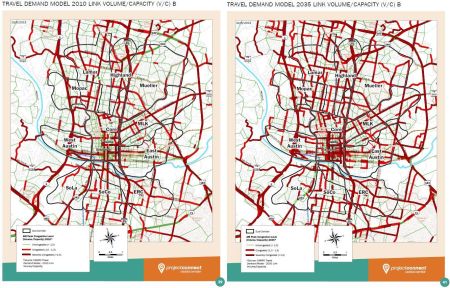
LEFT: Congestion by sector in 2015. RIGHT: Congestion by sector in 2035.

LEFT: Congestion by sector in 2015. RIGHT: Congestion by sector in 2035.

Some of this demographic and “misery” data could be relevant — if it were focused on actual travel corridors. The walking-distance “ridership watershed” of an inner-city transit corridor is usually about a mile either side of the the center of the corridor (which is usually a likely right-of-way for the proposed transit facility); this assumes an average pedestrian access of a half-mile to stations (within a 0 to one-mile range). Total population, density, employment, transit-dependency, income level, poverty, traffic congestion (especially in the directional flow pattern), and other indicators are all relevant within this travel corridor for assessing its potential.

Catastrophic methodological fault

However, there’s a much more fundamental (and disastrous) problem than either the configuration or the function of Project Connect’s designated sectors. Perhaps the most serious flaw in ProCon’s urban rail study methodology — actually, catastrophic, because it fundamentally impairs the integrity of the whole process — is that the actual travel corridors are not only basically ignored as workable corridors, but also are truncated and segmented by ProCon’s arbitrary slicing up of the urban area.

If you’re evaluating a travel corridor, you must evaluate the corridor as a whole — what it connects from, to, and in between; what the populations and densities along the corridor are; what activity centers it connects; and so on. All those are important, because they’re critical to what makes a transit line in that corridor actually feasible and worth investing in. For example, relevant to the “ERC” (“East Riverside Corridor”) sector is the eventual potential of an urban rail route to extend further east to the ABIA airport — but that’s not considered in this study.

Likewise, the possibility of extensions of a proposed Guadalupe-Lamar urban rail line further north on Lamar and northwest on the Capital Metro railway (i.e., converting MetroRail to electric urban light rail transit) would be crucial ingredients to the evaluation of a basic inner-city starter line. But this is prohibited by ProCon’s arbitrary sectionalization of the city (areas north of the “Central Corridor” belong to other “corridors”).

Similarly, the Guadalupe-Lamar route is severed just north of the UT-West Campus area at W. 29th St. In other words, most of this potential route is cut off from its highest-density population district as well as its most productive destinations in the core of the city!

What’s left is a “rump” route, from a few blocks south of U.S. 183 to W. 29th St., that seems to have little purpose beyond perhaps some kind of “shuttle” along this isolated route segment. If there were a prize for idiotic public transport planning, surely Project Connect would be very high on the candidate list.

Added to this seemingly heedless route segmentation is ProCon’s treatment of adjacent sectors as insular, isolated enclaves, whose demographics and other characteristics apply only to themselves. Likewise travel characteristics are treated in isolation, as if the population in all these different “enclaves” confine themselves to the sector boundaries that ProConn planners have established for them. Is it realistic to believe that residents of the “Highland” sector wouldn’t be allowed to hop a train on a Guadalupe-Lamar urban rail line, or that residents in the “West Austin” sector would be prohibited from catching a G-L train north to the Triangle area or Crestview?

Project Connect’s deformed “study”

Some of the most egregious problems with ProCon’s planning approach are summarized in the infographic below.

This inforgraphic summarized numerous major problems with Project connect's methodology.

This infographic summarizes numerous major problems with Project connect’s methodology. (Click to enlarge.)

As Austin Rail Now has noted previously, on Nov. 15th, the ProCon planning team are scheduled to recommend a sector (“sub-corridor”) as the basis for further urban rail planning. Given the dubious and even bizarre aspects of their methodology (and the occult nature of their process), predicting what their conclusion will be is somewhat like trying to predict whom the College of Cardinals would elect as a new pope.

In any case, this small analysis underscores that a truly realistic, rational urban rail study would want to look at the population, density, and other key indicators along Guadalupe-Lamar and other entire corridors. And furthermore, that a far more effective methodology for transportation corridor analysis needs to be implemented. So far, Project Connect seems to have made a mess of this process.

h1

Guadalupe-Lamar is highest-density corridor in Austin — according to Project Connect’s own data!

9 November 2013
Closeup of Project Connect's central Austin map of population density for 2010 shows intense clusters of density in West Campus, along Guadalupe above W. 29th St., and in Triangle area. Map: Rev. by LH from Project Connect.

Closeup of Project Connect’s central Austin map of population density for 2010 shows intense clusters of density in West Campus, along Guadalupe above W. 29th St., and in Triangle area. Map: Rev. by LH from Project Connect.

Even from the peculiarly selective and distorted data exhibited visually in Project Connect’s Map Books, it’s clear that the Guadalupe-Lamar (G-L) corridor currently has by far the highest concentration of population density within Austin central study area (and almost certainly the highest in the entire metro area). And this density appears predicted to persist in ProCon’s projection for 2030!

This density (pointed out decades ago by Lyndon Henry and Dave Dobbs as a pre-eminent justification for rail transit in this corridor) is shown in the following map graphics excerpted from the latest version (v. 5) of ProCon’s Map Book.


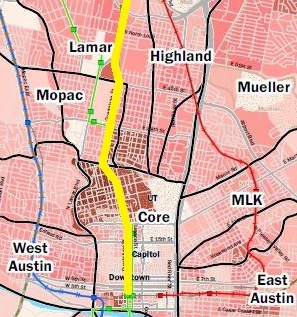
Central study area view

Population density in 2010 (G-L corridor spine in yellow). Map: Rev. by LH from Project Connect.

Population density in 2010 (G-L corridor spine in yellow). Map: Rev. by LH from Project Connect.

The map above shows the central-city study area (mislabeled by ProCon as a “Central Corridor”) with various sectors (mislabeled as “sub-corridors”) in 2010. The arterial spine of the G-L corridor (the most likely alignment for urban rail) is shown by a yellow line. Notice that heavy concentrations of high population density are clustered around the G-L corridor, particularly in the West Campus area, and just north of the campus, bordered by Guadalupe on the west and W. 29th St. on the south.


Population density projected for 2030 (G-L corridor spine in yellow). Map: Rev. by LH from Project Connect.

Population density projected for 2030 (G-L corridor spine in yellow). Map: Rev. by LH from Project Connect.

The map above shows the same study area and sectors, with population density concentrations projected for 2030. While these projections are far more subjective and tentative than actual current reality-based data, they do reflect speculation that extremely high density will not only intensify in 2030 in the same areas as it was located in 2010, but is expected to expand to other segments of the G-L corridor.


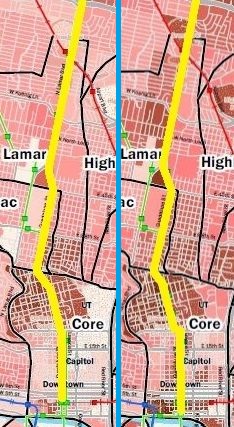
Guadalupe-Lamar focus

Composite of zoomed-in snips of Project Connect maps of population density. LEFT: 2010. RIGHT: 2030. Rev. by LH from Project Connect.

Composite of zoomed-in snips of Project Connect maps of population density. LEFT: 2010. RIGHT: 2030. Rev. by LH from Project Connect.

This composite focuses on population density the G-L corridor, showing density concentrations in 2010 on the left, and in 2030 on the right. Again, the probable alignment for urban rail is shown by a yellow line. This makes both the existing density and its projected intensification in the future even more obvious.


Conclusion

These data visualization maps clearly indicate that not only does the Guadalupe-Lamar corridor currently have extremely high levels of population density (as much as 30,000 persons per square mile in the West Campus) sufficient to support urban rail, but it surpasses all other corridors in the city! Furthermore, even in ProCon’s flawed analysis, this density is projected to intensify by 2030.

But this kind of bona fide corridor analysis counts for absolutely nothing in Project Connect’s “study”, because they’re not evaluating travel corridors such as Guadalupe-Lamar! They’ve been wasting taxpayer money on largely irrelevant studies of demographics and other conditions in isolated sectors while largely ignoring actual travel patterns in corridors into the core area, along with the demographics and other critical features along these actual corridors, such as G-L.

On Nov. 15th, the ProCon team are due to announce their “recommendation” for a sector (“sub-corridor”) as the location for urban rail … and it’s anybody’s guess as to what is the basis for their evaluation. But this small analysis we’ve just presented illustrates the actual kind of analysis of a travel corridor that official planners should be performing, and we suggest it as a far more effective model for the type of urban rail study this community actually should be supporting.

h1

Central Austin Combined Neighborhoods Planning Team endorses Guadalupe-Lamar for urban rail

3 November 2013
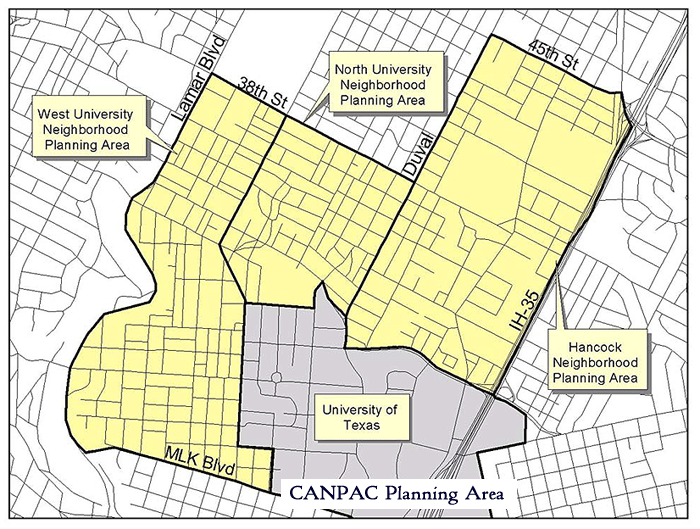
Central Austin Combined Planning Area. Map: CANPAC.

Central Austin Combined Planning Area. Map: CANPAC.

On October 21st, the effort to designate the Guadalupe-Lamar (G-L) corridor as the preferred route for urban rail (light rail transit, LRT) received a powerful boost with the endorsement of the Central Austin Combined Neighborhoods Planning Team (known as CANPAC), designated by the City of Austin to serve as the official neighborhood plan contact team for the Central Austin Combined Planning Area, involving seven major neighborhood associations:

  • West University Neighborhood Association
  • Hancock Neighborhood Association
  • Eastwoods Neighborhood Association
  • North University Neighborhood Association
  • Shoal Crest Neighborhood Association
  • Heritage Neighborhood Association
  • University Area Partners

These neighborhood associations are among the longest-established and most influential in the city.

The endorsement also emphasized that, unlike the G-L corridor, Red River St. — a link in the proposed semi-official route between downtown and the Mueller redevelopment site — lacks the projected future density necessary to adequately support light rail service. In contrast, density is considerably higher along the Guadalupe-Lamar corridor, especially in the West Campus neighborhood, which ranks variously as either the third or fourth-highest density residential area of major Texas cities.

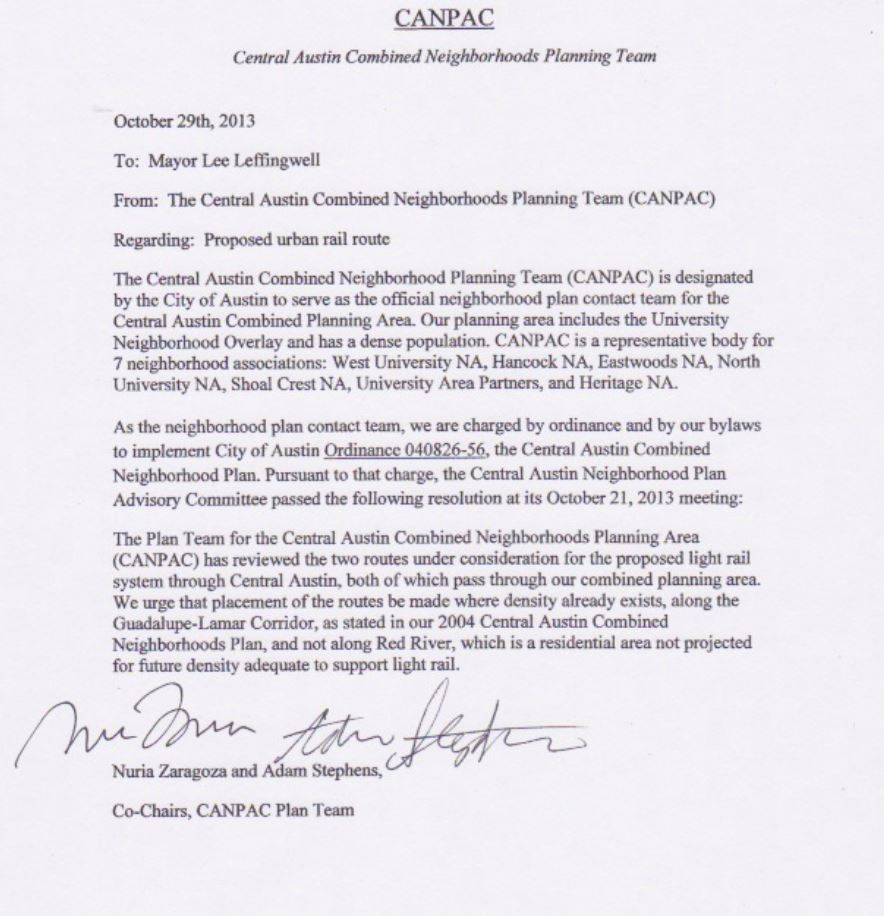
CANPAC also notes that it is commissioned both by City ordinance and its own bylaws to implement Ordinance No. 040826-56, the Central Austin Combined Plan.

As CANPAC reported in an October 29th memo to Austin Mayor Lee Leffinwell, on October 21st the Central Austin Neighborhood Plan Advisory Committee passed the following resolution:

The Plan Team for the Central Austin Combined Neighborhoods Planning Area (CANPAC) has reviewed the two routes under consideration for the proposed light rail system through Central Austin, both of which pass through our combined planning area. We urge that placement of the routes be made where density already exists, along the Guadalupe-Lamar Corridor, as stated in our 2004 Central Austin Combined Neighborhoods Plan, and not along Red River, which is a residential area not projected for future density adequate to support light rail.

Image of memo conveying G-L endorsement from CANPAC to Austin Mayor Leffingwell.

Image of memo conveying G-L endorsement from CANPAC to Austin Mayor Leffingwell.

This is an extremely important endorsement of central Austin’s most important potential corridor for urban rail, and G-L supporters are strongly urged to convey news of this and other major endorsements to the Austin City Council and other important political and civic leaders.

Related endorsement: UT Student Government backs West Campus, Guadalupe-Lamar route for first phase of urban rail

h1

Huge problems cited with Project Connect’s urban rail study data

3 November 2013
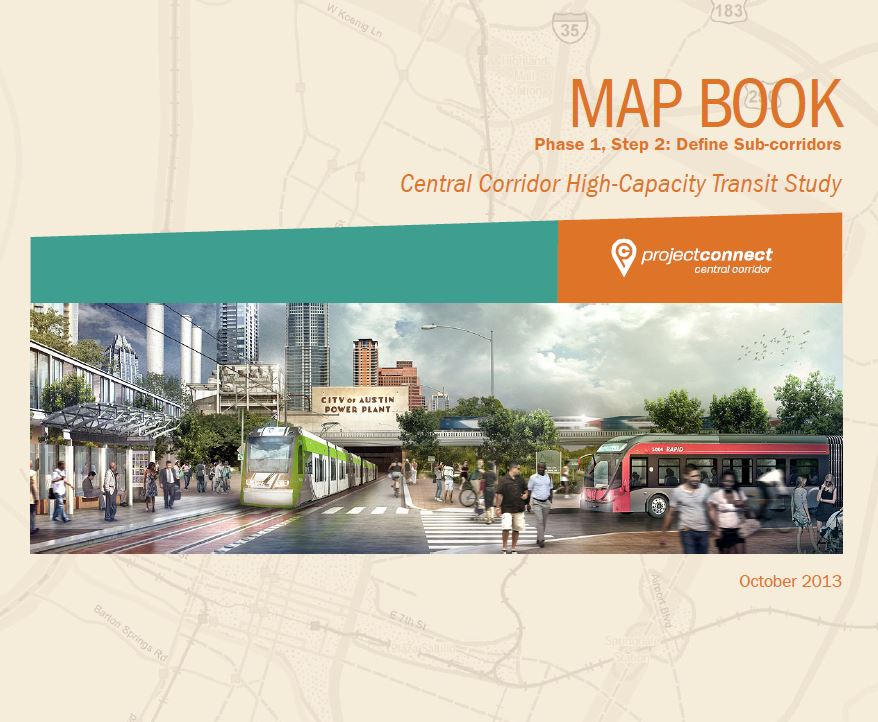
Cover of Project Connect's Map Book version 4. Screen capture: L. Henry

Cover of Project Connect’s Map Book version 4. Screen capture: L. Henry.

One of the most serious flaws in Project connect’s urban rail study process — in which top-level officials and planners are trying to rush to a selection of an Austin city sector for an urban rail starter line on or about November 15th — is problems with data inaccuracy and outright omissions. Focused on designated alternative city sectors (misnamed “sub-corridors”), the study team has been compiling purported data on demographic and transportation features of each sector (such as population, density, transit ridership, etc.) in a series of data-visualization “Map Books” (each new one an update of the previous one).

Map Books rife with data problems

Meanwhile, as this blog reported in a previous posting, Scott Morris, head of the Central Austin Community Development Corporation (CACDC) has been relentlessly and tediously scrutinizing each volume of Map Book data. As we’ve noted “Scott has performed amazingly detailed and well-supported research into these data issues, and he has found and pointed to a lengthy array of dozens of mostly serious errors. A handful of these have been quietly rectified.”

By far, as the Oct. 27th article Project Connect admits major data error in Guadalupe-Lamar corridor study highlighted, “One of the most serious data anomalies that Scott has recently detected is the “disappearance” of virtually all the ridership for Capital Metro’s routes #1M/L and #101, the heaviest-ridership transit routes in the system, serving the G-L corridor as well as South Congress.” As the article reports, Project Connect has publicly admitted that error and corrected it in the next Map Book edition.

Map Book errors go uncorrected

However, an unacceptable large number of similar errors — predominantly erroneous data or outright omissions — remain. The following are just some of the most egregious problems in Map Book v. 2, still carried into v. 4, that Scott has found and cited in a listing submitted by CACDC to the Project Connect urban rail study team:

ARN1_CACDC_Prj-Con-MapBook4-errors1

Partial listing of major errors in Project Connect Map Book and other material identified by CACDC. Screen image: L. Henry.

Partial listing of major errors in Project Connect Map Book and other material identified by CACDC. Screen image: L. Henry.

New error problems with Map Book 4

Scott has appended a listing of major new problems appearing in Map Book Version 4; here’s a summary:

• All “B” Pages and Definition Packages
West University NPA/University Neighborhood Overlay Removed From Defined Sub-Corridors A large, dense city area to the west of the UT campus and Guadalupe Street was moved out of the North Lamar and Mopac Sub-Corridors by the Project Team in response to a request to include UT in the core. This change was made in the current map. We understand the reasoning in placing UT in the core, however the manner in which surrounding non-UT areas were moved with it will create large, unintended impacts on the sub-corridor evaluation process. That area is not a part of UT, nor in the opinion of West Campus residents, can it be adequately served by a San Jacinto alignment on the UT Campus. West University is the densest planning area of our city that also employs over 5,000 people (Non-UT). The area west of Guadalupe anchors the Guadalupe-North Lamar Sub-Corridor and includes the University Neighborhood Overlay and 3 residential neighborhoods that are components of a City of Austin Central Austin Combined Neighborhood Planning Area. West Campus is the largest population differentiator in our city for the purposes of sub-corridor analysis. In our opinion, it should not be considered a common element to the core joining the CBD, UT, and the Capitol Complex, unless it receives a similar commitment to service. In the end, if it is desired to count West Campus as part of the core, we should also count on serving it directly as part of the definition of the core.
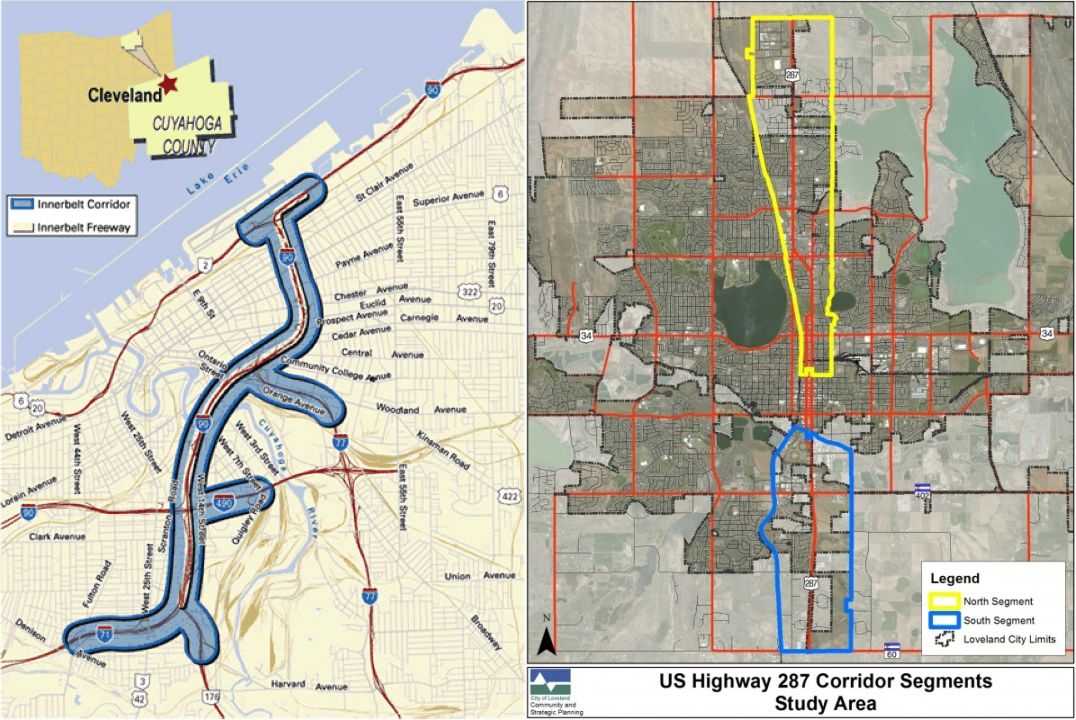
• Page 13 Employment Density with Major Employers
The State of Texas in the North Austin Complex has been omitted. It is the center of over 16,000 jobs within a 1/2 mile radius of 49th and N. Lamar. There is no purple symbol. Girling Healthcare is a small office, yet shows 2,225 employees in place of the TX Dept of Health.

• Page 28 Poverty, Vehicles, Affordable Housing
Hundreds of units of affordable housing in West Campus is not identified with the correctly-sized circle.

• Pages 36-37 Bus Ridership 2011
The North Lamar Transit Center has been cropped out of the frame. Much of the bus system for the northern half of the city has boardings there.

• Pages 55-59 Sub-Corridor Definition Package Lamar
Population Studies are not provided for North Lamar sub-corridor definition package.

• Pages 15-16. Employment Growth
Austin State Hospital should show >100% Growth. This is an identified P3.

• Pages 18-19 2010 Retail Employment Density
The Triangle is not identified as retail density.

• Pages 18-19 2010 Retail Employment Density
Koenig and N Lamar is not identified as retail employment density.

• Page 26 Population Growth 2010-2030
The growth projections that occur in an area north of 32nd St. South of 45th St east of Waller Creek, and west of Red River are too high. Per that neighborhood plan and numbers reflected in the zoning capacity studies, population growth should be a more modest 41% for the described area. This includes SF-3 zoning and the Hancock Golf Course, a dedicated park. http://centralaustincdc.org/land_use/Zoning_and_Capacity_Redev_Analysis_v11.pdf

• Page 30 Selected Land Use 2010
Adams Hemphill Park straddling 30th not identified as open space.

CACDC also provides data references as the basis for these corrections.

Summary

It’s understandable that some data problems will be encountered in almost any major study of this kind. What’s astounding, however, is the high number of problems in Project Connect’s urban rail study. Even worse is that almost all of them — even when identified — seem to be going uncorrected!

This seriously compromises the competency of this entire study process (and there are even more fundamental issues involved, as this blog will address). The data problem is especially threatening because data analysis is supposedly the foundation for decisionmaking to select an urban rail corridor; the Central Corridor Advisory Group (CCAG, whose recommendation is a key part of the process) is being led through a process of data scrutiny and analysis by Project Connect staff. Yet the Project Connect team — under duress from high-level local officials eager to force a quick decision on urban rail, and apparently overwhelmed by the need to rush to an imminent recommendation for the Austin City Council — seem merely to be “dumping” volumes of data with little regard for its reliability or relevance to the basic goal of selecting an urban rail route.

All of this calls into question just how “fair and balanced” — and accurate, reliable, and truly data-based — the process of comparatively evaluating alternative urban rail corridors and plans actually is.

What the final outcome will be, and whether its integrity will be accepted by the Austin public and voters in particular, remains to be seen.

h1

Houston’s MetroRail shows the way — How to fit urban rail into Austin’s Guadalupe and Lamar

30 October 2013
Two-car Houston MetroRail light rail train glides northbound in reservation along Main St. Notice landscaping in median, where station platforms are also placed. Photo: Mike Harrington.

Two-car Houston MetroRail light rail train glides northbound in reservation along Main St. Notice landscaping in median, where station platforms are also placed. Photo: Mike Harrington.

It’s pretty amazing.

While the so-called “People’s Republic of Austin” has agonized, dillied, dallied, and dawdled for years over whether or not to give priority to transit, or to preserve sacred traffic lanes for cars, Houston — long assumed to be a poster child of motor vehicle dependency — already took the plunge over a decade ago, carving dedicated transit reservations out of some of its busiest central-city arterials for its MetroRail light rail transit (LRT) line.

Opened in 2004, Houston’s MetroRail runs 7.5 miles with 16 stations through the heart of the city, from University of Houston–Downtown to Fannin South, using well-separated reservations created by re-allocating former traffic lanes and turning (“chicken”) lanes to rail transit. It’s highly successful, carrying 37,500 rider-trips per average weekday (second quarter 2013) at about 8% lower cost per passenger-mile than Houston’s bus system average (National Transit Database, 2011).

MetroRail is routed almost entirely on major arterials through central-city Houston. Map: Light Rail Now.

MetroRail is routed almost entirely on major arterials through central-city Houston. Map: Light Rail Now.

From the standpoint of the engineering design of its alignment, MetroRail presents a model of what could be possible in Austin’s Guadalupe-Lamar (G-L) corridor. Facing the constrained street right-of-way available, Houston’s local decisionmakers and planners bit the bullet, opting to re-allocate entire street lanes away from motor vehicle traffic, and allot the space to the much higher carrying-capacity of the planned new LRT line.

The most drastic re-allocation occurred on Main St., which in its most constrained section was originally a four-lane street with a center turning lane. About 40% (northern section) of the route runs in Main; there’s a short section of several blocks with the line split between Fannin and San Jacinto Streets; then the remaining southern portion of the route runs in Fannin.

Photo-essay: Houston MetroRail

The remainder of this post is mostly a photo-essay on selected street alignment features of Houston’s MetroRail, particularly showing how previous traffic lanes have been re-allocated to transit in route sections most closely resembling the conditions of Guadalupe St. and Lamar Blvd. in Austin.

Main St. alignment


Overhead view of MetroRail on Main St. at Preston. Photo: Houston Metro.

Overhead view of MetroRail on Main St. at Preston. Photo: Houston Metro.

The MetroRail LRT system was installed in Main Street as part of a massive overhaul of Houston’s downtown streets beginning in the late 1990s. The objective was to emphasize pedestrian and transit access while reducing motor vehicle traffic.

In the photo above, you can see how LRT tracks and stations — and widened sidewalks — have replaced what was once several traffic lanes. Traffic has been reduced to one lane in each direction, with occasional parking space, mainly so adjacent stores and offices can be accessed by commercial services.


Main St. without MetroRail. Photo: Wikipedia.

Main St. without MetroRail. Photo: Wikipedia.

Further south from downtown, near the Medical Center, the MetroRail alignment leaves Main St., and continues in Fannin and San Jacinto Streets. However, Main continues south.

In the photo above, Main St. is a bit wider than it is in the more constrained section downtown, but you can still get an idea of how the street looked before MetroRail.


Main St., 2 views of MetroRail alignment. LEFT: Train near Preston (photo: L. Henry). RIGHT: Train near Gray (photo: Frank Hicks).

Main St., 2 views of MetroRail alignment. LEFT: Train near Preston (photo: L. Henry). RIGHT: Train near Gray (photo: Frank Hicks).

The two photos above illustrate the MetroRail alignment from ground level — the left photo in the heart of downtown, the right photo further south on the edge of downtown. Notice the use of large traffic buttons to emphasize segregation of LRT tracks. Also notice how the median area between tracks is used for both stations and landscaping.


MetroRail passengers deboarding at Downtown Transit Center station. Photo: Peter Ehrlich.

MetroRail passengers deboarding at Downtown Transit Center station. Photo: Peter Ehrlich.

This view, showing passengers deboarding a MetroRail train at the Downtown Transit Center station, provides another ground-level view of a station fitted into the Main St. streetscape.


MetroRail passing under I-45. Photo: Peter Ehrlich.

MetroRail passing under I-45. Photo: Peter Ehrlich.

Houston’s MetroRail passes under a couple of freeways as it heads south from downtown. No reconstruction of the grade separations was necessary — track and overhead contact system (OCS) wires were simply installed through the underpass. Here, a train on Main St. passes under the I-45 freeway not far from the Downtown Transit Center station. This may offer design hints for solving similar underpass LRT needs in Austin, such as the proposed extension of the Guadalupe-Lamar line under the US 183 underpass.


Aerial view of MetroRail on Main St. at Ensemble-HCC station. Photo: Screen capture by L. Henry from Google Maps.

Aerial view of MetroRail on Main St. at Ensemble-HCC station. Photo: Screen capture by L. Henry from Google Maps.

This aerial view of the alignment in Main St. at the Ensemble-HCC station gives another perspective on how MetroRail has been fitted into the streetscape south of central downtown. Stations are staggered, with separate platforms and shelters to serve either northbound or southbound trains (thus not requiring extra street width).


Double-track to single tracks on Fannin-San Jacinto

Map showing MetroRail transition from Main St to Fannin-San-Jacinto (Screen capture by L. Henry from Google Maps).

Map showing MetroRail transition from Main St to Fannin-San-Jacinto (Screen capture by L. Henry from Google Maps).

The map above shows where the double-track MetroRail alignment leaves Main St. (at Richmond and Wheeler Ave.), runs diagonally southward, and then splits (just after passing under the Southwest Freeway), with the southbound track following Fannin St. and the northbound track following San Jacinto St.


Aerial view of 2 tracks splitting into single tracks on Fannin and San Jacinto. Photo: Screen capture by L. Henry from Google Maps.

Aerial view of 2 tracks splitting into single tracks on Fannin and San Jacinto. Photo: Screen capture by L. Henry from Google Maps.

In the aerial view above, the double-track MetroRail alignment can be seen running diagonally, passing beneath the Southwest Freeway, and then splitting into single tracks on Fannin St. and San Jacinto St., where the tracks are laid in curbside alignments.


MetroRail Museum District station. Photo: Houston Metro.

MetroRail Museum District station. Photo: Houston Metro.

The photo above shows the curbside MetroRail alignment and a curbside platform at the Museum District station. Note how light rail station platform is raised approximately 14 inches above track level (which is also street level) to permit level boarding into each car. The woman will be able to roll her baby carriage directly onto the train, with no lifting or need for a ramp.


Double-track alignment in Fannin and Braeswood

Aerial photo of Fannin-San Jacinto single tracks merging into double-track on Fannin. Photo: Photo: Screen capture by L. Henry from Google Maps.

Aerial photo of Fannin-San Jacinto single tracks merging into double-track on Fannin. Photo: Photo: Screen capture by L. Henry from Google Maps.

This aerial view shows how the single-track alignments on Fannin and San Jacinto are merged south of Hermann Drive into a double-track alignment on Fannin St.


MetroRail Hermann Park-Rice University station on Fannin St. Photo: Peter Ehrlich.

MetroRail Hermann Park-Rice University station on Fannin St. Photo: Peter Ehrlich.

Somewhat further on south on Fannin St. is the Hermann Park-Rice University station. This cross-sectional view shows how the median island-type station, serving both directional tracks, is fitted into the roadway, with trackage separated by traffic buttons.


Aerial view of Hermann Park-Rice University station. Screen capture by L. Henry from Google Maps.

Aerial view of Hermann Park-Rice University station. Screen capture by L. Henry from Google Maps.

The photo above provides an aerial perspective of the Hermann Park-Rice University station.


Train serving Memorial Hermann Hospital-Houston Zoo station. Photo: Panoramio.com.

Train serving Memorial Hermann Hospital-Houston Zoo station. Photo: Panoramio.com.

This ground-level photo of a train stopped at the Memorial Hermann Hospital-Houston Zoo station illustrates how (to accommodate the narrower roadway width) station design has reverted to the staggered-platform layout, with separate platforms and shelters for each direction .


Passengers waiting to board train at Dryden/TMC station Photo: Brian Flint.

Passengers waiting to board train at Dryden/TMC station Photo: Brian Flint.

Because of the tight street constraint, the Dryden/TMC station has a staggered-platform profile similar to the Memorial Hermann Hospital-Houston Zoo station.


Aerial view of Dryden/TMC station. Screen capture by L. Henry from Google Maps.

Aerial view of Dryden/TMC station. Screen capture by L. Henry from Google Maps.

This aerial view of the Dryden/TMC station illustrates how left turn lanes are handled. Notice that there are left-turn channelization arrows painted in the trackway. Cars are allowed access into these turning lanes (i.e., sharing the LRT tracks) via the traffic signal system. Notice cars in the upper right photo queued in the lane and preparing to turn left.


MetroRail train on S. Braeswood Blvd. Photo: Peter Ehrlich.

MetroRail train on S. Braeswood Blvd. Photo: Peter Ehrlich.

For a short “dogleg”, the MetroRail alignment departs from the Fannin route and runs in S. Braeswood Blvd. and Greenbriar Drive before returning to Fannin. This photo shows how the trackage is aligned in that section of the route.


Conclusion

Certainly, Houston’s MetroRail doesn’t represent a design “blueprint” for Austin (or any other community) that can simply be replicated — every city has its own challenges and needs in terms of streetscape and transit requirements. However, MetroRail does demonstrate an excellent Best Practices guide as to how this major auto-centric and asphalt-centric city has found the will and the way to incorporate workable, efficient, and attractive urban rail into a fairly constrained streetscape environment.

h1

Guadalupe-Lamar urban rail line would serve 31% of all Austin jobs

24 October 2013

ARNx0_CACDC_map_Austin-Urban-Rail-Employment-Centers-2013-snip

An urban rail line installed in the Guadalupe-Lamar (G-L) corridor (plus a short extension to the Seaholm area) would provide high-quality, high-capacity transit service to nearly one-third of all Austin jobs, according to a study based on 2011 U.S. Census data by the Central Austin Community Development Corporation (CACDC), led by Scott Morris.

ARNx1_CACDC_map_Austin-Urban-Rail-Employment-Centers-2013

The CACDC’s Austin Urban Rail website presents a map of a possible alignment on Guadalupe-Lamar, including 14 stations with locations optimized by the census employment data. The CACDC study says that that the On The Map online census utility “was used to measure jobs located within one quarter mile and one half mile of each proposed station point.”

According to the U.S. Census Bureau, Center for Economic Studies 2011 Current Employment Statistics, the Guadalupe-North Lamar Sub-Corridor contains the highest density of jobs in the city. … The results speak for themselves. If built, the Guadalupe North Lamar alignment would put tracks within a ten minute walk of over 31% of all jobs in the city.

One can infer that, if the G-L corridor route were combined with the proposed conversion of the eastside Red Line to electric urban rail (light rail transit) as proposed by Texas Association for Public Transportation — a proposal which includes a spur line into the Mueller site and Northeast Austin — it’s plausible to speculate that the total system would possibly provide access to as many as 40 to 50% of city jobs. And, in addition, serve the huge ACC campus developing at Highland.

TAPT proposes "loop" line, with routes on both Guadalupe-Lamar and eastide through converting the MetroRail line to electric light rail — plus a spur to Mueller.

TAPT proposes “loop” line, with routes on both Guadalupe-Lamar and eastside through converting the MetroRail line to electric light rail — plus a spur to Mueller.

h1

Petition — “I want to ride LIGHT RAIL on Guadalupe/North Lamar!”

18 October 2013
TAPT plan (left) and CACDC plan (right) both propose Guadalupe-Lamar as the major focus of Austin's Phase 1 urban rail starter line.

TAPT plan (left) and CACDC plan (right) both propose Guadalupe-Lamar as the major focus of Austin’s Phase 1 urban rail starter line.

Take your pick — the Texas Association for Public Transportation (TAPT) plan, or the Central Austin Community Development Corporation plan — or maybe even another plan for Guadalupe-Lamar (G-L)! — but be sure to sign the CACDC’s petition telling the Austin City Council and involved public transportation agencies you want a light rail transit (LRT) line on the G-L corridor where it belongs!

Wording:

Petitioning The Austin City Council, the boards of Capital Metro, Lone Star Rail, and the Capital Area Metropolitan Planning Organization, and the Federal Transit Administration.

I want to ride LIGHT RAIL on Guadalupe/North Lamar!

Petition by Central Austin Community Development Corporation

Add your (digital) signature here:

https://www.change.org/petitions/i-want-to-ride-light-rail-on-guadalupe-north-lamar#share

h1

Here’s what a real public meeting on rail transit looks like … in San Antonio

18 October 2013
Kyle Keahey, Project Connect's Urban Rail Lead and a consultant to San Antonio's VIA Metropolitan Transit, speaks during a VIA public meeting discussing San Antonio's modern streetcar plans this past July.

Kyle Keahey, Project Connect’s Urban Rail Lead and a consultant to San Antonio’s VIA Metropolitan Transit, speaks during a VIA public meeting discussing San Antonio’s modern streetcar plans this past July.

As this blog has been reporting, despite promises and assurances to local community leaders and activists who’ve been asking for bona fide public meetings to discuss local urban rail planning, Project Connect can’t seem to make one happen. Instead of real meetings, the Austin community has been offered “open houses”, which we’ve compared to “art galleries”, where people can walk through a room of “pretty pictures” (maps, charts, renderings, etc.), supposedly admiring and considering them and submitting comments or questions to the “guards” (planning personnel standing around). See: Back to “art galleries”! Project Connect reneges on community meetings and Meetings, “open houses”, workshops … and democratic process.
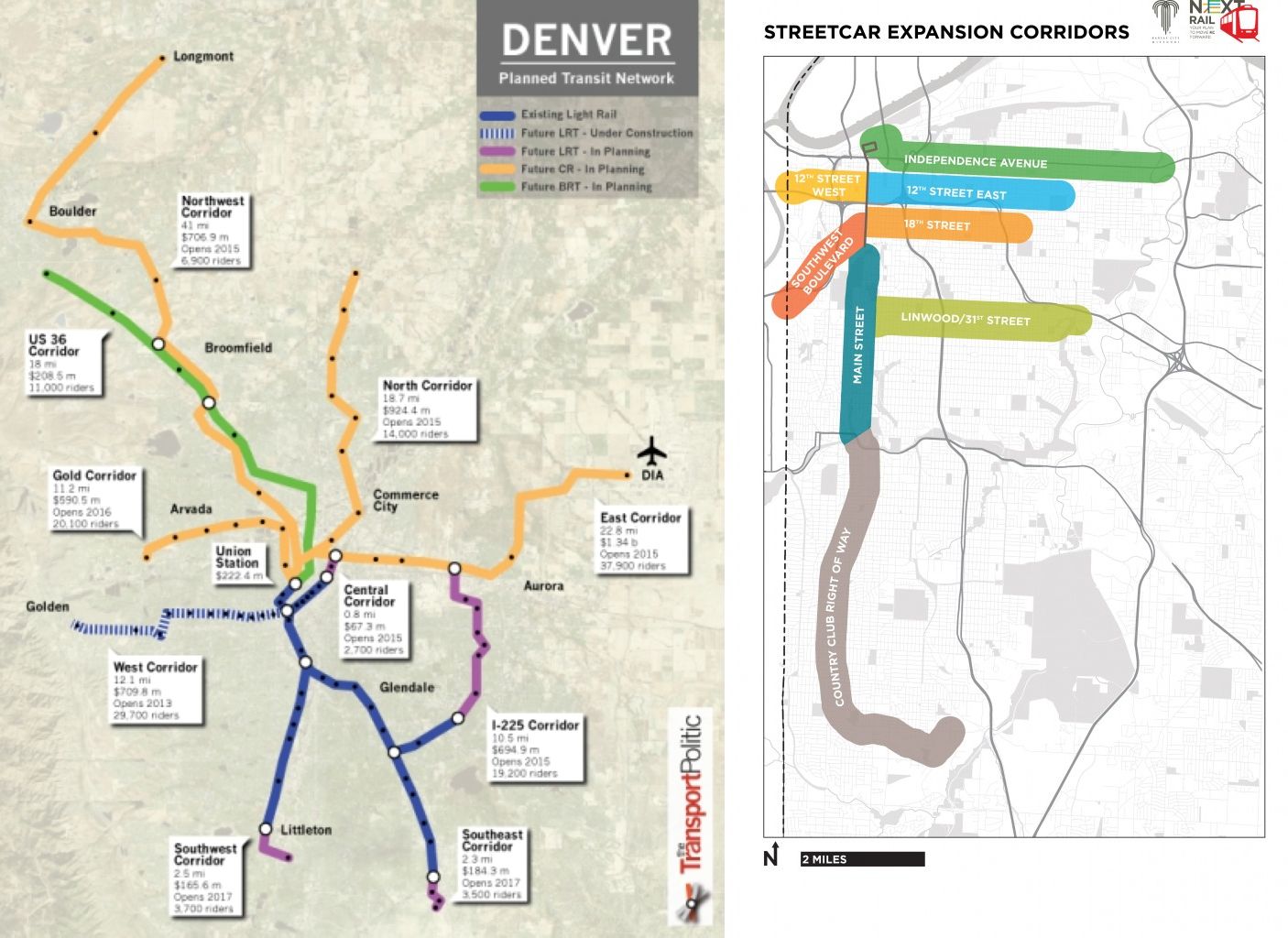
But while urban planners here in Austin haven’t been able to pull together a true public meeting, San Antonio has been holding real meetings — such as the one shown in the photo at the top of this post. And Kyle Keahey, Project Connect’s Urban Rail Lead, is also the lead rail planning consultant to San Antonio’s VIA Metropolitan Transit — and there he is, speaking to a San Antonio community meeting on urban rail!

San Antonio streetcar simulation. Graphic: VIA, from Rivard Report.

This was a meeting sponsored by VIA on 30 July 2013 at San Antonio’s Temple Beth-El to discuss the agency’s downtown modern streetcar project. According to a July 31st report in the San Antonio Express-News, “VIA officials gave more details about the possible streetcar routes, including two new ones ….” As the report noted, the two additional route alternatives “resulted from input from many directions — stakeholders along the route, movers-and-shakers and comment sheets from everyday citizens.” The paper also quotes VIA’s chief development officer’s assurance that “The process is to provide public input.”

And, in contrast to Austin, what has San Antonio got going for it — other than a far more realistic timeframe for decisionmaking, and an authentic official commitment to encouraging community participation?

h1

No urban rail on Guadalupe-Lamar? Then get ready for bus lanes…

18 October 2013
Ottawa's "BRT" Transitway delivers a "conga line" of buses onto urban streets. Photo: Errol McGhion.

Ottawa’s “BRT” Transitway delivers a “conga line” of buses onto urban streets. Photo: Errol McGhion.

by Dave Dobbs and Lyndon Henry

Which kind of transit — urban rail or buses in special lanes — do you want to see on Guadalupe-Lamar?

Not to decide is to decide.

It’s crucial that Austin’s first urban rail (starter) line be a whopping success. This means it must serve the heart of the city in its heaviest-traffic corridor, with its highest densities and employee and employment concentrations, and its most long-established neighborhoods. The Guadalupe-Lamar corridor offers the ideal alignment for an affordable, cost-effective surface light rail alignment.
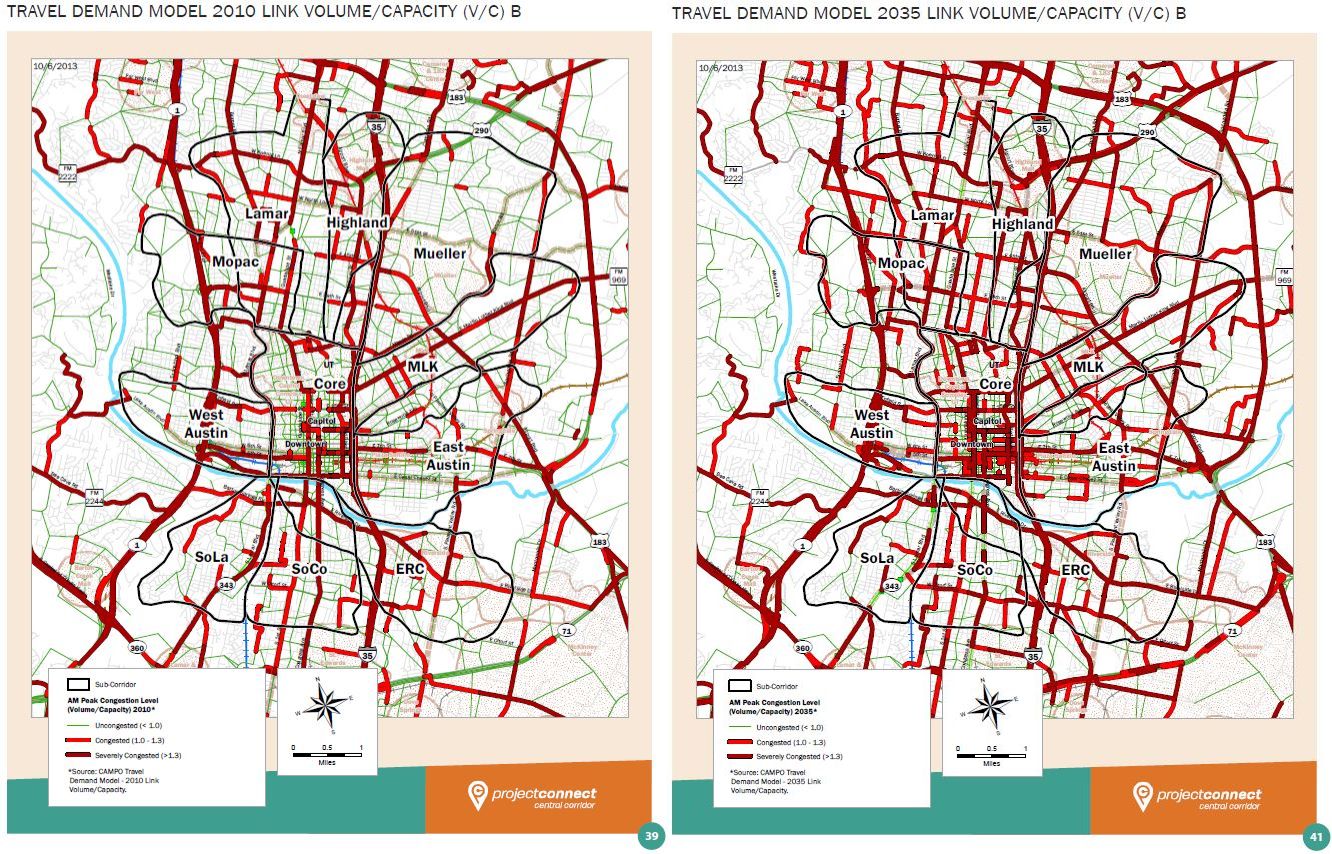
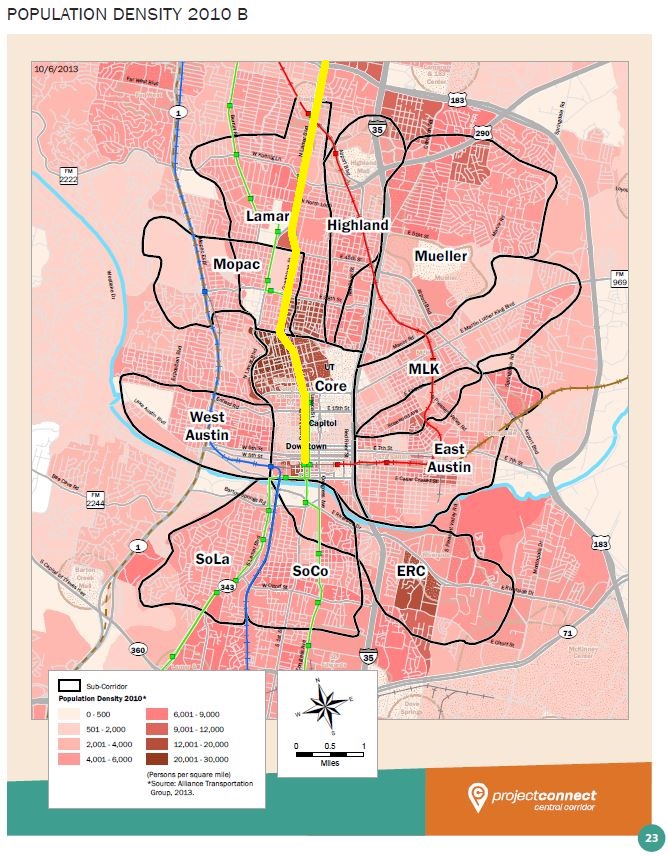
It’s also important to understand that if we don’t get light rail transit (LRT) on Guadalupe and North Lamar, we most certainly will get dedicated bus lanes within the next 10 years. A major project to overhaul the corridor by installing infrastructure for battalions of MetroRapid buses is waiting in the wings if urban rail is not implemented. This alternative, not requiring a public vote, would produce a far less efficient, adequate, and attractive system, seriously degrade urban conditions, and result in a less livable environment compared with urban rail.

This package of so-called “Bus Rapid Transit” (“BRT”) projects — whereby MetroRapid buses would enter stretches of dedicated bus lanes, and then merge back and forth, into and out of mixed general traffic — was first raised publicly in a Project Connect/City of Austin Transportation Department presentation made in City Council chambers on 25 May 2012 to the CAMPO Transit Working Group (TWG). Shown below is page 10 of that presentation, with arrows pointing to the relevant information.

Excerpt from Project Connect presentation in May 2012 indicating planned $500 million package for MetroRapid "BRT" facilities, including Guadalupe-Lamar. Graphic: Project Connect.

Excerpt from Project Connect presentation in May 2012 indicating planned $500 million package for MetroRapid “BRT” facilities, including Guadalupe-Lamar. Graphic: Project Connect.

These dedicated lanes will be built with 80% federal money, will not require an election, will be vetted publicly only at art gallery-style “open houses”, and approved by boards and commissions, the Capital Metro Board, and the Austin City Council, and then they will be built, unless we implement urban rail in the Guadalupe-North Lamar corridor. And keep in mind that — unlike the current minimalist MetroRapid project — this level of hefty physical investment in roadway infrastructure will become a de facto obstacle to any future rail project in the corridor.

These dedicated bus lanes are the official plan as things currently stand.

There are numerous drawbacks with premium buses, and even “BRT”, compared with LRT. Just to cite a couple:

• LRT on average is significantly more cost-effective than bus operations.

• Buses don’t attract nearly as much ridership as LRT, but as ridership starts to reach higher volumes, bus traffic and overwhelming “conga lines” of buses cause more problems … plus more queues of riders start to slow operations.

Another bus "conga line" leaving downtown Brisbane, Australia to enter busway.

Brisbane, Australia: More “conga lines” of buses travel on reserved lanes between the city’s downtown and a busway. Photo: James Saunders.

If you would prefer urban rail instead of a major bus lane project in Guadalupe-Lamar, it’s essential to speak up and act. Let neighborhood groups and other community organizations know what official plans have in store for this corridor. Sign petitions being circulated to support urban rail on G-L. Communicate to Project Connect and members of Austin City Council that you want to ride urban rail on Guadalupe-Lamar, running in reserved tracks, not just a souped-up bus service weaving in and out of special lanes.

Houston's MetroRail demonstrates that LRT can attract and carry more passengers faster, more effectitly and safely, more cost-effectively than high-capacity bus operations. Photo: Peter Ehrlich.

Houston’s MetroRail demonstrates that LRT can attract and carry more passengers faster, more effectively and safely, and more cost-effectively than high-capacity bus operations. Photo: Peter Ehrlich.