Posts Tagged ‘urban rail’

h1

Here’s what a REAL urban rail public involvement planning meeting looks like

10 January 2014
Minneapolis-area community meeting on proposed Southwest light rail project. Photo: Karen Boros.

Minneapolis-area community meeting on proposed Southwest light rail project. Photo: Karen Boros.

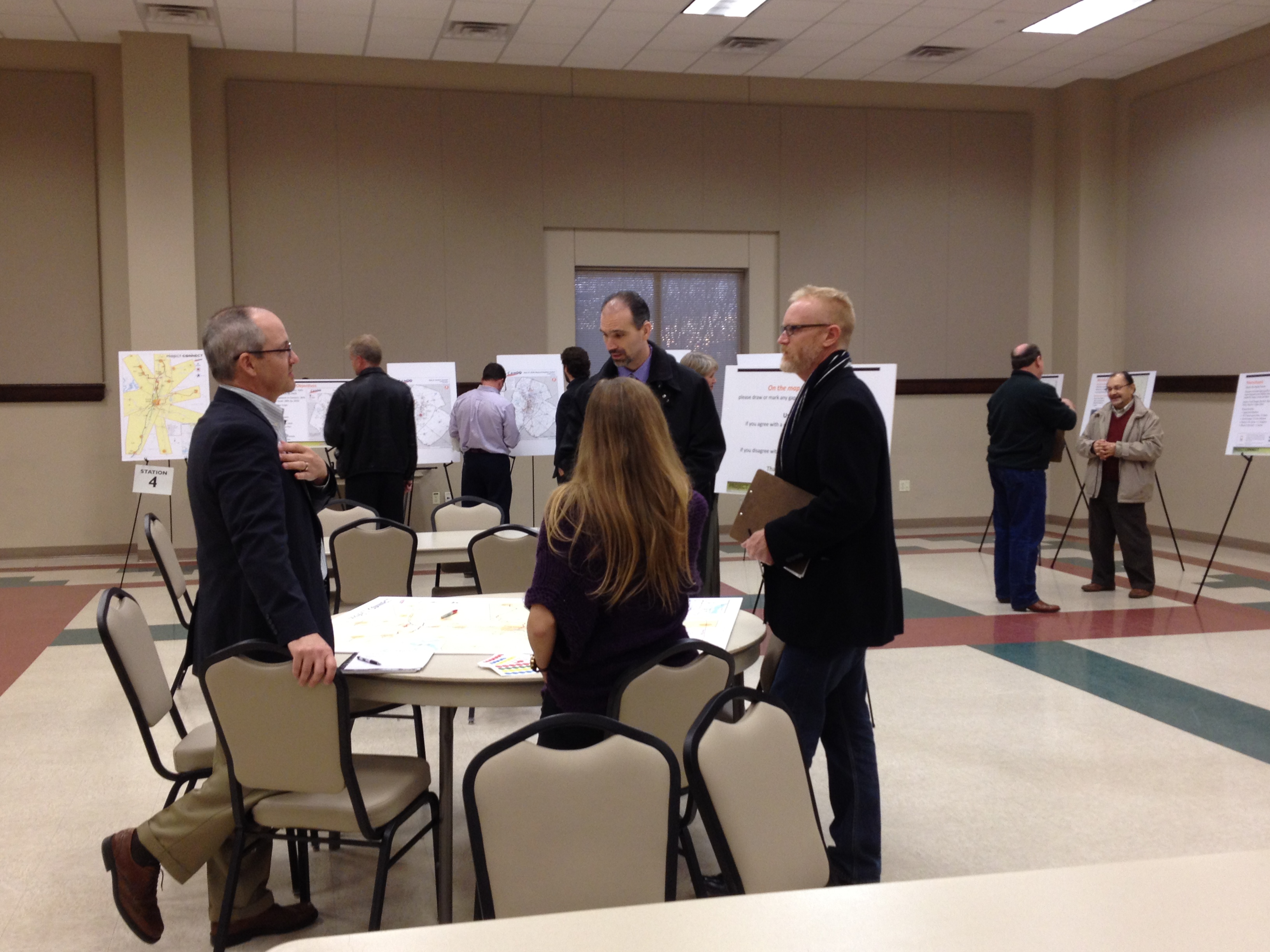
While Project Connect has been doubling down in its determination to squelch true public involvement (and substituting a process of rigidly controlled public manipulation portrayed as “community input”), a recent community meeting in the Minneapolis area gives an idea of what bona fide public involvement should look like (see lead photo, above).

The focus was the Southwest Light Rail Transit plan proposed by Minneapolis’s Metropolitan Council. About 14 miles long, connecting downtown Minneapolis and St. Paul with the suburban community of Eden Prairie, the line would be (after the Central Corridor project now under way) the next major extension of the metro area’s highly successful Hiawatha light rail line (named after a major highway corridor it uses for much of its route).

On January 8th, as reported by an article in the mostly online MinnPost, over 200 people filled the gym of a large recreation center (as shown above) to discuss and debate the project. Unlike Project Connect’s charade of “public participation” (where “meetings” consist of either personal one-on-one conversations with official representatives, or “opportunities” to approve predetermined choices with clickers), the Minneapolis event provides an example of a real community meeting, where participants were actually able to ask questions, voice comments, raise alternative approaches, and maybe come up with ideas and options the official planners hadn’t considered.

That’s the kind of robust community involvement process that in the past was typical here in Austin, until roughly a decade ago.

Project Connect, keeping its advisory committees in a kind of bell jar, and keeping itself in a virtual underground bunker, isolated from authentic public oversight, has been making extremely dubious decisions — including rigging a phony “Central Corridor” plan for “high-capacity transit” based in part on fantasy data.

In continuing to isolate and insulate itself from bona fide community involvement and oversight, it’s highly likely that Project Connect will continue to fashion plans that ignore authentic community needs, misplace resources, and squander taxpayers’ money. Provoking public disgust and anger — even among strong public transportation supporters — is surely not a prudent strategy for building a voting constituency for major rail transit projects.

“Stakeholders” cannot feel they have much “stake” when they’re excluded and manipulated. Will some members within Austin’s civic leadership have the strength and fortitude to recognize this, and demand an open, fully democratic, and authentic community involvement process?

Revision: 2014/01/12 — The second paragraph of this posting has been revised to clarify information about Minneapolis’s proposed Southwest light rail project.
h1

Dobbs: “Why are we squandering our best asset?”

22 December 2013
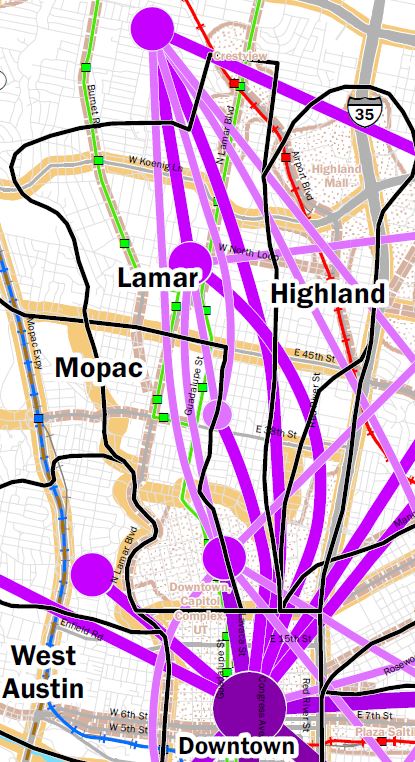
North Lamar traffic (several blocks north of the Triangle). Guadalupe-Lamar travel corridor carries heaviest traffic flow of any local Central Austin arterial, serves residential concentration ranking among highest density in Texas, serves 31% of all Austin jobs — yet corridor was "dismembered" by Project Connect and excluded from "Central Corridor" study! Photo: L. Henry.

North Lamar traffic (several blocks north of the Triangle). Guadalupe-Lamar travel corridor carries heaviest traffic flow of any local Central Austin arterial, serves residential concentration ranking among highest density in Texas, serves 31% of all Austin jobs — yet corridor was “dismembered” by Project Connect and excluded from “Central Corridor” study! Photo: L. Henry.

By Dave Dobbs

The following post has been slightly adapted and edited from a letter posted by the author to members of the Central Corridor Advisory Group (CCAG) on December 6th. Later that day, CCAG voted 14-1 to endorse Project Connect’s official “ERC-Highland” recommendation.

Dear CCAG members,

Eighteen months ago The Texas Association for Public Transportation (TAPT) offered a comprehensive urban rail plan to the Transit Working Group and to CAMPO that largely fulfilled most of the goals public officials said they wanted from a phase one project.  During the last two years of TWG meetings, it became clear that phase one urban rail would need to meet a constrained budget between $275 and $400 million locally that aimed at a 50% federal match for a total project cost of $800 million or less that included Mueller.

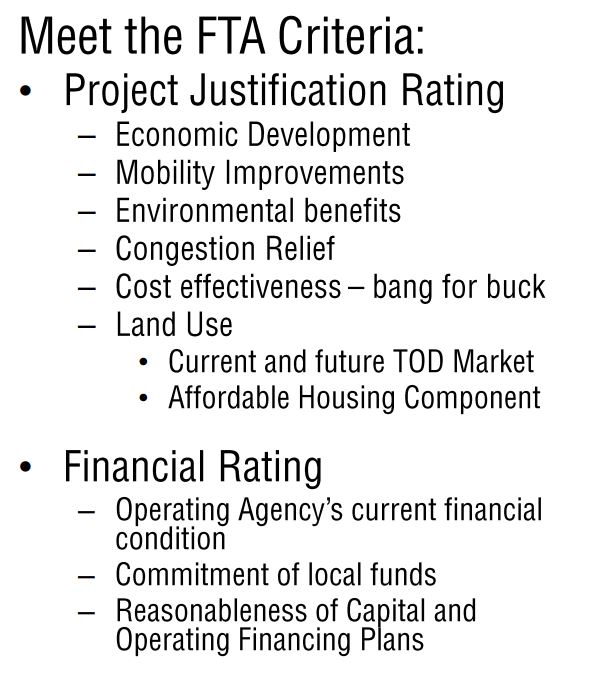
The most important elements to reach that goal are summarized on page 42 of the Urban Land Institute’s Daniel Rose Fellowship presentation made at Austin City Hall, Friday February 22, 2011.

Excerpt from ULI  presentation.

Excerpt from ULI presentation.

Rather than take a presumptive speculative sketch-planning approach to what might be 17 years from now, somehow somewhere in the city, TAPT’s plan relied on reality, decades and tens of millions of dollars of past rail planning that culminated in the comprehensive detailed 18-month long Federal Transit Administration (FTA) sanctioned and funded 2000 Preliminary Engineering/Environmental Impact Study (PE/EIS) that forecast 37,400 riders on the Guadalupe-Lamar corridor in the year 2025.

Compare that number to Project Connect’s year 2030 forecast of 2.9 million daily [transit] riders in the East Riverside Corridor (ERC).  This is more daily [transit] riders than [in] any US city except New York.  Even the low 2030 ERC forecast of 492,682 riders daily is 17% more daily riders than San Francisco’s 104-mile BART heavy rail system, one of the best rail systems in America.

As Mr. Keahey explained at last Wednesday’s [Dec. 4th] Alliance for Public Transportation meeting, a PE/EIS goes way beyond and is far more detailed than the kind of planning his team is currently engaged in, and as a transit [professional], I concur completely.

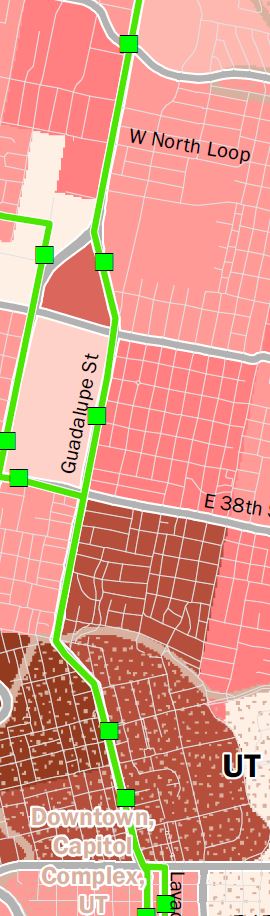
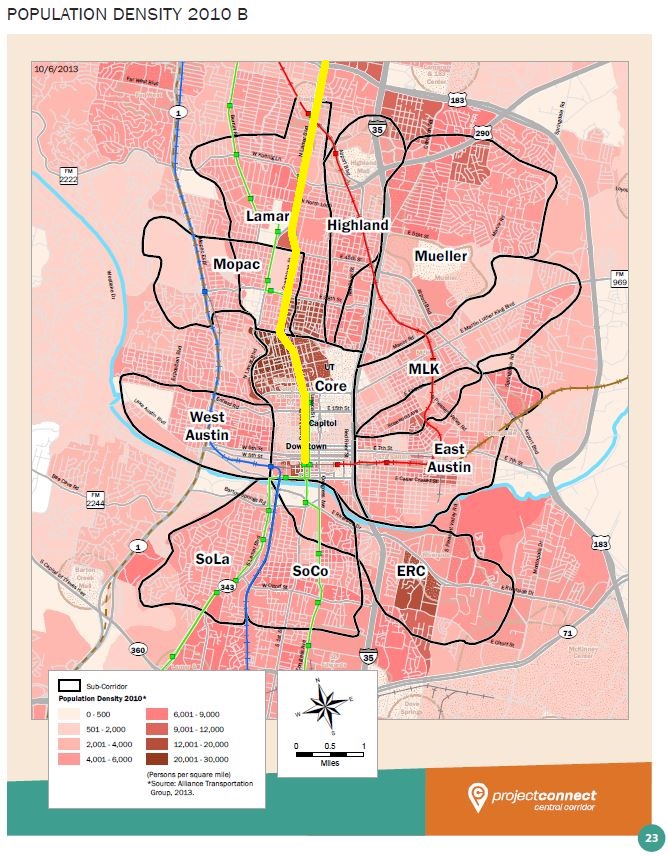
2_ARN_aus-urb-map-pop-density-G-L-corridor_ProCon-Mapbookv5

Excerpt from infographic in Project Connect’s Map Book v. 5. Data presented shows Austin’s highest population density clustered around West Campus-Guadalupe-Lamar corridor — but this travel corridor was omitted from Project Connect’s study! Green line on Lamar-Guadalupe represents MetroRapid bus route 801, green squares represent MetroRapid stations. In upper left of map, note that MetroRapid route 803 (primarily serving Burnet Rd. corridor) joins Guadalupe at E. 38th St. and shares route with #801 into core area.

The 2000 PE/EIS recognized that most of Austin’s growth has been North and Northwest and that’s likely to continue well into the future because that is where we’ve made most of the regional infrastructure and transportation investments for decades; e.g., IH-35, Loop 1, US 183, US 183A, SH45, etc.  For a host of reasons, future growth will almost surely be more clustered, more village-like with less single-family dwellings on detached lots and it will be located with access to frequent high capacity transit if (and only if) we provide for it.

When I moved here in 1969 the population of Leander was about 300 people, while today it is over 30,000.  Cedar Park, same story. In 1970 it had a population of 125; today Cedar Park is 58,000 plus.  These twin towns combined are only 17% smaller than Round Rock (107,000) and have been growing many times faster.  Bus ridership and MetroRail ridership reflect this reality, and if we want the most “bang for the buck”, we will put our first phase urban rail where the greatest employment is, where the congestion is, and where the people are, and are constrained to use alternatives because, in that corridor, urban rail is a more competitive choice than their automobile.  As former Capital Metro board chairman Lee Walker put it when he led the 2000 rail referendum, “We’ve got a meltdown in the core and we’ve got to fix it.”

Though we lost that election by a half percent, the situation hasn’t changed.  We still have a highly constricted, congested core fed by three main north/south arteries, only one of which is practical and affordable to meaningfully [expand] within the likely funds we can muster at this point in time.  And its name is not “Highland”, it’s North Lamar.  (Highland is a neighborhood bounded by North Lamar, US183, IH35 and Denson Drive and it has endorsed rail on Guadalupe/Lamar.)  Even “sliced and diced”, Project Connect’s own mapbook data shows that Guadalupe/Lamar is the highest density travel corridor in Austin.  Reconnecting America’s Jeff Wood, former Austinite with a UT Master’s degree on Austin’s rail history and leading authority on urban rail impacts says, “Rail line(s) extend existing market gravities, but do not create new ones … development corresponds with proximity to major employment. Ultimately, what matters is proximity to employment as to whether denser transit oriented development will happen. The major employment is along Guadalupe Lamar.”  Wood bases his remarks on “Rails to Real Estate Development Patterns along Three New Transit Lines”.

So Guadalupe-Lamar is the bird in our hand, so why strangle it hoping for two birds in the bush 17 years in the future?  Why are we squandering our best asset based on fantasy data derived by misusing a growth model from Portland, a city with the strongest land-use laws in the country?  Reinforcing what we have with a well-designed cost-effective “most bang for the buck” first phase rail line is the only way to provide the driving synergism necessary to build future support for extensions.  As Moody’s recent SH130 credit downgrade so dramatically illustrates, just because you build it doesn’t mean they will come.

And, please, let’s dispense with the fiction that MetroRapid is a substitute for rail, because, in fact. it’s just a nicer bigger bright red replacement for bus 101; no faster unless we tear up the street and install expensive dedicated concrete bus lanes, which is, in fact, the proposed plan, but the Project Connect team doesn’t talk about that unless they are specifically asked. (See “No urban rail on Guadalupe-Lamar? Then get ready for bus lanes…”)

Which brings me back to where I started. Why have those in charge of the process never given TAPT’s urban rail loop plan the same hearing opportunity before decision-makers that, say, Gateway Planning received in the spring of 2012 before the TWG?  We, after all, are the oldest urban rail stakeholders in the city, a Texas non-profit corporation, dedicated to promoting public transit and rail transit since 1973, drafting Austin’s first rail proposals in the early seventies, instrumental in the creation of Capital Metro in the 1980’s, playing a major role in formulating CMTA’s original service plan and whose leaders are widely recognized and known in the rail transit industry.  Lyndon is a former data analyst and planner with Capital Metro and served 4 years as a board member in the early 1990’s.  He was the first person (in 1975) to recognize the value and promote acquisition of the current MetroRail line from Southern Pacific in the mid 1980’s.

Both Lyndon and I have served on the APTA Streetcar Subcommittee for the last seven years and we have spent countless hours researching, riding, evaluating, photographing and writing about and promoting rail transit here and abroad for last 35-40 years.  Our transit professional list-serve is a constant daily source of transportation information from around the world and we know from traffic analysis that our website, www.lightrailnow.org, is heavily used by transit professionals and advocates and is highly regarded for the accuracy of its content, approximately ten thousand pages in size.

So why has this valuable free local resource been neglected for so long by those in charge of the process?  Perhaps the attached image from ROMA’s downtown planning circa 2008 says it all.  Note that Austin’s proposed (Project Connect) urban rail plan, despite hundreds of thousands of dollars spent since then, has not changed significantly at all.  It’s still Downtown to Mueller past DKR Memorial Stadium and an East Riverside Corridor line. Amazing!  But please note the Mueller-only line is now called “Highland.”

Original urban rail "circulator" system in 2008 map of ROMA consulting team plan, contracted by City of Austin.

Original urban rail “circulator” system in 2008 map of ROMA consulting team plan, contracted by City of Austin.

Attached, is TAPT’s urban rail loop plan in a one-page pdf that you may have seen in a simpler format on our Austin Rail Now blog.  Just like the City’s plan above (Project Connect) our plan was peer-reviewed by transit professionals, people who have actually worked here in Austin on light rail projects in the past.

TAPT proposes "loop" line, with routes on both Guadalupe-Lamar and eastide through converting the MetroRail line to electric light rail — plus a spur to Mueller.

TAPT proposes “loop” line, with routes on both Guadalupe-Lamar and eastside through converting the MetroRail line to electric light rail — plus a spur to Mueller.

Thank you for your service to the community.

Sincerely,

Dave Dobbs

Executive Director, TAPT
Publisher,  LightRailNow!
Texas Association for Public Transportation

h1

Will Project Connect continue to gag the public?

20 December 2013

0_ARN_gagged-woman_aclu

In response to community prodding, going into the recent “high-capacity transit” study process, Project Connect representatives gave seemingly earnest assurances of much greater “transparency” and “openness” in their “study” process. Instead, the Project connect team made their closed-door activities more opaque and insulated from community interaction than ever. See: From community participation then … to community exclusion today

Instead of public participation, it’s been more like public prohibition — exclusion of the community at large from any real role in the process, with Project Connect instead delivering decisions as faits accomplis for public acquiescence rather than an authentic process of involving community members in a bona fide process of actually studying, analyzing, evaluating, and participating in decisions.

To present a semblance of “public input”, Project Connect has staged “open houses” (where individuals are allowed to view posters, maps, and other presentations of official decisions) and so-called “workshops” (where small groups clustered at tables are asked to approve predetermined choices via electronic “clickers”). Authentic community meetings, with discussions and comments from the public in a large-group setting, have been avoided like the threat of an infectious disease.

See:

Meetings, “open houses”, workshops … and democratic process

Back to “art galleries”! Project Connect reneges on community meetings

Issues of process and organizational structure can be terribly boring. But Project Connect’s efforts to eliminate or gag bona fide community participation have undoubtedly performed a major role in allowing key insiders to rig the “high-capacity transit” study process, skewing the results and allowing officials to endorse the same basic route structure they wanted in the first place. Supporters of the Central Austin “backbone” corridor (West Campus-Guadalupe-Lamar) have been outraged by the blatant corruption of a purported “study” and its procedures.

See:

Surprise! Mayor and Project Connect select same routes they wanted in the first place

Gaudy mendacious suckfish

City Council to Central Austin: Drop Dead

TILT! Project Connect’s gerrymandering and data fiddling ignite public skepticism, pushback

Welcome to Project Dis-connect!

Lying with Maps

And, unless there’s effective community intervention to change the game, the same kind of thing could happen all over again in this upcoming “Phase 2” of the “study” (which seems more an exercise in adroitly skewing and manipulating the playing field than an actual study).

Some community activists are hopeful that the so-called “Riley amendment” — a provision successfully added to the City Council’s recent endorsement of Project Connect’s “ERC-Highland” route plan — may offer an opportunity to keep the West Campus-Guadalupe-Lamar “backbone” corridor issue alive within the current Project Connect process. Dan Keshet has posted the full text of the amendment on his Austin on Your Feet blog.

While Councilmember Riley probably intended the amendment as a kind of “sweetener” in hopes of wooing some Central Austinites into (perhaps begrudgingly) supporting the Project Connect plan, it is possible to construe it as opening a small crack in the door to possibly more major changes to the plan:

The City Manager is directed to work with Project Connect to identify future funding needs and potential sources to prioritize and continue critical Central Corridor project definition and development activities in the remaining identified sub-corridors, including the Lamar, Mueller, and East Austin sub-corridors, and report back to Council by August 1, 2014.

Further, reads the amendment, “The City Manager is directed to work with Project Connect and CMTA to continue cultivating a relationship with our regional Federal Transit Administration officials to cooperatively prepare for any future high-capacity transit investments in the Lamar sub-corridor.”

While the Riley amendment may indeed be viewed as a small compromise possibly helpful to the momentum to re-focus urban rail planning on the crucial West Campus-Guadalupe-Lamar “backbone” corridor, opening the tiny crack presented by that opportunity within Project Connect’s highly rigged process will remain dauntingly difficult, especially as long as Project Connect continues to insulate itself from real community engagement, managing and muzzling community input in a caricature of authentic “public participation”.

So back to “process”: Free, open, unconstrained community meetings are essential. There needs to be a groundswell of community pushback against the gagging. Project Connect needs to open up the community input process to full and free discussion, and the Austin community needs ongoing opportunities to be heard.

And that doesn’t mean just handing out clickers.

h1

Bus paveways on Guadalupe-Lamar — Project Connect’s “elephant in the room”

17 December 2013
MetroRapid bus, southbound on N. Lamar, nears Koenig Lane during testing on Dec. 10th. By dumping urban rail for this corridor, Project Connect would be free to proceed with plan to install specially paved bus lanes instead of rails. Photo: L. Henry.

MetroRapid bus, southbound on N. Lamar, nears Koenig Lane during testing on Dec. 10th. By dumping urban rail for this corridor, Project Connect would be free to proceed with plan to install specially paved bus lanes instead of rails. Photo: L. Henry.

By Dave Dobbs

The Elephant in the Room within the Project Connect (COA) urban rail plan (first to Mueller via East Campus, etc. and then out the East Riverside Corridor) is the official proposal to build 40% to 50% dedicated bus lanes, roughly 15-18 miles, within the 37-mile MetroRapid system. This $500 million expenditure appears as a near-term (within 10 years) investment, 80% of which would come from the Federal Transit Administration. Lyndon Henry and I have documented this and explained how it might work in an October 18th article entitled No urban rail on Guadalupe-Lamar? Then get ready for bus lanes….

When I spoke with Project Connect’s Scott Gross about the nature of this a few weeks ago, he said that the dedicated bus lane plan was one that included both right-of-way acquisition and exclusive bus lanes. The math here says that these lanes would be far more extensive than paint-on-paving such as we are about to see on Guadalupe and Lavaca between MLK and Cesar Chavez, 1.4 miles at a cost of $370,000.

Here’s the math …

$500,000,000 ÷ 18 miles = $27.8 million ÷ 2 lanes = $13.9 million per lane-mile

This figure points to a heavy-duty reinforced concrete bus lane in each direction, 18 inches thick, similar to the bus pads at bus stops we see along major bus routes. This would require tearing up the street as severely as a light rail installation would, with all the other utility improvements therein that might be accomplished at the same time.

While my cost-per-lane mile is a simple mathematical one, the result is consistent with what Ben Wear reports for building SH-130, 90 miles from Georgetown to Sequin, for $2.9 billion, or about $8 million a lane-mile. Construction costs in the middle of a very congested street, e.g., South Congress or North Lamar, would be significantly higher than a highway over farmland. That and ROW acquisition costs could easily account for $5.9 million dollars of difference.

These bus lanes, planned in the next decade, would definitely be an obstacle to further FTA investment for 20 to 30 years wherever they are installed. The question we ought to be asking is: What kind of “high capacity transit” do we want on our heaviest-traveled streets?

h1

What’s with Project Connect’s “2.9 million daily ridership” projection?

16 December 2013

0_ARN_Alice-through-the-looking-glass-2

By far, perhaps the most controversial and eyebrow-raising element of Project Connect’s self-styled “study” to select a route for “high-capacity transit” has been the heavy use of projections. Crucial data inputs involved projections of population, employment, economic activity, travel, and congestion, mostly for the year 2030, 17 years into the future.

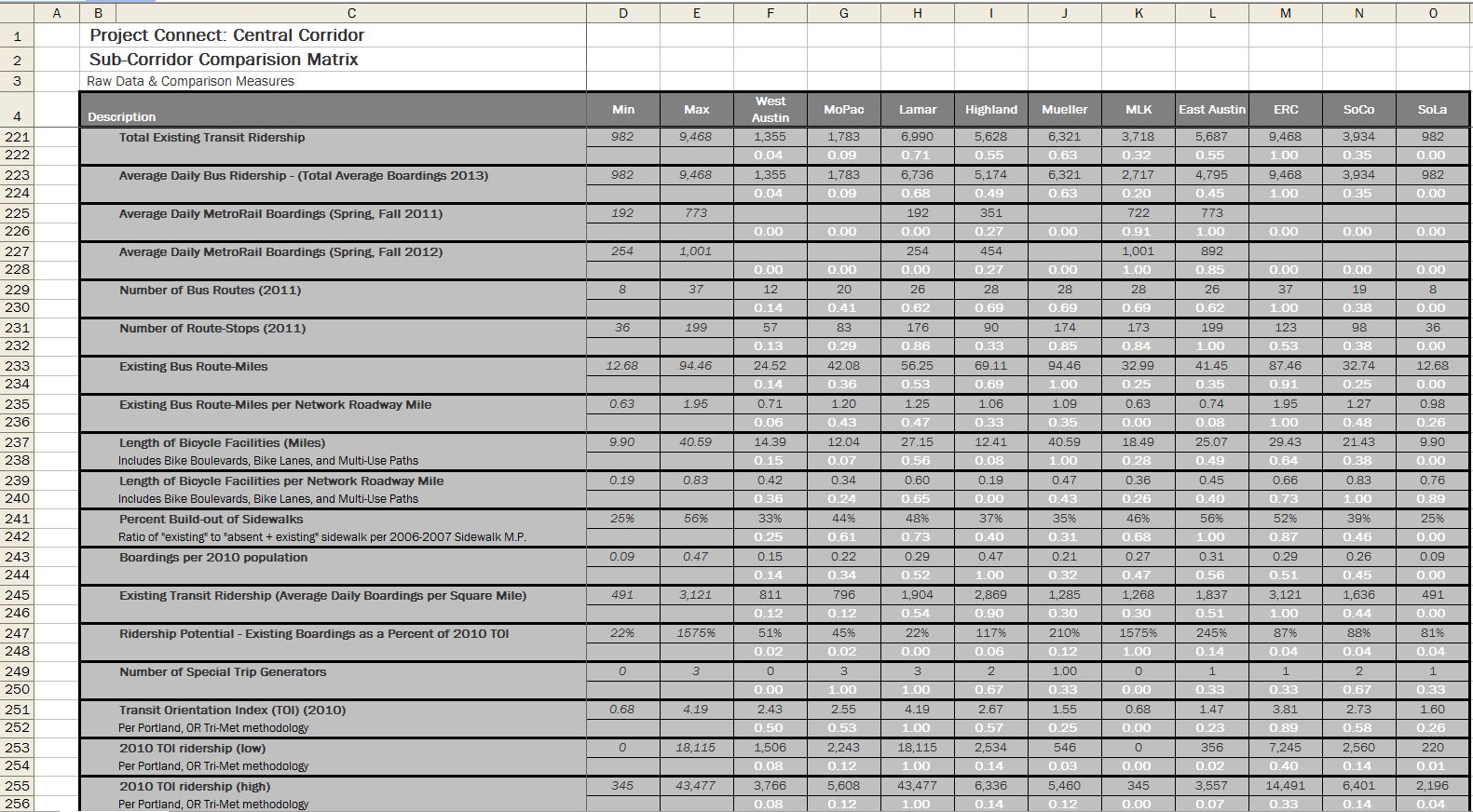
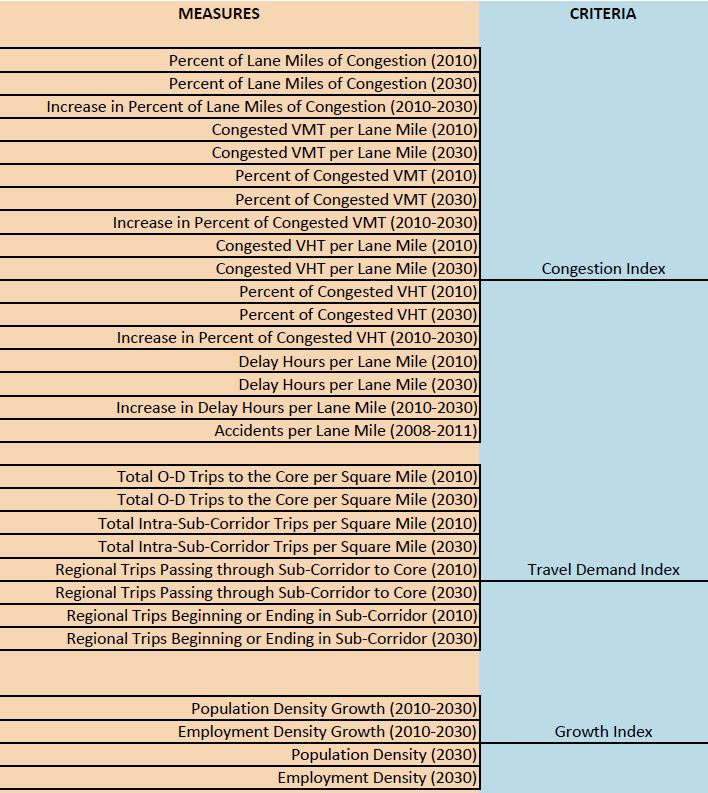
All of these, plus some current data, appear in a large Excel-based “Sub-Corridor Comparison Matrix” which forms the basic data foundation for justifying Project Connect’s route (“sub-corridor”) decision — the “Highland” and “ERC” sectors — which, amazingly, happen to be almost exactly the very route profile local officials wanted in the first place. (See: Surprise! Mayor and Project Connect select same routes they wanted in the first place.)

As Dan Keshet, a local software developer and research analyst, has shown, Project Connect’s own evaluation calculations have relied overwhelmingly on these questionable projections of key mobility-related factors rather than current factual data. (See, e.g., A first glance at Project Connect data.)

Similarly, Julio Gonzalez Altamirano, an Austin management consultant, has conducted his own analysis of Project Connect’s selection of the “Highland” sector (“sub-corridor”):

Highland Score

On the basis of his quite comprehensive analysis, Julio concludes that “it is clear that Highland’s score is the result of speculative assumptions about the nature of development in the sub-corridor.” His explanation seems to imply that, because planners would like to see certain types of development in certain areas, they just go ahead, assume it will happen, and voila! these become the projected inputs in the “evaluation” matrix.

Julio summarizes some of the key problems with Project Connect’s “projections” this way:

The bottom-line is that the methodology awards points to larger parcels that are relatively undeveloped and (seemingly?) car-dependent based on an optimistic outlook on future land-use variances being granted. It is not a prediction of how parcels will behave in the future given what similarly-zoned parcels have done in the past. It is not a sophisticated statistical model of what is likely to be that uses historical data to forecast. Instead, it is scoring based on where the methodology-designers would like development to go that uses a proven statistical technique to classify the parcels into different bins based on parcel attributes. The methodology has not been validated, so we don’t know if it actually predicts anything.

The public reasoning presented to CCAG by the PC team for Highland’s score is ‘significant future development’. Obviously, projects such as the ACC Highland Mall redevelopment and Austin’s evolving medical scene will have an impact on employment and residential density in the sub-corridor. But it also appears that the methodology selected assigns significant points to the type of parcels available in the sub-corridor. Needless, to say, the presence of certain types of parcels we’d like to see developed in a sub-corridor does not mean development will happen. Worse, it doesn’t mean they exist in a contiguous stretch that make sense for a transit route.

Another way of saying this is that Project Connect’s planners have converted their own wishful thinking into actual data inputs, that are then deployed to make their evaluation. Wishes are used to try to make the wishes come true.

In an effort to deflect criticism, Project Connect and some of its backers have mounted a “straw man” defense, trying to portray critics as absurdly renouncing the role of projections in planning major projects. But there’s a vast distinction between developing conservative, reliable, and plausible forecasts, and producing exaggerated, fantasy-like projections, as Project Connect has done, heavily skewed toward certain geographical areas.

The question of projections has been an extremely contentious issue in Project Connect’s urban rail “study”. For many critics, the agency’s “projections” have represented de facto fantasies about what they would like to see, rather than the solidly reliable output of competent predictive analytics.

So, where do the “2.9 million daily trips in East Riverside” come in? This is the result of plugging Project Connect’s demographic and economic projections for 2030 into their own transit ridership prediction model.

Apparently in an attempt at a gesture toward some kind of prediction of future transit ridership, one of the metrics Project Connect decided to use in their Comparison Matrix is a “Transit Orientation Index” (TOI), a ridership demand assessment model developed in 1997 by consultants for Portland, Oregon’s TriMet transit agency. To explain their use of the Transit Orientation Index (TOI), Project Connect has posted some documentary material:

http://www.projectconnect.com/connect/sites/default/files/TRIMET_PTN_STUDY_1997_TOI.pdf

The TOI model evidently was developed in conjunction with travel demand planning in Portland for the target year of 2015. The documentation describes its intent as “an effort to quantify the dependence of transit demand on land use variables …. The purpose is to develop a means of assessing transit demand for transportation zones in 2015, based on land use projections.”

The documentation also makes clear that the ultimate objective is to render a prediction of daily transit trips: “For the purposes of this assessment, the transit demand in a Regional Transportation Zone (RTZ) is represented by weekday transit trip productions per acre….”

According to the documentation, the TOI metric is envisioned to assess transit ridership demand at the level of a small analysis zone (Regional Transportation Zone), apparently a travel analysis zone (TAZ, described in the ARN posting Project Connect’s “corridor” study — without corridors!) Project Connect planners, however, have applied the model to considerably larger sectors covering several square miles with hundreds and even thousands of acres.

Whether it’s a small zone or a much larger area such as one of Project Connect’s study sectors (“sub-corridors”), the ultimate output of the model is (1) a “Transit Orientation” index (TOI) which, applied to the acreage in the zone for which it’s calculated, renders (2) both a low-end and high-end ridership prediction. Simply put, the TOI is calculated from three basic inputs:

• Household density (households per acre)
• Retail employment density (retail employment/acre)
• Total employment density (total employment/acre)

These are related in a formula, with various coefficients, analytical relationships, etc., developed by the Portland researchers, to calculate the TOI, which is then intended to predict daily transit trips for zones or sectors (based on trips per acre). Incidentally, it’s worth noting that the TOI was designed to predict ridership potential for an entire urban network, not to evaluate discrete corridors or disparate areas of a city in a competition for a major transit investment.

For Austin’s near-current (2010) data, the TOI model yields ridership levels that seem fairly plausible and reasonably close to actual experience. But when Project Connect’s own long-term future projections (i.e., fantasies) are plugged in — into its own model — the resulting daily transit ridership predictions (for both the “low” and “high” ends of the prediction range) are nothing short of jaw-dropping.

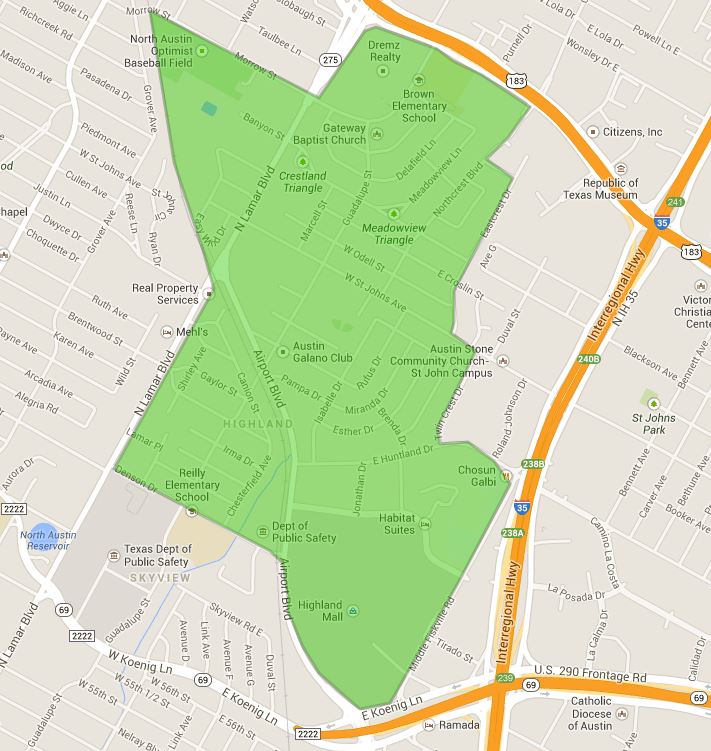
Much of the controversy has focused on the ridership predictions for the two sectors chosen by Project Connect (and embraced by both its “Central Corridor Advisory Group”, CCAG, and, most recently, the Austin City Council) — “ERC” (associated loosely with the East Riverside Drive travel corridor) and “Highland” (a heavily gerrymandered sector nestled next to I-35 north of the UT campus, then ballooning at its north end to encompass the Highland ACC site).

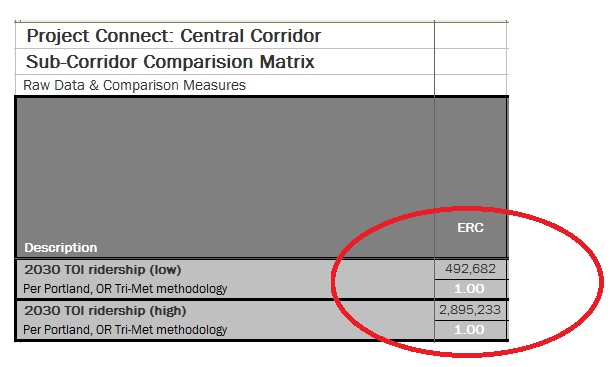
The “ERC” ridership predictions for 2030 have been targets of especial ridicule. These are shown in the snippet below from the Project Connect “evaluation” matrix.

Snippet from Project Connect's "evaluation" matrix shows implausibly high year-2030 daily ridership projections, both low and high, for the "ERC" sector.

Snippet from Project Connect’s “evaluation” matrix shows implausibly high year-2030 daily ridership projections, both low and high, for the “ERC” sector.

The high-end daily ridership prediction of 2.9 million, it’s been pointed out, roughly equals the combined daily transit system ridership of the cities of Chicago and Philadelphia.

However, Project Connect’s planners called Foul on this figure. For the top TOI index achieved by this sector, they point out that the TOI model yields an “infinite” multiplier to calculate the high-end ridership prediction. So Project Connect, with an index result predicting “infinitely” high ridership, decided to bring it down somewhat closer to Planet Earth’s reality by substituting an upper-bound value of 999 as the acreage multiplier to calculate ridership … and produced the “2.9 million” figure.

However, the low-end figure — daily ridership of 492,682 (493K) — is equally preposterous, exceeding the total system daily ridership of entire large cities. For example:

• Portland, 332K
• Seattle, 476K
• Denver, 324K
• Atlanta, 453K

Remember — 493K is the low-end predicted ridership for one single small segment of the Austin area. Currently, Capital Metro’s daily ridership for the entire service area is about 120K.

For the “Highland” sector, the TOI model results for 2030 are similarly off the scale. Whereas current 2013 ridership is about 5K (5100/day), the “low” TOI prediction for 2030 is about 127K — an increase of 2,440%. The “high” prediction (no need for upper-bound substitution in this case) is 279K — a predicted increase of 5,480%.

Put another way, to meet the lower-end ridership suggested by the demographic and economic projections, average daily ridership in the “Highland” sector would have to exhibit sustained average daily ridership growth of about 7,200 each year for 17 years.

To most reasonable analysts concerned with the accuracy of their forecasts, such wildly implausible predictions would surely prompt a re-evaluation of the basic data inputs — i.e., the projections. But not Project Connect’s planners, who have simply hunkered down and circled the wagons around the inviolability of their projection methodology.

Project Connect personnel, and at least one City Councilman, have attempted to disparage this criticism by noting that the actual ridership predictions have not been used as a metric in Project Connect’s “evaluation” matrix.

But that sidesteps the main issue! First, Project Connect’s matrix does use the TOI, itself based on the same dubious projection inputs, to render a metric score to bolster their preferred sectors (“sub-corridors”) in the competition they’ve set up. For the 2030 metric it gives a score of 1.00 to the “ERC” sector, and 0.65 to “Lamar”, in a points system where every hundredth of a point does count.

But, even more importantly, the TOI for 2030, dependent as it is upon Project Connect’s “projections” (de facto fantasies), exposes their absurdity. No wonder Project Connect and its entourage don’t want these used … no wonder they attempt to distance themselves from them!

It’s very simple — plug Project Connect’s own projections into this otherwise fairly realistic model, and you get bizarrely, unbelievably exaggerated results. Maybe a hint that the original projections are bizarrely unbelievable?

In effect, the TOI is performing here somewhat like a “canary in the coalmine” — telling Project Connect, and all of us, that something is terribly wrong with their demographic and economic projections for 2030.

Obviously, it’s a message that Project Connect, and a certain segment of Austin’s civic leadership, don’t want to hear.

h1

City Council to Central Austin: Drop Dead

16 December 2013
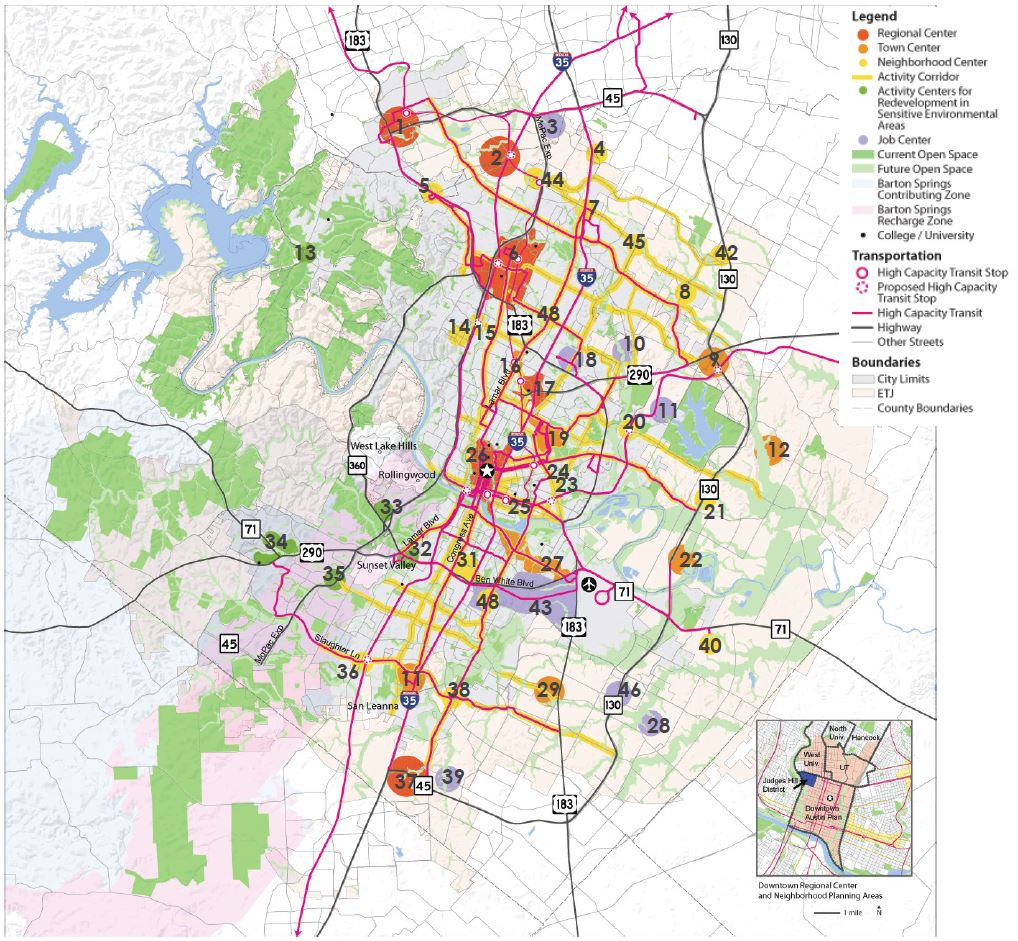
Growth Concept Centers and Corridors Map from COA's Imagine Austin plan. Numbers indicate proposed "centers", increasing in assumed importance as color becomes redder. Note orientation toward major freeways and highways, and trend to promote development to east of central city.

Growth Concept Centers and Corridors Map from COA’s Imagine Austin plan. Numbers indicate proposed “centers”, increasing in assumed importance as color becomes redder. Note orientation toward major freeways and highways, and trend to promote development to east of central city. (Click to enlarge.)

With its 7-0 unanimous vote on December 12th, endorsing Project Connect’s deeply flawed plan for an initial urban rail line, the Austin City Council made it clear it wasn’t just abandoning good sense and a reliance on sound, fact-based planning — unfortunately, the Council vote continued a pattern of recent policies by the City of Austin (COA) aimed at abandoning Central Austin itself and the core neighborhoods in the heart of the city, concentrating instead on predominantly promoting peripheral areas mostly to the east. In effect, the Council’s action was a vote that said to Central Austin: Drop Dead.

This pattern appears to reveal a major switch from past policies, which have aimed at strengthening the central core city and addressing mobility problems in the city’s major local traffic arteries, Guadalupe St. and Lamar Blvd. For example, urban rail plans in both 1993 and 2000 focused on this corridor, and Guadalupe-Lamar-South Congress was a major focus of the “rapid bus” plan (now MetroRapid).

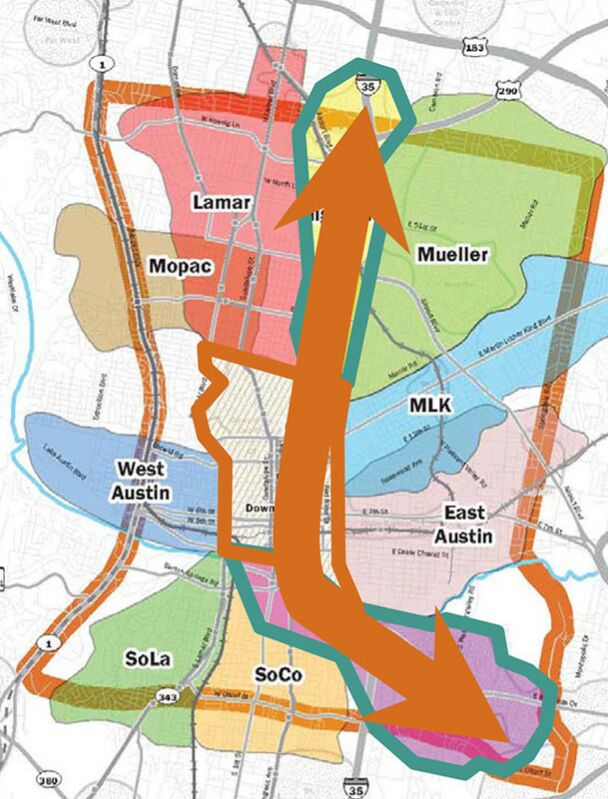
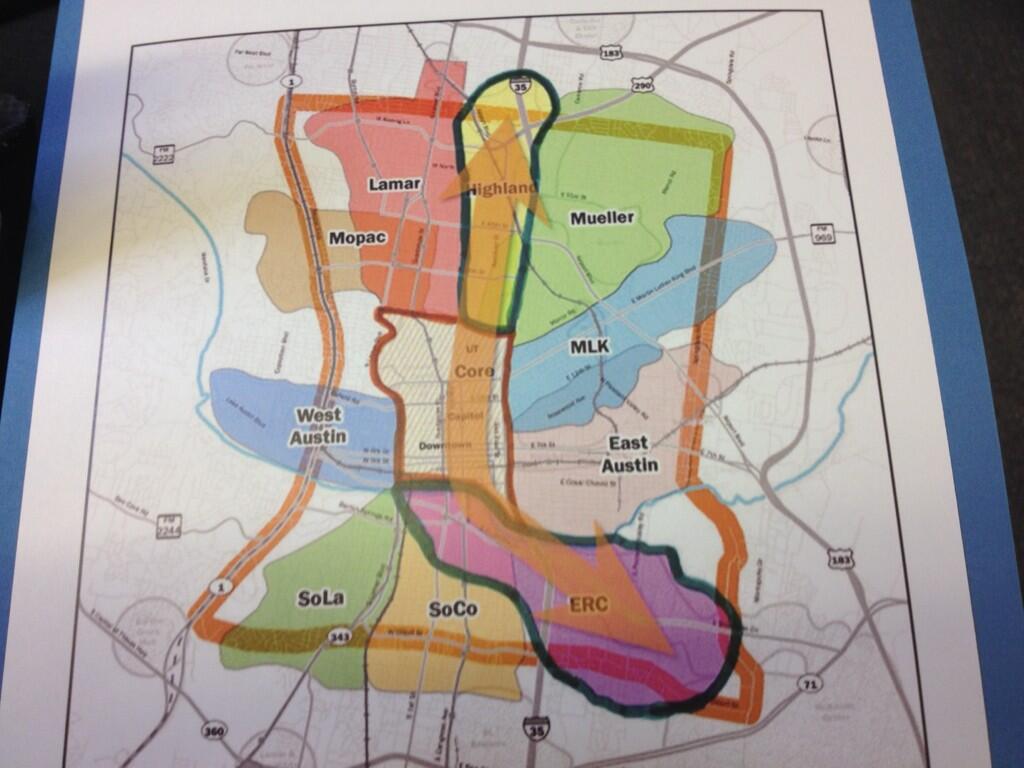
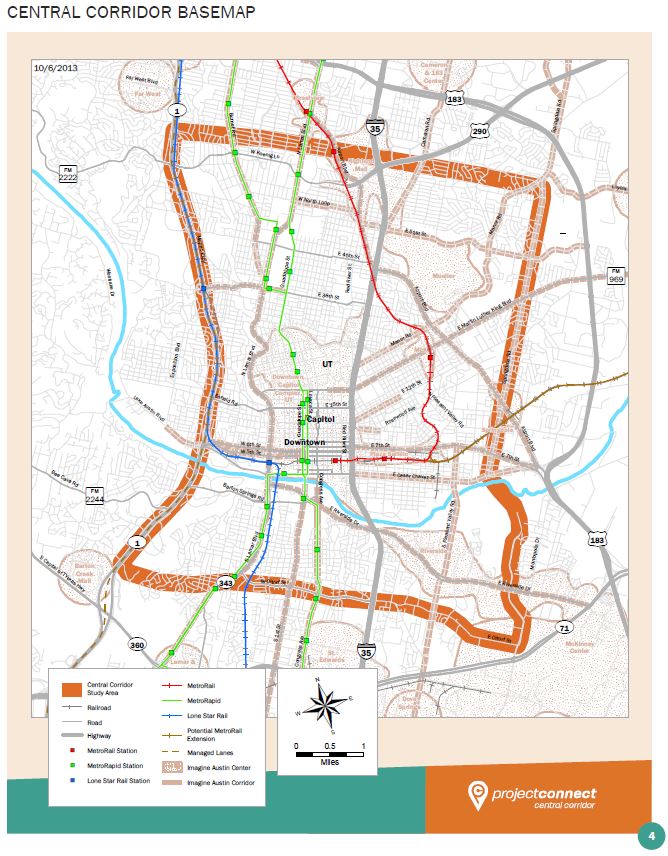
Project Connect's proposed urban rail route profile forms a crescent emphasizing more eastern sectors of city and avoiding heart of central city along West Campus-Guadalupe-Lamar corridor. Note how "Central Corridor" study area is skewed well to east of core area, encompassing large tracts of developable real estate.

Project Connect’s proposed urban rail route profile forms a crescent emphasizing more eastern sectors of city and avoiding heart of central city along West Campus-Guadalupe-Lamar corridor. Note how “Central Corridor” study area is skewed well to east of core area, encompassing large tracts of developable real estate.

This switch in policy is borne out not just by the Council’s Dec. 12th vote, and not just by the efforts of Project Connect and its supporters to depict Central Austin and its “backbone” travel corridor (West Campus-Guadalupe-Lamar) as more or less “withering away” demographically and economically (in complete disregard for the factual evidence). The pattern of neglecting the central heart of the city has become increasingly clear from COA’s preferential policy emphasis — expressed through tax incentives, infrastructure investment, long-range planning, and special projects focused exclusively on encouraging development in peripheral areas such as Mueller and East Riverside.

While the core area itself (downtown, Capitol Complex, UT campus) has been the focus of densification and new public development initiatives (e.g., Seaholm, Waller Creek project, proposed UT medical teaching facility), most of the city’s established core neighborhoods, both north and south of the core area, have been virtually written off in recent years.

This is well illustrated by the Imagine Austin Comprehensive Plan, adopted by the City Council in June 2012. The pattern is particularly evident in the Growth Concept Centers and Corridors Map, Appendix D, pp. A-29 through A-31, shown in the graphic below. (The relative impact of “centers” proposed in the Imagine Austin plan was an important metric in Project Connect’s carefully rigged “evaluation” matrix.)

COA's Imagine Austin Growth Concept Centers and Corridors Map, with legend.

COA’s Imagine Austin Growth Concept Centers and Corridors Map, with legend. (Click to enlarge.)

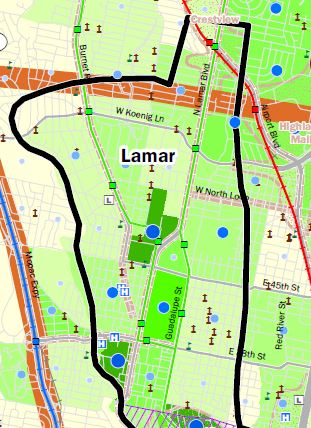
Each proposed center is identified in the main document (linked above) by a number, with red indicating major “regional” centers, orange indicating “town” centers, and yellow demarcating “neighborhood” centers. It can be seen that, outside the core area itself (a “regional” center), and the former Highland Mall area (now a major ACC site), most of the central inner city, following the traditional linear growth pattern along Guadalupe-Lamar and South Congress-Manchaca Rd., is comparatively very lightly targeted for “centers” development — there’s just one small “town” center at the Crestview MetroRail station, and a “neighborhood” center in the vicinity of St. Edward’s University (South Austin).

Despite the lofty rhetoric by COA officials promising to “bolster the city’s core” and so on, the really large-scale, influential pattern revealed in this “wish list” map is to emphasize outlying development, mainly associated with major freeways or highways (e.g., U.S. 183, I-35, U.S. 290), and peripheral development areas such as East Riverside and the “close-in suburb” of Mueller. There’s also a decidedly eastward skew to this plan, with major “centers” planned as far as SH 130 and even east of it.

The Imagine Austin plan in fact has a “suburbanization” emphasis uncomfortably reminiscent of the suburbanization policies of both federal and local governments following World War 2 which encouraged the sprawling, private-motor-vehicle-dependent form of development that is yielding such toxic fruit today. In fact, the COA itself, in a document discussing major demographic trends, warns of the threat of “Intensifying urban sprawl”:

The Austin region will continue to experience intense urban sprawl …. Although there is an enormous amount of residential development currently underway within the urban core and in downtown Austin, the thousands of new units being created there will be only a drop in the regional bucket of total residential units created. There simply are very few land availability constraints in the territory surrounding Austin.

And yet this is not to say that the positive effects of new urbanism and Smart Growth policies won’t be felt inside the city, it is rather to say that even with the success of the many enlightened urbanizing efforts currently afoot in Austin, urban sprawl and its footprint will have an enduring presence in central Texas.

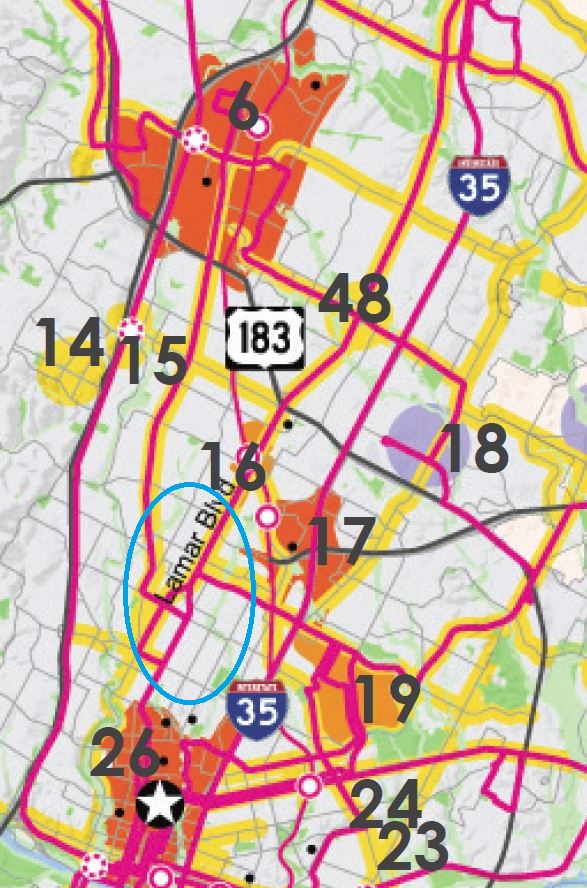
This abandonment of the central city and its core neighborhoods is evident in the map segment below, zoomed-in from the larger map. For these core neighborhoods and commercial areas north of the core area — particularly the area circled in blue — there are no “centers” in COA’s vision — despite major activities and opportunities in areas such as Guadalupe-38th St.-Lamar (Central Market, medical facilities), the Triangle (multi-use development), and Koenig at Lamar (major opportunity of for redevelopment as a major center). Similar sites further north (e.g., North Lamar Transit Center area) and south (SoCo area, Manchaca/Stassney, etc.) are also ignored.

Central inner city and established neighborhoods immediately north of core area. Circled area indicates absence of planned "centers", despite abundant opportunities.

Central inner city and established neighborhoods immediately north of core area. Circled area indicates absence of planned “centers”, despite abundant opportunities. (Click to enlarge.)

Central Austin’s core neighborhoods and commercial areas should take heed. Project Connect’s willingness to scrap the future of these crucial areas, and its plan for urban rail to bypass the central city and its established neighborhoods in preference for stimulating outlying development, should cause major concern to Austinites as a whole. Far from confined to Project Connect, it’s apparently merely the latest move in an insidious emerging policy by the COA administration itself.

h1

Memo to CCAG: “Pause” study or include “Lamar” sector

5 December 2013

0_ARN_Pause Button

By Lyndon Henry

This Email was sent on December 5th to members of the Central Corridor Advisory Group (CCAG). While the memo indicates an assumption that Citizens Communications would be allowed at the end of the CCAG meeting, the posted agenda, in a departure from past practice, now indicates that Citizens Communications will take place in the middle of the meeting, prior to “Discussion & Action”.

To Members of the Central Corridor Advisory Group:

I am writing to urge you either to hold off voting on a recommendation on the Phase 1 urban rail project, or to recommend including the “Lamar” sector (“sub-corridor”) for further evaluation in the next phase of Project Connect’s study.

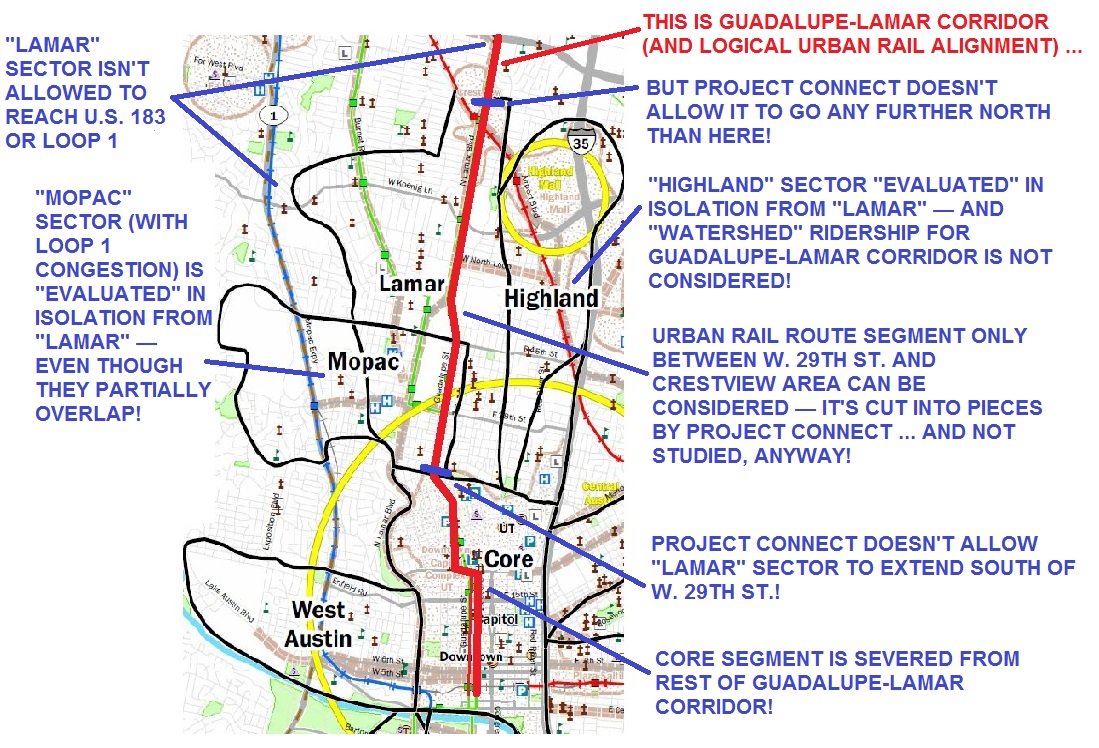
"Lamar" sector ("sub-corridor") includes a portion of Guadalupe-Lamar corridor. Map: Project Connect.

“Lamar” sector (“sub-corridor”) includes a portion of Guadalupe-Lamar corridor. Map: Project Connect.

As the Project Connect team has started releasing some of their methodology and basic data, an ever-widening array of problems has become evident, and questions from the community continue to multiply.

From the outset, this urban rail study (now a “High-Capacity Transit” study) has been inexplicably rushed, in clear violation of Best Practices within the transit industry and cities across the country. Even Kyle Keahey has repeatedly admitted that, ordinarily, this kind of study would require 12 to 18 months. Yet Project Connect has raced to a decision in less than five months of actual study.

This is not a sound or propitious basis for rallying community and voter support behind such a major public transportation investment. This project should preferably be put on Pause; barring that, the “Lamar” sector should at least be added for further consideration.

As I’ve mentioned, the list of problems and anomalies identified in this study is sizable, and continues to grow. Here are just a few of the most egregious that I’ve identified:

• The basic methodology of focusing on sectors (so-called”sub-corridors”) meant that the study failed to study a single actual potential travel corridor in the study area.

• This methodology also segmented an otherwise viable corridor such as Guadalupe-Lamar into nonsensical pieces, severing the corridor from its most logical destination (West Campus and core area), and thus creating an arbitrary “rump” route (29th St. to south of U.S. 183) that goes from nowhere to nowhere.

• As a measure of “Travel Demand” from each sector to the core, non-work trips such as UT student trips and recreational trips (e.g., to restaurants, bars, etc.) have been EXCLUDED — dismissing not only the enormous importance of non-work trips (which are heavy in the off-peak) for more cost-effective transit service, but especially the huge significance of student and recreational trips in a city with the largest university in the state (and located in its core).

• Rather than developing conservative, reliable, and plausible projections, Project Connect has produced bizarrely exaggerated and highly implausible projections that are heavily skewed toward certain geographical areas such as East Riverside and the so-called “Highland” sector.

• When these same projections are plugged into the Transit Orientation Index (TOI), the results are extremely implausible — e.g., for the “ERC” (East Riverside) sector, Project Connect calculates high total daily transit ridership of 2.9 million, about equal to the total citywide daily ridership of Chicago and Philadelphia combined. (Their “low estimate” for that single sector is higher than the total citywide ridership of entire cities like Denver and Seattle.) This strongly tends to corroborate other evidence that Project Connect’s projections have been seriously exaggerated and are utterly implausible.

• The study has assigned an extremely high “Constrained Right-of-Way” penalty to the “Lamar” sector, but not to the “Highland”, “Mueller”, “ERC” sectors — apparently implying that Project Connect considers there to be no “Constrained Right-of-Way” problems for “Highland”, “Mueller”, and “ERC”. This also is implausible, and this penalty seems to be arbitrarily applied to sectors (“sub-corridors”) that the Project Connect team dislikes (e.g., “Lamar”), but withheld from sectors they seem to prefer (e.g., “ERC”, “Highland”, “Mueller”).

In reality, “Highland”, “Mueller”, and “ERC” not only face serious problems of constrained ROW, but daunting problems of major civil works (e.g., a river bridge, grade-separations with I-35, etc.). In contrast, the Guadalupe-Lamar corridor would encounter no necessity for major civil works.

For Project Connect’s recent “Data Dig” meeting, I submitted a longer and more detailed list of problems and anomalies which is available online here:

Questions for Project Connect

The following article from the Austin Rail Now blog discusses even more problems, and includes links to a number of online posts from several other researchers, analysts, and transit advocates in the community:

TILT! Project Connect’s gerrymandering and data fiddling ignite public skepticism, pushback

The Austin public is certainly not stupid, yet Project Connect’s peculiar methods and rationales have made many in the community feel as if they’re being treated like fools. Contrary to Project Connect’s claims that their public participation process has been “robust” and “open”, it’s a serious departure from past democratic norms.

This is exemplified by the fact that public communications to CCAG were opened only in the very final stages of the study process, and just the last meeting before Project Connect made its decision. And now, since Citizens Communications comes at the conclusion of your Dec. 6th meeting, speakers will not even have a chance to address your meeting until after the recommendation issue has been dealt with.

Further problems with Project Connect’s community involvement are discussed in detail here:

From community participation then … to community exclusion today

Persuading the public to understand the need for urban rail in Austin, and to vote approval of bonds to fund it, will be an enormous challenge. This will be an even more difficult challenge if Project Connect persists in alienating the core neighborhoods in the heart of the central city — and West Campus and student population — by rushing to decisions based on implausible and dubious analyses, and a cavalier attitude toward bona fide community involvement.

Please give your strongest consideration to either pausing this process, or including the “Lamar” sector in Phase 2 of the study process so that it can be more adequately and fairly evaluated.

Lyndon Henry
Technical consultant
Light Rail Now Project
Texas Association for Public Transportation

h1

Questions for Project Connect

3 December 2013
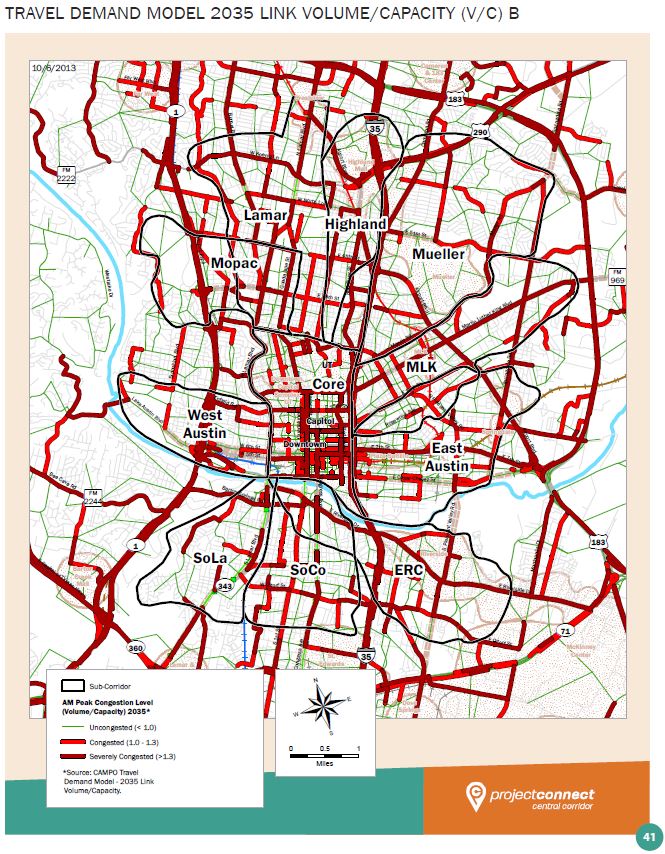
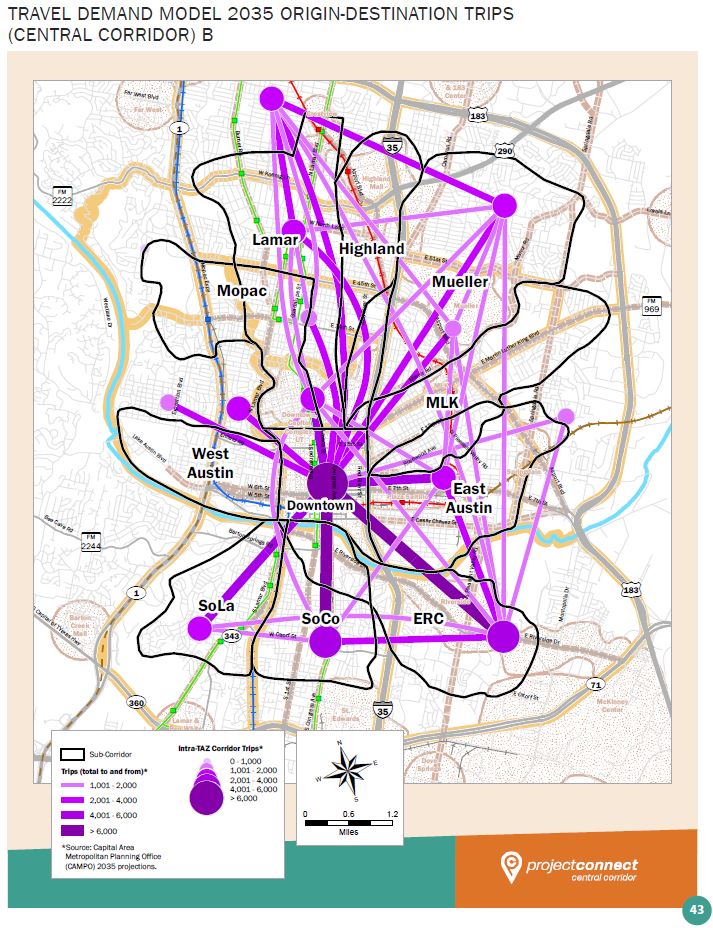
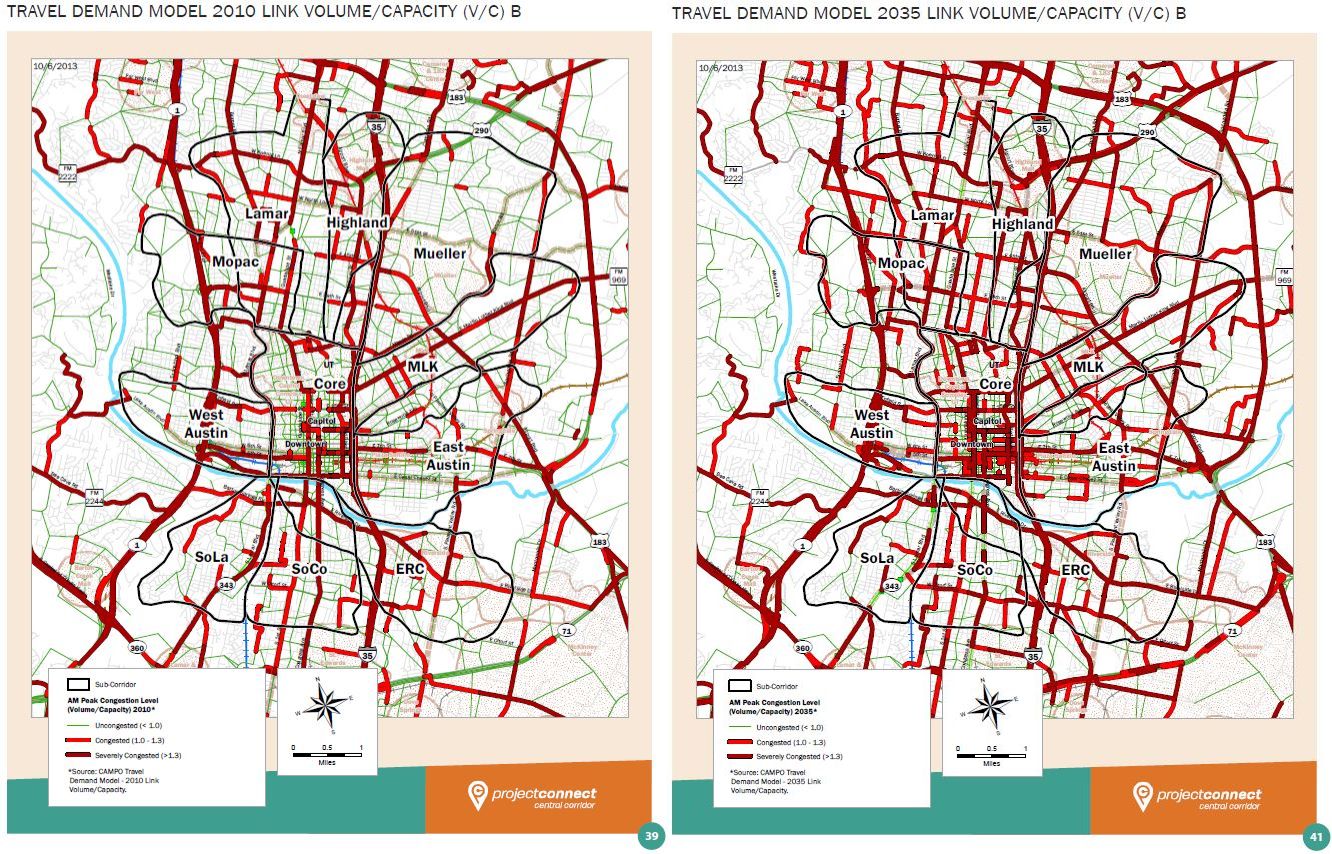
Project Connect's data visualization of congestion in 2035 for study area sectors shows congestion in every direction. But wasn't this supposed to be a study to determine best travel corridor to serve core area, not a "beauty contest" among "competing" sectors of the city?

Project Connect’s data visualization of congestion in 2035 for study area sectors shows congestion in every direction. But wasn’t this supposed to be a study to determine best travel corridor to serve core area, not a “beauty contest” among “competing” sectors of the city?

By Lyndon Henry

[These are some of the questions about the urban rail study that I hope to raise today at Project Connect’s “Data Dig” (Capital Metro boardroom, 11:30am-1:30pm).]

Why has Project Connect’s urban rail study failed to study a single actual potential travel corridor in the study area?

Why has this study avoided performing an actual corridor study, and instead spent its time (and taxpayers’ dollars) confined to undertaking a de facto inventory (and “beauty contest”) of various urban sectors in isolation?

• Why has this supposed “corridor” study segmented an otherwise viable corridor such as Guadalupe-Lamar into non-sensical pieces, severing it from its most logical destination (core area), and thus creating an arbitrary “rump” route (29th St. to south of U.S. 183) that goes from nowhere to nowhere?

• Why has this study failed to evaluate another logical route plan — the “loop” route using both Guadalupe-Lamar and the Red Line (converted to urban rail), with a spur line into the Mueller site?

• Why has this study used such speculative projections based on procedures that maximize all possible development for targeted areas (such as “ERC”, “Mueller”, and “Highland”), rather than using conservative projections based on conditions closer to reality?

• These same projections have produced bizarrely implausible transit ridership projections — e.g., 2.9 million daily rider-trips for the “ERC” (East Riverside) sector. That’s about as many trips in that single sector of Austin as the total urban ridership of Chicago and Philadelphia combined. That’s the output of the study’s main predictor of transit ridership. With results like that, why hasn’t Project Connect more intensely questioned its own demographic and economic assumptions and projections?

• Why have travel and congestion on major freeways (I-35, Loop 1, U.S. 290) — which are roadway arteries used throughout the urban area — been treated as if they affected only the sectors (“sub-corridors”) they happen to pass through? Why has their congestion been “assigned” only to the “inventory” for those sectors?

• Why has this study’s assessment of “travel demand” from each sector to the core ignored home-based non-work (HBNW) trips — including UT student trips and recreational trips — in a college city with the largest university in Texas in its core area?

• Why has this study, in determining the potential of a specific sector (“sub-corridor”) for supporting an urban rail line from that sector to the core, considered “Regional Trips Passing through Sub-Corridor to Core” — i.e., pass-through trips — as relevant?  Why have “Regional O-D Trips Beginning or Ending in Sub-Corridor” been considered relevant to a study focused on trips from a given area to the core? How does this provide any meaningful assessment of need or potential ridership for an urban rail line from any sector (“sub-corridor”) to the core area? Is it plausible that any significant number of motorists traveling from, say, the “Highland” sector to Round Rock or San Marcos would use urban rail to the core for part of the trip?

• Why has this study, for these trips whose validity and relevance for this study is far more dubious, nevertheless included all types of trips — including UT student and recreation trips —  while excluding them for the much more valid and plausible trips from each sector to the core (and intra-sector)?

Does this metric have any purpose other than to produce a particularly high score in this category for the “Highland” sector?

• Why does this study assign an extremely high “Constrained Right-of-Way” penalty to the “Lamar” sector, but not to the “Highland”, “Mueller”, “ERC” sectors? Is Project Connect saying that there are no “Constrained Right-of-Way” problems for “Highland”, “Mueller”, “ERC”? The “Constrained Right-of-Way” penalty seems to be arbitrarily applied to sectors (“sub-corridors”) that the Project Connect team dislikes (e.g., “Lamar”), but withheld from sectors they seem to prefer (e.g., “ERC”, “Highland”, “Mueller”).

• Project Connect’s “Physical Constraints” metric appears to be based on totally subjective value assessments, and no information has been given as to how these value judgements have been developed. Where’s the factual basis for this?

• Because, theoretically, Project Connect hasn’t actually selected an alignment, how can they assign “constraints” to anything? Isn’t this “Physical Constraints” metric premature, since the study is dealing not with actual corridors, but with great, huge, sprawling sectors (“sub-corridors”) in which routes could presumably be considered anywhere?

• For each sector, the study has tallied ridership for Capital Metro transit routes in every direction. How is this relevant in assessing ridership from each sector to the core?

• What is the breakdown of ridership (boardings) for each of the Capital Metro transit routes in each sector included in the total?

h1

From community participation then … to community exclusion today

1 December 2013
As democratic involvement and real meetings have disappeared, public participation at Project Connect's events, such as this "open house", has withered. Photo: Project Connect.

As democratic involvement and real meetings have disappeared, public participation at Project Connect’s events, such as this “open house”, has withered. Photo: Project Connect.

By Lyndon Henry

This posting has been excerpted, adapted, and expanded from a personal Email sent by the author to someone involved with Austin’s urban rail study, in response to an inquiry.

The lack of bona fide democratic discussion and participation by the public has been seen by many in the Austin community as an ongoing problem with Project Connect’s “community outreach” and “public participation” procedures. However, the current problem merely continues and intensifies a policy tendency, over approximately the last dozen or so years, among some local Austin-area public bodies — particularly involved with transportation and urban planning issues — to discourage and suppress authentic community involvement in planning such proposed projects and services.

This stands in stark contrast to the vibrant, lively public involvement of the 1970s through early 2000s, where popular input was encouraged and solicited in the form of participatory community meetings and personal involvement of a widely representative array of individuals in actual planning committees.

Finding a suitable model for implementing true democratic discussion today in Project Connect and other programs would be simple — reinstating the types of outreach, public participation programs, and community discussion activities that were typical of Austin-area transportation planning up until the early 2000s. These types of participatory processes have gradually been attenuated in recent years.

A fully democratic and effective process of community participation and discussion is essential, particularly so that community participants feel they have true involvement, engagement, and a stake in the planning process. At least as important, critical planning issues are effectively scrutinized and analyzed, and additional professional expertise (in architecture, engineering, planning, finance, etc.) in the community is accessed and brought to bear on various aspects of the project.

Almost certainly, the lack of such oversight and engagement of community expertise has been a major factor in the array of serious methdological and data problems that have characterized Project Connect’s urban rail study process and impugned its credibility. See, for example, the wide range of problems and community discontent documentted in this blog’s recent posting TILT! Project Connect’s gerrymandering and data fiddling ignite public skepticism, pushback.

Public participation process of the past

Ongoing citizen advisory committees used to be (and should be now) much larger, with multiple members typically appointed by each councilmember, Capital Metro board member, etc. In the late 1980s, Capital Metro’s Citizens’ Advisory Committee involved over a hundred members, with at least several dozen typically attending a given meeting. Professionals with transit-industry expertise and community activists on transportation issues were often appointed to these bodies, rather than specifically excluded, as they are now.

My longtime friend and professional colleague Dave Dobbs and I served on several such committees through the development of the regional transportation plan by the Austin Transportation Study (precursor to CAMPO) and the creation of Capital Metro (we both served on the Austin-Travis County Mass Transportation Commission that recommended creation of a regional transit authority for the Austin metro area). Another particularly important example of our community participation involvement was the advisory committee to the Transitway Corridor Analysis Project (TCAP), in the late 1980s. The TCAP committee had at least several dozen members, including interested stakeholders like Alan Kaplan and Roger Baker, and met regularly with the Capital Metro personnel and consultants directly involved with evaluating either a busway or light rail transit (LRT) for a fixed transit line from the core area to the northwest, possibly using U.S. 183, the railway alignment, I-35, or a combination of these alignments.

The democratic involvement of highly interested and technically savvy community members was critical to the final outcome of the TCAP study. Dave and I and other committee members questioned or challenged assumptions and methodology point by point, in a democratically interactive process that altered the course of the study. The original intent had seemed to be to justify a busway in this corridor, and if this had prevailed, buses would probably be rolling along through Crestview, Wooten, and other neighborhoods on a paveway in the Capital Metro railway right-of-way today instead of MetroRail DMU railcars. But instead, the advisory committee and consultants ultimately recommended LRT, and this was selected by the board as the Locally Preferred Alternative.

Trend from democratic involvement to “democratic” pretense

There has been nothing comparable to this kind of democratic community interactive planning within roughly the past decade.

Community meetings have likewise virtually disappeared. I recall open, fully democratic meetings, with large attendance, in various areas of the Capital Metro service area when I was on the authority’s board during the original LRT study in the early 1990s. Board members like me, and top officials like General Manager (CEO) Tony Kouneski, would attend these meetings. Participants weren’t just given clickers to respond to the contrived choices presented by Capital Metro — they were free to voice their opinions, ask questions, even respond to other views expressed in the meetings. New views, new options, could be voiced. The community members learned things from one another and felt a far greater sense of involvement in the process that is totally missing today.

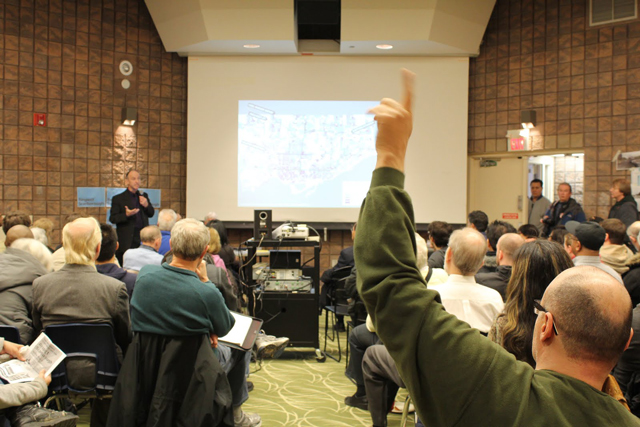
Real community meetings, such as this one focused on transit options in Toronto, allow free and open discussion and facilitate questions and comments from the attendees. In contrast, Project Connect's events have squelched community discussion and sought to manage and muzzle discussion. Photo: Torontoist.

Real community meetings, such as this one focused on transit options in Toronto, allow free and open discussion and facilitate questions and comments from the attendees. In contrast, Project Connect’s events have squelched community discussion and sought to manage and muzzle discussion. Photo: Torontoist.

During the LRT study process in 1999-2000, numerous small community meetings were held all over the city to explain the LRT plan and alternatives, and receive real input, freely voiced, from the community. Then-General Manager Karen Rae herself typically led these meetings, usually accompanied by one or more staff personnel. This interaction helped fine-tune the eventual alignment that was proposed.

Even after the LRT referendum narrowly failed, in 2001-2003 democratic public meetings continued, involving both smaller meetings around the city and larger public meetings, including charettes. Attendees had the opportunity to speak, voicing comments or criticism and asking questions, at all meetings.

Workshops in past periods previously were far different and more democratic than the recent ones sponsored by Project Connect. The groups, often subdivided by particular topics, would discuss an issue for perhaps 20-40 minutes. A participant was also free to visit other groups at other tables and inject comments, suggestions, etc. Each table group (“workshop”) would select one member to summarize the group’s conclusions, or controversial issues, to the entire meeting in a summation period. Individual group members had a chance to clarify points covered in the discussion.

In contrast, Project Connect’s recent “workshops” seemed more like mechanisms to contain and squelch discussion rather than facilitate it. Discussion was confined to each individual small group, for perhaps 5-10 minutes at most. Only very narrow topics — basically, “choices” presented by Project Connect — were presented for discussion within each table group … with no real opportunity for alternatives and questions to be presented. Project Connect staff members, present at each table, then filtered and briefly summarized some of the discussion to the larger group.

Similarly, “open houses” are not public “meetings” but mechanisms to fragment and granularize public involvement into one-to-one interactions with project representatives, who can “listen” and then rationalize official decisions to individual participants. Attendees are expected to wander through the room, viewing the results of project decisions previously made by the project bureaucracy, results that are typically presented with lots of graphics — prompting me to describe these as “art galleries”. But these are definitely not democratic community meetings. See:

Back to “art galleries” Project Connect reneges on community meetings

Meetings, “open houses”, workshops … and democratic process

In contrast to the Transit Working Group (TWG) meetings, which at least allowed a few 3-minute “citizen communications” at the end of each meeting, Project Connect abolished even such minimal community input at meetings of its successor, the Central Corridor Advisory Committee (CCAG), until the last one before Project Connect made its decision on urban rail sectors. In other words, CCAG could not formally be presented with alternative views, ideas, and proposals, or criticism of the official methodology, throughout the critical period when decisions were being made and ratified by CCAG.

In sum, Project Connect’s overall “public involvement” exercises have seemed more like a gesture at public involvement as a CYA effort to fulfill federal requirements.

Outline for bona fide community participation program

What would a more truly democratic public involvement program look like? For starters, here are some thoughts, based on examples and experience from the past:

• A general advisory group that is large and inclusive, with representatives appointed by all councilmembers, Capital Metro board members, and possibly other public bodies — rather than a small group hand-picked by the mayor. This advisory committee would also be able to co-opt additional members to itself. It would provide a forum to consider both official proposals and alternative proposals and ideas from the community, while seeking a consensus with the official project team.

• Numerous smaller meetings (covering several sectors with several neighborhood areas per sector) at least every couple of months, where participants could voice their alternative ideas, concerns, questions, criticisms, and other comments to the meeting group — thus sharing and disseminating alternative views and approaches within the general community as well as among project staff.

• At least a couple of charettes, open to the public at large, over the course of the project. These would focus on key issues particularly needing public input. The emphasis would be on the voicing of ideas and assessments, not just clicking choices among prescribing alternatives.

Major public meetings, every 3-4 months, in a “hearing” format, where community members could at least have a chance to voice their views.

In contrast with this kind of open process from past times, the new model of “public involvement” by public agencies, exemplified by Project Connect’s process, seems designed mainly to muzzle the public, procure some kind of very shallow public acquiescence for official decisions, and thus allow project officials to claim validation. It also ensures that officials can proceed with planning effectively isolated and insulated from democratic community scrutiny and input — thus (as I’ve characterized it) operating “inside a bell jar”.

Neighborhood groups and other community organizations need to make it clear they’ve had enough of this sham pretense at “public participation”. They need to demand a reinstatement of at least the level of democratic participation that was the norm in the past.

h1

TILT! Project Connect’s gerrymandering and data fiddling ignite public skepticism, pushback

30 November 2013
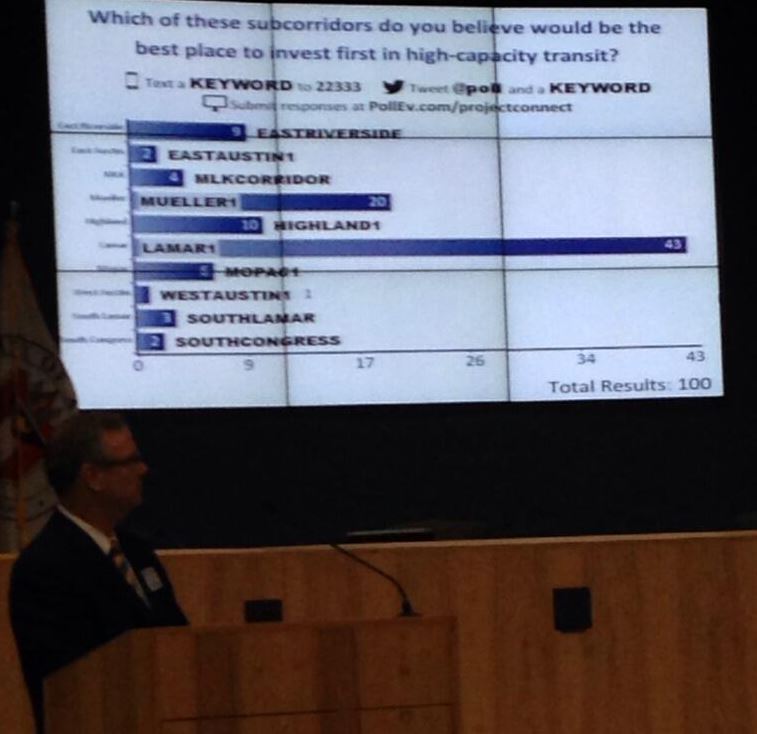
"Don't believe your lying eyes." At Nov. 26th "Community Conversation", Project Connect study director Kyle Keahey shows bar chart indicating overwhelming public support for "Lamar" sector, yet proceeded to justify study team's selection of "ERC" and "Highland". Photo: Julie Montgomery.

“Don’t believe your lying eyes.” At Nov. 26th “Community Conversation”, Project Connect study director Kyle Keahey showed bar chart indicating overwhelming public support for “Lamar” sector, yet proceeded to justify study team’s selection of “ERC” and “Highland”. Photo: Julie Montgomery.

Suddenly, the leadership of Project Connect’s urban rail study have scheduled, out of the blue, a “Public Data Dig”. On Tuesday, Dec. 3rd, from 11:30 am to 1:30 pm in the Capital Metro boardroom, the agency promises to provide “an interactive review of the approach, process, methodology, data, and evaluation results.”

And it’s not for the faint-hearted or the techno-wimpish: “WARNING: this will not be a layman’s discussion; this is an in-depth data-dig and technical review.” It’s hard to tell whether that’s a warning to intimidate the public and scare off the masses, or an effort to impress potential attendees with the daunting and immutable rectitude of Project Connect’s study efforts and final product.

But why have the study team suddenly decided to start publicly “digging into the data” now, setting a date 2.5 weeks after they made their decision (Nov. 15th) about where they wanted to put urban rail? Why didn’t they open these kinds of critical assumptions and methodological decisions to public discussion months ago?

Maybe they sense the mounting community outrage and anger at being treated like yokels by a flim-flam artist? And perhaps they’re starting to realize how seriously their credibility (and that of public officialdom generally) are being impugned by the barrage of savvy, insightful critical scrutiny of their shenanigans that has emerged, bolstering that community pushback.

That scrutiny has materialized in a veritable barrage of technically competent and even wonkish analyses that have been dissecting all the basic pillars of Project Connect’s wobbly “approach, process, methodology, data, and evaluation results”. From apparent gerrymandering of the study sectors (“sub-corridors”) to cherry-picking of data to peculiar fiddling of calculations, the agency’s procedures have deepened skepticism. For example, here’s a selection of community-generated analyses:

Project Connect’s “corridor” study — without corridors!
https://austinrailnow.wordpress.com/2013/11/11/project-connects-corridor-study-without-corridors/

Surprise! Mayor and Project Connect select same routes they wanted in the first place
https://austinrailnow.wordpress.com/2013/11/17/surprise-mayor-and-project-connect-select-same-routes-they-wanted-in-the-first-place/

A little oddity in Project Connect Evaluation Criteria
http://austinonyourfeet.wordpress.com/2013/11/21/a-little-oddity-in-project-connect-evaluation-criteria/

Project Connect’s Sub-Corridor Recommendation
http://jacedeloney.wordpress.com/2013/11/20/project-connects-sub-corridor-recommendation/

Highland Score
http://keepaustinwonky.wordpress.com/2013/11/25/highland-score/

A quick thought for tonight’s exercise
http://m1ek.dahmus.org/?p=914

Project Connect Reality Check: “Lamar” vs. “Highland” sector ridership comparison FAILS
https://austinrailnow.wordpress.com/2013/11/24/project-connect-reality-check-lamar-vs-highland-sector-ridership-comparison-fails/

“Highland” sector favored by Project Connect — but where’s the travel demand?
https://austinrailnow.wordpress.com/2013/11/19/highland-sector-favored-by-project-connect-but-wheres-the-travel-demand/

Lying with Maps
http://yarak.org/2013/11/lying-with-maps/

Welcome to Project Dis-connect!
http://www.icontact-archive.com/gV8wd5ityKfvqoWQQdiDT8IG1WNL1sIh?w=3

Huge problems cited with Project Connect’s urban rail study data
https://austinrailnow.wordpress.com/2013/11/03/huge-problems-cited-with-project-connects-urban-rail-study-data/

Another Rail Petition worth signing
http://highlandneighborhood.com/another-rail-petition-worth-signing/

Austin Rail Now encourages everyone interested in this crucial study and the need for urban rail (electric light rail transit) in Austin to attend this crucial event on Dec. 3rd. Project Connect’s announcement assures “We really want to take the time to answer all of your detailed questions….”

That sounds a bit like they’re approaching this as an exercise in explaining the complexities of their arcane brilliance to us benighted peons. After all, that’s pretty much the way they’ve conducted their so-called “public participation” process. Despite all their assurances of “transparency”, they’ve conducted this study with about the transparency of peat moss, keeping their most critical deliberations virtually locked within a reinforced bunker.

Let’s hope community participants at Tuesday’s meeting will be able to drill somewhat into that bunker.

Even more importantly, Project Connect’s urban rail program needs to be put on Pause. It took the wrong track back there, and has not only some explaining to do, but some reversing as well.

h1

City’s 2010 urban rail study actually examined corridors! But botched the analysis…

26 November 2013
Closeup of City's Central Austin Transit Study map, showing core, potential rail corridors, and City's version of route to "North Central Austin" (Hyde Park via Speedway). Guadalupe-Lamar was avoided. Map: Snip from COA document.

Closeup of City’s Central Austin Transit Study map, showing core, potential rail corridors, and City’s version of route to “North Central Austin” (Hyde Park via Speedway). Guadalupe-Lamar was avoided. Map: Snip from COA document.

By Lyndon Henry

In this blog and other forums, for months I’ve been making the case that Project Connect’s urban rail study has not been considering actual travel corridors, but rather large tracts of urban land more aptly described as sectors. Actual travel corridors haven’t just been ignored, they’ve been severed and segmented, so that effective evaluation of them for rail transit routes has been impossible. (The best example is Guadalupe-Lamar, for which Project Connect cut off the head — the core area — and then severed the legs — any extensions north of Crestview.)

Project Connect has supposedly been focusing on possible urban rail routes in the center of the city, so it designated a huge central-city study area — implausibly calling it the “Central Corridor”, although it had none of the characteristics of an actual urban travel corridor. (See Project Connect’s “corridor” study ­ without corridors!)

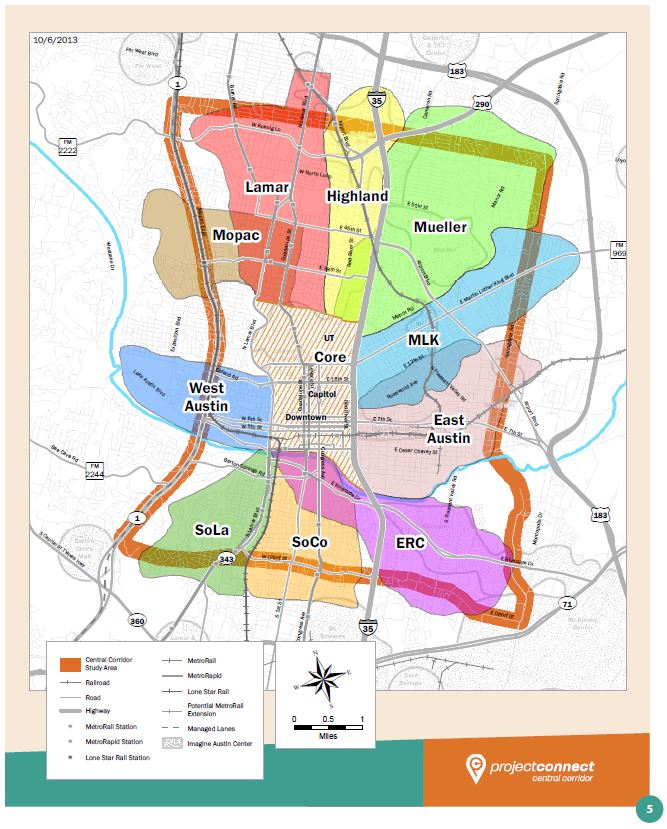
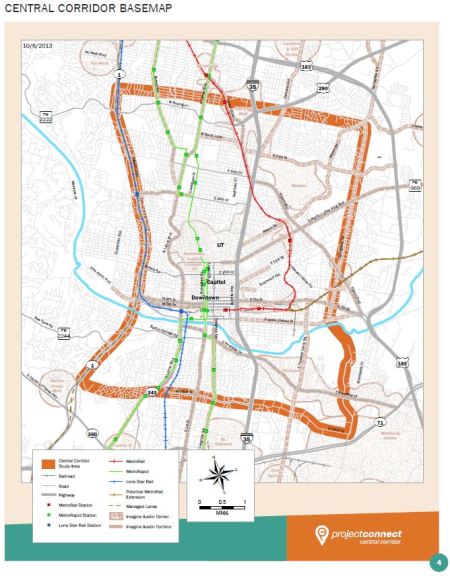
Project Connect's "Central Corridor" (study area) with "sub-corridors" (i.e., sectors). (Click to enlarge.)

Project Connect’s “Central Corridor” (study area) with “sub-corridors” (i.e., sectors). (Click to enlarge.)

As one can see in the map above, within this huge central study area, Project Connect then carved up a number of major study districts — which it then labeled “sub-corridors” (since the entire center of the city was now labeled a “corridor”). Rather than actual travel corridors — which are what you’d need to study fixed transit facilities like urban rail — these subdivisions are, in effect, huge, sprawling sectors of the center-city, mostly comprising several square miles. “Mueller”, for example, reaches out of the Mueller development site to reach central neighborhoods west of I-35, and north to gulp up most of Northeast Austin.

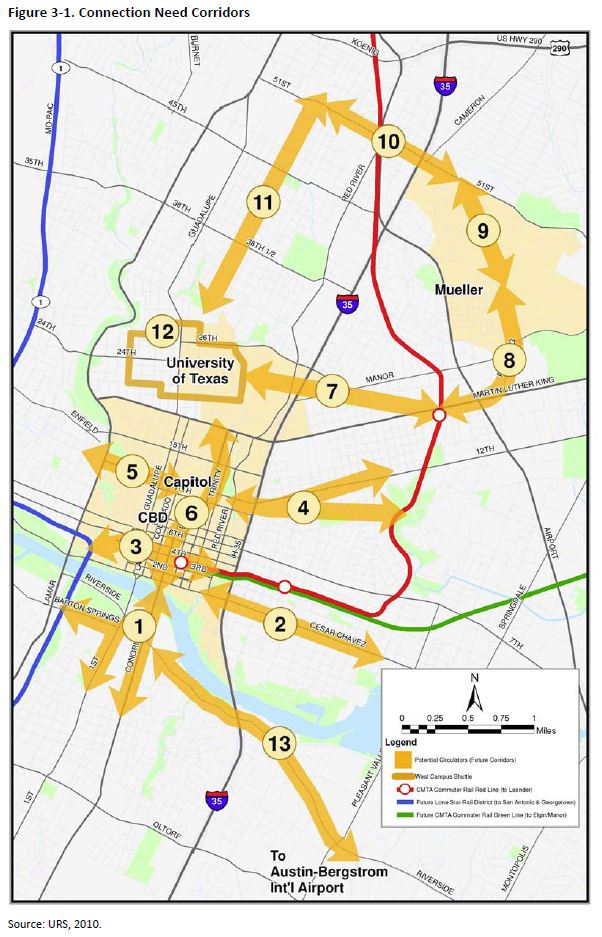
But local officials definitely know what real corridors are. As recently as 2010, the City of Austin, in collaboration with its consultant URS Corporation, produced the Central Austin Transit Study (CATS) — the pre-eminent initial feasibility study for a central Austin urban rail system. And, as the map below shows, they didn’t dither around with huge, arbitrary, misnamed blobs of urban land … they examined actual corridors:

CATS map of actual potential rail corridors studied. Map: COA and URS.

CATS map of actual potential rail corridors studied. Map: COA and URS.

However, then, as now, the basic aim was to justify a Phase 1 urban rail route through the east side of the UT campus and on out to the Mueller redevelopment site. So the study and the map of selected corridors were cleverly contrived to confine and steer the study in the “proper” direction.

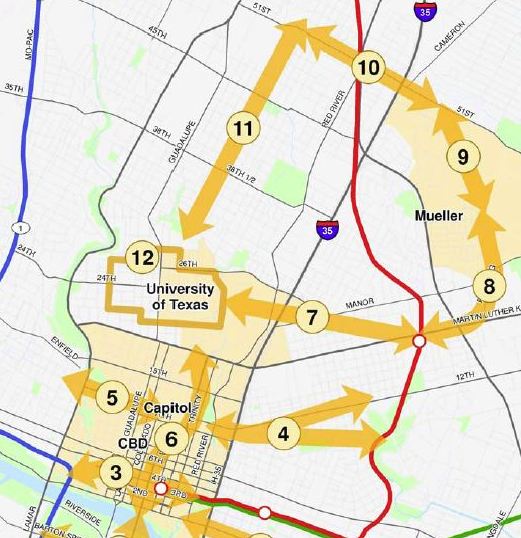
In particular, notice how the City planning team studiously avoided the most obvious route going north from the campus — up Guadalupe and North Lamar. Instead, Corridor #11 is fashioned as “University of Texas (UT) to North Central Austin (Hyde Park)”, and directed up Speedway (a minor arterial that’s almost a neighborhood street) as far as 51st St. And of course, it’s purpose is to make a connection to … Mueller!

But manipulating the routes was only half the game. The other half was manipulating the evaluatory methodology.

For the 2010 study, that was a lot simpler than now. Instead of “gerrymandering” data, playing with projections and hypothetical growth rates, and assigning heavy freeway traffic to relatively quiet neighborhoods, the City and URS team in 2010 just devised a simple, subjective 1-2-3 rating system that allowed them to assign a subjective “score” at whim to the various corridors. And whaddaya know … Mueller won!

But the point is that more or less real travel corridors were studied in 2010, although they were shaped and located to fit the outcome desired by top officials. So local planners do know what real corridors should look like.

And it’s real travel corridors that Project Connect’s urban rail study should have been scrutinizing and evaluating all along. That’s what the Austin community deserves. Instead, what Austin has gotten so far is another exercise in smoke-and-mirrors “planning” intended again to achieve a desired outcome.

h1

Project Connect Reality Check: “Lamar” vs. “Highland” sector ridership comparison FAILS

24 November 2013
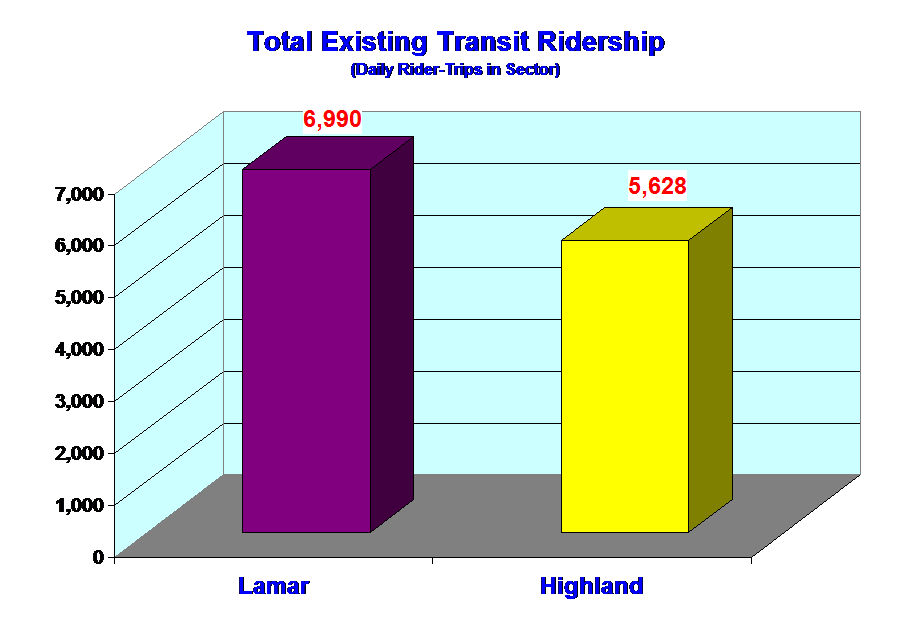
Despite Project Connect's startling claim, "Lamar" sector has significantly higher ridership than "Highland". Graph: ARN, from Project Connect data matrix.

Despite Project Connect’s startling claim, “Lamar” sector (left) has significantly higher ridership than “Highland” (right). Graph: ARN, from Project Connect data matrix.

During Project Connect’s somewhat eyebrow-raising rollout of the urban rail study team’s much-vaunted route decision at the Central Corridor Advisory Group meeting of November 15th, study director Kyle Keahey valiantly was attempting to combat considerable skepticism surrounding the project by highlighting some of the team’s supposed “findings”.

Perhaps in an effort to demonstrate even-handedness, Keahey had already shown a bar chart illustrating overwhelming popular support for the “Lamar” sector (“sub-corridor” in Project Connect parlance), totaled from public input, but he undoubtedly realized he needed to reveal the team’s “evidence” for their contrary decision. So, trying to justify the selection of the “ERC” (East Riverside) and “Highland” sectors, Keahey assured the audience that “Lamar” (a huge sector of over 4.5 square miles, stretching from east of North Lamar west to Shoal Creek) just didn’t have the desired characteristics.

The Guadalupe-Lamar corridor is well-known for its relatively high transit ridership (after all, it was the top choice for the MetroRapid special bus service planned to open in 2014), so apparently the study team has been hard-pressed to disparage the “Lamar” sector on its strongest points.

So Keahey unveiled a jaw-dropping claim — “Lamar” really doesn’t have the strongest ridership at all, but instead, “actual ridership is highest in East Riverside and Highland ….”

There are several problems with this comparison, starting with the fact that Project Connect has utterly failed to evaluate actual travel corridor ridership (and any other data, for that matter). Instead, the ridership figures (apparently obtained from Capital Metro) apply to all transit ridership, going in all directions. But wasn’t this a study of travel from these sectors to the core area?

One of the problems with this is that those sectors (which include “Highland” and “ERC”) that happen to encompass major transit route interchange hubs suddenly seem to have far more ridership than a sector (like “Lamar”) distinguished for its heavy corridor ridership. This is almost certainly a clear advantage of the “ERC” sector, with clusters of crosstown routes interchanging with UT shuttlebus routes serving student housing and other general routes linking to the core area.

While higher ridership is tallied for “ERC”, this does seem to correlate somewhat with the service level. Altogether, the “ERC” sector has a total of 37 routes, according to Project Connect’s evaluation matrix, compared with 26 for the “Lamar” sector — a ratio of 1.42. This is close to the ratio in “Total Existing Transit Ridership”: “ERC” with 9,648, “Lamar” with 6,990 — a ratio of 1.35. This suggests that ridership may be driven somewhat by the level of service (i.e., number of routes) provided to the sector.

But what about the “Highland” sector? Keahey’s claim that “Highland” currently exhibits higher ridership than the “Lamar” sector was quite shocking, even leaving aside the major interchange at the ACC Highland hub.

And it turns out this claim simply isn’t true — by Project Connect’s own evaluation data matrix.

Project Connect: Central Corridor Sub-Corridor Comparison Matrix

Here’s a screenshot of the page with the transit ridership data:


Project Connect Evaluation Data Table page with ridership data.

Project Connect Evaluation Data Table page with ridership data.


This screenshot zooms in on the ridership data cells for the “Lamar” and “Highland” sectors:


Closeup of matrix data for "Lamar" and "Highland" sectors.

Closeup of matrix data for “Lamar” and “Highland” sectors.


The actual data, above, seem clearly to contradict and refute Keahey’s “bombshell” claim that transit ridership in “Highland” beats that in the “Lamar” sector. By the “Total Existing Transit Ridership” metric, “Lamar” has 6,990, vs. “Highland” with 5,628 — leaving “Lamar” 24% higher (see bar graph at top of post). By the “Average Daily Bus Ridership” metric, Lamar” has 6,736, vs. “Highland” with 5,174 — leaving “Lamar” 30% higher.

Thus, this would seem to be a “bombshell” claim that fizzles

h1

Crestview Neighborhood Association endorses Guadalupe-Lamar for urban rail

20 November 2013
Crestview Neighborhood Association's eastern boundary lies along North Lamar Blvd. Map: CNA.

Crestview Neighborhood Association’s eastern boundary lies along North Lamar Blvd. Map: CNA.

Still another major neighborhood association has jumped on board the effort to designate the Guadalupe-Lamar (G-L) corridor as its preferred route for urban rail (light rail transit).

On Nov. 12th, the Crestview Neighborhood Association (CNA) voted to express its belief “that any first investment in light rail must serve as an expandable backbone of rapid transit, and such an alignment is most suited along North Lamar Blvd. and Guadalupe Street and terminated at or near the North Lamar Transit Center ….”

As indicated in the map at the top of this post, Crestview is a basically rectangular neighborhood bordered on the east by North Lamar Blvd., west by Burnet Rd., north by Anderson Lane, and south by Justin Lane. Encompassing the Crestview MetroRail station near Airport Blvd., the neighborhood touches the intersection of Lamar and U.S. 183 at its northeast corner, near the North Lamar Transit Center.

Like other neighborhoods in the corridor, the Crestview Neighborhood Association in its resolution underscores its participation in and ratification of the intensive planning for light rail that has already occurred in the corridor. In particular, the resolution notes that Crestview was “a signatory of the Crestview-Wooten Combined Neighborhood Plan, City of Austin Ordinance 040513-30, in which Crestview residents took part in extensive light rail planning for specific alignment and station placement along North Lamar Blvd. up to the North Lamar Transit Center and providing for light-rail to commuter rail transfers at Crestview station …

It goes on to point out that “several other neighborhood plans have planned light rail along the Guadalupe-North Lamar corridor such as the Central Austin Combined Neighborhood Plan, City of Austin Ordinance 040826-56, Brentwood-Highland Combined Neighborhood Plan, City of Austin Ordinance 040513-30, Hyde Park Neighborhood Plan, City of Austin Ordinance 000413-63, and the North Loop Neighborhood Plan, City of Austin Ordinance 020523-30 ….”

Furthermore, “… the Imagine Austin Comprehensive Plan, City of Austin Ordinance 20120614-058 incorporates the aforementioned existing neighborhood plans and designates North Lamar Blvd and Guadalupe Street as High Capacity Transit Corridors in its Growth Concept Map .…”

In addition to the previously noted endorsement of light rail as “an expandable backbone of rapid transit”, the Crestview measure also affirmed that the neighborhood association “supports a phase one locally preferred alternative to include light rail service that connects the densely populated and diverse communities of North Central Austin to the cultural, residential, and employment centers of the University of Texas, the Capitol Complex, and Downtown Austin ….”

Image of Crestview Neighborhood Association resolution supporting urban rail in Guadalupe-Lamar corridor.

Image of Crestview Neighborhood Association resolution supporting urban rail in Guadalupe-Lamar corridor (click to enlarge).

The full resolution in PDF format can be accessed here:

Crestview Neighborhood Association — Resolution in Support of Light Rail on North Lamar Boulevard

The Crestview endorsement is an especially noteworthy action because many Crestview residents had generally weighed in as opponents of light rail during both the initial presentation of a Guadalupe-Lamar urban rail plan in the early 1990s, and also during the campaign for a ballot measure to authorize a light rail system that narrowly failed in 2000. This new emergence of strong support is an indicator of the powerful community momentum for an urban rail alignment that has been building among neighborhoods in this corridor.

h1

“Highland” sector favored by Project Connect — but where’s the travel demand?

19 November 2013
Closeup of data visualization of 2035 travel demand projection focusing on "Highland" sector. Snip by L. Henry of Project Connect infographic.

Closeup of data visualization of 2035 travel demand projection focusing on “Highland” sector. Snip by L. Henry of Project Connect infographic.

As this blog recently reported, on Nov. 15th, Project Connect — newly empowered by Austin’s Mayor Lee Leffingwell to make the de facto final decision on urban rail — selected the “ERC” sector (with the somewhat daunting East Riverside corridor) in South Austin and the “Highland” sector (suspected to be a proxy for the western “Mueller” sector) in central Austin.

Project Connect's anointed sectors ("sub-corridors") for urban rail, selected on Nov. 15th. Map: Project Connect.

Project Connect’s anointed sectors (“sub-corridors”) for urban rail, selected on Nov. 15th. Map: Project Connect.

While the significant and growing Highland campus of Austin Community College (ACC) has been profusely brandished as a major activity center justifying “Highland” (in effect, a “gerrymandered” sector fabricated from pieces of the actual Highland and several other core-city neighborhoods), there seems very little likelihood that a rail route in the “Highland” sector itself would actually reach Highland ACC anytime soon or possibly even … ever.

It’s likely that urban rail is intended only to reach Hancock Center (per the previous Mueller plan), then to take the same previously planned northeasterly route (through the Hancock property, then crossing Red Line tracks, then under I-35 via Airport, and into Mueller via Aldrich). Very daunting right-of-way constraints almost certainly will remain an obstacle to extending urban rail to Highland ACC.

Besides the physical constraint of virtually no clear street right-of-way for an urban rail alignment to the core area, Project Connect’s chosen “Highland” sector presents another serious problem: extremely weak travel demand!

This is revealed in the data visualization of travel demand forecast for 2035 by sector and displayed in Project Connect’s Map Book (v.5), p. 43, based on projections from CAMPO’s own travel demand model. Two JPG snips of this visualization (showing travel demand activity as vectors and intra-zonal travel as bubbles) are shown below, one for the study area as a whole, and the other a closer focus on the central core city.

Travel demand in 2035 shows zero (or very weak) travel activity involving "Highland" sector. Infographic: CAMPO and Project Connect.

Travel demand in 2035 shows zero (or very weak) travel activity involving “Highland” sector. Infographic: CAMPO and Project Connect.

Closeup of projected travel demand in central core city.

Closeup of projected travel demand in central core city.

In comparison with “Highland”, the infographics shown above seem to indicate significantly more projected travel demand not just in the rather large “Lamar” sector but all along the Guadalupe-Lamar corridor specifically. There’s also significant travel to what seems to represent a centroid just northwest of the boundaries of the “Lamar” sector, which it’s arguable is logically in the ridership catchment area for an urban rail line on Guadalupe-Lamar.

A closeup of this visualization for a portion of the “Highland” sector (including the Highland ACC area) is shown at the top of this posting. In contrast to the seemingly intense travel demand involving the Guadalupe-Lamar, the “Highland” sector seems to have zero travel demand centroids or origin-destination points indicated, and there’s a total absence of “data bubbles” represent intra-zonal trips.

This seemingly total lack of projected transit demand in for the “Highland” sector is actually rather puzzling. It’s reasonable to assume some degree of future travel demand between this area bordering the west side of I-35 and the core area. In any case, the data visualization suggests a projection by the CAMPO model that that this area is astoundingly weak in this respect compared to Guadalupe-Lamar — certainly contradicting the claims and conclusions of Project Connect’s top decisionmakers, including Kyle Keahey, who have emphasized the greater travel demand potential of “Highland” (and “ERC”) over the “Lamar” sector (and, implicitly, the actual Guadalupe-Lamar corridor). Basically, the evidence for this — in this presentation of CAMPO 2035 projection results — is simply not there.

In fact, on the basis of this infographic, both the “Highland” and “MLK” sectors appear to have the weakest travel demand projected in the CAMPO travel demand model — possibly suggesting a deficiency in the model. In any case, since Project Connect based its assessment significantly on this data, the results presented, and the contrary evidence of very strong travel demand in the Guadalupe-Lamar corridor, contradicting Project Connect’s own stated conclusions, should at the very least raise questions about the competency and integrity of the study process.

h1

Surprise! Mayor and Project Connect select same routes they wanted in the first place

17 November 2013

0_ARN_shocked-guy-with-questions-cartoon

By Lyndon Henry

This past Friday, Nov. 15th, to a meeting of the Central Corridor Advisory Group (CCAG), the Project Connect (ProCon) team presented their “recommendation” of sectors (misnamed “sub-corridors”) for the first urban rail route(s) — a combination of “Highland” (a proxy to facilitate city officials’ desired route to Mueller) and “ERC” (containing the East Riverside Corridor, which the City has been heavily promoting as a development district).

Tilting the playing field

It should be noted that the “Highland” sector bears very little resemblance to the actual Highland neighborhood, delineated by both the Highland Neighborhood Association (see Highland Neighborhood Association endorses Guadalupe-Lamar for urban rail) and the Highland Neighborhood Planning Area defined by the City of Austin (COA). While the actual Highland neighborhood and planning district includes North Lamar Blvd. (mostly as its western boundary) all the way from Denson Drive to U.S. 183, ProCon’s “Highland” sector studiously avoids Lamar, and never reaches U.S. 183; instead, the sector incorporates I-35 (never even touched by the real Highland), and droops down far south of the actual neighborhood to include Hancock Center and the northern edge of the UT campus — thus overlapping the long-proposed Mueller route for urban rail. In this sense, “Highland” appears to be manipulated here as a kind of “proxy” for the COA’s original plan, functioning as a precursor of a full route to Mueller.

Project Connect's "recommendation" revealed on Nov. 15th. Photo: ProCon.

Project Connect’s “recommendation” revealed on Nov. 15th. Photo: ProCon.

Just a few days prior to Friday’s meeting, COA Mayor Lee Leffingwell cancelled plans to bring the selection of a sector for urban rail to both the Capital Metro board and the entire City Council for a vote. Instead, in what’s being portrayed by critics as a kind of “palace coup”, the mayor has ditched plans for such votes and authorized Project Connect to make its own decision about a sector (which in effect clinches the basic route decision). Thus, ProCon’s Nov. 15th “recommendation” amounts to the actual decision to start planning urban rail routes — lo and behold, the same basic routes the city administration, Project Connect, and an assortment of real estate development interests have wanted all along.

And all from a process that repeatedly seems to have rigged the game, and tilted the playing field.

Data flaw: Garbage In, Garbage Out

Kyle Keahey presented ProCon’s justification to the CCAG and the audience in the classic maneuver of a “data blitz” — a rapid PowerPoint barrage of tables of values, bar graphs, and bullet points almost guaranteed to dazzle and overwhelm. Assuring the CCAG attendees that his team had been busy slicing, dicing, and splicing the data approximately six different ways, including subjecting all that abundant data to a “sensitivity analysis”, Keahey wrapped up his case for basically the original official route plan (a line leading from downtown through UT’s East Campus to Hancock Center and eventually to the Mueller site, plus a route to bolster real estate and other commercial development along East Riverside).

But this picture of a fair, balanced, scrupulously diligent evaluation process is being greeted with considerable skepticism in the community. ProCon’s study has numerous hallmarks of having been rigged, from a peculiarly contrived methodology that departs from longstanding professional practice, to cherry-picking of a highly questionable set of data elements and the exclusion of data indicators far more appropriate for such an ostensible “corridor study”. (And, one might add, a highly secretive and insular process that immunized the ProCon team and their study procedures from public scrutiny and oversight.)

Thus the basic flaw in ProCon’s data analysis can be boiled down to one word: GIGO (“Garbage In, Garbage Out”). In effect, this appears to have been a process that involved limiting the focus to gerrymandered data sources, and then playing games with gerrymandered data.

Along the way, from the rather soft-focus Map Book “data visualizations” made available, a wide array of serious data errors and omissions were identified by various stakeholders. See, for example:

Huge problems cited with Project Connect’s urban rail study data

Sub-Corridor Selection Scoreboard

Three Suggestions for the Project Connect Sub-Corridor Survey

“Beauty contest”, not corridor analysis

But the core problems with ProCon’s exercise go far deeper. In addition to the numerous data anomalies (and the lack of public access to the raw data being used), there are serious methodological faults. Perhaps the most troubling involves the fundamental concept and approach of the study itself, discussed in Austin Rail Now’s article Project Connect’s “corridor” study — without corridors!

As the article cited above indicates, rather than performing a bona fide study of actual alternative corridors, ProCon embarked on what amounted to an inventory of highly filtered attributes of basically gerrymandered sectors, dubbed “sub-corridors”, devolving into a kind of “beauty contest” among sectors of the city, while distorting as well as ignoring the actual travel corridors that should have been the focus.

This involved the selection of a predominantly questionable array of data elements as the basis for “evaluation” of the various sectors. Leaving their “weighting” aside, in the aggregate the evaluatory elements themselves are inappropriate. Here’s why:

(1) Projections — ProCon relies very heavily on projections of future conditions for their basic measures. As the rail advocacy group AURA (Austinites for Urban Rail Action) has explained in its evaluation guide, projections themselves are basically unreliable, risky, flaky, whereas, in contrast, “We believe use of the real-world, recently-observed data gives the more accurate and reliable picture of potential ridership, as well as the greatest viability for federal funding.”

Snippet of ProCon's evaluation matrix shows preponderant emphasis on hypothetical future projections rather than current factual data.

Snippet of ProCon’s evaluation matrix shows preponderant emphasis on hypothetical future projections rather than current factual data.

This is especially true in regard to locational projections, i.e., projections of future developments in specific geographical locations. Beyond a roughly five-year horizon, projections for specific neighborhoods and similar chunks of real estate basically become unreliably speculative — which seems to be what we’ve actually been dealing with … a significant dollop of real estate speculation, given a kind of veneer of “techniness” by CAMPO and their land use/travel demand model package.

For decades, public transportation advocates have warned repeatedly about the “self-fulfilling prophecy” syndrome in this kind of transportation planning process. In the past, it’s been applied mainly to highway development — justifying “future growth” in just the right places where developers want to build, so as to rationalize huge investments in new freeways and other roads. And, lo and behold, these very projections somehow materialize after the transportation facilities are built, thus “proving” the “validity” of the projections!

Today, in Austin, this process may be at work justifying speculative land development in certain areas of the central city (i.e., the central study area — “Central Corridor”), this time with the added drawback of ignoring or dismissing opportunities for redevelopment of areas in the heart of the core city, particularly centered along the Guadalupe-Lamar corridor.

(2) Percentages and growth rates — Obviously, percentages (of poverty, transit dependency, etc.) and growth rates can be somewhat useful indicators, but relying on them overwhelmingly, as ProCon’s methodology does, can skew the planning process. Neither actual population, nor actual transit ridership in an actual corridor between any sector and the core, is considered as a measure!

Percentages can be deceptive, especially when it comes to forecasting transit ridership. Area A may have a population of 100, of which 50 are transit-dependent — 50% transit dependency. Area B may have 10,000 population, of which 2,000 are transit-dependent — 20% transit dependency. If you have a rating system that awards the higher score to the higher rate, then you’re giving a higher score to an area that will yield you only 50 potential transit-dependent riders, vs. an area that will yield you 2000!

Likewise with growth rates. If Area A is projected to grow over 20 years from 100 to 1000 residents, that’s a 900% growth rate. Meanwhile, much larger Area B is projected to grow from 40,000 to 50,000 — a 25% growth rate. Again, if your rating system awards scores based on growth rate, Area A will get the overwhelmingly higher rating. Yet Area A provides only 1,000 residents as a market for your transit line, whereas Area B provides 50,000!

ProCon’s evaluation methodology measures have over a dozen of this type of potentially fallacious characteristic. And ProCon’s growth rates, by presuming the validity of 2030 projections of land use and travel demand, compound the possible errors associated with the first category discussed, Projections.

(3) Black Box — For all their assurances of “transparency”, ProCon’s methodology for integrating and manipulating all these evaluation measures, and merging them into a model to render ratings, remains totally mysterious. Here and there are other occult items, such as the “Transit Orientation Index” (whazzat?), which seems to be rendering ratings for 2010 and 2030. If documentation of these model processes is available on the ProCon website, they sure have it well-concealed. So far, it’s either absurdly difficult or impossible to find anything either on their website or through Google searches.

Botched analysis

How could a study, from fallacious basic concept to botched data analysis, go so wrong?

Rush, rush, rush — From the outset, the ProCon team, apparently goaded by an impatient COA administration, has been puzzling both participants and observers of the study by their unprecedented breakneck race to wrap up an exceptionally complicated study — on an inordinately brief timeframe — and jump to a conclusion.

De facto objective — Suspicions are now rampant that the real aim, all along, behind the scenes, has been to find a way to deploy data “truthiness” (i.e., creatively selective collection and manipulation of data and advantageous “projections”) to justify the original rail route preferences of a small clique of powerful local political leaders and real estate interests to bolster and enhance somewhat speculative real estate investments in certain sectors of Austin.

Muzzling the public — As I said in my own Citizen Communication remarks, the ProCon team have pretty much operated in a kind of bell jar, insulating and isolating themselves from effective interaction and cooperation with the public, so I’ve really never had an opportunity for a substantive discussion of these issues.

Among some critics, ProCon’s ostensible selection of East Riverside and the so-called “Highland” sector is seen as basically camouflage for a stratagem focused on developing the desired line from downtown to Hancock Center, which was being considered by ProCon anyway for months prior to the start of the “study”. The expensive East Riverside line (requiring heavy investment in a new bridge across the Colorado as well as a rebuilding of the grade separation with I-35) would likely be put on hold until the Mueller line as far as Hancock is completed; the final Mueller link could be added later.

Both critics and many community observers, favoring urban rail but increasingly skeptical of ProCon and their methods, are planning to ratchet up their opposition to this ill-conceived plan. In effect, Project Connect seems to be preparing to push Austin toward a vote for an expensive rail investment in what would typically be an uphill struggle, but now with the added challenge of having made enemies out of its strongest pro-rail allies in the heart of the core city.

h1

Highland Neighborhood Association endorses Guadalupe-Lamar for urban rail

15 November 2013
Highland Neighborhood Association bundaries. Map: HNA.

Highland Neighborhood Association bundaries. Map: HNA.

On November 4th, the effort to designate the Guadalupe-Lamar (G-L) corridor as the preferred route for urban rail (light rail transit, LRT) received yet another powerful surge of support with the endorsement of the Highland Neighborhood Association (HNA). As the map at top shows, the western boundary of the Highland Neighborhood is mostly North Lamar Boulevard and Midtown Commons; its northern boundary is U.S. 183; and its southern boundary includes both Denson Drive and a segment of Airport Boulevard encompassing the Highland campus of Austin Community College.

Highland is an important component of the ridership “watershed” for public transportation on the east side of North Lamar, and this would include the Guadalupe-Lamar (G-L) route proposed for urban rail (light rail transit). The Highland neighborhood should not be confused with Project Connect’s “Highland” sector (“sub-corridor”), which usurps the name but has only a very minimal geographical relationship.


1_ARN_Highland-NA-G-L-endorsement-p1

Images of HNA resolution endorsing Guadalupe-Lamar corridor for urban rail.

Images of HNA resolution endorsing Guadalupe-Lamar corridor for urban rail.


The HNA’s endorsement resolution includes a number of “whereas” clauses that spell out the case for endorsing the G-L corridor as the priority route for urban rail. For example, it states, “residents of the Highland Neighborhood are often deprived of access to the employment, cultural, and educational centers along the Guadalupe – North Lamar Corridor due to traffic congestion ….”

The resolution goes on to document the HNA’s legal and regulatory authority for taking its position on urban rail:

… the Highland Neighborhood Association is a signatory of the Brentwood-Highland Combined Neighborhood Plan, City of Austin Ordinance 040513-30, a planning area with a population of 11,738, in which Highland residents took part in extensive light rail planning for specific alignment and station placement along North Lamar Blvd. up to the North Lamar Transit Center and providing for light-rail to commuter rail transfers at Crestview station;

… several other neighborhood plans have planned light rail along the Guadalupe-North Lamar corridor such as the Central Austin Combined Neighborhood Plan, City of Austin Ordinance 040826-56, Crestview-Wooten Combined Neighborhood Plan, City of Austin Ordinance 040513-30, Hyde Park Neighborhood Plan, City of Austin Ordinance 000413-63, and the North Loop Neighborhood Plan,
City of Austin Ordinance 020523-30

… the Imagine Austin Comprehensive Plan, City of Austin Ordinance 20120614-058 incorporates the aforementioned existing neighborhood plans and designates North Lamar Blvd and Guadalupe Street as High Capacity Transit Corridors in its Growth Concept Map …

HNA presents as its justification for officially endorsing Guadalupe-Lamar “a poll taken of Highland residents on the HNA website on September 22…” posing the question, “Should Urban Rail hit the Guadalupe-Lamar corridor or Mueller?” The resolution notes that the results were “a 97% response for Guadalupe Lamar and 3% for Mueller ….”

With this background of procedural and factual substantiation, the HNA board comes down irmly on the side of a “first investment in light rail” that “must serve as an expandable backbone of rapid transit”, which means “an alignment is most suited along North Lamar Blvd. and Guadalupe Street” with a northern terminus “terminated at or near the North Lamar Transit Center….” This, the resolution makes clear, definitely means “a phase one locally preferred alternative” with light rail service connecting “the densely populated and diverse communities of North Central Austin to the cultural, residential, and employment centers of the University of Texas, the Capitol Complex, and Downtown Austin”:

BE IT RESOLVED, the Highland Neighborhood Association believes that any first investment in light rail must serve as an expandable backbone of rapid transit, and such an alignment is most suited along North Lamar Blvd. and Guadalupe Street and terminated at or near the North Lamar Transit Center; and,

BE IT RESOLVED, the Highland Neighborhood Association supports a phase one locally preferred alternative to include light rail service that connects the densely populated and diverse communities of North Central Austin to the cultural, residential, and employment centers of the University of Texas, the Capitol Complex, and Downtown Austin; and,

BE IT RESOLVED, the Highland Neighborhood Association supports light rail planning to utilize the area under elevated 183 for transit purposes including and not limited to the maintenance of a park and ride, and to stimulate Transit Oriented Development along its service roads.

This extremely significant endorsement of central Austin’s most important potential corridor for urban rail by one of the city’s most important neighborhood associations also has political implications that hopefully will not go unnoticed by local officials and decisionmakers.

The full resolution can be found here:

Highland Neighborhood Association Resolution in Support of Light Rail on North Lamar Boulevard

Related endorsements:

Central Austin Combined Neighborhoods Planning Team endorses Guadalupe-Lamar for urban rail

UT Student Government backs West Campus, Guadalupe-Lamar route for first phase of urban rail

h1

Project Connect’s “corridor” study — without corridors!

11 November 2013
Project Connect's central Austin study area (so-called "Central Corridor")

Project Connect’s central Austin study area (so-called “Central Corridor”)

Coming soon, on November 15th, is the momentous day when the Project Connect (ProCon) “team” (however that’s defined) is scheduled to make its recommendation for an inner-city sector (“sub-corridor”) for urban rail — i.e., a light rail transit (LRT) starter line. This is supposed to be the result of a study purportedly aimed at identifying just the right “corridor” for an urban rail line connecting to the core area of the city. However that recommendation may go, the fact remains that ProCon’s urban rail study has been fundamentally flawed by disastrous faults, weaknesses, and errors.

Even leaving aside all the data errors and anomalies (see Huge problems cited with Project Connect’s urban rail study data), what seems to be the program’s really catastrophic conceptual fault is its approach in (1) defining a huge Central study area (“Central Corridor” — see map above) and then (2) because this huge “Central Corridor” is so unwieldy, subdividing it into sectors (which they must call “sub-corridors”) that are effectively treated in isolation from one another.

Project Connect's "Central Corridor" (study area) with "sub-corridors" (i.e., sectors). (Click to enlarge.)

Project Connect’s “Central Corridor” (study area) with “sub-corridors” (i.e., sectors). (Click to enlarge.)

In effect, this subdivision of the study area has created an array of balkanized sectors that are analyzed more as autonomous geographic-demographic “islands” than as components essential to work together as a whole. As a result, actual, realistic, workable travel corridors have been obscured by all this.

What’s a travel corridor, anyway?

So, what exactly is an urban travel corridor? Until now, there’s usually been no dispute in Austin — as per widely accepted transportation planning practice, travel corridors in Austin (and virtually all other metro areas) have typically been laid out as fairly narrow swaths following travel patterns (and, almost always, some kind of existing transportation right-of-way) and encompassing population and employment in fairly long, narrow strips of the urban area. Wikipedia provides a particularly succinct and useful definition:

A transportation corridor is a generally linear tract of land that contains lines of transportation like highways, railroads, or canals. Often, new transport lines are built alongside existing ones to minimize pollution.

A possibly even better idea of urban travel corridors can be derived from how they’re depicted in maps. Below are several examples of corridor planning maps from several other communities.


LEFT: Houston urban corridor planning map (City of Houston). RIGHT: Portland high-capacity transit (HCT) planning map (Transport Politic).

LEFT: Houston urban corridor planning map (City of Houston). RIGHT: Portland high-capacity transit (HCT) planning map (Transport Politic).

Both of these maps (Houston left, Portland right) show urban travel corridors as very elongated bands following major transportation features such as arterials and rail lines.

Note that in each case, the core is not designated as a “corridor” — in Houston, it’s the Core Pedestrian District; in Portland it’s simply the Central City.


LEFT: Travel corridor in Cleveland (FHWA). RIGHT: Travel corridor in Loveland, Colorado (City of Loveland).

LEFT: Travel corridor in Cleveland (FHWA). RIGHT: Travel corridor in Loveland, Colorado (City of Loveland).

Multiple urban corridors can be designated for study, or the focus can be on individual corridors. In these cases, individual corridors have been selected for more intensive study — one in Cleveland, left, and one in Loveland, Colorado, right. But note that these corridors are still elongated, narrow, and shaped to comform to predominant travel flow patterns.


LEFT: Denver — planned transit corridors (RTD). RIGHT: Kansas City — Proposed streetcar expansion corridors (NextRail-KC).

LEFT: Denver — planned transit corridors (RTD). RIGHT: Kansas City — Proposed streetcar expansion corridors (NextRail-KC).

Once again, transit corridors are typically designated as fairly narrow, often shaped around existing travel facilities (roadways or railways). They do this because they are designed to designate travel movement patterns, i.e., traffic flows. The adjacent areas are often regarded as “watershed” for ridership, i.e., the “travel market” from which ridership to the proposed transit services could be attracted. It’s the demographics and other characteristics in these corridors that are important, not areas of huge urban sectors remote from these corridors.


LEFT: Washington — potential transit study corridors (WMATA). RIGHT: Sacramento — Designated commercial corridors (City of Sacramento).

LEFT: Washington — potential transit study corridors (WMATA). RIGHT: Sacramento — Designated commercial corridors (City of Sacramento).

What’s significant in these cases (Washington, DC left, Sacramento right) is the addition of arrows to the corridor designations on the maps to emphasize that these are travel corridors.


ProCon’s “sub-corridors” = isolated enclaves

Yet Project Connect’s “sub-corridors” resemble none of these actual case examples — maybe because they’re actually urban districts or sectors, not true travel corridors. Indeed, these sectors have virtually nothing to do with actual travel corridors following traffic patterns. Instead, in the way they’re used by ProCon, they resemble, to some extent, rather large travel analysis zones (TAZs, also called traffic analysis zones or transportation analysis zones).
LEFT: Baltimore TAZ map (Baltimore Metropolitan Council). RIGHT: Minneapolis TAZ map (Metropolitan Council).

LEFT: Baltimore TAZ map (Baltimore Metropolitan Council). RIGHT: Minneapolis TAZ map (Metropolitan Council).

But ProCon’s sectors (“sub-corridors” — see map at beginning of post) weren’t intended to be TAZs, and they don’t function that way at all. TAZs (typically based on small geographic units such as census tracts or electoral precincts) are designed to be the basic geographic components to provide data inputs for a coordinated, integrated, metro-area-wide transportation network.

Project Connect’s sectors, in contrast, seem more designed to pit one part of the city against another — to function more as neighborhood enclaves to be assessed for their isolated demographics and “level of misery” (poverty, congestion, etc.) in a competitive showdown within a game of “Which sector deserves the urban rail prize?” It’s astounding that this charade is presented as a form of officially sponsored urban transportation planning.

Rather than tracking existing, logical corridors, almost all of these sectors sprawl over vast stretches of the inner city. The “Lamar” sector, for example, extends westward as far as Shoal Creek — approximately 1.5 miles from the Guadalupe-Lamar (G-L) corridor, and up to two miles wide — and encompasses over 2,900 acres, about 4.6 square miles. It includes both Shoal Creek Blvd. and Burnet Rd. as well as Guadalupe-Lamar. Yet, curiously, despite all this stretching of the corridor, ProCon planners have stopped the boundaries of the “Lamar” sector short of Loop 1 (MoPac Freeway) and, even worse, they’ve ruled out a logical extension as far as U.S. 183.

The “Mueller” sector, widening to approximately 2.5 miles in girth, sprawls even further, encompassing a chunk of the Hancock neighborhood, north of UT, and then most of northeast Austin, as well as the relatively small Mueller development site, in almost 4,000 acres, more than 6.2 square miles.

Not only have the sectors been gerrymandered, the data Project Connect is attributing to them has been gerrymandered as well. The “study” purports to be focused on getting the proper routes (through the proper sectors, of course) to the “Core” sector (from which all other sectors are banned) … yet in not one single sector have the actual travel-related conditions of a major potential transit route corridor been even mentioned, much less tallied, examined, or analyzed.

The existence of corridor travel patterns, and particularly of available physical corridors (e.g., fairly wide arterials in sectors such as “Lamar”, “ERC”, and “MLK”), are critical factors that nevertheless seem immaterial to ProCon planners. Thus, rather than assessing corridors to the core, the Map Book provides (for each sector in the study area map) a chaotic riot of “congested” streets (using dark and bright red colors designating “congested” and very congested” conditions), in virtually every direction. It doesn’t matter if a roadway heads the wrong way — everything counts in registering a sector’s score in the “congestion” misery index.
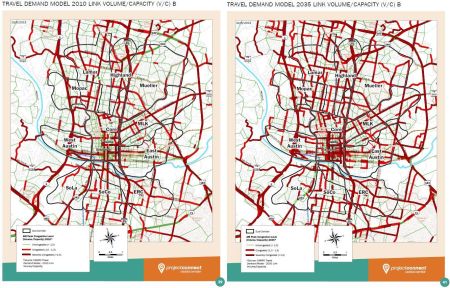
LEFT: Congestion by sector in 2015. RIGHT: Congestion by sector in 2035.

LEFT: Congestion by sector in 2015. RIGHT: Congestion by sector in 2035.

Some of this demographic and “misery” data could be relevant — if it were focused on actual travel corridors. The walking-distance “ridership watershed” of an inner-city transit corridor is usually about a mile either side of the the center of the corridor (which is usually a likely right-of-way for the proposed transit facility); this assumes an average pedestrian access of a half-mile to stations (within a 0 to one-mile range). Total population, density, employment, transit-dependency, income level, poverty, traffic congestion (especially in the directional flow pattern), and other indicators are all relevant within this travel corridor for assessing its potential.

Catastrophic methodological fault

However, there’s a much more fundamental (and disastrous) problem than either the configuration or the function of Project Connect’s designated sectors. Perhaps the most serious flaw in ProCon’s urban rail study methodology — actually, catastrophic, because it fundamentally impairs the integrity of the whole process — is that the actual travel corridors are not only basically ignored as workable corridors, but also are truncated and segmented by ProCon’s arbitrary slicing up of the urban area.

If you’re evaluating a travel corridor, you must evaluate the corridor as a whole — what it connects from, to, and in between; what the populations and densities along the corridor are; what activity centers it connects; and so on. All those are important, because they’re critical to what makes a transit line in that corridor actually feasible and worth investing in. For example, relevant to the “ERC” (“East Riverside Corridor”) sector is the eventual potential of an urban rail route to extend further east to the ABIA airport — but that’s not considered in this study.

Likewise, the possibility of extensions of a proposed Guadalupe-Lamar urban rail line further north on Lamar and northwest on the Capital Metro railway (i.e., converting MetroRail to electric urban light rail transit) would be crucial ingredients to the evaluation of a basic inner-city starter line. But this is prohibited by ProCon’s arbitrary sectionalization of the city (areas north of the “Central Corridor” belong to other “corridors”).

Similarly, the Guadalupe-Lamar route is severed just north of the UT-West Campus area at W. 29th St. In other words, most of this potential route is cut off from its highest-density population district as well as its most productive destinations in the core of the city!

What’s left is a “rump” route, from a few blocks south of U.S. 183 to W. 29th St., that seems to have little purpose beyond perhaps some kind of “shuttle” along this isolated route segment. If there were a prize for idiotic public transport planning, surely Project Connect would be very high on the candidate list.

Added to this seemingly heedless route segmentation is ProCon’s treatment of adjacent sectors as insular, isolated enclaves, whose demographics and other characteristics apply only to themselves. Likewise travel characteristics are treated in isolation, as if the population in all these different “enclaves” confine themselves to the sector boundaries that ProConn planners have established for them. Is it realistic to believe that residents of the “Highland” sector wouldn’t be allowed to hop a train on a Guadalupe-Lamar urban rail line, or that residents in the “West Austin” sector would be prohibited from catching a G-L train north to the Triangle area or Crestview?

Project Connect’s deformed “study”

Some of the most egregious problems with ProCon’s planning approach are summarized in the infographic below.

This inforgraphic summarized numerous major problems with Project connect's methodology.

This infographic summarizes numerous major problems with Project connect’s methodology. (Click to enlarge.)

As Austin Rail Now has noted previously, on Nov. 15th, the ProCon planning team are scheduled to recommend a sector (“sub-corridor”) as the basis for further urban rail planning. Given the dubious and even bizarre aspects of their methodology (and the occult nature of their process), predicting what their conclusion will be is somewhat like trying to predict whom the College of Cardinals would elect as a new pope.

In any case, this small analysis underscores that a truly realistic, rational urban rail study would want to look at the population, density, and other key indicators along Guadalupe-Lamar and other entire corridors. And furthermore, that a far more effective methodology for transportation corridor analysis needs to be implemented. So far, Project Connect seems to have made a mess of this process.

h1

Guadalupe-Lamar is highest-density corridor in Austin — according to Project Connect’s own data!

9 November 2013
Closeup of Project Connect's central Austin map of population density for 2010 shows intense clusters of density in West Campus, along Guadalupe above W. 29th St., and in Triangle area. Map: Rev. by LH from Project Connect.

Closeup of Project Connect’s central Austin map of population density for 2010 shows intense clusters of density in West Campus, along Guadalupe above W. 29th St., and in Triangle area. Map: Rev. by LH from Project Connect.

Even from the peculiarly selective and distorted data exhibited visually in Project Connect’s Map Books, it’s clear that the Guadalupe-Lamar (G-L) corridor currently has by far the highest concentration of population density within Austin central study area (and almost certainly the highest in the entire metro area). And this density appears predicted to persist in ProCon’s projection for 2030!

This density (pointed out decades ago by Lyndon Henry and Dave Dobbs as a pre-eminent justification for rail transit in this corridor) is shown in the following map graphics excerpted from the latest version (v. 5) of ProCon’s Map Book.


Central study area view

Population density in 2010 (G-L corridor spine in yellow). Map: Rev. by LH from Project Connect.

Population density in 2010 (G-L corridor spine in yellow). Map: Rev. by LH from Project Connect.

The map above shows the central-city study area (mislabeled by ProCon as a “Central Corridor”) with various sectors (mislabeled as “sub-corridors”) in 2010. The arterial spine of the G-L corridor (the most likely alignment for urban rail) is shown by a yellow line. Notice that heavy concentrations of high population density are clustered around the G-L corridor, particularly in the West Campus area, and just north of the campus, bordered by Guadalupe on the west and W. 29th St. on the south.


Population density projected for 2030 (G-L corridor spine in yellow). Map: Rev. by LH from Project Connect.

Population density projected for 2030 (G-L corridor spine in yellow). Map: Rev. by LH from Project Connect.

The map above shows the same study area and sectors, with population density concentrations projected for 2030. While these projections are far more subjective and tentative than actual current reality-based data, they do reflect speculation that extremely high density will not only intensify in 2030 in the same areas as it was located in 2010, but is expected to expand to other segments of the G-L corridor.


Guadalupe-Lamar focus

Composite of zoomed-in snips of Project Connect maps of population density. LEFT: 2010. RIGHT: 2030. Rev. by LH from Project Connect.

Composite of zoomed-in snips of Project Connect maps of population density. LEFT: 2010. RIGHT: 2030. Rev. by LH from Project Connect.

This composite focuses on population density the G-L corridor, showing density concentrations in 2010 on the left, and in 2030 on the right. Again, the probable alignment for urban rail is shown by a yellow line. This makes both the existing density and its projected intensification in the future even more obvious.


Conclusion

These data visualization maps clearly indicate that not only does the Guadalupe-Lamar corridor currently have extremely high levels of population density (as much as 30,000 persons per square mile in the West Campus) sufficient to support urban rail, but it surpasses all other corridors in the city! Furthermore, even in ProCon’s flawed analysis, this density is projected to intensify by 2030.

But this kind of bona fide corridor analysis counts for absolutely nothing in Project Connect’s “study”, because they’re not evaluating travel corridors such as Guadalupe-Lamar! They’ve been wasting taxpayer money on largely irrelevant studies of demographics and other conditions in isolated sectors while largely ignoring actual travel patterns in corridors into the core area, along with the demographics and other critical features along these actual corridors, such as G-L.

On Nov. 15th, the ProCon team are due to announce their “recommendation” for a sector (“sub-corridor”) as the location for urban rail … and it’s anybody’s guess as to what is the basis for their evaluation. But this small analysis we’ve just presented illustrates the actual kind of analysis of a travel corridor that official planners should be performing, and we suggest it as a far more effective model for the type of urban rail study this community actually should be supporting.

h1

Central Austin Combined Neighborhoods Planning Team endorses Guadalupe-Lamar for urban rail

3 November 2013
Central Austin Combined Planning Area. Map: CANPAC.

Central Austin Combined Planning Area. Map: CANPAC.

On October 21st, the effort to designate the Guadalupe-Lamar (G-L) corridor as the preferred route for urban rail (light rail transit, LRT) received a powerful boost with the endorsement of the Central Austin Combined Neighborhoods Planning Team (known as CANPAC), designated by the City of Austin to serve as the official neighborhood plan contact team for the Central Austin Combined Planning Area, involving seven major neighborhood associations:

  • West University Neighborhood Association
  • Hancock Neighborhood Association
  • Eastwoods Neighborhood Association
  • North University Neighborhood Association
  • Shoal Crest Neighborhood Association
  • Heritage Neighborhood Association
  • University Area Partners

These neighborhood associations are among the longest-established and most influential in the city.

The endorsement also emphasized that, unlike the G-L corridor, Red River St. — a link in the proposed semi-official route between downtown and the Mueller redevelopment site — lacks the projected future density necessary to adequately support light rail service. In contrast, density is considerably higher along the Guadalupe-Lamar corridor, especially in the West Campus neighborhood, which ranks variously as either the third or fourth-highest density residential area of major Texas cities.

CANPAC also notes that it is commissioned both by City ordinance and its own bylaws to implement Ordinance No. 040826-56, the Central Austin Combined Plan.

As CANPAC reported in an October 29th memo to Austin Mayor Lee Leffinwell, on October 21st the Central Austin Neighborhood Plan Advisory Committee passed the following resolution:

The Plan Team for the Central Austin Combined Neighborhoods Planning Area (CANPAC) has reviewed the two routes under consideration for the proposed light rail system through Central Austin, both of which pass through our combined planning area. We urge that placement of the routes be made where density already exists, along the Guadalupe-Lamar Corridor, as stated in our 2004 Central Austin Combined Neighborhoods Plan, and not along Red River, which is a residential area not projected for future density adequate to support light rail.

Image of memo conveying G-L endorsement from CANPAC to Austin Mayor Leffingwell.

Image of memo conveying G-L endorsement from CANPAC to Austin Mayor Leffingwell.

This is an extremely important endorsement of central Austin’s most important potential corridor for urban rail, and G-L supporters are strongly urged to convey news of this and other major endorsements to the Austin City Council and other important political and civic leaders.

Related endorsement: UT Student Government backs West Campus, Guadalupe-Lamar route for first phase of urban rail

h1

Huge problems cited with Project Connect’s urban rail study data

3 November 2013
Cover of Project Connect's Map Book version 4. Screen capture: L. Henry

Cover of Project Connect’s Map Book version 4. Screen capture: L. Henry.

One of the most serious flaws in Project connect’s urban rail study process — in which top-level officials and planners are trying to rush to a selection of an Austin city sector for an urban rail starter line on or about November 15th — is problems with data inaccuracy and outright omissions. Focused on designated alternative city sectors (misnamed “sub-corridors”), the study team has been compiling purported data on demographic and transportation features of each sector (such as population, density, transit ridership, etc.) in a series of data-visualization “Map Books” (each new one an update of the previous one).

Map Books rife with data problems

Meanwhile, as this blog reported in a previous posting, Scott Morris, head of the Central Austin Community Development Corporation (CACDC) has been relentlessly and tediously scrutinizing each volume of Map Book data. As we’ve noted “Scott has performed amazingly detailed and well-supported research into these data issues, and he has found and pointed to a lengthy array of dozens of mostly serious errors. A handful of these have been quietly rectified.”

By far, as the Oct. 27th article Project Connect admits major data error in Guadalupe-Lamar corridor study highlighted, “One of the most serious data anomalies that Scott has recently detected is the “disappearance” of virtually all the ridership for Capital Metro’s routes #1M/L and #101, the heaviest-ridership transit routes in the system, serving the G-L corridor as well as South Congress.” As the article reports, Project Connect has publicly admitted that error and corrected it in the next Map Book edition.

Map Book errors go uncorrected

However, an unacceptable large number of similar errors — predominantly erroneous data or outright omissions — remain. The following are just some of the most egregious problems in Map Book v. 2, still carried into v. 4, that Scott has found and cited in a listing submitted by CACDC to the Project Connect urban rail study team:

ARN1_CACDC_Prj-Con-MapBook4-errors1

Partial listing of major errors in Project Connect Map Book and other material identified by CACDC. Screen image: L. Henry.

Partial listing of major errors in Project Connect Map Book and other material identified by CACDC. Screen image: L. Henry.

New error problems with Map Book 4

Scott has appended a listing of major new problems appearing in Map Book Version 4; here’s a summary:

• All “B” Pages and Definition Packages
West University NPA/University Neighborhood Overlay Removed From Defined Sub-Corridors A large, dense city area to the west of the UT campus and Guadalupe Street was moved out of the North Lamar and Mopac Sub-Corridors by the Project Team in response to a request to include UT in the core. This change was made in the current map. We understand the reasoning in placing UT in the core, however the manner in which surrounding non-UT areas were moved with it will create large, unintended impacts on the sub-corridor evaluation process. That area is not a part of UT, nor in the opinion of West Campus residents, can it be adequately served by a San Jacinto alignment on the UT Campus. West University is the densest planning area of our city that also employs over 5,000 people (Non-UT). The area west of Guadalupe anchors the Guadalupe-North Lamar Sub-Corridor and includes the University Neighborhood Overlay and 3 residential neighborhoods that are components of a City of Austin Central Austin Combined Neighborhood Planning Area. West Campus is the largest population differentiator in our city for the purposes of sub-corridor analysis. In our opinion, it should not be considered a common element to the core joining the CBD, UT, and the Capitol Complex, unless it receives a similar commitment to service. In the end, if it is desired to count West Campus as part of the core, we should also count on serving it directly as part of the definition of the core.
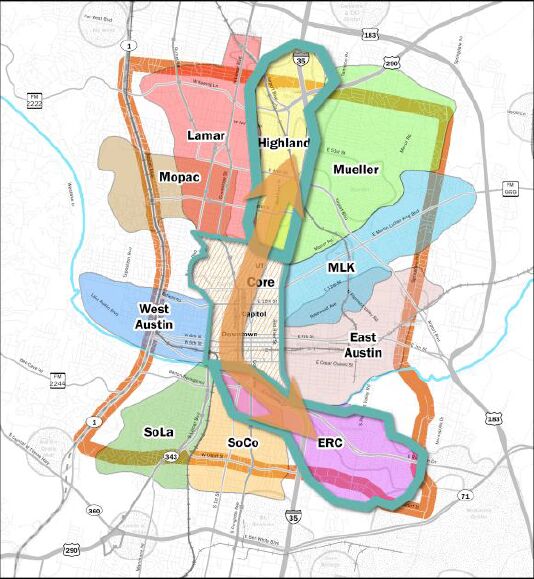
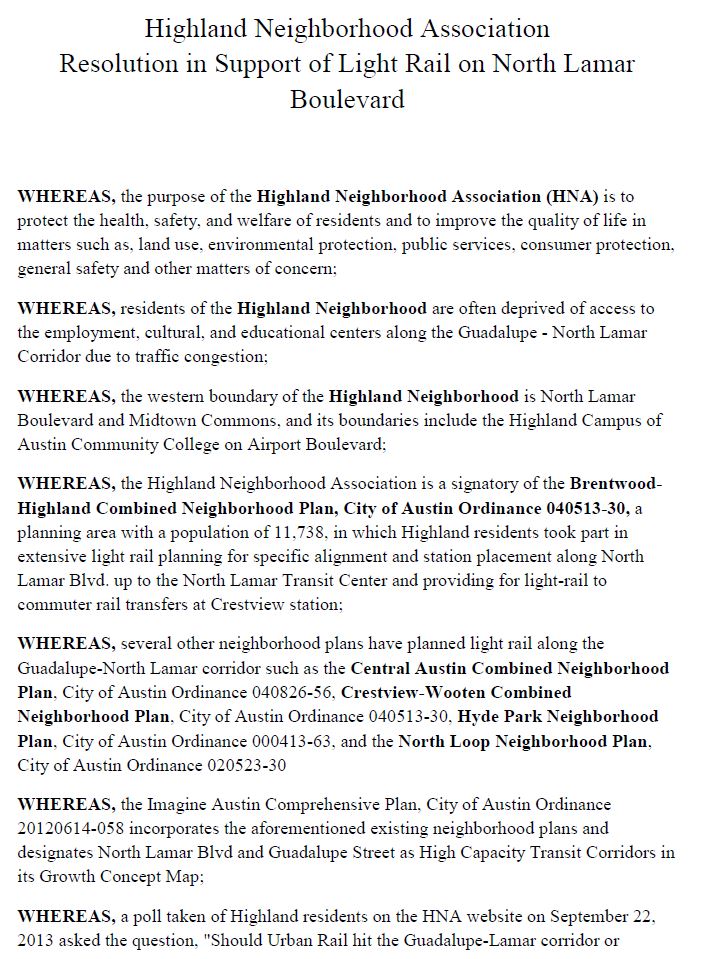
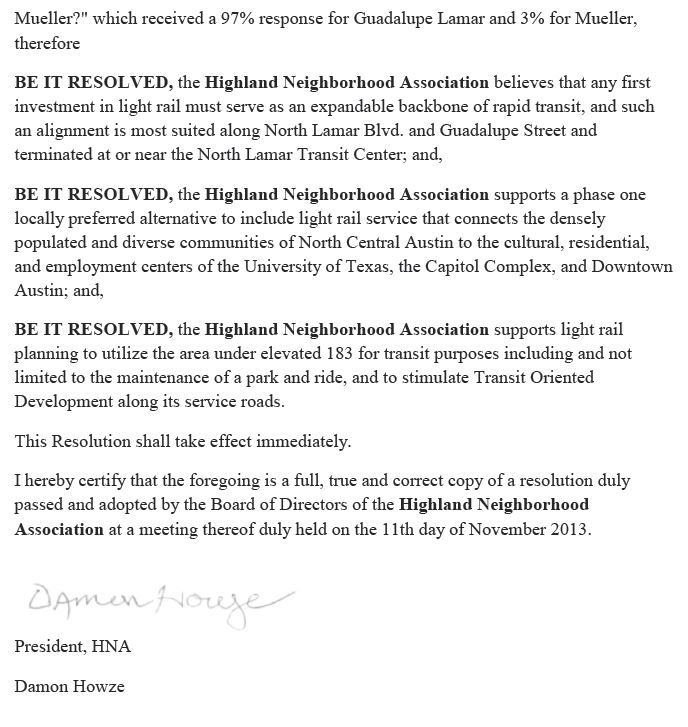
• Page 13 Employment Density with Major Employers
The State of Texas in the North Austin Complex has been omitted. It is the center of over 16,000 jobs within a 1/2 mile radius of 49th and N. Lamar. There is no purple symbol. Girling Healthcare is a small office, yet shows 2,225 employees in place of the TX Dept of Health.

• Page 28 Poverty, Vehicles, Affordable Housing
Hundreds of units of affordable housing in West Campus is not identified with the correctly-sized circle.

• Pages 36-37 Bus Ridership 2011
The North Lamar Transit Center has been cropped out of the frame. Much of the bus system for the northern half of the city has boardings there.

• Pages 55-59 Sub-Corridor Definition Package Lamar
Population Studies are not provided for North Lamar sub-corridor definition package.

• Pages 15-16. Employment Growth
Austin State Hospital should show >100% Growth. This is an identified P3.

• Pages 18-19 2010 Retail Employment Density
The Triangle is not identified as retail density.

• Pages 18-19 2010 Retail Employment Density
Koenig and N Lamar is not identified as retail employment density.

• Page 26 Population Growth 2010-2030
The growth projections that occur in an area north of 32nd St. South of 45th St east of Waller Creek, and west of Red River are too high. Per that neighborhood plan and numbers reflected in the zoning capacity studies, population growth should be a more modest 41% for the described area. This includes SF-3 zoning and the Hancock Golf Course, a dedicated park. http://centralaustincdc.org/land_use/Zoning_and_Capacity_Redev_Analysis_v11.pdf

• Page 30 Selected Land Use 2010
Adams Hemphill Park straddling 30th not identified as open space.

CACDC also provides data references as the basis for these corrections.

Summary

It’s understandable that some data problems will be encountered in almost any major study of this kind. What’s astounding, however, is the high number of problems in Project Connect’s urban rail study. Even worse is that almost all of them — even when identified — seem to be going uncorrected!

This seriously compromises the competency of this entire study process (and there are even more fundamental issues involved, as this blog will address). The data problem is especially threatening because data analysis is supposedly the foundation for decisionmaking to select an urban rail corridor; the Central Corridor Advisory Group (CCAG, whose recommendation is a key part of the process) is being led through a process of data scrutiny and analysis by Project Connect staff. Yet the Project Connect team — under duress from high-level local officials eager to force a quick decision on urban rail, and apparently overwhelmed by the need to rush to an imminent recommendation for the Austin City Council — seem merely to be “dumping” volumes of data with little regard for its reliability or relevance to the basic goal of selecting an urban rail route.

All of this calls into question just how “fair and balanced” — and accurate, reliable, and truly data-based — the process of comparatively evaluating alternative urban rail corridors and plans actually is.

What the final outcome will be, and whether its integrity will be accepted by the Austin public and voters in particular, remains to be seen.