Archive for the ‘Guadalupe-Lamar corridor’ Category

h1

Project Connect admits major data error in Guadalupe-Lamar corridor study

27 October 2013
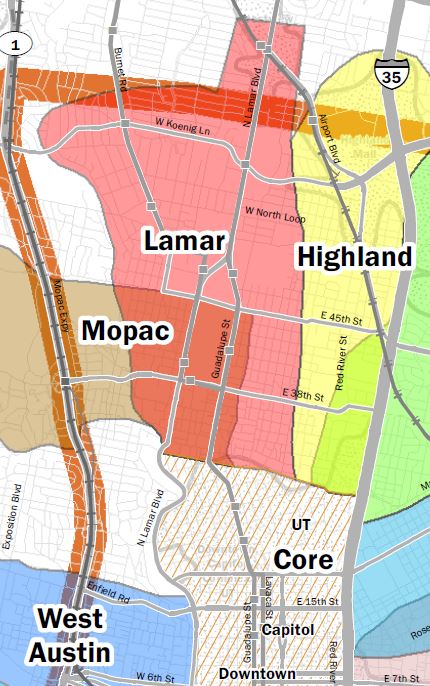
Snippet of Project Connect's much larger "Central Corridor" map (actually, the central-city study area) shows "Lamar" sector (in orange, dubbed a "sub-corridor" in Project Connect's peculiar nomenclature) plus several adjacent sectors. Actual Guadalupe-Lamar travel corridor includes both the Lamar and Core sectors, but each sector is being evaluated in isolation.

Snippet of Project Connect’s much larger “Central Corridor” map (actually, the central-city study area) shows “Lamar” sector (in orange, dubbed a “sub-corridor” in Project Connect’s peculiar nomenclature) plus several adjacent sectors. Actual Guadalupe-Lamar travel corridor includes both the Lamar and Core sectors, but each sector is being evaluated in isolation.

The Project Connect urban rail planning team has been conducting a nominal study of designated alternative “sub-corridors” for urban rail (they’re actually not “corridors”, but sectors of the central-city study area). In the process, the agency has been compiling purported data (covering key indicators for each “corridor”, or study sector, such as population, density, transit ridership, etc.) in a series of so-called Map Books (each one an update of the previous one).

Meanwhile, tirelessly and tediously scrutinizing each volume of Map Book data has been the self-appointed task of Scott Morris, head of the Central Austin Community Development Corporation (CACDC), which, together with Texas Association for Public Transportation, has been advancing the case for the Guadalupe-Lamar travel corridor as the most effective alignment for Austin’s proposed urban rail starter line. Scott has performed amazingly detailed and well-supported research into these data issues, and he has found and pointed to a lengthy array of dozens of mostly serious errors. A handful of these have been quietly rectified.

One of the most serious data anomalies that Scott has recently detected is the “disappearance” of virtually all the ridership for Capital Metro’s routes #1M/L and #101, the heaviest-ridership transit routes in the system, serving the G-L corridor as well as South Congress. This was cited in a listing of nearly three dozen data problems submitted by CACDC to the Project Connect urban rail study team:

v4 Comment 29 High
Pages 36-37 Bus Ridership 2011
According to the 2020 service plan in January 2010, the #1 North Lamar and the #101 had over 17,000 daily boardings combined. But, this chart seems to omit nearly all boardings for the Guadalupe-North Lamar Corridor.

At last, Project Connect has publicly admitted at least one of the numerous errors that have been published in the series of Map Books. Responding mainly to criticism by Jace Deloney, one of the leaders of Austinites for Urban Rail Action (AURA, which supports a transparent, open, and fair route evaluation process), on October 22nd Project Connect issued a statement acknowledging the erroneous ridership data, which it says resulted from “populating” the map (data visualization graphic) with the “wrong data field”. A screen capture of the statement is shown below.
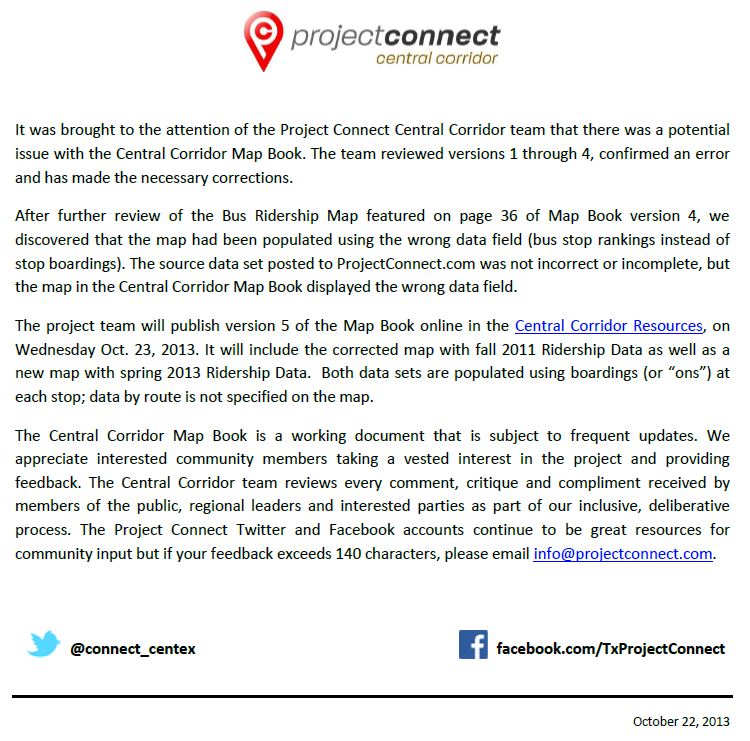
Project Connect statement admits major error in transit ridership data for Lamar-Guadalupe corridor.

Project Connect statement admits major error in transit ridership data for Guadalupe-Lamar corridor.

Data errors, in particular large ones like this, are especially serious because the selection of a “corridor” (actually, a sector of the huge central-city study area) depends critically on key data factors, including existing transit ridership in a given corridor.
h1

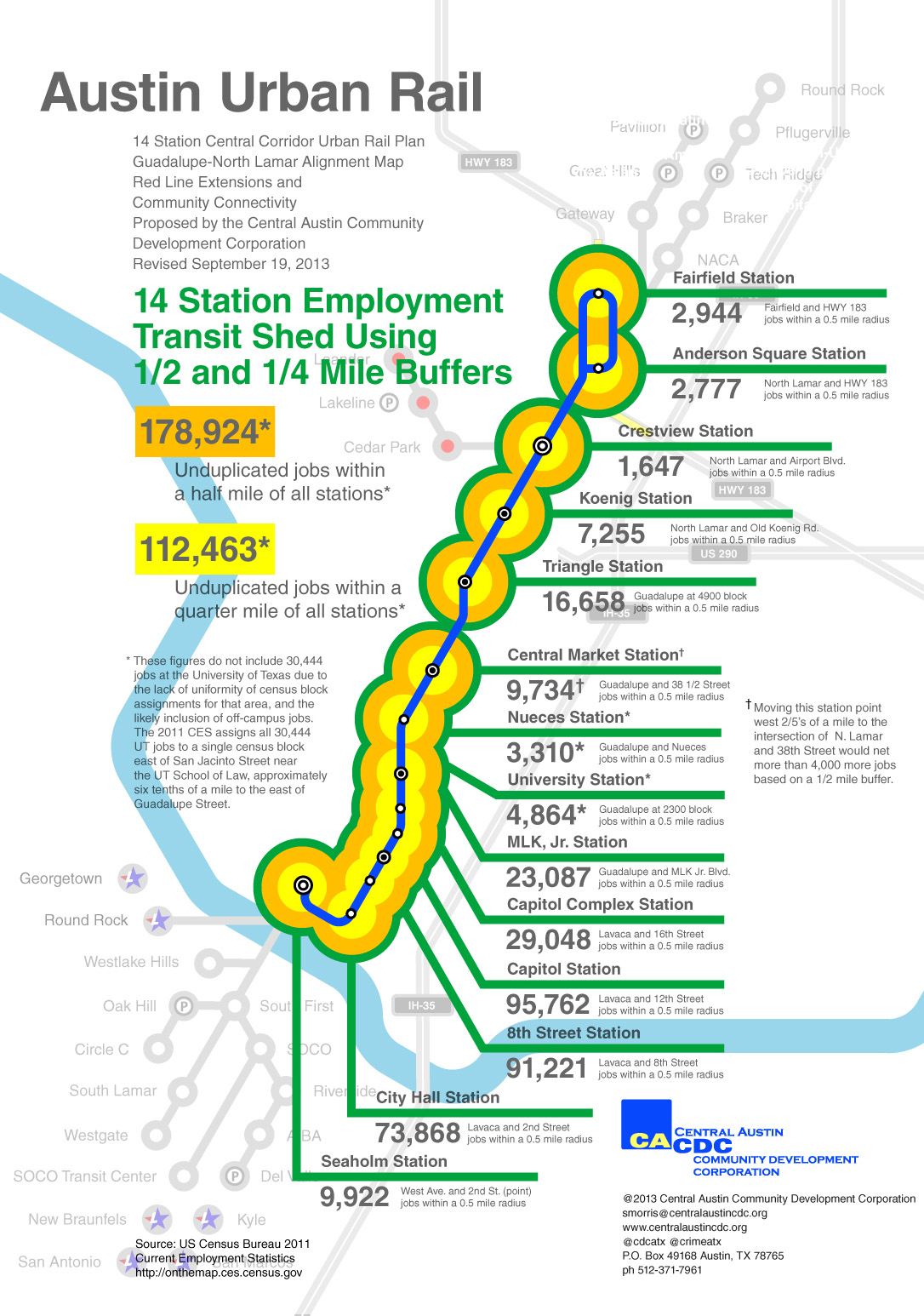
Guadalupe-Lamar urban rail line would serve 31% of all Austin jobs

24 October 2013

ARNx0_CACDC_map_Austin-Urban-Rail-Employment-Centers-2013-snip

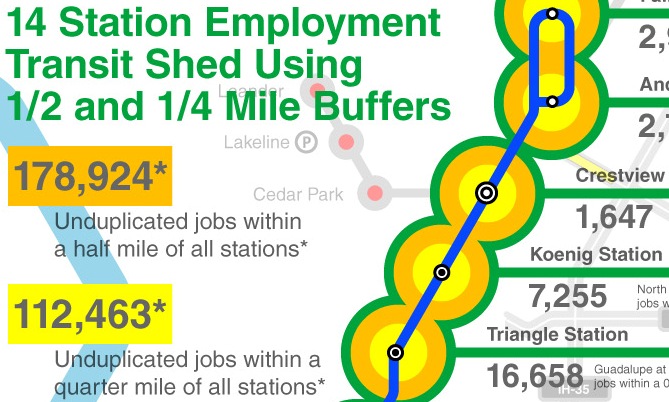
An urban rail line installed in the Guadalupe-Lamar (G-L) corridor (plus a short extension to the Seaholm area) would provide high-quality, high-capacity transit service to nearly one-third of all Austin jobs, according to a study based on 2011 U.S. Census data by the Central Austin Community Development Corporation (CACDC), led by Scott Morris.

ARNx1_CACDC_map_Austin-Urban-Rail-Employment-Centers-2013

The CACDC’s Austin Urban Rail website presents a map of a possible alignment on Guadalupe-Lamar, including 14 stations with locations optimized by the census employment data. The CACDC study says that that the On The Map online census utility “was used to measure jobs located within one quarter mile and one half mile of each proposed station point.”

According to the U.S. Census Bureau, Center for Economic Studies 2011 Current Employment Statistics, the Guadalupe-North Lamar Sub-Corridor contains the highest density of jobs in the city. … The results speak for themselves. If built, the Guadalupe North Lamar alignment would put tracks within a ten minute walk of over 31% of all jobs in the city.

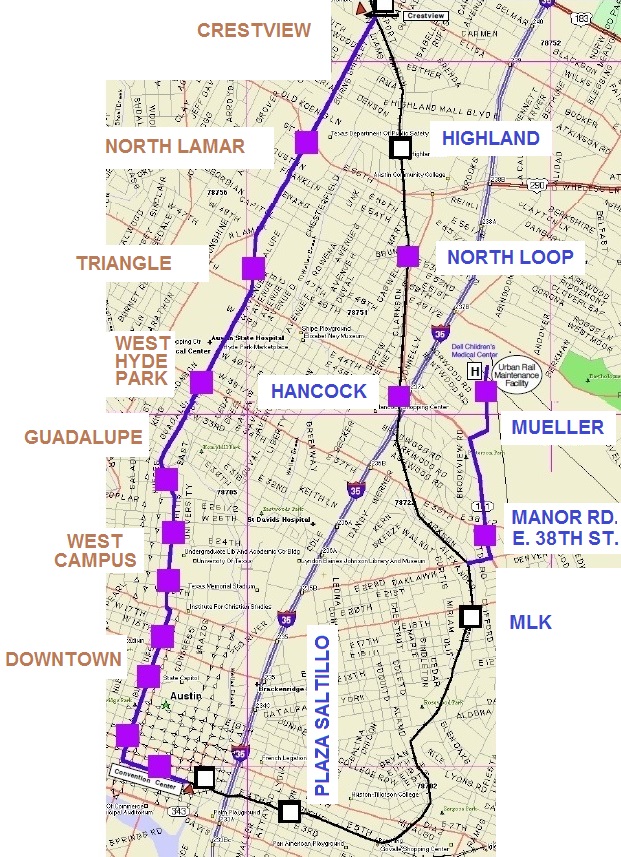
One can infer that, if the G-L corridor route were combined with the proposed conversion of the eastside Red Line to electric urban rail (light rail transit) as proposed by Texas Association for Public Transportation — a proposal which includes a spur line into the Mueller site and Northeast Austin — it’s plausible to speculate that the total system would possibly provide access to as many as 40 to 50% of city jobs. And, in addition, serve the huge ACC campus developing at Highland.

TAPT proposes "loop" line, with routes on both Guadalupe-Lamar and eastide through converting the MetroRail line to electric light rail — plus a spur to Mueller.

TAPT proposes “loop” line, with routes on both Guadalupe-Lamar and eastside through converting the MetroRail line to electric light rail — plus a spur to Mueller.

h1

Petition — “I want to ride LIGHT RAIL on Guadalupe/North Lamar!”

18 October 2013
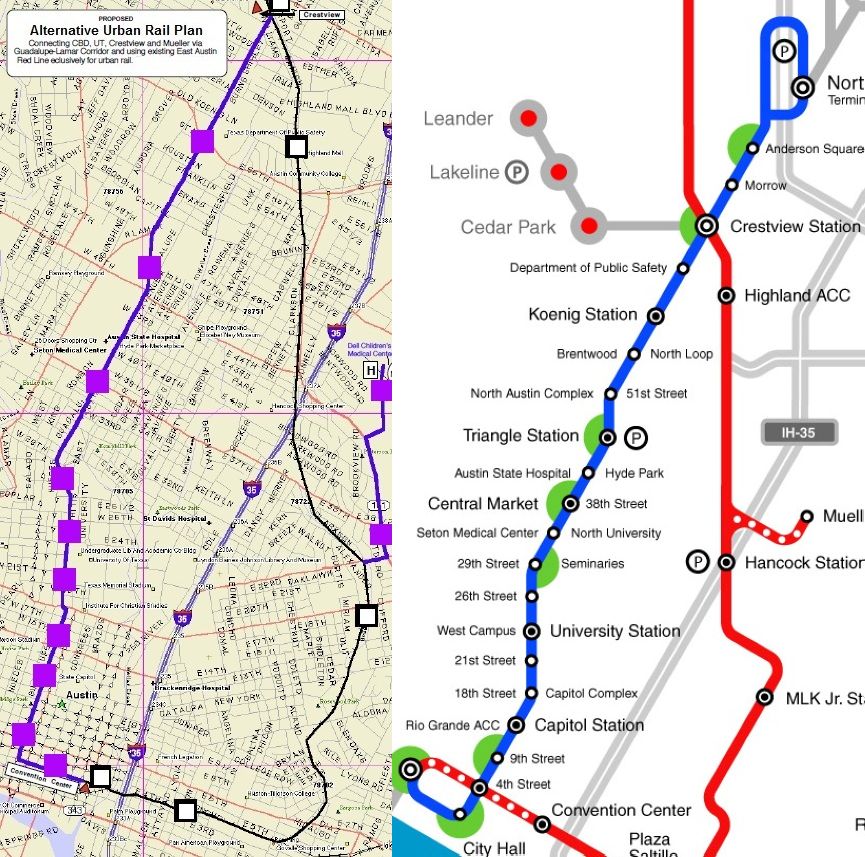
TAPT plan (left) and CACDC plan (right) both propose Guadalupe-Lamar as the major focus of Austin's Phase 1 urban rail starter line.

TAPT plan (left) and CACDC plan (right) both propose Guadalupe-Lamar as the major focus of Austin’s Phase 1 urban rail starter line.

Take your pick — the Texas Association for Public Transportation (TAPT) plan, or the Central Austin Community Development Corporation plan — or maybe even another plan for Guadalupe-Lamar (G-L)! — but be sure to sign the CACDC’s petition telling the Austin City Council and involved public transportation agencies you want a light rail transit (LRT) line on the G-L corridor where it belongs!

Wording:

Petitioning The Austin City Council, the boards of Capital Metro, Lone Star Rail, and the Capital Area Metropolitan Planning Organization, and the Federal Transit Administration.

I want to ride LIGHT RAIL on Guadalupe/North Lamar!

Petition by Central Austin Community Development Corporation

Add your (digital) signature here:

https://www.change.org/petitions/i-want-to-ride-light-rail-on-guadalupe-north-lamar#share

h1

No urban rail on Guadalupe-Lamar? Then get ready for bus lanes…

18 October 2013
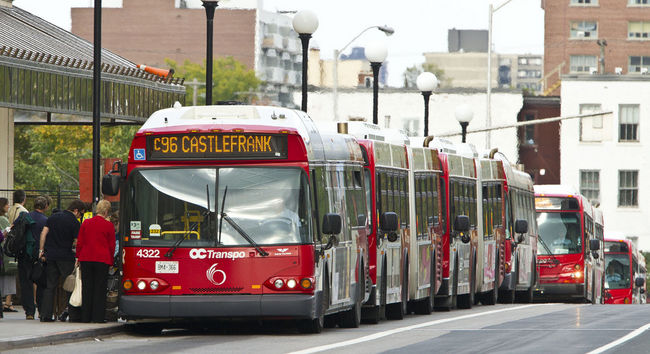
Ottawa's "BRT" Transitway delivers a "conga line" of buses onto urban streets. Photo: Errol McGhion.

Ottawa’s “BRT” Transitway delivers a “conga line” of buses onto urban streets. Photo: Errol McGhion.

by Dave Dobbs and Lyndon Henry

Which kind of transit — urban rail or buses in special lanes — do you want to see on Guadalupe-Lamar?

Not to decide is to decide.

It’s crucial that Austin’s first urban rail (starter) line be a whopping success. This means it must serve the heart of the city in its heaviest-traffic corridor, with its highest densities and employee and employment concentrations, and its most long-established neighborhoods. The Guadalupe-Lamar corridor offers the ideal alignment for an affordable, cost-effective surface light rail alignment.

It’s also important to understand that if we don’t get light rail transit (LRT) on Guadalupe and North Lamar, we most certainly will get dedicated bus lanes within the next 10 years. A major project to overhaul the corridor by installing infrastructure for battalions of MetroRapid buses is waiting in the wings if urban rail is not implemented. This alternative, not requiring a public vote, would produce a far less efficient, adequate, and attractive system, seriously degrade urban conditions, and result in a less livable environment compared with urban rail.

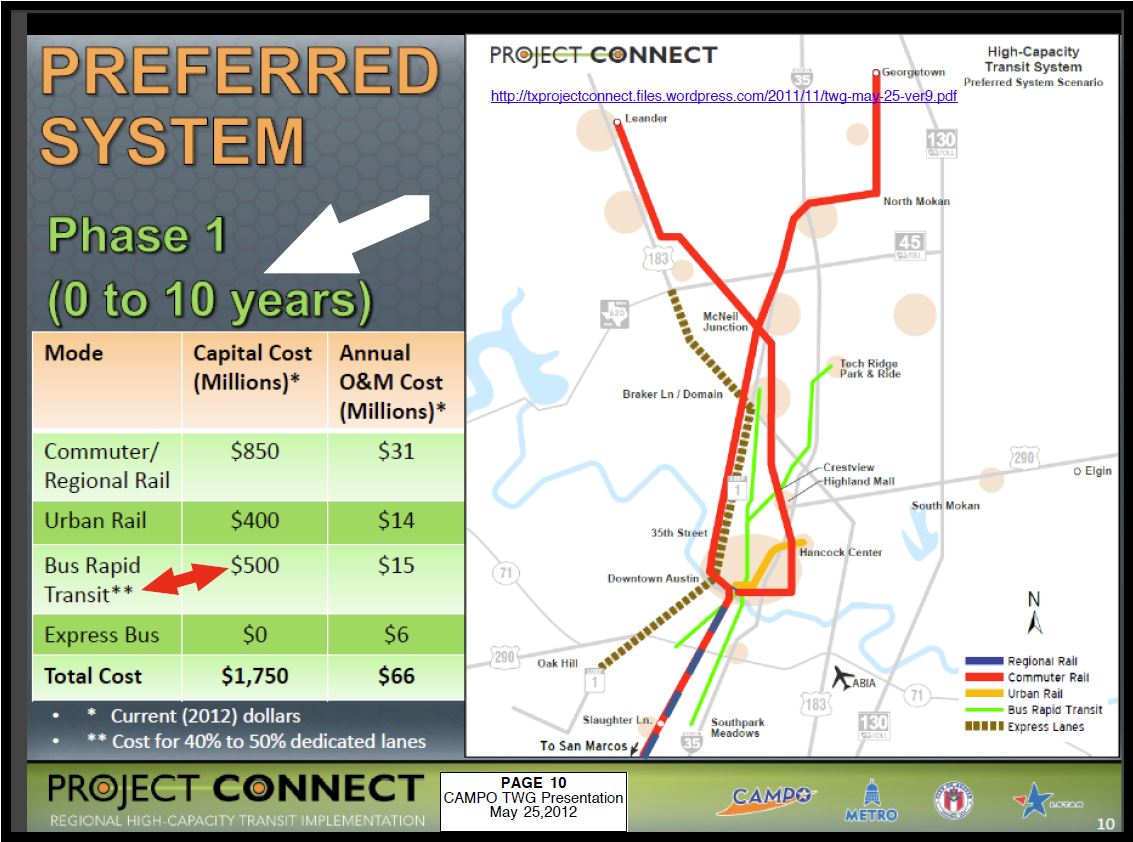
This package of so-called “Bus Rapid Transit” (“BRT”) projects — whereby MetroRapid buses would enter stretches of dedicated bus lanes, and then merge back and forth, into and out of mixed general traffic — was first raised publicly in a Project Connect/City of Austin Transportation Department presentation made in City Council chambers on 25 May 2012 to the CAMPO Transit Working Group (TWG). Shown below is page 10 of that presentation, with arrows pointing to the relevant information.

Excerpt from Project Connect presentation in May 2012 indicating planned $500 million package for MetroRapid "BRT" facilities, including Guadalupe-Lamar. Graphic: Project Connect.

Excerpt from Project Connect presentation in May 2012 indicating planned $500 million package for MetroRapid “BRT” facilities, including Guadalupe-Lamar. Graphic: Project Connect.

These dedicated lanes will be built with 80% federal money, will not require an election, will be vetted publicly only at art gallery-style “open houses”, and approved by boards and commissions, the Capital Metro Board, and the Austin City Council, and then they will be built, unless we implement urban rail in the Guadalupe-North Lamar corridor. And keep in mind that — unlike the current minimalist MetroRapid project — this level of hefty physical investment in roadway infrastructure will become a de facto obstacle to any future rail project in the corridor.

These dedicated bus lanes are the official plan as things currently stand.

There are numerous drawbacks with premium buses, and even “BRT”, compared with LRT. Just to cite a couple:

• LRT on average is significantly more cost-effective than bus operations.

• Buses don’t attract nearly as much ridership as LRT, but as ridership starts to reach higher volumes, bus traffic and overwhelming “conga lines” of buses cause more problems … plus more queues of riders start to slow operations.

Another bus "conga line" leaving downtown Brisbane, Australia to enter busway.

Brisbane, Australia: More “conga lines” of buses travel on reserved lanes between the city’s downtown and a busway. Photo: James Saunders.

If you would prefer urban rail instead of a major bus lane project in Guadalupe-Lamar, it’s essential to speak up and act. Let neighborhood groups and other community organizations know what official plans have in store for this corridor. Sign petitions being circulated to support urban rail on G-L. Communicate to Project Connect and members of Austin City Council that you want to ride urban rail on Guadalupe-Lamar, running in reserved tracks, not just a souped-up bus service weaving in and out of special lanes.

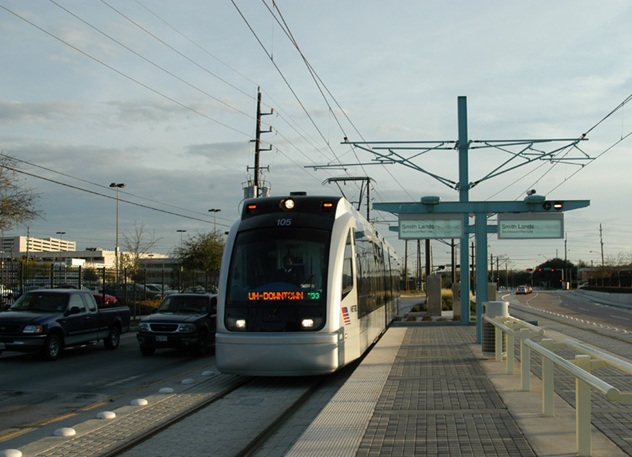
Houston's MetroRail demonstrates that LRT can attract and carry more passengers faster, more effectitly and safely, more cost-effectively than high-capacity bus operations. Photo: Peter Ehrlich.

Houston’s MetroRail demonstrates that LRT can attract and carry more passengers faster, more effectively and safely, and more cost-effectively than high-capacity bus operations. Photo: Peter Ehrlich.

h1

UT Student Government backs West Campus, Guadalupe-Lamar route for first phase of urban rail

12 October 2013
West Campus neighborhood is area in light green just to west (left) of the Drag (Guadalupe, vertical white line just to right of center). UT campus shown in orange. Map: The Galileo, rev. by ARN.

West Campus neighborhood is area in light green just to west (left) of the Drag (Guadalupe, vertical white line just to right of center). UT campus shown in orange. Map: The Galileo, rev. by ARN.

The effort to reset Austin’s urban rail planning focus onto the Guadalupe-Lamar (G-L) corridor got a huge boost on October 1st with the University of Texas Student Government’s passage of a resolution endorsing a West Campus and Guadalupe-Lamar corridor alignment for the Phase 1 starter line of urban rail — thus implicitly rejecting the officially proposed East Campus alignment and route out to the Mueller redevelopment site.

Designated as AR 15, the resolution contains a number of “Whereas” clauses, with meticulous documentation of the facts and arguments underpinning the basic decisions. For example, the resolution notes that

…Future-use plans for neighborhoods that include significant student populations, including the Brentwood/Highland Combined Neighborhood Plan , the North Loop Neighborhood Plan, Central Austin Combined Neighborhood Plan, and Hyde Park Neighborhood Plan support urban rail and stations along the proposed Guadalupe-Lamar alignment; and,

… there has been over $30 million worth of studies that have looked at the feasibility of light rail transit along the Guadalupe-Lamar Corridor since the 1970s; and,

… A 2011 study at the University of California-Berkeley found that “light-rail systems need around 30 people per gross acre around stations and heavy rail systems need 50 percent higher densities than this to place them in the top one-quarter of cost-effective rail investments in the U.S.” and “the ridership gains from such increases…showed, would be substantial, especially when jobs are concentrated within ¼ mile of a station and housing within a half mile”; and,

… the largest concentration of students living off campus, West Campus, is the third-densest population district in the state of Texas with a density of over 25,000 people per square mile; and,

… a large majority of the student population along with a vast majority the Central Austin population lives along the proposed Guadalupe-Lamar alignment, totaling over 54,000 people within a quarter-mile to proposed stations ….

On the basis of this evidentiary background, declares the resolution,

BE IT RESOLVED, That the Student Government of the University of Texas at Austin is in full support of the first phase of light rail running through the Guadalupe-Lamar Sub-Corridor; and,

BE IT FURTHER RESOLVED, That Student Government will support any proposed urban rail line that prioritizes transportation access to where students are currently living….

The full resolution can be accessed as a DOC file:

UT-Stu-Govt_AR 15 – In Support of The Guadalupe-Lamar SubCorridor as Phase I of Austin Urban Rail

Certainly, if this vote by UT’s Student Government is any guide, the majority of UT students want an urban rail route to serve the West Campus, where they can most effectively use it.