Archive for 2015

h1

Minneapolis light rail — possible model for Austin

30 December 2015
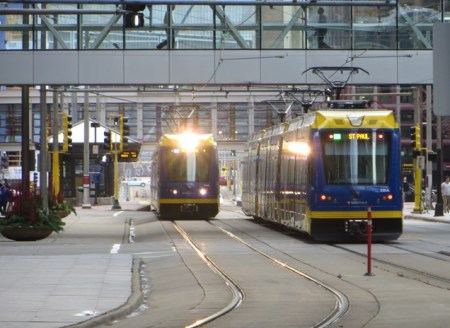
Two light rail trains pass on 5th St., a major downtown east-west thoroughfare with dedicated lanes for light rail. Photo: L. Henry.

In downtown Minneapolis, two light rail trains pass on 5th St., a major east-west thoroughfare with dedicated lanes for light rail. Photo: L. Henry.

Last month, the 13th National Light Rail Conference, co-sponsored by the American Public Transportation Association (APTA) and U.S. Transportation Research Board (TRB), was held in Minneapolis, whose initial light rail transit (LRT) starter line has been operating since 2004 (see «Minneapolis-St. Paul (Twin Cities) Public Transport»). Attending the conference were two contributors to Austin Rail Now, Dave Dobbs and Lyndon Henry.

Minneapolis’s LRT system has been a spectacular success — particularly by exceeding ridership projections and providing more efficient and cost-effective transit service through lowering the average operating and maintenance (O&M) cost of urban transit per passenger-mile. Add to that the significant improvement of urban mobility and livability. This has convinced local policymakers and planners that further investment and expansion of the system are justified, leading to the opening of a second route, crossing the Mississippi River and connecting the Twin Cities of Minneapolis and St. Paul, Minnesota, in 2014. Additional routes are now in development, and the Northstar Line, a regional passenger rail (commuter) line serving northwest suburbs and exurban communities, was also launched in 2009. See: «Minneapolis Area: Northstar Regional Rail Links Northwest Communities With Central City».

Overall, the Minneapolis LRT system appears to be a highly appropriate model for other cities — and especially Austin, where community support has been growing for an LRT starter line project in the Guadalupe-Lamar corridor (Guadalupe St.-North Lamar Blvd.). (See «Plan for galvanizing Austin’s public transport development: Light rail starter line in Guadalupe-Lamar».) As with Minneapolis’s original starter line, Austin’s Guadalupe-Lamar LRT line could serve as the trunk or spine for additional lines branching out into other segments of the urban area.

This article/photo-essay presents a brief summary description of the Minneapolis LRT system and focuses especially on particular features that highlight why LRT is such an exceptionally appropriate and desirable public transport mode for a city like Austin.

Overview

So far, the Twin Cities LRT system extends approximately 23 miles, mainly south and east of central Minneapolis, as illustrated in the map below.
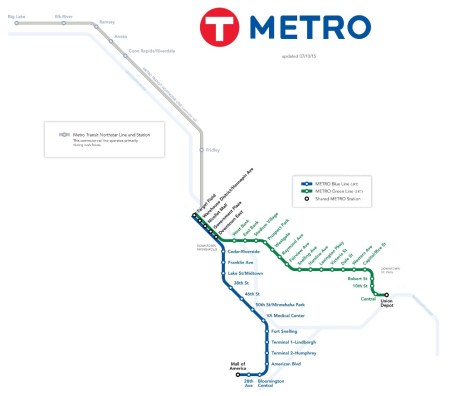

Map of Minneapolis Metro Transit rail transit system shows Blue and Green LRT Lines plus Northstar regional rail line (grey) to the northwest. Map adapted by ARN from Metro Transit map. (Click to enlarge.)

Map of Minneapolis Metro Transit rail transit system shows Blue and Green LRT Lines plus Northstar regional rail line (grey) to the northwest. Map adapted by ARN from Metro Transit map. (Click to enlarge.)


Blue Line — Originally dubbed the Hiawatha Line because much of its alignment uses a former railroad right-of-way (ROW) paralleling the city’s Hiawatha Avenue, the initial route (opened 2004) is now designated the Blue Line. Extended slightly, it now stretches about 12 miles south from the city’s downtown to the airport and terminates at the Mall of America. In the CBD, generally from the Downtown East station west, the Blue Line runs in dedicated lanes within 5th Street — in effect, a quasi-transit-mall configuration with some access allocated to motor vehicles (see photo at top of post).
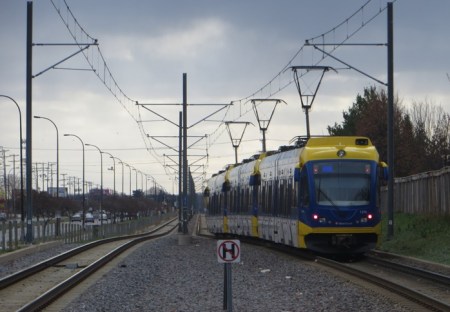
Outside the city's core area, much of the Blue Line alignment, running on former freight railroad right-of-way, parallels Hiawatha Avenue, seen on the far left in this view. Photo: L. Henry.

Outside the city’s core area, much of the Blue Line alignment, running on former freight railroad right-of-way, parallels Hiawatha Avenue, seen on the far left in this view. Photo: L. Henry. (Click to enlarge.)
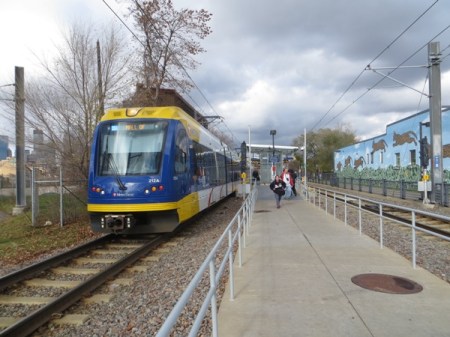

Blue Line train at Cedar-Riverside station, closer in to the CBD, where the former railroad ROW is quite narrow. This is similar to the narrow railroad ROW of Austin's MetroRail (Red Line), which ARN and other groups have advocated to be converted to LRT (from its current status as a diesel-propulsion light railway). LRT's electric propulsion enables faster, smoother train operation that is less costly, cleaner, and friendlier to urban livability.

Blue Line train at Cedar-Riverside station, closer in to the CBD, where the former railroad ROW is quite narrow. This is similar to the narrow railroad ROW of Austin’s MetroRail (Red Line), which ARN and other groups have advocated to be converted to LRT (from its current status as a diesel-propulsion light railway). LRT’s electric propulsion enables faster, smoother train operation that is cheaper, cleaner, and friendlier to urban livability. (Photo: L. Henry.)


Green Line — Also called the Central Line, this 11-mile route (opened 2014) crosses the Mississippi River to link the downtowns of Minneapolis and St. Paul. It also re-establishes what was once the Twin Cities’ formerly busiest streetcar route, part of the region’s vast, efficient electric rail system destroyed in the 1950s amidst the widespread national Transit Devastation, when public policy eliminated urban and interurban electric railways in a disastrous effort to encourage (and coerce) the American population to rely exclusively on personal automobiles and other rubber-tired transport (buses) rather than urban and interurban electric rail for mobility.

In contrast to the Blue Line, the Green Line is routed almost entirely via dedicated lanes or reservations within major arterials and other thoroughfares, with a particularly long stretch along University Avenue west of the Mississippi and toward St. Paul. In the Minneapolis CBD, the Green Line shares dedicated tracks on 5th St. with the Blue Line. Also of note is the use of the iconic Washington Avenue bridge (retrofitted to accommodate LRT) to cross the Mississippi River, as discussed further below.
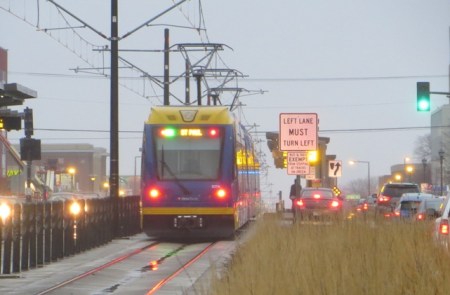

Green Line alignment in median of University Avenue. Photo: L. Henry.

Green Line alignment in median of University Avenue. Photo: L. Henry.


Joint use of 5th St. trunk line — As mentioned above, both the Blue and Green Lines share tracks of the original 5th St. trunk route in downtown Minneapolis. A section of this alignment is illustrated in the photo at the top of this post. The following photo shows one of the stations in this alignment.
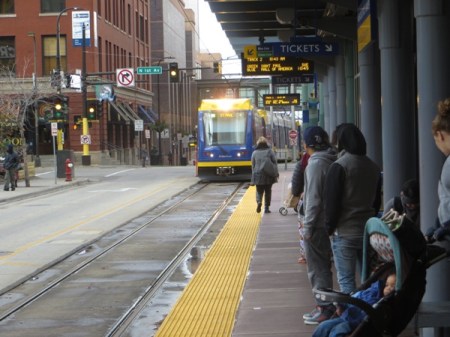

Passengers awaiting arrival of Green Line train at downtown Warehouse District/Hennepin Avenue station in 5th St. alignment. Photo: L. Henry.

Passengers awaiting arrival of Green Line train at downtown Warehouse District/Hennepin Avenue station in 5th St. alignment. Photo: L. Henry.


Self-service fare system — As with most new LRT systems, the Minneapolis operation uses self-service fare collection. Passengers purchase tickets at ticket vending machines (TVMs). Roving inspectors then spot-check passengers’ tickets aboard trains. (Austin’s MetroRail also uses the self-service system.)
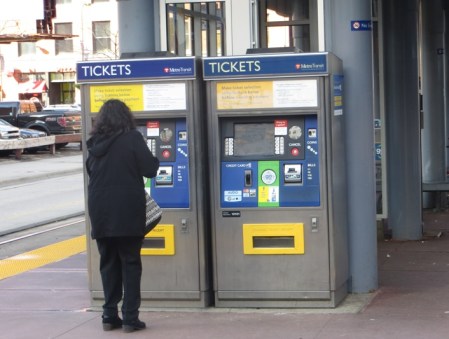

Passenger purchases ticket from TVM at downtown station. Photo: L. Henry.

Passenger purchases ticket from TVM at downtown station. Photo: L. Henry.


Rail access/interconnections among major activity centers — The Twin Cities LRT system is outstanding in accessing and interconnecting some of the urban area’s most significant activity centers. These include, for example:

• Downtown Minneapolis
• Downtown St. Paul
• Minneapolis-St. Paul International Airport
• Twin Cities Amtrak station (Union Depot, St. Paul)
• University of Minnesota (St. Paul)
• Minnesota state capitol (St. Paul)
• VA Medical Center
• Major shopping malls (Mall of America and University Ave. West/Hamline Ave.)
• Target Field sports center

Airport access

LRT can provide a cost-effective way to implement rail access to a city’s major local airport. However, typically the heaviest airport ridership tends to come from employees rather than passengers, so to be cost-effective the LRT route must also serve other significant sources of ridership close by (exemplified by LRT routes to airports in Baltimore, St. Louis, Portland, Phoenix, Seattle, Dallas, and Salt Lake City).

Minneapolis’s Blue Line LRT strongly fulfills this requirement, since its airport stations are situated in the middle of good traffic generators on both sides (between the CBD on the north end and the Mall of America on the south end, with other activity centers and residential areas also in between). From visual observation, it’s clear that lots of passengers and airline crews utilize the convenience of the LRT connection.
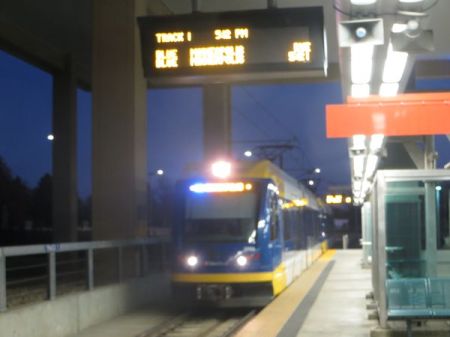

Blue Line train arriving at Airport Humphrey Terminal station. Photo: L. Henry.
Blue Line train arriving at Airport Humphrey Terminal station. Photo: L. Henry.


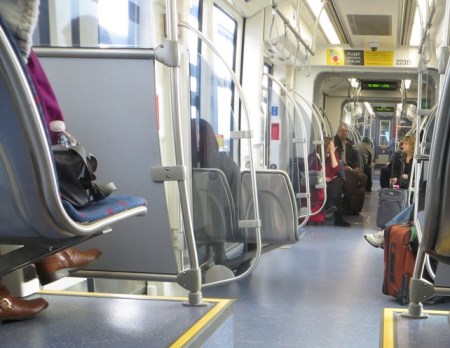
Lots of visible baggage on Blue Line train gives an indication that LRT service to Minneapolis's airport is well-used by air passengers. Photo: L. Henry.

Lots of visible baggage on Blue Line train gives an indication that LRT service to Minneapolis’s airport is well-used by air passengers. Photo: L. Henry.
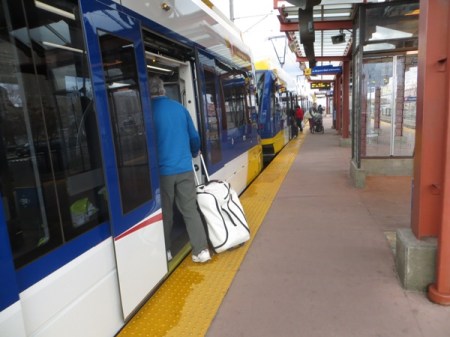

Traveler with baggage boards Blue Line train at downtown station. With level boarding (station platform level with car floor), carrying on luggage is easy. Photo: L. Henry.

Traveler with baggage boards Blue Line train at downtown station. With level boarding (station platform level with car floor), carrying on luggage is easy. Photo: L. Henry.


Shopping mall access

Access to shopping malls is a major advantage for any rail transit line, and a huge convenience for the public (especially out-of-town visitors). The Minneapolis LRT system provides access to malls in both Bloomington (south of Minneapolis) and St. Paul.
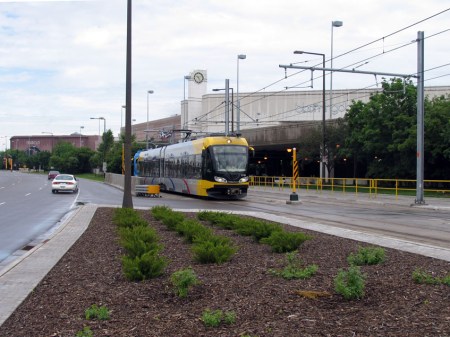

Blue Line train leaves the Mall of America station located in the parking garage of this mall, which hosts the most mall visitors  in the world and is a popular tourist destination. Photo: Ymtram.mashke.org.

Blue Line train leaves the Mall of America station located in the parking garage of this giant mall, which hosts the most mall visitors in the world and is a popular tourist destination. Photo: Ymtram.mashke.org.
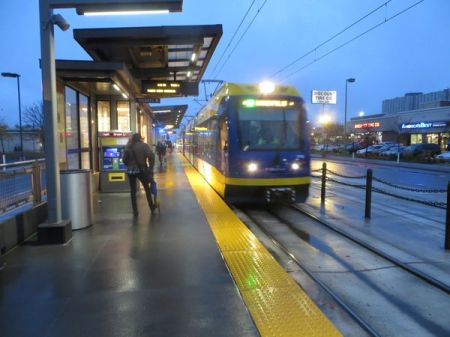

Green Line's Hamline station accesses major mall on University Ave. at West/Hamline Ave., with two "big box" stores (Walmart and Target). Photo: L. Henry.

Green Line’s Hamline station accesses major mall on University Ave. at West/Hamline Ave., with two “big box” stores (Walmart and Target). Photo: L. Henry.


Bridge retrofitted for LRT

To cross the Mississippi River, the Green Line uses the iconic Washington Avenue bridge, rather than a specially built bridge. According to the Minneapolis Metro Council, retrofitting the bridge rendered “cost savings to the project estimated at $80 million to $100 million and a minimum of two years in project schedule in comparison to a full bridge replacement.” The bridge was retrofitted “for an estimated $21 million, $2 million under budget….”

In Austin, ARN and other groups have advocated retrofitting either the Congress Avenue or South First (Drake) bridge to cross Lady Bird Lake (Colorado River) and link South Austin to the rest of the city on the north side of the river. We suggest this would be far more financially accessible and cost-effective than the expense of a totally new, specially constructed bridge.
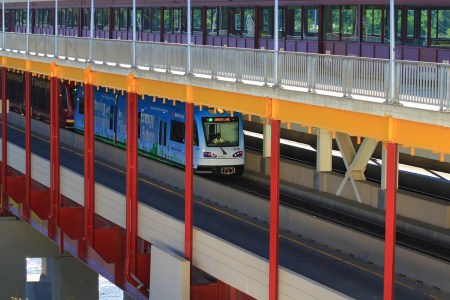

Green Line train crosses over Mississippi River on newly retrofitted Washington Ave. bridge. Photo: Streets.mn.

Green Line train crosses over Mississippi River on newly retrofitted Washington Ave. bridge. Photo: Streets.mn.


Solution to complicated intersections

Somewhat like Austin’s MetroRail alignment along Airport Blvd., the Minneapolis Blue Line along Hiawatha Avenue encounters design challenges at intersections, especially where these approach at an angle. How these problems have been dealt with may suggest some traffic solutions in Austin with respect to a potential intersection of road traffic with a proposed Guadalupe-Lamar LRT at Airport/North Lamar.
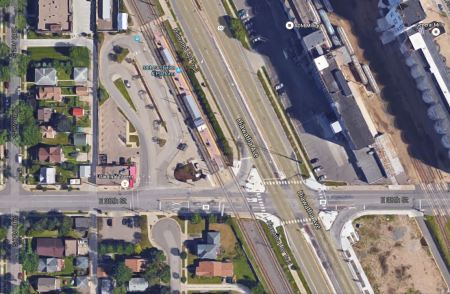

In this Google Earth view, Hiawatha Ave., with the LRT line paralleling it on its western edge, runs diagonally north-south through the center of the photo. The 38th St. LRT station can also be seen, while E. 38th St. crosses both LRT line and Hiawatha Ave. east-west, in the bottom third of the graphic. Note that Hiawatha and the LRT line intersect E. 38th St. at about a 60-degree angle, somewhat similarly to Airport Blvd and N. Lamar and the MetroRail Red Line in Austin. Photo: ARN, from Google Earth.
In this Google Earth view, Hiawatha Ave., with the LRT line paralleling it on its western edge, runs diagonally north-south through the center of the photo. The 38th St. LRT station can also be seen, while E. 38th St. crosses both LRT line and Hiawatha Ave. east-west, in the bottom third of the graphic. Note that Hiawatha and the LRT line intersect E. 38th St. at about a 60-degree angle, somewhat similarly to Airport Blvd and N. Lamar and the MetroRail Red Line in Austin. Photo: ARN, from Google Earth.


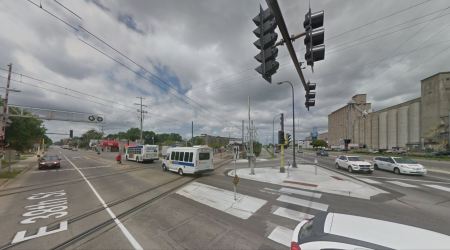
From a surface view, this shows the intersection protected with crossing gates. Photo: ARN, from Google Street View.

From a surface view, this shows the intersection protected with crossing gates. Photo: ARN, from Google Street View.


Easy transport of bicycles

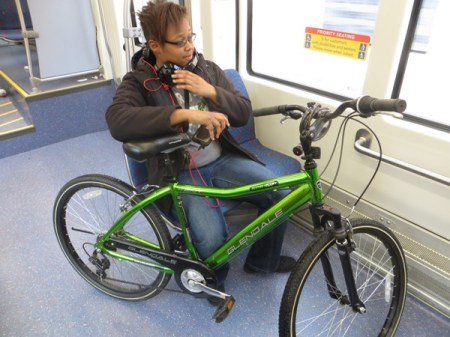
With typically spacious vehicles, LRT has the advantage of accommodating onboard bicycles, in contrast with the constrained interior space of buses, which usually require cyclists to place their bikes on an outside rack (if one is available). These views show how bikes are accommodated aboard Twin Cities LRT trains.
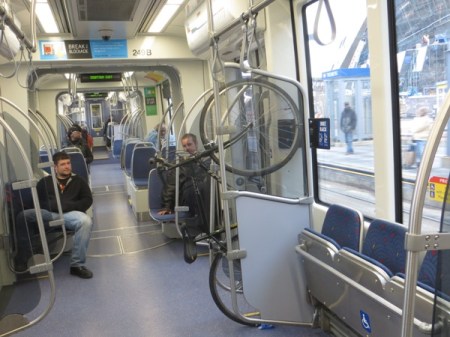

Bikes can be hung on special racks inside the LRT cars. Photo: L. Henry.
Bikes can be hung on special racks inside the LRT cars. Photo: L. Henry.


In some cases, smaller bikes are simply held by the passenger. Photo: L. Henry.

In some cases, smaller bikes are simply held by the passenger. Photo: L. Henry.


Easy accessibility for mobility-challenged

Level boarding, spacious interiors, and smooth ride qualities mean that LRT cars are exceptional in their ability to accommodate disabled, wheelchair-using, and other mobility challenged passengers. This also means that long delays in boarding wheelchairs, typical of buses, are eliminated, thus speeding transit service for all.
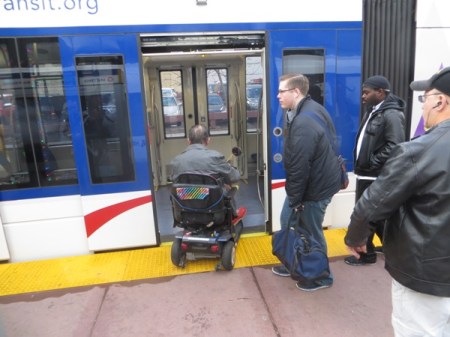

Passenger in wheelchair boards train at downtown station. Photo: L. Henry.
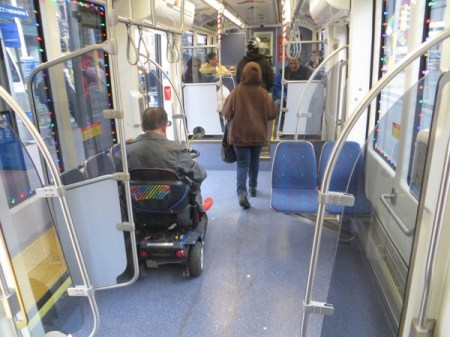
Passenger in wheelchair boards train at downtown station. Photo: L. Henry.


Passenger in wheelchair easily maneuvers chair into accessible space aboard car. In contrast to buses — no tiedowns, no operator assistance needed, no passengers ousted from their seats!  Photo: L. Henry.

Passenger in wheelchair easily maneuvers chair into accessible space aboard car. In contrast to buses — no tiedowns, no operator assistance needed, no passengers ousted from their seats! Photo: L. Henry.


Summing up

Certainly, a reasonable case can be made for considering Minneapolis (along with Portland, Salt Lake City, Phoenix, and several other cities) as a particularly appropriate model for designing an LRT system for Austin, starting in the Guadalupe-Lamar corridor. As this discussion/photo-essay has attempted to suggest, smart, cost-effective design can be combined with significant public transit conveniences and advantages to galvanize public support, attract significant ridership. improve mobility and urban livability, and reduce the cost burden of urban travel. ■
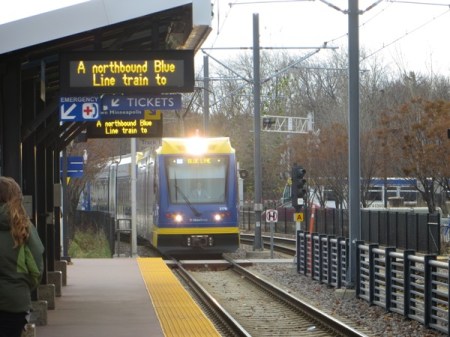

Blue Line train approaches station along Hiawatha Avenue alignment. Photo: L. Henry.
Blue Line train approaches station along Hiawatha Avenue alignment. Photo: L. Henry.

h1

Another major Austin community recommendation for light rail transit in Guadalupe-Lamar

12 November 2015
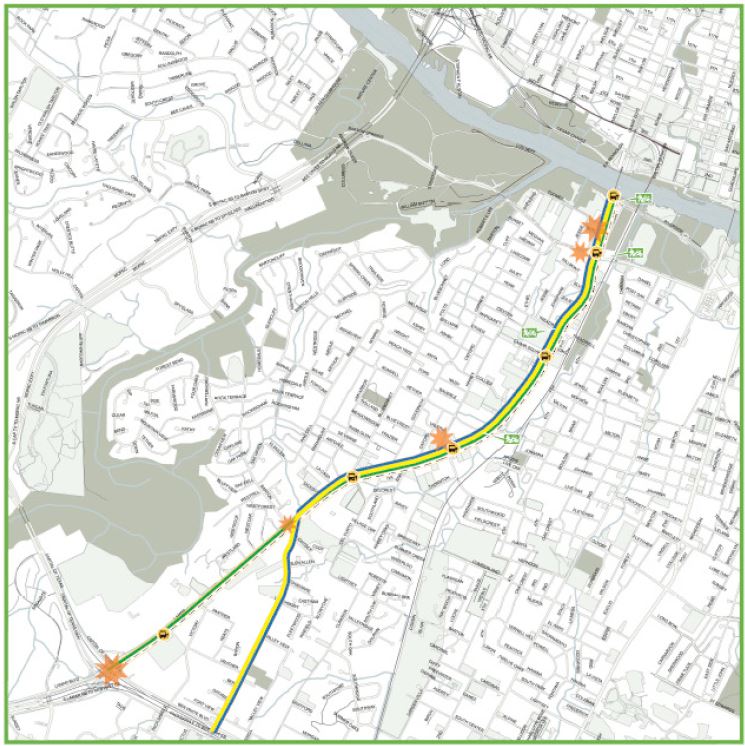
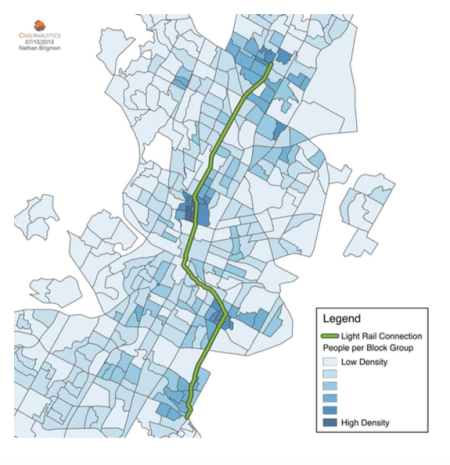
Light rail transit alignment following North Lamar Blvd., Guadalupe St., Riverside Dr., and Pleasant Valley Rd. as proposed by MobilityATX.

Light rail transit alignment following North Lamar Blvd., Guadalupe St., Riverside Dr., and Pleasant Valley Rd. as proposed by MobilityATX.

The prospect of a light rail transit (LRT) starter line project in the Guadalupe-Lamar corridor has received another huge boost in a recommendation from MobilityATX, an eminent Austin-focused civic organization that describes itself as “a community-engagement initiative sponsored by both public and private community partners that invites the public to create and shape public policy solutions to Austin’s transportation woes.” The recommendation for Guadalupe-Lamar light rail is included as one of ten “Popular Ideas” resulting from a community input process in the spring and summer of 2015, elaborated in a Mobility ATX Findings Report produced by Glasshouse Policy “in conjunction with community partners and stakeholders …” and packed with supportive factual documentation. The report was originally released in mid-October.

As the report relates, “Part of the MobilityCity umbrella initiative, MobilityATX is a privately-funded online and in-person platform for all Austinites to explore discrete topics that impact Austin mobility.” And regarding the background of the report: “Lasting from April to July, MobilityATX curated a conversation by inviting the public, Austin community leaders, regional transportation brands, mobility influencers and regional employers to join this effort to turn citizen-sourced priorities into effective policy solutions.”

The report’s proposed LRT alignment, shown in its map at the top of this post (see above), includes the Guadalupe-Lamar segment (which we’ve consistently advocated as the most feasible LRT starter line), then crosses Lady Bird Lake (the Colorado River) to include a possible line branching into southeast Austin. The proposed route follows North Lamar Blvd. and Guadalupe St. (and presumably the Guadalupe-Lavaca street pair downtown), then crosses the river via a bridge that appears to be roughly located parallel to either the South First St. (Drake) Bridge, or the Congress Avenue Bridge — or possibly it involves an adaptation of either bridge to include lanes for LRT (as we’ve also proposed).

Heading southeast, the proposed route appears to follow Riverside Drive, then turns southward to follow Pleasant Valley Road and then other unspecified alignments south of Ben White Blvd. (State Highway 71). Population density levels shown on the route map indicate that areas of high density are connected by the alignment.

In presenting the proposal, the report notes that

Despite two major defeats for light rail in recent history, it’s clear that there is sustained community interest in exploring and developing an expansive light rail system in Austin. According to the 2015 Zandan Poll of Austin-area residents, 63% of respondents would favor seeing an increase in taxes to construct an above ground rail system. In addition, Austin’s commuter rail line, the MetroRail Red Line, has seen dramatic increases in ridership. …

We must get cracking on planning a light-rail line that will serve the greatest number of riders on day one, and going forward. We can’t give up on light rail just because the city floated a bad plan and voters shot that bad plan down. Bus Rapid Transit is not a substitute.

(Emphasis added in above quotations. Original quote implied that MetroRail began operation in 2008; in actuality, MetroRail opened in spring of 2010.)

Supported by a consortium of leading civic “partners”, including the Downtown Austin Alliance, the Greater Austin Chamber of Commerce, Capital Metro (the region’s transit authority), RECA (the Real Estate Council of Austin), Leadership Austin, the Central Texas Regional Mobility Authority, the Austin Monitor (online news media), and a variety of mainly tech-involved businesses and other organizations, MobilityATX clearly represents much of the top civic leadership of the city. (See complete list of partners in the graphic below, from the Findings Report).

Mobility ATX/Glasshouse Policy partners. Graphic: MobilityATX Findings Report.

Mobility ATX/Glasshouse Policy partners. Graphic: MobilityATX Findings Report.

In his Foreword to the report, City of Austin Mayor Steve Adler emphasized:

As Austin rapidly evolves, we must continually innovate new approaches to engage Austinites in the discussions that shape City policy. Given the participation in the MobilityATX initiative, it’s clear Austinites are anxious to contribute their ideas for transforming mobility, and how it impacts our commutes, our economy, and our lives.

The final Glasshouse Policy report on this process provides me, my colleagues on the Austin City Council, private employers, public agencies, and all Austinites, with a new community perspective from which to approach our shared mobility challenge. We need to add this perspective to those gathered from other community engagement efforts to
ensure that we hear from all Austinites in every district as we plan for our mobility future. I’d also like to thank the array of public and private stakeholders for their vision and support of this effort, including business, government, and civic leaders like RideScout CEO Joseph Kopser, Dewitt Peart of the Downtown Austin Alliance, and Capital Metro CEO Linda Watson.

Each of you who took part in MobilityATX confirmed that all Austinites have something to say and deserve a forum in which to say it. I look forward to working with the MobilityATX partners to ensure Austin leads the global conversation on what constitutes a smarter, more connected city, and continues to reflect the innovators and entrepreneurs that call Austin home.

Mobility ATX’s LRT recommendation notes that

After the defeat of Proposition 1 in November, there has been no significant movement to develop a new light rail plan for Austin. In order to build new light rail in Austin, bond funding would have to be secured for a new plan. There is no official public effort underway to develop a new light rail plan.

Austinites are anticipating that city and regional transportation authorities will develop a new plan for a light rail system, a process that should include sustained and inclusive community input in the planning and development of that system. Beyond all other data collected, the expectation of inclusion is most critical to understanding Austin’s evolving mobility constituency.

And it concludes with what seems a call for action (emphasis added):

Contact your Council Member. Like the Bicycle Master Plan, building a light rail line requires a bond election. In order for a bond to appear on the ballot, City Council must vote to put that bond proposal up to popular vote. Once City Council does that, a simple majority in a popular election is required to pass the bond proposal.

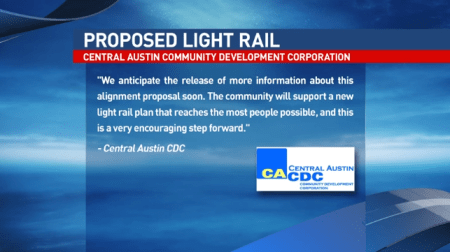
The MobilityATX Findings Report has been received enthusiastically by proponents of Guadalupe-Lamar light rail, including Texas Association for Public Transportation, Austin Rail Now, and the Central Austin Community Development Corporation (CACDC), which have long advocated for such a project. A report on KEYE-TV News included a graphic (see below) with an excerpt from a CACDC statement that commented, in part, “The community will support a new light rail plan that reaches the most people possible, and this is a very encouraging step forward.”

CACDC statement applauding Mobility ATX report, as shown on KEYE-TV News. Screenshot: ATXRail.

CACDC statement applauding Mobility ATX report, as shown on KEYE-TV News. Screenshot: ATXRail.

Hopefully, the MobilityATX report’s recommendation will add significant momentum to the ongoing campaign for an initial LRT starter line project in the crucial Guadalupe-Lamar travel corridor. ■

h1

Austin’s competing growth factions both continuing on road to worsening congestion

25 October 2015
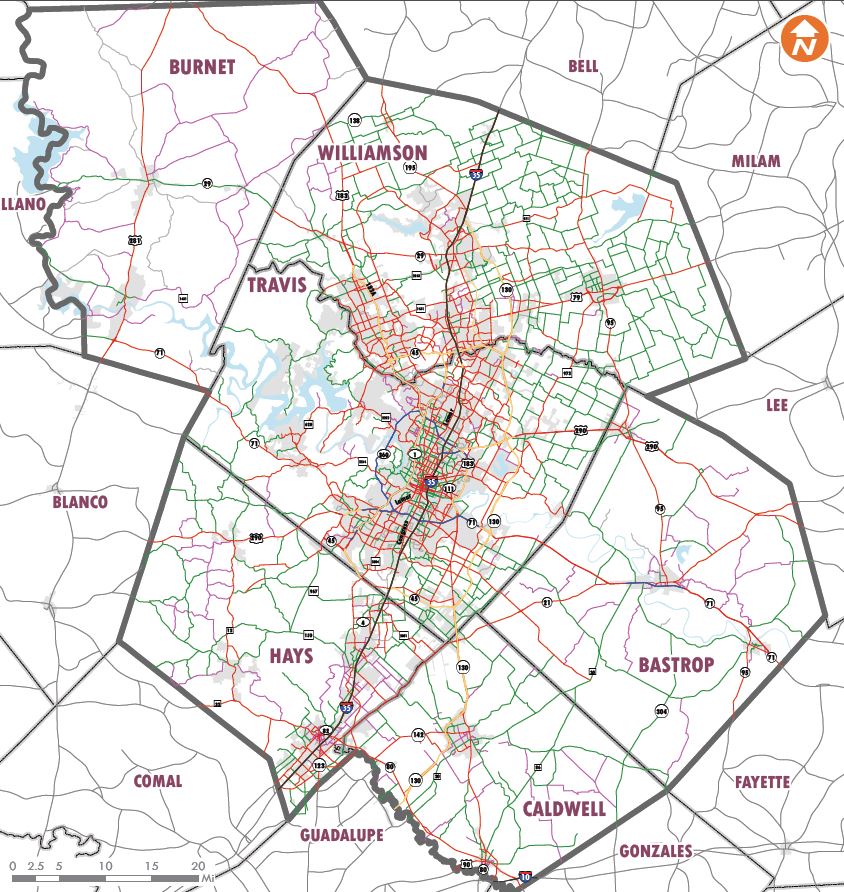
CAMPO's 2040 regional roadway plan emphasizes expanding web of roadways catering to real estate development, intensifying addiction to private motor vehicle travel, and accelerating sprawl. Map: CAMPO 2040 Draft Plan.

CAMPO’s 2040 regional roadway plan emphasizes expanding web of roadways catering to real estate development, intensifying addiction to private motor vehicle travel, and accelerating sprawl. Map: CAMPO 2040 Draft Plan.

By Roger Baker

Roger Baker is a longtime Austin transportation, energy, and urban issues researcher and community activist. The following commentary has been adapted and slightly edited from his comments recently posted by E-mail to multiple recipients.

Most Austin folks still don’t know it (and how could they without much good investigative reporting?) but there is actually a behind-the-scenes struggle being conducted by two Austin-area real estate coalitions with quite different visions — a contest conducted through the agency of our federally mandated transportation planning body, Capital Area Metropolitan Planning Authority, or CAMPO.

For the time being, the more influential growth alliance which benefits from roads and more roads to serve Austin-area sprawl development has won out. There is also a distinctly different group of landed beneficiaries centered around a transition to high-level transit as the future mode choice. This policy difference is basically a long-lasting political battle between two politically influential real estate development coalitions doing normal business under somewhat unique circumstances.

Texas is a “property rights” fundamentalist state, in which unregulated land development is the rule in about the only U.S. state without county zoning. In light of this fact, it is easy to imagine why this land development policy difference would arise. Sometimes the development strategies of these coalitions coincide and at other times they don’t. But they are in complete solidarity when it comes to their support for maintaining maximum Austin-area tech-job-led population growth forever. The impossibility of doing that, as is now being planned by CAMPO, makes Texas politics all the more colorful and interesting.

Let us call these development coalitions first the “sprawler growthers” more closely allied with RECA (Real Estate Council of Austin), and with fast land deal profiteering their uppermost consideration. The other policy bloc is the “transit growthers“, more allied with the Chamber of Commerce and Project Connect, based on somewhat more of a long-term sustainable growth vision. The latter transit-supportive, somewhat smarter-growth coalition recognizes that with congestion becoming a major challenge to maintaining Austin’s tech-based growth, and buses caught up in the same congestion, this leaves only old-fashioned, high-level rail to serve on travel corridors like Lamar/Guadalupe. There is no other way to maintain what still remains of Austin’s severely degraded peak hour travel mobility.

Former Austin Mayor Lee Leffingwell was forced by RECA, which is the more sprawl oriented development coalition, to include $400 million in roads into his rail bond package, which ballooned it to a full billion dollars, using up all the city’s remaining high-grade bonding ability, and likely priming it for defeat. With the defeat of the billion-dollar bond package election in November 2014, and with the recent approval of the heavily sprawl-oriented CAMPO plan favored by TxDOT and the Central Texas Regional Mobility Authority (CTRMA), the sprawl-growth faction now has the upper hand. They are proceeding to build and widen roads as fast as their increasingly limited finances allow, as I’ve recently reported in a Rag Blog article:

http://www.theragblog.com/roger-baker-metro-risky-business-in-central-texas-the-toll-road-bond-gamble/

The recent Travis County support for bringing the Rocky Mountain Institute into the Austin area planning process to tackle Austin congestion can’t change this unhappy reality very much. Nothing can solve problems that really stem from decades of anarchistic sprawl development, and at this late stage in the urban development process.

Now that Uber has created and promoted software that undermines certain traditional inefficiencies of the taxicab industry, there isn’t much to be done there. Capital Metro has gotten a new app that makes it possible for riders to track buses, but these buses are still largely trapped in congestion at peak, which remains their main problem. Squeezing what advantages are left to develop through wider use of telecommuting to eliminate physical travel might help some, but new breakthroughs in that area are getting hard to find.

Much slower regional growth will no doubt win out as the obvious resolution in the end. When things can’t go on any longer, they don’t. ■

h1

Dedicated transit lanes on Austin’s Drag must be designed for light rail

29 September 2015
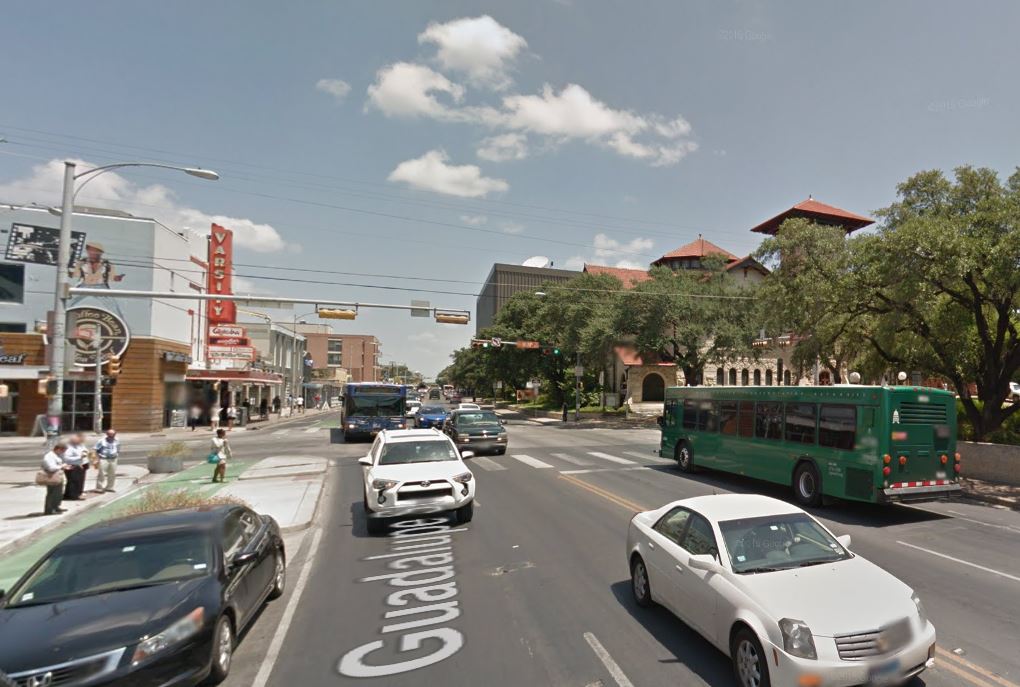
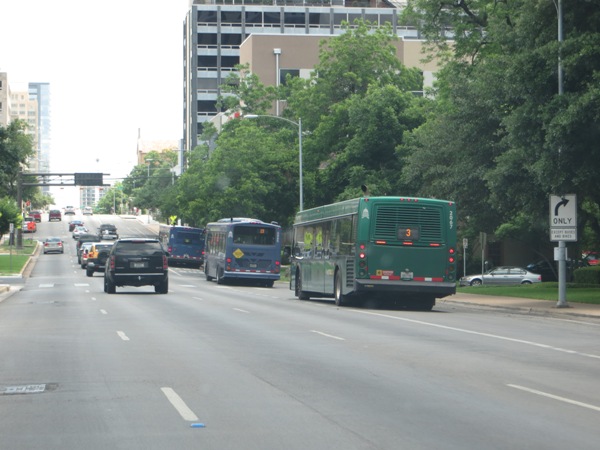
Busy section of Austin's Drag, Guadalupe St. at W. 24th St. Official city planning by CTR has proposed curbside transit lanes, with buses running on outside lanes as seen in this photo. (Screenshot from Google Streetview.)

Busy section of Austin’s Drag, Guadalupe St. at W. 24th St. Official city planning by CTR has proposed curbside transit lanes, with buses running on outside lanes as seen in this photo. (Screenshot from Google Streetview.)

By Lyndon Henry

The following commentary has been adapted and expanded from remarks posted to an online Austin rail discussion. Lyndon Henry is a transportation planning consultant, a technical consultant to the Light Rail Now Project, an online columnist for Railway Age magazine, and a contributing editor to Austin Rail Now. He is also a member of the Light Rail Technical Forum and Streetcar Subcommittee of the American Public Transportation Association (APTA). His comments highlight the vision of Austin Rail Now and other transit advocates that light rail is justified in, and needs to be planned for, a number of the Austin area’s major travel corridors.

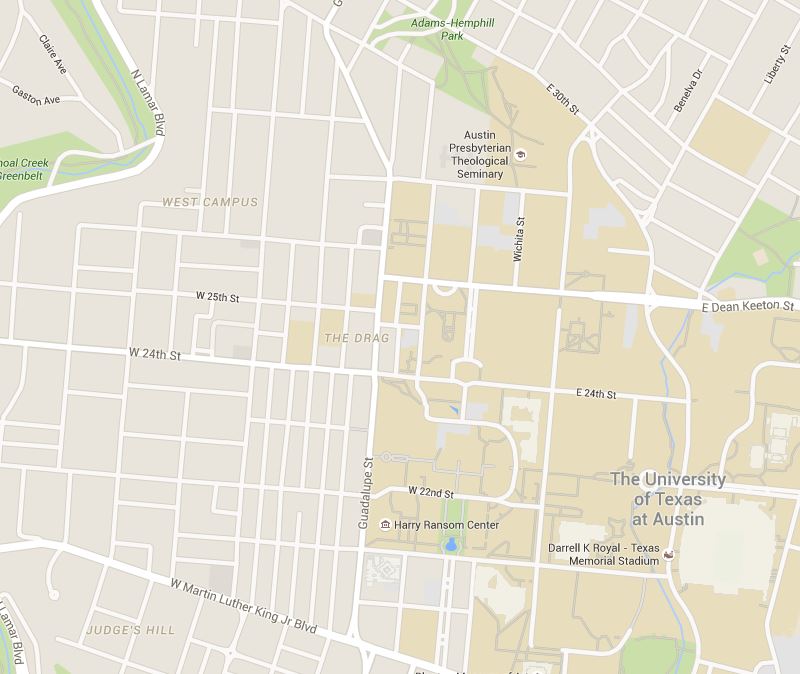
As most Austinites are undoubtedly aware, the Drag is that section of Guadalupe St. stretching between (approximately) West MLK Jr. Blvd. and W. 27th St. Straddled by the University of Texas campus on its east side and the high-density West Campus neighborhood on its west side, the Drag is perhaps the single most important segment of the Guadalupe-Lamar corridor. See: «Long saga of Guadalupe-Lamar light rail planning told in maps» and «Dobbs: Density, travel corridor density, and implications for Guadalupe-Lamar urban rail».


Map shows the Drag area (Guadalupe St., running north-south in center). UT campus lies on the east, West Campus neighborhood on the west. (Screenshot from Google Maps.)

Map shows the Drag area (Guadalupe St., running north-south in center). UT campus lies on the east, West Campus neighborhood on the west. (Screenshot from Google Maps.)


Now, driven partly by their fixation to substitute buses for rail as “rapid transit”, and partly by pressure from some community groups and activists, local civic leaders and official planners are floating plans for dedicated transit (read “bus”) lanes on the Drag. (Official planning defines “the Drag” as continuing north to W. 29th St.)

Last month (August 2015), AURA (originally Austinites for Urban Rail Action), a grouping of mostly Millennial-aged urban planning enthusiasts, posted a proposal for major improvements on the Drag, one of which suggested: “Extend transit priority lanes from Downtown to the Drag”.

At peak periods, transit moves roughly half of the people passing through the corridor. This is to be expected in a central location like the Drag, as transit is by far the most efficient way to move people in a city.

Given the anticipated growth of the city, increasing the throughput of people in the corridor is of paramount importance. The city should plan ahead for increased frequency of existing bus routes, and continue to examine the viability of Guadalupe as a future corridor for rail service. Buses should not have their effectiveness limited by less efficient forms of mobility. Two lanes of Guadalupe should be dedicated solely to transit.

Back in May, per its contract with the City of Austin (COA), UT’s Center for Transportation Research (CTR) produced for city staff a memo of its findings with respect to installing dedicated lanes on the Drag. As summarized by AURA’s John Laycock, the report “modeled three scenarios: Scenario 0) the baseline scenario, Scenario 1) a transit lane in each direction on Guadalupe, and Scenario 2) diverting the buses completely off of Guadalupe onto San Antonio.” Laycock reports that the city subsequently requested CTR to model an additional case, involving one transit lane northbound on Guadalupe and another southbound on Nueces/San Antonio. Results from that additional modeling effort apparently have not yet been released publicly.


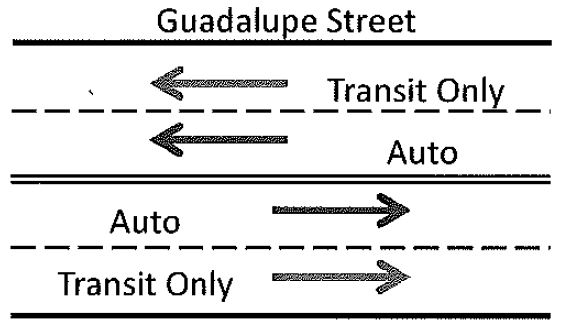
Diagram from CTR report for curbside dedicated lanes on the Drag. (Screenshot from CTR memo.)

Diagram from CTR report for curbside dedicated lanes on the Drag. (Screenshot from CTR memo.)


The proposal for dedicated transit lanes on the Drag may seem fairly benign, helpful to public transport and innocuous to the prospects for light rail (LRT). However, installing reserved transit lanes without broader planning for rail can raise some quite serious problems. Depending on their design and implementation, transit lanes could significantly improve or seriously impede the prospects for light rail transit (LRT) — by far, the most feasible and affordable rail option — in the Guadalupe-Lamar corridor. (See «Plan for galvanizing Austin’s public transport development: Light rail starter line in Guadalupe-Lamar».)

First, I’ll note that implementing a high-quality bus service as a precursor to rail can be an effective way of building ridership and preparing the public for the coming rail upgrade. Likewise, establishing reserved transit lanes that can be dedicated to rail can also be helpful. However, both infrastructure and configuration of dedicated transit lanes, done improperly, can create problems.

Infrastructure — Proponents of dedicated transit lanes have argued that all that’s needed is to paint some stripes on the street. And certainly, in the scheme of transit capital projects, just “painting” markings on pavement is relatively cheap. But there’s almost always more involved. The Guadalupe-Lavaca transit lanes, for example, included repaving, plus bus stop relocation and upgrading. Parking meters were removed. And the project has resulted in effectively eliminating the possibility of dedicated LRT tracks on those sides of these streets (bus traffic too heavy).


Buses use curbside reserved lanes on one-way Lavaca St. downtown. Curbside lanes on the Drag would be similar, but on two-way street. Photo: L. Henry.
Buses use curbside reserved lanes on one-way Lavaca St. downtown. Curbside lanes on the Drag would be similar, but on two-way street. Photo: L. Henry.


In previous discussions I’ve suggested that LRT dedicated lanes would need to be relocated on the opposite side of each street. Total cost of the downtown bus lane project was about $370,000 — not a billion-dollar investment, but enough of an investment certainly to give pause to totally redoing this project, or making substantial modifications to it (although modification to add LRT would definitely be a highly worthwhile investment).

We also don’t know what COA and Capital Metro have in mind for the Drag project. Some community transit activists might be thinking very minimalist, but what are official planners thinking?

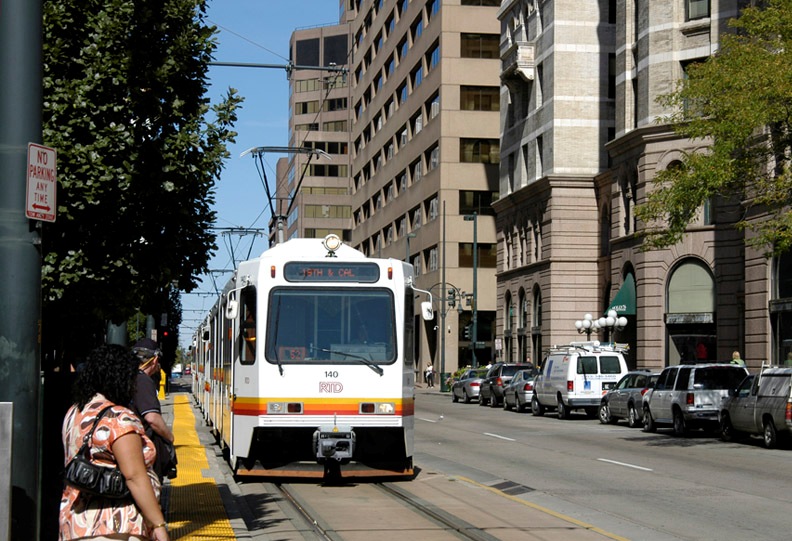
Configuration — The precise alignment on the transit lanes also needs serious consideration with respect to the needs of LRT (and evidence suggests that a substantial portion of the Austin community would like to see LRT as a project on the planning table now). Curbside lanes — as assumed in the CTR design, described above — are used by several major LRT systems (Portland, Houston, Dallas, and Denver come immediately to mind), but this configuration can often encounter serious problems, mainly with motor vehicle right-turns and especially pedestrian traffic (including where the right turns are made). Another problem for the Drag is the number of driveway cuts and the issue of access to businesses along this commercial alignment.


Denver: Passengers waiting to board LRT train running in curbside lane on Stout St. Photo: Peter Ehrlich.

Denver: Passengers waiting to board LRT train running in curbside lane on Stout St. Photo: Peter Ehrlich.


To be sure, a number of different LRT alignment and configuration options are possible. My preferred alignment concept for the Drag has been to keep both LRT tracks on Guadalupe, in the center (with stations also in the center), and the outside (curb) lanes continued for mixed motor vehicle traffic, including buses. The main reason for this configuration is that buses need access to right-side loading at stops, and I envisioned that local routes like #1 would need to be continued. Of course, bus routes could be moved further west, probably to San Antonio-Nueces, but keeping them on Guadalupe would facilitate relatively easy transfers to and from LRT and bus.

Ideally, the main Drag segment in this heavy-pedestrian/heavy-transit traffic area should be converted to a pedestrian-transit mall, with general motor vehicle traffic prohibited (except perhaps in the case of service vehicles for adjacent businesses). However, a design with reserved transit lanes plus a single mixed-traffic lane in each direction would appear to be possible.

To sum up: While dedicated transit lanes, with very minimal investment, could possibly be helpful as a preparation for LRT, I’d recommend huge caution and vigilance as this notion moves forward. Keeping particularly in mind the considerations I’ve raised above.

In this regard, it’s important to realize that a major chunk of Austin’s civic leadership, and planning establishment, still regard MetroRapid as the city’s “rapid transit system”. Likewise, the fantasy persists that Austin could “become the best bus system we can be” without a rail system. (Cities with the “best bus systems” also seem to happen to have excellent rail systems too.) Reserved transit lanes on the Drag could advance the case for LRT, but only if they’re properly configured, designed, and planned in the context of an ultimate LRT outcome. ■

h1

Austin is a village of villages — and they need to be connected by rail

29 August 2015
City of Austn's Imagine Austin "Centers and Corridors" map shows "regional centers", "town centers", neighborhood centers" and "activity centers". Center-city has three de facto villages, aka "town centers", that align in almost a perfectly straight line down the city's spine. Map excerpt: City of Austin.

City of Austn’s Imagine Austin “Centers and Corridors” map shows “regional centers”, “town centers”, neighborhood centers” and “activity centers”. Center-city has three de facto villages, aka “town centers”, that align in almost a perfectly straight line down the city’s spine. Map excerpt: City of Austin.

By Mary Rudig

Mary Rudig is a Gracy Woods Neighborhood Association coach and editor of the North Austin Community Newsletter. The following commentary has been adapted and slightly edited from her comments recently posted to selected recipients.

Right now, there is a very logical and straightforward way to create a solid transportation system in Austin — but it starts with all of us in this community having to realize that Austin, like most cities in the Southwest, is a village of villages. Most people don’t want to go downtown, they want to go to the next village.

We need to go back to the Imagine Austin plan and start by truly connecting the major activity centers through rail, going down the spine of the city. Rundberg/Lamar down to the North Lamar Transit Center down to the Triangle, then into campus, then through downtown to Seaholm. Add rapid bus systems to connect the Parmer/Mopac tech employment hub, drop more rapid buses along Parmer so you can add density in the Techridge area to the Northeast, add another rapid bus system into Highland Mall/ACC, and another rapid bus into Riverside and down into Slaughter. Eventually those rapid systems will build enough ridership to justify more legs and spurs to the main rail line.

Proposed 6.8-mile "Plan B" light rail transit line in Guadalupe-Lamar corridor

Light rail transit starter line in Guadalupe-Lamar corridor could serve as basic spine for eventual urban rail system together with other transit modes connecting metro area “villages”.

Second, we need to tear apart the PUD (Planned Unit Development) ordinance and basically make PUDs temporary TIFs (Tax increment Financing districts) — I would suggest twenty years. So to pay for the infrastructure, sidewalks, and other things to create this massive transportation plan, we could encourage neighborhoods to allow PUDs to be built, but the revenue and some of the property tax from each PUD would then go back into an account that can only be used for transportation and park/greenbelt/trails in the immediate area.

Third, we would need to force developers to stop building massive parking garages every time they put in another apartment complex and insist, instead, that they have to come up with some matching funds to put in sidewalks and hike & bike trails that connect their development into the surrounding neighborhoods. Sure, the developers will howl, but we just need to tell them sweetly, but firmly, that sidewalks and hike & bike trails are actually far cheaper than parking garages, and we are no longer buying the idea that an apartment complex is truly “compact AND connected”, unless it has very few parking spots and a whole ton of, you know, actual connectivity into surrounding neighborhoods. If we can get enough PUDs generating some funds, then there will be plenty of cash on hand to match the developers’ funds.

As for the idea (being promulgated by some community activists) that all of us in the outer ring of neighborhoods are living in “suburbs” where everybody is wealthy and low-density, that’s an interesting theory — let’s test it.

Let’s see, even though the City includes the Walnut Creek Metro Park into their density calculations, my neighborhood is still over 1200 people per square mile denser than the average density in Austin (4700 versus the typical 3500), and we have a ton of fairly affordable duplexes and older apartments. Oh, and I live in a 960-square-foot bungalow, on a street that is surrounded by duplexes, and we have the Domain two blocks away. Did I mention that I walk to work, my husband walks to work, my nextdoor neighbor bikes to work, and the neighbor next to him also walks to work?

In fact, my area of town (north of U.S. 183) has nearly 90,000 people packed into 13 square miles — so we have downtown beat when it comes to density. We also have neighborhoods to the east of me where 15% of the population doesn’t have cars, versus the 3-5% that is typical in most of Austin. (The official planners have never studied my neighborhood, so I haven’t a clue where we stand on this, but we have a lot of families that do exist happily on one (1) vehicle, instead of the typical family armada)

The truth is, the development crowd in this town keeps the myth of low-density outer suburbs going because they don’t want anybody to clue into the fact that the developers are — yup, actually building sprawl. A super-dense development carefully built to hide a massive parking garage, with a sidewalk that goes nowhere tacked on as a nod to “connectivity”? That’s a vertical gated suburban community that caters to the car culture, folks — and each one of these that gets built is pushing us a little further away from the goal of Austin having good mass transit and walkable, bikable connectivity.

And just to be super-transparent … Yes, I am one of those awful “anti-growth”, “anti-density”, “ANCer” “neighborhood NIMBYs” that both well-heeled real estate groups and some “liberal” community activist groups warn you about. Because I want stuff like rail and walkability, and I don’t think car-culture sprawl and gated communities are good for Austin. Huh. ■

h1

Texas Tribune op-ed urges support for “Plan B” light rail in Guadalupe-Lamar

27 July 2015
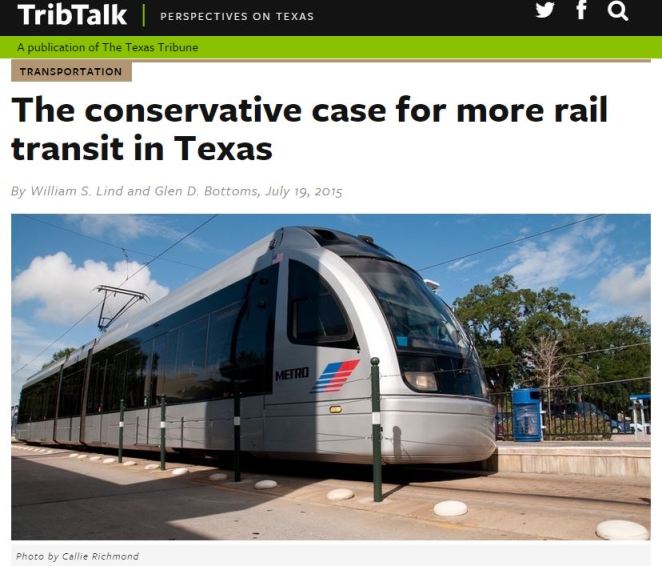
TribTalk op-ed headline with photo of Houston light rail train. (Screenshot: ARN)

TribTalk op-ed headline with photo of Houston light rail train. (Screenshot: ARN)

The case for light rail transit (LRT) in Austin’s Guadalupe-Lamar corridor just received a huge boost with the publication of an op-ed in TribTalk, the op-ed web page of the widely respected Texas Tribune.

“It may seem unlikely in Texas, but across the state, people are benefiting from rail transit” say William S. Lind and Glen D. Bottoms in their commentary (ARN emphasis added here and subsequently).

In Dallas, which now has the country’s largest light rail system, more than 100,000 Texans escape traffic congestion each day by riding Dallas Area Rapid Transit rail. In Houston, the light rail Red Line draws about 3,500 weekday boardings per mile, more than any other modern light rail operation in the country.

“Critics, many of whom call themselves conservatives (though most are really libertarians), predicted that both systems would fail because no one would ride them” they add.

Both writers are venerable, renowned veterans of the U.S. public transportation industry. Lind was also a close associate of the late conservative leader Paul Weyrich, a well-known advocate of rail transit among conservative circles.

In their op-ed, Lind and Bottoms note that “As conservatives, we find it odd that many people expect us to oppose public transportation, especially rail.”

In fact, high-quality transit, which usually means rail, benefits conservatives in a number of important ways. It spurs development, something conservatives generally favor, especially in Texas. It saves people, including conservatives, precious time, because those who ride rail transit can work or read on the train instead of wasting hours stuck in traffic. Transit of all kinds helps poor people get to jobs, which conservatives prefer over paying welfare. And rail transit, especially streetcars, helps support retail in downtowns by increasing the number of middle-class people on sidewalks.

Libertarians’ arguments against rail transit mostly boil down to one criticism: It’s subsidized. Yes, it is. So is all other transportation. Highway user fees now cover only 47.5 percent of the cost of highways. Nationally, rail transit of all types covers 50 percent of its operating costs from fares. It’s a veritable wash. In contrast, bus systems, which libertarians often favor over rail, cover only 28 percent of their operating costs from the farebox.

“Regrettably,” the writers caution, “conservatives’ tendency to accept libertarians’ arguments against rail transit (without checking their numbers) may deprive Texas conservatives of more chances to escape traffic congestion.”

As a case in point, they turn to Austin, explaining that it “may be different from other Texas cities in many ways, but not when it comes to traffic.”

The city’s rapidly growing population has packed its freeways at rush hours. And as other cities have found, building more freeways is not the answer. New lanes fill up as soon as they’re opened, and limited-access freeways in urban areas slice up and kill surrounding communities.

While they recount that “Austin voters last year rejected a poorly conceived light rail proposal that supporters said would help alleviate that congestion”, Lind and Bottoms argues that the failure of that plan nevertheless

…could be a good thing because it opened the door to a “Plan B” rail line that would serve the city better. A basic rule of rail transit planning is to “build it where people want to go,” and the alternative plan proposes a rail line that would run along Guadalupe Street and North Lamar Boulevard, Austin’s most heavily traveled urban corridor. We hope Austin conservatives will support “Plan B.”

Included in their commentary is a hyperlink to our own article from last October, «A “Plan B” proposal for a Guadalupe-Lamar alternative urban rail starter line». (Also see our recent article «Plan for galvanizing Austin’s public transport development: Light rail starter line in Guadalupe-Lamar», which links to our series of articles for this alternative plan with “what, where, how, and how soon” details about the proposed project.

Lind and Bottoms also point to other opportunities for rail, such as the streetcar project in El Paso and the Texas Central Railway highspeed rail system proposed to connect Dallas and Houston. “A combination of high-speed rail connecting Texas cities and good light rail and streetcar systems in those cities would make Texas a national leader…” they say in their conclusion. ■

h1

Plan for galvanizing Austin’s public transport development: Light rail starter line in Guadalupe-Lamar

30 June 2015
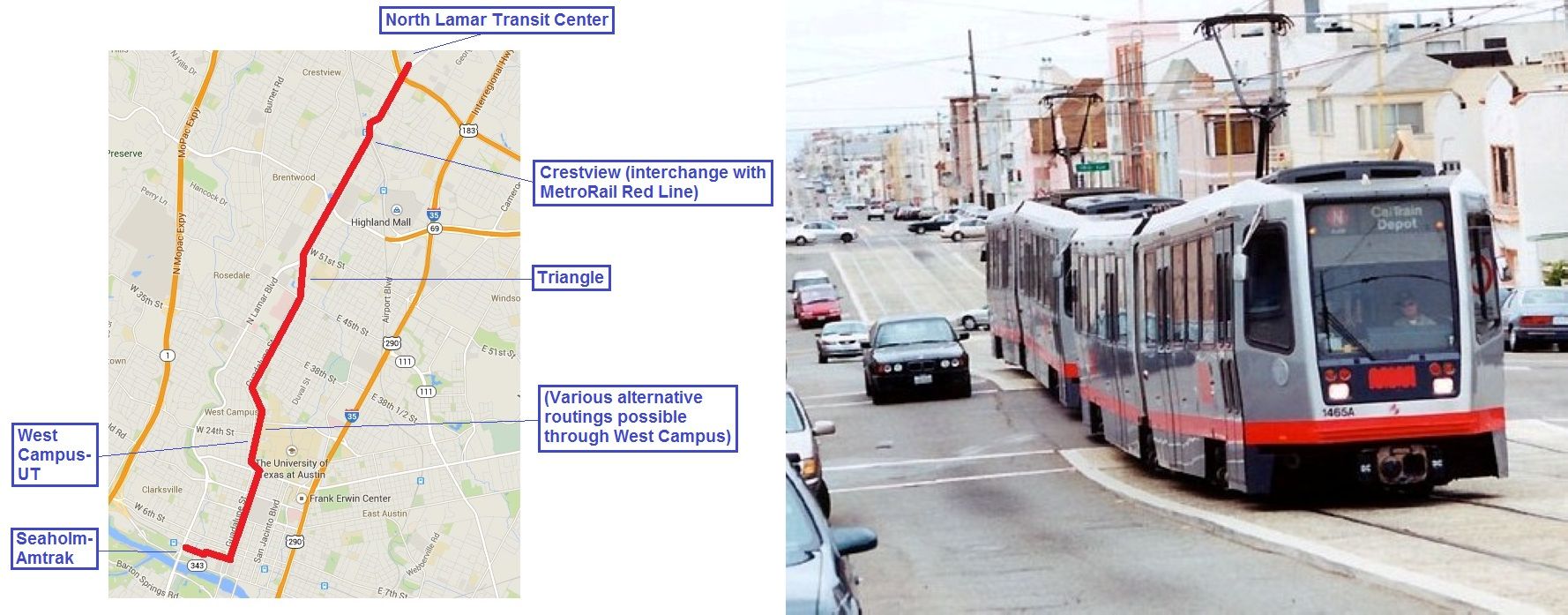
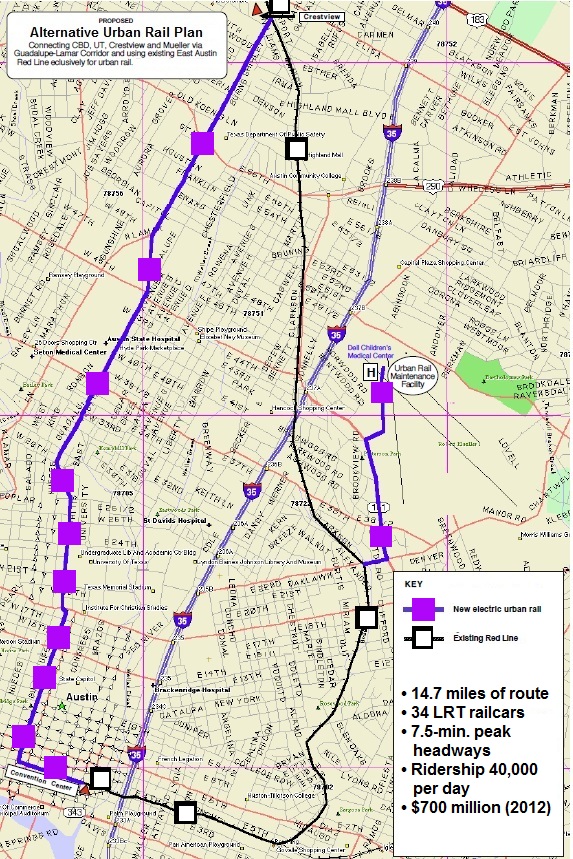
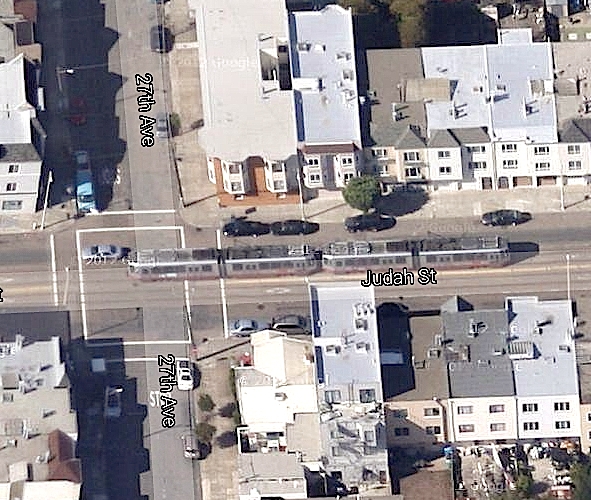
LEFT: Map of proposed 6.8-mile light rail route in Guadalupe-Lamar corridor. (Map: ARN.) RIGHT: San Francisco light rail train in dedicated lanes in Judah St., similar to Guadalupe-Lamar corridor. (Photo: Eric Haas.)

LEFT: Map of proposed 6.8-mile light rail route in Guadalupe-Lamar corridor. (Map: ARN.) RIGHT: San Francisco light rail train in dedicated lanes in Judah St., similar to Guadalupe-Lamar corridor. (Photo: Eric Haas.) (Click to enlarge.)

LEFT: Map of proposed 6.8-mile light rail route in Guadalupe-Lamar corridor. (Map: ARN.) RIGHT: San Francisco light rail train in dedicated lanes in Judah St., similar to Guadalupe-Lamar corridor. (Photo: Eric Haas.)

Austin’s transportation planning could be seen as “a tale of two systems“. On one hand, here in the 21st century — amidst crises over the climbing cost of energy, increasing road congestion by private vehicles, and global climate change impacted by greenhouse gas emissions — local planners and leaders are expanding highways like it’s 1955. In all directions, nowadays it’s mostly tollways, with new ones under development or planned in southwestern Travis County; across the river, double-decked over Loop 1 (MoPac); from East Austin to ABIA; and through the heart of the city with new toll lanes on I-35. Austinites who’re already paying taxes to fund roads now get to pay out-of-pocket tolls to use the new ones — a kind of Double Whammy.

So what about public transportation? Basically, since last year’s “Rail to Nowhere” Highland-Riverside proposal crashed and burned, public transportation planning has been going in circles — a circular maze, to be exact.

In other words, roads burgeon while transit diddles.

Meanwhile the solution continues to stare the Austin community in the face. As we noted in our March 29th article «Austin’s urban transport planning seems struck by catastrophic case of amnesia and confusion», “For two and a half decades, local officials and planners have explained why urban rail — affordable light rail transit (LRT), in Austin’s case — has been an absolutely essential component of the metro area’s mobility future.” We went on to elaborate that

…the fundamental case for LRT in Austin has been grounded in truth — the higher capacity, greater ridership attraction, cost-effectiveness, environmental benefits, unsurpassed magnetism to transit-oriented development and economic development, and other advantages of light rail are indeed essential for the future of this community. Mobility cannot be sustained of a continuing expansion of rivers of highways and tollways and a steadily rising flood of personal motor vehicles. Urban rail continues to be key to providing truly attractive public transit alternative, and shifting at least significant segments of the Austin metro to a sustainable alternative mobility lifestyle.

Austin Rail Now has underscored the case — and extensive evidence — in an array of solidly documented articles, including:

Long saga of Guadalupe-Lamar light rail planning told in maps

Latest TTI data confirm — Guadalupe-Lamar is central local arterial corridor with heaviest travel

Dobbs: Density, travel corridor density, and implications for Guadalupe-Lamar urban rail

West Campus is where the students are!

Guadalupe-Lamar is highest-density corridor in Austin — according to Project Connect’s own data!

Guadalupe-Lamar urban rail line would serve 31% of all Austin jobs

Demographic maps show Lamar-Guadalupe trumps Mueller route for Urban Rail

Dobbs: “Why are we squandering our best asset?”

How urban rail can be installed in the Guadalupe-Lamar corridor

Strong community support for Guadalupe-Lamar light rail continues — but officials seem oblivious

Poll: Austinites want surface rail!

Community endorsements

Why the MetroRapid bus project currently is NOT an obstacle to urban rail in Guadalupe-Lamar

Contradicting local official claims, FTA says it “would consider request” for urban rail on North Lamar

So where and how could LRT be installed in the Guadalupe-Lamar corridor? Austin Rail Now has provided conceptual details for a workable, affordable, attractive, cost-effective plan in a series of thoroughly researched articles:

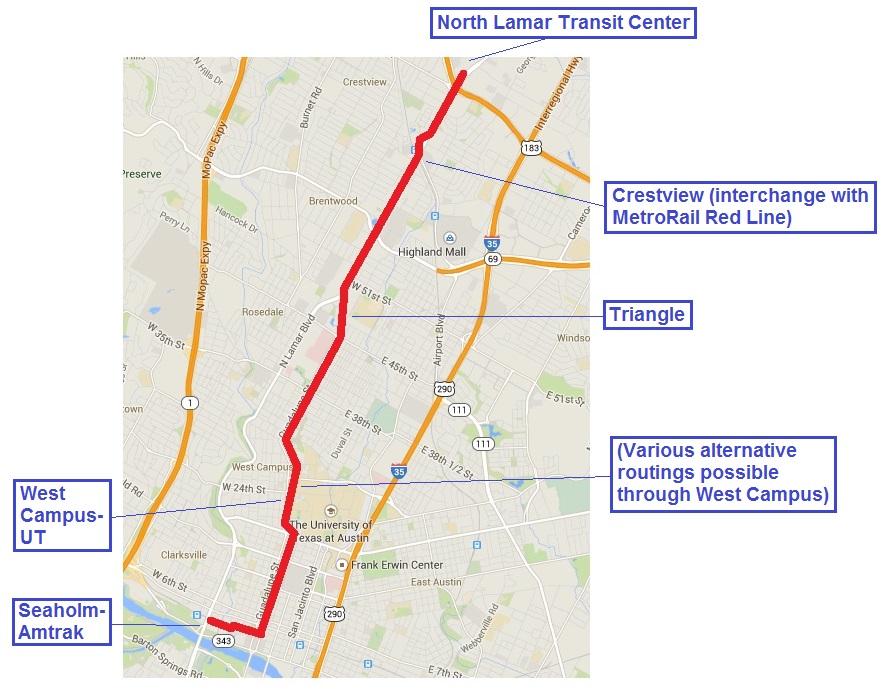
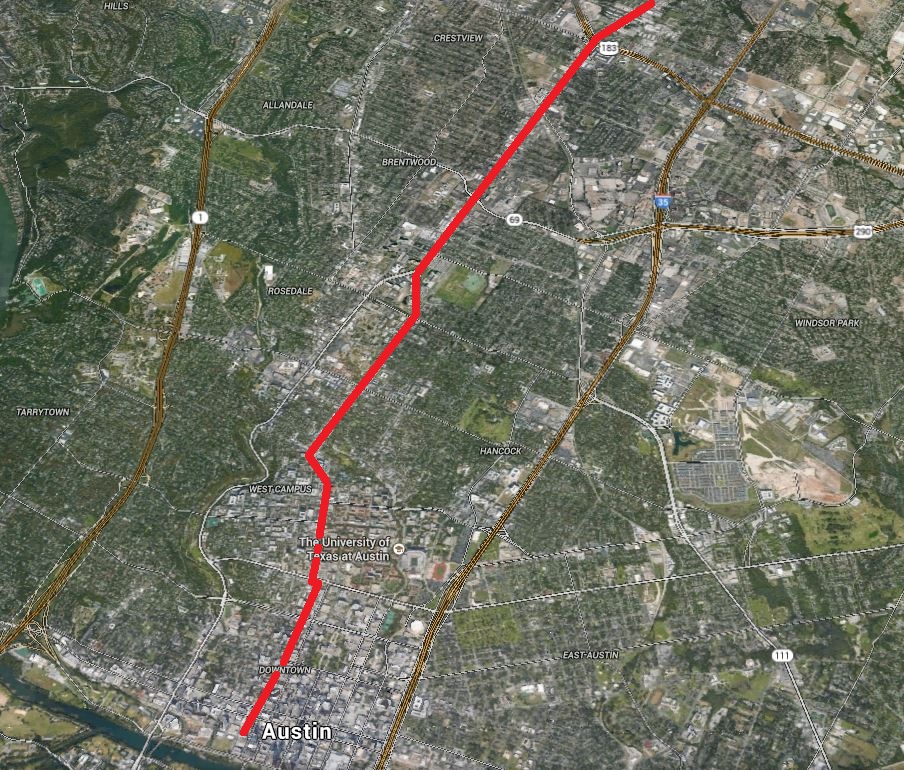
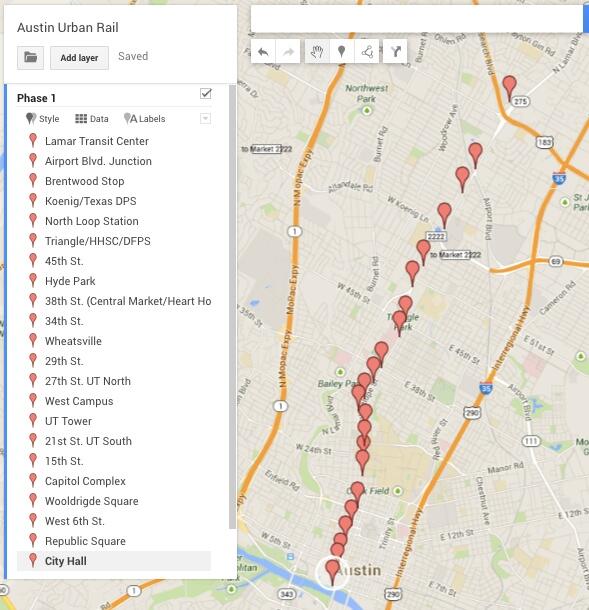
What and where — Our article «A “Plan B” proposal for a Guadalupe-Lamar alternative urban rail starter line» proposed a 6.8-mile LRT starter line from the North Austin Transit Center down North Lamar and then Guadalupe and Lavaca to downtown, with a westward spur to the Seaholm-Amtrak Station area. Total cost was estimated at less than $600 million (2014 dollars), and daily ridership was estimated at 30,000 to 40,000.


Proposed 6.8-mile "Plan B" light rail transit line in Guadalupe-Lamar corridor would have 17 stations and connect  the North Lamar Transit Center at U.S> 183 with Crestview, the Triangle, UT and the West Campus, the Capitol Complex, the CBD, and the Seaholm-Amtrak area. It's projected to serve 3 times the ridership of the Prop. 1 Highland-Riverside rail line at slightly over half the capital cost.

Map of proposed 6.8-mile LRT starter line in Guadalupe-Lamar corridor, with connection to Seaholm-Amtrak Station site. (Map: ARN. Click to enlarge.)


How — Our article «San Francisco’s N-Judah Muni Metro line shows design option for light rail in Austin’s Guadalupe-Lamar corridor» explains how two dedicated LRT tracks could be installed in the Guadalupe-Lamar corridor in a design that maintains four traffic lanes (two per direction) and facilities for pedestrians and cyclists.


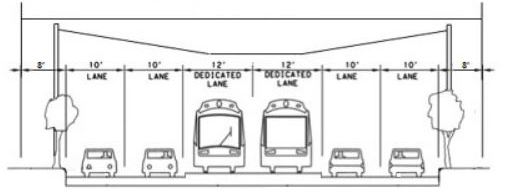
Cross-sectional diagram of major arterials in corridor, showing center LRT reservation, traffic lanes, sidwalks, and side-mounted TES poles for suspending the OCS. Graphic: ARN.

Cross-section of proposed LRT dedicated lanes in Guadalupe-Lamar, including 4 traffic lanes and pedestrian-bicycle facilities. (ARN. Click to enlarge.)


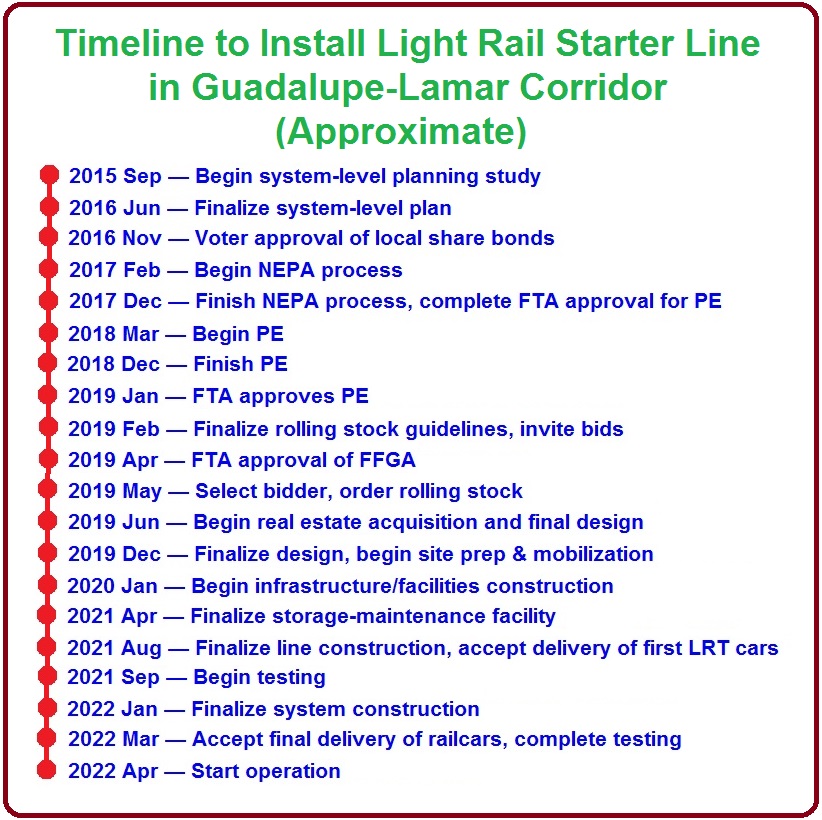
How soon — Our article «How soon to get Austin’s urban rail on track after Nov. 4th?» explains policy steps that the new City Council could implement to re-focus planning on a viable Guadalupe-Lamar LRT starter line and a local funding mechanism. Our subsequent, more detailed article «Possible timeline for installing light rail transit in Guadalupe-Lamar corridor» lays out a plausible itemized timeline that brings an LRT plan for Guadalupe-Lamar from the start of system-level planning to opening of operations in less than seven years.


Hypothetical timeline.

Conceptual timeline for proposed LRT starter line project, with assumed starting point in fall of 2015. (ARN. Click to enlarge.)


Until this city has a signature rail system, beginning with a starter line in the right corridor to serve as a spine and anchor for a citywide and regionwide network, Austinites will continue to face one highway ripoff after another — burdened with steadily rising costs for more roads and shackled to dependency on increasingly expensive private vehicles in worsening traffic congestion.

We’ve proposed a plan that can work and initiate a realistic path forward for solving Austin’s mobility crisis. Will Austin decide to proceed on that path, or continue to circle around in the maze of indecision and procrastination? ■

h1

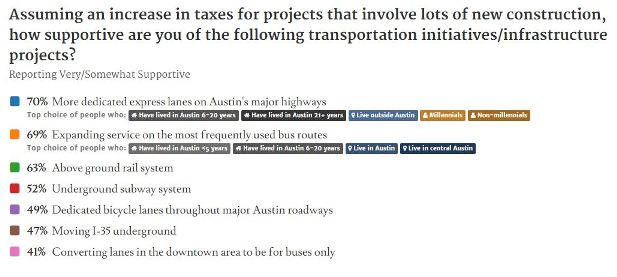
Poll: Austinites want surface rail!

31 May 2015
(Sceenshot of poll results)

(Sceenshot of poll results)

We’ve been insisting that — despite last November’s voter rejection of the deeply flawed official “urban rail” plan — Austinites do support rail.

Now this has been corroborated. A poll conducted in early March by the Zandan Poll (and reported April 16th by the Austin American-Statesman) indicates that 63% of respondents would favor “an increase in taxes” to construct an “Above ground rail system”.

According to the Statesman, the results are based on the responses of over 800 people that participated in online surveys. Yhr particupar quesrion on transportation was:

Assuming an increase in taxes for projects that involve lots of new construction, how supportive are you of the following transportation initiatives/infrastructure projects?

As the graphic at top shows, respondents also gave a thumbs-up to “More dedicated express lanes on Austin’s major highways ” and “Expanding service on the most frequently used bus routes”. And over half apparently even favor a subway.

All in all, this suggests that votes could be mustered to support money for rail — if the project is right. ■

h1

Plan Now for Light Rail in South Lamar!

29 April 2015
South Lamar corridor. Map: City of Austin.

South Lamar corridor. Map: City of Austin.

By Lyndon Henry

The following comments, adapted here to webpage format, were distributed to attendees at a public event sponsored by the City of Austin’s South Lamar Boulevard Corridor Study project on 10 December 2014. Lyndon Henry is a transportation planning consultant, a technical consultant to the Light Rail Now Project, and a contributing editor to Austin Rail Now. His comments highlight the vision of Austin Rail Now and other transit advocates that light rail is justified in, and needs to be planned for, a number of the Austin area’s major travel corridors.

► South Lamar light rail transit line makes sense

• In terms of both travel density and traffic congestion, South Lamar Blvd. ranks high among Austin’s major travel corridors (see Latest TTI data confirm — Guadalupe-Lamar is central local arterial corridor with heaviest travel). Current travel density plus rapidly increasing population density plus commercial growth in this corridor all indicate that planning for light rail transit (LRT) should long since have been under way.

• A South Lamar surface LRT line, possibly using an alignment design such as is illustrated below, needs to be a major part of an eventual citywide system branching north, south, east, and west throughout our region from an initial central spine in the Guadalupe-North Lamar corridor.


Cross-sectional diagram showing how center LRT reservation could be inserted in South Lamar, maintaining traffic lanes and sidwalks. Design would use side-mounted traction electrification system poles for suspending the overhead contact system for LRT electric propulsion. Graphic: ARN. (Click to enlarge.)

Cross-sectional diagram showing how center LRT reservation could be inserted in South Lamar, maintaining traffic lanes and sidwalks. Design would use side-mounted traction electrification system poles for suspending the overhead contact system for LRT electric propulsion. Graphic: ARN. (Click to enlarge.)


• The South Lamar Corridor Improvement Program should be reconfigured to include planning for LRT as a crucial focus of this project. Planners and traffic engineers need to ensure that any “improvements” in this corridor facilitate dedicated transit lanes for future light rail, and certainly should not impose obstacles to it. It’s way past time to scrap the practice of proceeding with major projects with little if any thought to the future.

► Form a Community Policy & Technical Oversight Committee

• Planning should involve the Austin community as a whole, and this means forming a broad, inclusive community committee to oversee policy and technical decisions, including a comprehensive transit-focused mobility plan for Austin and its surrounding region. No more secretive project teams meeting in a virtual “bunker”, then emerging to tell us what they’ve decided for us! Authentic public participation means including representatives of neighborhood and other community groups, plus others with applicable expertise within the Austin community at large.


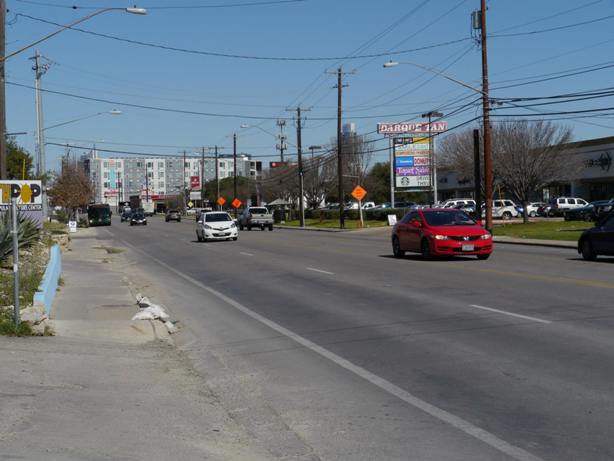
Current view of traffic on South Lamar. Photo: Austin Mobility.

Current view of traffic and urban development on South Lamar. Photo: Austin Mobility.


► Dedicate street lanes for light rail transit

Light rail can carry many more peak passengers than private cars, and attract many more riders than buses (both “regular” and MetroRapid). Austin needs to start re-allocating street space from traffic lanes to transit lanes, and the South Lamar corridor must be included. Smart design could install LRT in this corridor while retaining at least 4 lanes of traffic (see diagram in first section, above). ■

h1

Texas Legislature’s transportation policy: Full speed backwards?

23 April 2015
Highway Patrol TV series opening image. Graphic: flickr.

Highway Patrol TV series opening image, c. 1955. Graphic: flickr.

While much of the USA — and the world — seems committed to moving vigorously into the future with rail mass transportation systems, the Texas legislature (currently in its 2015 biennial session) seems determined to proceed backwards (perhaps to somewhere in the mid-1950s). This can readily be concluded from recent Senate and House bills (designated with S.B. and H.B. respectively) introduced in both state houses.

Hostility to public transportation among the predominantly Tea-Party-leaning Republican majority was hinted early on in the discussion over S.B. 5, which proposes to bestow a new gusher of state sales tax money (from motor vehicle sales and rental car services) on highway expansion. Legislative discussion of S.B. 5 involved assurances that not a dime of this new flood of money would be allocated to the despised “rail mass transit”.

Rail public transportation was then specifically targeted by S.B. 1048, introduced in early March, which would mandate that “The [Texas Transportation] department, a local governmental entity, or another political subdivision of this state may not use money provided by the Federal Transit Administration for a mass transit passenger rail project.” In other words, under this proposed legislation, a local government entity, such as a city or transportation authority, would be prohibited from using grant funds approved and awarded for a rail transit project by the FTA.

Other legislators have aimed their target sights at intercity rail issues, particularly with measures to obstruct highspeed rail development. H.B. 3918 would mandate that “no bonds may be issued to finance, in whole or in part, the construction or operation of an electric railway as defined by Section 131.011 Transportation Code or high speed rail as defined by Section 111.103(a) Transportation Code, that is capable of operating at speeds greater than 100 miles per hour, between two municipalities in this state.” S.B. 1601, curiously defining “High-speed rail” as “intercity passenger rail service that is reasonably expected to reach speeds of at least 110 miles per hour”, then proposes to eliminate any such project’s ability to acquire right-of-way through eminent domain: “…a company that operates a high-speed rail system may not exercise the power of eminent domain for the system.” (While these measures probably reflect a response to the fears of landowners along the proposed route of a somewhat dubious Dallas-Houston highspeed rail concept, they could have much wider impact on more immediately feasible rail improvement projects as well.)

This anti-mass transportation bias suggested by the proposed legislative measures has basically been confirmed by actual statements from key Texas legislators. As Dick Kallerman, a transportation policy leader in the Austin-area Sierra Club, reports,

On Tuesday, April 7, I attended “Texas Tribune Talks” hosted by Evan Smith. His guests were Senator Nichols and Rep. Pickett, both heads of their transportation committees. They said nothing new or interesting, no insight from the top, just well-worn, politically correct statements. I got the microphone during the question session. I made the case that Texas has very little mass transit and asked if that might change in the future.

Pickett said that the Texas culture is an automobile culture and that Texans aren’t much interested in mass transit. Nichols said that since 97% of Texans drive their cars to work it shows that they’re not interested in transit, and besides, transit requires subsidies while the auto pays its own way.

These attitudes seem straight out of the 1950s and 1960s — in effect, the dinosaur era of American transportation (including the misconception that private automobile transportation, showered with fuel sales tax money, local government bond proceeds, and parking subsidies, is in effect a “free ride”). Here in the 21st century, what is a supposedly forward-looking state like Texas doing with a legislative majority that seems focused on mobility assumptions and policies from five or six decades ago in the last century?

Texas is not just the second-largest state in the USA, it’s also home to some of America’s most powerful corporate and private business giants — companies like ExxonMobil, AT&T, American Airlines, Kimberly-Clark, USAA, Southwest Airlines, Whole Foods, Texas Instruments, J. C. Penney, KBR, FMC Technologies, Clear Channel, Dell Computer, Neiman Marcus, Shell Oil, Schlumberger, 7-Eleven, BNSF, Hewlett-Packard … and dozens more. One wonders how long these mammoth and influential commercial institutions and powerful national leaders will continue to tolerate a state political leadership that so blithely dismisses the value and relevance of public transportation, urban rail, and highspeed rail for Texas’s diverse and rapidly expanding population.

We suspect that a lot of top-level business movers and shakers will start to re-evaluate the effectiveness of a political transportation mindset still rooted the middle of the last century. And will take action accordingly… ■

h1

Stealth plans for “forced busing” in heavy local travel corridors may be wasteful barrier to light rail

30 March 2015
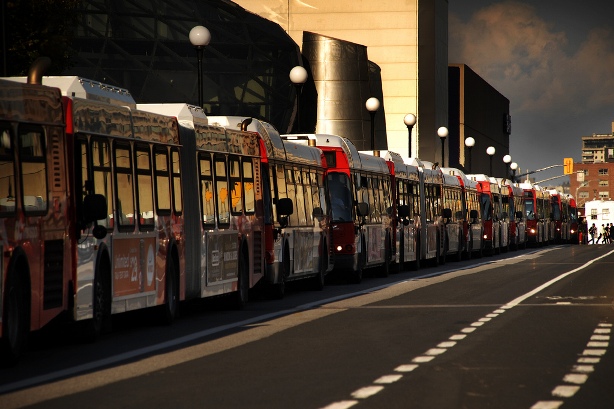
Consequences of investing in bus-based "rapid transit" (BRT) can be seen in Ottawa, where bus bunching and huge bus jams like this one reveal massive size of fleet necessary to support "rapid transit" levels of ridership — ridership far more efficiently accommodated by urban rail . Similar plans for expanded BRT infrastructure in Austin pose similar need for light rail transit (LRT) alternative. Photo: Flickr.

Consequences of investing in bus-based “rapid transit” (BRT) can be seen in Ottawa, where bus bunching and huge bus jams like this one reveal massive size of fleet necessary to support “rapid transit” levels of ridership — ridership far more efficiently accommodated by urban rail. Similar plans for expanded BRT infrastructure in Austin pose need for light rail transit (LRT) alternative. Photo: Flickr.

By Dave Dobbs

Dave Dobbs is publisher of LightRailNow.com. This commentary has been adapted and expanded from original private Email comments.

Recent developments in local metro area transportation planning, particularly in the aftermath of last November’s ill-conceived “urban rail” bond vote debacle, have made it evident to some of us that there’s a need for a grassroots collection of stakeholders to unite behind a new urban rail planning process, and getting it started ASAP. This is more urgent than most people realize.

It’s abundantly clear that, over the past several years, Project Connect and CAMPO planners and officials have been aiming toward “forced busing” on Austin’s best potential light rail routes, the heavy local travel routes where currently the big red MetroRapid buses run — Guadalupe/North Lamar, South Congress, and South Lamar. As I pointed out in an earlier article on this issue («No urban rail on Guadalupe-Lamar? Then get ready for bus lanes…»), it’s ironic that, for the past several years, while some public officials have piously insisted we can’t possibly convert car travel lanes to reserved rail lanes on Guadalupe/North Lamar, it seems that all along, since at least 2012, this has been in planning for MetroRapid — in effect, a “stealth” plan for incremental BRT.


Light rail/urban rail has simply vanished from CAMPO's 2040 Transportation Plan. Screenshot of Urban Transit page: ARN.

CAMPO 2040 plan includes hundreds of millions of dollars in proposed “BRT” projects, including plans to construct dedicated lanes in Guadalupe-Lamar corridor in lieu of light rail. Screenshot of Urban Transit page: ARN. (Click to enlarge.)


If, this coming May, the CAMPO 2040 plan is adopted with the Urban Transit Projects (2020 – 2040) currently in the plan, Capital Metro, perhaps together with the City, will have the green light to immediately pursue federal funding for concrete bus lanes on the above thoroughfares. And they will no doubt do so, as the 80% federal matching funds for buses are far more available than 50% federal matching funds for rail. Yet, even with the heavier federal proportion, this would be a disastrous waste in the longer term, since the ridership attractiveness, cost efficiency, more livable urban environment, stimulus for transit oriented development (TOD) and economic development, and other benefits for the community, far outweigh the advantage of a higher rate of federal bus system funding.


Total cost per passenger of urban rail becomes lower than "bus rapid transit" as ridership rises above about 10,000 per day. Graph: Project Connect.

Project Connect graph, presented in June 2012 to Transit Working Group, showed greater cost-effectiveness of urban rail (LRT) compared with BRT, as ridership increases. Screenshot: ARN. (Click to enlarge.)


We should expect that the MetroRapid bus lane process will be similar to the Project Connect rail public process — i.e., art gallery open houses, boards and commission hearings and approvals, and finally, council and Capital Metro board approval … but no general public vote, because the the local 20% match will be small enough to construct discrete sections and can probably be found in a slush fund someplace. While 20% of the overall $442,861,656 Capital Metro has identified for dedicated MetroRapid bus lanes is around $88.6 million, it’s logical to expect a piecemeal approach, one section at a time, so as to avoid a citywide response over the loss of vehicle travel lanes. Divide and conquer.

For example, after having paint-striped a little over a mile of Guadalupe and Lavaca between Cesar Chavez and MLK, the most likely next step is to convert two vehicle travel lanes on Guadalupe from MLK to the Triangle (North Lamar at Guadalupe), a distance of 2.5 miles, for about $60 million. Of this, Austin’s share would be roughly $12 million, small enough to be found in current budget funds without going to the voters. Perhaps an even shorter segment, 1.5 miles to 38th Street, would be considered, where the local share would be only about $7 million.

While the downtown Guadalupe/Lavaca paint striping cost $270,000/mile, the dedicated lanes called for in the CAMPO 2040 plan are tear-up-the-street, fix-utilities, and pour 18 inches of concrete (very much like installing light-rail-dedicated reserved lanes) and cost about $24 million/mile for a lane in each direction. Of course, once the bus lanes are in, we couldn’t change our minds because (1) we’ll have spent a lot of federal dollars, and switching over to rail anytime soon would not get a hearing from the Federal Transit Administration (FTA), and (2) merchants and residents are not going to easily, willingly, or peacefully suffer urban street surgery twice. Currently the $38 million in Federal grants for MetroRapid in mixed traffic is mostly portable to another corridor (like Riverside, where it would be appropriate), and after seven years, buses are mostly amortized in the eyes of the FTA. Exclusive bus lanes at $350 million is another matter entirely, for something that can’t be moved.


Construction for dedicated bus lanes, rarely shown by "BRT" promoters, is very similar to that for LRT, as this example from San Bernardino demonstrates. Yet effective capacity, ridership attraction, cost-effectiveness, TOD, and other benefits typically fall short of what LRT typically achieves. Photo: Omnitrans.org.

Construction for dedicated bus lanes, rarely shown by “BRT” promoters, is very similar to that for LRT, as this example from San Bernardino demonstrates. Yet effective capacity, ridership attraction, cost-effectiveness, TOD, and other benefits typically fall short of what LRT achieves. Photo: Omnitrans.org. (Click to enlarge.)


Proceeding with major investment in bus infrastructure in Guadalupe-Lamar and other high-travel local corridors is a huge mistake. As I warned in the earlier article cited above, if you would prefer urban rail instead of a major dedicated bus lane project in Guadalupe-Lamar, “it’s essential to speak up and act. Let neighborhood groups and other community organizations know what official plans have in store for this corridor.” It’s also important to communicate to local agencies involved with planning and members of the Austin City Council “that you want to ride urban rail on Guadalupe-Lamar, running in reserved tracks, not just a souped-up bus service weaving in and out of special lanes.” ■

h1

Austin’s urban transport planning seems struck by catastrophic case of amnesia and confusion

29 March 2015
Graphic: Rich's Management Blog

Graphic: Rich’s Management Blog

The devastating befuddlement of Austin’s official-level urban transportation planning over the past five months has been nothing short of jaw-dropping. Especially when you consider this in context.

For two and a half decades, local officials and planners have explained why urban rail — affordable light rail transit (LRT), in Austin’s case — has been an absolutely essential component of the metro area’s mobility future. As our recent article «Long saga of Guadalupe-Lamar light rail planning told in maps» describes, the logical starting point for an initial LRT route has been the central city’s heaviest-traveled central corridor, Guadalupe-Lamar.

Year after year, planning proceeded in some way for LRT. Even after 2003, while official planning was distracted and mis-directed toward potential routes more to the east of the central core city, the need for rail transit was still proclaimed. Austin had to have rail to maintain an adequate level of mobility into the future.

Beginning about 2006, an original streetcar “connector” rail transit concept emerged that gradually morphed into more ambitious “urban rail” — a full LRT system. An official blue-ribbon committee of civic leaders, the Transit Working Group (TWG), was hand-picked (first by State Sen. Kirk Watson, then by Austin Mayor Lee Leffingwell) to guide rail planning. Extensive planning documents were finalized for a route scheme linking the Core Area with Seaholm, East Riverside, the East Campus, and Mueller — a rather deranged route, in our view, but rail nonetheless. The City then launched a full-fledged NEPA (National Environmental Policy Act) process (required for federal funding), with a series of “open houses” and other public events.

Activities of the TWG continued to heat up, primarily focused on planning for the urban rail line to Mueller. Route alternatives, cost issues, funding issues, organizational and management arrangements, and all kinds of associated issues were discussed exhaustively. A new consortium of public agencies, called Project Connect, was formed, mainly to coordinate rail planning and to produce a massive regional plan criss-crossed with proposed rail lines. Remember all this?

By 2013, the official establishment apparently felt urban rail needed the scrutiny of a special High-Capacity Transit study. So a special Project Connect team, headed by consultant Kyle Keahey, was formed, and virtually the second half of 2013 was consumed with “studying” (translation: justifying) and finalizing the need, size, and shape of an officially preferred urban rail plan. Mueller was sidelined, replaced by a desperate quest for a rail line from East Riverside to the former Highland Mall site. “Gotta get to Mueller! Mueller! Mueller!” became “Gotta get to Highland! Highland! Highland!”


Urban rail has been on the official planning agenda for decades. Throughout the first 10 months of 2014, the Highland-Riverside plan (envisioned in this simulated scene) was hyped incessantly. Graphic: Project Connect.

Urban rail has been on the official planning agenda for decades. Throughout the first 10 months of 2014, the Highland-Riverside plan (envisioned in this simulated scene) was hyped incessantly. Graphic: Project Connect.


As this blog, and a sizable segment of local transit advocates, insisted, the plan was conceived for the wrong reasons and fundamentally flawed. But for about the last two months of 2013, and ten months of 2014, the City administration, plus Capital Metro, plus the prevailing faction of local civic leaders, all insisted over and over that rail was absolutely, positively essential (although it had to be the peculiar Highland-Riverside plan officials had concocted). An expensive ad campaign, much of it financed from federal funds channeled through Capital Metro, bombarded the public via the Internet and virtually all major media outlets — reiterating the message that traffic congestion was a growing threat to the metro area and rail (the official plan of course) was the essential remedy. Mayor Leffingwell’s familiar aphorism was suddenly appearing and being heard everywhere: “Rail or Fail!

And then, on Nov. 4th, it all hit a wall, as voters said No to the puzzling, nonsensical, controversial, and fabulously expensive Project Connect plan that had been offered.

And all of a sudden, rail was erased, scrubbed, from official discourse. Despite all the years, decades, of documentation of the need for a rail transit system for the city, the official vision of transit became refocused on “becoming the best bus system we can be”; after years of explanations that reliance on further highway development wasn’t a realistic solution for preserving the city’s mobility, regional highway and tollway development has suddenly received a new surge of energy in official policy.

Meanwhile, rail transit planning has basically vanished from official planning. It’s just gone “Poof”. As David Orr has reported in his recent commentary «Austin’s “shadow government” (CAMPO) disappears light rail from local planning», all reference to urban rail has been expunged from the 2040 Transportation Plan of CAMPO (Capital Area Metropolitan Planning Organization), and replaced by line items for “bus rapid transit” (i.e., expansion of the MetroRapid limited-stop bus service).

Affirmed, until last November, as an absolutely essential component of Austin’s future mobility, light rail has now disappeared from public discourse, from the mainstream media, from the lips of politicians and civic leaders. Is it some kind of collective amnesia? Have the local planning and decisionmaking establishment all been struck with a strange disability, like the global mass blindness in Day of the Triffids? Or is the obliteration of rail a calculated excision, like the Soviet Stalin regime’s air-brushing elimination of political undesirables from photos, or the “Photoshopping” of group photos by some misguided religious media to “disappear” women?


Evaporation of Austin's light rail planning resembles a catastrophe of collective affliction, like the mass blindness portrayed in Day of the Triffids. Movie poster: IMDb.com.

Evaporation of Austin’s light rail planning resembles a catastrophe of collective affliction, like the mass blindness portrayed in Day of the Triffids. Movie poster: IMDb.com.


One wonders whether any of these Austin-area leaders and planners have given a thought as to how this plays in public perceptions of their own credibility and integrity. Were all the assurances and explanations of the need for urban rail to maintain Austin’s future mobility and vitality just deceptive hype, a marketing ploy for some kind of alternative agenda?

Maybe, but we believe the fundamental case for LRT in Austin has been grounded in truth — the higher capacity, greater ridership attraction, cost-effectiveness, environmental benefits, unsurpassed magnetism to transit-oriented development and economic development, and other advantages of light rail are indeed essential for the future of this community. Mobility cannot be sustained of a continuing expansion of rivers of highways and tollways and a steadily rising flood of personal motor vehicles. Urban rail continues to be key to providing truly attractive public transit alternative, and shifting at least significant segments of the Austin metro to a sustainable alternative mobility lifestyle.


According data from Texas Transportation Institute, even with implementation of infrastructure expansion in CAMPO 2035 plan, Austin metro travel time would increase 80% due to traffic congestion. Graph: Austin Chamber of Commerce 2013 Mobility Report.

According to data from Texas Transportation Institute, even with implementation of infrastructure expansion in CAMPO 2035 plan, Austin metro travel time would increase 80% due to traffic congestion. Graph: Austin Chamber of Commerce 2013 Mobility Report. (Click to enlarge.)


And we have a strong suspicion that a preponderant number of local planners and officials actually continue to agree with this perspective. If so, they need to realize there’s a lot of community support for urban rail — from voters on both sides of last year’s debate — and they need to start stepping forward. They need to heed their sense of responsibility, find their mojo, or whatever it takes, to take the lead to get LRT planning back on track.

The groundwork, in terms of preliminary planning, is already there — and, in recent articles and other public information, Austin Rail Now along with other mass transit advocates have expanded on it.

Austin is waiting. We’re wondering who’ll take the first step. ■


LRT train on Portland's 5th Ave. transit mall swings to the curbside station to pick up waiting passengers. Photo: L. Henry.
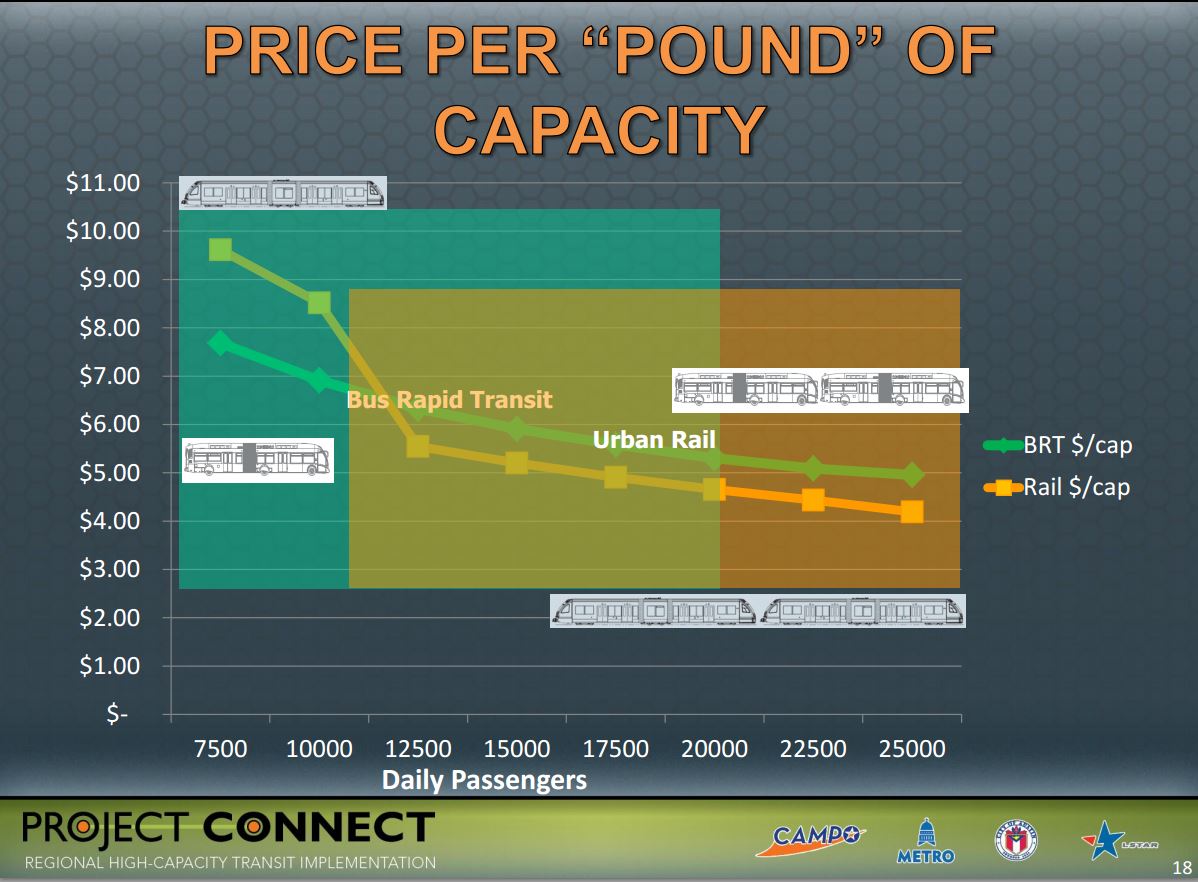
Portland’s light rail trains (in dedicated lanes) share 5th and 6th Avenue transit mall with buses as well as cars — a potential transit design model for Austin? Photo: L. Henry.
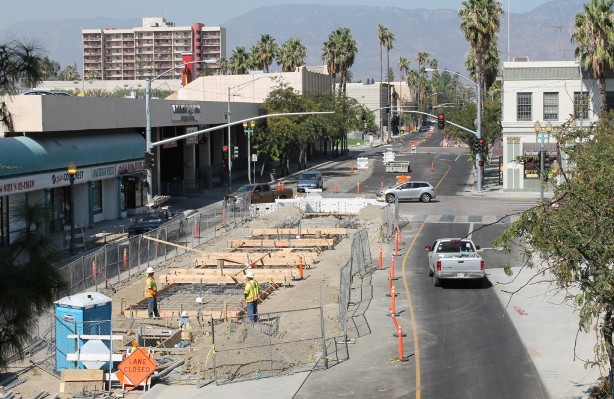
h1

Austin’s “shadow government” (CAMPO) disappears light rail from local planning

26 March 2015
Graphic: PEHUB.com

Graphic: PEHUB.com

By David Orr

David Orr, an Austin community activist involved with transportation issues, is a longtime environmental justice and transportation advocate.

The more I learn about how the political sausage gets made around here nowadays, the more I’m convinced that CAMPO (Capital Area Metropolitan Planning Organization) is Austin’s “shadow government“, at least so far as large-scale transportation-related land use decisions are concerned.

The CAMPO 2040 Plan is egregiously deficient in providing alternatives to automobile-based transportation. Indeed, it seems like the plan is designed — intentionally so — to ensure that development of efficient rail-transit infrastructure cannot occur.

From what I’ve read, there are exactly ZERO miles of light rail in the plan, whereas a decision has apparently been made to go all in on BRT (bus rapid transit). It’s not clear to me where, or by whom, the decision was made to pretend light rail is no longer an option, but the fact that this policy is embedded so deeply in CAMPO’s planning documents makes clear that the agency has a clear agenda.

CAMPO 2040 Plan includes hundreds of millions of dollars for additional investment in MetroRapid "BRT" operation. Such facilities could impose a barrier to urban rail in key corridors such as Guadalupe-Lamar. Photo: L. Henry.

CAMPO 2040 Plan includes hundreds of millions of dollars for additional investment in MetroRapid “BRT” operation. Such facilities could impose a barrier to urban rail in key corridors such as Guadalupe-Lamar. Photo: L. Henry.
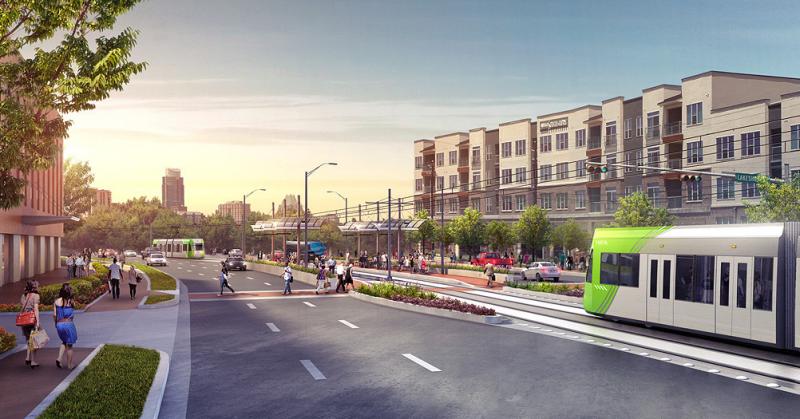
Where is the political accountability for this? Have local governments adopted resolutions of support for BRT while unequivocally stating opposition to any further study of light rail?

It seems to me that citizens have to demand that the City of Austin and Travis County — the most populous city and county in the CAMPO region — respond to CAMPO’s 2040 Plan before it is finalized next month (April). Even though it seems that the majority of CAMPO’s board have made it clear that their priorities are not in synch with concerns of Austin and Travis County officials who would like to see less emphasis on highway construction, it should be incumbent on both local entities to stand up for the interests and concerns of the residents here.

If CAMPO adopts a plan that zeros out light rail for the next 25 years, that will greatly complicate any effort that we can marshal to promote a light-rail project. I’m not well-versed in U.S. DOT (Department of Transportation) and FTA (Federal Transit Administration) law and regulations, so I don’t know whether an Austin-based light-rail project would have to obtain CAMPO’s support to proceed, but the FTA surely would notice if CAMPO was not behind it. Another crucial question is whether the Austin City Council or the Travis County Commissioners would be inclined to object to the finalizing of the 2040 Plan.

Light rail/urban rail has simply vanished from CAMPO's 2040 Transportation Plan. Screenshot of Urban Transit page: ARN.

Light rail/urban rail has simply vanished from CAMPO’s 2040 Transportation Plan. Screenshot of Urban Transit page: ARN. (Click to enlarge.)

During CAMPO’s meeting on the night of March 9th, the agency’s director stated that they were required by federal rules to adopt this plan in the next month or two. If that’s true, such a requirement may make it impossible to stop this measure, but at least the city and/or county could register official displeasure (and preferably opposition?) at the lack of public input on so many key policies and plan provisions.

I encourage others to join me in expressing concern publicly. If you have a good relationship with friendly elected officials, it seems like this is a critical time to ask them to engage. ■

h1

Possible timeline for installing light rail transit in Guadalupe-Lamar corridor

17 February 2015
LRT construction in Houston. A similar LRT line in the Guadalupe-Lamar could potentially be completed and in service in less than a decade. Photo: Houston Metro.

LRT construction in Houston. A similar LRT line in Austin’s Guadalupe-Lamar corridor could potentially be completed and in service in less than a decade. Photo: Houston Metro.

In our Feb. 10th article «Long saga of Guadalupe-Lamar light rail planning told in maps» we provided a selective summary chronicle of the exhaustive history of planning for major infrastructure upgrades — almost all of it light rail transit (LRT) — to expand capacity, enhance urban livability and the environment, and improve and sustain mobility in Austin’s most important central local corridor, Guadalupe-Lamar (G-L). Over 40 years of LRT proposals and studies were noted and maps associated with them were presented, among them several alternatives we’ve featured on this website.

As we’ve contended in our article «Strong community support for Guadalupe-Lamar light rail continues — but officials seem oblivious», there’s abundant evidence of enduring community interest in, and support for, LRT in this crucial corridor, indicated in part by various alternative route proposals that have emerged in recent years. One of these — originally presented in a posting on this website last October as a so-called “Plan B” proposal (the name deriving from the presumption that the disastrously flawed officially sponsored Highland-Riverside urban rail plan, decisively rejected by voters in November, was “Plan A”) — has been modestly developed as a light rail transit (LRT) starter line project with suggested basic planning, route, and design concepts:

A “Plan B” proposal for a Guadalupe-Lamar alternative urban rail starter line

San Francisco’s N-Judah Muni Metro line shows design option for light rail in Austin’s Guadalupe-Lamar corridor

So, on the assumption that the critical mass of community and political support could be mustered to proceed, how long would it take to get an actual G-L starter line (the seminal “spine” from which extensions throughout the metro area and the region would subsequently branch) in operation? What milestones might there be along the way, and what might be typical (or at least realistic) timeframes for achieving each milestone? And could a new Project Connect-style study be initiated and concluded within about a year, in time to put a rail project funding measure on the ballot in 2016?

In response to these issues, we’re posting here a somewhat fanciful and speculative timeline (based on the proposed 6.8-mile G-L-Seaholm line described in our “Plan B” article cited above), with some modestly rosy assumptions, but based on real-world experience elsewhere. In addition, it’s been vetted by a number of transit industry professionals and savvy advocates.


Hypothetical timeline.

Hypothetical timeline (click to enlarge).


(Click to enlarge.)

(Click to enlarge.)

Our timeline assumes that some project phases could be accelerated or “telescoped” because so much previous study and analytical work has already been completed on this corridor (and some of the planning work involved in the Highland-Riverside proposal might also be applicable). Obviously, all dates (and phases) should be considered as hypothetical, and thus to have some room for adjustment.

This information is mainly intended just to provide a general idea of a possible timeline for such a project in the G-L corridor. Typically, project timelines are meticulously developed by an entire project team and are subject to ongoing revisions.

As our timeline suggests, it’s plausible to envision that a G-L LRT starter line project could be completed within about seven years from the start of conceptual system-level planning. This would lead to a possible opening of the line for service in 2022. To meet such a schedule, system-level planning (to develop a basic conceptual plan to present to the public and to voters for funding) would need to begin sometime later this year — ideally, in the early to middle autumn. Otherwise it would be difficult to finalize a plan for a public vote by November 2016.

Missing the Nov. 2016 vote deadline, as we understand current state law governing bond elections, would likely introduce two more years of delay. This would push a hypothetical vote to 2018, and service startup to the year 2024. In any event, it’s clear that a plausible case can be made that urban rail, in the form of surface LRT, could be up and running in the Guadalupe-Lamar corridor within a decade, and quite likely sooner. ■

h1

Baker: CAMPO’s 2040 plan = “prescription for intense and auto-addictive suburban sprawl development far into future”

16 February 2015
Suburban highways, freeways, and tollways like Loop 1 (MoPac) have driven suburban sprawl, forcing dependency on personal motor vehicles for nearly all local transportation. CAMPO's planning continues to be focused mainly on promoting suburban growth through further roadway expansion. Photo: CTRMA.

Suburban highways, freeways, and tollways like Loop 1 (MoPac) have driven suburban sprawl, forcing dependency on personal motor vehicles for nearly all local transportation. CAMPO’s planning continues to be focused mainly on promoting suburban growth through further roadway expansion. Photo: CTRMA.

By Roger Baker

Roger Baker is a longtime Austin transportation, energy, and urban issues researcher and community activist. The following commentary has been adapted and slightly edited from his comments recently posted by E-mail to multiple recipients.

On February 9th, CAMPO (the federally sanctioned Capital Area Metropolitan Planning Organization) held its monthly meeting, as usual to discuss regional planning policies. Although these tend to resemble (and to some extent overlap with) the City of Austin’s own planning issues, CAMPO’s anti-environmental, pro-sprawl policy governs state policy and the disposition of federal money, and thus tends to overrule Austin’s policies. So Austinites involved in local urban planning and transportation issues should take some interest.

Following is a link to the CAMPO agenda. I’d recommend reviewing Items 6A and 6B in particular, which discuss the new long-range 2040 CAMPO plan. When approved in May, this will lock-in regional funding and construction priorities policy for this new $32 billion 2040 plan:

http://www.campotexas.org/wp-content/uploads/2015/02/TPB-Agenda-February-9-2015.pdf

This CAMPO plan currently in the works, and nearing approval as our top regional infrastructure policy, seeks to double the Central Texas population to about 4 million, while putting most of the future population increase In Hays and Williamson Counties. This amounts to a prescription for intense and auto-addictive suburban sprawl development far into the future.

If you feed the projected sprawl-related commuter demand into CAMPO’s secretive travel demand model, you get nightmare-ish congestion throughout the region in 2040, as CAMPO has had to admit. I wrote about that here (my apologies for the misspelling of “congestion”):

http://changeaustin.org/2014/11/campos-congetion-nightmare/

This nightmare presents CAMPO with a political problem — trying to explain how it makes sense to spend $32 billion in fanciful future money only to see congestion get much worse than now, and what happens to congestion without this optimistic funding.

The CAMPO politics of planning policy assumes that the special interests tied to land development proceed as usual. The whole effort amounts to damage control. Congestion is treated like a dragon to be slayed mostly by roads, a process unconstrained by rational land use planning.

One response to CAMPO’s political problem of horrible modeled congestion is to use various behavior change assumptions to make future travel demand disappear, effectively by edict, by a united proclamation of the travel modelers and politicians.

The CAMPO planners have now managed to generate enough driver trip demand assumptions that they make more than 50% of the total Austin’s travel demand disappear as if by magic. This process is called Transportation Systems Management, which makes Austin’s future congestion picture, if still bad, look a lot better, despite CAMPO’s huge predicted level of sprawl development ringing Austin.

According to agenda Item 6A in the agenda linked above:

Staff is developing an analysis section similar to the analysis conducted by the Greater Austin Chamber of Commerce for their 2013 Mobility Report. This analysis will quantify the estimated congestion reduction benefit achieved by implementing 2040 Plan projects as well as additional travel demand management (telework, peak-shift and mode-shift) and transportation system management (operational improvements) strategies. Staff is also preparing a qualitative analysis of the CAMPO activity centers as a land use strategy.

And according to Item 6B:

PURPOSE AND EXECUTIVE SUMMARY

CAMPO staff and modeling consultants are developing a needs analysis for the draft CAMPO 2040 Plan which is similar to the analysis conducted by the Texas A&M Transportation Institute for the Greater Austin Chamber of Commerce 2013 Mobility Report. The analysis will quantify the estimated congestion reduction benefit achieved by implementing 2040 Plan projects as well as additional travel demand management (telework, peak-shift and mode-shift) and transportation system management (operational improvements) strategies. Staff and consultants developed assumptions regarding the implementation rates of the strategies so that the analysis will reflect reasonable results. Staff is requesting that the TAC review and provide input on the assumptions.

However, you won’t find this miracle of congestion reduction anticipation spelled out in CAMPO’s agenda. You would have to know just where to look. Here is where you can go to find the details:

http://www.campotexas.org/wp-content/uploads/2015/02/TAC-Presentation-January-2015.pdf

Scroll down to slide #29 where the future improvements contributing to future traffic flow are quantified in a tiny blurry side box as follows:


Assumed capacity impacts of Transportation System Management measures. Table: CAMPO Technical Advisory Committee.

Assumed capacity impacts of Transportation System Management measures. Table: CAMPO Technical Advisory Committee.


Grand total = 51.15% (assumed) total future trip demand reduction!

You can see these assumed policies/impacts also by going to the end of section 4B “Assumptions for Needs Analysis”, or scrolling down to page 55 of this other PDF file, and finding the list of policies in a box:

http://www.campotexas.org/wp-content/uploads/2015/01/TAC-Agenda-January-28-2015.pdf

Also see the same info at my Google link here:

https://drive.google.com/file/d/0B9kg5NdhKh8RSGhvVjg3aTBRb28/view

All this begs the question of why, assuming these congestion reduction policies can really work as claimed, CAMPO doesn’t put the highest policy priority on reducing our traffic demand 50% in these various ways immediately, instead of waiting any longer.

Are there really examples of this much telecommuting-led travel demand reduction on this scale, or this much voluntary peak travel time shifting? Are there local engineering reports to add credibility to the claimed travel reductions from the various suggested signal policies? How credible is CAMPO’s claim of over 50% demand reduction? If we do this stuff, will we still need rail that bad, or is it already assumed in the “Intermodal Transportation Projects” share of demand reduction?

Bottom line:

Business as usual. Sprawl land developers make no sacrifices, while taxpayers and drivers do all the heavy lifting and funding, and supposedly change their behavior enough to make more than half the projected travel demand go away.


Barton Creek Resort development near Loop 360. Lower-density suburban development, facilitated by publicly funded highway expansion, is virtually impossible to serve effectively and affordably by mass transit — and this leads to near-total dependency on personal motor vehicles for mobility. Photo: Mopacs, via Skyscraperpage.

Barton Creek Resort development near Loop 360. This kind of lower-density suburban development, facilitated by publicly funded highway expansion, and widespread throughout the Austin region, is virtually impossible to serve effectively and affordably by mass transit — and this leads to near-total dependency on personal motor vehicles for mobility. Photo: Mopacs, via Skyscraperpage.

h1

Long saga of Guadalupe-Lamar light rail planning told in maps

10 February 2015
Red highlighting line demarcates North Lamar Blvd. and Guadalupe St., north-south central spine of Guadalupe-Lamar travel corridor. (Click to enlarge.)

Red highlighting line demarcates North Lamar Blvd. and Guadalupe St., north-south central spine of Guadalupe-Lamar travel corridor. (Click to enlarge.)

Last October, in our article titled «Latest TTI data confirm — Guadalupe-Lamar is central local arterial corridor with heaviest travel», this website noted that “For years, many Austin public transit activists have been insisting that the Guadalupe-Lamar (G-L) corridor is the central inner city’s most heavily traveled local travel route, and should be the first priority for installing urban rail.” As the article further explained:

By far, the heavy travel flow in this corridor one of that most compelling features that cry out for the capacity, public attractiveness, and cost-effectiveness of urban rail (light rail transit, LRT). Study after study has documented the fact that this is the most intensely traveled inner-city local corridor — the only major corridor serving the city’s central axis between I-35 and Loop 1 (MoPac).

Now, the latest annual report of the Texas Transportation Institute (TTI), endorsed by the Texas Department of Transportation (TxDOT) not only strongly corroborates these assessments, but provides data that further emphasize the key importance of the G-L corridor.

The article summarized the TxDOT data with several graphs showing that, in both traffic and mobility congestion, Guadalupe-Lamar surpasses all other major local arterial corridors in the city. Conclusion: Once again, “Good sense suggests that Guadalupe-Lamar remains the top-priority corridor for an urban rail starter line.”

This conclusion merely corroborates a reality that has changed relatively little in more than 50 years — a saga of planning for this crucial central corridor that can be more fully grasped in the following series of maps spanning over five decades.

Central Freeway plan

As early as 1962, the Guadalupe-Lamar corridor was proposed as the route of a Central Freeway (also designated a Central Expressway) in a regional transportation plan produced by the Texas Highway Department (predecessor of the Texas Department of Transportation, TxDOT). The map below, an excerpt from the larger 1962 regional map in the official report, zooms in on roadways planned for central Austin, with proposed freeways shown as dashed red lines. We’ve annotated the Central Freeway in the Guadalupe-Lamar corridor (running north-south just to the left of center) with an additional yellow line in the middle of the red.


Central Freeway (annotated here with yellow line in center of dashed red line). (Click to enlarge.)

Central Freeway (annotated here with yellow line in center of dashed red line). (Click to enlarge.)


The prospect of a new freeway slicing through established neighborhoods like Hancock, Hyde Park, and the West Campus eventually prompted interest in a rail transit alternative for the corridor. This is noted in the following information from the Texas Freeway website, which provides a verbal narrative of the proposed Central Freeway route:

Central Freeway Starting downtown just west of the Capitol, this freeway would have been located a block or two west of Guadalupe and proceeded northward up to the UT campus, where it would join Guadalupe and follow Guadalupe northward to Koenig lane. It then curved to follow the route of Lamar street. A light rail line was planned for this route in 2000, but was narrowly rejected by Austin voters in November 2000. In the long run, there is still a very good chance that light rail will be built on this route.

Past light rail plans

The prominence of the Guadalupe-North Lamar travel corridor, the need to effectively provide access to major core activity centers including the University of Texas campus, the Capitol Complex, and downtown, plus the looming prospect of a major freeway to cut through the heart of the city, prompted strong interest in exploring public transit alternatives. Starting in the 1970s, these began to emerge.

► CARTRANS proposal — The possibility of rail transit as an effective and plausible alternative to the Central Freeway for Austin’s central Guadalupe-Lamar corridor emerged decisively in 1973 via the release of A Preliminary Feasibility Study for a Capital Area Rapid Transit System (with the acronym CARTRANS). Prepared by Lyndon Henry, a leader of Texas Association for Public Transportation (TAPT), with the collaboration of Phil Sterzing, a former Austin city planner, the plan proposed a 19.2-mile electrically propelled light transit (LRT) line running in a subway and on elevated structure through the heart of the center-city, then on surface railway alignments north and south. (Lyndon Henry is currently a contributing editor to this website.)


CARTRANS report (left) proposed LRT 19.2-mile route (right) stretching from north to south Austin and paralleling major central flow of travel along North and South Lamar, South Congress, and I-35. Photos: ARN.

CARTRANS report (left) proposed LRT 19.2-mile route (right) stretching from north to south Austin and paralleling major central flow of travel along North and South Lamar, South Congress, and I-35. Photos: ARN.


Published by the Washington, DC-based RAIL Foundation, the CARTRANS report quickly garnered interest and support from the Austin City Council and much of Austin’s top civic leadership. This catapulted rail transit — previously disparaged as inappropriate for any Texas city — into a possibility under serious consideration as a realistic public transit alternative for the central city.

► Capital Metro planning in early 1990s — After approximately a decade of additional transit planning conducted mainly via the Austin Transportation Study, civic interest and public excitement over the possibility of an Austin rail transit system (particularly as an alternative to the metro area’s increasingly congested and dangerous roadways) helped facilitate creation of the Capital Metropolitan Transportation Authority (CMTA, Capital Metro) in 1985. Subsequently, the agency’s initial major planning effort, the Transitway Corridor Analysis Project (TCAP), having concluded in 1989 with robust community involvement, led to the designation of LRT as the agency’s Locally Preferred Alternative (LPA, a federally required decision).

Also emerging from the TCAP experience was the concept of connecting access to the northwest metro area, via the City of Austin’s newly acquired railway line, with the Guadalupe-Lamar corridor, serving multiple destinations, established and high-density neighborhoods, the University of Texas (UT), Capitol Complex, and downtown. In addition, most local transit advocates, including TAPT, as well as local planners and decisionmakers realized that a surface LRT system (rather than significant subway or elevated infrastructure) was best suited for Austin’s scale and financial resources.

Beginning in the early 1990s, Capital Metro contracted with a consulting team led by E.P. Hamilton & Associates to conceptually design and evaluate a surface-routed electric LRT alignment to serve primarily the Guadalupe-Lamar corridor plus a segment of Austin’s northwest corridor, served by available “opportunity assets” including the now publicly owned railway line as well as the major arterials North Lamar and Guadalupe St. Also included was a short additional spur into East Austin, using a segment of the same CMTA railway. As with all such proposals, this was envisioned as merely a “starter line”, seen as the first crucial leg of an ultimately multi-route system serving the entire metro area.

The eventual plan, finalized by a Light Rail Transit Station and Corridor Area Planning consultant team led by Carter Design Associates, in association with 6 other consulting firms, proposed a 14-mile starter line route running from Parmer Lane southward to the CBD. From Parmer to U.S. 183 the route uses the CMTA railway right-of-way; alternative routes using U.S. 183/North Lamar or the railway are proposed from there to Justin Lane; then the route follows Lamar, Guadalupe, and Lavaca into the CBD, with the already mentioned branch into East Austin. The plan was projected to have a total investment cost of $244 million (1992 dollars), with opening targeted for 2000, and daily ridership forecast as 34,900 in 2010. The route map and key features are summarized in the following informational page from Capital Metro, dated April 1994:


Capital Metro LRT plan for Guadalupe-Lamar and northwest, 1994. Map: CMTA. (Click to enlarge.)

Capital Metro LRT plan for Guadalupe-Lamar and northwest, 1994. Map: CMTA. (Click to enlarge.)


► Capital Metro 2000 LRT plan — During the mid-to-late 1990s, Capital Metro changed course somewhat to focus on a possible diesel-operated rail service exclusively on the agency’s railway. Mainly because of this, and political and organizational upheavals at Capital Metro, the 1994 plan was effectively shelved … only to be resurrected, almost intact, in 1999-2000 by a reorganized Capital Metro board chaired by tech industry executive Lee Walker. In a charette convened by the agency, dozens of national transit industry professionals reaffirmed the primacy of the Guadalupe-Lamar and northwest travel corridors, and endorsed the need for a line very similar to the 1994 proposal.

Assisted by the Parsons-Brinckerhoff consulting firm, Capital Metro planners devised an LRT plan intended to be funded 50% with Federal Transit Administration (FTA) grants. As described in our article «Austin’s 2000 light rail plan — Key documents detail costs, ridership of Lamar-Guadalupe-SoCo route», “Capital Metro’s proposal was sectioned into two parts — a shorter Minimum Operable Segment (MOS), running from McNeil Rd. in north Austin — using railway right of way (now used by today’s MetroRail), then Lamar-Guadalupe — to the CBD, and a full Phase 1 plan, which added a line down South Congress to Ben White, and another branch on Capital Metro’s railway right of way to Pleasant Valley Rd.”

The MOS (McNeil Rd. to CBD) consisted of a 14.6-mile initial starter line segment, with ridership for the forecast year (2025) projected at 37,400 per day. The complete Phase 1 plan — adding the South Congress (SoCo) extension, plus a branch into East Austin, comprised 20.0 miles of route. These are shown in the following map from the FTA’s New Starts report on the project:


Capital Metro's 2000 MOS (dashed line) and full Phase 1 light rail plan. Map: FTA.

Capital Metro’s 2000 MOS (dashed line) and full Phase 1 light rail plan. Map: FTA. (Click to enlarge.)


While Capital Metro’s LRT initiative was rejected in a November 2000 referendum, it lost by less than one percentage point — and actually got a solid majority vote within the City of Austin itself. This thread of public support would help keep the project alive.

► Rapid Transit Project planning — Because of the very narrow margin of the loss in the 2000 LRT plan vote, and the clear evidence of support from City of Austin voters, following the 2000 election Capital Metro and the City of Austin established a joint Rapid Transit Project (RTP) that continued planning, with a focus on the Guadalupe-Lamar corridor as well as a potential alignment on Capital Metro’s railway to the northwest. While several alternative segments were considered (including a subway option, which was discarded), the primary route through the heart of the central city remained Guadalupe-Lamar, as indicated in the following annotated map disseminated in April 2002 by the RTP:


Route alternatives considered by the City-Capital Metro joint Rapid Transit Project, as presented in 2002. Guadalupe-Lamar remained the heart of the plan's route into the Core Area, as shown by the red line. Map: RTP. (Click to enlarge.)

Route alternatives considered by the City-Capital Metro joint Rapid Transit Project, as presented in 2002. Guadalupe-Lamar remained the heart of the plan’s route into the Core Area, as shown by the red line. Map: RTP. (Click to enlarge.)


During this period, intensive planning for LRT, particularly in the G-L corridor and downtown, continued, with vigorous public meetings and consultations. Included in these activities was the extensive involvement of community activists and residents of neighborhoods along the proposed route, much of it focused on developing and finalizing neighborhood station-area plans with the aim of effectively utilizing the anticipated resource of LRT.

These planning efforts continued until the RTP’s activities were effectively curtailed and eventually terminated as Capital Metro abruptly ended planning for LRT in the G-L corridor in mid-2003 and turned instead to developing a diesel-operated “urban commuter rail” line (in effect, a revival of a very similar concept from the mid-1990s). That effort led to voter endorsement of the plan in November 2004, and the Red Line, rebranded as MetroRail, opened in the spring of 2010.

However, as this website has related in our Nov. 2014 article «Derailing the Mueller urban rail express — Preamble to Project Connect’s 2013 “High-Capacity Transit Study”», unlike the LRT plan that would run straight to Austin’s Core Area, the new diesel-multiple-unit (DMU) operated system lacked this access: “Since the newly approved DMU line ran on a railway alignment that bypassed most of the heart of the city, ending only at the southeast corner of the CBD, officials and planners realized they needed some way to connect passengers with key activity points, including UT and the Capitol Complex.”

This led officials and planners to try to solve the problem with various schemes, including “connector” buses, then the MetroRapid bus project, and some kind of rail “circulator” that would connect the commuter-like MetroRail with key destinations. As our article cited above explains, a streetcar scheme morphed into a more robust LRT concept that included both a route on East riverside Drive and a more central line running through the east side of downtown, UT’s East Campus on San Jacinto Blvd., and on into the Mueller site, first via Manor Road, then eventually via a route using Red River St., Hancock Center, and Airport Blvd. to access Mueller. Any vestige of LRT in the city’s most heavily traveled central local arterial corridor — Guadalupe-Lamar, including access to the West Campus and the business commercial district and established neighborhoods along it — was abandoned.

Current light rail plans

But while the obsession of Austin’s local political establishment and official planners had turned to a route apparently motivated in part by a desire to bolster real estate development plans at Mueller and East Riverside, and the UT administration’s East Campus expansion plans, local community activists and public transit activists continued to call attention to the abiding need for LRT in the Guadalupe-Lamar corridor. It was clear years ago, and now, that reliable data has continued to corroborate what Austinites can themselves see and experience — that this is the most important, heavily traveled local corridor in the heart of the city. See, for example, data cited in our articles:

Demographic maps show Lamar-Guadalupe trumps Mueller route for Urban Rail

Guadalupe-Lamar urban rail line would serve 31% of all Austin jobs

Guadalupe-Lamar is highest-density corridor in Austin — according to Project Connect’s own data!

Latest TTI data confirm — Guadalupe-Lamar is central local arterial corridor with heaviest travel

This community involvement, including the efforts of TAPT and the Light Rail Now Project, has led in more recent years to a series of alternative proposals for LRT/urban rail alignments in the Guadalupe-Lamar corridor, as described below.

► TAPT “loop route” — In May 2012, responding to an official proposal for a 5.5-mile, $550 million “urban rail” line running from downtown, through the East Campus, to Mueller, TAPT leaders Dave Dobbs and Lyndon Henry presented an alternative $700 million plan for 14.7 miles of LRT serving both the Guadalupe-Lamar corridor and the eastside Red Line corridor. Connected at both north and south ends where the west and eastside lines would converge, the route thus formed a “loop” around the heart of the city. A branch serving the Mueller site was also included. (When an estimated $150 million was added into the official “urban rail” plan — accounting for a projected “BRT” line in the G-L corridor — the TAPT “loop” proposal matched the cost of the official concoction of rail + “BRT”.)

The route proposed in this plan, described in our March 2013 article «An alternative Urban Rail plan», is illustrated in the original map below:


TAPT "loop" plan from the early summer of 2012 proposed a 14.7-mile route "looping" around the heart of the central city, including a line in the G-L corridor, plus a branch to Mueller. Map: TAPT. (Click to enlarge.)

TAPT “loop” plan from the early summer of 2012 proposed a 14.7-mile route “looping” around the heart of the central city, including a line in the G-L corridor, plus a branch to Mueller. Map: TAPT. (Click to enlarge.)


► CACDC proposal — In this general period, prior to the start of Project Connect’s “High-Capacity Transit Study” activities in the late summer of 2013, the Central Austin Community Development Corporation (CACDC), led by Scott Morris, posted maps and data for a seven-mile-long Central Corridor urban rail plan following North Lamar and then Guadalupe. As described in our article «Another alternative urban rail plan for Guadalupe-Lamar corridor»,

The CACDC route would extend from the North Lamar Transfer Center, down North Lamar past the Crestview station, through the West Campus area, to 4th St. From there, it includes an eastward spur to the Seaholm development site, and also proposes a short spur line branching from the existing MetroRail Red Line into the Mueller development site.


CACDC's Central Corridor urban rail plan (blue), with MetroRail (red) and various bus links (grey). Map: CACDC

CACDC proposed 7-mile G-L urban rail route from the North Lamar Transit Center to downtown, then to the Seaholm development site (shown in blue). Existing MetroRail line shown in red. Map: CACDC.(Click to enlarge.)


► Skinner proposal — In late November 2013, while debate raged over the Highland-Riverside route recommendation just presented by the Project Connect study team, community activist Adrian Skinner, a member of Austinites for Urban Rail Action (AURA) group, posted on Twitter a map of a proposed urban rail route along the G-L corridor. Skinner’s annotated map (below) indicates nearly two dozen significant points that would be served, from key activity centers to major neighborhoods.


Adrian Skinner map (Nov. 2013) shows important points that would be connected by urban rail in Guadalupe-Lamar corridor. Screenshot: L. Henry.
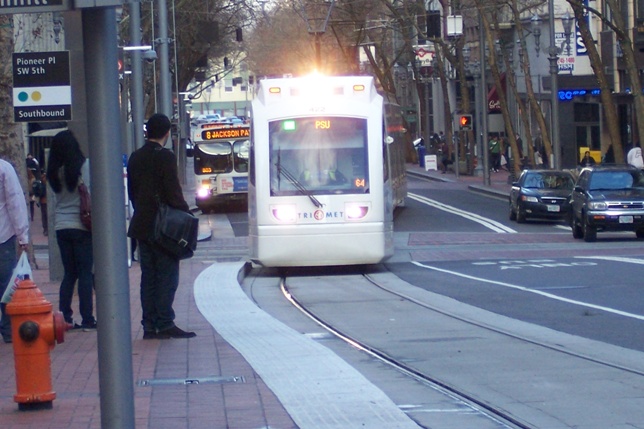
Adrian Skinner map (Nov. 2013) shows important points that would be connected by urban rail in Guadalupe-Lamar corridor. Screenshot: L. Henry.


► ARN Plan B proposal — This plan was devised last October (2014) in response to the contention (mainly articulated by supporters of the Highland-Riverside urban rail ballot measure, but also by some media personnel) that “there’s no Plan B” if the official rail proposal were to be rejected by voters (as, of course, it was on Nov. 4th). As we pointed out in our Oct. 5th article «A “Plan B” proposal for a Guadalupe-Lamar alternative urban rail starter line»,

Apparently, they’re willfully ignoring that there definitely is a “Plan B”. All along, there’s been an alternative urban rail project on the table … and it’s ready to replace the Project Connect/Prop. 1 plan if it fails.

Our proposal aimed to provide an example of a “Plan B” for the Guadalupe-Lamar corridor, “a plausible and fairly simple option for an LRT starter line aimed at minimizing design and cost while providing an attractive service with adequate capacity.” As our above-cited article explains, the plan assumes “a 6.8-mile line starting at the North Lamar Transit Center (NLTC, Lamar and U.S. 183) on the north, running south down North Lamar and Guadalupe, then Guadalupe and Lavaca to the CBD, then west on 4th and 3rd Streets to a terminus to serve the Seaholm development and Amtrak station at Lamar. Capital investment cost was roughly estimated at $586 million (2014 dollars), of which it was assumed 50% (less than $300 million) would be locally funded and the other 50% funded via FTA grants.

For this proposed line, our plan also assumed “30,000 to 40,000 as a plausible potential ridership range …, based on previous forecasts for this corridor plus factors such as the interconnection with MetroRail service at Crestview, and extensions both to U.S. 183 and to the Seaholm-Amtrak site.” The route, and several of the most important activity centers served, are shown in the annotated map below.


Proposed 6.8-mile "Plan B" light rail transit line in Guadalupe-Lamar corridor would have 17 stations and connect  the North Lamar Transit Center at U.S> 183 with Crestview, the Triangle, UT and the West Campus, the Capitol Complex, the CBD, and the Seaholm-Amtrak area. It's projected to serve 3 times the ridership of the Prop. 1 Highland-Riverside rail line at slightly over half the capital cost.

ARN’s “Plan B” proposed a 6.8-mile LRT line in the Guadalupe-Lamar corridor, from the North Lamar Transit Center to downtown, plus a short branch to the Seaholm-Amtrak site. Map: ARN. (Click to enlarge.)


► Parsons proposal — One of the most recent proposals for a Guadalupe-Lamar LRT route was presented in late December by Brad Parsons, a community activist involved with urban and transportation issues. As described in our article «Strong community support for Guadalupe-Lamar light rail continues — but officials seem oblivious»,

Starting at the North Lamar Transit Center at U.S. 183, this route would follow North Lamar Blvd., Guadalupe St., Nueces St., San Antonio St., and finally Guadalupe and Lavaca St. past established central Austin neighborhoods and activity centers, through the West Campus, past the Capitol Complex, and into Austin’s CBD. Brad’s proposal underscores the fact that there’s a variety of ways that LRT can be fitted into this constrained but high-volume traffic corridor.

Parsons’s map, shown below, includes markers indicating key points of interest along the route.


Map of Guadalupe-Lamar corridor light rail route proposed by Brad Parsons.

Guadalupe-Lamar LRT route proposed in December by community activist Brad Parsons. Screenshot: ARN. (Click to enlarge.)


Summing up

The experience of more than five decades can be summed up in several major takeaways.

• Clearly, the importance of Austin’s most central travel corridor is underscored by the long history of study and design efforts that has been concentrated on major investments to expand capacity and expedite access, and on planning for a rail line in particular.

• It should be apparent that an enormous volume of examination, evaluation, and analysis has reflected the significant attention — from both the community at large and official agencies — brought to bear on the Guadalupe-Lamar corridor. This has produced an abundance of previous federally approved documentation of the need for LRT in the corridor. In this context, the need for additional study should be minimal — mainly minor updating and evaluation of alignment and design issues.

Recommendations to “go back to Ground Zero” and “start again from scratch” amount merely to a recipe for further delay and dithering. There’s no need for further studies of the re-studies of the re-studies of the studies. It’s high time to finalize a workable, affordable, effective LRT project for this key center-city corridor, and move forward with it.

Support for LRT among Austinites has endured. This is substantiated by evidence, for example, we’ve shown in our earlier-cited article «Strong community support for Guadalupe-Lamar light rail continues — but officials seem oblivious».

Bolstering this is the support of neighborhood associations, community activists, and residents along in the corridor itself — “the extensive involvement of community activists and residents of neighborhoods along the proposed route” noted earlier has translated into a series of endorsements of G-L LRT from neighborhoods. See: Community endorsements.

The seemingly interminable saga of indecision, dithering, agonizing, despairing, dallying, official dementia, waste, and delay that has persisted for over half a century needs to come to an end. An achievable, affordable LRT starter line plan is within reach, and the resources to finalize planning for it are at hand. Let’s do it!


Rendition of LRT on Drag from 2000. Graphic: Capital Metro, via Light Rail Now.

Rendition of LRT on the Drag (2000). Graphic: Capital Metro, via Light Rail Now.

h1

Dobbs: Council’s Feb. 9th “Data Dig” is “wasteful ill-advised exercise of top-down insider back-room-deal-making trying to con the public”

9 February 2015
Graphic: MovieZeal.com

Graphic: MovieZeal.com

By Dave Dobbs

The following comments, slightly edited and adapted here to webpage format, were distributed via Email to members of the Austin City Council on 9 February 2015, prior to a “Data Dig” workshop session on transportation and mobility scheduled for later in the day. Dave Dobbs is Executive Director of the Texas Association for Public Transportation and publisher of the Light Rail Now website.
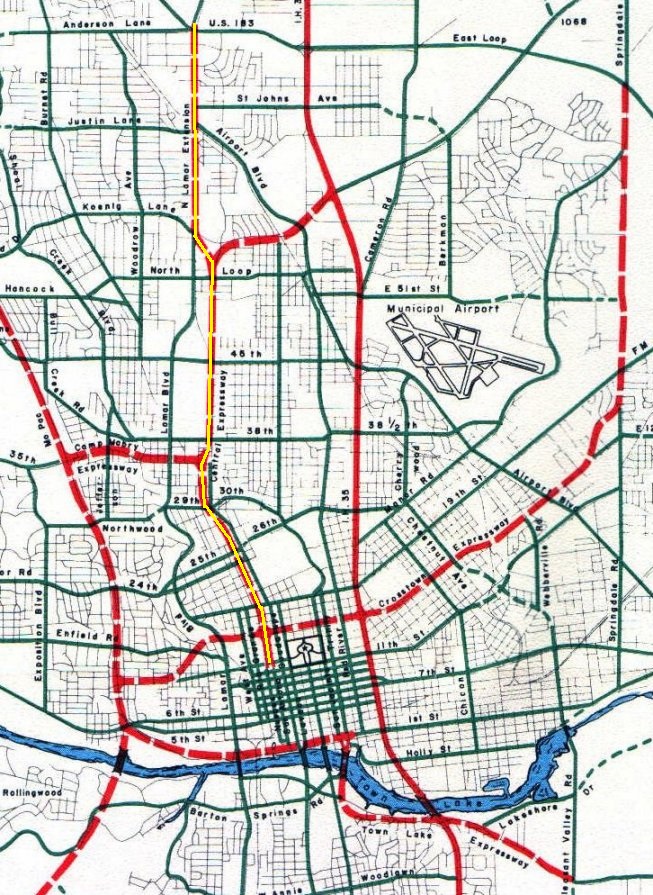
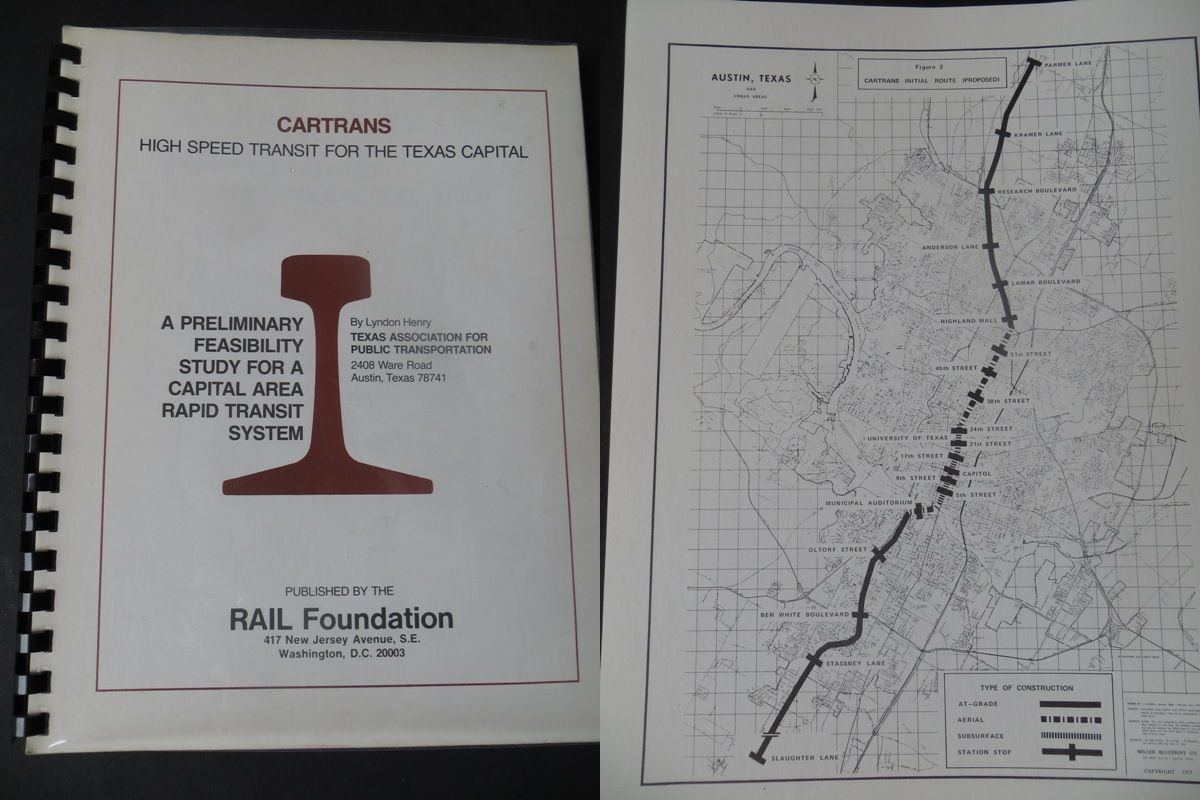
Once again this afternoon [9 Feb. 2015] Austin will see the kind of insider staff behavior that led voters in November 2012 to choose our current 10-1 city council format in the hope of more open government and real community input. Alas, it seems that staff has learned nothing from the failed Project Connect Urban Rail debacle after pro-rail advocates spent five years, starting in September 2009 with the COA [City of Austin] Transportation staff, warning the staff, the council, the Transit Working Group (TWG), and the Central Corridor Advisory Group (CCAG) that the pre-determined Downtown Austin Plan 2008 streetcar proposal (note 1), that essentially became Project Connect’s (PC) Urban Rail plan, and the gerrymandered planning process to justify it that was devoid of true public input, would be a failure at the bond ballot box.

Repeatedly we pointed out, three minutes at a time, with handouts and on several websites, that any new urban rail starter line had to utilize the Guadalupe-North Lamar (G/L) corridor to get the ridership required to justify the capital investment and operating costs of urban rail. And we had Federal Transit Authority (FTA) and Texas Transit Institute (TTI) data to support it. (Notes 2 and 3) Additionally, we offered well-thought-out detailed G-L alternatives that were far more cost-effective — only to be ignored.

Today you will not hear a balanced assessment of Austin’s transportation situation or get many real solutions to address our problems because staff has ensured that the deck is stacked against it.

Please note that there is no backup material posted with today’s agenda and no list of participants, but of the ten speakers I am told will be present, eight either publicly endorsed the Project Connect Rail Bond Package and/or represent organizations that endorsed, or were complicit in, this wasteful ill-advised exercise of top-down insider back-room-deal-making trying to con the public into tying your hands as new council members with an issue you need more time to study and digest.

Imagine where this council would be if the Project Connect Rail Bonds had passed and you were politically mandated to issue $400 million in Certificates of Obligation (COs). There wouldn’t be any air left in council chambers, today or any other day as special interests clamored continuously for a piece of asphalt public pie.

Only Jim Skaggs of COST and Julio Gonzalez Altamirano of AURA represent the public that prevailed November 4th. On election day 58% of the public said No to the Project Connect Proposition, and yet today 80% of your speakers will be de facto representatives of the minority position.

You should ask why you’re not hearing from former Capital Metro board member and former CMTA [Capital Metro] planner, Lyndon Henry, the person who first brought the light rail concept to Texas, the man most responsible for creating Capital Metro in the early 1980s, and who has, since 1970, made urban rail for Austin and better public transit his life work. Many of his papers for implementing rail in our capital city can be found at the Austin History Center. Mr. Henry holds a Master’s Degree from UT in Urban and Regional Planning, is well represented in professional papers peer-reviewed and accepted by the Transportation Research Board, National Academy of Sciences, writes for Railway Age, and led the public opposition to the PC bond package in public meetings and through our blog, AustinRailNow.com. If you want to know who, what, when, where, which, how and why about Austin transit, Lyndon Henry is an invaluable resource for elected officials wanting to understand our city’s mobility issues.

Another person who should be on your agenda is Scott Morris, Director of the Central Austin Community Development Corporation (CACDC), who early on recognized that city management and the previous council were abandoning the core neighborhoods with rail plans primarily to benefit developers, rather than to provide essential rail transit to keep the city’s congested core alive and growing. Scott’s PAC [political action committee], OurRail.org, played a major role in organizing rail advocates and core neighborhoods to support a Guadalupe-Lamar rail plan and to oppose the Project Connect package voters rejected November 4th. Mr. Morris can offer council considerable political insight and knowledge about Central Austin housing, jobs, and transportation issues and needs, and I recommend his counsel highly.

Mr. Henry and Mr. Morris are two of many who could give council a far better public-interest perspective about transportation than the viewpoints provided by self-serving interlocking private and public special interests. However, as long as city management decides who will be heard and when they will be heard with last-minute agenda postings sans real substance, not much will change. So much for 10-1. In the words of Tammany Hall’s Boss Tweed, “I don’t care who does the electing as long as I get to do the nominating.”


Notes:

(1) “New Rail Plan Rolled Out The latest line on streetcars”
By Katherine Gregor, Austin Chronicle, Fri., April 25, 2008
http://www.austinchronicle.com/news/2008-04-25/616178/

(2) FTA [Federal Transit Administration], Austin, Texas/Light Rail Corridors (November 2000)
http://www.fta.dot.gov/12304_3104.html

(3) CAMPO TWG meeting TTI presentation (PDF), January 13, 2012, page 15
https://txprojectconnect.files.wordpress.com/2011/11/twg-jan-13_ver10_no-video.pdf

h1

Strong community support for Guadalupe-Lamar light rail continues — but officials seem oblivious

3 January 2015
Graphic: Midwest District Blog.

Graphic: Midwest District Blog.

While Project Connect’s disastrously flawed Highland-Riverside “urban rail” plan recedes into history — decisively rejected by voters on Nov. 4th — community support for a sensible, workable, affordable light rail transit (LRT) plan continues. For example, see:

A “Plan B” proposal for a Guadalupe-Lamar alternative urban rail starter line

Resume planning light rail in Guadalupe-Lamar!

As this website reported in a “post-mortem” analysis posted a day after the Nov. 4th rail vote, “…it’s clear that Austin is basically a very pro-rail city. Widespread community sentiment for urban rail — much of it for just about any rail line, anywhere — was palpably strong.”

The Highland-Riverside plan may be dead, but the campaign for a Guadalupe-Lamar light rail starter line is firing up. Light rail in this heavily traveled, high-density central corridor can become the basic spine of a far more effective and truly extensive urban rail system in the future for the city.

There’s already a strong constituency and base of support for light rail transit (LRT) in the Guadalupe-Lamar corridor.

Ironically, part of the evidence of community support for rail comes from the Nov. 4th election results themselves. While a majority voted to defeat the Highland-Riverside plan on the ballot, a tally of precincts suggests strong pro-rail sentiment in the heart of the city. This is shown in an interactive election results map provided by Travis County, illustrating precinct-by-precinct vote preponderance, with pro-rail sentiment indicated as light blue (or turquoise) and opposition to the measure as lavender or purple (screenshot below).


Screenshot of interactive map of Nov. 4th "urban rail" vote by precinct. Source: Travis County. (Click to enlarge.)

Screenshot of interactive map of Nov. 4th “urban rail” vote by precinct. Source: Travis County. (Click to enlarge.)


Although the central pro-rail precincts (blue in the above map) seem surrounded by a sea of precincts against the measure, it’s important to realize that those central precincts include some of the densest and most populous in the city. An analysis by veteran Guadalupe-Lamar LRT supporter Mike Dahmus suggests that these central-city precincts that voted for the rail measure did so less enthusiastically than in the 2000 LRT referendum — tending to corroborate the hypothesis that opposition from rail transit advocates and supporters played a major role in helping defeat the official Highland-Riverside plan, perceived as flawed and even “worse than nothing”. (Stronger core-city support could have outweighed opposition in suburban precincts.)

Conversely, this tends to bolster the plausibility that a sensible, widely supported light rail (“urban rail”) proposal could muster the majority of votes needed to pass. The prospect of an LRT starter line project in the crucial, central, high-travel Guadalupe-Lamar corridor has already mustered affirmations of support from adjacent neighborhood associations, the UT student government, and other community sources, and would seem to have strong potential to succeed as a ballot measure.

Kate Harrington, in an article posted by the Building ATX.com website on Nov. 11th, just a week after the Nov. 4th vote, reminded readers of Austin Mayor Lee Leffingwell’s prediction that if the “urban rail” bond measure failed it “would mean that no new transit initiative would take shape for a decade or more.” But, Harrington observed, “Instead, it seems the issue is anything but dead. … Since voters decisively shot down the rail proposal last week, conversations about a possible ‘Plan B’ have sprung up all over the city.”

Most recently, via an interactive, annotated map (see screenshot below), the latest proposal for a Guadalupe-Lamar LRT route has been publicized by Brad Parsons, a community activist involved with urban and transportation issues. Starting at the North Lamar Transit Center at U.S. 183, this route would follow North Lamar Blvd., Guadalupe St., Nueces St., San Antonio St., and finally Guadalupe and Lavaca St. past established central Austin neighborhoods and activity centers, through the West Campus, past the Capitol Complex, and into Austin’s CBD. Brad’s proposal underscores the fact that there’s a variety of ways that LRT can be fitted into this constrained but high-volume traffic corridor.


Map of Guadalupe-Lamar corridor light rail route proposed by Brad Parsons.

Map of Guadalupe-Lamar corridor light rail route proposed by Brad Parsons. (Click to enlarge.)


Throughout last year’s ballot measure campaign, supporters of the official rail proposal (led by Let’s Go Austin) continuously depicted “urban rail” as absolutely essential to secure and sustain Austin’s future mobility and livability. With the slogan “Rail or Fail”, Mayor Leffingwell himself repeatedly warned that Austin needed an urban rail transit system to maintain its economic vitality and mobility in the face of steadily menacing traffic “gridlock”. Furthermore, news reports and competent analyses emphasized that simply building more highways or adding more buses to the roadway grid was counterproductive.

But while much of the Austin public seem to perceive and even embrace the alternative of an urban rail “Plan B” starter line routed in Guadalupe-Lamar (where the population density, major employment and activity centers, and heavy local travel are), key public officials and former leaders of the Let’s Go Austin pro-rail campaign seem to have been struck blind and deaf, oblivious to the obvious feasibility of LRT in the city’s most central and heavily used local corridor. For instance, the City’s Guadalupe Street Corridor Study, suddenly awakened from apparent dormancy to hold its first widely publicized public event on Dec. 3rd discussing “how to improve” the Drag, has explicitly ruled out consideration of rail transit, according to project manager Alan Hughes.

For Capital Metro board chairman (and outgoing City Councilmember) Mike Martinez, who had been expounding for the past year that “urban rail” was absolutely essential, further study of an alternative LRT plan now is apparently inconceivable. Martinez’s new mantra — basically a variant of “my way or the highway” — is that “the voters have spoken”, rail is off the table, and “we have to become the best bus city in America.”

Evidently at Martinez’s behest, Capital Metro has been sifting about for other ways to spend nearly $3 million in planning funds previously scheduled for further “urban rail” study (on the now-defunct Highland-Riverside proposal). Re-allocate these funds to a resumption of planning for LRT in Guadalupe-Lamar (where urban rail would actually make overwhelmingly good sense)? Certainly not.


Capital Metro's "Heart of the City" latest projects propose to usurp millions in urban rail planning funds for other purposes. Screenshot from video of Dec. 15th Capital Metro board meeting.

Capital Metro’s “Heart of the City” latest projects propose to usurp millions in urban rail planning funds for other purposes. Screenshot from video of Dec. 15th Capital Metro board meeting.


Instead, at a Dec. 15th Capital Metro board meeting, Todd Hemingson, the agency’s head of strategic planning and development, outlined a “Heart of the City” list of potential study efforts (see photo of PowerPoint slide, above). Hemingson’s presentation made clear that even the two items seemingly most relevant to the central Guadalupe-Lamar corridor — “Guadalupe/Lavaca Transit Mall” and “Central Corridor Transit Entryways” — were actually focused merely on modest bus service expansion and infrastructure (including a possible tunnel for buses between the Loop 1 toll lanes and arterials leading into downtown).

Austin — supposedly the most “progressive” city in the “reddest” rightwing state of Texas — has a distinctive (read: notorious) reputation for dithering, dallying, and derailing in its public transport planning … while excluding the general public and making key decisions secretively behind closed doors. Surely the time has come to break this pattern. Will a new mayor and a new district-based 10-1 City Council provide an opportunity to scrap this modus operandi of failure and disaster, bring the community into authentic involvement in crucial decisions, and move forward with the first phase of LRT as a starter line in Guadalupe-Lamar?

We’re trying our hardest to help make that happen. ■


Light rail in Guadalupe and North Lamar could be modeled after San Francisco's N-Line route in Judah St., seen in this satellite view from Google Maps. Screenshot: Dave Dobbs.

Light rail in Guadalupe and North Lamar could be modeled after San Francisco’s N-Line route in Judah St., seen in this satellite view from Google Maps. Screenshot: Dave Dobbs. (Click to enlarge.)