Posts Tagged ‘Project Connect’

h1

“Highland” sector favored by Project Connect — but where’s the travel demand?

19 November 2013
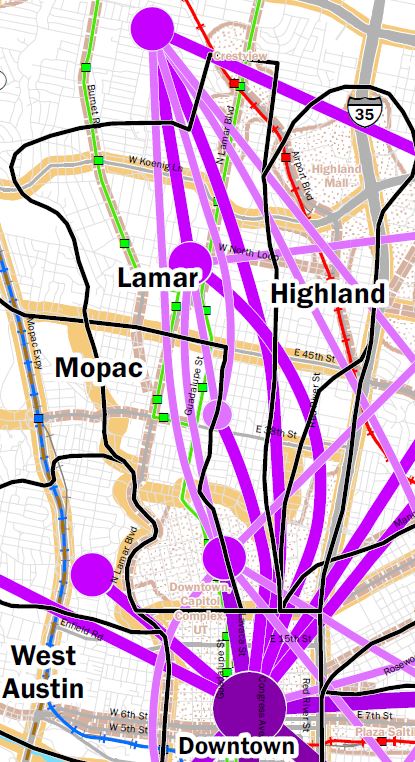
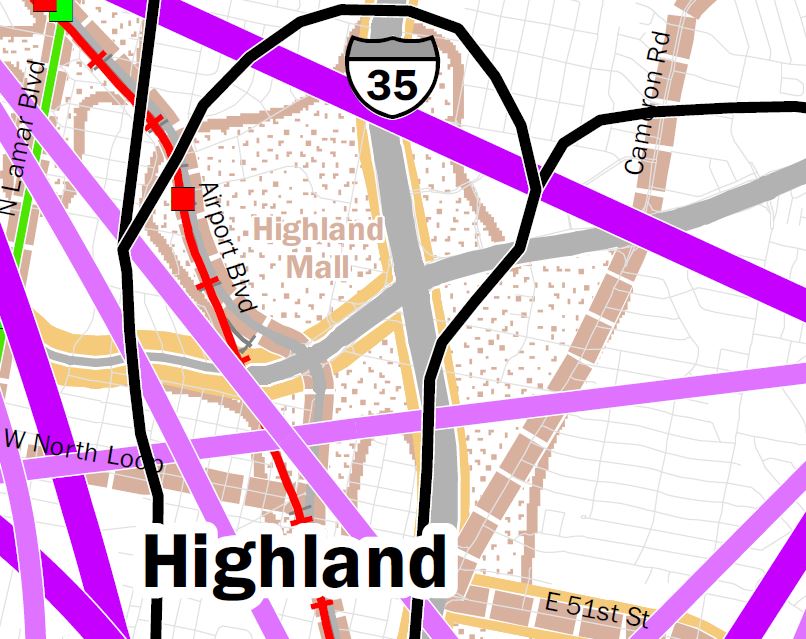
Closeup of data visualization of 2035 travel demand projection focusing on "Highland" sector. Snip by L. Henry of Project Connect infographic.

Closeup of data visualization of 2035 travel demand projection focusing on “Highland” sector. Snip by L. Henry of Project Connect infographic.

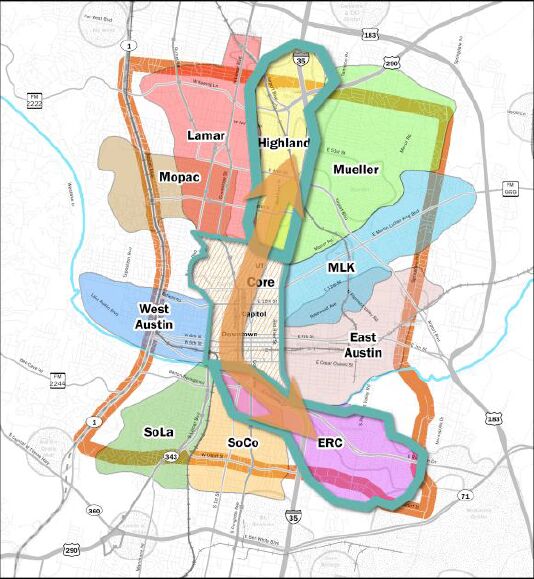
As this blog recently reported, on Nov. 15th, Project Connect — newly empowered by Austin’s Mayor Lee Leffingwell to make the de facto final decision on urban rail — selected the “ERC” sector (with the somewhat daunting East Riverside corridor) in South Austin and the “Highland” sector (suspected to be a proxy for the western “Mueller” sector) in central Austin.

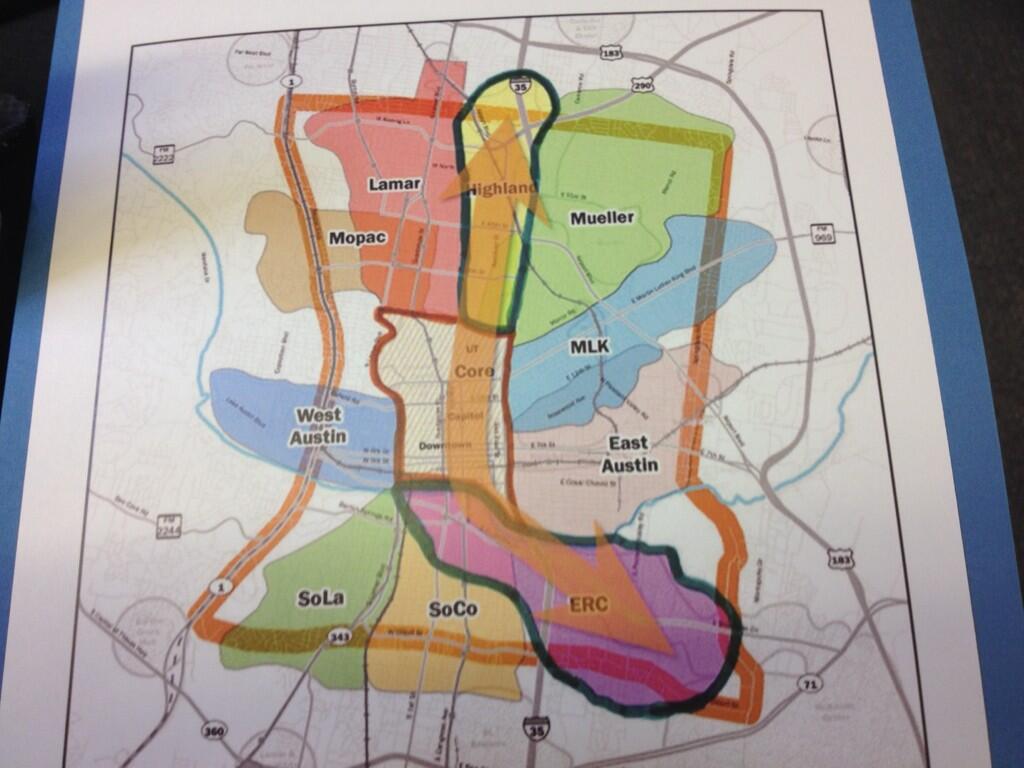
Project Connect's anointed sectors ("sub-corridors") for urban rail, selected on Nov. 15th. Map: Project Connect.

Project Connect’s anointed sectors (“sub-corridors”) for urban rail, selected on Nov. 15th. Map: Project Connect.

While the significant and growing Highland campus of Austin Community College (ACC) has been profusely brandished as a major activity center justifying “Highland” (in effect, a “gerrymandered” sector fabricated from pieces of the actual Highland and several other core-city neighborhoods), there seems very little likelihood that a rail route in the “Highland” sector itself would actually reach Highland ACC anytime soon or possibly even … ever.

It’s likely that urban rail is intended only to reach Hancock Center (per the previous Mueller plan), then to take the same previously planned northeasterly route (through the Hancock property, then crossing Red Line tracks, then under I-35 via Airport, and into Mueller via Aldrich). Very daunting right-of-way constraints almost certainly will remain an obstacle to extending urban rail to Highland ACC.

Besides the physical constraint of virtually no clear street right-of-way for an urban rail alignment to the core area, Project Connect’s chosen “Highland” sector presents another serious problem: extremely weak travel demand!

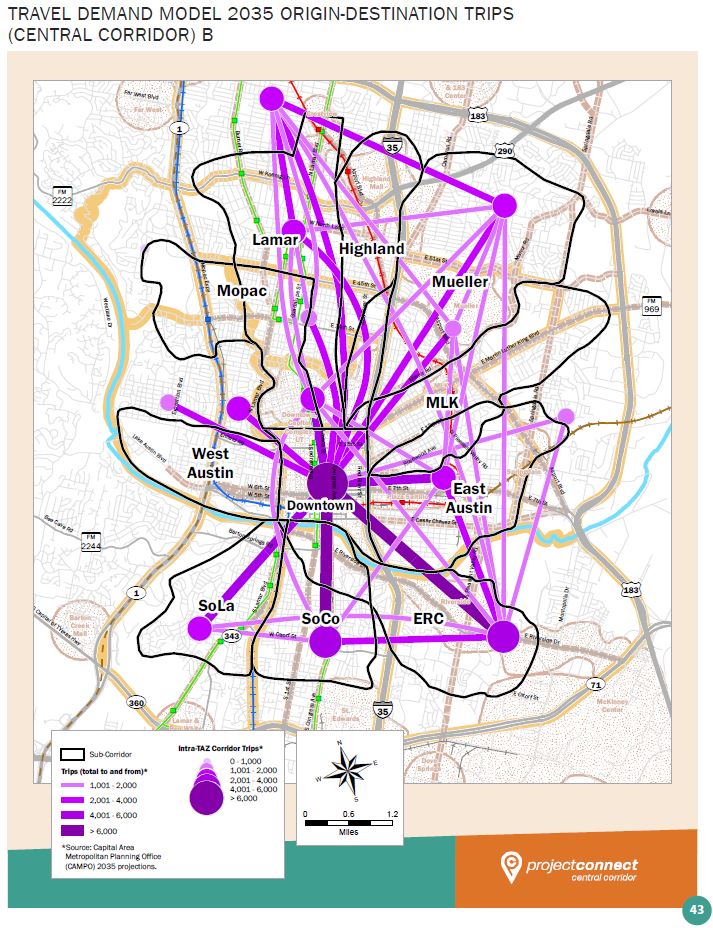
This is revealed in the data visualization of travel demand forecast for 2035 by sector and displayed in Project Connect’s Map Book (v.5), p. 43, based on projections from CAMPO’s own travel demand model. Two JPG snips of this visualization (showing travel demand activity as vectors and intra-zonal travel as bubbles) are shown below, one for the study area as a whole, and the other a closer focus on the central core city.

Travel demand in 2035 shows zero (or very weak) travel activity involving "Highland" sector. Infographic: CAMPO and Project Connect.

Travel demand in 2035 shows zero (or very weak) travel activity involving “Highland” sector. Infographic: CAMPO and Project Connect.

Closeup of projected travel demand in central core city.

Closeup of projected travel demand in central core city.

In comparison with “Highland”, the infographics shown above seem to indicate significantly more projected travel demand not just in the rather large “Lamar” sector but all along the Guadalupe-Lamar corridor specifically. There’s also significant travel to what seems to represent a centroid just northwest of the boundaries of the “Lamar” sector, which it’s arguable is logically in the ridership catchment area for an urban rail line on Guadalupe-Lamar.

A closeup of this visualization for a portion of the “Highland” sector (including the Highland ACC area) is shown at the top of this posting. In contrast to the seemingly intense travel demand involving the Guadalupe-Lamar, the “Highland” sector seems to have zero travel demand centroids or origin-destination points indicated, and there’s a total absence of “data bubbles” represent intra-zonal trips.

This seemingly total lack of projected transit demand in for the “Highland” sector is actually rather puzzling. It’s reasonable to assume some degree of future travel demand between this area bordering the west side of I-35 and the core area. In any case, the data visualization suggests a projection by the CAMPO model that that this area is astoundingly weak in this respect compared to Guadalupe-Lamar — certainly contradicting the claims and conclusions of Project Connect’s top decisionmakers, including Kyle Keahey, who have emphasized the greater travel demand potential of “Highland” (and “ERC”) over the “Lamar” sector (and, implicitly, the actual Guadalupe-Lamar corridor). Basically, the evidence for this — in this presentation of CAMPO 2035 projection results — is simply not there.

In fact, on the basis of this infographic, both the “Highland” and “MLK” sectors appear to have the weakest travel demand projected in the CAMPO travel demand model — possibly suggesting a deficiency in the model. In any case, since Project Connect based its assessment significantly on this data, the results presented, and the contrary evidence of very strong travel demand in the Guadalupe-Lamar corridor, contradicting Project Connect’s own stated conclusions, should at the very least raise questions about the competency and integrity of the study process.

h1

Surprise! Mayor and Project Connect select same routes they wanted in the first place

17 November 2013

0_ARN_shocked-guy-with-questions-cartoon

By Lyndon Henry

This past Friday, Nov. 15th, to a meeting of the Central Corridor Advisory Group (CCAG), the Project Connect (ProCon) team presented their “recommendation” of sectors (misnamed “sub-corridors”) for the first urban rail route(s) — a combination of “Highland” (a proxy to facilitate city officials’ desired route to Mueller) and “ERC” (containing the East Riverside Corridor, which the City has been heavily promoting as a development district).

Tilting the playing field

It should be noted that the “Highland” sector bears very little resemblance to the actual Highland neighborhood, delineated by both the Highland Neighborhood Association (see Highland Neighborhood Association endorses Guadalupe-Lamar for urban rail) and the Highland Neighborhood Planning Area defined by the City of Austin (COA). While the actual Highland neighborhood and planning district includes North Lamar Blvd. (mostly as its western boundary) all the way from Denson Drive to U.S. 183, ProCon’s “Highland” sector studiously avoids Lamar, and never reaches U.S. 183; instead, the sector incorporates I-35 (never even touched by the real Highland), and droops down far south of the actual neighborhood to include Hancock Center and the northern edge of the UT campus — thus overlapping the long-proposed Mueller route for urban rail. In this sense, “Highland” appears to be manipulated here as a kind of “proxy” for the COA’s original plan, functioning as a precursor of a full route to Mueller.

Project Connect's "recommendation" revealed on Nov. 15th. Photo: ProCon.

Project Connect’s “recommendation” revealed on Nov. 15th. Photo: ProCon.

Just a few days prior to Friday’s meeting, COA Mayor Lee Leffingwell cancelled plans to bring the selection of a sector for urban rail to both the Capital Metro board and the entire City Council for a vote. Instead, in what’s being portrayed by critics as a kind of “palace coup”, the mayor has ditched plans for such votes and authorized Project Connect to make its own decision about a sector (which in effect clinches the basic route decision). Thus, ProCon’s Nov. 15th “recommendation” amounts to the actual decision to start planning urban rail routes — lo and behold, the same basic routes the city administration, Project Connect, and an assortment of real estate development interests have wanted all along.

And all from a process that repeatedly seems to have rigged the game, and tilted the playing field.

Data flaw: Garbage In, Garbage Out

Kyle Keahey presented ProCon’s justification to the CCAG and the audience in the classic maneuver of a “data blitz” — a rapid PowerPoint barrage of tables of values, bar graphs, and bullet points almost guaranteed to dazzle and overwhelm. Assuring the CCAG attendees that his team had been busy slicing, dicing, and splicing the data approximately six different ways, including subjecting all that abundant data to a “sensitivity analysis”, Keahey wrapped up his case for basically the original official route plan (a line leading from downtown through UT’s East Campus to Hancock Center and eventually to the Mueller site, plus a route to bolster real estate and other commercial development along East Riverside).

But this picture of a fair, balanced, scrupulously diligent evaluation process is being greeted with considerable skepticism in the community. ProCon’s study has numerous hallmarks of having been rigged, from a peculiarly contrived methodology that departs from longstanding professional practice, to cherry-picking of a highly questionable set of data elements and the exclusion of data indicators far more appropriate for such an ostensible “corridor study”. (And, one might add, a highly secretive and insular process that immunized the ProCon team and their study procedures from public scrutiny and oversight.)

Thus the basic flaw in ProCon’s data analysis can be boiled down to one word: GIGO (“Garbage In, Garbage Out”). In effect, this appears to have been a process that involved limiting the focus to gerrymandered data sources, and then playing games with gerrymandered data.

Along the way, from the rather soft-focus Map Book “data visualizations” made available, a wide array of serious data errors and omissions were identified by various stakeholders. See, for example:

Huge problems cited with Project Connect’s urban rail study data

Sub-Corridor Selection Scoreboard

Three Suggestions for the Project Connect Sub-Corridor Survey

“Beauty contest”, not corridor analysis

But the core problems with ProCon’s exercise go far deeper. In addition to the numerous data anomalies (and the lack of public access to the raw data being used), there are serious methodological faults. Perhaps the most troubling involves the fundamental concept and approach of the study itself, discussed in Austin Rail Now’s article Project Connect’s “corridor” study — without corridors!

As the article cited above indicates, rather than performing a bona fide study of actual alternative corridors, ProCon embarked on what amounted to an inventory of highly filtered attributes of basically gerrymandered sectors, dubbed “sub-corridors”, devolving into a kind of “beauty contest” among sectors of the city, while distorting as well as ignoring the actual travel corridors that should have been the focus.

This involved the selection of a predominantly questionable array of data elements as the basis for “evaluation” of the various sectors. Leaving their “weighting” aside, in the aggregate the evaluatory elements themselves are inappropriate. Here’s why:

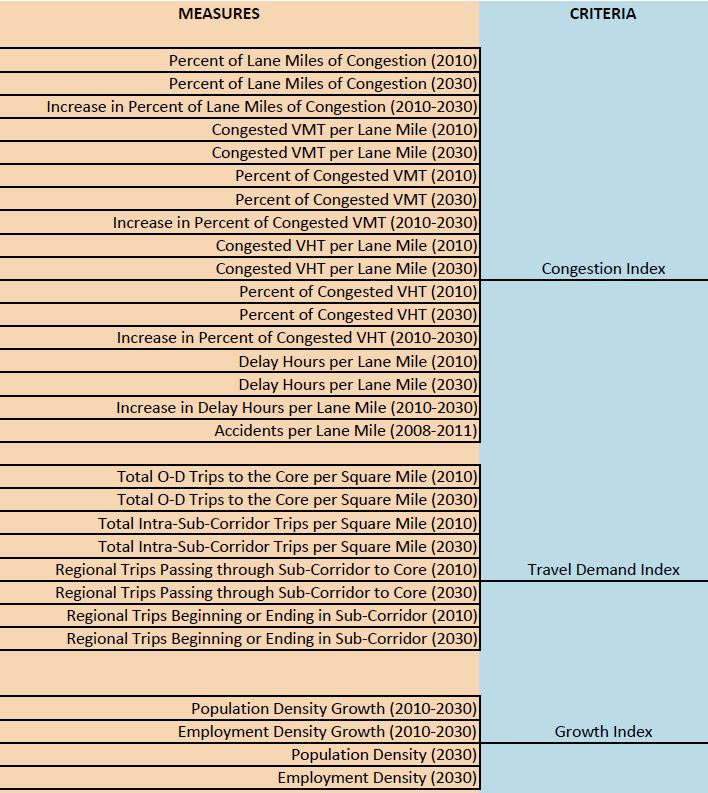
(1) Projections — ProCon relies very heavily on projections of future conditions for their basic measures. As the rail advocacy group AURA (Austinites for Urban Rail Action) has explained in its evaluation guide, projections themselves are basically unreliable, risky, flaky, whereas, in contrast, “We believe use of the real-world, recently-observed data gives the more accurate and reliable picture of potential ridership, as well as the greatest viability for federal funding.”

Snippet of ProCon's evaluation matrix shows preponderant emphasis on hypothetical future projections rather than current factual data.

Snippet of ProCon’s evaluation matrix shows preponderant emphasis on hypothetical future projections rather than current factual data.

This is especially true in regard to locational projections, i.e., projections of future developments in specific geographical locations. Beyond a roughly five-year horizon, projections for specific neighborhoods and similar chunks of real estate basically become unreliably speculative — which seems to be what we’ve actually been dealing with … a significant dollop of real estate speculation, given a kind of veneer of “techniness” by CAMPO and their land use/travel demand model package.

For decades, public transportation advocates have warned repeatedly about the “self-fulfilling prophecy” syndrome in this kind of transportation planning process. In the past, it’s been applied mainly to highway development — justifying “future growth” in just the right places where developers want to build, so as to rationalize huge investments in new freeways and other roads. And, lo and behold, these very projections somehow materialize after the transportation facilities are built, thus “proving” the “validity” of the projections!

Today, in Austin, this process may be at work justifying speculative land development in certain areas of the central city (i.e., the central study area — “Central Corridor”), this time with the added drawback of ignoring or dismissing opportunities for redevelopment of areas in the heart of the core city, particularly centered along the Guadalupe-Lamar corridor.

(2) Percentages and growth rates — Obviously, percentages (of poverty, transit dependency, etc.) and growth rates can be somewhat useful indicators, but relying on them overwhelmingly, as ProCon’s methodology does, can skew the planning process. Neither actual population, nor actual transit ridership in an actual corridor between any sector and the core, is considered as a measure!

Percentages can be deceptive, especially when it comes to forecasting transit ridership. Area A may have a population of 100, of which 50 are transit-dependent — 50% transit dependency. Area B may have 10,000 population, of which 2,000 are transit-dependent — 20% transit dependency. If you have a rating system that awards the higher score to the higher rate, then you’re giving a higher score to an area that will yield you only 50 potential transit-dependent riders, vs. an area that will yield you 2000!

Likewise with growth rates. If Area A is projected to grow over 20 years from 100 to 1000 residents, that’s a 900% growth rate. Meanwhile, much larger Area B is projected to grow from 40,000 to 50,000 — a 25% growth rate. Again, if your rating system awards scores based on growth rate, Area A will get the overwhelmingly higher rating. Yet Area A provides only 1,000 residents as a market for your transit line, whereas Area B provides 50,000!

ProCon’s evaluation methodology measures have over a dozen of this type of potentially fallacious characteristic. And ProCon’s growth rates, by presuming the validity of 2030 projections of land use and travel demand, compound the possible errors associated with the first category discussed, Projections.

(3) Black Box — For all their assurances of “transparency”, ProCon’s methodology for integrating and manipulating all these evaluation measures, and merging them into a model to render ratings, remains totally mysterious. Here and there are other occult items, such as the “Transit Orientation Index” (whazzat?), which seems to be rendering ratings for 2010 and 2030. If documentation of these model processes is available on the ProCon website, they sure have it well-concealed. So far, it’s either absurdly difficult or impossible to find anything either on their website or through Google searches.

Botched analysis

How could a study, from fallacious basic concept to botched data analysis, go so wrong?

Rush, rush, rush — From the outset, the ProCon team, apparently goaded by an impatient COA administration, has been puzzling both participants and observers of the study by their unprecedented breakneck race to wrap up an exceptionally complicated study — on an inordinately brief timeframe — and jump to a conclusion.

De facto objective — Suspicions are now rampant that the real aim, all along, behind the scenes, has been to find a way to deploy data “truthiness” (i.e., creatively selective collection and manipulation of data and advantageous “projections”) to justify the original rail route preferences of a small clique of powerful local political leaders and real estate interests to bolster and enhance somewhat speculative real estate investments in certain sectors of Austin.

Muzzling the public — As I said in my own Citizen Communication remarks, the ProCon team have pretty much operated in a kind of bell jar, insulating and isolating themselves from effective interaction and cooperation with the public, so I’ve really never had an opportunity for a substantive discussion of these issues.

Among some critics, ProCon’s ostensible selection of East Riverside and the so-called “Highland” sector is seen as basically camouflage for a stratagem focused on developing the desired line from downtown to Hancock Center, which was being considered by ProCon anyway for months prior to the start of the “study”. The expensive East Riverside line (requiring heavy investment in a new bridge across the Colorado as well as a rebuilding of the grade separation with I-35) would likely be put on hold until the Mueller line as far as Hancock is completed; the final Mueller link could be added later.

Both critics and many community observers, favoring urban rail but increasingly skeptical of ProCon and their methods, are planning to ratchet up their opposition to this ill-conceived plan. In effect, Project Connect seems to be preparing to push Austin toward a vote for an expensive rail investment in what would typically be an uphill struggle, but now with the added challenge of having made enemies out of its strongest pro-rail allies in the heart of the core city.

h1

Project Connect’s “corridor” study — without corridors!

11 November 2013
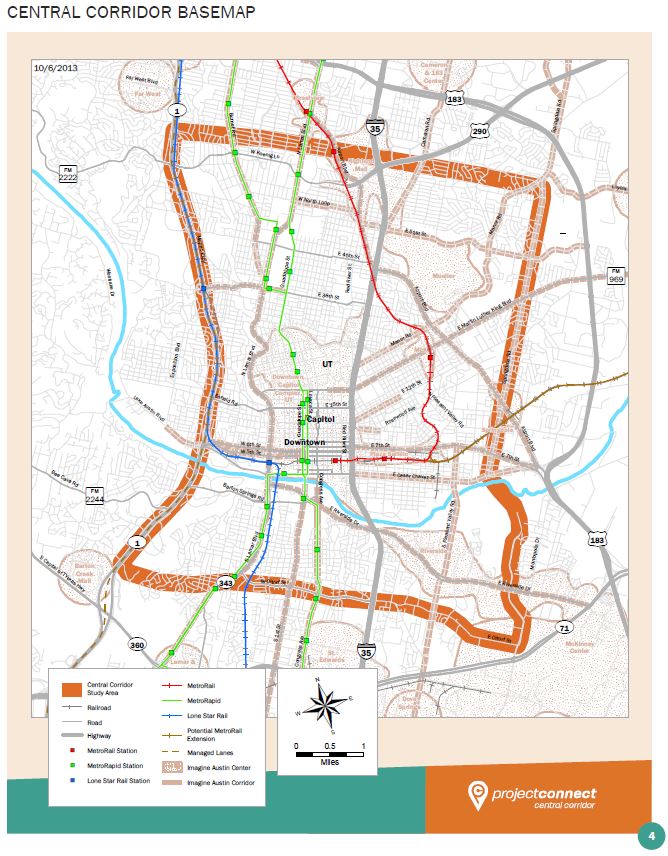
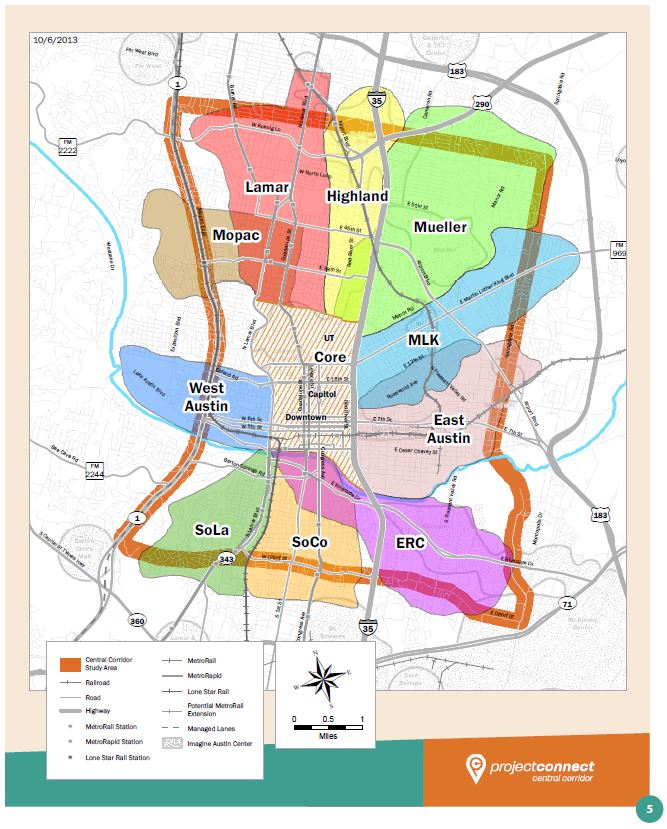
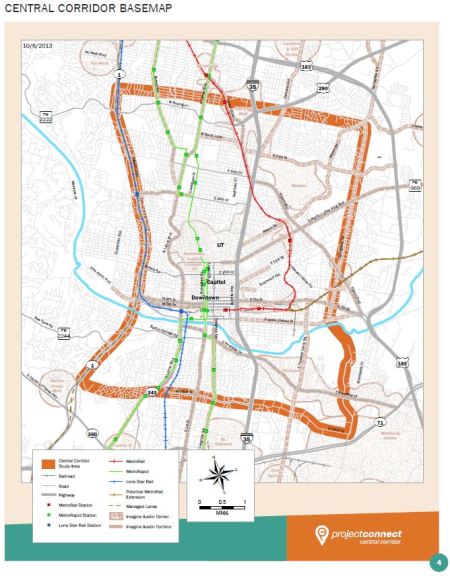
Project Connect's central Austin study area (so-called "Central Corridor")

Project Connect’s central Austin study area (so-called “Central Corridor”)

Coming soon, on November 15th, is the momentous day when the Project Connect (ProCon) “team” (however that’s defined) is scheduled to make its recommendation for an inner-city sector (“sub-corridor”) for urban rail — i.e., a light rail transit (LRT) starter line. This is supposed to be the result of a study purportedly aimed at identifying just the right “corridor” for an urban rail line connecting to the core area of the city. However that recommendation may go, the fact remains that ProCon’s urban rail study has been fundamentally flawed by disastrous faults, weaknesses, and errors.

Even leaving aside all the data errors and anomalies (see Huge problems cited with Project Connect’s urban rail study data), what seems to be the program’s really catastrophic conceptual fault is its approach in (1) defining a huge Central study area (“Central Corridor” — see map above) and then (2) because this huge “Central Corridor” is so unwieldy, subdividing it into sectors (which they must call “sub-corridors”) that are effectively treated in isolation from one another.

Project Connect's "Central Corridor" (study area) with "sub-corridors" (i.e., sectors). (Click to enlarge.)

Project Connect’s “Central Corridor” (study area) with “sub-corridors” (i.e., sectors). (Click to enlarge.)

In effect, this subdivision of the study area has created an array of balkanized sectors that are analyzed more as autonomous geographic-demographic “islands” than as components essential to work together as a whole. As a result, actual, realistic, workable travel corridors have been obscured by all this.

What’s a travel corridor, anyway?

So, what exactly is an urban travel corridor? Until now, there’s usually been no dispute in Austin — as per widely accepted transportation planning practice, travel corridors in Austin (and virtually all other metro areas) have typically been laid out as fairly narrow swaths following travel patterns (and, almost always, some kind of existing transportation right-of-way) and encompassing population and employment in fairly long, narrow strips of the urban area. Wikipedia provides a particularly succinct and useful definition:

A transportation corridor is a generally linear tract of land that contains lines of transportation like highways, railroads, or canals. Often, new transport lines are built alongside existing ones to minimize pollution.

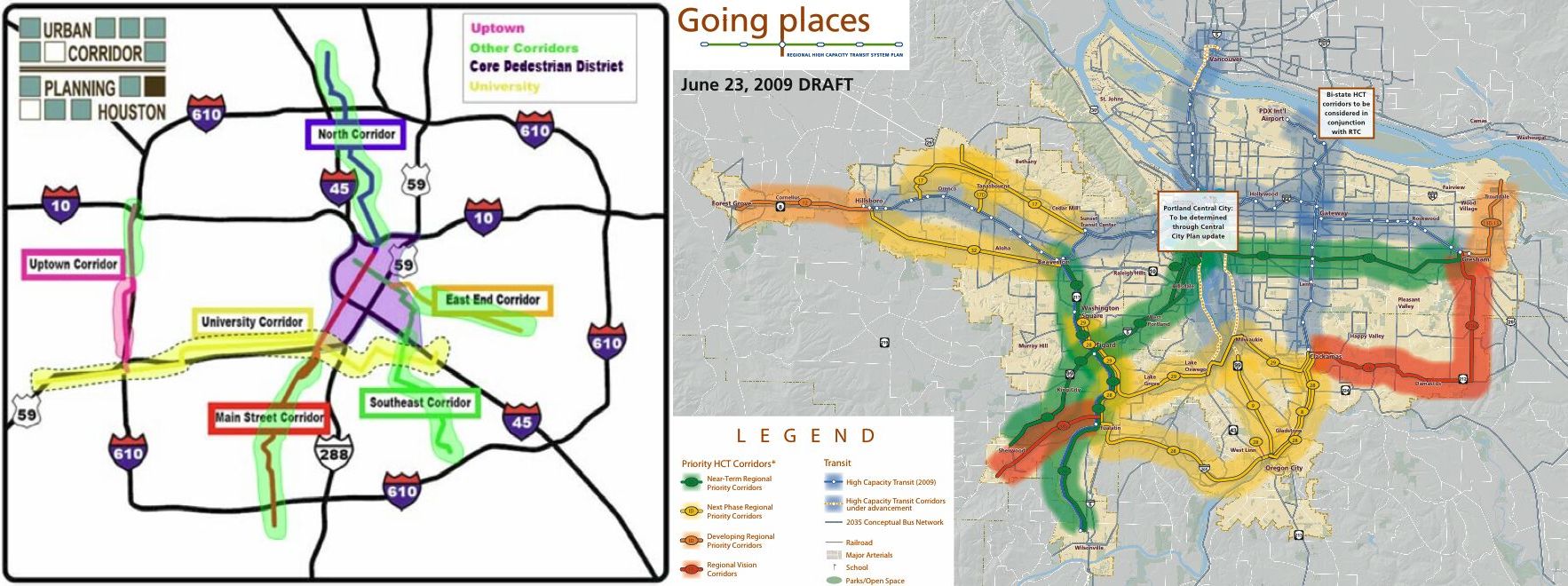
A possibly even better idea of urban travel corridors can be derived from how they’re depicted in maps. Below are several examples of corridor planning maps from several other communities.


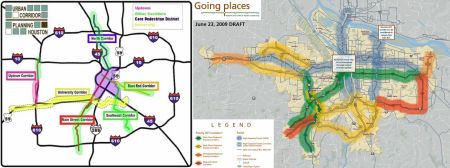
LEFT: Houston urban corridor planning map (City of Houston). RIGHT: Portland high-capacity transit (HCT) planning map (Transport Politic).

LEFT: Houston urban corridor planning map (City of Houston). RIGHT: Portland high-capacity transit (HCT) planning map (Transport Politic).

Both of these maps (Houston left, Portland right) show urban travel corridors as very elongated bands following major transportation features such as arterials and rail lines.

Note that in each case, the core is not designated as a “corridor” — in Houston, it’s the Core Pedestrian District; in Portland it’s simply the Central City.


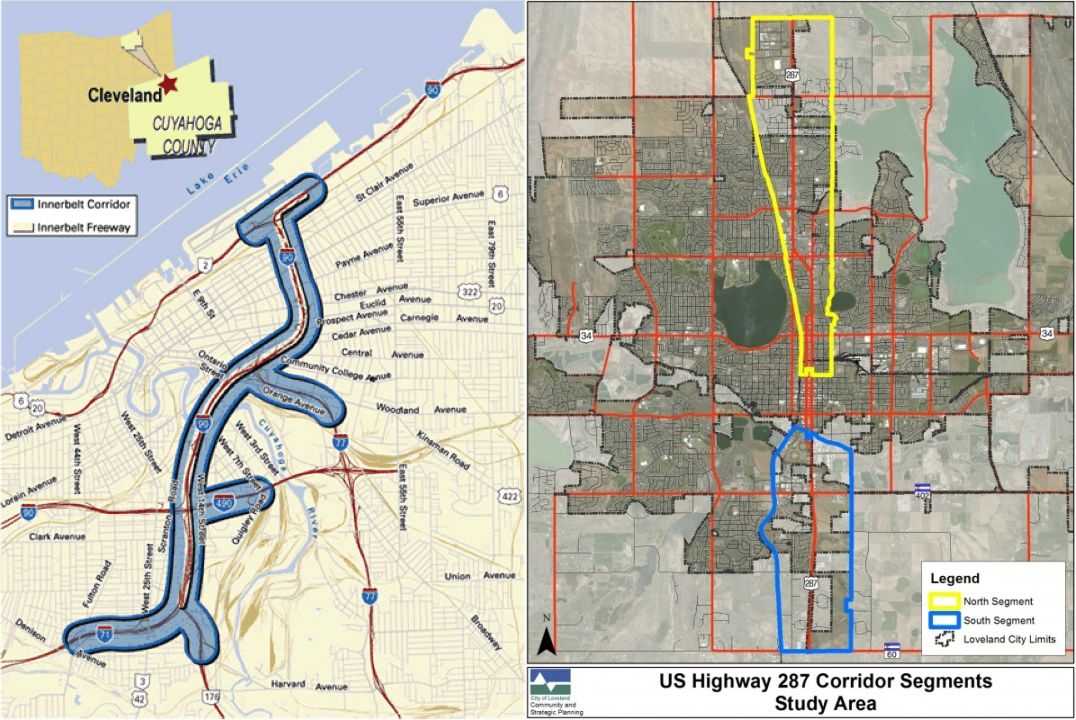
LEFT: Travel corridor in Cleveland (FHWA). RIGHT: Travel corridor in Loveland, Colorado (City of Loveland).

LEFT: Travel corridor in Cleveland (FHWA). RIGHT: Travel corridor in Loveland, Colorado (City of Loveland).

Multiple urban corridors can be designated for study, or the focus can be on individual corridors. In these cases, individual corridors have been selected for more intensive study — one in Cleveland, left, and one in Loveland, Colorado, right. But note that these corridors are still elongated, narrow, and shaped to comform to predominant travel flow patterns.


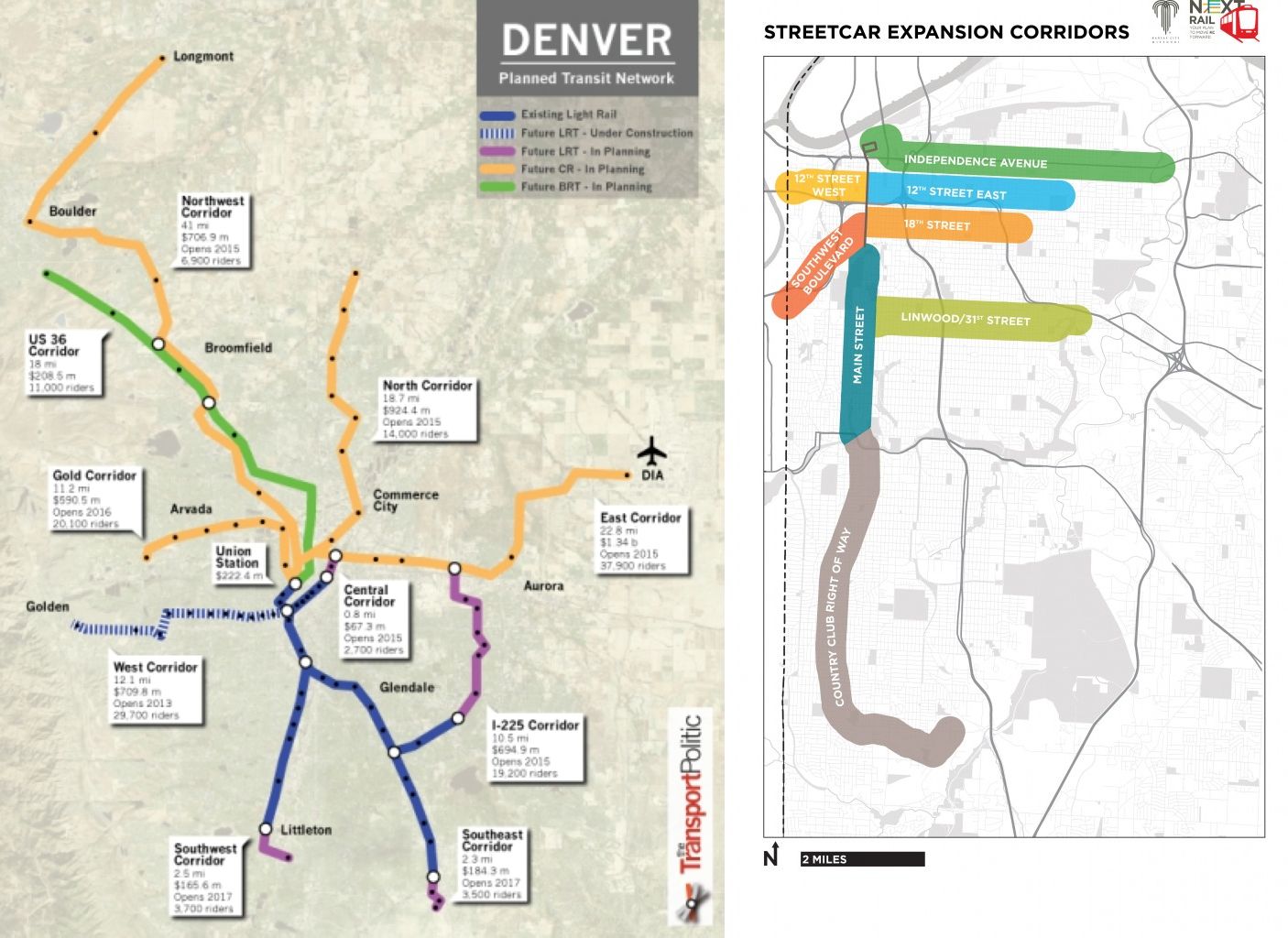
LEFT: Denver — planned transit corridors (RTD). RIGHT: Kansas City — Proposed streetcar expansion corridors (NextRail-KC).

LEFT: Denver — planned transit corridors (RTD). RIGHT: Kansas City — Proposed streetcar expansion corridors (NextRail-KC).

Once again, transit corridors are typically designated as fairly narrow, often shaped around existing travel facilities (roadways or railways). They do this because they are designed to designate travel movement patterns, i.e., traffic flows. The adjacent areas are often regarded as “watershed” for ridership, i.e., the “travel market” from which ridership to the proposed transit services could be attracted. It’s the demographics and other characteristics in these corridors that are important, not areas of huge urban sectors remote from these corridors.


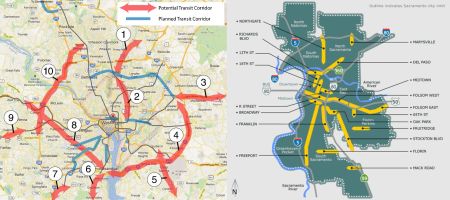
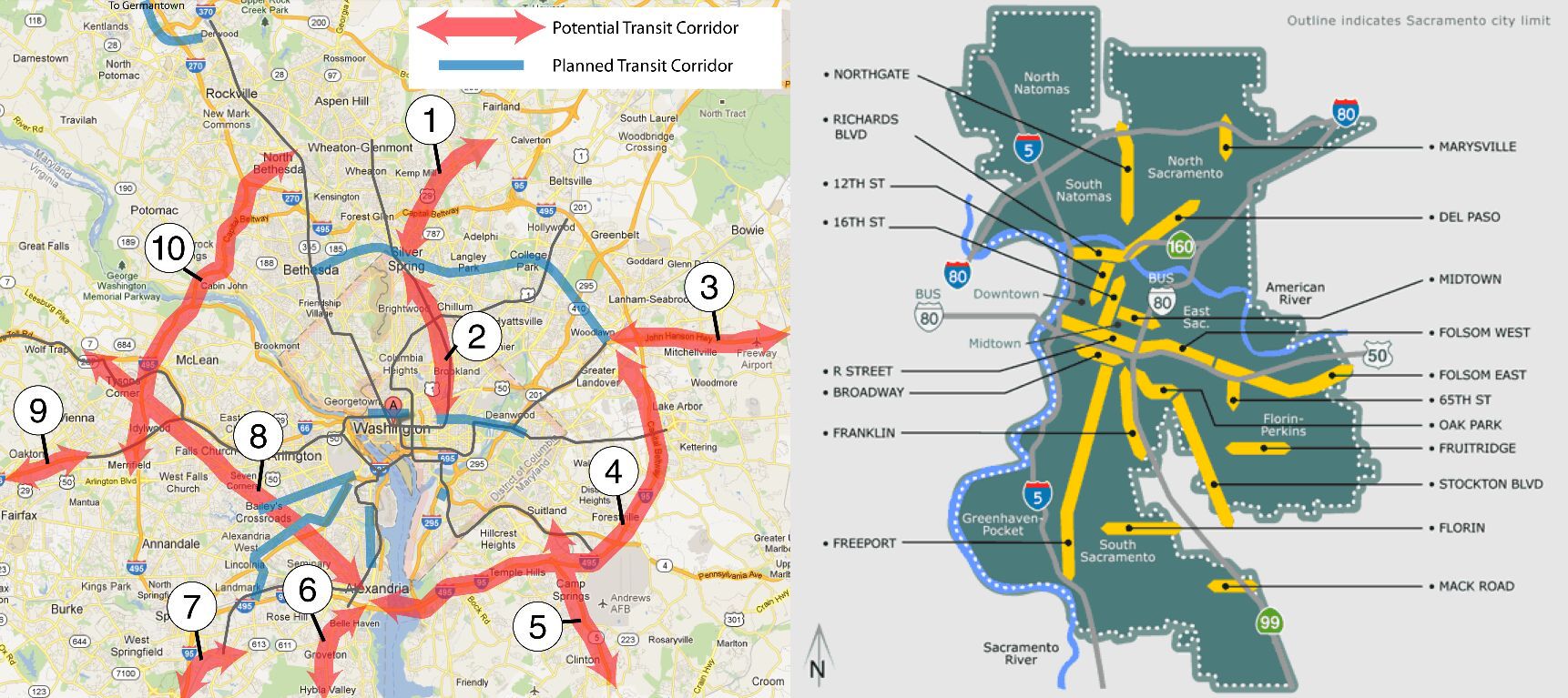
LEFT: Washington — potential transit study corridors (WMATA). RIGHT: Sacramento — Designated commercial corridors (City of Sacramento).

LEFT: Washington — potential transit study corridors (WMATA). RIGHT: Sacramento — Designated commercial corridors (City of Sacramento).

What’s significant in these cases (Washington, DC left, Sacramento right) is the addition of arrows to the corridor designations on the maps to emphasize that these are travel corridors.


ProCon’s “sub-corridors” = isolated enclaves

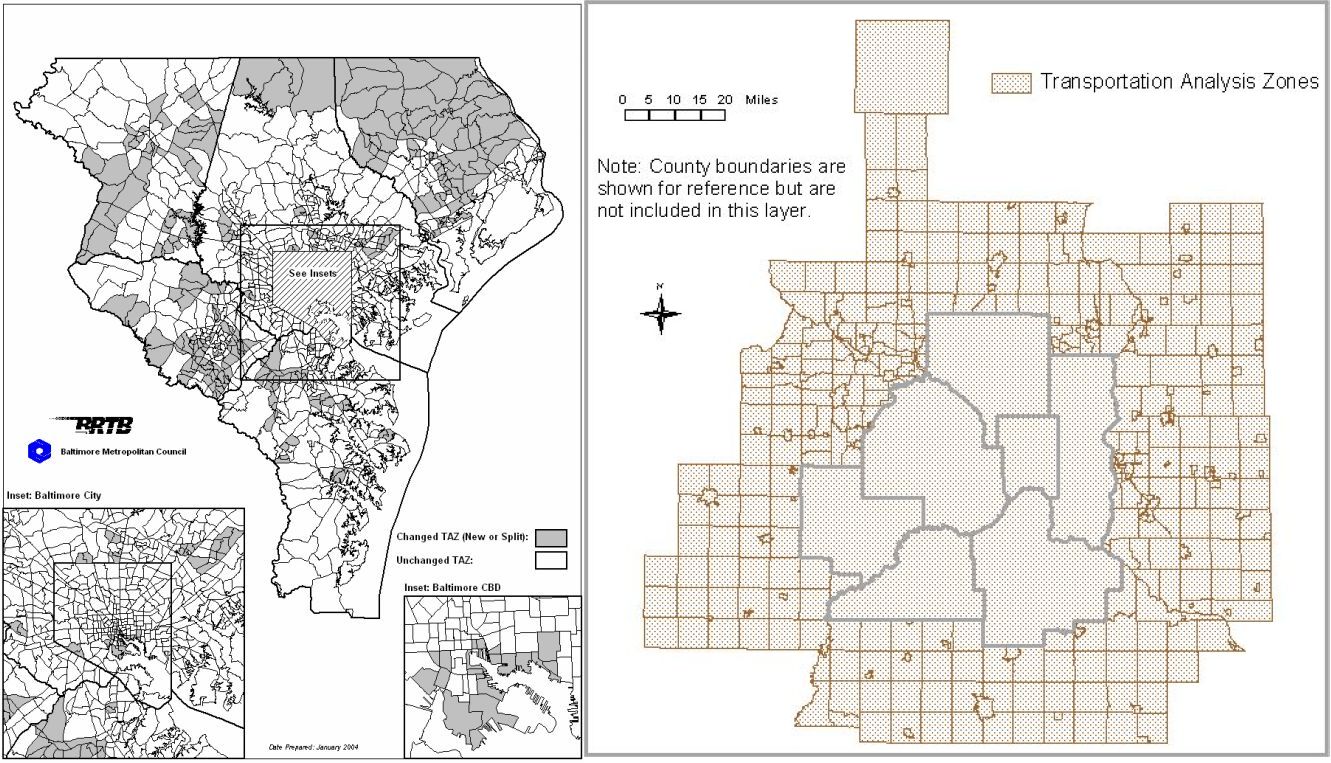
Yet Project Connect’s “sub-corridors” resemble none of these actual case examples — maybe because they’re actually urban districts or sectors, not true travel corridors. Indeed, these sectors have virtually nothing to do with actual travel corridors following traffic patterns. Instead, in the way they’re used by ProCon, they resemble, to some extent, rather large travel analysis zones (TAZs, also called traffic analysis zones or transportation analysis zones).
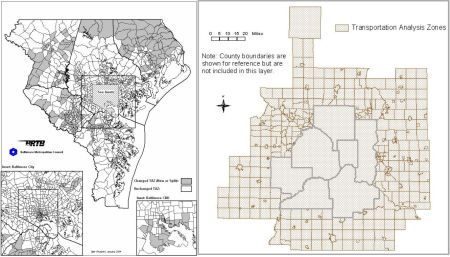
LEFT: Baltimore TAZ map (Baltimore Metropolitan Council). RIGHT: Minneapolis TAZ map (Metropolitan Council).

LEFT: Baltimore TAZ map (Baltimore Metropolitan Council). RIGHT: Minneapolis TAZ map (Metropolitan Council).

But ProCon’s sectors (“sub-corridors” — see map at beginning of post) weren’t intended to be TAZs, and they don’t function that way at all. TAZs (typically based on small geographic units such as census tracts or electoral precincts) are designed to be the basic geographic components to provide data inputs for a coordinated, integrated, metro-area-wide transportation network.

Project Connect’s sectors, in contrast, seem more designed to pit one part of the city against another — to function more as neighborhood enclaves to be assessed for their isolated demographics and “level of misery” (poverty, congestion, etc.) in a competitive showdown within a game of “Which sector deserves the urban rail prize?” It’s astounding that this charade is presented as a form of officially sponsored urban transportation planning.

Rather than tracking existing, logical corridors, almost all of these sectors sprawl over vast stretches of the inner city. The “Lamar” sector, for example, extends westward as far as Shoal Creek — approximately 1.5 miles from the Guadalupe-Lamar (G-L) corridor, and up to two miles wide — and encompasses over 2,900 acres, about 4.6 square miles. It includes both Shoal Creek Blvd. and Burnet Rd. as well as Guadalupe-Lamar. Yet, curiously, despite all this stretching of the corridor, ProCon planners have stopped the boundaries of the “Lamar” sector short of Loop 1 (MoPac Freeway) and, even worse, they’ve ruled out a logical extension as far as U.S. 183.

The “Mueller” sector, widening to approximately 2.5 miles in girth, sprawls even further, encompassing a chunk of the Hancock neighborhood, north of UT, and then most of northeast Austin, as well as the relatively small Mueller development site, in almost 4,000 acres, more than 6.2 square miles.

Not only have the sectors been gerrymandered, the data Project Connect is attributing to them has been gerrymandered as well. The “study” purports to be focused on getting the proper routes (through the proper sectors, of course) to the “Core” sector (from which all other sectors are banned) … yet in not one single sector have the actual travel-related conditions of a major potential transit route corridor been even mentioned, much less tallied, examined, or analyzed.

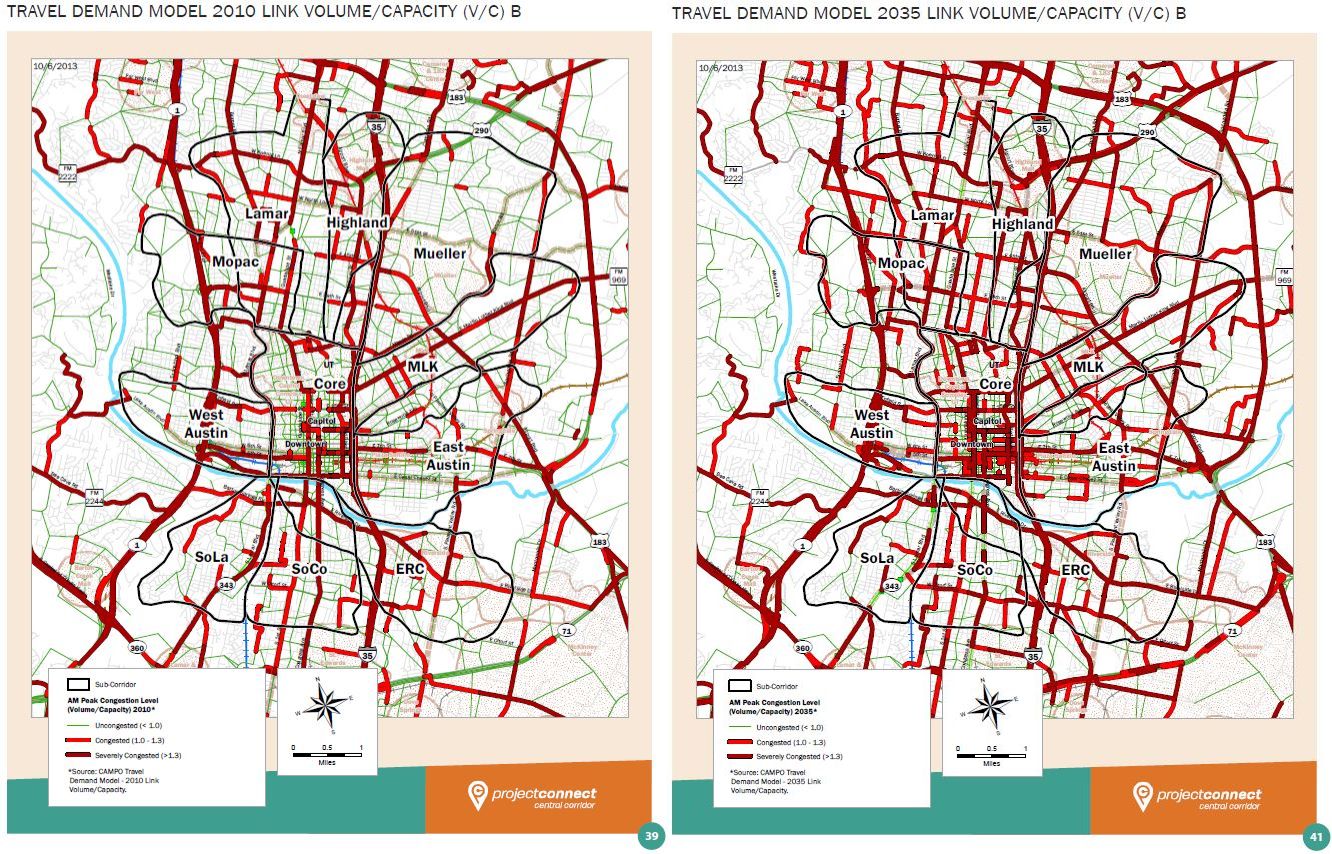
The existence of corridor travel patterns, and particularly of available physical corridors (e.g., fairly wide arterials in sectors such as “Lamar”, “ERC”, and “MLK”), are critical factors that nevertheless seem immaterial to ProCon planners. Thus, rather than assessing corridors to the core, the Map Book provides (for each sector in the study area map) a chaotic riot of “congested” streets (using dark and bright red colors designating “congested” and very congested” conditions), in virtually every direction. It doesn’t matter if a roadway heads the wrong way — everything counts in registering a sector’s score in the “congestion” misery index.
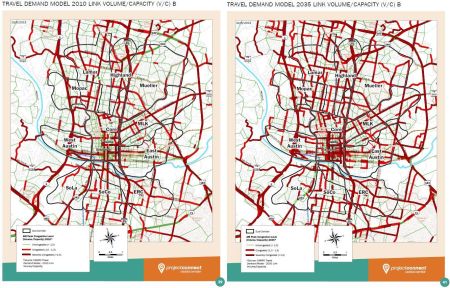
LEFT: Congestion by sector in 2015. RIGHT: Congestion by sector in 2035.

LEFT: Congestion by sector in 2015. RIGHT: Congestion by sector in 2035.

Some of this demographic and “misery” data could be relevant — if it were focused on actual travel corridors. The walking-distance “ridership watershed” of an inner-city transit corridor is usually about a mile either side of the the center of the corridor (which is usually a likely right-of-way for the proposed transit facility); this assumes an average pedestrian access of a half-mile to stations (within a 0 to one-mile range). Total population, density, employment, transit-dependency, income level, poverty, traffic congestion (especially in the directional flow pattern), and other indicators are all relevant within this travel corridor for assessing its potential.

Catastrophic methodological fault

However, there’s a much more fundamental (and disastrous) problem than either the configuration or the function of Project Connect’s designated sectors. Perhaps the most serious flaw in ProCon’s urban rail study methodology — actually, catastrophic, because it fundamentally impairs the integrity of the whole process — is that the actual travel corridors are not only basically ignored as workable corridors, but also are truncated and segmented by ProCon’s arbitrary slicing up of the urban area.

If you’re evaluating a travel corridor, you must evaluate the corridor as a whole — what it connects from, to, and in between; what the populations and densities along the corridor are; what activity centers it connects; and so on. All those are important, because they’re critical to what makes a transit line in that corridor actually feasible and worth investing in. For example, relevant to the “ERC” (“East Riverside Corridor”) sector is the eventual potential of an urban rail route to extend further east to the ABIA airport — but that’s not considered in this study.

Likewise, the possibility of extensions of a proposed Guadalupe-Lamar urban rail line further north on Lamar and northwest on the Capital Metro railway (i.e., converting MetroRail to electric urban light rail transit) would be crucial ingredients to the evaluation of a basic inner-city starter line. But this is prohibited by ProCon’s arbitrary sectionalization of the city (areas north of the “Central Corridor” belong to other “corridors”).

Similarly, the Guadalupe-Lamar route is severed just north of the UT-West Campus area at W. 29th St. In other words, most of this potential route is cut off from its highest-density population district as well as its most productive destinations in the core of the city!

What’s left is a “rump” route, from a few blocks south of U.S. 183 to W. 29th St., that seems to have little purpose beyond perhaps some kind of “shuttle” along this isolated route segment. If there were a prize for idiotic public transport planning, surely Project Connect would be very high on the candidate list.

Added to this seemingly heedless route segmentation is ProCon’s treatment of adjacent sectors as insular, isolated enclaves, whose demographics and other characteristics apply only to themselves. Likewise travel characteristics are treated in isolation, as if the population in all these different “enclaves” confine themselves to the sector boundaries that ProConn planners have established for them. Is it realistic to believe that residents of the “Highland” sector wouldn’t be allowed to hop a train on a Guadalupe-Lamar urban rail line, or that residents in the “West Austin” sector would be prohibited from catching a G-L train north to the Triangle area or Crestview?

Project Connect’s deformed “study”

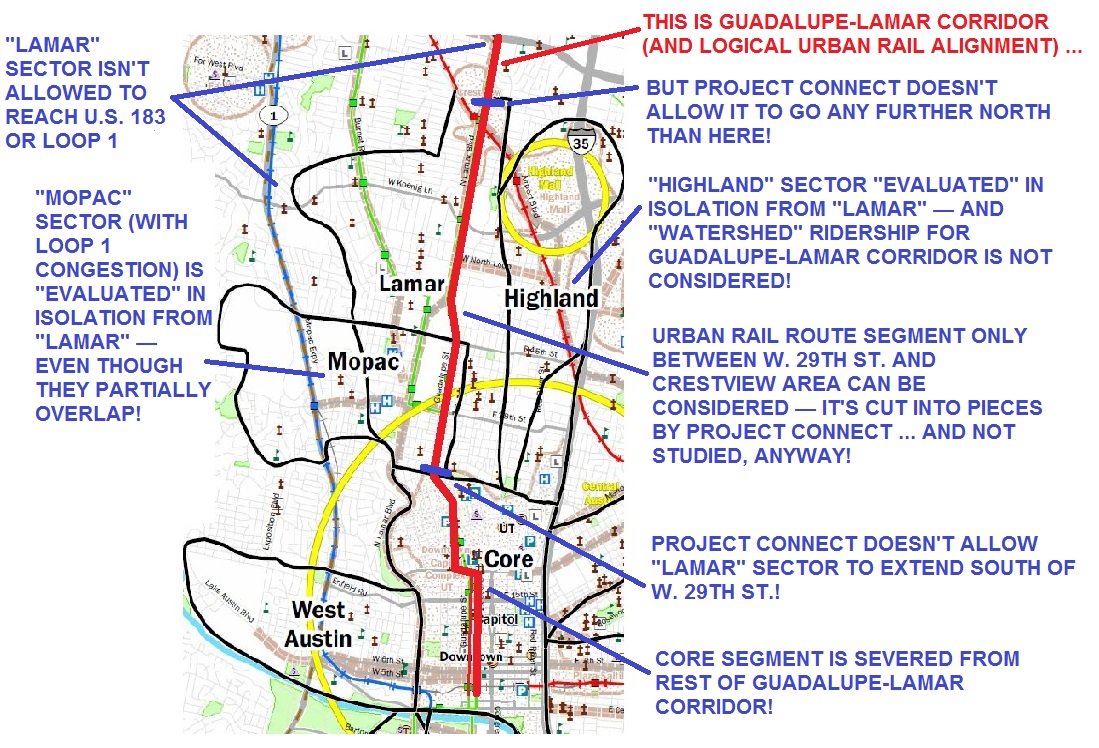
Some of the most egregious problems with ProCon’s planning approach are summarized in the infographic below.

This inforgraphic summarized numerous major problems with Project connect's methodology.

This infographic summarizes numerous major problems with Project connect’s methodology. (Click to enlarge.)

As Austin Rail Now has noted previously, on Nov. 15th, the ProCon planning team are scheduled to recommend a sector (“sub-corridor”) as the basis for further urban rail planning. Given the dubious and even bizarre aspects of their methodology (and the occult nature of their process), predicting what their conclusion will be is somewhat like trying to predict whom the College of Cardinals would elect as a new pope.

In any case, this small analysis underscores that a truly realistic, rational urban rail study would want to look at the population, density, and other key indicators along Guadalupe-Lamar and other entire corridors. And furthermore, that a far more effective methodology for transportation corridor analysis needs to be implemented. So far, Project Connect seems to have made a mess of this process.

h1

Guadalupe-Lamar is highest-density corridor in Austin — according to Project Connect’s own data!

9 November 2013
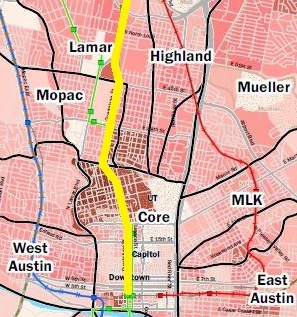
Closeup of Project Connect's central Austin map of population density for 2010 shows intense clusters of density in West Campus, along Guadalupe above W. 29th St., and in Triangle area. Map: Rev. by LH from Project Connect.

Closeup of Project Connect’s central Austin map of population density for 2010 shows intense clusters of density in West Campus, along Guadalupe above W. 29th St., and in Triangle area. Map: Rev. by LH from Project Connect.

Even from the peculiarly selective and distorted data exhibited visually in Project Connect’s Map Books, it’s clear that the Guadalupe-Lamar (G-L) corridor currently has by far the highest concentration of population density within Austin central study area (and almost certainly the highest in the entire metro area). And this density appears predicted to persist in ProCon’s projection for 2030!

This density (pointed out decades ago by Lyndon Henry and Dave Dobbs as a pre-eminent justification for rail transit in this corridor) is shown in the following map graphics excerpted from the latest version (v. 5) of ProCon’s Map Book.


Central study area view

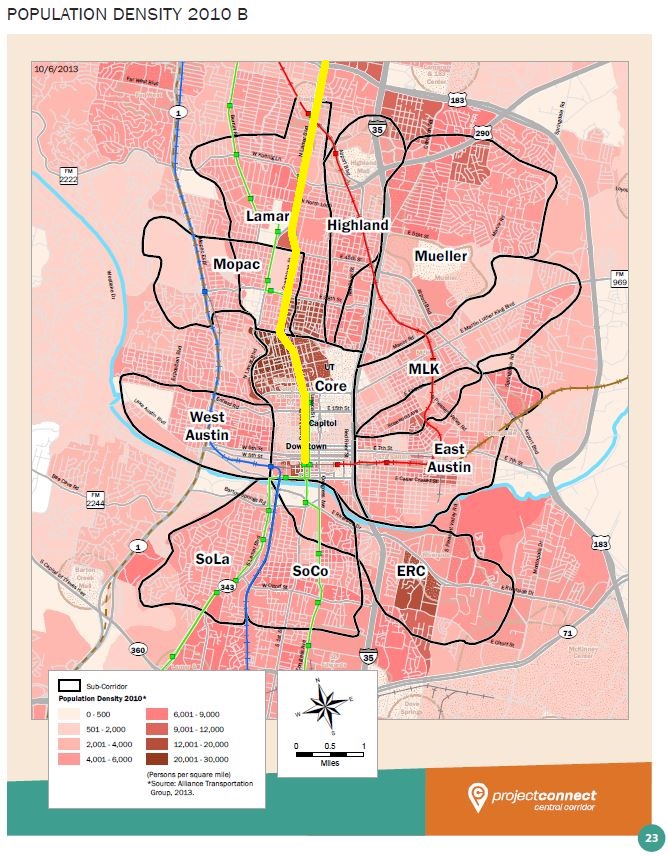
Population density in 2010 (G-L corridor spine in yellow). Map: Rev. by LH from Project Connect.

Population density in 2010 (G-L corridor spine in yellow). Map: Rev. by LH from Project Connect.

The map above shows the central-city study area (mislabeled by ProCon as a “Central Corridor”) with various sectors (mislabeled as “sub-corridors”) in 2010. The arterial spine of the G-L corridor (the most likely alignment for urban rail) is shown by a yellow line. Notice that heavy concentrations of high population density are clustered around the G-L corridor, particularly in the West Campus area, and just north of the campus, bordered by Guadalupe on the west and W. 29th St. on the south.


Population density projected for 2030 (G-L corridor spine in yellow). Map: Rev. by LH from Project Connect.

Population density projected for 2030 (G-L corridor spine in yellow). Map: Rev. by LH from Project Connect.

The map above shows the same study area and sectors, with population density concentrations projected for 2030. While these projections are far more subjective and tentative than actual current reality-based data, they do reflect speculation that extremely high density will not only intensify in 2030 in the same areas as it was located in 2010, but is expected to expand to other segments of the G-L corridor.


Guadalupe-Lamar focus

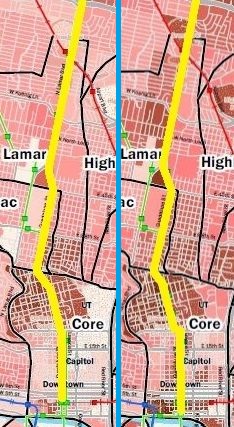
Composite of zoomed-in snips of Project Connect maps of population density. LEFT: 2010. RIGHT: 2030. Rev. by LH from Project Connect.

Composite of zoomed-in snips of Project Connect maps of population density. LEFT: 2010. RIGHT: 2030. Rev. by LH from Project Connect.

This composite focuses on population density the G-L corridor, showing density concentrations in 2010 on the left, and in 2030 on the right. Again, the probable alignment for urban rail is shown by a yellow line. This makes both the existing density and its projected intensification in the future even more obvious.


Conclusion

These data visualization maps clearly indicate that not only does the Guadalupe-Lamar corridor currently have extremely high levels of population density (as much as 30,000 persons per square mile in the West Campus) sufficient to support urban rail, but it surpasses all other corridors in the city! Furthermore, even in ProCon’s flawed analysis, this density is projected to intensify by 2030.

But this kind of bona fide corridor analysis counts for absolutely nothing in Project Connect’s “study”, because they’re not evaluating travel corridors such as Guadalupe-Lamar! They’ve been wasting taxpayer money on largely irrelevant studies of demographics and other conditions in isolated sectors while largely ignoring actual travel patterns in corridors into the core area, along with the demographics and other critical features along these actual corridors, such as G-L.

On Nov. 15th, the ProCon team are due to announce their “recommendation” for a sector (“sub-corridor”) as the location for urban rail … and it’s anybody’s guess as to what is the basis for their evaluation. But this small analysis we’ve just presented illustrates the actual kind of analysis of a travel corridor that official planners should be performing, and we suggest it as a far more effective model for the type of urban rail study this community actually should be supporting.

h1

Huge problems cited with Project Connect’s urban rail study data

3 November 2013
Cover of Project Connect's Map Book version 4. Screen capture: L. Henry

Cover of Project Connect’s Map Book version 4. Screen capture: L. Henry.

One of the most serious flaws in Project connect’s urban rail study process — in which top-level officials and planners are trying to rush to a selection of an Austin city sector for an urban rail starter line on or about November 15th — is problems with data inaccuracy and outright omissions. Focused on designated alternative city sectors (misnamed “sub-corridors”), the study team has been compiling purported data on demographic and transportation features of each sector (such as population, density, transit ridership, etc.) in a series of data-visualization “Map Books” (each new one an update of the previous one).

Map Books rife with data problems

Meanwhile, as this blog reported in a previous posting, Scott Morris, head of the Central Austin Community Development Corporation (CACDC) has been relentlessly and tediously scrutinizing each volume of Map Book data. As we’ve noted “Scott has performed amazingly detailed and well-supported research into these data issues, and he has found and pointed to a lengthy array of dozens of mostly serious errors. A handful of these have been quietly rectified.”

By far, as the Oct. 27th article Project Connect admits major data error in Guadalupe-Lamar corridor study highlighted, “One of the most serious data anomalies that Scott has recently detected is the “disappearance” of virtually all the ridership for Capital Metro’s routes #1M/L and #101, the heaviest-ridership transit routes in the system, serving the G-L corridor as well as South Congress.” As the article reports, Project Connect has publicly admitted that error and corrected it in the next Map Book edition.

Map Book errors go uncorrected

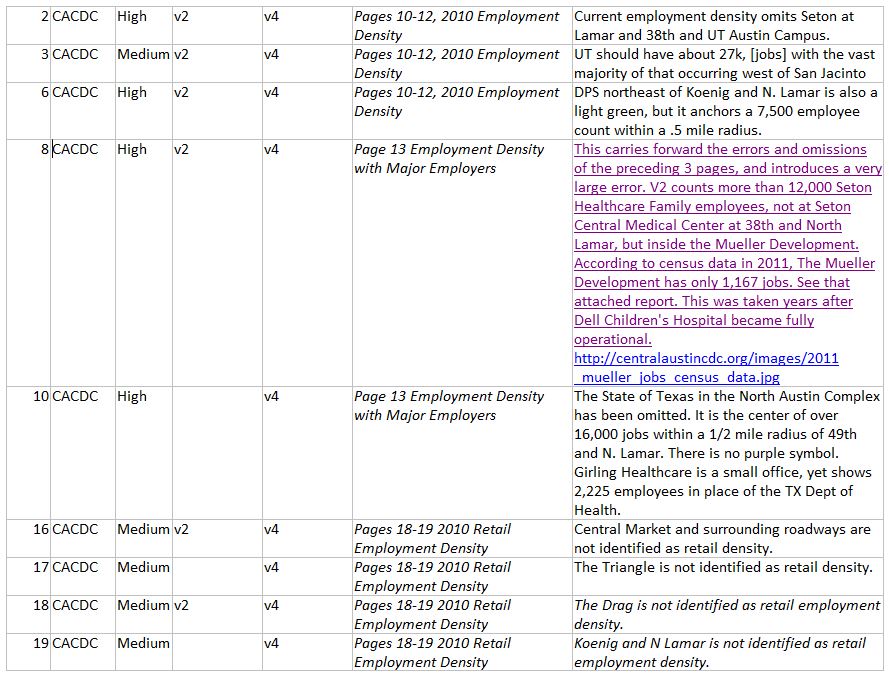
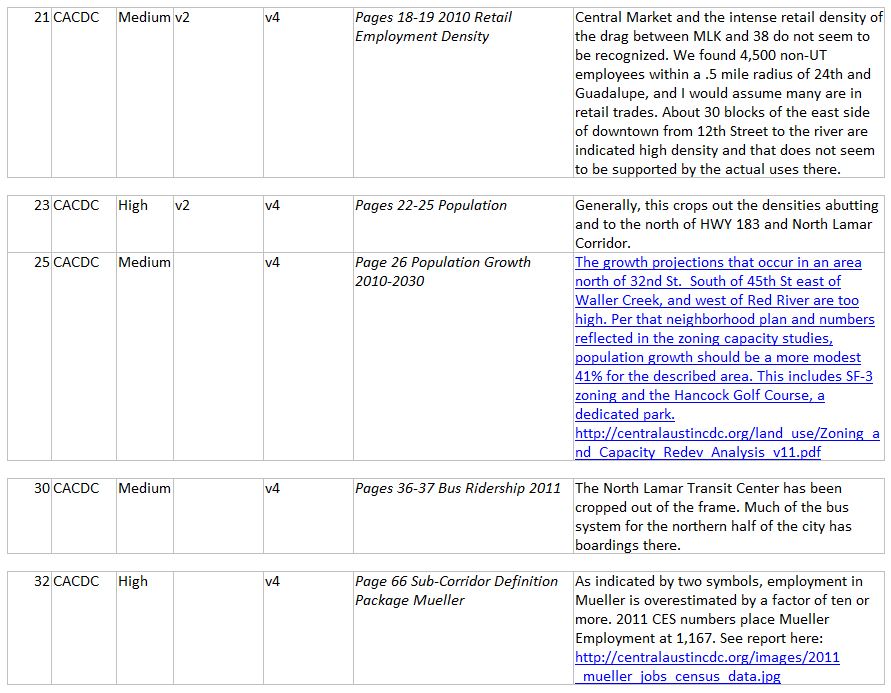
However, an unacceptable large number of similar errors — predominantly erroneous data or outright omissions — remain. The following are just some of the most egregious problems in Map Book v. 2, still carried into v. 4, that Scott has found and cited in a listing submitted by CACDC to the Project Connect urban rail study team:

ARN1_CACDC_Prj-Con-MapBook4-errors1

Partial listing of major errors in Project Connect Map Book and other material identified by CACDC. Screen image: L. Henry.

Partial listing of major errors in Project Connect Map Book and other material identified by CACDC. Screen image: L. Henry.

New error problems with Map Book 4

Scott has appended a listing of major new problems appearing in Map Book Version 4; here’s a summary:

• All “B” Pages and Definition Packages
West University NPA/University Neighborhood Overlay Removed From Defined Sub-Corridors A large, dense city area to the west of the UT campus and Guadalupe Street was moved out of the North Lamar and Mopac Sub-Corridors by the Project Team in response to a request to include UT in the core. This change was made in the current map. We understand the reasoning in placing UT in the core, however the manner in which surrounding non-UT areas were moved with it will create large, unintended impacts on the sub-corridor evaluation process. That area is not a part of UT, nor in the opinion of West Campus residents, can it be adequately served by a San Jacinto alignment on the UT Campus. West University is the densest planning area of our city that also employs over 5,000 people (Non-UT). The area west of Guadalupe anchors the Guadalupe-North Lamar Sub-Corridor and includes the University Neighborhood Overlay and 3 residential neighborhoods that are components of a City of Austin Central Austin Combined Neighborhood Planning Area. West Campus is the largest population differentiator in our city for the purposes of sub-corridor analysis. In our opinion, it should not be considered a common element to the core joining the CBD, UT, and the Capitol Complex, unless it receives a similar commitment to service. In the end, if it is desired to count West Campus as part of the core, we should also count on serving it directly as part of the definition of the core.

• Page 13 Employment Density with Major Employers
The State of Texas in the North Austin Complex has been omitted. It is the center of over 16,000 jobs within a 1/2 mile radius of 49th and N. Lamar. There is no purple symbol. Girling Healthcare is a small office, yet shows 2,225 employees in place of the TX Dept of Health.

• Page 28 Poverty, Vehicles, Affordable Housing
Hundreds of units of affordable housing in West Campus is not identified with the correctly-sized circle.

• Pages 36-37 Bus Ridership 2011
The North Lamar Transit Center has been cropped out of the frame. Much of the bus system for the northern half of the city has boardings there.

• Pages 55-59 Sub-Corridor Definition Package Lamar
Population Studies are not provided for North Lamar sub-corridor definition package.

• Pages 15-16. Employment Growth
Austin State Hospital should show >100% Growth. This is an identified P3.

• Pages 18-19 2010 Retail Employment Density
The Triangle is not identified as retail density.

• Pages 18-19 2010 Retail Employment Density
Koenig and N Lamar is not identified as retail employment density.

• Page 26 Population Growth 2010-2030
The growth projections that occur in an area north of 32nd St. South of 45th St east of Waller Creek, and west of Red River are too high. Per that neighborhood plan and numbers reflected in the zoning capacity studies, population growth should be a more modest 41% for the described area. This includes SF-3 zoning and the Hancock Golf Course, a dedicated park. http://centralaustincdc.org/land_use/Zoning_and_Capacity_Redev_Analysis_v11.pdf

• Page 30 Selected Land Use 2010
Adams Hemphill Park straddling 30th not identified as open space.

CACDC also provides data references as the basis for these corrections.

Summary

It’s understandable that some data problems will be encountered in almost any major study of this kind. What’s astounding, however, is the high number of problems in Project Connect’s urban rail study. Even worse is that almost all of them — even when identified — seem to be going uncorrected!

This seriously compromises the competency of this entire study process (and there are even more fundamental issues involved, as this blog will address). The data problem is especially threatening because data analysis is supposedly the foundation for decisionmaking to select an urban rail corridor; the Central Corridor Advisory Group (CCAG, whose recommendation is a key part of the process) is being led through a process of data scrutiny and analysis by Project Connect staff. Yet the Project Connect team — under duress from high-level local officials eager to force a quick decision on urban rail, and apparently overwhelmed by the need to rush to an imminent recommendation for the Austin City Council — seem merely to be “dumping” volumes of data with little regard for its reliability or relevance to the basic goal of selecting an urban rail route.

All of this calls into question just how “fair and balanced” — and accurate, reliable, and truly data-based — the process of comparatively evaluating alternative urban rail corridors and plans actually is.

What the final outcome will be, and whether its integrity will be accepted by the Austin public and voters in particular, remains to be seen.

h1

Project Connect admits major data error in Guadalupe-Lamar corridor study

27 October 2013
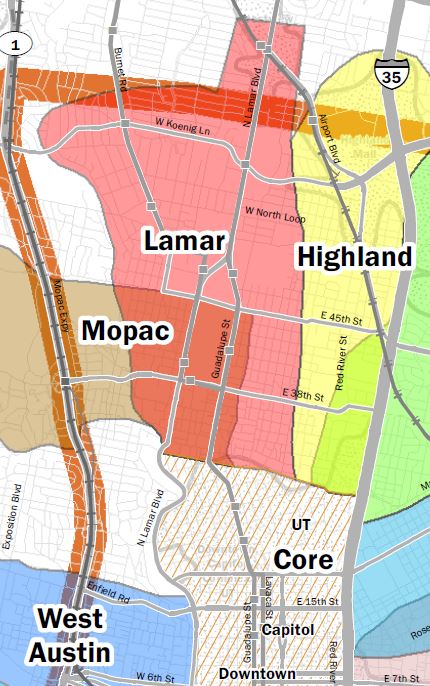
Snippet of Project Connect's much larger "Central Corridor" map (actually, the central-city study area) shows "Lamar" sector (in orange, dubbed a "sub-corridor" in Project Connect's peculiar nomenclature) plus several adjacent sectors. Actual Guadalupe-Lamar travel corridor includes both the Lamar and Core sectors, but each sector is being evaluated in isolation.

Snippet of Project Connect’s much larger “Central Corridor” map (actually, the central-city study area) shows “Lamar” sector (in orange, dubbed a “sub-corridor” in Project Connect’s peculiar nomenclature) plus several adjacent sectors. Actual Guadalupe-Lamar travel corridor includes both the Lamar and Core sectors, but each sector is being evaluated in isolation.

The Project Connect urban rail planning team has been conducting a nominal study of designated alternative “sub-corridors” for urban rail (they’re actually not “corridors”, but sectors of the central-city study area). In the process, the agency has been compiling purported data (covering key indicators for each “corridor”, or study sector, such as population, density, transit ridership, etc.) in a series of so-called Map Books (each one an update of the previous one).

Meanwhile, tirelessly and tediously scrutinizing each volume of Map Book data has been the self-appointed task of Scott Morris, head of the Central Austin Community Development Corporation (CACDC), which, together with Texas Association for Public Transportation, has been advancing the case for the Guadalupe-Lamar travel corridor as the most effective alignment for Austin’s proposed urban rail starter line. Scott has performed amazingly detailed and well-supported research into these data issues, and he has found and pointed to a lengthy array of dozens of mostly serious errors. A handful of these have been quietly rectified.

One of the most serious data anomalies that Scott has recently detected is the “disappearance” of virtually all the ridership for Capital Metro’s routes #1M/L and #101, the heaviest-ridership transit routes in the system, serving the G-L corridor as well as South Congress. This was cited in a listing of nearly three dozen data problems submitted by CACDC to the Project Connect urban rail study team:

v4 Comment 29 High
Pages 36-37 Bus Ridership 2011
According to the 2020 service plan in January 2010, the #1 North Lamar and the #101 had over 17,000 daily boardings combined. But, this chart seems to omit nearly all boardings for the Guadalupe-North Lamar Corridor.

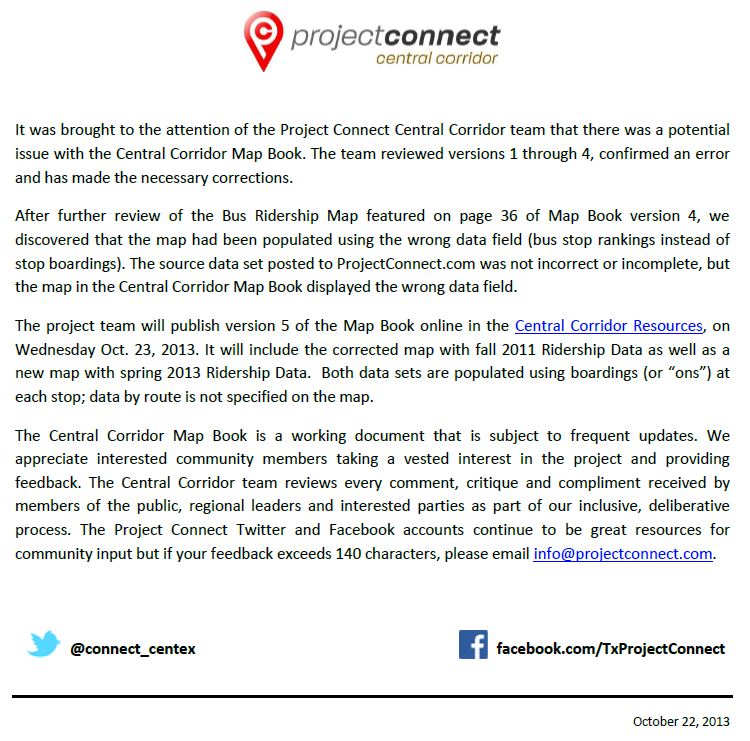
At last, Project Connect has publicly admitted at least one of the numerous errors that have been published in the series of Map Books. Responding mainly to criticism by Jace Deloney, one of the leaders of Austinites for Urban Rail Action (AURA, which supports a transparent, open, and fair route evaluation process), on October 22nd Project Connect issued a statement acknowledging the erroneous ridership data, which it says resulted from “populating” the map (data visualization graphic) with the “wrong data field”. A screen capture of the statement is shown below.

Project Connect statement admits major error in transit ridership data for Lamar-Guadalupe corridor.

Project Connect statement admits major error in transit ridership data for Guadalupe-Lamar corridor.

Data errors, in particular large ones like this, are especially serious because the selection of a “corridor” (actually, a sector of the huge central-city study area) depends critically on key data factors, including existing transit ridership in a given corridor.

h1

No urban rail on Guadalupe-Lamar? Then get ready for bus lanes…

18 October 2013
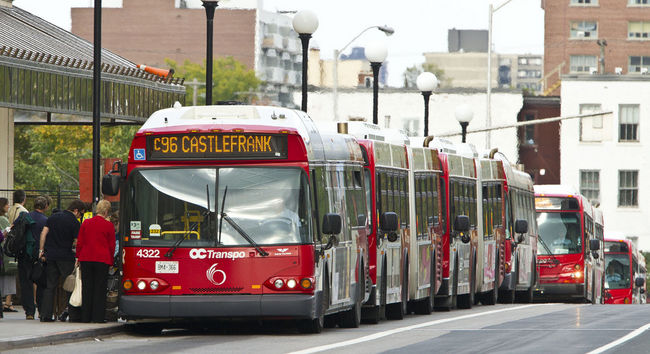
Ottawa's "BRT" Transitway delivers a "conga line" of buses onto urban streets. Photo: Errol McGhion.

Ottawa’s “BRT” Transitway delivers a “conga line” of buses onto urban streets. Photo: Errol McGhion.

by Dave Dobbs and Lyndon Henry

Which kind of transit — urban rail or buses in special lanes — do you want to see on Guadalupe-Lamar?

Not to decide is to decide.

It’s crucial that Austin’s first urban rail (starter) line be a whopping success. This means it must serve the heart of the city in its heaviest-traffic corridor, with its highest densities and employee and employment concentrations, and its most long-established neighborhoods. The Guadalupe-Lamar corridor offers the ideal alignment for an affordable, cost-effective surface light rail alignment.

It’s also important to understand that if we don’t get light rail transit (LRT) on Guadalupe and North Lamar, we most certainly will get dedicated bus lanes within the next 10 years. A major project to overhaul the corridor by installing infrastructure for battalions of MetroRapid buses is waiting in the wings if urban rail is not implemented. This alternative, not requiring a public vote, would produce a far less efficient, adequate, and attractive system, seriously degrade urban conditions, and result in a less livable environment compared with urban rail.

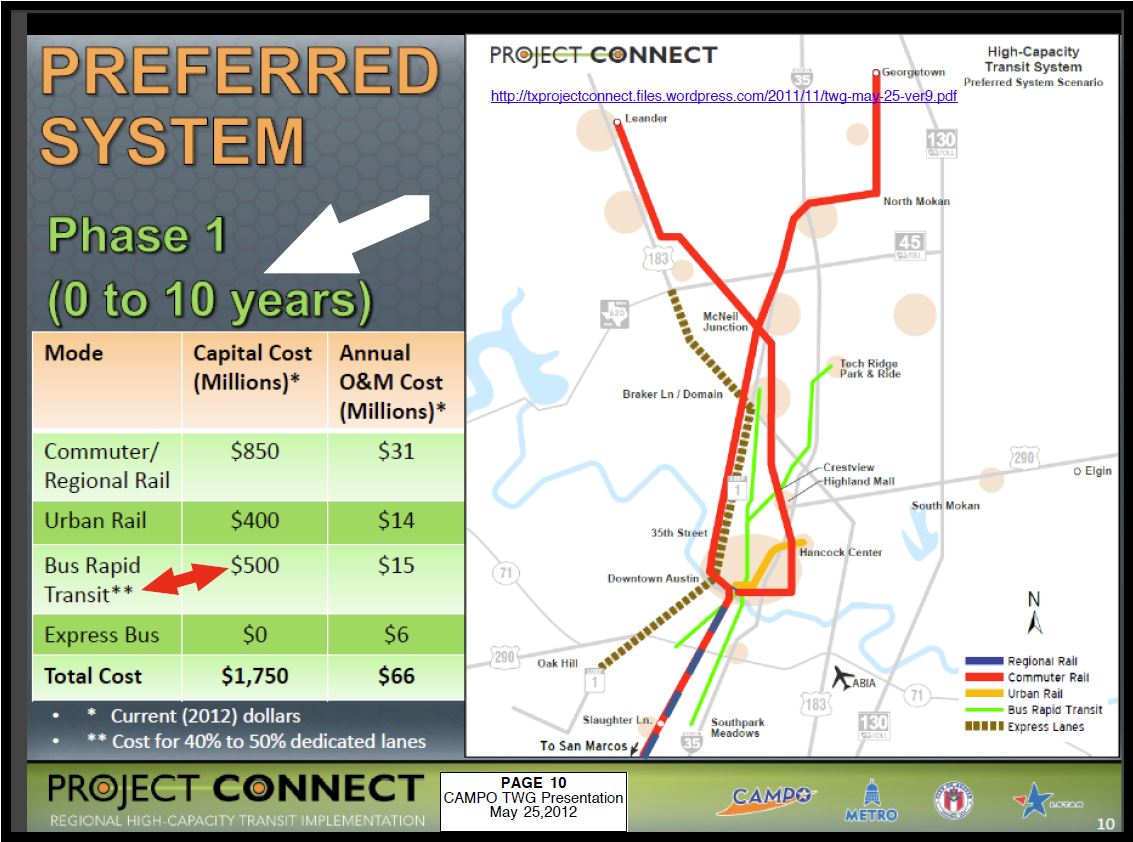
This package of so-called “Bus Rapid Transit” (“BRT”) projects — whereby MetroRapid buses would enter stretches of dedicated bus lanes, and then merge back and forth, into and out of mixed general traffic — was first raised publicly in a Project Connect/City of Austin Transportation Department presentation made in City Council chambers on 25 May 2012 to the CAMPO Transit Working Group (TWG). Shown below is page 10 of that presentation, with arrows pointing to the relevant information.

Excerpt from Project Connect presentation in May 2012 indicating planned $500 million package for MetroRapid "BRT" facilities, including Guadalupe-Lamar. Graphic: Project Connect.

Excerpt from Project Connect presentation in May 2012 indicating planned $500 million package for MetroRapid “BRT” facilities, including Guadalupe-Lamar. Graphic: Project Connect.

These dedicated lanes will be built with 80% federal money, will not require an election, will be vetted publicly only at art gallery-style “open houses”, and approved by boards and commissions, the Capital Metro Board, and the Austin City Council, and then they will be built, unless we implement urban rail in the Guadalupe-North Lamar corridor. And keep in mind that — unlike the current minimalist MetroRapid project — this level of hefty physical investment in roadway infrastructure will become a de facto obstacle to any future rail project in the corridor.

These dedicated bus lanes are the official plan as things currently stand.

There are numerous drawbacks with premium buses, and even “BRT”, compared with LRT. Just to cite a couple:

• LRT on average is significantly more cost-effective than bus operations.

• Buses don’t attract nearly as much ridership as LRT, but as ridership starts to reach higher volumes, bus traffic and overwhelming “conga lines” of buses cause more problems … plus more queues of riders start to slow operations.

Another bus "conga line" leaving downtown Brisbane, Australia to enter busway.

Brisbane, Australia: More “conga lines” of buses travel on reserved lanes between the city’s downtown and a busway. Photo: James Saunders.

If you would prefer urban rail instead of a major bus lane project in Guadalupe-Lamar, it’s essential to speak up and act. Let neighborhood groups and other community organizations know what official plans have in store for this corridor. Sign petitions being circulated to support urban rail on G-L. Communicate to Project Connect and members of Austin City Council that you want to ride urban rail on Guadalupe-Lamar, running in reserved tracks, not just a souped-up bus service weaving in and out of special lanes.

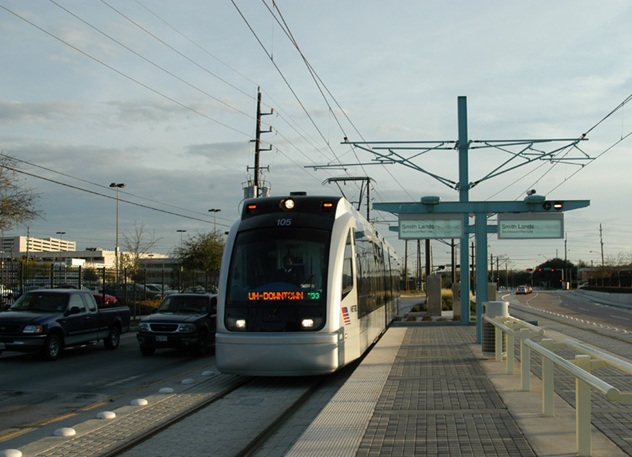
Houston's MetroRail demonstrates that LRT can attract and carry more passengers faster, more effectitly and safely, more cost-effectively than high-capacity bus operations. Photo: Peter Ehrlich.

Houston’s MetroRail demonstrates that LRT can attract and carry more passengers faster, more effectively and safely, and more cost-effectively than high-capacity bus operations. Photo: Peter Ehrlich.

h1

Meetings, “open houses”, workshops … and democratic process

1 October 2013

ARN0_PrjCon_mbrs-logo-xx

In ARN’s previous blog entry, Back to “art galleries”! Project Connect reneges on community meetings, we noted that “In a sudden reversal — and what appears to be a breach of trust and a breach of a de facto agreement with many in the Austin community”, Project Connect (the current ongoing rail planning consortium) had abruptly changed its forthcoming Urban Rail Central Corridor public involvement events from meetings into so-called “Open Houses”.

Our commentary went on to point out that

Meetings are fundamental to truly democratic process. They allow for community interactive input, i.e. community discussion along with the project personnel. They bring members of the entire community together, allow them to hear ideas and views from one another, allow them to interact on the public record (or at least with public witnesses) with officials present, force official representatives to deal with and respond to difficult questions and issues, and allow officials and participants to get a sense of community attitudes expressed in a community manner. One person’s question or comment may give ideas or motivation to other participants.
It should be noted that Project Connect is also deploying other means of communication with the public, in addition to “open house” events — a webinar was held this past Friday, and project staff are also considering workshop-style small-group activities. Plus the team are outreaching through individual meetings with various community groups.

However, while these are worthy activities, they still don’t substitute for the fully democratic process inherent in full, multi-group, diverse community meetings. To repeat our previous observations: Community meetings enable community interactive input; they “bring members of the entire community together, allow them to hear ideas and views from one another, allow them to interact on the public record (or at least with public witnesses) with officials present, force official representatives to deal with and respond to difficult questions and issues, and allow officials and participants to get a sense of community attitudes expressed in a community manner.”

Project Connect, the City of Austin, Capital Metro, and other public agencies have a crucial responsibility to facilitate these kinds of cross-community, cross-demographic, cross-organizational, fully diverse, fully democratic public meetings. So far, they seem to be trying to avoid them like the flu.

Austin Rail Now will continue to support efforts to reinstate the truly democratic public meeting process as Project Connect moves forward with its planning activities.

h1

Back to “art galleries”! Project Connect reneges on community meetings

25 September 2013
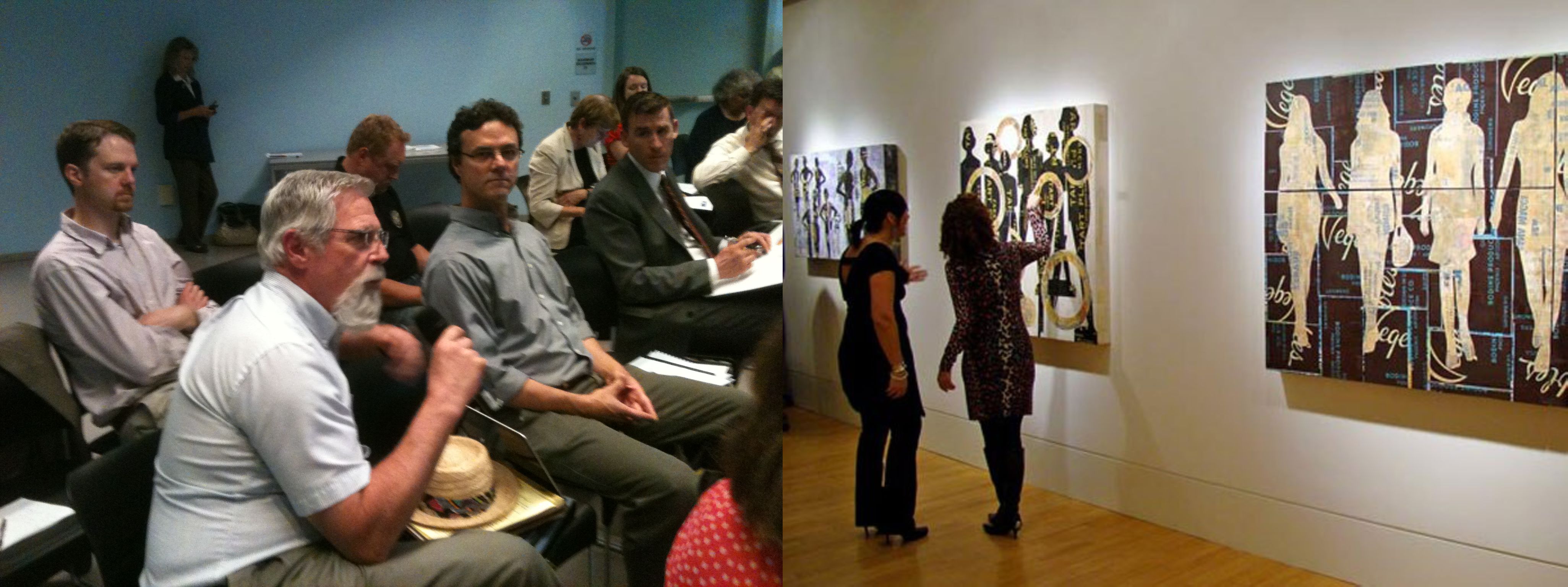
Community meeting (left) vs. art gallery (right)

Community meeting (left) vs. art gallery (right)

In our article of Sep. 17th, If you support urban rail for Guadalupe-Lamar, attend these community meetings! Austin Rail Now reported that

… Project Connect has scheduled some upcoming meetings (and a “webinar”) between Sep. 4th and Oct. 2nd (details below) that seem to offer a bona fide opportunity for the public to meet in a community fashion, both discussing the issues and interacting with one another.

Unfortunately, the prospect of bona fide public meetings “for the public to meet in a community fashion, both discussing the issues and interacting with one another” no longer seems valid.

In a sudden reversal — and what appears to be a breach of trust and a breach of a de facto agreement with many in the Austin community — Project Connect has abruptly stopped describing the forthcoming Urban Rail Central Corridor public involvement events as meetings, and instead is now promoting them as so-called “Open Houses”.

The Sep. 23rd edition of the Austin Mobility Go! Email newsletter from the City of Austin’s Transportation Department now describes the activities this week as “open houses”, not meetings. This was confirmed in Email comments from Capital Metro/Project Connect community outreach specialist John-Michael Cortez:

It is labeled as an Open House because that connotes that people are free to show up at any time, unlike a public meeting or workshop, which usually has a set agenda and starting time, thus limiting full participation to those who are able to show up at the start of the meeting. These meetings will be more of a hybrid open house/workshop. Participants can come at whatever time they choose and be able to see exhibits and speak directly to agency staff to have their questions answered, and formal input will be gathered through questionnaires and encouraging participants to draw and make comments on sub-corridor maps.

This is a crucial point, and one that many community activists involved with the urban rail planning process thought had been settled — in favor of community meetings.

Meetings are fundamental to truly democratic process. They allow for community interactive input, i.e. community discussion along with the project personnel. They bring members of the entire community together, allow them to hear ideas and views from one another, allow them to interact on the public record (or at least with public witnesses) with officials present, force official representatives to deal with and respond to difficult questions and issues, and allow officials and participants to get a sense of community attitudes expressed in a community manner. One person’s question or comment may give ideas or motivation to other participants.
This community interactivity is lost in the individual, one-on-one format of “Open Houses”, which have no set agenda, no community public speaking, and involve agency personnel displaying graphics of their pre-determined plans and chatting individually with the occasional community members that might attend the event. Transportation consultant Lyndon Henry (an Austin Rail Now contributor) has compared these events to wandering through an art gallery, with the chance to chat individually with the gallery guards (agency personnel). There’s no opportunity for real interactive community involvement.

In the view of local Austin researcher and transportation activist Roger Baker,

The major problem I see is that while Open Houses usually have lots of big impressive maps, these meetings commonly tend to evolve toward little unstructured conversation clusters, with an official at their center, near a map, and with others standing around, trying to hear, waiting to ask their own questions. Every citizen can come in and ask the same question as those who came earlier, and these exchanges are essentially rambling private discussions that tend to go on and on without clearly answering certain important policy questions. Usually there is no record of the questions asked, nor the responses given. These events tend to become a succession of unrecorded one to one exchanges.

In a comprehensive explanation and analysis of public involvement, the Federal Highway Administration (FHWA) explains that

Meetings provide a time and place for face-to-face contact and two-way communication-dynamic components of public involvement that help break down barriers between people and the agencies that serve them. Through meetings, people learn that an agency is not a faceless, uncaring bureaucracy and that the individuals in charge are real people. Meetings give agencies a chance to respond directly to comments and dispel rumors or misinformation.

Far from being passive gatherings, meetings are interactive occasions when people discuss issues of consequence to them and their neighbors, listen to opposing viewpoints on the issues, and work together for the common good. Agency staff people who handle public meetings need to be trained in skills that encourage interaction and also keep the process focused and productive.

In contrast, says FHWA,

An open house is an informal setting in which people get information about a plan or project. It has no set, formal agenda. Unlike a meeting, no formal discussions and presentations take place, and there are no audience seats. Instead, people get information informally from exhibits and staff and are encouraged to give opinions, comments, and preferences to staff either orally or in writing.

Is the planning and decisionmaking process really that important to the kind of plan that emerges? You bet it is.

Vigorous, authentic community involvement is absolutely critical, particularly in injecting new ideas and perspectives, raising special concerns, scrutinizing and evaluating official approaches and decisions, safeguarding the project from the influence of special interests and extraneous political issues, and generally keeping the official planners and decisionmakers “honest”.

Furthermore, voters are far more inclined to support ballot measures for major rail projects if they have a sense of ownership through opportunities for bona fide participation in the process.
Project Connect’s seemingly abrupt decision to downgrade the format of these public events from meetings to “art galleries” (“open houses”) suggests more of a desire to minimize, or squelch, rather than maximize, public involvement and dialogue in the urban rail planning process. This would also appear corroborated by Project Connect’s rather puzzling lack of publicity for these public events.

As Lyndon Henry recently warned, in comments Emailed to a list of community transportation activists,

The consistent and steady pattern by local public agencies (particularly involved in public transportation issues) of degrading the bona fide democratic public participation process over the past period has been alarming, and I did speak out about this when I worked at Capital Metro. Individual chats between individual community members and official personnel do not represent a democratic process of community participation, and I’ve personally seen the level of such participation decline significantly over the past couple of decades. It’s very troubling to see this same policy now being carried forward and rationalized despite assurances made otherwise.

Despite these efforts by Project Connect to discourage public participation, Austin Rail Now continues to urge supporters of a Phase 1 urban rail starter line in the Guadalupe-Lamar corridor to attend these events and vigorously express their views.

h1

If you support urban rail for Guadalupe-Lamar, attend these community meetings!

17 September 2013
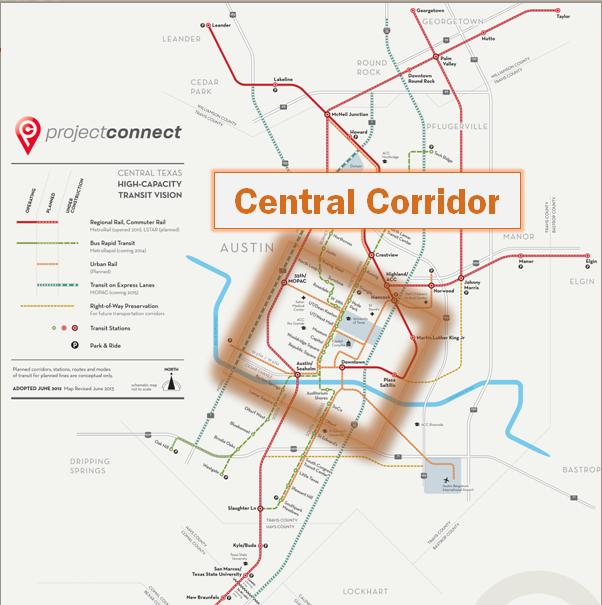
Map of so-called "Central Corridor" study area.

Map of so-called “Central Corridor” study area.


Project Connect, the consortium of the City of Austin, Capital Metro, and other public entities to pursue coordinated transit planning for Central Texas and the Austin metro region, has ostensibly pulled back somewhat from the previous emphasis on urban rail in the downtown-East Campus-Mueller corridor, and has a project under way to vigorously study (at least nominally) alternative corridors for a Phase 1 urban rail starter line — and one of those corridors is Guadalupe-Lamar (G-L).

There’s some debate over just how serious local officials and planners are about breaking from their fixation on the previous Mueller route (which would install urban rail in a very weak non-corridor), but in any case, Project Connect has scheduled some upcoming meetings (and a “webinar”) between Sep. 4th and Oct. 2nd (details below) that seem to offer a bona fide opportunity for the public to meet in a community fashion, both discussing the issues and interacting with one another.

So Austin Rail Now strongly encourages supporters of an urban rail Phase 1 starter line in the G-L corridor to attend these meetings (and participate in the “webinar”) — and voice their support for the G-L corridor.

The current project is specifically focused on a so-called “Central Corridor” — actually, a huge square study area extending as far west as Loop 1 (MoPac Expressway), east to roughly Springdale Rd., north to Crestview and the Highland/ACC area, and south to roughly Oltorf St. (see map above).

Since it’s not really a “corridor”, but an entire city sector with potential routes running in all directions, Project Connect planners have had to rename the actual travel corridors under study as “sub-corridors”. While the downtown-East Campus-Mueller route is designated as one of these “sub-corridors”, so is Guadalupe-Lamar, as well as a route out Riverside to the ABIA Airport, a route south on South Congress, and routes out Lake Austin Blvd. and West 38th St. to the Seton-Medical Center area.

While just about all these routes might make sense for urban rail at some point, obviously there must be a prioritization process that can select one for the first line to start with. Austin Rail Now believes a line in the G-L corridor makes by far the most sense in every way, and has the best chance of attracting community-wide voter support for bonds to help fund installation.

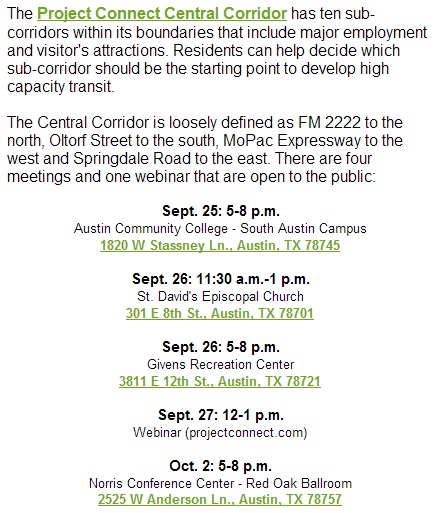
Here’s a screen capture from the City’s Austin Mobility website giving details — dates, times, locations — of the upcoming community meetings and the “webinar”:

ProCon_aus-txt-Central-Corridor-mtgs-2013-Sep-Oct_COA

If you want urban rail to go where it makes the most sense, and will have the best chance to win voter support — i.e., the Guadalupe-Lamar corridor — you have a major stake in this. Please plan to attend at least one of these meetings (or participate in the “webinar”)!