Posts Tagged ‘light rail transit’

h1

Amsterdam’s Leidsestraat shows how interlaced (gauntlet) track can help squeeze light rail into a narrow alignment

13 October 2013
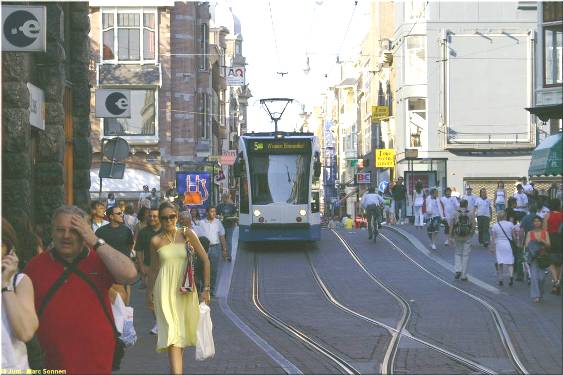
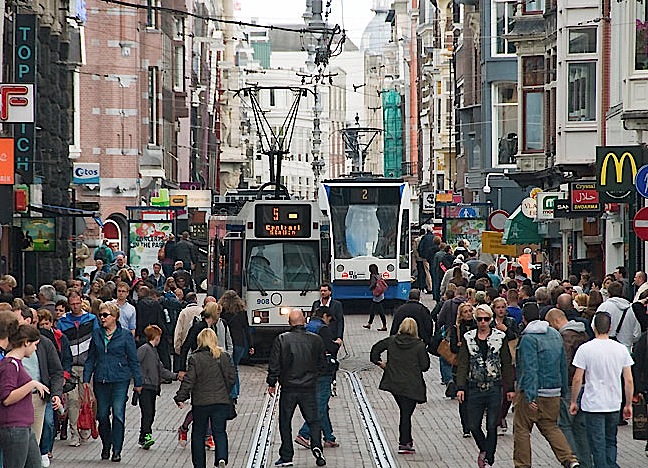
Amsterdam's Leidsestraat shows how gauntlet track allows bidrectional light rail operation in a very narrow alignment, even with very close headways. Also remarkable is how smoothly, efficiently, peacefully, and safely the tram line blends in with, complements, and serves all the pedestrians who walk alongside, behind, and even in front of the trams.

Amsterdam’s Leidsestraat shows how gauntlet track allows bidrectional light rail operation in a very narrow alignment, even with very close headways. Also remarkable is how smoothly, efficiently, peacefully, and safely the tram line blends in with, complements, and serves all the pedestrians who walk alongside, behind, and even in front of the trams. Photo: Roeland Koning .

by Dave Dobbs

In the recent posting How urban rail can be installed in the Guadalupe-Lamar corridor (Oct. 10th), Lyndon Henry discussed how urban rail in the Guadalupe-Lamar (G-L) corridor could deal with right-of-way constraints. For especially confined, narrow stretches, Lyndon suggested that interlaced, or gauntlet, track was an option.

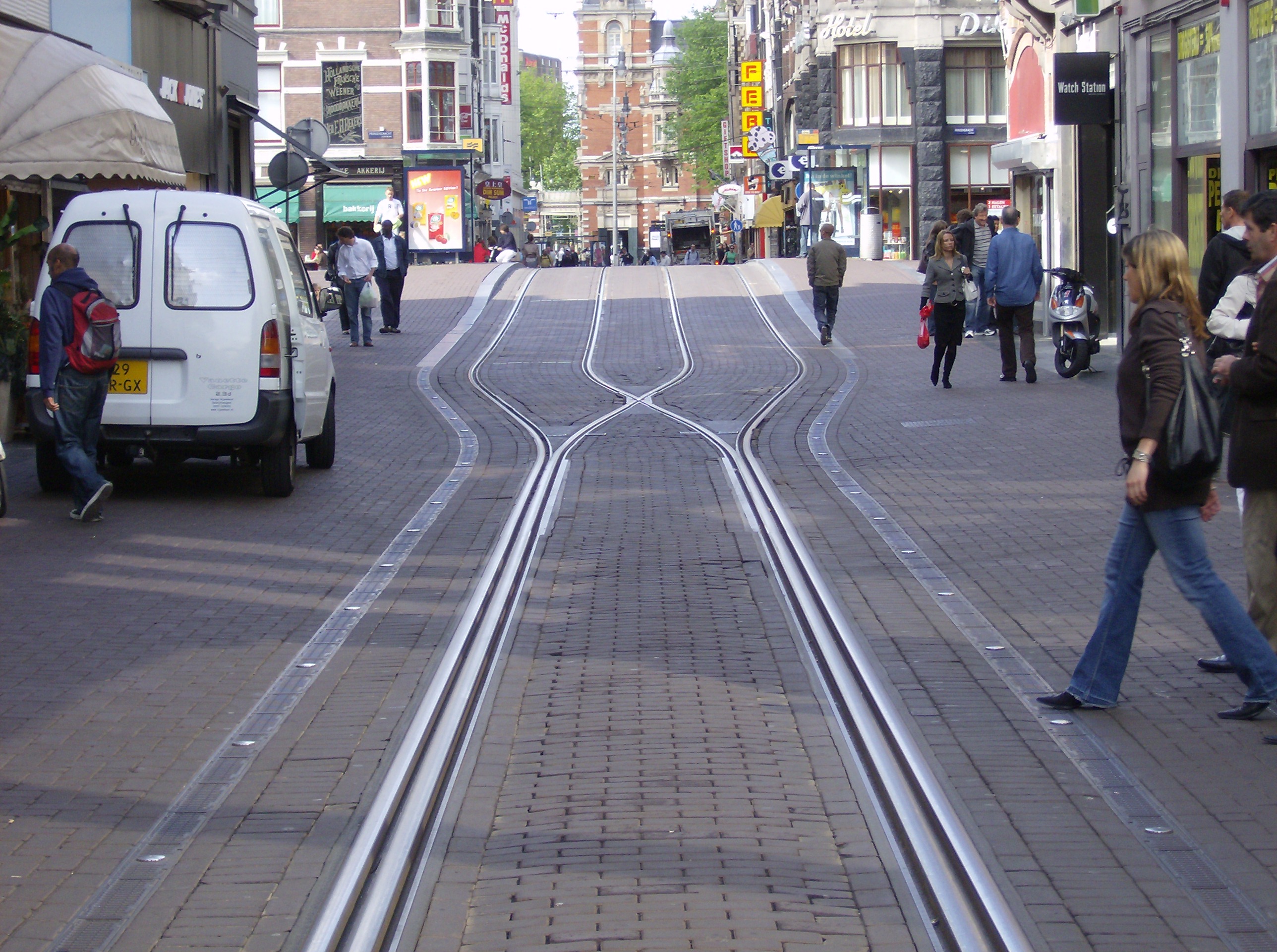
Basically, gauntlet track works like a single-track section, but it doesn’t require movable switchpoints. Instead, it’s completely stationary, with one track in one direction overlapping, or interlacing, with the track in the opposite direction. Then, when the right-of-way becomes wider, the two tracks divide back into separate tracks in each direction again.

To expand on what Lyndon has explained about dealing with constrained rights-of-way (ROW) and the use of interlaced or gauntlet track, probably it’s helpful to focus on perhaps the most famous example — the Leidsestraat, a very narrow street in Amsterdam. This is a city filled with trams (aka streetcars, light rail).
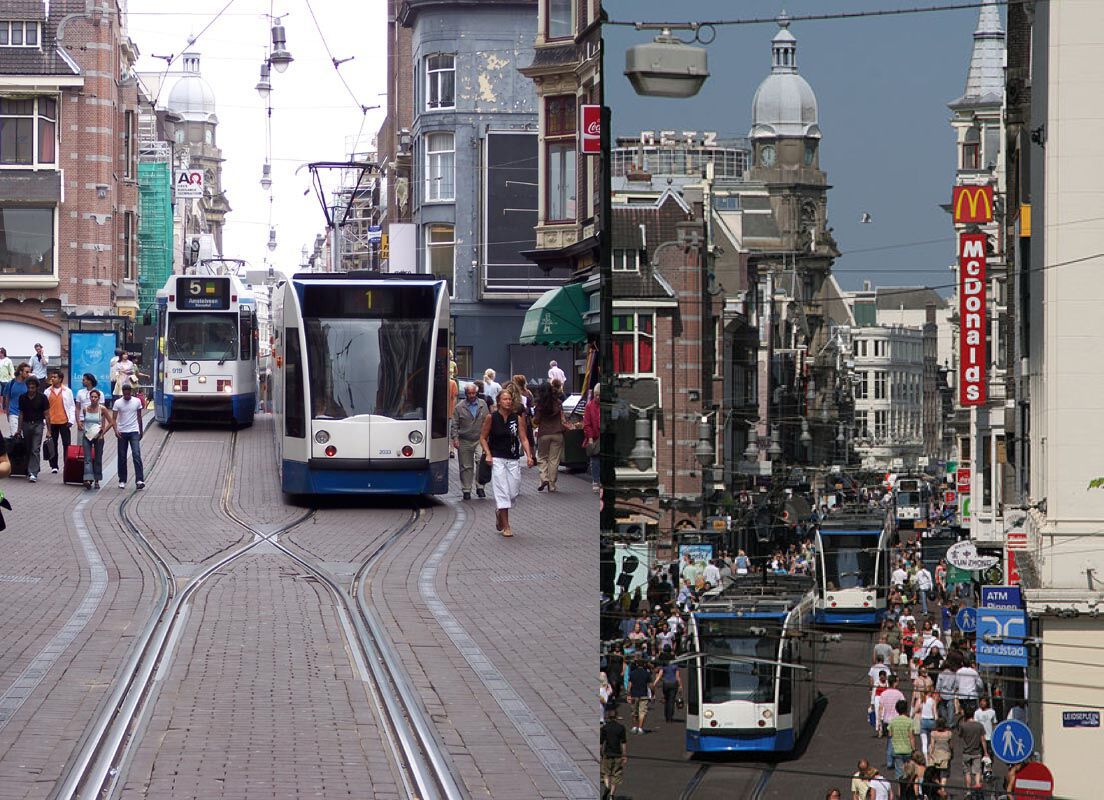
Two views of the Leidsestraat. LEFT: A #1 tram, heading away from camera, has just left the interlaced section onto double track, passing a #5 tram headed toward the camera and the interlaced section. (Photo: Stefan Baguette) RIGHT: You can see the stead stream of trams, sometimes just a couple of minutes apart, passing the heavy flows of pedestrians on each side. (Photo: Mauritsvink)

Two views of the Leidsestraat. LEFT: A #1 tram, heading away from camera, has just left the interlaced section onto double track, passing a #5 tram headed toward the camera and the interlaced section. (Photo: Stefan Baguette) RIGHT: You can see the steady stream of trams, sometimes just a couple of minutes apart, passing the heavy flows of pedestrians on each side. (Photo: Mauritsvink)

In Europe, the tramway is basically surface electric urban rail ­(light rail transit) that can adapt like a chameleon — it is what it is, wherever it is. Flexibility is its trademark and it’s designed to fit within a budget.

The Leidsestraat is about a third of a mile long in the center of the city and is home to three GVB (transit agency) tram lines running bi-directionally two to three minutes apart (see map below). Trams run constantly back and forth, sharing the gauntlet (interlaced) sections one at a time, and passing one another where the tracks branch out into double-tracked sections, where the street appears to be less than 40 feet (12-13 meters) wide.
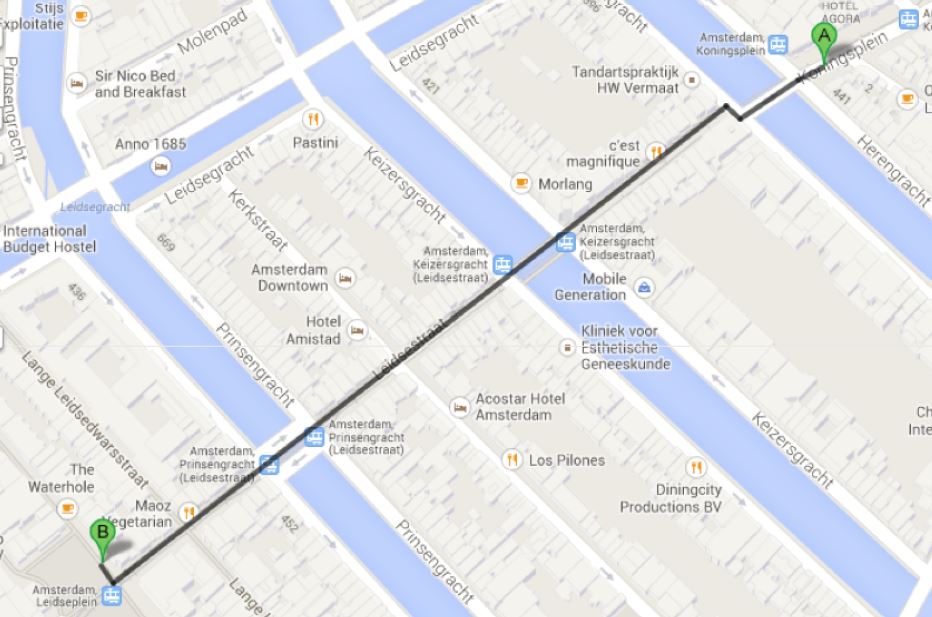
Leidsestraat alignment runs about 500 meters (0.31 mile) in length, passing over several canals.

Leidsestraat alignment runs about 500 meters (0.31 mile) in length, passing over several canals. Map: Dave Dobbs (from Google Maps).

Light rail operation in the Leidsestraat is even more remarkable when you consider that it’s one of the busiest autofree streets in the world, teeming with pedestrians and bicyclists (as you can tell from the photos). Motor vehicles are allowed very limited access to serve retail stores, restaurants, and other businesses. Besides how well gauntlet track works with relatively close headways, allowing light rail trains to access this extremely narrow urban street, is how smoothly, efficiently, peacefully, and safely it blends in with, complements, and serves all the pedestrians who walk alongside, behind, and even in front of the trams.

The following are some additional photos of light rail tramway operation along this alignment


Another photo showing crowds of pedestrians, an approaching tram, and a clearview of a transition from double-track to interlaced track. (Photo: Marc Sonnen.)

Another photo showing crowds of pedestrians, an approaching tram, and a clearview of a transition from double-track to interlaced track. (Photo: Marc Sonnen.)


Focus on interlaced track construction in the Leidsestraat. Notice how the two tracks  Notice how the two tracks virtually merge to form what almost seems like a single track — but there are separate parallel rails for each direction, laid next to each other. Also, only one rail in each direction actually cross each other (this type of passive, stationary rail crossing is called a frog).

Focus on interlaced track construction in the Leidsestraat. Notice how the two tracks virtually merge to form what almost seems like a single track — but there are separate parallel rails for each direction, laid next to each other. Also, only one rail in each direction actually crosses the other (this type of passive, stationary rail crossing is called a frog). Photo: Revo Arka Giri Soekatno


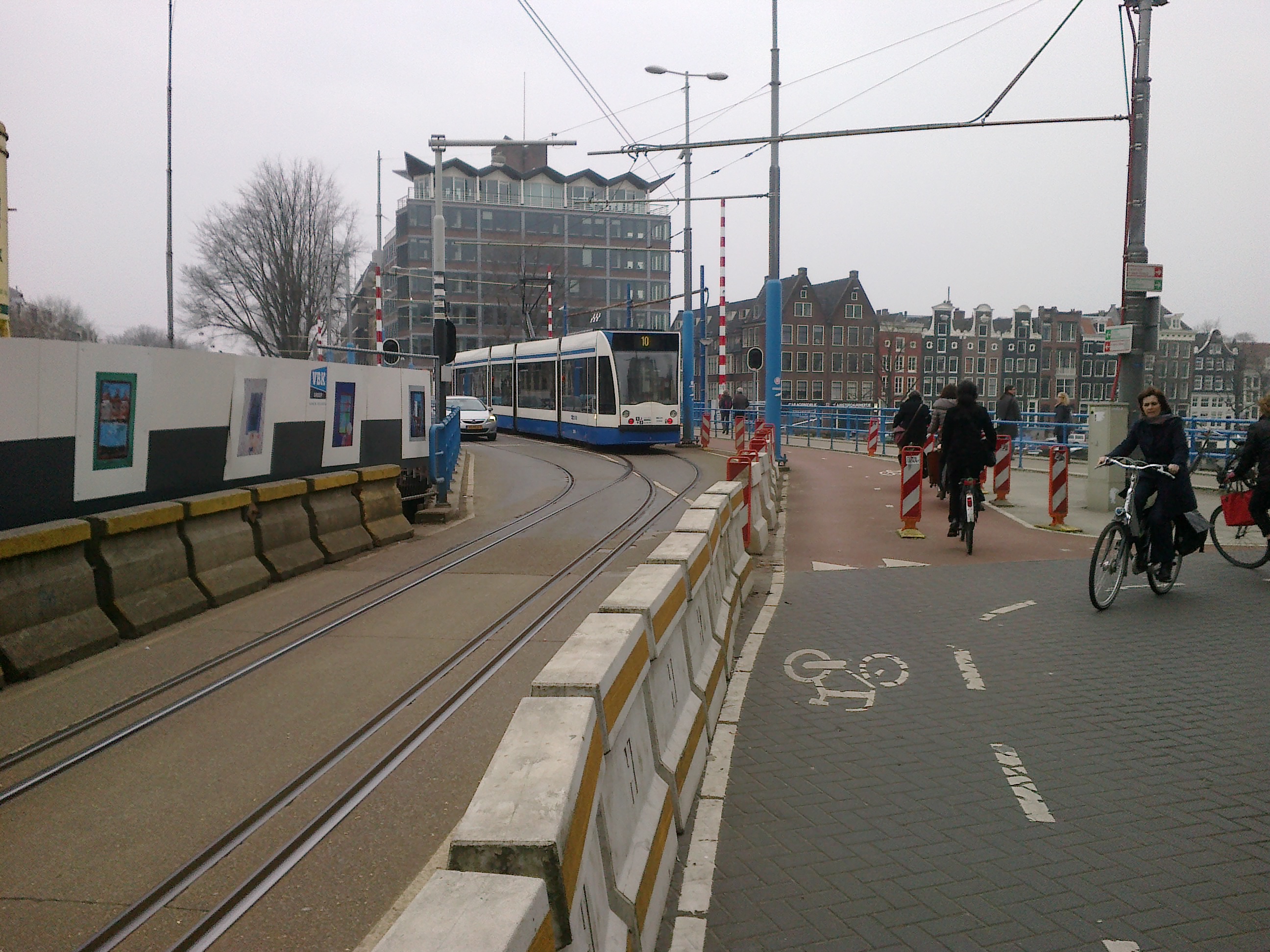
Interlaced track is also used in other narrow locations, some shared with motor vehicle traffic. Here a Route 10 tram leaves the interlaced track over the Hoge Sluis bridge, as an autombile waits to proceed over the same right-of-way.

Interlaced track is also used in other narrow locations, some shared with motor vehicle traffic. Here a Route 10 tram leaves the interlaced track over the Hoge Sluis bridge, as an autombile waits to proceed over the same right-of-way. (Photo by TobyJ, via Wikipedia.)


Here’s an excellent 2-minute video showing trams operating in both directions into and out of one of the interlaced sections through the Leidsestraat.

Original YouTube URL:
http://www.youtube.com/watch?v=Gv9Vgo_W0HU

For further information, this link to Wikipedia’s article on Trams in Amsterdam may be helpful:

http://en.wikipedia.org/wiki/Trams_in_Amsterdam

Special thanks to Roeland Koning and his Studio Koning photography service for his kind permission to use his photo of the Leidsestraat at the top of this posting. Visit his website at:

http://www.studiokoning.nl

h1

UT Student Government backs West Campus, Guadalupe-Lamar route for first phase of urban rail

12 October 2013
West Campus neighborhood is area in light green just to west (left) of the Drag (Guadalupe, vertical white line just to right of center). UT campus shown in orange. Map: The Galileo, rev. by ARN.

West Campus neighborhood is area in light green just to west (left) of the Drag (Guadalupe, vertical white line just to right of center). UT campus shown in orange. Map: The Galileo, rev. by ARN.

The effort to reset Austin’s urban rail planning focus onto the Guadalupe-Lamar (G-L) corridor got a huge boost on October 1st with the University of Texas Student Government’s passage of a resolution endorsing a West Campus and Guadalupe-Lamar corridor alignment for the Phase 1 starter line of urban rail — thus implicitly rejecting the officially proposed East Campus alignment and route out to the Mueller redevelopment site.

Designated as AR 15, the resolution contains a number of “Whereas” clauses, with meticulous documentation of the facts and arguments underpinning the basic decisions. For example, the resolution notes that

…Future-use plans for neighborhoods that include significant student populations, including the Brentwood/Highland Combined Neighborhood Plan , the North Loop Neighborhood Plan, Central Austin Combined Neighborhood Plan, and Hyde Park Neighborhood Plan support urban rail and stations along the proposed Guadalupe-Lamar alignment; and,

… there has been over $30 million worth of studies that have looked at the feasibility of light rail transit along the Guadalupe-Lamar Corridor since the 1970s; and,

… A 2011 study at the University of California-Berkeley found that “light-rail systems need around 30 people per gross acre around stations and heavy rail systems need 50 percent higher densities than this to place them in the top one-quarter of cost-effective rail investments in the U.S.” and “the ridership gains from such increases…showed, would be substantial, especially when jobs are concentrated within ¼ mile of a station and housing within a half mile”; and,

… the largest concentration of students living off campus, West Campus, is the third-densest population district in the state of Texas with a density of over 25,000 people per square mile; and,

… a large majority of the student population along with a vast majority the Central Austin population lives along the proposed Guadalupe-Lamar alignment, totaling over 54,000 people within a quarter-mile to proposed stations ….

On the basis of this evidentiary background, declares the resolution,

BE IT RESOLVED, That the Student Government of the University of Texas at Austin is in full support of the first phase of light rail running through the Guadalupe-Lamar Sub-Corridor; and,

BE IT FURTHER RESOLVED, That Student Government will support any proposed urban rail line that prioritizes transportation access to where students are currently living….

The full resolution can be accessed as a DOC file:

UT-Stu-Govt_AR 15 – In Support of The Guadalupe-Lamar SubCorridor as Phase I of Austin Urban Rail

Certainly, if this vote by UT’s Student Government is any guide, the majority of UT students want an urban rail route to serve the West Campus, where they can most effectively use it.

h1

Strasbourg’s tram-pedestrian mall: How “transit priority” and “pedestrian-friendly” are blended in Europe

11 October 2013
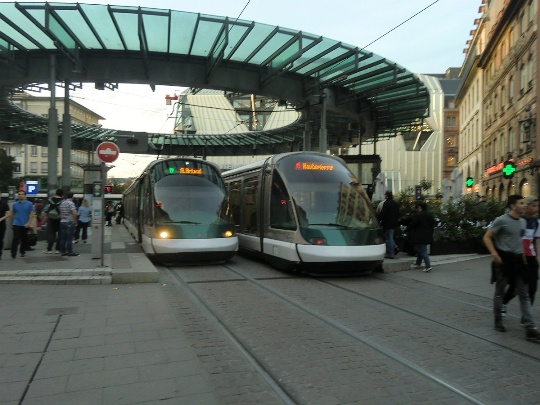
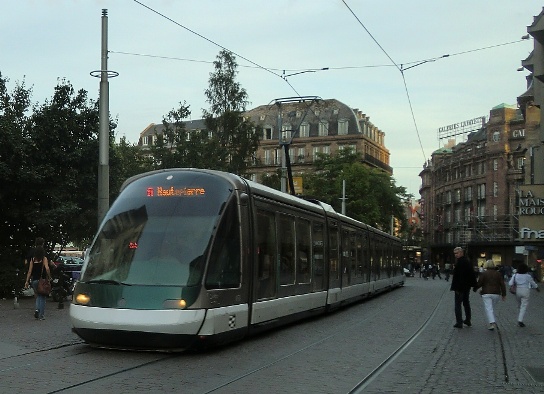
As evening approaches, a tram glides through Strasbourg's Place Kléber as pedestrians stroll along the other track. Photo: Franz Roski.

As evening approaches, a tram glides through Strasbourg’s Place Kléber as pedestrians stroll along the other track. Photo: Franz Roski.

Since urban rail supporters been discussing possible alignment designs for the Guadalupe-Lamar (G-L) corridor, the need for transit-priority lanes, and other issues, it might be helpful and interesting to observe how Europeans address this issue — typically, by converting entire streets to transit-pedestrian malls.

In this case, these recent photos (taken late in the day on 25 Sep. 2013 and posted to the online Eurotrams list by Franz A. Roski) show the transit-pedestrian mall in the French city of Strasbourg.


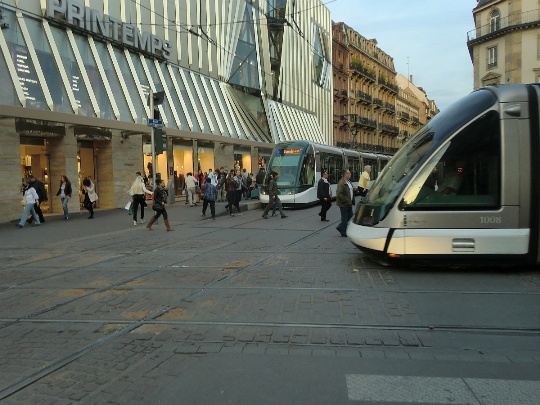
An A-Line tram approaches Homme de Fer (Iron Man) station as pedestrians stroll alongside the open track. Photo: Franz Roski.

An A-Line tram approaches Homme de Fer (Iron Man) station as pedestrians stroll alongside the open track. Photo: Franz Roski.


An A-Line tram arrives at Homme de Fer station as a D-Line tram for the opposite direction waits at the in the opposite platform.  Photo: Franz Roski.

An A-Line tram arrives at Homme de Fer station as a D-Line tram for the opposite direction waits at the in the opposite platform. Photo: Franz Roski.


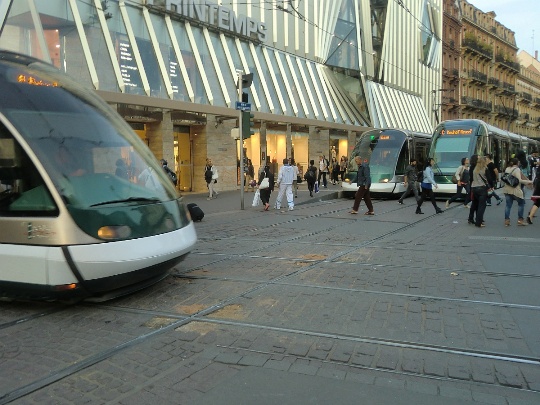
Major crossing of different tram routes near Homme de Fer.  Photo: Franz Roski.

Major crossing of different tram routes near Homme de Fer. Photo: Franz Roski.


Another view of the tram line crossing near Homme de Fer — trams coming, going, and crossing!  Photo: Franz Roski.

Another view of the tram line crossing near Homme de Fer — trams coming, going, and crossing! Photo: Franz Roski.


• Notice the crowds — street capacity for motor vehicles is gone … but look at all the people that have come there, mostly by transit. Where would they park all their cars, anyway?

• Notice the safety issue — pedestrians comfortably, safely walking around, next to, in back of, even in front the light rail trams.

• Notice the tram traffic — trams coming and going, trams crossing the tracks of other tram lines …

Food for thought.

h1

Portland — Light rail in East Burnside Street

9 October 2013
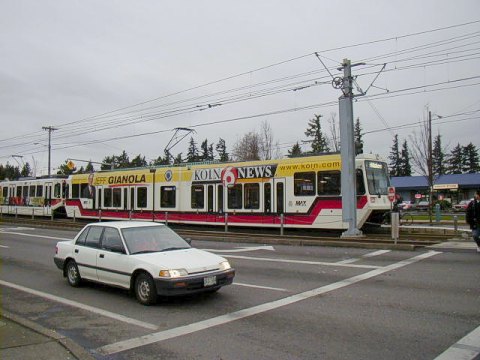
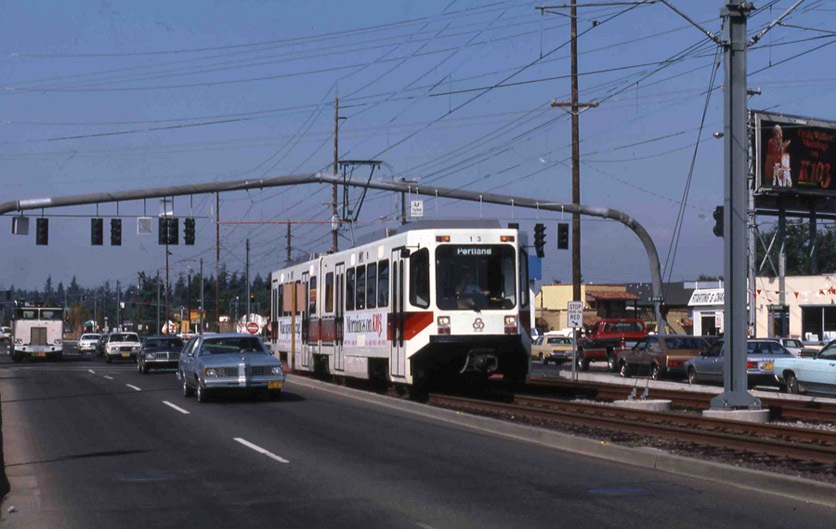
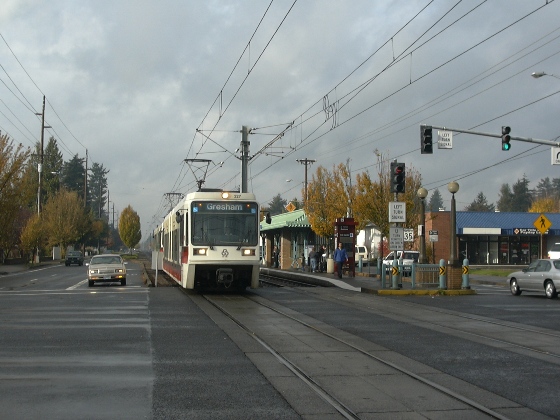
Light rail train in East Burnside St. approaches intersection and station at NE 181st. Ave. Photo: Adam Benjamin.

Light rail train in East Burnside St. approaches intersection and station at NE 181st. Ave. Photo: Adam Benjamin.

How might an urban rail line — in the form of light rail transit (LRT) — be fitted into four-lane roadways like North Lamar Blvd. and Guadalupe St.?

First, inserting any kind of transit-priority lanes (with or without tracks) requires tradeoffs, including an acceptance of the principle that public transport provides more mobility potential — and people-moving capacity — in the longer term, and needs to be emphasized.

Basically, Austin needs to start making realistic, sensible choices to expedite public transit over general motor vehicle traffic. Officials need to start replacing abstract platitudes about the “importance of alternative mobility” with action. This will require, one way or another, shifting more and more priority to transit.

Second, it’s crucial to keep in mind that there’s a fairly wide variety of options for addressing routing and design issues. Even fairly good consultants aren’t necessarily aware of all of them. There’s no “one and final answer” — community activists need to examine the assumptions and the design alternatives, and have an opportunity to input new ones and have them seriously considered.

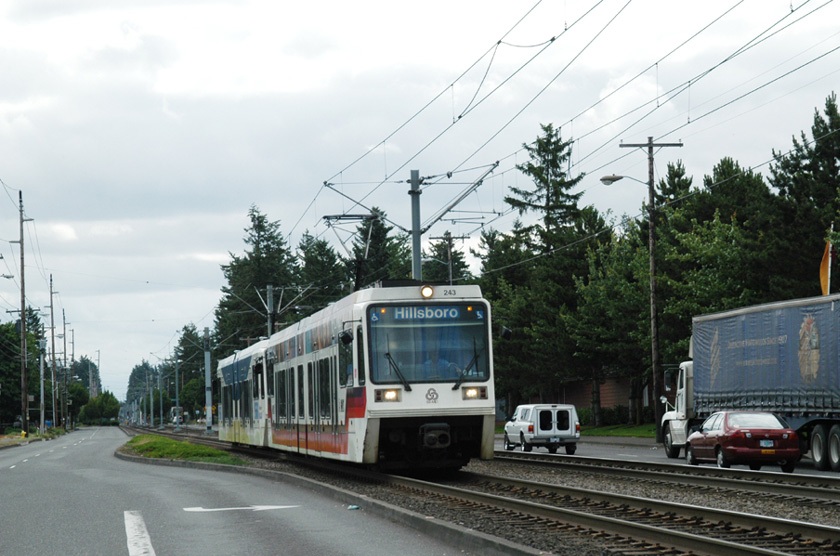
Portland, Oregon’s MAX LRT system — operated by the TriMet regional transit agency and generally considered one of the finest models for surface urban rail in the USA — offers a useful example of how LRT can be workably and efficiently inserted into a four-lane roadway. Since 1986, MAX’s Blue Line (the original line that is routed east from downtown Portland to the suburb of Gresham) has run in the middle of East Burnside St. for most of its outer section to Gresham. The following photo-overview gives an idea of design details.


LRT train in E. Burnside St. crossing major arterial

Photo: Peter Ehrlich

Photo: Peter Ehrlich

The photo above shows a one-car MAX LRT train in East Burnside St. after it has just crossed a major intersection with SE Stark. TriMet did not feel it necessary to build expensive grade separations at such intersections.

Also notice that the LRT line in this case is installed with ballasted, not paved, track. This is cheaper (in both capital cost and ongoing maintenance) than paving embedded track, and also discourages incursions by both motor vehicles and pedestrians, thus enhancing safety.


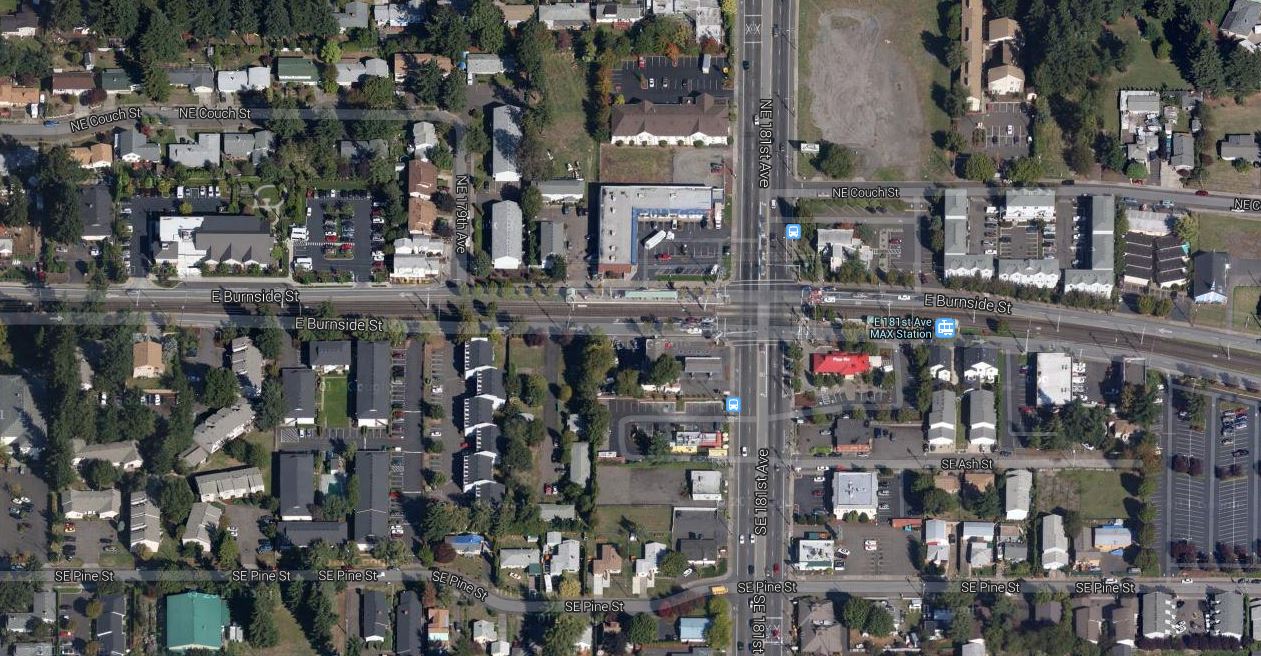
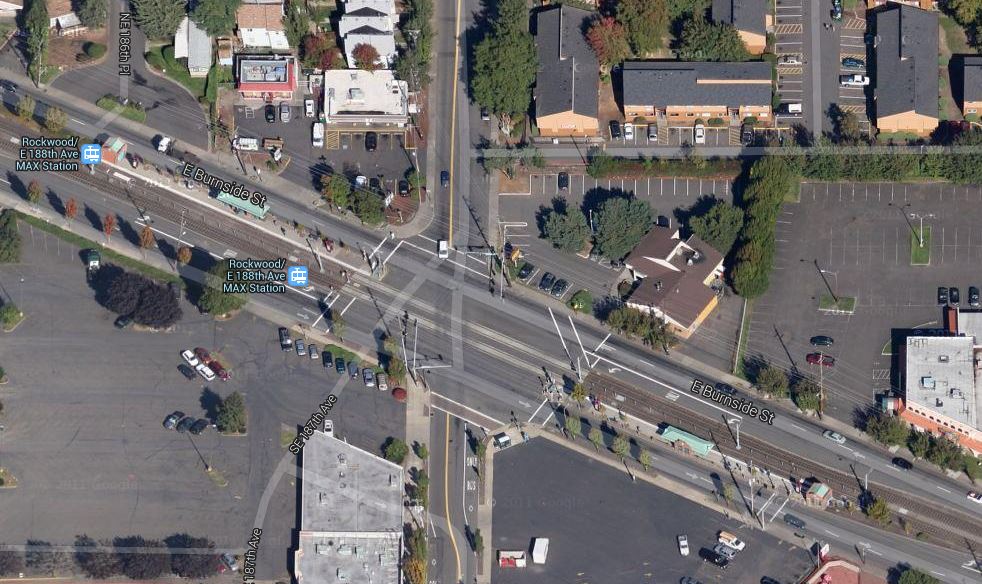
Aerial view of East Burnside LRT alignment

Photo: Google Maps screen capture by L. Henry

Photo: Google Maps screen capture by L. Henry

The aerial view above shows a segment of East Burnside running east-west (from left to right in middle of photo), with the MAX LRT as a brown strip (because of the ballasted track). Here the Burnside LRT alignment crosses NE 181st Ave., a major arterial running north and south and the location of a major station-stop.

Notice how the LRT alignment is relatively narrow (far left and right in photo) but widens somewhat nearing the intersection and each station facility — to allow space for extra turning lanes and the station platforms. Also note how the stations are staggered on each side of the intersection so as to absorb the minimum of right-of-way width. Traffic engineers offset both tracks and traffic lanes slightly, and may add additional right-of-way, to maintain road capacity and even install the narrow turning lanes.

Also, it’s worth noting that, even on this major busy arterial, TriMet saw no need for a grade separation.


LRT alignment showing track and lane offset

Photo: Peter Ehrlich

Photo: Peter Ehrlich

In the photo above, with a train approaching an intersection, you can see that the LRT track has gradually been offset to the right (from the alignment further back in the distance), and the road has been slightly widened, with a turning lane inserted.


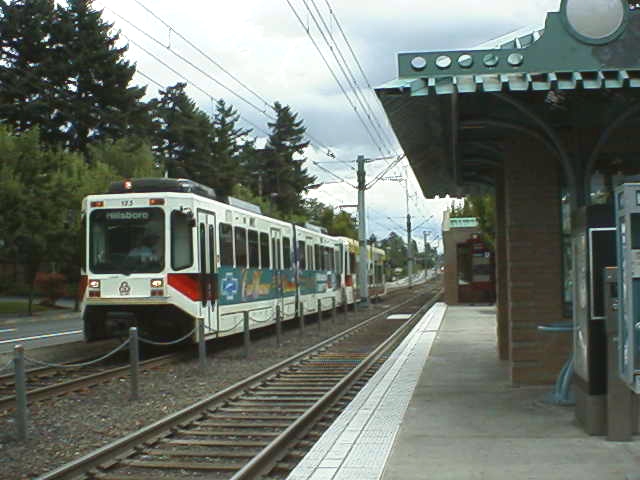
Train passing station

In the photo above a train on the opposite track passes the East 102nd Ave. station. Even with a platform width of only 10-12 feet, LRT stations have sufficient space for TVMs (ticket vending machines), a shelter, waiting bench, and other amenities.

Photo: Adam Benjamin

In the photo above a train on the opposite track passes the East 102nd Ave. station. Even with a platform width of only 10-12 feet, LRT stations have sufficient space for TVMs (ticket vending machines), a shelter, waiting bench, and other amenities.


Aerial view showing LRT line, intersection, stations

Photo: Google Maps screen capture by L. Henry

Photo: Google Maps screen capture by L. Henry

In this closer view of the intersection and stations at NE 188 Ave. you can see each of the two station platforms, offset on each side of the intersection. The beige color of each platform contrasts with the brown of the track alignment, and the green-tinted roof of each platform’s waiting shelter can be seen.

Also note the configuration of left-turning lanes. Motor vehicles queue up in these lanes, waiting their special signal to make a turn across the tracks. LRT train operation interfaces with the traffic signal system, and trains have their own special signals.


Train entering intersection, approaching station

Photo: L. Henry

Photo: L. Henry

Here a train passes a station on the other track as it enters the 181st Ave. intersection, approaching the waiting platform for its direction on the other side. On the opposite side of the street, next to the tracks, you can see a car is waiting to make a left turn.

h1

Back to “art galleries”! Project Connect reneges on community meetings

25 September 2013
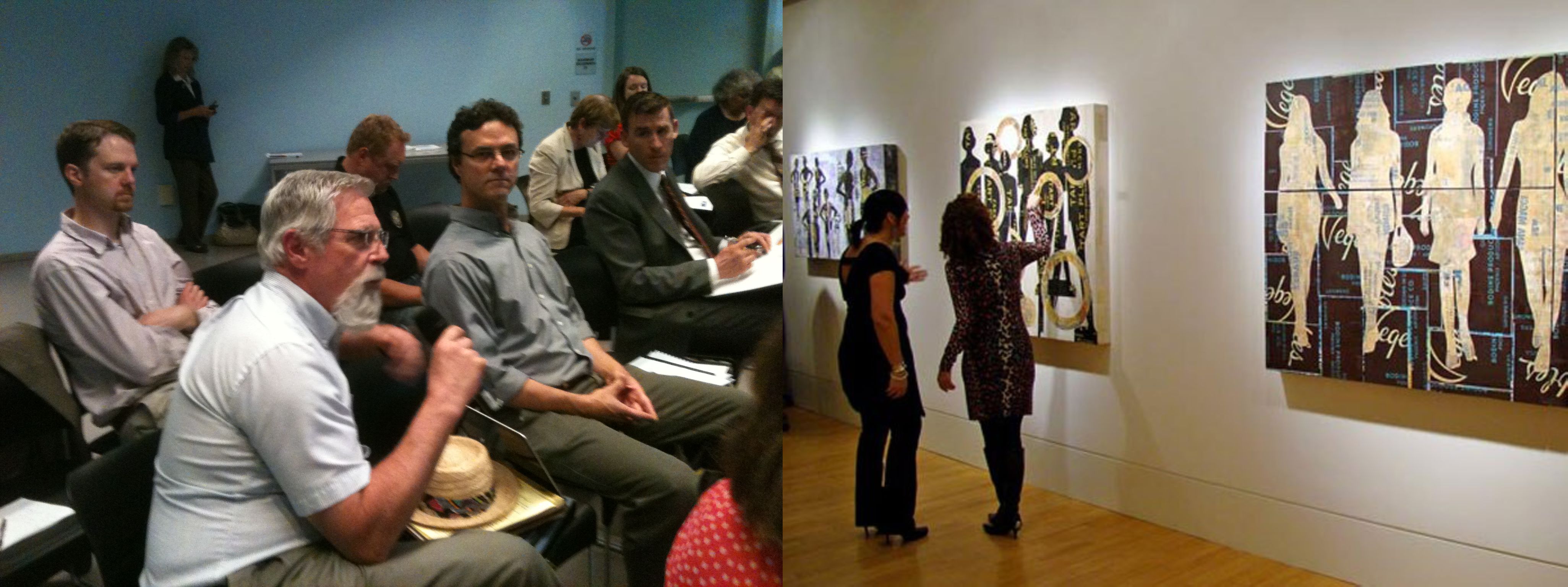
Community meeting (left) vs. art gallery (right)

Community meeting (left) vs. art gallery (right)

In our article of Sep. 17th, If you support urban rail for Guadalupe-Lamar, attend these community meetings! Austin Rail Now reported that

… Project Connect has scheduled some upcoming meetings (and a “webinar”) between Sep. 4th and Oct. 2nd (details below) that seem to offer a bona fide opportunity for the public to meet in a community fashion, both discussing the issues and interacting with one another.

Unfortunately, the prospect of bona fide public meetings “for the public to meet in a community fashion, both discussing the issues and interacting with one another” no longer seems valid.

In a sudden reversal — and what appears to be a breach of trust and a breach of a de facto agreement with many in the Austin community — Project Connect has abruptly stopped describing the forthcoming Urban Rail Central Corridor public involvement events as meetings, and instead is now promoting them as so-called “Open Houses”.

The Sep. 23rd edition of the Austin Mobility Go! Email newsletter from the City of Austin’s Transportation Department now describes the activities this week as “open houses”, not meetings. This was confirmed in Email comments from Capital Metro/Project Connect community outreach specialist John-Michael Cortez:

It is labeled as an Open House because that connotes that people are free to show up at any time, unlike a public meeting or workshop, which usually has a set agenda and starting time, thus limiting full participation to those who are able to show up at the start of the meeting. These meetings will be more of a hybrid open house/workshop. Participants can come at whatever time they choose and be able to see exhibits and speak directly to agency staff to have their questions answered, and formal input will be gathered through questionnaires and encouraging participants to draw and make comments on sub-corridor maps.

This is a crucial point, and one that many community activists involved with the urban rail planning process thought had been settled — in favor of community meetings.

Meetings are fundamental to truly democratic process. They allow for community interactive input, i.e. community discussion along with the project personnel. They bring members of the entire community together, allow them to hear ideas and views from one another, allow them to interact on the public record (or at least with public witnesses) with officials present, force official representatives to deal with and respond to difficult questions and issues, and allow officials and participants to get a sense of community attitudes expressed in a community manner. One person’s question or comment may give ideas or motivation to other participants.

This community interactivity is lost in the individual, one-on-one format of “Open Houses”, which have no set agenda, no community public speaking, and involve agency personnel displaying graphics of their pre-determined plans and chatting individually with the occasional community members that might attend the event. Transportation consultant Lyndon Henry (an Austin Rail Now contributor) has compared these events to wandering through an art gallery, with the chance to chat individually with the gallery guards (agency personnel). There’s no opportunity for real interactive community involvement.

In the view of local Austin researcher and transportation activist Roger Baker,

The major problem I see is that while Open Houses usually have lots of big impressive maps, these meetings commonly tend to evolve toward little unstructured conversation clusters, with an official at their center, near a map, and with others standing around, trying to hear, waiting to ask their own questions. Every citizen can come in and ask the same question as those who came earlier, and these exchanges are essentially rambling private discussions that tend to go on and on without clearly answering certain important policy questions. Usually there is no record of the questions asked, nor the responses given. These events tend to become a succession of unrecorded one to one exchanges.

In a comprehensive explanation and analysis of public involvement, the Federal Highway Administration (FHWA) explains that

Meetings provide a time and place for face-to-face contact and two-way communication-dynamic components of public involvement that help break down barriers between people and the agencies that serve them. Through meetings, people learn that an agency is not a faceless, uncaring bureaucracy and that the individuals in charge are real people. Meetings give agencies a chance to respond directly to comments and dispel rumors or misinformation.

Far from being passive gatherings, meetings are interactive occasions when people discuss issues of consequence to them and their neighbors, listen to opposing viewpoints on the issues, and work together for the common good. Agency staff people who handle public meetings need to be trained in skills that encourage interaction and also keep the process focused and productive.

In contrast, says FHWA,

An open house is an informal setting in which people get information about a plan or project. It has no set, formal agenda. Unlike a meeting, no formal discussions and presentations take place, and there are no audience seats. Instead, people get information informally from exhibits and staff and are encouraged to give opinions, comments, and preferences to staff either orally or in writing.

Is the planning and decisionmaking process really that important to the kind of plan that emerges? You bet it is.

Vigorous, authentic community involvement is absolutely critical, particularly in injecting new ideas and perspectives, raising special concerns, scrutinizing and evaluating official approaches and decisions, safeguarding the project from the influence of special interests and extraneous political issues, and generally keeping the official planners and decisionmakers “honest”.

Furthermore, voters are far more inclined to support ballot measures for major rail projects if they have a sense of ownership through opportunities for bona fide participation in the process.

Project Connect’s seemingly abrupt decision to downgrade the format of these public events from meetings to “art galleries” (“open houses”) suggests more of a desire to minimize, or squelch, rather than maximize, public involvement and dialogue in the urban rail planning process. This would also appear corroborated by Project Connect’s rather puzzling lack of publicity for these public events.

As Lyndon Henry recently warned, in comments Emailed to a list of community transportation activists,

The consistent and steady pattern by local public agencies (particularly involved in public transportation issues) of degrading the bona fide democratic public participation process over the past period has been alarming, and I did speak out about this when I worked at Capital Metro. Individual chats between individual community members and official personnel do not represent a democratic process of community participation, and I’ve personally seen the level of such participation decline significantly over the past couple of decades. It’s very troubling to see this same policy now being carried forward and rationalized despite assurances made otherwise.

Despite these efforts by Project Connect to discourage public participation, Austin Rail Now continues to urge supporters of a Phase 1 urban rail starter line in the Guadalupe-Lamar corridor to attend these events and vigorously express their views.

h1

Why MetroRapid bus service is NOT “bus rapid transit”

22 September 2013
Capital Metro MetroRapid bus. Photo: CMTA blog.

Capital Metro MetroRapid bus. Photo: CMTA blog.

Capital Metro’s MetroRapid bus project received its $38 million of Federal Transit Administration (FTA) funding through its designation as a “Bus Rapid Transit” project under the FTA’s Small Starts program. But calling a bus operation “rapid transit” that will run predominantly in mixed motor vehicle traffic seems either rather fraudulent, self-deceptive, or a branding effort that has descended to the ridiculous. Yet some local officials, planners, and enthusiasts of the officially promoted downtown-to-Mueller Urban Rail route have been vigorously singing the praises of MetroRapid as a viable and equivalent substitute for light rail transit (LRT) in the Guadalupe-Lamar corridor.

Even LRT, which typically runs entirely or predominantly in reserved or exclusive alignments, and (for comparable levels of service) is faster than so-called “BRT”, isn’t called “rapid transit”.

The un-rapid drawbacks of CapMetro’s MetroRapid have been cited by other analyses. For example, Austin American-Statesman transportation reporter Ben Wear, in a February 2012 article titled MetroRapid bus service not so rapid, not expected until 2014, noted:

Despite an agency goal of offering time savings of 10 percent, in hopes of attracting more people to buses, the two lines would mostly offer minimal time savings, according to a Capital Metro presentation on the MetroRapid bus system, now scheduled to start operating in 2014.

In one case, a MetroRapid bus running from Howard Lane in North Austin to downtown would make the trip in 47 minutes — the same as an existing limited-stop bus that runs the same route. Trips between South Austin and downtown on that same line would offer time savings of just two to three minutes.

Community public transit activist Mike Dahmus, in a blog entry titled Rapid Bus Ain’t Rapid, 2011 Confirmation, provided schedule evidence from CapMetro’s own website indicating that travel time differentials between the proposed Route 801 service (North Lamar-Guadalupe-South Congress) for atypically long trip lengths were minimal — time savings of 0 to perhaps 3 minutes even for such unusually lengthy trips as journeys between far-flung transit centers.

And in another article titled Rapid [sic] Bus Fact Check: Will It Improve Frequency? Dahmus offered a cogent argument that headways (thus waiting times for passengers) would be increased, not decreased, with MetroRapid service in the Route 801 corridor. Assuming the most likely operating scenario, Dahmus figures the number of scheduled bus trips in an average hour would be reduced from 9 to 8 — i.e., an increase in service headways and concomitant increase in waiting time for passengers.

Wikipedia provides a useful definition/description of Rapid Transit:

A rapid transit system is a public transport system in an urban area with high capacity, high frequency not needing timetables, is fast and is segregated from other traffic…. Operating on an exclusive right of way, rapid transit systems are typically grade separated and located either in underground tunnels (subways) or elevated above street level (elevated transit line). … Modern services on rapid transit systems are provided on designated lines between stations typically using electric multiple units on rail tracks, although some systems use guided rubber tyres, magnetic levitation, or monorail.

Numbered citations were omitted from the quotation above, but the Wikipedia article’s references included:

• “Rapid transit”. Merriam-Webster.
• “Metro”. International Association of Public Transport.
• “Glossary of Transit Terminology”. American Public Transportation Association.
• “Rapid Transit”. Encyclopedia Britannica.

In the USA, the term “rail rapid transit” has a de facto meaning of such an urban electric metro or subway/elevated system, running entirely (with rare exceptions) on its own, exclusive right-of-way, with no grade crossings or other interference with street traffic or pedestrians.

It would seem reasonable that the public, political and civic leaders, and transportation professionals should hold “bus rapid transit” to the same standard. Certainly, “bus rapid transit” should not be applied to bus operations running merely in reserved traffic lanes, or in and out of mixed and reserved or exclusive lanes, etc. — yet these are precisely the kinds of operating applications that FTA, and several major BRT advocacy organizations, have been blithely characterizing as “BRT”.

To call a modestly enhanced bus operation “rapid transit” while denying this designation to a streetcar/light rail operation with much or most of its alignment in exclusive or reserved ROW seems like branding gone haywire — particularly so when the buses depart from the totally exclusive alignment and meander on routes in mixed traffic. Why should a bus coming down the street, waiting in traffic jams, etc., be called “rapid transit”? This would seem to make a mockery of the term.

In effect, the term Bus Rapid Transit is being applied to service/capacity mode configurations that are significantly inferior not just to Rail Rapid Transit but to Light Rail Transit — and that would seem highly misleading, especially to the general public. For these modestly improved bus services, a term such as Bus Premium Transit would appear more accurate and appropriate.

The section below provides a brief photo-summary distinguishing among bona fide rail rapid transit and bus rapid transit, and Bus Premium Transit operations erroneously (and widely) characterized as “BRT”.


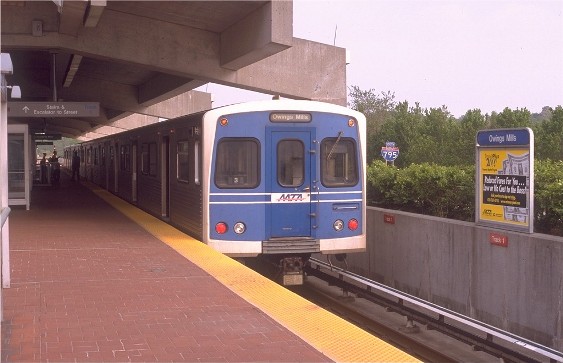
♦ This is rail rapid transit (RRT)

Baltimore Metro. Photo: Doug Grotjahn.

Baltimore Metro. Photo: Doug Grotjahn.

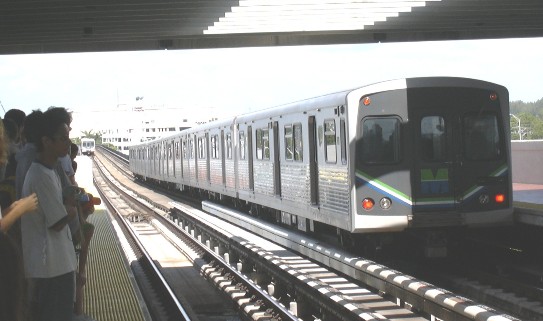
Miami MetroRail. Photo: L. Henry.

Miami MetroRail. Photo: L. Henry.


♦ This is bus rapid transit (BRT)

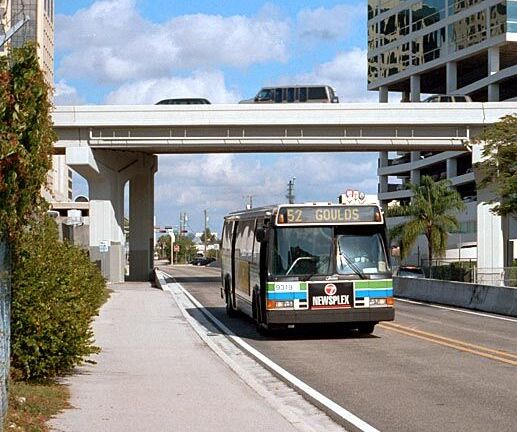
Miami-Dade County Busway. Photo: Jon Bell.

Miami-Dade County Busway. Photo: Jon Bell.

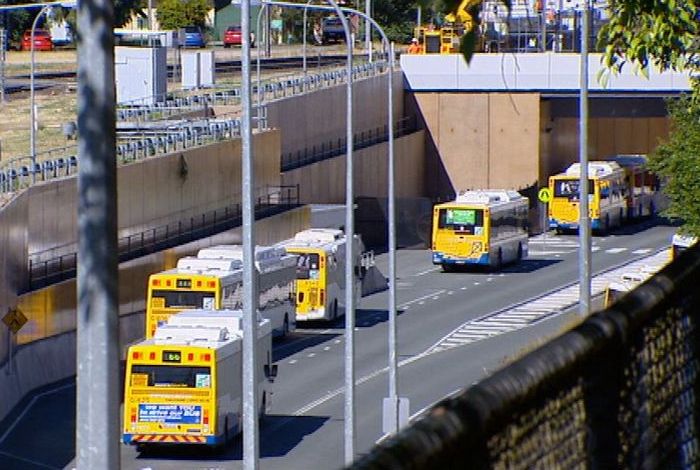
Brisbane (Australia) busway. Photo: That Jesus Bloke.

Brisbane (Australia) busway. Photo: That Jesus Bloke.

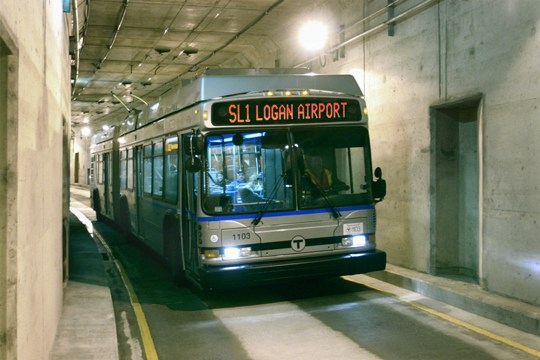
Boston Waterfront Silver Line. Photo: Massachusetts Government blog.

Boston Waterfront Silver Line. Photo: Massachusetts Government blog.


♦ This is NOT “bus rapid transit”

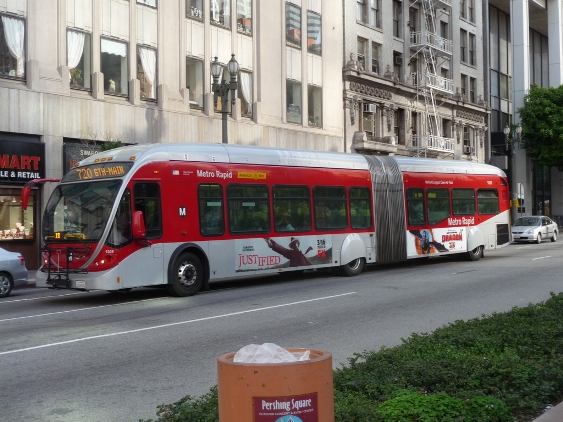
Los Angeles MetroRapid Route 720. Photo: Sopas EJ.

Los Angeles MetroRapid Route 720. Photo: Sopas EJ.

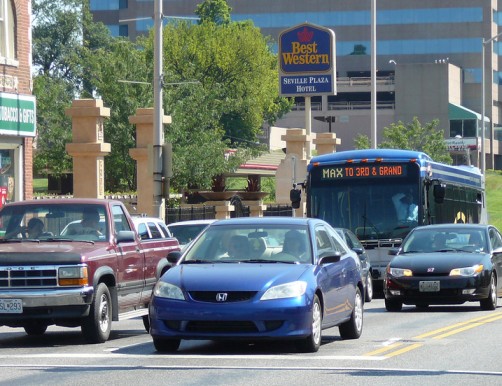
Kansas City MAX premium bus service (branded as "BRT"). Photo: Metro Jacksonville.

Kansas City MAX premium bus service (branded as “BRT”). Photo: Metro Jacksonville.


Bottom Line: With MetroRapid bus service, Capital Metro does seem to be modestly upgrading current bus service in the Guadalupe-Lamar corridor and elsewhere with spiffier station facilities and newer buses — improvements that most bus riders, and probably the public in general, would welcome.

But an acceptable substitute for urban rail … it ain’t.

h1

How Portland’s light rail trains and buses share a transit mall

19 September 2013
LRT train on Portland's 5th Ave. transit mall swings to the curbside station to pick up waiting passengers. Photo: L. Henry.

LRT train on Portland’s 5th Ave. transit mall swings to the curbside station to pick up waiting passengers. Photo: L. Henry.

Capital Metro and the City of Austin have a project under way to designate “Transit Priority Lanes” on Guadalupe and Lavaca Streets downtown between Cesar Chavez St. and MLK Jr. Blvd. It’s mainly to expedite operation of the planned new MetroRapid bus services (Routes 801 and 803), but virtually all bus routes running through downtown will also be shifted to these lanes, located on the far-righthand side of traffic on each street (i.e., the righthand curbside lanes).

According to a 2011 study funded by the City of Austin, the Official (City + Project Connect) Urban Rail route is also envisioned to use these lanes downtown. Alternatives to the Official plan have also assumed that these routes would be available for alternative urban rail lines serving the Guadalupe-Lamar corridor.

However, there are legitimate questions as to whether these two lanes could simultaneously and effectively accommodate the two MetroRapid bus routes (10-minute headways each) plus all other Capital Metro routes (various headways) as well as urban rail (10-minute headway), all running in both directions.

Experience with both light rail transit (LRT) trains and buses sharing the same running way is rare in the USA, but one of the best examples can be seen in Portland, Oregon. For years, 5th and 6th Avenues through the downtown have been used by multiple bus routes as a transit mall, with a single lane provided for general motor vehicle access. In September 2009 LRT was added with the opening of the new Green Line; see: Portland: New Green Line Light Rail Extension Opens.

The integration of LRT with bus service in the 5th and 6th Avenue transit malls has worked well. Here’s a brief photo-summary illustrating some of the configurational and operational details.

• Buses and LRT trains share transitway

This illustrates how both bus services and LRT trains share the mall. Tracks, embedded in the pavement, weave from curbside to the second lane over. A third lane is kept open for mixed motor vehicle traffic.

Portland 5th Ave. transit mall. Photo: Dave Dobbs.

Portland 5th Ave. transit mall. Photo: Dave Dobbs.

• LRT routes cross

This photo shows how the Green and Yellow LRT lines on the 5th Ave. transit mall cross the Red and Blue LRT lines running on 5th St. You’re looking north on 5th Ave., and just across the tracks in the foreground, the LRT tracks on 5th Ave. weave from the middle of the street over to the curbside, where a station-stop is located. This allows LRT trains to access stations but otherwise pass buses stopped at bus stops on the same street.

Portland 5th Ave. transit mall. Photo: L. Henry.

Portland 5th Ave. transit mall. Photo: L. Henry.

• LRT train leaving station

Here an LRT train has just left the curbside station, following the tracks into the middle lane of the street. This track configuration allows the train to pass a bus boarding passengers at a stop.

Portland 5th Ave. transit mall. Photo: Dave Dobbs.

Portland 5th Ave. transit mall. Photo: Dave Dobbs.

• LRT train passing bus

Another train moves to the street center lane and passes the bus stop. Meanwhile, other buses queue up at the street behind.

Portland 5th Ave. transit mall. Photo: Dave Dobbs.

Portland 5th Ave. transit mall. Photo: Dave Dobbs.

• Bus bunching

Buses are prone to “bus bunching” (queuing) in high-volume situations because of their smaller capacity, slower operation, slower passenger boarding/deboarding, difficulty adhering to schedule, etc. However, notice how they’re channeled to queue up in a lane off the LRT track.

Portland 5th Ave. transit mall. Photo: L. Henry.

Portland 5th Ave. transit mall. Photo: L. Henry.

Can and will Austin and Project Connect planners learn anything about how to create workable Transit Priority Lanes from examples like this? Time will tell…

h1

MetroRapid bus service should be a precursor to urban rail, not an obstacle!

18 September 2013
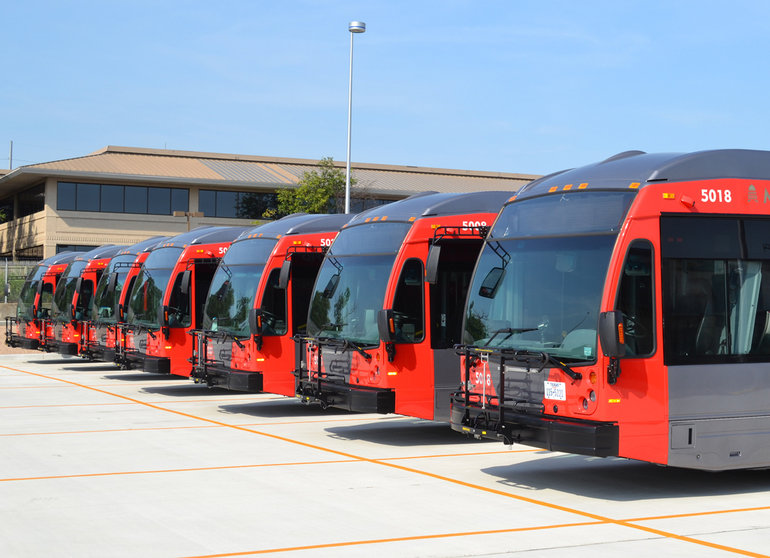
View of part of MetroRapid fleet.

View of part of MetroRapid fleet.

Some local officials, favoring the City’s long-preferred Urban Rail plan from downtown through the UT East Campus to the Mueller development site, have been presenting Capital Metro’s MetroRapid juiced-up-bus-service project as a barrier to alternative proposals for implementing urban rail in the Guadalupe-Lamar (G-L) corridor.

As Austin Rail Now will discuss in subsequent analyses, this argument is fatuous and fallacious. Instead, MetroRapid can and should be re-purposed and re-branded as a precursor to urban rail, not a competitor and obstacle.

This concept of MetroRapid as a precursor to rail was first presented in a 27 April 2012 commentary by Lyndon Henry (technical consultant for Light Rail Now) to the Transit Working Group:

Rapid Bus can be a precursor to Urban Rail in Lamar-Guadalupe corridor!

Here are excerpts (adapted for Webpage format) from that commentary that may be useful to the discussion of such a possible role for MetroRapid as a precursor to urban rail (using light rail transit technology) in the G-L corridor:


♦ Useful reference: BRT as a Precursor of LRT? (TRB conference paper, 2009)

Paper presented by Dave Dobbs and [Lyndon Henry] to 2009 Joint International Light Rail Conference sponsored by Transportation Research Board [TRB] provides research and guidelines for BRT as rail precursor:

Cover of TRB conference proceedings.

Cover of TRB conference proceedings.

Title and author lines from published paper.

Title and author lines from published paper.

[Link to proceedings]

http://onlinepubs.trb.org/onlinepubs/circulars/ec145.pdf

♦ Examples where “BRT” has been precursor to rail – including with FTA approval

Various U.S. examples exist where both technically and policy-wise, a RapidBus or BRT-type system can function as a precursor to rail transit service – and with Federal Transit Administration (FTA) approval!

• Dallas – BRT-like express bus service, operated by Dallas Area Rapid Transit (DART) on North Central Expressway, served as a precursor to DART’s LRT extension to Plano.
• Miami – Miami-Dade Busway has been serving as precursor to extensions of MetroRail rapid transit.
• Los Angeles – Wilshire Boulevard MetroRapid service, operated by Los Angeles County Metropolitan Transportation Authority (MTA), has served as precursor to extension of MTA’s rail rapid transit metro system, a project now under way.
• Seattle – In Downtown Seattle Transit Tunnel, BRT-type bus service functioned as precursor to Link light rail (now operating jointly with buses – see photos below).

♦ In 2009, Capital Metro’s MetroRapid was envisioned as precursor to rail

As recently as 2009, MetroRapid project was being designed for eventual conversion to light rail:

Excerpt from section of paper.

Excerpt from section of paper.

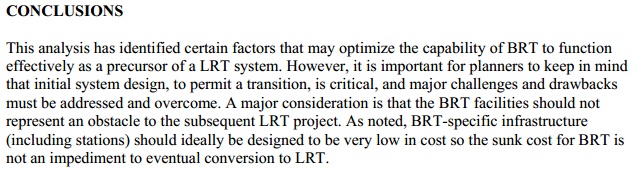
♦ Conclusion: BRT or RapidBus must be originally designed as light rail precursor!

Paper concludes that best-practices approach to plan for BRT or RapidBus as precursor to rail is to design it for eventual conversion from the start. This means keeping infrastructure investment minimal and designing for modularity (i.e., designing station components, communications, etc. so they can be easily relocated or reconfigured for the rail mode during conversion).

Excerpt from Conclusion of paper.

Excerpt from Conclusion of paper.

If the transit agency can demonstrate that the BRT or RapidBus investment won’t be lost, but can be upgraded into a higher and more effective use (e.g., Urban Rail), FTA has approved such conversion.

h1

If you support urban rail for Guadalupe-Lamar, attend these community meetings!

17 September 2013
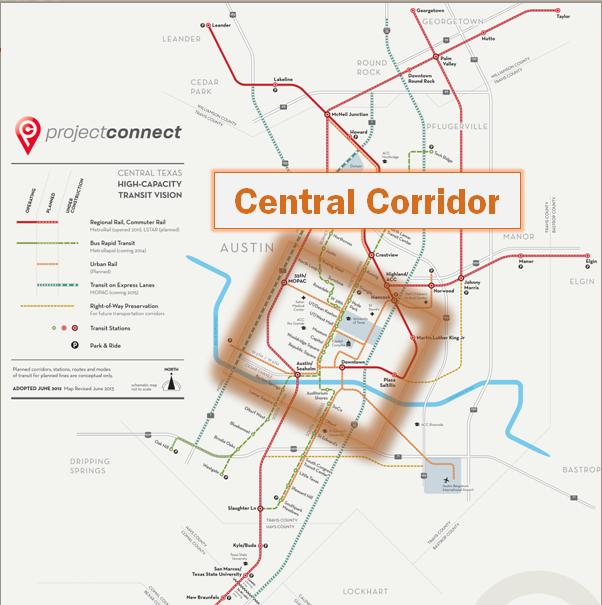
Map of so-called "Central Corridor" study area.

Map of so-called “Central Corridor” study area.


Project Connect, the consortium of the City of Austin, Capital Metro, and other public entities to pursue coordinated transit planning for Central Texas and the Austin metro region, has ostensibly pulled back somewhat from the previous emphasis on urban rail in the downtown-East Campus-Mueller corridor, and has a project under way to vigorously study (at least nominally) alternative corridors for a Phase 1 urban rail starter line — and one of those corridors is Guadalupe-Lamar (G-L).

There’s some debate over just how serious local officials and planners are about breaking from their fixation on the previous Mueller route (which would install urban rail in a very weak non-corridor), but in any case, Project Connect has scheduled some upcoming meetings (and a “webinar”) between Sep. 4th and Oct. 2nd (details below) that seem to offer a bona fide opportunity for the public to meet in a community fashion, both discussing the issues and interacting with one another.

So Austin Rail Now strongly encourages supporters of an urban rail Phase 1 starter line in the G-L corridor to attend these meetings (and participate in the “webinar”) — and voice their support for the G-L corridor.

The current project is specifically focused on a so-called “Central Corridor” — actually, a huge square study area extending as far west as Loop 1 (MoPac Expressway), east to roughly Springdale Rd., north to Crestview and the Highland/ACC area, and south to roughly Oltorf St. (see map above).

Since it’s not really a “corridor”, but an entire city sector with potential routes running in all directions, Project Connect planners have had to rename the actual travel corridors under study as “sub-corridors”. While the downtown-East Campus-Mueller route is designated as one of these “sub-corridors”, so is Guadalupe-Lamar, as well as a route out Riverside to the ABIA Airport, a route south on South Congress, and routes out Lake Austin Blvd. and West 38th St. to the Seton-Medical Center area.

While just about all these routes might make sense for urban rail at some point, obviously there must be a prioritization process that can select one for the first line to start with. Austin Rail Now believes a line in the G-L corridor makes by far the most sense in every way, and has the best chance of attracting community-wide voter support for bonds to help fund installation.

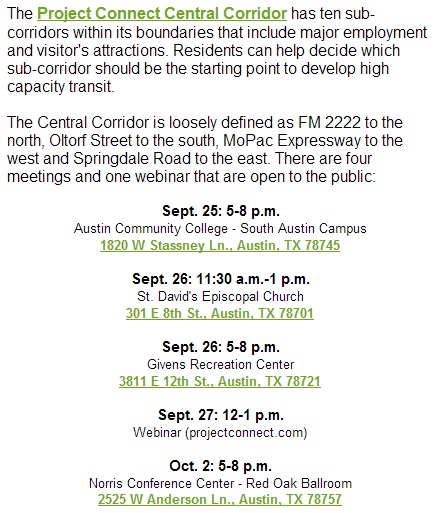
Here’s a screen capture from the City’s Austin Mobility website giving details — dates, times, locations — of the upcoming community meetings and the “webinar”:

ProCon_aus-txt-Central-Corridor-mtgs-2013-Sep-Oct_COA

If you want urban rail to go where it makes the most sense, and will have the best chance to win voter support — i.e., the Guadalupe-Lamar corridor — you have a major stake in this. Please plan to attend at least one of these meetings (or participate in the “webinar”)!

h1

Another alternative urban rail plan for Guadalupe-Lamar corridor

9 September 2013
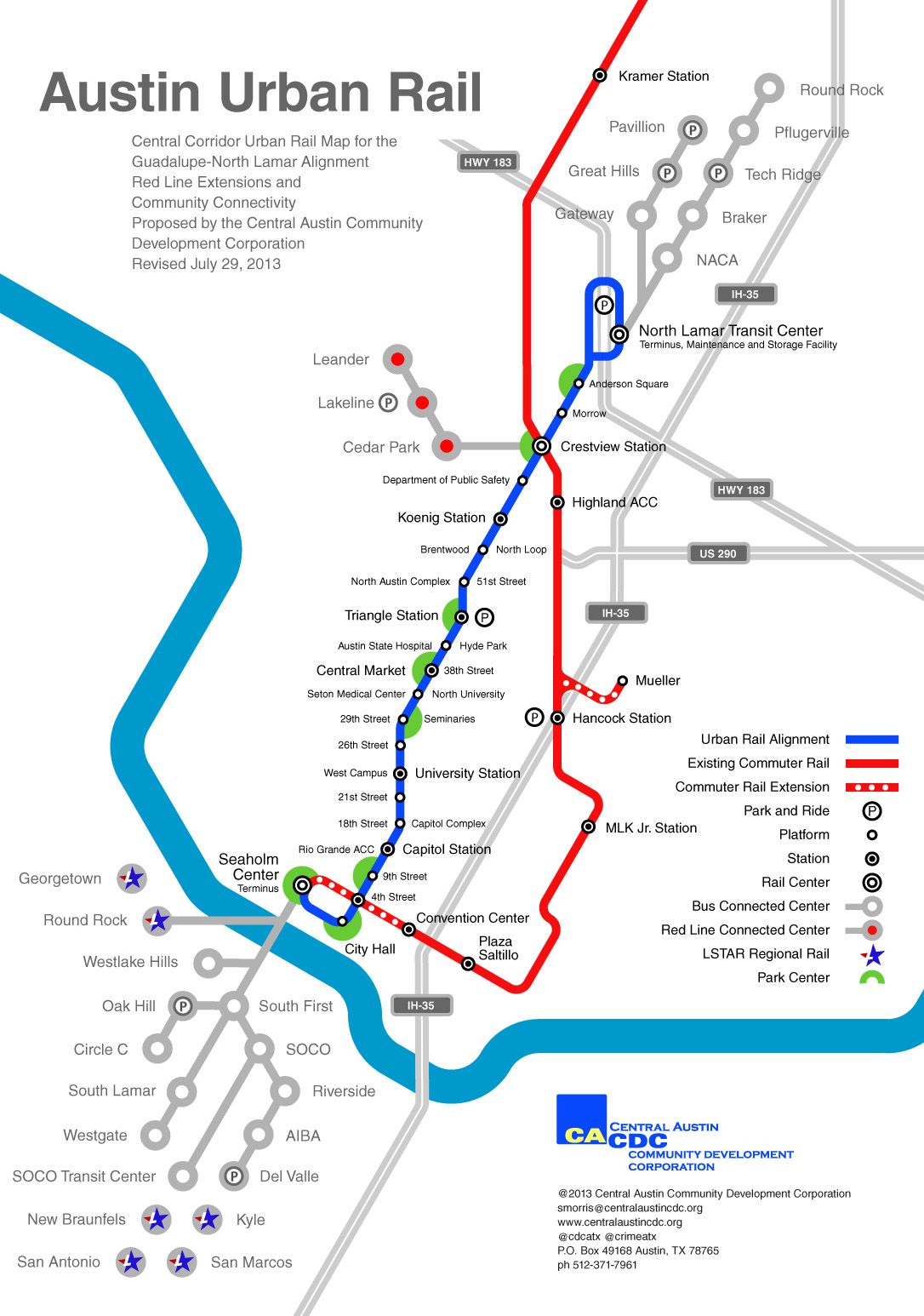
CACDC's Central Corridor urban rail plan (blue), with MetroRail (red) and various bus links (grey). Map: CACDC

CACDC’s Central Corridor urban rail plan (blue), with MetroRail (red) and various bus links (grey). Map: CACDC

Within the Austin community, momentum continues to grow to re-orient the officially promoted Urban Rail project (downtown-East Campus-Mueller) into a focus on the Guadalupe-Lamar (G-L) corridor as the primary spine for a Phase 1 (i.e., starter line) project. Much of this effort is coming from businesses, neighborhoods, and community groups within the G-L corridor itself.

Besides the “loop” proposal (one line through the G-L corridor, the other formed by converting the eastiside Red Line to electric urban rail) proposed a year ago by Texas Association for Public Transportation (TAPT), suggestions for other possible routes serving the G-L corridor are forthcoming from the community.

One of the most thoroughly developed is a 7-mile-long Central Corridor urban rail plan designed by the Central Austin Community Development Corporation (CACDC), led by Scott Morris (see map above).

From Crestview south to 4th St., the CACDC plan is virtually identical to the west branch of the TAPT “loop”, following Lamar and then Guadalupe. However, CACDC extends the line further up Lamar to the North Lamar Transfer Center, where it would provide connectivity to various bus routes at this major transit interchange, and then make a loop beneath the US 183 freeway to return south on Lamar. Also, at its southern end, it includes a spur east to the Seaholm development site.

The plan also proposes a short spur from the existing MetroRail Red Line (“commuter” light railway) into the Mueller development site. (The TAPT plan similarly includes an urban rail spur into Mueller from the eastside urban rail branch formed, as previously noted, by converting the Red Line to electric urban rail.)

Both of the CACDC urban rail extensions (the extension up Lamar and the connection to Seaholm) are similarly proposed by TAPT for a subsequent phase of urban rail development. However, if public and political sentiment can be shifted in the more rational direction of supporting an urban rail Phase 1 (starter line) route in this extremely heavy, productive G-L corridor, perhaps a “melding” of plans, incorporating the best features of these and other proposals, will be possible.

According to CACDC’s website, “This 7 mile phase one alignment serves the greatest number of riders, forms the expandable backbone of a much larger future system, and satisfies all public benefit criteria ….” The proposal also presents a long list of “communities, centers, and nodes” — almost entirely in the G-L corridor — that would be served

What the Austin-area public — especially voters — will prefer and accept can eventually be sorted out. What’s critical now is for all those who favor primary emphasis on the G-L corridor to work together to reallocate local planning focus away from the absurd downtown-East Campus-Hancock Center-Mueller non-corridor, and onto the G-L corridor — a real corridor (which also includes the fourth-highest residential density of all major Texas cities) — where it should have been in the first place, over the past 8 years of local planning.

h1

Advantages of Light Rail in Street Alignments

22 April 2013

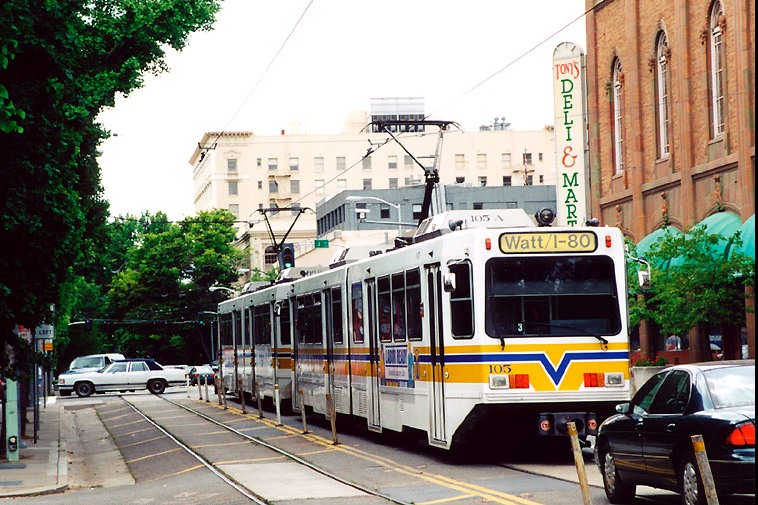
sac-lrt-12th-Str-mixed-trf-15347-20010428x_Eric-Haas
Sacramento’s light rail system shares space with general traffic in one direction on 12 th St., just north of the city’s CBD. Photo: Eric Haas.

The issue of installing reservations (e.g., reserving existing street lanes) for light rail transit (LRT) in highly constricted urban arterial corridors is a continuously recurring issue for urban public transportation discussions, and it became particularly intense in Austin’s Transit Working Group (TWG) meetings in late April/early May of 2012. Conceding some street space to transit is a wide practice in almost all major world cities, and in the last several decades has become increasingly recognized as a necessity for maintaining mobility in U.S. cities like Austin.

Surface transit, particularly surface LRT, has special advantages — ease of access for passengers, increased public visibility, for example — but it’s also the lowest-cost way to install high-quality rail transit. Of course, using exclusive alignments (which are typically abandoned or lightly used railway corridors) is one way to get lower-cost surface alignments, but these often don’t go through the heart of cities, reaching all the activity centers it’s necessary to serve. One way or another, at least some of the existing grid of urban streets needs to be used.

And they are used, to great success, in cities like Dallas, Houston, San Diego, Sacramento, Portland, Salt Lake City, Denver. Minneapolis, and other cities where some street space has been dedicated to transit. In several other cities, portions of streets are also dedicated to reserved use by buses.

But often it’s hard for public officials, accustomed to accommodating as much motor vehicle traffic as possible, to understand that (especially with urban population growth) this traffic will eventually overwhelm the street system, and that installing urban rail in streets can ultimately achieve far greater and more sustainable mobility. But (despite nominal lip service to advancing a “green” agenda and endorsing public transit conceptually) official policy often remains resistant to giving priority to public transit use of available street space.

Whatever the cause, several members of Austin’s TWG began questioning the relevance of proposed surface LRT for urban rail in key streets of central-city Austin. Instead, they suggested, Austin should shift focus to some kind of subway-elevated system. In response, Lyndon Henry presented a commentary titled Advantages of Light Rail in Street Alignments (11 May 2012) which summarized the benefits of surface construction and pointed to the success of Sacramento’s LRT line (shown in photo above), which uses a number of street alignments in the central city, and runs one of its tracks on 12th St. in shared traffic and the other in a reservation. The following is adapted from the original text of Henry’s printed commentary:

♦ Some important aspects and advantages of surface light rail transit (LRT)

Much lower capital cost — On average, 1/3 the cost of elevated guideway, 1/10 the cost of subway…

Lower operating/maintenance cost — Compared with elevated or subway, surface LRT systems and stations are easier and cheaper to operate and maintain…

Outracing private cars isn’t realistic — Central-city urban rail systems (even subway or elevated services) typically can’t “outrace” cars, because of multiple station-stops. Also, because of frequent center-city stops, <strong>LRT is almost as fast as subway or elevated services…

Rail’s special attractiveness — Faster than most bus transit; faster than some personal car trips; cheaper than private car travel; riders can read, use laptops, or otherwise use time during travel; eliminates parking hassles; eliminates stress of highway commute; more space, ride comfort, reliability, safety than bus alternative; rail routes easier to understand…

Available, publicly owned right-of-way — Typically available to a public transit operation…

Heavily developed corridors — Major established public thoroughfares typically are where much of a city’s activity is and where people want to travel to or from…

Passengers like the view — Passengers prefer to be able to see the cityscape they’re traveling through — this helps orientate them to where they are…

Surface stations are more accessible — Typically, surface stations (without stairs, elevators, etc.) are far more accessible to both the general public and passengers with ambulatory constraints…

Transit deserves priority — Public transit is the sustainable transport of the future, and cities like Austin must start re-prioritizing and re-allocating available street space to favor transit

Alignment versatility — LRT has always been a “hybrid” … able to operate in street reservations, mixed traffic, exclusive railway alignments, elevated, subway…

Design versatility — Street alignments can include a broad range of design options, depending on specific challenges, such as right-of-way width, traffic volume, etc. … including short segments of single track, gantlet (interlaced) track, both tracks in mixed traffic, one track mixed + one track reserved (see example above, Sacramento LRT in 12th St.) Often, these measures are useful for relatively short, more constricted segments of an alignment…

♦ Examples of successful street-routed light rail

All-reserved lanes — San Diego, Portland (MAX LRT), Baltimore, Denver, Dallas, Salt Lake City, Houston, Tacoma (streetcar), Tampa (streetcar), Phoenix…• Mixed-traffic segments — Sacramento (see photo above), Portland (streetcar), Seattle (streetcar)…

h1

Demographic maps show Lamar-Guadalupe trumps Mueller route for Urban Rail

30 March 2013

aus-urb-map-rte-decisions-Austin-Densities_Wood
[Map: Jeff Wood. Click to enlarge.]

In early 2012, Jeff Wood, a top planner and analyst for Reconnecting America in Oakland, California (and former Austinite and UT student), prepared and posted on his own website several maps utilizing recent demographic data to compare the City of Austin’s Urban Rail plan with an alternative Urban Rail line in the Lamar-Guadalupe corridor.

As the map above shows, the results are stunning. While the map shows the COA’s entire Urban Rail plan in orange (which includes a route out the Riverside corridor to the ABIA Airport), it’s clear that the proposed starter line from downtown to Mueller serves significantly lower density on the whole than the Lamar-Guadalupe line (shown in gold/yellow), which consistently serves much higher population densities (including the West Campus neighborhood, with the 4th-highest residential density in Texas).

We’ll have more detailed analysis of Jeff’s demographic results in subsequent postings.

h1

Limitations of RapidBus (and “BRT”)

30 March 2013

brb-bus-busjam4-20080909_james-saunders-1
[Huge bus jam on Brisbane, Australia’s busway illustrates one of the major problems of trying to deploy relatively lower-capacity buses in a rapid transit role. Photo, 2008: James Saunders.]

In a previous posting, we mentioned a commentary prepared by Lyndon Henry for a presentation to the Transit Working Group on 27 January 2012, Urban Light Rail vs. Limitations of RapidBus.

This presentation and commentary addressed the issue of RapidBus (aka “Bus Rapid Transit”) as the City of Austin’s longer-term alternative to rail transit in the Lamar-Guadalupe corridor. The commentary argued that RapidBus (which, it emphasized, is not “rapid transit”) should be considered not a replacement, but a precursor to electric light rail transit (LRT) in the corridor, and indicated a number of considerations for ensuring this:

♦ RapidBus (“MetroRapid”) in Lamar-Guadalupe should be precursor to light rail

Design for conversion to rail — make sure location and design of facilities are compatible
Keep investment minimal — heavy bus facility investment is obstacle to rail conversion
Modular, movable stations — bus and rail station placement and platforms may differ
Plan relocation to serve Mueller and San Jacinto corridor — RapidBus can then become precursor to rail in these alignments

The commentary then focused on the drawbacks of RapidBus (or “BRT”) in comparison with LRT, emphasizing that even these high-quality bus service fail to provide the service and performance capabilities of rail:

♦ Limitations of RapidBus vs. electric light rail

Not “BRT” — RapidBus is not “bus rapid transit” … but even “BRT” would have problems
Lower ridership — nowhere nearly as attractive to public, resulting in much lower ridership
Minimal to no TOD — bus facilities have very little attraction to developers
Less capacity — even articulated buses have much less capacity and can’t be entrained
Lower speed — lower acceleration means slower schedules, more buses needed
Higher unit operating cost — more buses, slower schedules, drivers for every bus = high cost
Street crowding — many more buses (than railcars) mean more vehicles crowding streets
Slower passenger boarding — constricted doors and aisles mean slower boarding/deboarding
Less space — buses provide less space per passenger, thus more crowded conditions
Rougher, less reliable ride — poor ride quality, plus less perceived reliability and safety for public
Problems for ADA passengers — buses (not railcars) have boarding problems and need tiedowns
Petroleum fuel — less efficient and versatile, and more costly than electric propulsion (for rail)
Higher fuel costs — diesel fuel costs will skyrocket as supply dwindles from Peak Oil syndrome
Emissions — unlike electric rail, diesel or gas buses directly emit fumes with GHGs

The original handout, in Word .DOC format, can be accessed via this link: Urban Light Rail vs. Limitations of RapidBus.

h1

Why abandon Austin’s major corridor and congestion problem?

30 March 2013

aus-lrt-map-COA-Urban-Rail-central-vs-Lamar-Guad-annot-20120127_lh
[Map: L. Henry. Click to enlarge.]

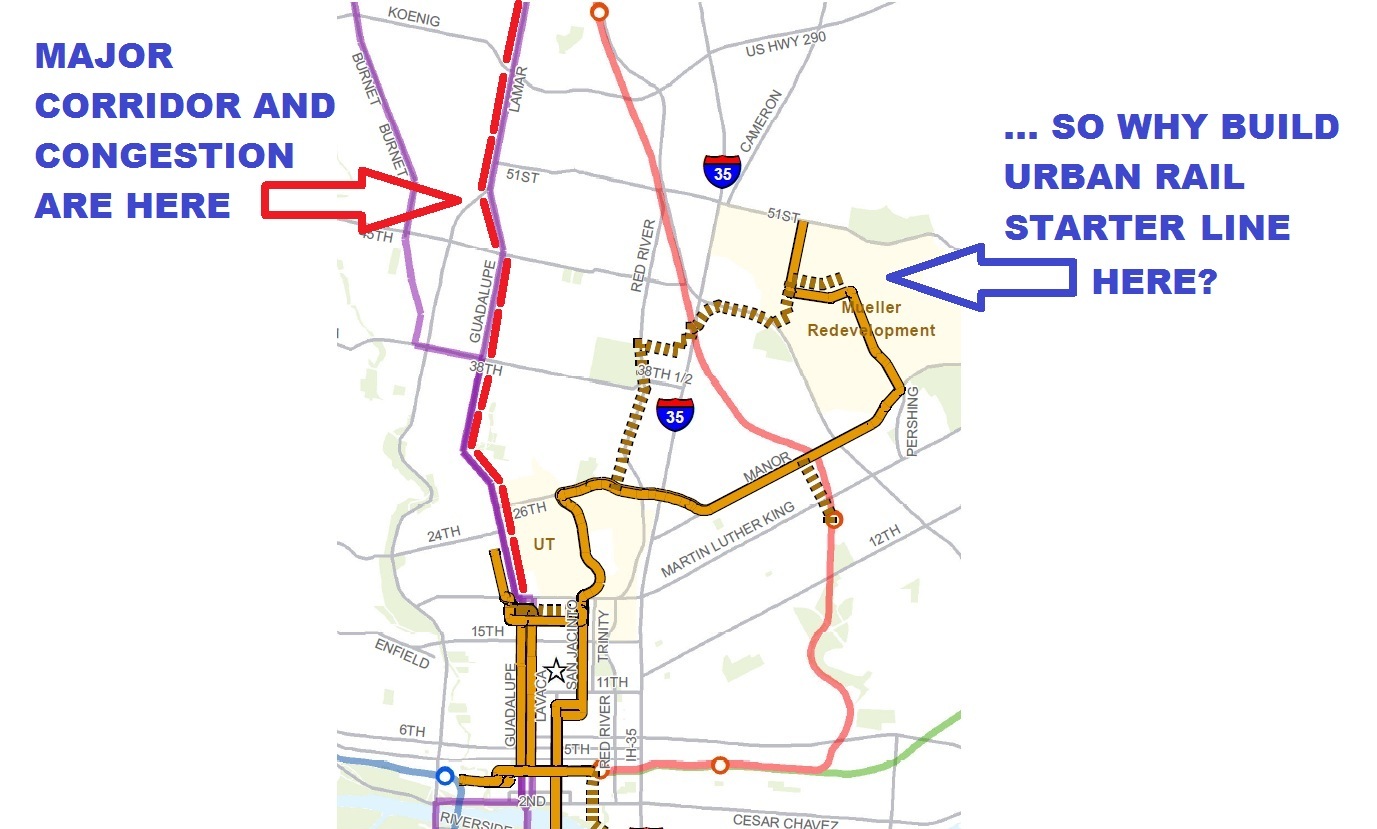
Several previous entries in this blog have already underscored the contradiction between the City of Austin’s emphasis on the severely congested condition of the Lamar-Guadalupe corridor and city planners’ astounding conclusion that building an Urban Rail line in an entirely different (and virtually non-existent) travel corridor would be some kind of remedy for this.

This glaring disparity is captured in a graphic contained in a handout prepared by Lyndon Henry for another presentation to the Transit Working Group on 27 January 2012, Urban Light Rail vs. Limitations of RapidBus.

In this map snippet, adapted from COA’s own route map, the high-traffic, congested Lamar-Guadalupe corridor is shown by a dashed red line and the annotation “Major Corridor and Congestion Are Here”, while the proposed routes to Mueller are shown (gold/ochre color, both solid and patterned — the patterned line eventually became the preferred route to Mueller).

The issue of RapidBus (aka “Bus Rapid Transit”) as the COA’s longer-term alternative to rail in the Lamar-Guadalupe corridor is addressed further in the original presentation handout, and will be discussed in a subsequent posting.

The original handout, in Word .DOC format, can be accessed via this link: Urban Light Rail vs. Limitations of RapidBus.

h1

Give priority to “Missing Link”

29 March 2013

aus-lry-lrt-map-Missing-Link-zoom_LH
[Map: L. Henry. Click to enlarge.]

Since the winter of 2011, several local advocates of rail public transportation have been laying out a case for relocating the proposed Urban Rail line to serve the Lamar-Guadalupe corridor and UT West Campus rather than the official City of Austin (COA) plan for a line through the relatively sedate East Campus and eastward to the Mueller site.

In a presentation to the Transit Working Group on 2 December 2011, including a handout, A Sensible, Workable Urban Rail Plan, Lyndon Henry emphasized the West Campus-Guadalupe-Lamar route from the central business district (CBD) to Crestview as a “Missing Link” in the official plans. This included the map excerpt shown above. The proposed Urban Rail “Missing Link” (using electric LRT) is shown in green. The red-and-white dashed line (with icons showing stations) indicates Capital Metro’s existing MetroRail DMU-operated Red Line. The Red Line, meandering through East Austin, bypasses the heart of the Core Area and the crucial Lamar-Guadalupe corridor — thus the need to install the “Missing Link” in that alignment.

The main argument for including the West Campus-Guadalupe-Lamar corridor in an Urban Rail starter system is given in the following section:

• Give priority to “Missing Link” — Lamar/Guadalupe from Crestview to downtown

Lamar-Guadalupe is the primary local traffic corridor in central-city Austin, and any rail transit investment must serve this crucial corridor. Initially, this means a connection between the Crestview Red Line MetroRail station and the West Campus – in effect, a return to the route alignment under official study until mid-2003.

In addition to serving this very heavy corridor, implementing the “Missing Link” add direct rail service between the northwest suburbs and Hyde Park, the Triangle, the UT campus, the dense West Campus area, the Capitol Complex, and downtown; provide UT with the critical connection it needs between the main central campus and the Pickle campus; eliminate the need for costly dedicated Connector bus service for MetroRail; and enable more cost-effective use of the current MetroRail DMU rolling stock (by shifting them to outlying service corridors).

In addition, installing electric LRT service in this major corridor would increase total rail system ridership dramatically. Compare the original 2000 LRT plan with the COA’s deficient Urban Rail plan: In the original plan, a single LRT line, 14.6 miles, from McNeil to downtown (using the Red Line, then Lamar and Guadalupe) was projected to carry 32,100 daily trips in its first year! COA’s entire, 5-route system, 16.5 miles, is projected to carry just 27,600 trips in 2030. Why spend the better part of $2 billion (about 80% more) to get less?

The presentation also argued for integrating both Urban Rail and MetroRail on the basis of electric LRT:

• Integrate Urban Rail and MetroRail systems

Splitting rail development between “Urban Rail” (City of Austin, COA) and MetroRail (Capital Metro, CMTA) is inefficient, wasteful, and reckless with taxpayer dollars. It’s essential for both COA and CMTA to move toward a technological integration of the two rail systems, on the basis of electric light rail transit (LRT, basically the Urban Rail technology). This would enable economies of scale, particularly in rolling stock procurement, and a number of other advantages, such as the better performance, environmental benefits, and cost advantages of electric propulsion. The current MetroRail DMUs could be deployed for service to more outlying corridors where extension of electrification would be less cost-effective.

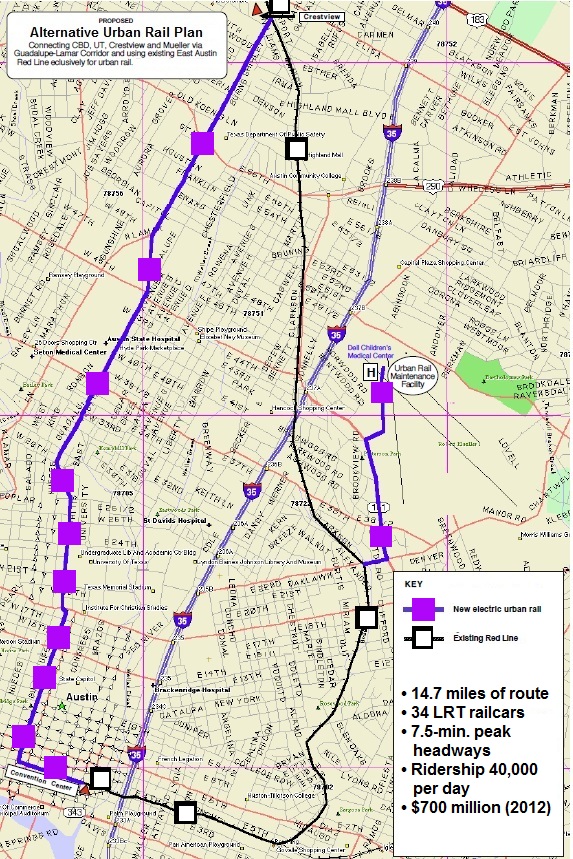
At the time, for a more immediate, affordable starter line, advocates were proposing a relatively short east-west line connecting the existing MetroRail station at the convention Center with the Seaholm development project and Amtrak station — referred to as a “No Nonsense” starter line. This alignment is still considered a viable additional route, but emphasis has shifted more to the Lamar-Guadalupe corridor and the proposed 14.7-mile Alternative Plan (including conversion of MetroRail to LRT between Crestview and downtown).

Lyndon Henry’s original handout , in Word .DOC file format, can be accessed at this link: A Sensible, Workable Urban Rail Plan

h1

City of Austin’s Urban Rail (and “BRT”) plan

29 March 2013

aus-lrt-brt-rpr-map-proposed-COA-Intial-Rail-M1_dd
[Map: Dave Dobbs. Click to enlarge.]

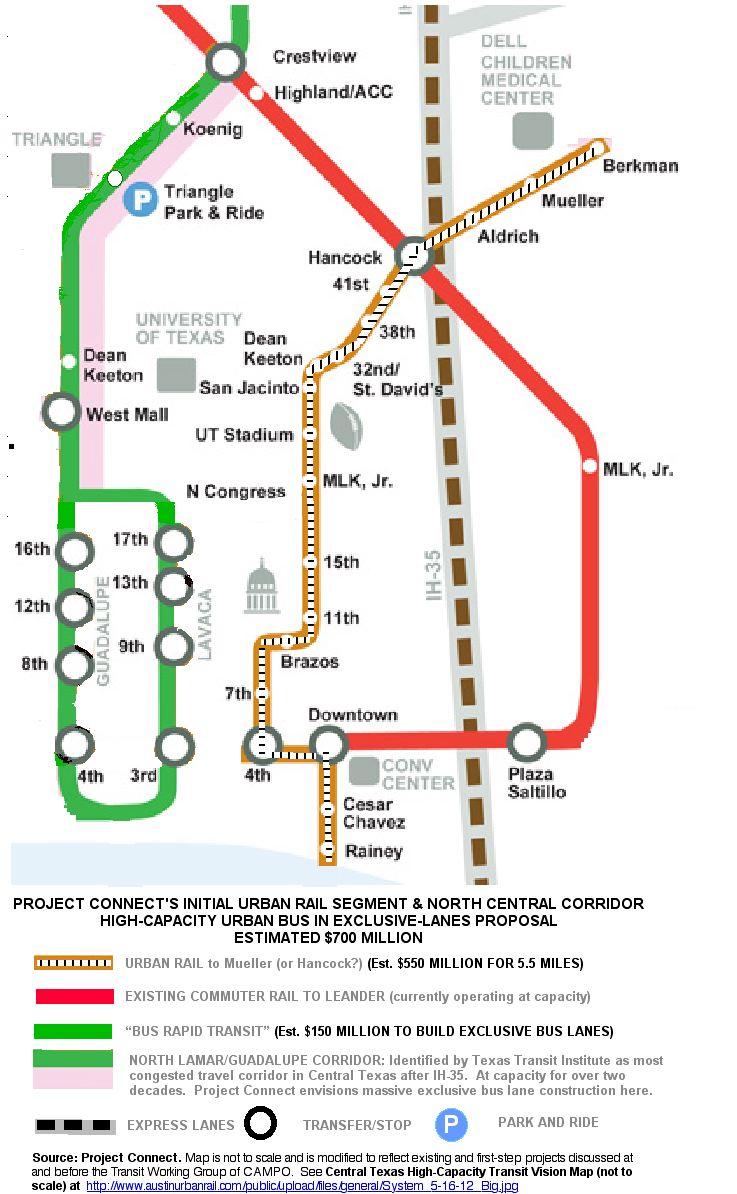
The map shown above has been rendered by Dave Dobbs from official maps, provided by the City of Austin (COA) and Project Connect, to show (as far as we can infer) what COA planners are proposing for their basic Urban Rail (using LRT) and “bus rapid transit” (BRT) starter system.

The 5.5-mile Urban Rail proposed route (downtown, through the UT East Campus, and Hancock Center into Mueller) is shown as a gold-ochre line with a pattern representing “tracks” in the center of it. The green line represents the proposed “BRT” route intended to serve the Lamar-Guadalupe corridor. The Red Line represents the currently operating MetroRail Red Line route.

This route plan can be compared with the 14.7-mile Alternative Urban Rail plan prepared by Dave Dobbs and Lyndon Henry — see map in right column. The details of the Alternative Plan are discussed in the previous article: An alternative Urban Rail plan.

h1

Welcome to Austin Rail Now

28 March 2013

aus-lrt-sim-Guadalupe-10th-Str-2012-crop-rev_coa
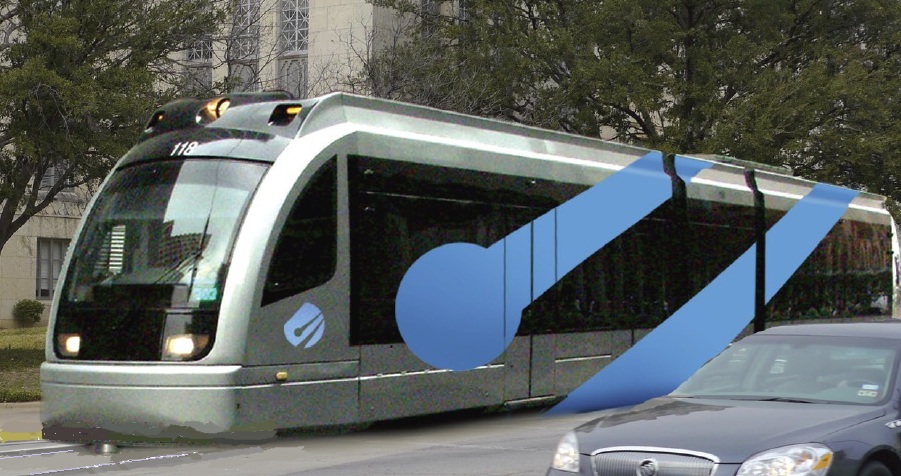
Simulation of Austin Urban Rail line with electric light rail transit train running on Guadalupe St. downtown.

Welcome to Austin Rail Now — representing the views of Austin-area public transportation advocates and professionals who envision better mobility choices for urban rail and rail passenger service in Central Texas.

Our most immediate and urgent priority is to achieve a restructuring of the current official Urban Rail plan to focus priority on Austin’s Lamar Blvd.-Guadalupe St. corridor for the starter line of an electric light rail transit (LRT) system. While the the City of Austin (COA) currently emphasizes a proposed Urban Rail route from downtown to the Mueller (old airport) development site — basically non-existent as a major travel corridor — Lamar-Guadalupe is the “Missing Link” in their plan. Ironically, COA has also been emphasizing that Lamar-Guadalupe is the primary local traffic corridor in central-city Austin, and even identified this corridor in the NEPA (National Environmental Policy Act) scoping meetings, held throughout Austin in spring 2012, as being at maximum capacity for over the past 2 decades.

Any truly adequate and justifiable rail transit investment must serve this crucial corridor. Austin’s limited resources must be invested to yield the maximum ridership — initially, a rail connection between the Crestview Red Line MetroRail station, the West Campus, and downtown. In addition, we favor a plan that technologically integrates COA’s Urban Rail and Capital Metro’s MetroRail on the basis of electric light rail transit (LRT).