Posts Tagged ‘light rail transit’

h1

Three “incontrovertible facts” about urban rail proposals in Austin

2 August 2014
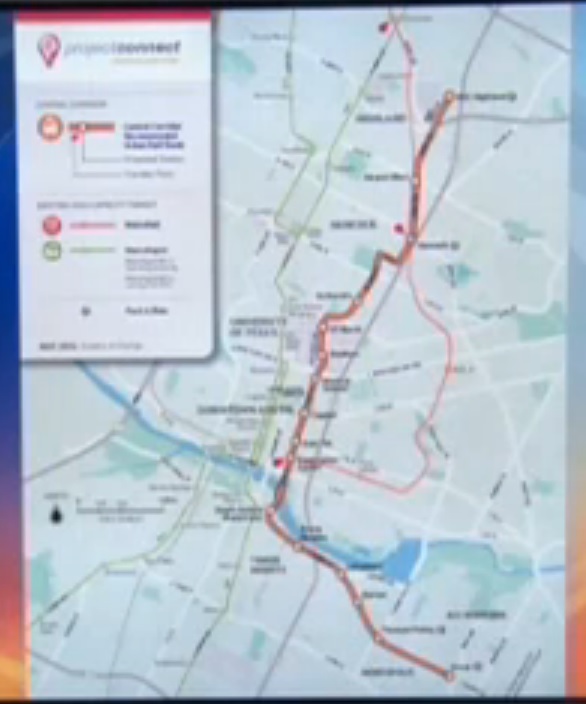
ACC's map from its own website (annotated by Austin Rail Now) shows ACC campus (marked with inverted blue "teardrop" with MetroRail's Highland station at its northwest corner.

ACC’s map from its own website (annotated by Austin Rail Now) shows ACC campus (marked with inverted blue “teardrop”) with MetroRail’s Highland station at its northwest corner.

By Andrew Clements

The following commentary has been slightly adapted from an original Letter to the Editor published July 21st by the Austin Chronicle.

On June 26th, the City Council endorsed Project Connect’s urban rail line route. Public testimony was limited, but I would have pointed out three incontrovertible facts.

(1) The first is that the approved route terminates at the old Highland Mall, with no plans to extend any further. Every initial line, as part of any transit system, should have plans to be extended, but this one isn’t. Terminating Austin’s initial urban rail line there is proven illogical by no plans to extend it.

(2) And doubly illogical because, second, the entire proposed redevelopment is already served by passenger rail. As shown in ACC’s own map at the top of this post (with annotations by ARN), the Highland station on the MetroRail Red Line is within a half-mile of the entire Highland Mall site – the distance passengers are willing to walk in a transit trip.

Spending hundreds of millions of dollars on a tunnel, and placing new rail on Airport Boulevard (paralleling, only a few feet away, the already existing Red Line passenger rail) to reach a planned redevelopment already served by voter-approved (and funded) passenger rail is a very expensive double service.


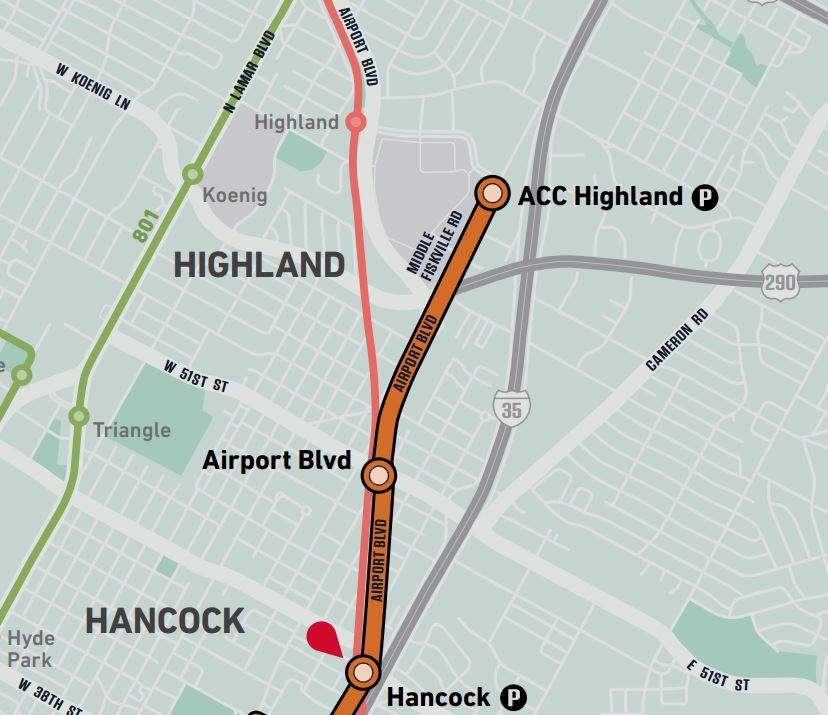
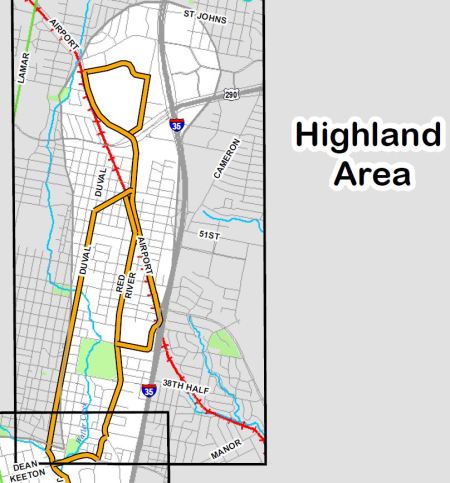
Closeup of Highland ACC segment of Project Connect's proposed urban rail map shows how the proposed urban rail line (orange) would effectively duplicate the existing MetroRail Red Line paralleling Airport Blvd. (MetroRail drawn as red line, with Highland station shown as red dot near top of map). Project Connect line would terminate at ACC administration building on far east side of campus, with no plans for extension, and no available corridor for extension. Map: Screenshot by ARN, from Project Connect map.

Closeup of Highland ACC segment of Project Connect’s proposed urban rail map shows how the proposed urban rail line (orange) would effectively duplicate the existing MetroRail Red Line paralleling Airport Blvd. (MetroRail drawn as red line, with Highland station shown as red dot near top of map). Project Connect line would terminate at ACC administration building on far east side of campus, with no plans for extension, and no available corridor for extension. Map: Screenshot by ARN, from Project Connect map.


(3) Third, the projected ridership for the Guadalupe/North Lamar light rail route, considered by voters in 2000, was twice what is proposed now. Higher ridership indicates overall success of a rail line, which means federal funding is more likely, with a likelihood of more voter support of the next urban rail line. Guadalupe and North Lamar is where millions of dollars were spent, in 1999-2000, in an already approved federal study determining where rail should be.


Screenshot from Federal Transit Administration's New Start summary table of Capital Metro's 2000 urban rail (light rail transit) plan. Projected daily ridership (circled in red) of 37,400 is more than double the 18,000 Project Connect claims for its current Highland-Riverside proposal — and more than triple a more realistic figure of 12,000. Annotation: ARN.

Screenshot from Federal Transit Administration’s New Start summary table of Capital Metro’s 2000 Guadalupe-Lamar urban rail (light rail transit) plan. Projected daily ridership (circled in red) of 37,400 is more than double the 18,000 Project Connect claims for its current Highland-Riverside proposal — and more than triple a more realistic figure of 12,000. Annotation: ARN.


Mayor Leffingwell has coined the phrase “rail or fail”. A November referendum will likely fail, because the mayor has unfortunately led a special-interest-dominated effort that has not considered neighborhood and rail advocate voices, but instead a process where the data has been manipulated to a point where the result is anything but objective. Rail advocates like me hope that following a likely November referendum failure, we can immediately begin planning, and achieving, rail on Guadalupe/North Lamar. ■

h1

Project Connect’s tax-funded urban-rail-campaign ad blitz raises red flags

14 July 2014
Graphic excerpted from Project Connect's ad blitz currently running on local TV outlets. Graphic: Screenshot.

Graphic excerpted from Project Connect’s ad blitz currently running on local TV outlets. Graphic: Screenshot.

For months, Project Connect (with public tax-based funding largely funneled through Capital Metro) has been conducting an ad blitz with the clear de facto objective of soliciting voters’ support for the widely discussed urban rail bond funding measure expected to be placed on the ballot this coming November.

Within the last couple of weeks, this political ad campaign has been expanded to include television advertising and, this past Friday (July 11th), a front-page ad in the Austin American Statesman. For example, here’s one of Project Connect’s 30-second TV commercials, titled Learn more about Project Connect: Urban Rail.

Here’s the text of this obviously promotional TV pitch:

110 people a day move to Central Texas, making Austin traffic even worse.

But urban rail could help. The newest proposal from Project Connect, urban rail will arrive every 10 to 15 minutes, seven days a week and feature 16 stations and four park & rides.

It will connect the Convention Center, downtown businesses, entertainment areas, the new medical school, UT, and lots of neighborhoods, and would be part of a growing system with connections to bus and commuter rail.

Urban rail could expand to serve even more of Austin in the future. Learn more at Project Connect dot com

As usual, Project Connect blithely bulldozes forward, willing to discard the decades of work and tens of millions of dollars that have been invested in identifying the Guadalupe-Lamar corridor as the pre-eminent candidate for Austin’s urban rail starter line. They continue to ignore the widespread barrage of community bafflement, criticism, and anger provoked by their arrogant, “damn-the-torpedoes” Blitzkrieg, aimed at rewarding real estate developer interests and the UT administration’s East Campus expansion aims, instead of addressing the true mobility needs of the Austin community.

With this ad initiative, Project Connect, Capital Metro, and possibly other members of the Project Connect consortium seem to be skating very close to the edge of what may be legally permissible (and definitely over the edge of what could be construed as political abuse of public tax funding). Here’s an excerpt relevant to “Unlawful Use Of Public Funds for Political Advertising”, quoted from the Texas Election Code, Title 15. Regulating Political Funds and Campaigns, Chapter 255. Regulating Political Advertising and Campaign Communications:

Sec. 255.003. UNLAWFUL USE OF PUBLIC FUNDS FOR POLITICAL ADVERTISING. (a) An officer or employee of a political subdivision may not knowingly spend or authorize the spending of public funds for political advertising.
(b) Subsection (a) does not apply to a communication that factually describes the purposes of a measure if the communication does not advocate passage or defeat of the measure.
(b-1) An officer or employee of a political subdivision may not spend or authorize the spending of public funds for a communication describing a measure if the communication contains information that:
(1) the officer or employee knows is false; and
(2) is sufficiently substantial and important as to be reasonably likely to influence a voter to vote for or against the measure.
(c) A person who violates Subsection (a) or (b-1) commits an offense. An offense under this section is a Class A misdemeanor.
(d) It is an affirmative defense to prosecution for an offense under this section or the imposition of a civil penalty for conduct under this section that an officer or employee of a political subdivision reasonably relied on a court order or an interpretation of this section in a written opinion issued by:
(1) a court of record;
(2) the attorney general; or
(3) the commission.
(e) On written request of the governing body of a political subdivision that has ordered an election on a measure, the commission shall prepare an advance written advisory opinion as to whether a particular communication relating to the measure does or does not comply with this section.

Project Connect’s aggressive political campaigning — using taxpayers’ money to try to persuade voters to approve more taxpayer money to finance the highly controversial (and, in the view of many, flawed and wasteful) urban rail proposal — has disturbed and outraged many citizens within the Austin community. On July 11th, Austinites for United Rail Action (AURA) — a group mainly composed of young professionals that support urban rail but dislike Project Connect’s proposal — issued a public statement, addressed to the the Capital Metro board and titled “AURA Questions the Project Connect Marketing Campaign“.

Here’s the basic content of that statement:

As you know, Project Connect has been running — and continues to run — an aggressive marketing campaign on behalf of your policy efforts. While some advertisements seem intended to convey basic information, others (such as the radio campaign) seem like political advocacy on behalf of the Regional Mobility Plan’s controversial recommendations.

As taxpayers and transit advocates, we are concerned about the expenditure of public money for this campaign-related advertising. While the words “vote for the bond package” are not included in any of the advertisements, this sort of technicality prioritizes form over substance: since the rest of the content makes no mention of opposing viewpoints or data, this advertising campaign is public relations, not genuine engagement.

It is possible that we are misunderstanding these efforts. We are hoping that your body can answer the following questions:

1. What entity is paying for existing Project Connect-related advertising?
2. How large is the purchase and how long will it last?
3. Who determines the content and themes featured in the advertising?
4. What standards has the Board provided to ensure that advertisements do not cross over into advocacy and remain firmly within the engagement realm?

Thank you for your attention to the matter. While Austinites may disagree on the best path forward for transit, we all agree that using taxpayer funds for political campaigning is unethical.

While these questions deserve answers, Austin Rail Now fully expects that AURA’s objections will be met with claims by Capital Metro and Project Connect that, by their own interpretation, no laws are being violated by the ad campaign. But it’s one thing to split legal hairs over legal violations, and quite another to commit a breach of faith and violate public trust over such a fractious and contentious issue. The alibi that this is merely an “educational” campaign is evidently intended for (1) the Project Connect faithful and (2) the hopelessly stupid.

And, by heavily investing tax dollars in commercial media advertising buys to advance this ballot measure, is Project Connect attempting to cultivate friendly media attention and treatment?

Pouring tax dollars into this ad blitz, aimed at subsidizing the dreams of a small assortment of private developers and the UT administration, discredits Project Connect and legitimate public transport planning as well. Community leaders and activists concerned with the future of democratic and fair process in this city should demand a stop to it — now.

h1

Why Project Connect’s “Highland” urban rail would do nothing for I-35 congestion

9 July 2014
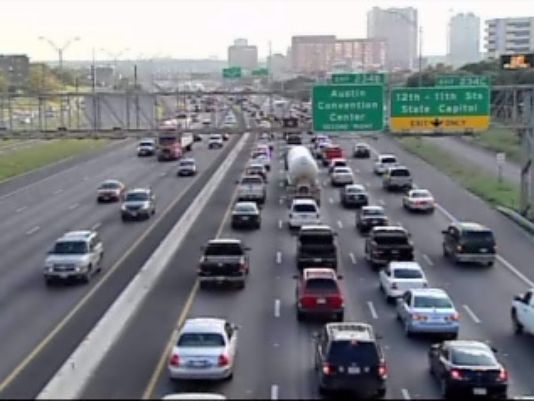
I-35 is the most congested roadway in Texas. But is this really the main travel corridor for commuters from "Highland-Riverside" neighborhoods to the Core Area? And would Project Connect's proposed urban rail line have any perceptible impact? Photo source: KVUE-TV.

I-35 is the most congested roadway in Texas. But is this really the main travel corridor for commuters from “Highland-Riverside” neighborhoods to the Core Area? And would Project Connect’s proposed urban rail line have any perceptible impact? Photo source: KVUE-TV.

By Dave Dobbs and Lyndon Henry

Lately, Project Connect representatives have been trying to claim that their meandering urban rail route proposed from Highland, through Red River and San Jacinto, to East Riverside, somehow addresses the problem of congestion on … I-35.

Really?

Leaving I-35 at the Highland site to ride a slow train to downtown doesn’t make any sense when, at Highland ACC, you are almost at the Core Area. By the time you leave the freeway, park your car, walk to the station, wait for the train, and ride downtown, you might as well have stayed on the freeway.

The I-35 traffic jam actually begins way north of Highland — at the confluence of Howard Lane, North Lamar, and I-35 — and that’s where people would park and ride a train if it were there. But first we have to build urban rail in the right place — up Guadalupe and North Lamar.

You have to put your transit station, with park & ride (P&R) access, near the outer end of the traffic jam. You don’t have to be a transportation savant to figure this out.

After all, as the public transit planning profession knows very well, P&R facilities need to be provided well upstream of the heavy congestion on a highway facility. There’s very little hope of attracting travelers off the highway if they already have to travel through severe congestion to access the transit station.

Project Connect’s claim of “congestion relief” is especially implausible when you further consider that they’re expecting prospective urban rail passengers to slog their way through the I-35 congestion, then, just a few minutes from their destination, to exit the freeway, hassle with parking, wait for a train, and then take a long, slow, sinuous train ride into the Core Area — a route that includes entering Airport Blvd., navigating through mixed traffic on Red River St., then winding through San Jacinto Blvd. and other streets comprising this tortuous “Highland” route.

What about the the hints from Project Connect that I-35 may be a major artery that neighborhood commuters themselves, along the proposed “Highland” rail route, supposedly use to reach the Core Area? To believe this speculation, you’d have to accept a vision of about 260 commuters per peak hour from these neighborhoods, currently driving, on average, about 6 blocks to then pack themselves onto a severely congested I-35 (#1 on TxDOT’s list of the state’s most congested roads) to then travel an average 28 blocks into the Core. And doing this when they have at least four other important but much less congested local arterials, including Guadalupe-Lamar, to use instead.

Commuters on I-35 would need to drive through miles of heavy congestion to reach Project Connect's proposed urban rail P&R at Highland ACC  — thus, little potential for "congestion relief". In contrast, Capital Metro's Tech Ridge P&R is located upstream of I-35 congestion. Alternative Guadalupe-Lamar urban rail plan would have North Lamar Transit Center P&R at US 183, upstream of congestion. Future urban rail extension up North Lamar to Howard Lane could provide another P&R upstream of I-35 congestion. Infographic map by ARN based on Google Maps.

Commuters on I-35 would need to drive through miles of heavy congestion to reach Project Connect’s proposed urban rail P&R at Highland ACC — thus, little potential for “congestion relief”. In contrast, Capital Metro’s Tech Ridge P&R is located upstream of I-35 congestion. Alternative Guadalupe-Lamar urban rail plan would have North Lamar Transit Center P&R at US 183, upstream of congestion. Future urban rail extension up North Lamar to Howard Lane could provide another P&R upstream of I-35 congestion. Infographic map by ARN based on Google Maps. (Click to enlarge.)

Maybe, but this is a scenario that similarly invites powerful skepticism. And is it worth over a billion dollars for an urban rail alignment that would lure perhaps about 65 motorists off I-35 in a peak hour (assuming about 25% modal split for Project Connect’s urban rail)?

Instead, as an authentic urban rail alternative to either I-35 or MoPac into the Core Area, you have to travel through the actual heart of the central city and its core neighborhoods on an actual travel corridor where you actually travel to and get off close to your destination. And a lot more of those destinations are within walking distance of Guadalupe-Lamar. That’s why there are 23,000 bus riders daily in this corridor today.

Some transit planner a quarter century ago put it something like this at an Austin public meeting: “All transit studies show that people will climb high mountains and/or swim deep rivers to access good rail service if it’s far enough out and is easily accessible by another mode (i.e., beyond the traffic jam), providing that their final destinations are within a quarter mile of a stop.”

The MetroRail Red Line demonstrates this wisdom; after Howard Lane, for passengers riding inbound AM peak trains, it’s standing-room only. And don’t expect a seat outbound in the evening rush until Howard Lane.

However, the Red Line’s biggest fault is that while it’s quite long enough, it fails to “connect the dots”. It misses serving the heavy-traffic Guadalupe-Lamar corridor, and bypasses core central-city neighborhoods, the UT campus, the Capitol Complex, and most of downtown (while providing virtually useless service for East Austin en route).

MetroRail Red Line (red) skirts entire heart of central Austin, illustrated by "Missing Link" through Guadalupe-Lamar corridor. Urban rail would provide the crucial connections to core neighborhoods, UT West Campus, and Capitol Complex missed by MetroRail. Infographic Map by Light Rail Now.

MetroRail Red Line (red) skirts entire heart of central Austin, illustrated by “Missing Link” through Guadalupe-Lamar corridor. Urban rail would provide the crucial connections to core neighborhoods, UT West Campus, and Capitol Complex missed by MetroRail. Infographic Map by Light Rail Now.

In bypassing the heart of the city and the Core Area, the Red Line does indeed miss the big dots, but people hate US 183. Before the freeway to Lakeway and beyond, the bumper sticker read: “Pray for me, I drive 183!” Nothing has changed except that we have a much bigger road, even more traffic, more stress. longer drive times, and only a glimmer of a solution around it.

And by far the biggest part of any solution is urban rail on Guadalupe-Lamar.

Summing up: Most I-35 travelers are not going to get off the freeway at the proposed Highland station when the real traffic jam starts to form at Howard Lane. The current bus park & ride, Tech Ridge Transfer Center, for AM commuters to the Core, is located where it makes most sense — much further north (upstream) from Highland, at Howard near I-35.

Again, it comes back to the real alternative: Urban rail on Guadalupe-Lamar, which could serve a P&R station at the North Lamar Transit Center (upstream of the congestion on North Lamar) — with a clear path for further extension north — and interface with train service to the northwest (initially MetroRail, eventually an extension of electric urban rail) serving outlying P&R facilities such as Howard and Lakeline.

We think that’s a “congestion relief” plan that actually makes sense. ■

h1

City Council to Austin community: Shut Up

1 July 2014
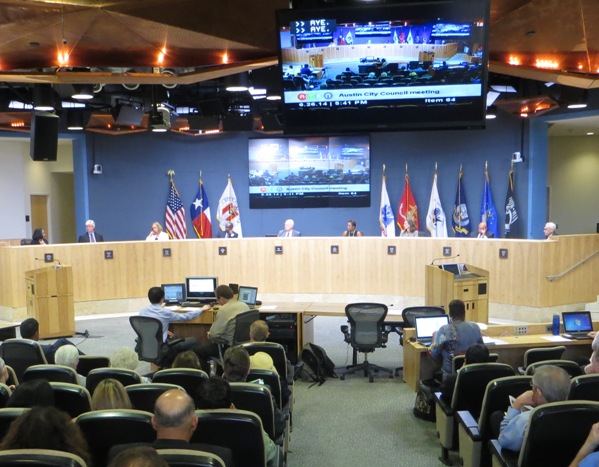
After squelching public input, Austin City Council votes unanimously on June 26th to endorse Project Connect's Highland-Riverside urban rail plan as Locally Preferred Alternative. Photo: L. Henry.

After squelching public input, Austin City Council votes unanimously on June 26th to endorse Project Connect’s Highland-Riverside urban rail plan as Locally Preferred Alternative. Photo: L. Henry.

The Austin City Council really doesn’t want to hear from you. They’re tired of having to listen to you at all, and want you to just keep your thoughts to yourself, and shut up.

They’re exhausted, they’re bored, they’re busy, and besides, they know what’s best for the city, and for the movers and shakers they deal with, and you’re just getting in the way.

This is the message that came across loud and clear at the last Council meeting on Thursday, June 26th, when the Council voted to cut off dozens of speakers prepared to criticize Project Connect’s Highland-Riverside urban rail proposal, allowing only a relative few from “each side”.

Trouble is, the side opposing Project Connect’s plan is not a single “side”, but factions representing several major, different viewpoints, from virulent opponents of rail transit altogether, to strong urban rail supporters (such as the sponsors of this blog) who just think the Project Connect plan is a bad idea. No matter — Off With All Their Heads. Time to move on.

And “move on” they did, voting unanimously on June 26th to embrace the seriously corrupt and flawed Project Connect plan as the Locally Preferred Alternative (LPA) as a prerequisite for federal funding being sought. (In so doing, they actually re-designated the LPA from the Guadalupe-Lamar corridor to the current Highland-Riverside alignment.)

Prior to the final vote, several opponents of the measure among the handful allowed to speak ditched their prepared remarks and assailed the suppression of democratic speech.

Scott Morris, representing the Our Rail Political Action Committee (OurRail PAC), angrily noted that “This plan is opposed by groups that represent or serve over a hundred thousand Austinites, and you’re giving them 30 minutes of time.”

We have patiently waited through numerous — through scores — of work sessions where Project Connect has been given unfettered access to your attention. We have patiently waited through scores of briefings that have no citizen communication. And now we’re ready to say: Enough of this. We’re fed up. This plan does not fly. … You need to listen to the citizens of Austin ….

OurRail PAC leader Scott Morris denounces Council's action to constrict debate. Photo: COA video screenshot.

OurRail PAC leader Scott Morris denounces Council’s action to constrict debate. Photo: COA video screenshot.

Longtime rail transit supporter Mike Dahmus likewise expressed outrage at the Council’s squelching of citizen input:

You’ve chosen … to eliminate all meaningful opportunities for public input, as has Project Connect before you. We will make sure the FTA [Federal Transit Administration] is aware of this”

Also discarding his prepared comments, Lyndon Henry (a contributing editor to this blog) denounced the Council meeting as “a travesty”, adding:

This issue cries out for a public hearing. Instead, you subvert the democratic process and proceed with the agenda of special interests. … You should be ashamed.

Far from unique, the Council’s stifling of democratic process continues a pattern among various Austin public agencies in recent years of excluding community participation in planning major public projects. Public hearings have almost totally disappeared from the scene for at least a decade or more.

For over a decade, Austin public agencies have shut out and gagged the community from authentic participation in planning major projects.

For over a decade, Austin public agencies have shut out and gagged the community from authentic participation in planning major projects.

And not just the Austin City Council, but Capital Metro and Project Connect itself have been leading offenders. As this blog observed last December, in our post Will Project Connect continue to gag the public?

In response to community prodding, going into the recent “high-capacity transit” study process, Project Connect representatives gave seemingly earnest assurances of much greater “transparency” and “openness” in their “study” process. Instead, the Project Connect team made their closed-door activities more opaque and insulated from community interaction than ever. …

Instead of public participation, it’s been more like public prohibition — exclusion of the community at large from any real role in the process, with Project Connect instead delivering decisions as faits accomplis for public acquiescence rather than an authentic process of involving community members in a bona fide process of actually studying, analyzing, evaluating, and participating in decisions.

To present a semblance of “public input”, Project Connect has staged “open houses” (where individuals are allowed to view posters, maps, and other presentations of official decisions) and so-called “workshops” (where small groups clustered at tables are asked to approve predetermined choices via electronic “clickers”). Authentic community meetings, with discussions and comments from the public in a large-group setting, have been avoided like the threat of an infectious disease.

Following the Council’s action ramrodding of the urban rail plan on July 26th (strong-armed by Austin Mayor Lee Leffingwell), longtime local community affairs activist Bill Oakey warned:

The level of insensitivity and lack of respect for the citizen speakers displayed by Mayor Leffingwell marks the darkest day for this lame duck Council. His actions essentially guarantee the defeat of the bond proposition. Austin is a community that places high value on citizen involvement. The Council should have held a public hearing soon after Project Connect announced their final proposal. Today the promise of no limit on the number of speakers was broken, after two days of planning by several groups to come and speak. The resulting lack of trust will contribute to the failure of the bonds. We will look to the new Council with a spirit of hope for respect, transparency and inclusiveness.

Changing the LPA to identify the Highland-Riverside alignment is just one of the steps the Project Connect consortium must follow in moving the official urban rail project forward. In August, the Council is expected to consider — and likely approve — placing approximately $600 million of bond funding on the November ballot for a public vote. How Austin voters will weigh in on this issue remains to be seen.

h1

Project Connect’s urban rail forecasting methodology — Inflating ridership with “fudge factor”?

20 June 2014
Graphic: Watts Up With That blog

Graphic: Watts Up With That blog

By Susan Pantell

Recently Project Connect posted a Technical Memorandum dated 13 June 2014 from Alliance Transportation Group discussing what it describes as “Central Corridor Initial LPA Transit Ridership Forecasting Methodology and Summary Ridership Forecasts”. In this posting, researcher Susan Pantell provides a critical analysis of this memo.
Screenshot of page 1 of Alliance Transportation Group's Technical Memorandum on Project Connect's ridership forecasting methodology.

Screenshot of page 1 of Alliance Transportation Group’s Technical Memorandum on Project Connect’s ridership forecasting methodology.

This memo does not really provide data on their methodology since the model is secret. Beyond that, their documentation is largely hand-waving.

1. Most importantly, they did analysis only for 2030. FTA now requires current year ridership analysis. “Current year” is the most recent year for which data on the existing system and demographic data are available. An applicant may choose to also evaluate a 10-year or 20-year horizon, and, in that case, the current-year and future-year estimates will each count 50%. Current year ridership would be a lot lower because there is not the development around Highland or the eastern side of UT, but they did not do it.

2. They estimate 15,580 daily trips using the model, which they round up to 16,000. Then they say that on game or event days, ridership could be 20,000 or higher. So they conclude “the project team believes that the median value of 18,000 is a reasonable preliminary estimate of 2030 ridership.” At the end of the memo they explain that this is not based on their calculations, but on their assumption of a 10-15% increase in ridership based on future development (18,000 is a 15% increase).

Lyndon Henry says that is a reasonable assumption, and it may be, but it is not based on data or adequately documented in this memo. They don’t say how many days they predict ridership will be 20,000 or over. There are a lot of events in Austin, but not a lot with high ridership — only 8-9 game days for football and about 10 days for SXSW. If I assume 40 days with 21,000 ridership and 15,600 on the other days, the average comes to 16,300.

They are also accounting for the special event days by adding 25 to the annualization factor of 300 that FTA uses. In addition, they add 103,000 to the annual ridership figure to account for special events.

3. Note that they estimate that total trips for the Capital Metro system will increase by 10,700 in 2030, which is lower than the ridership estimate above because bus ridership will be reduced along the route. Based on that figure, bus ridership will go down by almost 5,000 trips.

4. “Transit fares were set at the equivalent Capital Metro fares for premium transit modes discounted to 2005 model base year dollars.”

Why are they estimating 2030 ridership based on 2005 fares? Because ridership is higher with lower fares. They are assuming $1.50 fare. Using an online calculator, $1.50 is $2.78 in 2030 dollars for a 2.5% inflation rate. (For 2020 it would be $2.02 – $2.34.) That’s assuming they don’t raise the rates beyond the inflation rate.

I calculated the ridership based on a 2030 fare of $2.78 and assuming a 0.4% decrease in transit ridership for every 1% fare increase [TCRP, Report 95, Transit Pricing and Fares, 2004, Chapter 12, p. 12-6. TCRP RRD #61, Traveler Response to Transportation System Changes, 2003, p.19]. I come up with a 2030 ridership of 12,300, as compared with their 15,580. If you add their 15% fudge factor, it comes out to 14,000. If you decrease the base ridership of 12,300 by the same percentage as they do to come up with the total system trips, it comes to 8,500 new trips for the system.

Is that worth $1.4 billion?

h1

Austin Business Journal guru slams Highland-Riverside urban rail proposal as “a very small plan benefiting a limited group of people”

6 June 2014
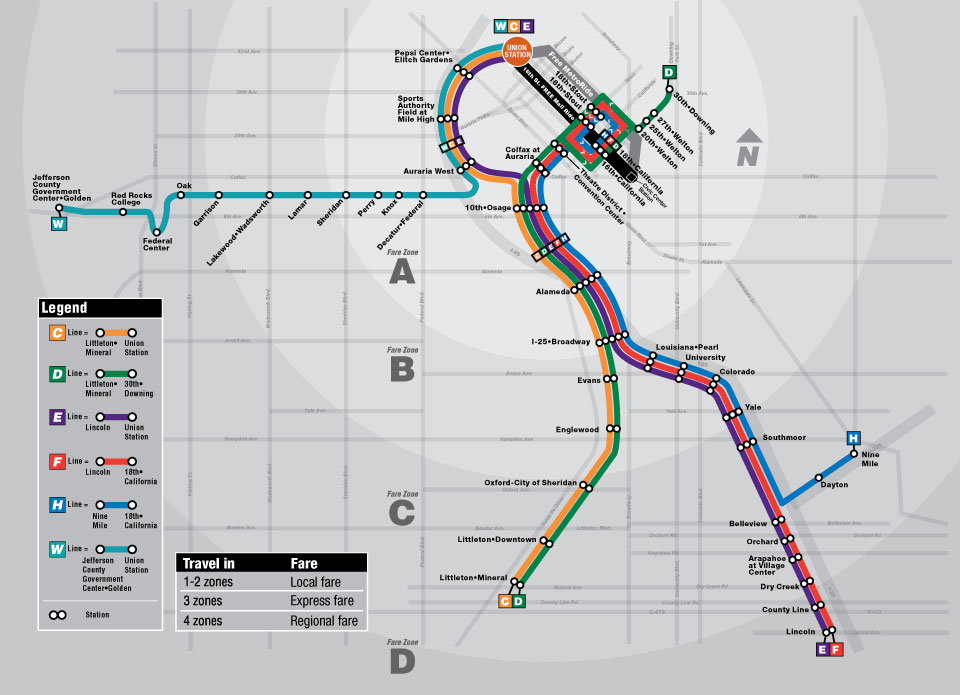
Because design and implementation dollars have been invested wisely, Denver’s light rail system increasingly resembles a network that’s expanding to serve more crucial corridors in the region. High ridership has also attracted transit oriented development (TOD) near stations, helping influence urban growth patterns. Map: RTD.

Because design and implementation dollars have been invested wisely, Denver’s light rail system increasingly resembles a network that’s expanding to serve more crucial corridors in the region. High ridership has also attracted transit oriented development (TOD) near stations, helping influence urban growth patterns. Map: RTD.

For the most part, Austin’s business and civic elite seem to have closed ranks around Mayor Lee Leffiingwell (“The Lee Team”) and his administration’s efforts to promote a very pricey 9.5-mile, $1.4-billion urban rail project widely suspected to be concocted more as a giveaway to the development ambitions of the University of Texas and a faction of private developers, and less as a remedy for alleviating Austin’s most serious mobility deficits. Included in this “business and civic elite” is virtually the entirety of the local media establishment.

Jan Buchholz. Photo: Austin Business Journal.

Jan Buchholz. Photo: Austin Business Journal.

But occasionally there are fractures in this ostensibly solid consensus, and one of these is represented by Jan Buchholz, an Austin Business Journal staff writer who seems to have the professional role of a de facto guru specializing in real estate market happenings. In a May 7th column, comparing urban development and transportation in Denver and Austin, she seems very favorably impressed with Denver, a model from which Austin, in her estimation, falls far short.

“Rejuvenated neighborhoods are cropping up across Denver and development is being defined in many instances by the evolution of public transit” she writes. But unfortunately, “This dynamic does not exist in Austin to any great degree, and there’s little evidence that transit will play a significant role here any time soon.”

The reason? Mainly that Project Connect’s urban rail plan is pretty crummy:

The latest rail plan rolled out … is a $1.4 billion project that will run from Highland Mall to East Riverside Drive. Already, folks are decrying its high cost, but I don’t think it’s the cost that’s the real issue. It’s the fact that it’s a very small plan benefiting a limited group of people. That makes this price tag hard to swallow.

One of Buchholz’s gripes is that the proposal, which runs a short way southeast, ends way short of the region’s ABIA airport. And while local politicians are talking about “sweetening” the urban rail ballot measure with some dollops of highway projects, Buchholz doesn’t feel the highway capacity element is enough. (For the record, Austin Rail Now believes the Austin area’s emphasis on highway expansion is excessive, and should be ended.)

In regard to Denver’s urban rail development, Buchholz admires how the Mile-High City has prudently and energetically installed and expanded its system:

During the past 20 years, the Denver Regional Council of Governments — with support from a wide spectrum of stakeholders from government officials to businesses and residents — has embraced a huge vision for transportation improvements across the five-county metro area. It was never an easy sell, but for the most part taxpayers have supported the expensive, time-consuming and often inconvenient plan.

… The light rail is fully built out to the south, southeast and western suburbs. Construction is in progress for the light-rail line from downtown Denver to Denver International Airport, and another line will be built to the northwest suburbs.

Rejuvenated neighborhoods are cropping up across Denver and development is being defined in many instances by the evolution of public transit.

This dynamic does not exist in Austin to any great degree, and there’s little evidence that transit will play a significant role here any time soon.

What’s critical to understand is that, from the start, Denver planners and political honchos realized that resources were scarce and that the region’s first light rail transit (LRT) — i.e., urban rail — starter line had to be located where it would get the proverbial “best bang for the buck”. And they also realized that, to influence developers’ decisions and encourage transit-oriented development (TOD), rail lines would need to be routed to maximize ridership.

Yes, most rail stations often do attract some adjacent development. But it’s the potential volume of ridership — i.e. the traffic on the line — that carries the most influence on private developers’ decisions. The more people, the more residents and customers at your development, which in turn becomes more attractive in the real estate market.

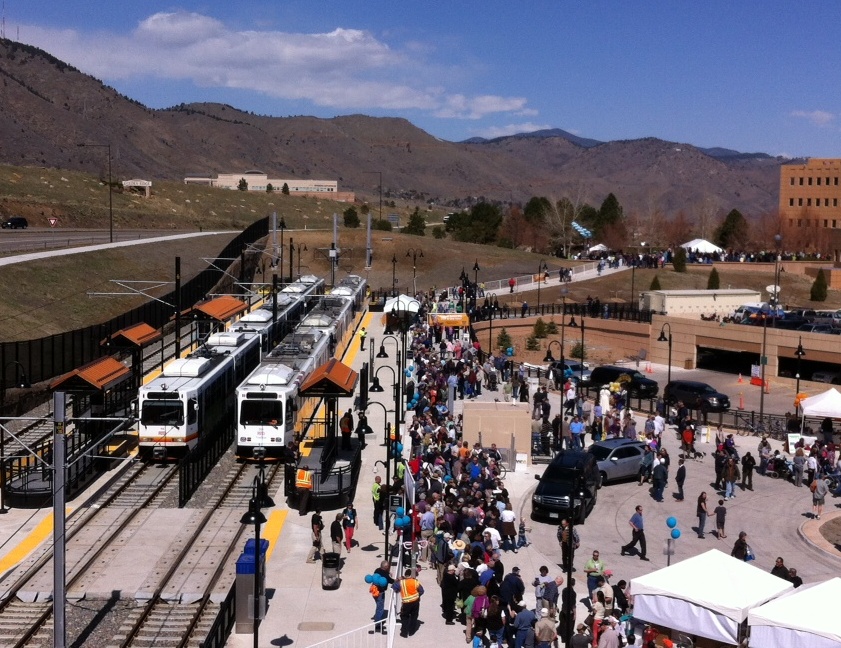
Opening day of Denver's West Line light rail extension to Golden, Colorado, April 2013. Photo: David Warner.

Opening day of Denver’s West Line light rail extension to Golden, Colorado, April 2013. Photo: David Warner.

Key to urban rail expansion is conserving financial resources and deploying them wisely. Relatively lower outlays in the initial installation and operation of a new system means more funding available for expansion. So Denver started with a minimalist, 5.3-mile route from a northeastern neighborhood, proceeding down a busy corridor, via both street-running and a railway alignment, through a major commercial district, into the CBD, including a multi-institution university complex.

In 1994, they did that for $115 million. In 2014 dollars, about $37 million a mile. Compare that with Project Connect’s extravagant plan, including a tunnel and below-ground station, plus a “signature” bridge, at $119 million a mile. And Project Connect’s plan doesn’t even serve a major travel corridor!

Partly because they’d conserved financial resources, and partly because of the “big bang for the buck” effect that galvanized popular support, Denver’s Regional Transportation District (RTD) was able to embark on the vigorous urban rail expansion and TOD development program that so impresses Jan Buchholz. As a result, Denver’s light rail ridership mushroomed from 15,000 in 1994 to 86,900 a day by the end of 2013 — a nearly five-fold increase.

But Denver’s approach to urban rail has been virtually the polar opposite of Austin’s. Project Connect’s extravagantly wasteful billion-dollar starter line, with its peculiar, head-scratching route structure and high-dollar infrastructure, has divided potential urban rail supporters, pitting pro-rail community members and neighborhoods against one another in a way the pro-highway, anti-transit Road Warriors never could.

And the results are apparent in potential ridership. An alternative route for urban rail, long proposed for the heavily traveled, busy, dense Guadalupe-Lamar corridor, serving the high-density West Campus of the University of Texas, has been forecast to attract six times as much ridership as Project Connect’s meandering, peripheral line — at about 20% lower capital cost.

The prospects for voter approval of municipal bonds to finance Project Connect’s project are not sanguine. As Buchholz points out,

No one wants to be nickel and dimed to death for a mediocre and limited public transit system. Add to that the public perception that the MetroRail from Leander to downtown has been only marginally effective and has been fraught with issues from the get-go. Combine those two factors and this latest plan doesn’t have a chance for ever leaving the station.

If Austin has any hope of matching urban development and public transport successes like Denver’s it needs to start with an affordable urban rail starter line that makes sense. This notion seems to have “Lamar-Guadalupe-West Campus” written all over it.

h1

Project Connect’s wasteful plan — Ultra-pricey urban rail “decoration” in the wrong route

17 May 2014
Lyndon Henry speaking to Central Corridor Advisory Group, 16 May 2014. Screenshot from City of Austin video.

Lyndon Henry speaking to Central Corridor Advisory Group, 16 May 2014. Screenshot from City of Austin video.

By Lyndon Henry

The following comments were made during Citizen Communications to Project Connect’s Central Corridor Advisory Group on 16 May 2014. At the meeting, Project Connect’s Urban Rail Lead Kyle Keahey revealed the agency’s estimates and proposals regarding operating & maintenance costs, property valuation and tax revenue increases, funding, phasing issues, and “governance” (oversight and administration) the proposed 9.5-mile, $1.4 billion line connecting East Riverside (southeast) with the old Highland Mall site (north), currently under development as a new Austin Community College campus.

For months, Project Connect and Austin civic leaders have been considering subways, elevated lines, and other extravagant investments way out of scale for an urban rail starter line in a city of Austin’s size and density. The result is a $1.4 billion plan for urban rail linking a weak corridor, East Riverside, with a non-existent corridor, so-called “Highland”.

Meanwhile, Project Connect and the city’s leadership appear to have virtually abandoned the core neighborhoods, and heaviest local travel corridor, in the central city – Guadalupe-Lamar, where urban rail is desperately needed. The problem isn’t $1.4 billion for urban rail, it’s investing this money on what amounts to a very pricey decoration instead of addressing congestion with essential mobility.

At $119 million per mile in current dollars, Project Connect’s urban rail plan for Austin would be the third most costly light rail starter line in U.S. history, in terms of cost per mile. Compared with the previous Guadalupe-Lamar light rail project, planned until 2003, Project Connect’s plan costs 29% more than what that project would cost today, yet provides 35% less route length, and 47% fewer riders.

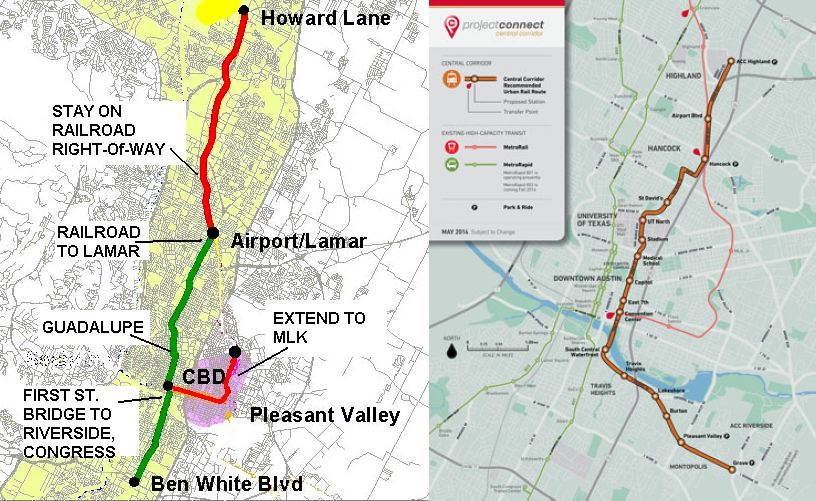
LEFT: Capital Metro 2000 urban rail plan included initial minimum operable segment (MOS) running 14.6 miles down Capital Metro railway, Lamar, and Guadalupe to CBD, plus 5.4 miles of extension down South Congress to Ben White and branch into East Austin. Total 20.0 miles surface route (with adaptation of existing river bridge) would cost $1.2 million in current dollars ($60 million/mile). RIGHT: Project Connect plan proposes a 9.5-mile route from East Riverside, crossing river on new "signature" bridge, proceeding through east side of CBD, East Campus, along Dean Keaton and Red River to Hancock Center, then into open cut and tunnel, then along Airport Blvd. into Highland site.  Total cost: $1.1 billion ($119 million/mile) in current dollars.

LEFT: Capital Metro 2000 urban rail plan included initial minimum operable segment (MOS) running 14.6 miles down Capital Metro railway, Lamar, and Guadalupe to CBD, plus 5.4 miles of extension down South Congress to Ben White and branch into East Austin. Total 20.0 miles of surface route (with adaptation of existing river bridge) would cost $1.2 million in current dollars ($60 million/mile). RIGHT: Project Connect plan proposes a 9.5-mile route from East Riverside, crossing river on new “signature” bridge, proceeding through east side of CBD, East Campus, along Dean Keaton and Red River to Hancock Center, then into open cut and tunnel, then along Airport Blvd. into Highland site. Total cost: $1.1 billion ($119 million/mile) in current dollars.

Stretching over 14 miles from McNeil along what’s now the MetroRail corridor, then down Lamar and Guadalupe to the CBD, that original starter line in today’s dollars would cost roughly $878 million, or about $60 million per mile, for 54% more miles of route. Ridership for 2025 was projected at 37,400 per day – 87% higher than the “high” 20,000 for Project Connect’s plan.

The next phase involved expanding into a larger 20-mile urban rail system for roughly $320 million more in today’s dollars, also amounting to about $60 million per mile. But that’s through the heart of central and south Austin, with over twice as much rail as Project Connect’s plan. By serving Austin’s highest-traffic, most populated, densest inner-city corridors, ridership was projected at 51,000 a day.

Project Connect and Austin’s leadership seem to have abandoned all thought of cost-effectiveness and seeking the best value for spending taxpayers’ money. Now they’re playing a game of magic tricks with operating-maintenance costs and dreams of a bonanza of real estate valuation increases.

But many Austin voters realize that lower ridership means higher operating subsidies from taxpayers. And while a tax rate increase is real, projections of future tax revenues are just projections — in other words, hopes and dreams.

Judging from Project Connect’s flawed, fairytale projections from last fall’s study process, Austin voters should view these hopes and dreams with strong skepticism.

Lyndon Henry, a transportation planning consultant, is a technical consultant for the Light Rail Now Project, and a former board member and data analyst for Capital Metro. He also writes an online column for Railway Age magazine.
h1

Project Connect’s Austin urban rail would be 3rd-most-pricey LRT starter line in U.S. history

8 May 2014

0_ARN_money-flying-away

Project Connect’s urban rail plan for Austin, if implemented, at $119 million per mile in current dollars, would be the third most costly light rail transit (LRT) starter line in U.S. history, in terms of cost per mile.

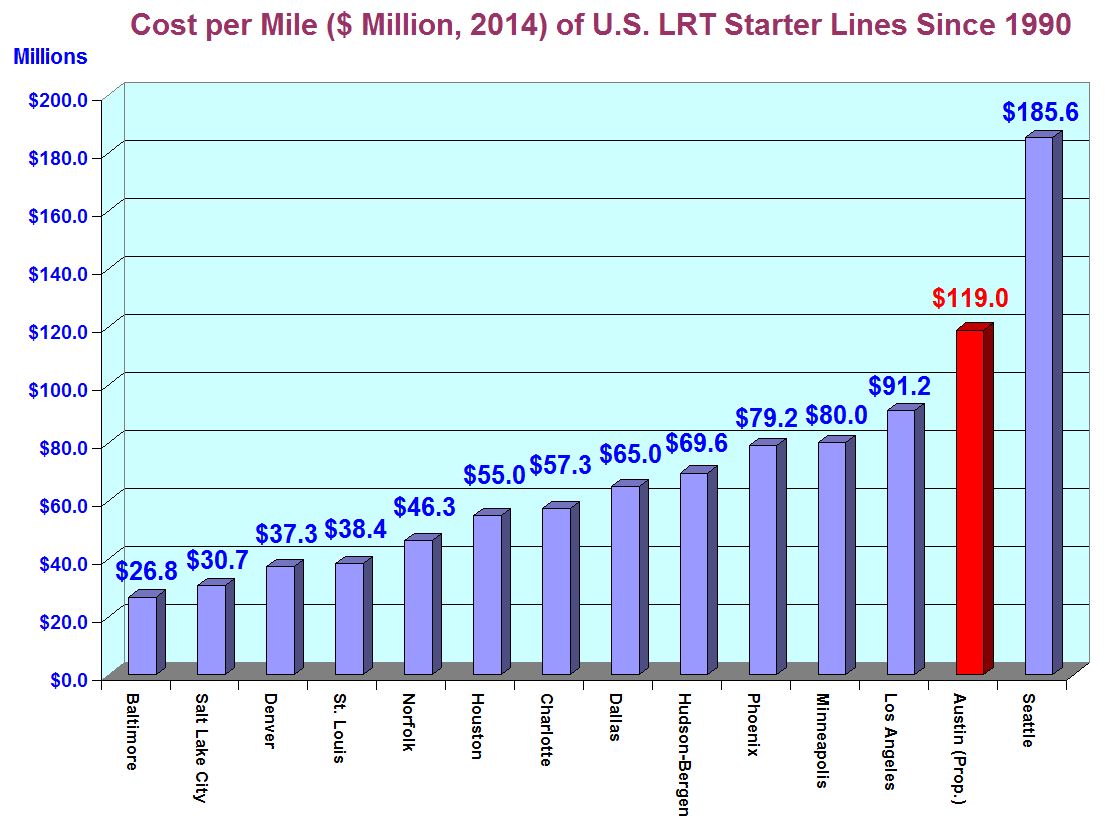
That’s a conclusion Austin Rail Now draws from results emerging from a recent study posted on the Light Rail Now blog, plus other available data. The LRN study, reported in an article titled New U.S. light rail transit starter systems — Comparative total costs per mile, researched the cost per mile of a dozen new “heavy-duty” (as opposed to streetcar-type) LRT starter lines installed since 1990. In 2014 dollars, these range in investment cost from $26.8 million per mile (Baltimore, opened 1992) to $185.6 million per mile (Seattle, opened 2009).

Project Connect’s urban rail proposal

Project Connect revealed their proposal for urban rail (see map below) at a meeting of the Central Corridor Advisory Group (CCAG) on May 2nd. The 9.5-mile project comes with a pricetag of $1.13 billion in current dollars, escalating to $1.38 billion in Year of Expenditure (YOE) dollars by 2020, for a projected ridership in the range of 16,000-20,000 per day.

Project Connect's proposed line, criticized for avoiding Austin's central axis and most serious mobility needs, would run 9.5 miles from the Highland site (north) to a terminus on East Riverside (southeast). Map: Project Connect.

Project Connect’s proposed line, criticized for avoiding Austin’s central axis and most serious mobility needs, would run 9.5 miles from the Highland site (north) to a terminus on East Riverside (southeast). Map: Project Connect.

The proposal invites comparison with the plan for light rail in the Guadalupe-Lamar corridor (see Austin’s 2000 light rail plan — Key documents detail costs, ridership of Lamar-Guadalupe-SoCo route). When compared, Project Connect’s $1.4 billion plan can be seen to cost 29% more than the previous Guadalupe-Lamar line would cost today, yet provide 35% less route length, and 47% fewer riders.

To finance such a plan through general obligation bonds, according to an April 29th Austin American Statesman report, Austin homeowners would face a substantial increase in property tax, estimated to range between $77 to $153 per year for a “typical” $200,000 home. That estimate was based on financing a $965 million project, about 85% of the actual size of the project now on the table.

Even if the Federal Transit Administration agrees to fund half the project cost, city officials and civic leaders are considering “bundling” the rail proposal with several hundred million dollars for additional road projects. The result could be a substantial 67% increase in Austin’s debt load per capita.

Urban rail cost comparison

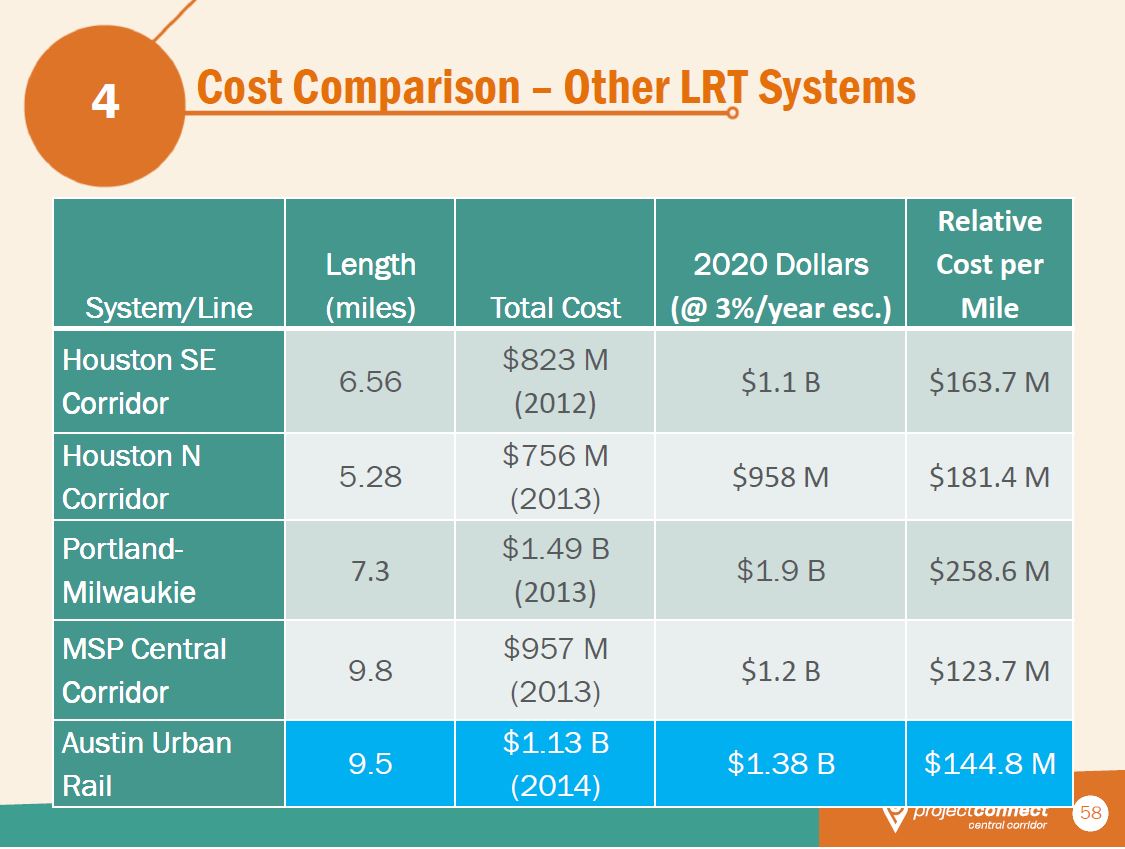
At the May 2nd CCAG meeting, Project Connect’s Urban Rail Lead Kyle Keahey assured his audience that the investment cost of the 9.5-mile proposal was quite comparable with recent similar projects, particularly in cost per mile, with the chart shown below as evidence:

3_ARN_ProCon_LRT-cost-comparison

However, there’s a serious problem with this comparison — it compares the proposed starter line for Austin with extensions of these several well-established LRT systems, each of them contending with the much more difficult urban and terrain conditions that are typically avoided and deferred in the process of selecting routes for original starter systems. A far more valid cost comparison would evaluate the cost of starter system projects, thus offering better “apples-to-apples” cost equivalence.

That’s because, in designing a starter line — the first line of a brand-new system for a city — the usual practice is to maximize ridership while minimizing costs through avoiding more difficult design and construction challenges, often deferring these other corridors for later extensions. In this way, the new system can demonstrate sufficient ridership and other measures of performance sufficient to convince both local officials and the public that it’s a success from the standpoint of being a worthwhile investment. Thus, comparing the cost of Project Connect’s 9.5-mile project with that of similar U.S. starter lines enables a better evaluation of the Project Connect project in terms of transit industry Best Practices.

Placing the per-mile cost of Project Connect’s proposed line in the cost listing from the recent LRN study affords such a comparison, as shown in the chart below (click to enlarge).

4_ARN_Chart_US-LRT-starter-lines-cost-per-mi_rev2

It’s evident from this comparison that Project Connect’s proposed project for Austin would rank as the second most costly U.S. starter line, in cost per mile, since 1990.

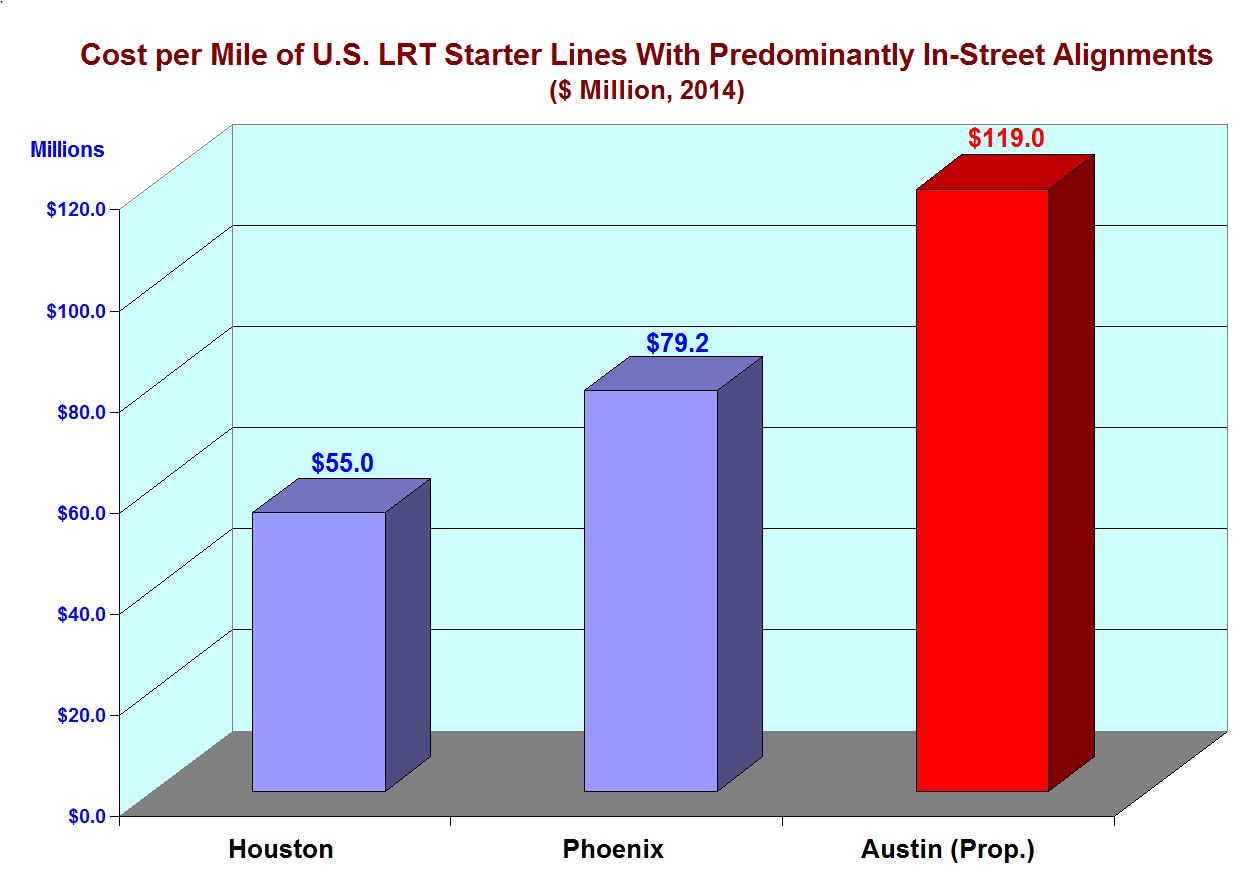
But several of these starter lines benefited from the less challenging, lower-cost advantage of being installed in existing railway rights-of-way. Project Connect’s 9.5-mile line would use predominantly paved trackage embedded in existing streets and arterials. Of the new systems tabulated since 1990, only Houston and Phoenix feature comparable in-street alignments.

To evaluate cost in terms of type of type of alignment, Austin Rail Now has compared Project Connect’s proposed line with these other two systems. The results are displayed in the chart below (click to enlarge).

5_ARN_Chart_US-LRT-starter-lines-in-street-cost-per-mi

It’s clear that Project Connect’s proposed line is significantly more expensive, in cost per mile, than either of these similarly constructed in-street starter lines in considerably larger urban areas than Austin.

Finally, how would Project Connect’s urban rail plan rank among all U.S. LRT starter lines for totally new systems in the modern rail transit era? By far, the most expensive LRT project has been Buffalo’s 6.4-mile Metrorail line, constructed 81% in subway and opened in 1985. Based on a cost analysis prepared by Alan Hoback for the 2008 Annual Meeting of the Transportation Research Board, the cost of Buffalo’s starter line can be calculated as $228.9 million per mile in 2014 dollars.

Thus, Project Connect’s proposed line, in cost per mile among modern systems, would rank as the third most expensive light rail transit starter line in U.S. history. ■

h1

Project Connect’s urban rail plan “costs way too much to do too little”

3 May 2014
Map of Project Connect's urban rail proposal, as shown by KEYE-TV. Despite blurry image quality, the convoluted, meandering character of the route, well to the east of central Austin and its core axis, can be seen. Screenshot: L. Henry.

Map of Project Connect’s urban rail proposal, as shown by KEYE-TV. Despite blurry image quality, the convoluted, meandering character of the route, well to the east of central Austin and its core axis, can be seen. Screenshot: L. Henry.

By Lyndon Henry

The following comments were made during Citizen Communications to Project Connect’s Central Corridor Advisory Group on 2 May 2014. At the meeting, Project Connect’s Urban Rail Lead Kyle Keahey revealed the agency’s proposal for a 9.5-mile, $1.4 billion line connecting East Riverside (southeast) with the old Highland Mall site (north).

I’m Lyndon Henry. I’m a transportation planning consultant, and am considered among the strongest rail transit advocates in Austin. Since I originally launched the notion of urban rail for this region over four decades ago, I’ve consistently made the case for urban rail as a crucial mobility alternative for Austin’s heaviest traffic, plus other benefits such as better urban development patterns.

Urban rail’s primary focus is mobility, to provide some relief for congestion – not to just enhance the value of real estate development or be a decoration for other public projects. Unfortunately, Austin’s political and civic leadership have lost this essential focus, and the result is Project Connect’s seriously misguided plan. Austin voters should reject it.

Austin voters are being asked to authorize a billion-dollar investment for this convoluted adornment for real estate interests and proposed developments — a line that bypasses the heart of the city and slowly meanders nine miles, from the East Riverside “Apartment City” area, through the backwater East Campus, up to Hancock, then through a tunnel and into the old Highland site. How many Austinites are traveling such a route? Installing a second rail line parallel to MetroRail along Airport Blvd. just squanders more money.

Furthermore, a vote for Project Connect’s plan is very likely a vote to lock out any hope of rail on Guadalupe-Lamar — our heaviest travel corridor — and lock in the MetroRapid bus replacement — so-called “BRT”. Project Connect has hundreds of millions of dollars’ worth of dedicated bus lanes and other infrastructure planned for this corridor that would block rail, possibly for decades.

By depleting available financial resources on tunnels and other lavishly expensive construction, this wasteful urban rail plan limits the more effective expansion of rail regionally. Tunnels and subway stations are options way out of scale for an urban rail starter line for Austin or virtually any city this size.

Voter rejection of this plan is the better option, because it opens the possibility for a return to planning a basic north-south rail spine along the central Guadalupe-Lamar corridor. Project Connect’s plan costs way too much to do too little, and Austin deserves better. Voters can opt for a better plan by saying No on November 4th.

Kyle Keahey, Project Connect's Urban Rail Lead (bottom row, center) during presentation to CCAG. Top row, facing, left to right: CCAG leading members Bill Spelman (Austin City Council), John Langmore (Capital Metro), Maypor Lee Leffingwell, Sid Covington (Lone Star Rail). Photo: L. Henry.

Kyle Keahey, Project Connect’s Urban Rail Lead (bottom row, center) during presentation to CCAG. Top row, facing, left to right: CCAG leading members Bill Spelman (Austin City Council), John Langmore (Capital Metro), Mayor Lee Leffingwell, Sid Covington (Lone Star Rail). Photo: L. Henry.

h1

Austin urban rail: Unfortunate revelations from Project Connect’s April 12th “workshop”

14 April 2014
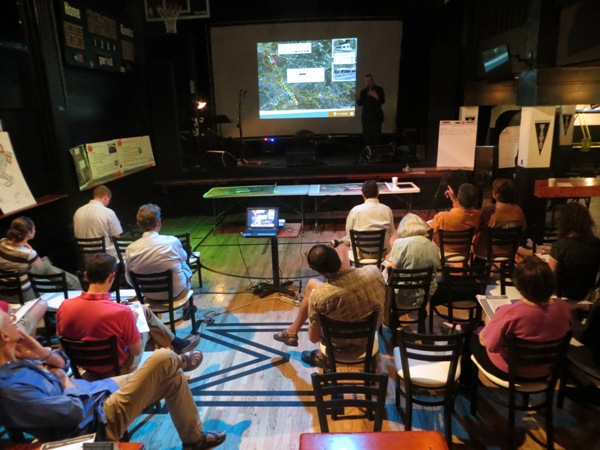
At April 12th "public workshop", attendees watch presentation from Project Connect Urban rail Lead Kyle Keahey. Photo: L. Henry.

At April 12th “public workshop”, attendees watch presentation from Project Connect Urban Rail Lead Kyle Keahey. Photo: L. Henry.

By Lyndon Henry

On Saturday, April 12th, Project Connect held an event they described as a “Central Corridor Public Workshop” at a location on East Riverside Drive. The notice for the event stated that Project Connect team members would be available “to provide an overview of the issues under study, gather input on maps and final alternatives and answer questions. Input gathered from the workshop will help develop potential transit projects for further study.”

Prior to the event, I prepared a number of questions I would like to have answered. I also disseminated these among other Austin public transit activists.

My questions are presented below, followed by feedback — some of it troubling — that I was able to receive from Project Connect personnel.


• Why are the public (who are expected to vote ultimate approval) being allowed only these rare, occasional, highly constrained opportunities to review and select from a narrow assortment of choices determined by the Project Connect team and officials? Why aren’t the public, through an inclusive community-wide technical committee, being given the opportunity to be involved in reviewing the basic data, interacting with the consultants, and formulating the choices themselves?

One Project Connect representative seemed to recognize the value of “an inclusive community-wide technical committee” in broadening the pool of possible alternative solutions to challenging issues. He suggested that names of possible candidates for such a group could be forwarded to him.

• Why is Project Connect still going through the motions of a purported high-capacity transit “study” to determine alignment and mode, and seek CCAG and Council approval for an LPA (Locally Preferred Alternative), when it’s already submitted $1.6 billion of URBAN RAIL projects for inclusion in CAMPO’s 2040 plan — including $275mn already projected for an initial route to Hancock to open in 2020? If URBAN RAIL and its details are already a foregone conclusion, why is taxpayers’ money and the time and effort of CCAG, the City Council, and other bodies being wasted on this?

A Project Connect representative’s explanation (consistent with arguments already reported in a newspaper account) was that the “urban rail” data were submitted as “placeholders” in CAMPO’s preparatory process for its 2040 regional transportation plan. However, since Project Connect has supposedly “zeroed out” its previous urban rail plans for central Austin, and within the current “high-capacity transit” study process no mode or specific alignment has yet been formally determined, why were specific “urban rail” projects inserted as “placeholders”, and not a more generic “high-capacity transit” designation? “That’s a good question” was the response.

The dollar amounts were described as mere “updates” of previous Project Connect cost estimates from approximately 2012. But at that time, no “Hancock-Highland” route was planned, so where did the $91.4 million cost for this segment come from? This was “another good question”.

• Why is $190mn in “BRT” infrastructure being proposed for Guadalupe-Lamar? Won’t this be a barrier to future urban rail?

Including $12.9 million allocated to “BRT” infrastructure on Guadalupe and Lavaca, the total for Guadalupe-Lamar “BRT” amounts to $202.9 million. A Project Connect representative was unable to say what specific infrastructure items this included, nor whether these would present a physical barrier to future urban rail.

• Why is a Guadalupe-Lamar route omitted from the $1.6bn urban rail submission to CAMPO’s 2040 plan?

I didn’t have a chance to raise this question directly, but a Project Connect representative insisted that urban rail as well as “BRT” and possibly other modes would be evaluated for future needs in this corridor.

• Why is this plan proposing a slow, tortuous, meandering route from downtown, the least active part of the UT campus, and Hancock Center, to ultimately reach Highland/ACC? Where’s evidence of the travel demand in this route? Does this route carry as much travel as the Guadalupe-Lamar corridor?

The basic responses from a couple of Project Connect personnel at this event seemed to be that the situation has changed since the original “straight and simple” urban rail route in the Lamar-Guadalupe-South Congress corridor was proposed in 2000. Issues of comparative travel demand and ridership weren’t addressed by the personnel. However, several Project Connect representatives seemed to regret that official attitudes no longer favor shifting existing street (and bridge) space from motor vehicle traffic capacity to urban rail.

• What’s the ridership projected for this route? (Wouldn’t that be considered in the decision to submit this to CAMPO?) How can Project Connect claim that this route would have more ridership than the 30,000+ daily ridership previously forecast for the Guadalupe-Lamar route?

A Project Connect representative emphasized that ridership figures for the current proposed line will be forthcoming. But Project Connect representatives seemed to regard previous assessments of the potential of urban rail in the Guadalupe-Lamar corridor as a moot issue.

• Why is a new $75mn bridge proposed to cross Lady Bird Lake, when either the Congress or S. First St. bridge could be retrofitted for urban rail at half the cost or less ($23-36mn)?

Project Connect Urban Rail Lead Kyle Keahey indicated that the option of retrofitting one of the existing bridges was presented to the Central Corridor Advisory Group (CCAG) but was rejected by the group. Accordingly, it has not been pursued further, so the only option has been to propose constructing a totally new bridge.

I pointed out that current officials and selected civic leaders in the CCAG and Transit Working Group (TWG) seem to have adopted a position that retrogresses from the general consensus of 2000 that traffic lanes in streets, arterials, and bridges should and would be reallocated from general traffic to rail transit. Thus, Austin’s leaders appear to have taken a big step backward in their mindset.

• Is a grade separation considered necessary for urban rail to cross the MetroRail line? Why? Dispatching is entirely under the control of CapMetro. Light rail already crosses heavy rail lines in Philadelphia and Tampa. (This issue would also be involved in the case of urban rail on N. Lamar and the MetroRail line.)

According to a couple of Project Connect personnel, because Capital Metro is converting MetroRail to full compliance with Federal Railroad Administration (FRA) heavy rail standards, the unfortunate (and disputable) assessment of Project Connect planners is that urban rail can no longer cross this line at grade, unlike general traffic. This has not specifically been discussed with either FRA or the Federal Transit Administration (FTA), but Project Connect doesn’t want to get involved with the FRA over this. This also means that, according to Project Connect, urban rail will not cross the MetroRail line at grade either downtown or on North Lamar.

I pointed out that this now encumbers any urban rail plan with an extra liability of tens of millions of dollars for constructing grade separations at any future crossing, but Project Connect and civic leaders now seem to exhibit an unfortunate willingness to accept this. The “Highland” urban rail route plan now includes options for tunnels with a cost range of $230 to $290 million for urban rail to access the north side of the MetroRail line and reach Airport Blvd. This would seem to push the total cost of just the downtown-Hancock-Highland/ACC segment close to $600 million (roughly $275 million + $90 million + $250 million).

As I pointed out to several Project Connect representatives, this entire “study” process (post-2004 through the creation of the Project Connect consortium) has resulted in morphing from a simple, relatively straight, affordable surface urban rail route through central Austin’s major activity centers and highest residential densities, with no need for any major civil works, into a meandering, convoluted, complicated route serving more marginal activity centers and less density, and requiring vast expense to build bridges and tunnels.

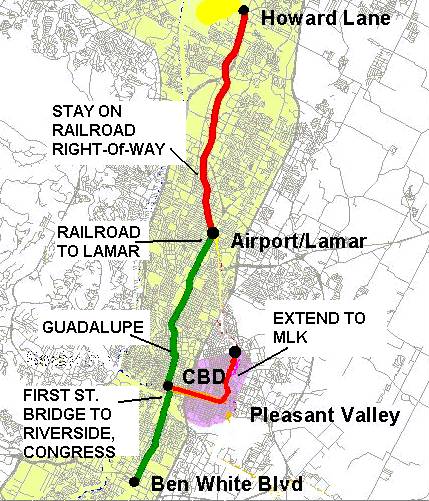
Urban rail (light rail transit) route proposed in 2000 was much straighter, simpler, cost-effective, and affordable, will no major civil works. Project was approved by majority of City of Austin voters, but failed in Capital Metro service area as a whole. Map: Light Rail Now library.

Urban rail (light rail transit) route proposed in 2000 was much straighter, simpler, cost-effective, and affordable, with no major civil works — and it served central Austin’s heaviest travel needs and highest population density. Project was approved by majority of City of Austin voters, but ballot measure very narrowly (<1%) failed in Capital Metro service area as a whole. Map: Light Rail Now library.

This seems to be the result of errors that are built upon previous errors — in a sense, a process whereby Project Connect is simply digging itself (and the Austin community) into a deeper and deeper hole. Perhaps they’ll begin to understand why I and so many other advocates of public transportation expansion in Austin have become so disgusted not only with Project Connect and its process, but also with the proposals that are emerging from it.

Apparently under pressure from City officials and various civic leaders, the Project Connect process unfortunately also seems to have departed from the goal of seeking a cost-effective, affordable urban rail network for metro Austin. In addition to the other revelations, this was indeed very disturbing. Ideally, the entire Project Connect process would be “reset” back to zero, and a totally new process, embracing once again this goal, would be re-launched.

Possibly, a rejection of Project Connect’s plan and quest for bond funding in November by voters would lead to such a “re-boot” of the urban rail planning process. Otherwise, if this approach to rail development goes forward, it would certainly seem that future rail transit infrastructure expansion in Austin would be severely constrained by the legacy of bad past decisions and design criteria that impose very heavy cost encumbrances.

h1

Average time for rail transit vote to succeed after first failing: 3.8 years

8 April 2014

0_ARN_Ballot-Box-Cartoon-crying-kid

If a proposed rail transit project is rejected by local voters, how long does it take to get voters to approve a subsequent rail project, if one is presented?

According to a study of applicable U.S. cases by the Light Rail Now Project (one of the organizations sponsoring ARN), on average, it takes between 3 and 4 years (i.e., mean delay of 3.8 years). What this means is that — if there’s community will do do so — a new rail transit proposal (typically, a revision of the original one that has failed) can be re-submitted to voters and approved within a relatively short time.

Here in Austin’s “transit war” over competing visions of urban rail, these results challenge contentions of dire consequences (from a possible rail vote loss) being made by partisans of the official Project Connect plan for “high-capacity transit” in a dubious “Highland-East Riverside” route. Rail supporters that perceive major flaws and drawbacks in the Project Connect plan are being advised to swallow their disgust and support the official plan, on the premise that if it fails to win voter support, the development of urban rail would be catastrophically delayed another decade or more, perhaps even forever.

A couple of comments posted online in response to news reports on local media websites give some of the flavor of this line of argument.

See the problem is, if we vote against the urban rail, it will get put off for another ten years. Unfortunately, our fate was sealed when the urban rail committee, who wants the urban rail to eventually go to Mueller, decided upon the San Jacinto/Highland route. We might as well vote for it so that we’ll get some sort of rail closer and more relevant to downtown than MetroRail.
Daily Texan, 3 February 2014

Referring to the Austinites United for Rail Action (AURA) group — many of whose members seems to have misgivings about the official “Highland-East Riverside” route recommendation — another reader, in a comment posted to an article in the Feb. 28th Austin Chronicle, warned

For the good of the city I hope the AURA folks will reconsider their opposition to the likely starter route. With an entirely new district-based City Council taking office in January, November will probably be our last chance at rail for many, many years.

Other proponents of Project Connect’s “high-capacity transit” route recommendation (which currently still doesn’t specify whether it would involve buses or trains meandering along it) have conjured even more dire warnings that urban rail could be stalled for “10 or 20 years or more” if voters fail to pass bond funding for the official plan. For example, in a similar online news site exchange in late February, a commenter identifying herself as a UT development associate argued:

The Federal Government just gave Austin $35 Million for MetroRapid. There is no way they are going to allow us to spend more Federal Money on that route. We have to look forward and make a first step. If we don’t do it now, it’s going to be another 20 years before it’s on the table again. No one wins if we don’t support Project Connect.

The results from the LRN study would seem to debunk these contentions and warnings of doom upon the failure of Project Connect’s plan. LRN explains the methodology used:

To … assess the actual delay between the failure of rail ballot measures and the ultimate passage of support for a subsequent rail transit ballot initiative, the LRN Project team examined available cases since 2000 where an initial rejection of rail was followed by a successful later vote. LRN’s approach has examined this issue strictly from the standpoint of attracting voter support — in other words, if the issue of rail transit is re-voted, how long does it take to win approval?

It should be noted that this study has examined the sequence of events only in cities where, after the failure of an initial measure, a new measure for rail transit (often with a somewhat different plan) was offered to voters. In other cases, poorly prepared or presented rail plans were rejected by voters, but rail planning was subsequently dropped (e.g., Spokane, Columbus) or has proceeded without needing a public vote (e.g., San Antonio).

The study examined six cases, meeting the basic critieria, where such re-votes have occurred — Austin, Kansas City, Cincinnati, Tucson, Seattle, and St. Louis. The analysis indicated that “recent re-votes on rail transit have taken from one to seven years to succeed”, with an average delay of 3.8 years.

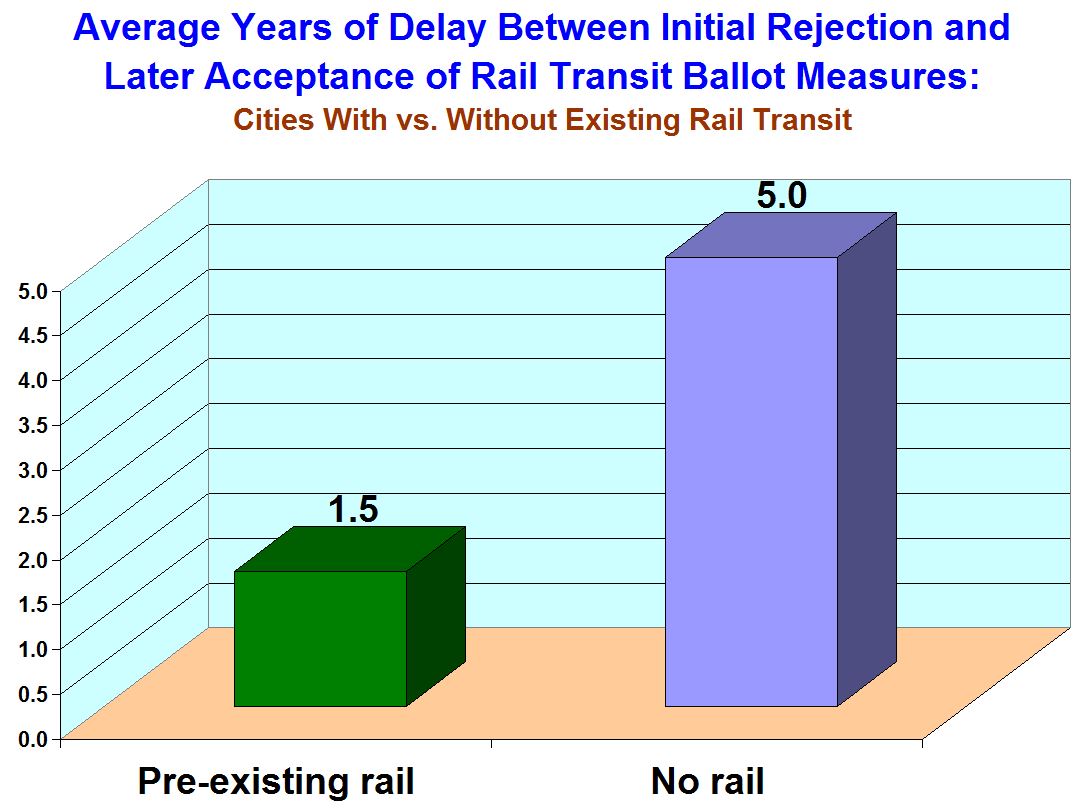
In addition, LRN notes that “the data seems to suggest a pattern, whereby the delay before a successful rail transit re-vote is less in cities already operating some form of rail transit (Seattle, St. Louis), in contrast to cities where rail would be a totally new addition to the transit mix (Austin, Tucson, Kansas City, Cincinnati).” Indeed, in the two cities operating some form of rail transit (St. Louis and Seattle), the delay averaged just 1.5 years:

Left bar: Average years of delay in cities already operating rail transit. Right bar: Average delay in cities with no current rail transit.

Left bar: Average years of delay in cities already operating rail transit. Right bar: Average delay in cities with no current rail transit.

While this study “with its very small data set does not offer a basis for strong conclusions” states the LRN report, nevertheless it is possible “to infer that the loss of a vote does not inevitably represent a ‘catastrophic’ setback for rail transit in a given city….” Furthermore, “there is opportunity for plausible speculation….”

• Conditions for a more speedy re-vote and approval of a rail transit ballot measure may be more propitious in communities that already have experience with successful rail transit systems.

• The process of re-submitting a rail transit measure to a vote may depend not so much on public attitudes but on the determination of sponsoring officials, their responsiveness to public input, and their willingness to re-craft specific project details to more closely conform to public needs and desires.

h1

SXSW transit — MetroRail trains attracted crowds, excitement! MetroRapid buses? Nyah…

18 March 2014
Commuting passengers deboard a MetroRail train. During SXSW, passengers have jammed onto trains, setting new ridership records. Photo: L. Henry.

Commuting passengers deboard a MetroRail train. During SXSW, passengers have jammed onto trains, setting new ridership records. Photo: L. Henry.

For at least most of the past year, as this blog has been noting, Project Connect has gradually shifted away from promoting “urban rail” (light rail transit, LRT) and more into emphasizing the delights of an abstract, amorphous mode of travel they’re calling “high-capacity transit”, which can supposedly range from dressed-up buses running in mixed traffic (MetroRapid) to actual high-capacity trains or railcars running on tracks.

In Project Connect’s schema, the impression is conveyed that it’s all the same — rubber-tired buses running on the street, or trains running on tracks, either will do the same basic job. So, for the Guadalupe-Lamar (G-L) corridor, where Capital Metro launched the first MetroRapid route this past January, the new bus service has been christened “bus rapid transit” (BRT).

This has occurred in the midst of Project Connect’s jaw-dropping campaign to forsake the City of Austin’s long-standing commitments of urban rail for core neighborhoods and commercial activities along the heavy-traffic Guadalupe-Lamar and the high-density West Campus, in favor of serving the much weaker East Riverside area and a virtually non-existent “corridor” connecting downtown, the relatively backwater East Campus, Hancock Center, and the old Highland Mall site (now becoming a major ACC campus). Curiously, more than half of the “Highland” route replicates the previous Mueller route that had already sparked enough controversy to force Project Connect to embark on its “study” charade last summer.

As the debate heated up over Project Connect’s very dubious “study” and subsequent decision to proceed with the Riverside-Highland route, neighborhood residents and other supporters of the G-L route found themselves repeatedly lectured that they should be satisifed with the spiffy new MetroRapid bus service they were getting — just like rail, but cheaper, it was implied. And in any case, these buses are so “permanent”, you can just forget any urban rail for decades, so just take it and accept it.

Meanwhile, after launching MetroRapid bus (accompanied by a rather low-key ceremony with invited guests) in late January, CapMetro encountered a swarm of new problems, mainly (1) widespread passenger irritation over the disruption and degradation of previous bus service in the corridor, (2) complaints over the tendency of MetroRapid buses (with no fixed schedule. but supposedly about 10 minutes apart at peak) to bunch up (leaving many passengers waiting 20 minutes), and (3) a decidedly unexcited public reception of the new service — prompting CapMetro to issue a steady stream of marketing pitches on Twitter and in other media attempting to persuade the public to try the service. And despite CapMetro’s hoopla, the fact remains that MetroRapid buses run almost entirely in mixed traffic, often congested, and it’s arguable that the actual level of service has been degraded, not improved. (Also see: Is Capital Metro’s New MetroRapid Service Leaving Bus Riders Behind?)

MetroRapid bus at a stop on the Drag. Passengers have not crowded aboard the new service as they have on MetroRail. Photo: L. Henry.

MetroRapid bus at a stop on the Drag. Passengers have not crowded aboard the new service as they have on MetroRail. Photo: L. Henry.

… Which brings us to Austin’s famous South by Southwest (SXSW) annual extravaganza March 7th-16th in the city’s core area. With a daunting array of street closures and street-fair-style activities, local transportation officials’ efforts to encourage people to leave their cars elsewhere and ride transit are virtually a no-brainer. And, by Project Connect’s schema, besides regular buses, visitors have had two major choices in “high-capacity transit” to choose from in getting downtown: the brand-new, MetroRapid service with its spiffy-looking, red-and-grey articulated (“bendy”) buses, and MetroRail, CapMetro’s “commuter” light railway with its large, comfortable, smooth-riding railcars, now in their fourth year of service.

The choices that SXSW transit riders have made, the object of media attention and other indications of public excitement, and reports from CapMetro via Twitter and other media have spoken volumes about what kind of “high-capacity transit” mode — rail or MetroRapid bus — generates real excitement and is most preferred by the public. And it ain’t MetroRapid bus.

Overwhelmingly, it’s been CapMetro’s MetroRail rail transit trains that have been crowded with passengers, and it’s been MetroRail that has gotten nearly all the focus of favorable news coverage and other attention. And that should give you some idea of why so many neighborhoods, UT students, and others along the G-L corridor are clamoring for urban rail, not a faux “bus rapid transit” substitute, to provide the high-quality transit service they need.

Typical of news coverage during SXSW was a KXAN-TV report Web-posted with the headline “Additional road closures during SXSW push more people to take MetroRail”.

“During South by Southwest, traffic jams are not unusual…” observed the reporter. “But for those who live here, trying to get to and from work can be even more frustrating than usual.”

One commuter, Shermayne Crawford, told the reporter: “I drove to work Monday and I think it took me an hour and a half to get home.” Because of that, explained the reporter, “She decided she would be using MetroRail for the rest of the week.”

“It’s worth taking it. It moves fast…” said Crawford. “It’s a little packed this week but overall I’ve been able to get a seat and enjoy myself on my way to work.”

According to a report by KUT-FM radio, MetroRail has been experiencing record ridership during the festival, with boardings “up from last year by almost 7,000” just in “the first several days” according to CapMetro. .

Capital Metro even had to operate an additional train after hours to carry more than 100 passengers still waiting on the platform. The trains on Saturday are starting at 10 a.m. – a few hours earlier than usual.

Perhaps nothing better highlights the enthusiasm of SXSW visitors for MetroRail’s train service than CapMetro’s own announcements and news bulletins. For example, on its website the agency posted:

Extended MetroRail Service
We know MetroRail is popular for traveling downtown during SXSW. We’re expanding our regular MetroRail service to help ease congestion:

Extra service on Saturday, March 8 and 15 (10 a.m. – 2 a.m.)
Additional trips all day, March 10-14
Monday – Tuesday, March 10-11: 6 a.m. – 7 p.m.
Wednesday – Thursday, March 12-13: 6 a.m. – 12:30 a.m.
Friday, March 14: 6 a.m. – 1 a.m.

Friday & Monday, March 7 & 17 – Regular schedule
No MetroRail service on Sunday, March 9 & 16
See the extended schedule tables below for exact times.
Our train is popular, so expect some crowding onboard. What can you do if the train’s full?

Cyclists encouraged to use at-station bike racks
Check our Trip Planner or station signage for alternative routes downtown, many bus routes accessible within a few blocks

As the crush of passengers on the trains grew, in some cases causing delays, CapMetro labored to keep riders informed and assured that the service was being maintained, via an avalanche of nearly frenzied Twitter news feeds. Here’s just a small sampling from the past several days:

Capital Metro ‏@CapMetroATX 19h
It’s 2 AM & you still have one more chance to ride the #MetroRail during #SXSW. Last Northbound train from Downtown Station departs at 2:19.

Capital Metro ‏@CapMetroATX 20h
MetroRail experiencing delays of approx. 20-25 mins. due to overcrowding & operating additional trains. Trains at capacity. #MetroRailAlert

Capital Metro ‏@CapMetroATX 21h
Though the clock has hit midnight, #MetroRail is still going strong. Last Northbound train from the Downtown Station is at 2:19 AM.

Capital Metro ‏@CapMetroATX 21h
MetroRail experiencing delays of approx. 15-20 mins. due to overcrowding & operating additional trains. Trains at capacity. #MetroRailAlert

Capital Metro ‏@CapMetroATX 22h
MetroRail currently experiencing delays of approximately 10-15 minutes due to overcrowding & operating additional trains. #MetroRailAlert

Capital Metro ‏@CapMetroATX 25h
MetroRail is currently experiencing delays of 15-20 minutes due to overcrowding. #MetroRailAlert

Capital Metro ‏@CapMetroATX 26h
MetroRail experiencing delays of approximately 10-12 minutes due to overcrowding & operating additional trains. #MetroRailAlert

Capital Metro ‏@CapMetroATX 28h
Be aware: Trains have been packed this #SXSW! It’s a great way to get around, but expect crowds and possible waits at platforms all day.

Capital Metro ‏@CapMetroATX Mar 15
Parking and riding? Temp. #SXSW MetroRail parking available at Kramer at City Electric Supply on 2540 Brockton Dr.

Capital Metro ‏@CapMetroATX Mar 15
Rail riders: MetroRail frequency being bumped up, service every 34 mins ALL DAY this SXSW Saturday to ease crowds: http://bit.ly/1lFtEH4

Capital Metro ‏@CapMetroATX Mar 15
MetroRail is running on a 15-20 min. delay at this time. Thanks for your patience. #MetroRailAlert

Capital Metro ‏@CapMetroATX Mar 15
MetroRail is currently operating on a 15-20 min. delay due to overcrowding. #MetroRailAlert

Capital Metro ‏@CapMetroATX Mar 15
MetroRail is currently operating on a 15 min. delay due to overcrowding. #MetroRailAlert

Capital Metro ‏@CapMetroATX Mar 15
FRI 3/14: See tonight’s MetroRail schedules here: http://www.capmetro.org/sxsw.aspx?id=3262#scheduletables …. #MetroRailAlert ^AP

Capital Metro ‏@CapMetroATX Mar 14
MetroRail is experiencing 15 min delays due to crowds and running an extra train. #MetroRailAlert

To be fair, CapMetro’s buses have also seen strong ridership. As the above-cited KUT report recounts,

The bus service has also been popular. Capital Metro could not provide preliminary figures on ridership, but the transit company says many buses have been at full capacity.

However, next to no mention of the previously much-vaunted MetroRapid bus service. That new “bus rapid transit” operation? No reports of crowding, no extra service rollout, no media excitement. No frenzy of Twitter feeds or other media messages from CapMetro.

It’s trains, not dressy buses, that have drawn the crowds aboard and captured news media attention.

Keep in mind, however, that urban rail — using electric light rail transit trains — would be vastly superior even to MetroRail’s diesel-powered service. Instead of MetroRail’s circuitous “dogleg” around the heart of Austin and into lower downtown, urban rail trains would ride straight down Lamar and Guadalupe, able to make more stops and offer faster service because of their electric-powered acceleration. And they’d also be cheaper to operate.

As in this example from Houston's light rail system, urban rail would be powered by electricity and operate mainly in the street — in Austin's case, Guadalupe and Lamar. Photo: Peter Ehrlich.

As in this example from Houston’s light rail system, urban rail would be powered by electricity and operate mainly in the street — in Austin’s case, Guadalupe and Lamar. Photo: Peter Ehrlich.

However, MetroRail at least gives a taste of the advantages of rail transit. And the SXSW experience has provided a de facto “test case” of MetroRail and MetroRapid bus running more or less “head-to-head”, providing somewhat “parallel” transit service opportunities. And it certainly looks like the one rolling with steel wheels on steel rails wins.

That should give a clue as to why supporters of urban rail for Guadalupe-Lamar are far from satisified with being given a bus “rapid transit” substitute for bona fide LRT. One would hope that Project Connect, CapMetro, and City of Austin officials and transportation planners would get the message.

But even if they don’t, maybe Austin voters will.

h1

Northfield Neighborhood Association: “First investment of light rail” should be Guadalupe-Lamar!

11 March 2014
Left map shows Northfield Neighborhood Association (shaded brown) in central-city context, between North Lamar and I-35. Right map zooms in on the association's boundaries, with the MetroRail Red Line (labeled as "Austin and Northwestern"), albeit with no stations, cutting through its easten side. "University of Texas" section just southwest of Northfield is UT's Intramural Fields property, which has been used for athletics and a park & ride facility for UT shuttlebuses. Maps: Northfield NA.

Left map shows Northfield Neighborhood Association (shaded brown) in central-city context, between North Lamar and I-35. Right map zooms in on the association’s boundaries, with the MetroRail Red Line (labeled as “Austin and Northwestern”), albeit with no stations, cutting through its easten side. “University of Texas” section just southwest of Northfield is UT’s Intramural Fields property, which has been used for athletics and a park & ride facility for UT shuttlebuses. Maps: Northfield NA.

They just keep piling up — community and neighborhood endorsements of urban rail (light rail transit, LRT) for the Guadalupe-Lamar (G-L) corridor as a key public transport “backbone” for the heart of the central core city.

This time it’s a resolution passed unanimously late last month by the Northfield Neighborhood Association (NA), basically located along the east side of North Lamar just south of the Highland NA. According to the association’s website, the boundaries of Northfield Neighborhood Association are defined by 51st, Lamar, Airport, and Koenig (see map at top).

There are approximately 1,400 households in the neighborhood. … There is also a thriving local business scene on North Loop Blvd and two of our border streets: Airport Blvd and Lamar Blvd.

Screenshot of Northfield NA resolution supporting light rail transit on Guadalupe-Lamar corridor. (Click to enlarge.)

Screenshot of Northfield NA resolution supporting light rail transit on Guadalupe-Lamar corridor. (Click to enlarge.)

Emphasizing that “light rail would improve the quality of life of our residents by giving them a new and efficient transportation choice and reducing dependency on cars of those of those who use our area’s roads to commute …,” the resolution proceeds to note that

…the Northfield Neighborhood Association is a signatory of the North Loop Neighborhood Plan, City of Austin Ordinance 020523-30, a planning area with a 2010 population of 5,814, in which Northfield residents took part in extensive light rail planning for specific alignment and station placement along North Lamar Blvd. up to the North Lamar Transit Center, providing for light-rail to commuter rail transfers at Crestview station, and a future commuter rail line on Airport Boulevard corridor ….

As the resolution also points out,

…several other neighborhood plans have planned light rail along the Guadalupe-North Lamar corridor such as the Central Austin Combined Neighborhood Plan, City of Austin Ordinance 040826-56, Crestview-Wooten Combined Neighborhood Plan, City of Austin Ordinance 040513-30, Hyde Park Neighborhood Plan, City of Austin Ordinance 000413-63, and the Brentwood-Highland Combined Neighborhood Plan, City of Austin Ordinance 040513-30 ….

This underscores the long record of cooperation by Austin’s core central neighborhoods with the planning objectives and assurances given to them by the City of Austin — now basically being shredded by Project Connect and the current city council, which are proceeding to forsake these commitments and discard rational, data-supported planning in preference for fabricating a rigged “high-capacity transit” plan aimed at fulfilling the needs of private developers and pushing Austin’s center of gravity away from the core city and further eastward. (See: City Council to Central Austin: Drop Dead.)

In contrast, the Northfield resolution focuses squarely on the clear and obvious public transportation priority for the city, affirming that

…the Northfield Neighborhood Association believes that any first investment in light rail must serve as an expandable backbone of rapid transit, and such an alignment is most suited along North Lamar Blvd. and Guadalupe Street and terminated at or near the North Lamar Transit Center; [and]

…the Northfield Neighborhood Association supports a phase one locally preferred alternative to include light rail service that connects the densely populated and diverse communities of North Central Austin to the cultural, residential, and employment centers of the University of Texas, the Capitol Complex, and Downtown Austin….

This strong endorsement of central Austin’s top-priority local travel corridor as a potential urban rail starter line, provided by another of Austin’s most important central-neighborhood associations, has political implications that should send a pointed message to local officials and decisionmakers. As Scott Morris — head of the Central Austin Community Development Corporation and leader of the Our Rail coalition — has observed, this action by Northfield “is a major milestone.”

Not only is Northfield “a dual-alignment neighborhood” (i.e., served both by North Lamar and the MetroRail Red Line), Morris points out, but the association’s constituency “have had tremendous exposure to the Red Line operations, and have participated directly in the Airport Corridor Initiative.”

Of particular significance, Morris notes, is that the resolution action “came weeks after council action” — emphasizing that, despite the pretense of planning “derived from the Project Connect process”, the momentum in favor of Guadalupe-North Lamar “is not going away.” With Northfield’s formal support through its resolution endorsing the G-L corridor, Morris emphasizes, “it is now possible to walk from MLK to 183 by only passing through communities that support rail on Guadalupe-North Lamar.”

h1

Project Connect data in 2012 showed urban rail beats “BRT” in cost-effectiveness

1 March 2014
xxxxxx

Left: Urban rail simulation (Graphic: COA rev. ARN). Right: MetroRapid bus on the Drag (Photo: L. Henry).

As this blog has noted, it’s curious how, in recent months, Project Connect — at least in official statements — has been somewhat distancing itself from explicitly advocating “urban rail” (Mayor Leffingwell’s recent “rail or fail” rhetoric is an exception, but, then, he’s not officially a Project Connect official) and increasingly portraying its focus to be “high-capacity transit“, a generic term that seems to apply to virtually all surface public transport modes approximately above the capacity of a van.

Moreover, this “high-capacity” concept seems to consider just about everything somehow equal in function. Thus, bus routes and urban rail lines could, in this rather dubious schema, be interchanged or substituted in planning.

This, of course, is nonsense — there are huge differences between rail and bus in performance, attractiveness to the public, operational capabilities, environmental implications, longterm cost-effectiveness, and other attributes, with rail tending to lead. But Project Connect’s approach treating these modes as generally interchangeable seems to accord the agency at least two advantages:

(1) It gives Project Connect and other public officials some flexibility to put urban rail where they want it, MetroRapid (faux “bus rapid transit” or BRT) where they want it … and it helps alibi why some areas supposedly due for “high-capacity transit” end up getting just a fancy bus route (MetroRapid). With money tight, Project Connect can install perhaps a few miles of rail (or perhaps none), cover the rest with bus service, and claim they’re offering a vast “rapid transit” system to the Austin-area public (and voters).

(2) It has allowed City and Capital Metro officials, as well as Project Connect’s leadership, to designate the modest, minimal MetroRapid bus service in the Guadalupe-Lamar corridor as “high-capacity transit” and even “rapid transit” — for which, it’s implied, this key section of the central city should be profoundly grateful. And in any case, it’s all the “high-capacity transit” these core neighborhoods can expect to get for the foreseeable future — so be content with what you’ve got, while we all move on.

But Project Connect’s championing of generic “high-capacity transit” and the alleged marvels of MetroRapid stands in glaring contrast to the agency’s narrative and course of argument of the recent past. Just two years ago, and for the past six or so years before that, City planners and then Project Connect were hammering away incessantly about the need for Urban Rail — urban rail was absolutely essential, it was a must-have, it was the linchpin of the regional transit plan …

Of course, local officials and their planners insisted it had to run from downtown, through the relatively empty East Campus, to Mueller.

So … why not run just a good bus service?

Well, official planners have gone to great lengths to justify the need for rail. Rail, it’s argued, has an exceptional tendency to attract adjacent development, especially transit-oriented development. That’s true. Also true is their insistence that urban rail, particularly as ridership grows, is far more cost-effective than bus service over the longer term.

And that’s precisely the point succinctly made, for example, in a couple of neatly rendered data-visualization slides included in a presentation from Project Connect to the Transit Working Group (TWG) on 1 June 2012.

This first slide compares urban rail and “bus rapid transit” (i.e., bus upgraded transit of some kind) in total cost per passenger. The graph indicates that rail and bus become equal in total cost per passenger (presumably, rider-trip) at a ridership level of around 10,000 daily passengers. After that, urban rail becomes significantly lower.

Total cost per passenger of urban rail becomes lower than "bus rapid transit" as ridership rises above about 10,000 per day. Graph: Project Connect.

Total cost per passenger of urban rail becomes lower than “bus rapid transit” as ridership rises above about 10,000 per day. Graph: Project Connect.

In this second slide (below), Project Connect displays that the operating and maintenance (O&M) cost of urban rail is projected to be consistently less than that of “BRT”.

Operating & maintenance (O&M) cost per passenger-mile of urban rail is projected to be consistently lower than "bus rapid transit". Graph: Project Connect.

Operating & maintenance (O&M) cost per passenger-mile of urban rail is projected to be consistently lower than “bus rapid transit”. Graph: Project Connect.

So these projections from Project Connect raise intriguing questions:

• If urban rail is so much more cost-effective than “BRT”, doesn’t this mean that it would be more cost-effective than MetroRapid, which various Project connect, City, and Capital Metro spokesmen have repeatedly characterized as “BRT”?

• If urban rail is indeed so much more cost-effective than MetroRapid, why is the Guadalupe-Lamar corridor being consigned MetroRapid as its “high-capacity transit” solution — especially when ridership projections have forecast this corridor as having the highest ridership potential in the entire region?

• Put another way — Why is Guadalupe-Lamar — Austin’s heaviest center-city local traffic corridor, and its densest and most promising core neighborhoods and commercial districts — being saddled with a more costly MetroRapid service, less appropriate for needed capacity, while the heavy resources to install urban rail are being focused on a convoluted Rube Goldberg-style route scheme to serve the East Campus, Hancock Center, and (purportedly) an eastern access to the Highland/ACC site?

h1

Subway cost per mile nearly 9 times higher than for light rail, says study

15 February 2014
Chart showing median cost results from Light Rail Now subway vs, LRT study. Graphic: Light Rail Now blog.

Chart showing median cost results from Light Rail Now subway vs, LRT study. Graphic: Light Rail Now blog.

For years, Austin’s civic leaders and official urban rail planners have been trying to figure out how to raise more than $500 million in local and federal funding for a new-start surface urban rail project — 5-6 miles of light rail transit (LRT) running in relatively lower-cost surface alignments. Suddenly, at least some official interest has turned to ….building a subway instead?

This seems to be influenced mainly by two factors:

• An aversion or reluctance to shift urban public thoroughfare space away from apparently precious motor vehicle traffic and re-allocate it to public transit (rail in this case), and

• Insistent claims by several subway proponents (disputed by professionals and advocates of LRT) that subway construction costs are nearly the same as, or only slightly more than, surface LRT.

Recent study results of subway-LRT investment costs posted on the Light Rail Now (LRN) blog site provide a sobering reality check on the cost issue. As portrayed graphically in the chart at the top of this post, LRN found median investment cost to be nearly 9 times higher for subway construction projects than for in-street LRT.

Projects examined were an assortment of “recent urban rail projects (all from the 2000s), either completed or well under construction and fully budgeted.” The report lists 24 subway and 13 LRT projects included in the analysis.

• Only “full subway projects (entirely or nearly totally underground)” were examined in the study, including subway portions of LRT projects.

• Only surface LRT projects exclusively, or nearly totally, in street alignments were included (“to compare the most difficult, highest-cost type of surface construction with subway construction”).

Summarizing the study results, LRN underscores the huge cost disparity between subway and in-street LRT construction, and the implications for a long-term rail expansion policy:

…for recent U.S. projects, subway construction has a median cost nearly seven times that of in-street LRT construction. Worldwide, the differential is nearly 9:1. And thats only comparing in-street LRT construction, not accounting for the possibility of, say, transitioning into an available railway alignment outside the city center, with far lower installation cost.

What this means is that, even if your community can somehow afford the initial financial commitment (even with federal assistance), expansion of your system will be severely attenuated. Basically, for a given amount of available funding, you can construct 7 to 9 times as much surface LRT as subway. Put another way: For available resources, you can have a far more comprehensive rail system with surface LRT, many times the size of a system relying on subway construction.

Buffalo's 6.4-mile LRT line, with 5.2 miles (81%) in subway, has never been expanded since its opening in 1985. On the whole, the heavy cost of subway (and elevated) construction has been a powerful deterrent that has delayed or prevented the expansion of totally grade-separated urban rail systems.

Buffalo’s 6.4-mile LRT line, with 5.2 miles (81%) in subway, has never been expanded since its opening in 1985. On the whole, the heavy cost of subway (and elevated) construction has been a powerful deterrent that has delayed or prevented the expansion of totally grade-separated urban rail systems. Photo: Buffalo Tourism.

(LRN’s results — which tabulate subway construction costs ranging from $114 million to well over $1 billion per mile — appear generally consistent with information provided at Project Connect’s Feb. 8th “interactive workshop”. Official consultants at this event described “tunnel” construction as costing in the range of $220 to $350 million per mile. However, it’s unclear whether this included the costs of underground stations, access portals and ramps, and major system costs such as rolling stock and storage-maintenance-operations facilities.)

Noting examples of appropriate subway deployment in Dallas and Portland, LRN emphasizes that, for these mature systems, some underground construction may be needed “to keep pace with ridership growth and the need for fast, more frequent service going beyond in-street capacity.” However, the article points out that “both cities relied primarily on surface construction to start and develop their initial systems….”

LRN’s report ends by cautioning that, in the face of evidence from this study, any commitment to launch a new urban rail startup system “should not be made on the supposition that a subway would cost ‘just a little bit more’ than constructing LRT in the street.”

h1

Science seems missing from Project Connect’s “scientific” transit planning

10 February 2014
Project Connect's proposed "high-capacity transit" alternative alignments for "Highland" sector.

Project Connect’s proposed “high-capacity transit” alternative alignments for “Highland” sector.

By Lyndon Henry

This past Saturday, Feb, 8th, I attended Project Connect’s “interactive workshop” event at the Highland ACC site with a specific mission in mind: raising questions to gather information and data. I particularly wanted to refrain from actually providing input into the process, because Project Connect seems to use this type of public feedback as evidence of popular validation of, and acquiescence to, their overall process, methods, and conclusions — and I wanted to avoid that as much as possible. I did strongly encourage other supporters of the Guadalupe-Lamar alignment proposed for urban rail to attend this event if at all possible.

The most recent documents on the topic of the event, as far as I knew, were the “alternative route” maps that Project Connect had made available online, as a PDF:

http://www.projectconnect.com/connect/sites/default/files/Preliminary%20Alternatives.pdf

Through Project Connect’s presentations to the Transit Working Group and Central Corridor Advisory Group, and in other presentations and statements here and there, a multitude of questions had already been raised, and these maps raised even more issues. Much of my curiosity was motivated by unanswered questions associated with the “Phase 1” study process — supposedly a thoroughly “data-driven” study. Indeed, City Councilman (and Capital Metro chairman) Mike Martinez has emphasized that the route profiles selected by the Project Connect team are all based on a highly “scientific” process. So, in my view, it’s entirely valid to seek the “scientific” evidence that supposedly underpins the route alignment choices now being presented for public perusal.

At the Feb. 8th event, I didn’t have an opportunity to raise all my questions or obtain definitive answers to the ones I did raise, but I’m sharing much of what I did learn in this post. I’ll note that I mainly discussed these with a couple of volunteer Project Connect table moderators, and a couple of Project Connect consultants. I’ve categorized these questions into several sub-issues.

“Highland” issues

• The “Phase 1” study projected huge increases in population and economic activity in this sector by 2030. Where, exactly, would these increases occur?

Basically, the Project Connect representatives I discussed this with didn’t have an answer. They’re planning “high-capacity transit” routes on the basis of projections of enormous population and economic growth, but they seemed somewhat confused about whether there was any data indicating exactly where in this sector such growth would occur.

So, how could station locations be determined if you don’t know where the heaviest growth will be? Is there huge growth projected west of Red River, along the proposed Duval alignment? They couldn’t say.

• Do the proposed alignment alternatives take the actual locations of population and economic concentration into account? If so, how?

Basically, no — for the same reason as with the previous response.

However, I did overhear one of the consultants explain to another participant (who favored an alignment to the Mueller development area) that Project Connect was giving “major consideration” to the possibility that an alignment serving Hancock Center would “set you up” for an ultimate extension to Mueller.

• Of the routes within the “Highland” sector from the UT campus to Highland/ACC, I-35 is omitted. Yet heavy traffic on I-35 was included as a major factor in swaying the Phase 1 recommendation for this sector. So, why is this major travel artery not included as a possible “high-capacity transit” (HCT) alignment for this sector? Where’s the metrics-based evaluation to eliminate it?

The impression I got from discussing this is that there’s no “metrics-based” evaluation, just a sort of hunch that an alignment in or along I-35 would not be a good idea. So, if traffic volumes on I-35 were a major factor in selecting the “Highland” route, are there any park & ride sites in mind? I was told that the Highland/ACC site would be an excellent location for a P&R facility — and that seems a quite reasonable judgement.

However, there’s been no study of the relative attractiveness of such a P&R to I-35 motorists between access to the UT and core area via the eastern “Highland” routes or the more direct, western route via Lamar and Guadalupe.

• Duval and Red River are both capacity-constricted minor thoroughfares narrowing into 2-lane neighborhood streets. Are these routes appropriate for the mainline of a HCT service, particularly an urban rail alignment?

Project Connect is seriously considering rail on these streets, but other than that confirmation, I couldn’t get any evaluatory comments. One participant mentioned a possible streetcar-type alignment, and another argued that these were “three-lane” streets, which is hard to believe from the visual evidence. (To procure a third lane, you’d have to eliminate neighborhood street parking on Red River and bike lanes on Duval.)

Both Red River (left) and Duval (right) are narrow 2-lane neighborhood streets, with barely space for local parking on Red River and bike lanes on Duval. L. Henry screenshot from Google Maps streetview.

Both Red River (left) and Duval (right) are narrow 2-lane neighborhood streets, with barely space for local parking on Red River and bike lanes on Duval. L. Henry screenshot from Google Maps streetview.

I mentioned that “HCT” by Project Connect’s definition could mean MetroRapid bus service, but I was assured that, for reasons not explained, they have rail in mind for this route.

• To install HCT in these alignments, are property acquisitions for right-of-way (ROW) being considered?

I couldn’t get a clear answer on this.

• For these alignments, are elevated or subway alignments under consideration for urban rail? In the case of a subway, where would the portal be located (this generally takes most of a city block)?

Elevated and subway construction seems to be under consideration only in a very general way; I got the definite impression that Project Connect’s thinking is focused more on a surface alignment. I didn’t have a chance to raise the portal issue.

• Where would a storage-maintenance-operations site for rolling stock be located?

I didn’t have a chance to raise this issue. (Previous urban rail planning tended to locate an SMO facility on the Mueller site, or just north of it.)

• For the alignments along Airport Blvd., wouldn’t these duplicate MetroRail service?

A consultant explained that Project Connect doesn’t see duplication, because the HCT service (whatever it is) would have intermediate stops, unlike MetroRail. Apparently, in their minds, you only have duplication if you duplicate all or most of the parallel line’s stations. I found it rather peculiar that Project Connect planners would regard it as impermissible to replace MetroRapid bus service on Guadalupe-Lamar with urban rail, but quite acceptable to in effect duplicate rail transit service along Airport Blvd. with, possibly, another form of rail transit.

• Is Project Connect planning to replace a segment of MetroRail service with urban rail? If so, how would MetroRail connect from downtown to Crestview?

Apparently they’re not planning to replace MetroRail with urban rail in this phase of planning.

• If Project Connect is planning on FTA funding for urban rail, would this be possible with a line paralleling existing MetroRail service?

As discussed above, Project Connect doesn’t consider such a route along Airport Blvd. as duplicate service to MetroRail. I doubt, however, that — in the case of a major rail investment — the Federal Transit Administration (FTA) would readily agree with this, especially after their recent award of a TIGER grant to upgrade the MetroRail line.

Core area issues

• Various routes are proposed through the core area. On what specific core area metrics analyses are these based?

Project Connect representatives were somewhat confused by this question about core area metrics. Having followed the “Phase 1” HCT study process closely, I never saw evidence of any metrics-focused study of the core area (Core “sub-corridor”, i.e., sector). One consultant offered the University of Texas’s campus plan as a factor in the decision to follow the East Campus alignment along San Jacinto, but I explained that a plan is more like a wishlist, not a metrics-based analysis. I was told that maybe there was some kind of comparison of ridership, cost, etc. between the eastside and westside (Drag/West Campus) alignments, but nobody could produce one.

• Was a data-driven analysis of various alignments, evaluating ridership potential, cost, etc., ever performed for alternative routes through the core area?

Apparently there has been no metrics-based analysis that would guide alignments within the core area. Project Connect basically is taking major activity centers, such as the planned medical school, into account — but this is more based on whim rather than a “scientific” analysis evaluating data-based metrics.

• Was any kind of data-driven analysis of projected demographics, economic activity, etc., ever performed on the core area in the “Phase 1” study?

No, per the answer to the previous question.

• On what “scientific” data metrics-based rationale is the Drag excluded as an alignment through the core area?

Apparently none.

• On what data-driven basis is the crosstown alignment on 4th and 3rd Streets included?

I didn’t have a chance to raise this issue.

“East Riverside” issues

• The “Phase 1” study projected huge increases in population and economic activity in this sector by 2030. Where, exactly, would these increases occur?

As with the responses to similar questions in regard to “Highland” there seems to be no data for this.

• Do the proposed alignment alternatives take the actual locations of population and economic concentration into account? If so, how?

Again, apparently not, as with the previous responses. It would seem that much of the placement of alternatives is based on hunch and whim rather than a “scientific” evaluation of data elements.

• Why have other major potential alignments through this sector, such as Oltorf St., Congress Ave., and S. Lakeshore Blvd., been excluded? All of these were included in the original “ERC” sector in the “Phase 1” study. Is there data-based evidence for singling out East Riverside as the sole alignment?

Again, no one could explain this.

• Project Connect has repeatedly referred to MetroRapid, with buses running in normal general road traffic, as “high-capacity transit”. Why, then, are bridge options being considered for the “East Riverside” area? Could these buses not use existing traffic bridges?

Bridges are being considered for urban rail or possibly special bus-only use. But representatives agreed that, if MetroRapid is HCT, you could have Project Connect’s definition of “rapid transit” fulfilled by running MetroRapid buses in mixed traffic over existing bridges.

h1

Project Connect’s “interactive workshop” event was tiny gesture toward democratic engagement

9 February 2014
Structured around issue-oriented tables, Project Connect's Feb. 8th "interactive workshop" finally managed to get dozens of community participants engaged in lively discussion.

Structured around issue-oriented tables, Project Connect’s Feb. 8th “interactive workshop” finally managed to get dozens of community participants engaged in lively discussion.

Project Connect’s Feb. 8th “interactive open house-workshop” event was interesting both in the information to be learned (discussed in another posting) and in the way it was structured — at last, an opportunity in an event, open and publicized to the public, for community participants to actually raise questions and discuss issues in a small-group community environment.

In that sense, it can be regarded as at least a minuscule gesture toward actually democratic community engagement. One can only imagine how the outcome might have been different — in terms of the process of selecting routes — if even this very minimal kind of “interactive workshop” event, rather than the art-gallery-style “open houses” and highly managed shut-up-and-click-on-the-choices-we give-you “clicker workshops”, had been deployed in the “Phase 1” process of this “high-capacity transit study” process.

With at least dozens of people in attendance, the event was structured mainly around small-group tables discussing various issues, such as mode and alignment, for the proposed “high-capacity transit” services along routes selected in “Phase 1”. At these tables, questions could, at last, be asked in a group setting. This facilitated a more earnest discussion of issues, and allowed community members to interact more effectively with one another — learning things, encountering different viewpoints, exchanging new perspectives and information.

This, however, is a very long way from what’s needed for a fully democratic process with effective community oversight (along the lines of the precedence of years ago). Instead of seeking validation and acquiesence from poorly informed and misled participants, an authentic community involvement process would have one or more ongoing, widely accessible oversight committees, meeting with Project Connect staff and receiving reports — somewhat like the so-called CCAG (“Central Corridor Advisory Group”) or TWG (“Transit Working Group”), but with some members well-seasoned in the issues and armed with expertise to enable them to ask the really crucial and trenchant questions, and raise far more critical issues.
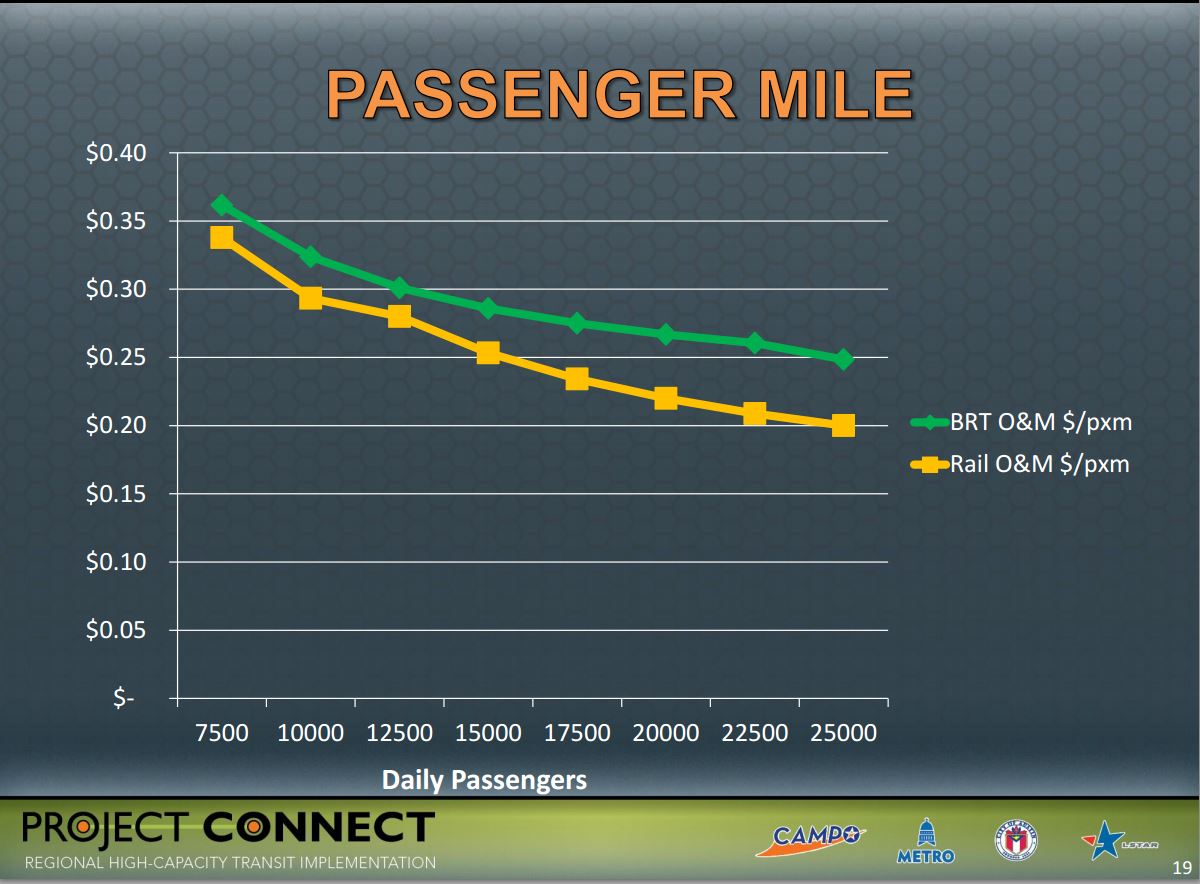
General community meetings would dispense with Project Connect’s “lecture-and-clicker” approach, and allow short presentations by staff followed by open public questions and comments at an open mike. These would be supplemented by true workshops and charettes (for which the Feb. 8th event gave a small taste of how this could work).

But don’t hold your breath — Project Connect’s leadership all along has seemed to have a firm idea of what it wants this process to propose, and doesn’t appear to be prepared to allow community input to divert it from its course.

h1

Viewpoint: Community action must clean up public agencies’ transportation planning mess

1 February 2014
Traffic congestion on North Lamar on morning of Jan. 27th, first day of full MetroRapid service. MetroRapid "rapid transit" bus can be seen in far distance at rear of traffic queue. Photo: Steve Knapp.

Traffic congestion on North Lamar on morning of Jan. 27th, first day of full MetroRapid service. MetroRapid “rapid transit” bus can be seen in far distance at rear of traffic queue. Photo: Steve Knapp.

By Mary Rudig

Mary Rudig is a Gracy Woods Neighborhood Association coach and editor of the North Austin Community Newsletter.

While I honestly don’t think it’s intentional, what I see in the recent developments with Project Connect is that Capital Metro and our transportation “experts” are continuing the same pattern government entities have always followed. Somebody at the top gets fixated on an idea, and that becomes the top-down policy for everything to do with transportation. Any thinking outside of the box is strongly discouraged.

When I moved to Austin in 1992, there was a fixation on downtown and all policy was designed to support this. Every bus route had to go downtown, and cross-connections, going around downtown to better connect destinations, and supporting the jobs/growth in the outer ring, were discouraged. This was followed by a series of other fixations — there was a change at the top, and Capital Metro became fixated on rail, going from one plan to another plan. Then came the fixation with the park-and-rides, and the Domain, and moving people from one activity node to another activity node (remember those days?). Then the fixation switched back to moving people to downtown. Again.

Now we have Project Connect, and the latest fixation is with bus rapid transit (BRT) and New Urbanism. New Urbanism will magically create a boom of jobs and housing east of I-35 very, very soon. BRT is the magic pixie dust that City Council has been looking for to fix all our woes. And all this is great — until 2015 when the new City Council takes over and another idea is put forward to be the new magic pill.

The problems though, are the same.

North Lamar/Guadalupe, the backbone of our city, is congested and constrained.

• The outer ring of neighborhoods don’t want to go to downtown, they want to go to their jobs and make cross-connections.

• The other cities in Central Texas need to get people into Austin, in a cost-effective way that won’t put a too high burden on them, because they are struggling to balance their growth needs with a tax base that just isn’t big enough yet.

• Large employers are not being held responsible for assisting with transportation solutions, such as providing shuttles and park and ride space, scheduling shifts away from peak times, flexing workers to work from home/remote offices, etc.

• The high-tech/IT jobs at the north end need more mixed transportation, and most of that transportation need is east-west.

• Many service workers are living either east of I-35 or moving to outlying communities because of the lack of affordable housing, and these populations need better transportation to get to their jobs, which again, are usually not downtown.

• We have huge gaps in how we are serving student populations outside of UT. We have absolutely no idea what the students at our vocational and smaller colleges need in the way of transportation because nobody has asked. ACC’s idea — to rotate campus populations in and out of Highland, so they can close and remodel other campuses — is both brilliant, and a transportation nightmare waiting for a place to happen.

• We are a city of small businesses, but we have barely cracked the shell with what this population needs. 80% of the city works for small business. Think about that — we don’t honestly know where 80% of our workers want to go, transportation-wise. The only study I know of that touches on this issue is the 2012 transportation study by Austin Chamber of Commerce.

• We must connect the urban core in North Austin to the urban core downtown, while figuring out a better way to shuttle people in and out of both of these cores.

Major North Austin neighborhoods. Map: LoveNorthAustin.com.

Major North Austin neighborhoods. Map: LoveNorthAustin.com.

I think Scott Morris (Central Austin Community Development Corporation) and Lyndon Henry (Light Rail Now Project) have made a good start — pick the spine, explore if we can fix it with rail or not, and then maybe we can use the coalition we have built to begin to address these other issues.

Capital Metro and CAMPO and the rest are never going to get their act together, people, because they are too busy worrying about the latest directive from the top. So it’s up to us to fix the mess they have made.

h1

Contradicting local official claims, FTA says it “would consider request” for urban rail on North Lamar

1 February 2014
MetroRapid bus (left) and simulation of urban rail (right). Actual FTA view expresses openness to consider replacing MetroRapid service with urban rail in North Lamar corridor. Photo: L. Henry; simulation: COA.

MetroRapid bus (left) and simulation of urban rail (right). Actual FTA view expresses openness to consider replacing MetroRapid service with urban rail in North Lamar corridor. Photo: L. Henry; simulation: COA.

On December 12th, in the course of a contentious meeting, the Austin City Council endorsed Project Connect’s recommendation to pursue “high-capacity transit” in East Riverside and a narrow swath of area mostly northeast of the UT campus, dubbed the “Highland sub-corridor”. (See City Council to Central Austin: Drop Dead.) Present at this meeting was a long queue of critics of the proposal, and proponents of an alternative urban rail route in the “backbone” West Campus-Guadalupe-Lavaca corridor.

Over previous months, Project Connect and its partisans had repeatedly insisted that Capital Metro’s new MetroRapid bus service in the Guadalupe-Lamar corridor – because it was funded by the Federal Transit Administration (FTA) – was an impenetrable barrier to urban rail. In recent days, the argument had intensified, with solemn declarations that even raising the issue of replacing MetroRapid bus with urban rail might so incense FTA that all future federal funding could be jeopardized.

Thus, in this context, earlier in the December 12th Council meeting, anticipating a barrage of criticism over the rejection of the Guadalupe-Lamar corridor, Councilman Mike Martinez (also chairman of Capital Metro) took the opportunity to make a special announcement, evidently intended to steal a march on Guadalupe-Lamar proponents. Word from the FTA had just come in, he intoned, that the agency considered Metro Rapid an absolutely “permanent” investment, and therefore a daunting obstacle to its replacement by rail.

From the City of Austin transcript, the following are Councilman Martinez’s remarks (for readability, edited for spelling, grammar, and punctuation):

I wanted to read a response from FTA that Capital Metro received this afternoon in a meeting with them in Fort Worth. This is an FTA official that … his response to the question about the high-capacity transit that is already going in, the BRT in the Lamar corridor.

His response was: BRT in the North Lamar corridor is a priority transit project. The project was supported by the region through CAMPO. Capital Metro and FTA signed a contract to this effect. FTA sees their investment as permanent.

It is important to consider that there are many demands for federal funds on new starts and small starts [projects]. and FTA made a permanent investment in this [corridor]. If Capital Metro were to come back to FTA and indicate there is a change in priorities or new need in this corridor, Capital Metro, CAMPO and the community would need to go through the entire planning process again to show that urban rail is the highest priority for this corridor.

That to me is a pretty definitive statement from FTA that it would be difficult, if not impossible, to go back through the process and receive new start money in that corridor. They view the current investment as permanent.

City of Austin transcript excerpt with Councilmember Mike Martinez's Dec. 12th remarks on FTA, MetroRapid, and urban rail for North Lamar. Screenshot: L. Henry.

City of Austin transcript excerpt with Councilmember Mike Martinez’s Dec. 12th remarks on FTA, MetroRapid, and urban rail for North Lamar. Screenshot: L. Henry.

While the FTA statement, as read orally, seemed less of a definitive and absolute rejection of an urban rail alternative in the Lamar corridor than Councilman Martinez portrayed it, as it turned out, further examination or evaluation of the statement was not immediately possible because a printed copy was not made available to the public for scrutiny. Instead, it took a Public Information Request by Scott Morris of the Central Austin Community Development Corporation, and over 40 days, before the actual FTA statement was made available, in the original form provided to Councilman Martinez.

The FTA’s views, as communicated orally to Capital Metro’s representative Ken Cartwright, are summarized by Capital Metro in an internal document available by download from ARN. As this document indicates, Capital Metro raised the issue: “We have been approached about the possibility of putting an urban rail investment in the North Lamar corridor where we already have the BRT investment.”

FTA’s oral (“verbal”) response is summarized:

The Austin community decided that bus rapid transit in the North Lamar corridor was a priority and the next need. The project was supported by the region through CAMPO. Capital Metro and FTA signed a contract to this effect. FTA sees their investments as permanent. However, if the Austin community were to come back to FTA and indicate that there has been a change in priorities or a new need in this corridor, FTA would consider the request. Before making this request, Capital Metro and the community would need to go through the entire planning process again to show that urban rail is the highest priority in this corridor. It is important to consider that there are many demands on federal funds for New Starts and Small Starts projects, and FTA has already made a permanent investment in this corridor.

Of particular interest is FTA’s assurance that “FTA would consider the request” for urban rail if Capital Metro and the Austin community were able “to show that urban rail is the highest priority in this corridor.”

FTA's actual statement, summarized in CMTA memo provided to Councilmember Martinez. Screenshot from PDF by L. Henry.

FTA’s actual statement, summarized in CMTA memo provided to Councilmember Martinez. Screenshot from PDF by L. Henry.

Clearly, the FTA’s actual statement on the issue of replacing MetroRapid service with urban rail is considerably more encouraging than the interpretation verbalized by Councilmember Martinez during the highly polemical Dec. 12th City Council debate on rejecting the Guadalupe-Lamar corridor and endorsing Project Connect’s recommendation for a less centrally located route for “high-capacity transit”. This basically corroborates the position expressed by Austin Rail Now.

See:

MetroRapid bus service should be a precursor to urban rail, not an obstacle!

Why the MetroRapid bus project currently is NOT an obstacle to urban rail in Guadalupe-Lamar

Bottom line: FTA’s actual statement offers a far more propitious prospect for FTA support of urban rail in this crucial core-city corridor.

h1

Baker: What’s behind the switch from urban rail to “BRT”?

24 January 2014
Roger Baker speaks to CAMPO committee, 14 Nov, 2011. Screengrab from YouTube video by Winter Patriot.

Roger Baker speaks to CAMPO committee, 14 Nov, 2011. Screengrab from YouTube video by Winter Patriot.

Under the leadership of Kyle Keahey, designated in early 2013 as Urban Rail Lead, Project Connect’s former “urban rail” planning has morphed into “high-capacity-transit” planning — apparently moving away from urban rail and toward embracing so-called “bus rapid transit” (“BRT”) as its new mode du jour. Represented by Capital Metro’s new MetroRapid bus operation, the newly favored “BRT” is in reality merely a version of ordinary limited-stop bus service modestly upgraded with extra features like traffic signal prioritization, nicer stops, nicer and larger buses with amenities like Wi-Fi … but it’s not rapid transit. (And may even represent an overall degradation of service in the corridor.) See: Why MetroRapid bus service is NOT “bus rapid transit”.
In this commentary, Roger Baker provides a perspective of background and analysis helping explain why Project Connect, the City of Austin, and Capital Metro seem to be now leading Austin’s rail planning way off the rails and not merely into a ditch, but over a cliff.

By Roger Baker

Austin has persistently lacked a strong progressive populist voice, like a crusading newspaper, willing to dig in and take sides against the prevailing business interests. Even though Austin is liberal compared to Texas, we have an unprincipled Democratic mayor willing to make Toronto’s discredited right-wing mayor Rob Ford an honorary citizen, and equally willing to cut sleazy deals with local business interests tied to certain favorite rail alignments and other official projects.

At the top of state politics, we have Gov. Rick Perry’s climate change deniers and transportation cronies running TxDOT, trying to attract cheap-labor jobs, and to maintain profitable suburban sprawl development, which is creating huge budget shortfalls at TxDOT.

The proceeds from land development as usual are disappearing into the Hip Pocket National Bank.

If we had adult supervision and rational enforcement of sound transit planning on the federal level, coming from the Federal Highway Administration (FHWA) and Federal Transit Administration (FTA), we might be in good shape. But what mid-level federal officials are willing to lose their jobs by crossing the Republicans who run our state for the benefit of the landed gentry?

Austin is also facing a water crisis, likely even more serious than California’s, since Austin’s water comes from now bone dry West Texas. Our daily paper has admitted that we face a water crisis, but without ever mentioning global warming or climate change.

Given all this, special-interest-oriented light rail planning tends to prevail, and the public doesn’t have easy media access to good analysis of rail corridor alternatives.

A likely reason that Austin transportation planners are now redirecting their focus toward BRT instead of rail, is that the special interests involved have run voter polls and see that an urban rail election (required to approve local bond funding) is likely to fail, and they are hedging their bets. Five years from now maybe average folks will get frustrated enough with Austin’s already severe congestion to be broadly supportive of rail, but for now an election might not succeed. Also, our rail-hating opponents are aligned with the Texas road lobby who want roads to complement the current Austin growth boom.

Our six-county MPO, CAMPO, is doing a $32 billion transportation plan that would put 70% of our year 2040 population growth (supposedly doubled by then) in the five counties ringing Travis County, the county which includes Austin. This is like a prescription for an extreme suburban sprawl land use future, which by its nature is road-dependent low-density development that can’t be served efficiently by transit.

This plan can’t work, but the idea is to get federal approval to channel our shrinking fuel tax revenues toward roads to serve sprawl development, before the shortcomings become apparent.