Posts Tagged ‘Lamar-Guadalupe’

h1

UT Student Government backs West Campus, Guadalupe-Lamar route for first phase of urban rail

12 October 2013
West Campus neighborhood is area in light green just to west (left) of the Drag (Guadalupe, vertical white line just to right of center). UT campus shown in orange. Map: The Galileo, rev. by ARN.

West Campus neighborhood is area in light green just to west (left) of the Drag (Guadalupe, vertical white line just to right of center). UT campus shown in orange. Map: The Galileo, rev. by ARN.

The effort to reset Austin’s urban rail planning focus onto the Guadalupe-Lamar (G-L) corridor got a huge boost on October 1st with the University of Texas Student Government’s passage of a resolution endorsing a West Campus and Guadalupe-Lamar corridor alignment for the Phase 1 starter line of urban rail — thus implicitly rejecting the officially proposed East Campus alignment and route out to the Mueller redevelopment site.

Designated as AR 15, the resolution contains a number of “Whereas” clauses, with meticulous documentation of the facts and arguments underpinning the basic decisions. For example, the resolution notes that

…Future-use plans for neighborhoods that include significant student populations, including the Brentwood/Highland Combined Neighborhood Plan , the North Loop Neighborhood Plan, Central Austin Combined Neighborhood Plan, and Hyde Park Neighborhood Plan support urban rail and stations along the proposed Guadalupe-Lamar alignment; and,

… there has been over $30 million worth of studies that have looked at the feasibility of light rail transit along the Guadalupe-Lamar Corridor since the 1970s; and,

… A 2011 study at the University of California-Berkeley found that “light-rail systems need around 30 people per gross acre around stations and heavy rail systems need 50 percent higher densities than this to place them in the top one-quarter of cost-effective rail investments in the U.S.” and “the ridership gains from such increases…showed, would be substantial, especially when jobs are concentrated within ¼ mile of a station and housing within a half mile”; and,

… the largest concentration of students living off campus, West Campus, is the third-densest population district in the state of Texas with a density of over 25,000 people per square mile; and,

… a large majority of the student population along with a vast majority the Central Austin population lives along the proposed Guadalupe-Lamar alignment, totaling over 54,000 people within a quarter-mile to proposed stations ….

On the basis of this evidentiary background, declares the resolution,

BE IT RESOLVED, That the Student Government of the University of Texas at Austin is in full support of the first phase of light rail running through the Guadalupe-Lamar Sub-Corridor; and,

BE IT FURTHER RESOLVED, That Student Government will support any proposed urban rail line that prioritizes transportation access to where students are currently living….

The full resolution can be accessed as a DOC file:

UT-Stu-Govt_AR 15 – In Support of The Guadalupe-Lamar SubCorridor as Phase I of Austin Urban Rail

Certainly, if this vote by UT’s Student Government is any guide, the majority of UT students want an urban rail route to serve the West Campus, where they can most effectively use it.
h1

How urban rail can be installed in the Guadalupe-Lamar corridor

10 October 2013
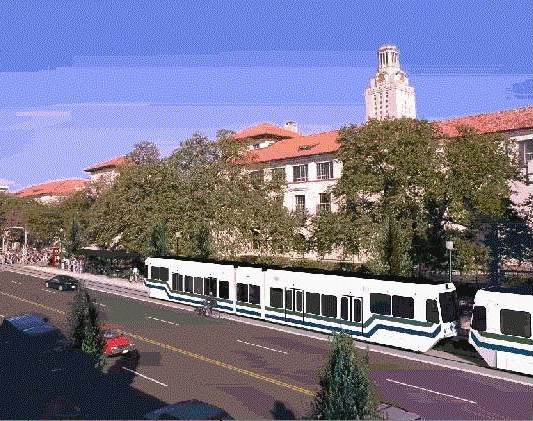
Except for the the somewhat clunkier styling of the railcars, this 2000 simulation of what light rail transit might look like on the Drag is not that different from one of the options today. Graphic: Light Rail Now collection.

Except for the the somewhat clunkier styling of the railcars, this 2000 simulation of what light rail transit might look like on the Drag is not that different from one of the options today. Graphic: Light Rail Now collection.

by Lyndon Henry

Some supporters of the Guadalupe-Lamar (G-L) corridor for Austin’s urban rail starter line have been seeking details about how urban rail (i.e., light rail transit, or LRT) would be installed in these thoroughfares — running in mixed traffic, in reserved lanes, or how? At about the same time, proponents of the Official (aka City of Austin-Capital Metro) proposal for an urban rail line from downtown to Mueller have recently begun raising the issue of right-of-way (ROW) constraints in this same G-L corridor.

It’s important to keep in mind that the Mueller proposal itself has its own ROW constraints and other challenges, but I think it would be helpful here to address some of the issues in the G-L corridor. One of the reasons for this is that I’m not convinced that all parties in the Project Connect team will necessarily make a good-faith effort to find a truly workable, affordable design for inserting urban rail into the G-L thoroughfare alignments — and advocates need to be prepared to insist that valid (and proven) alternatives be examined.

The basic idea is for urban rail (light rail transit, LRT) to operate totally, or almost entirely, in its own lanes. This would require some reconstruction of Lamar Blvd. and probably Guadalupe St. in sections, including slight narrowing of existing lanes, elimination of the turning (“chicken”) lane and replacement with transit-integrated traffic controls (such as left turn lanes), and other measures. Light rail systems in places like Portland, Dallas, Houston, Phoenix, Denver, Salt Lake City, etc. are models for this.

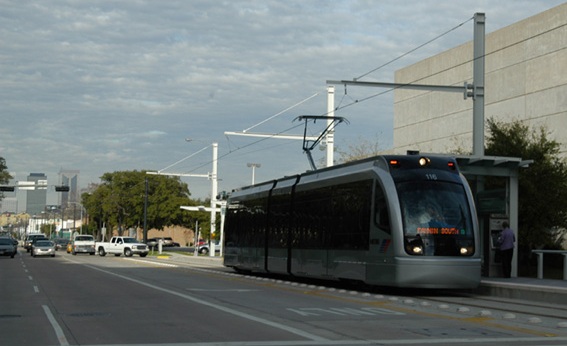
Having crossed intersection, Houston LRT train accesses station on Fannin St. as traffic control system allows queue of motor vehicles to make left turn over track reservation behind it.

Having crossed intersection, Houston LRT train accesses station on Fannin St. as traffic control system allows queue of motor vehicles to make left turn over track reservation behind it. Photo: Peter Ehrlich.

Also keep in mind that Project Connect’s longer-range plan for buses on Lamar-Guadalupe is to install tens of millions of dollars’ worth of reserved lanes — so official planners are already prepared to bite a bullet on this basic issue. What advocates of urban rail in the G-L corridor are saying is that it makes a lot more sense to install reserved lanes for rail rather than buses.

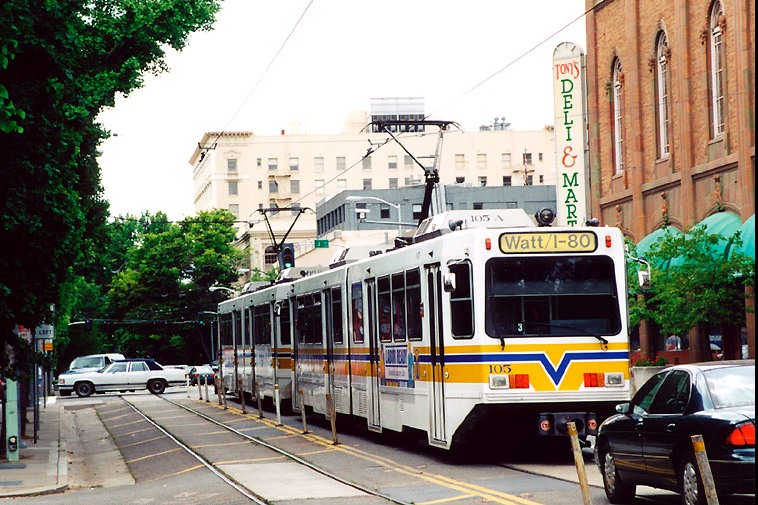
It’s possible that there might be a short section of LRT in mixed traffic (one or both tracks). Sacramento’s LRT operates with this kind of compromise (for about a mile along 12th St., approaching the city’s downtown from the northwest), and has done so for the past 26 years — see Advantages of Light Rail in Street Alignments.
https://austinrailnow.wordpress.com/2013/04/22/advantages-of-light-rail-in-street-alignments/

Sacramento's LRT shares one lane with traffic along 12th St.

Sacramento’s LRT shares one lane with traffic along 12th St.

There’s a very narrow section on the Drag (especially in the 24th-29th St. area) that might require, totally or partially, something like an interlaced (“gauntlet”) track (i.e., two tracks overlapping each other). This would operate effectively like a single-track section but could be fitted into 5-minute headways and possible shorter. (In Amsterdam, interlaced track is even used with 2-minute headways. More on this rail design configuration in a subsequent posting.)

Further downtown, south of MLK Blvd., it would be logical for the double-track line on Guadalupe to split into two single-track lines — southbound on Guadalupe, northbound on Lavaca St. However, it’s likely that LRT would need its own priority lanes in these streets.

Here’s why: The “Transit Priority Lanes” now being installed on the Lavaca and Guadalupe street pair already seem to present major problems for MetroRapid bus, much less LRT. The reason: Official plans involve inserting MetroRapid into a single lane each way along with well over two dozen bus routes. The City’s own 2011 study of this warned that delays to transit might result. And that’s even before urban rail comes along.

It seems eminently reasonable that LRT would need its own reserved lanes on the opposite side of each street (Lavaca and Guadalupe) from the bus lanes. It’s possible that urban rail could perhaps share lane use with MetroRapid, but not with all those other routes.

Since MetroRapid buses can operate only on the righthand side of the street, these buses (with righthand-side doors) couldn’t share a “lefthand” lane with urban rail on the opposite side of each street. So the solution seems to come down to reserving an additional lane exclusively for urban rail on each street.