

[Huge bus jam on Brisbane, Australia’s busway illustrates one of the major problems of trying to deploy relatively lower-capacity buses in a rapid transit role. Photo, 2008: James Saunders.]
♦
In a previous posting, we mentioned a commentary prepared by Lyndon Henry for a presentation to the Transit Working Group on 27 January 2012, Urban Light Rail vs. Limitations of RapidBus.
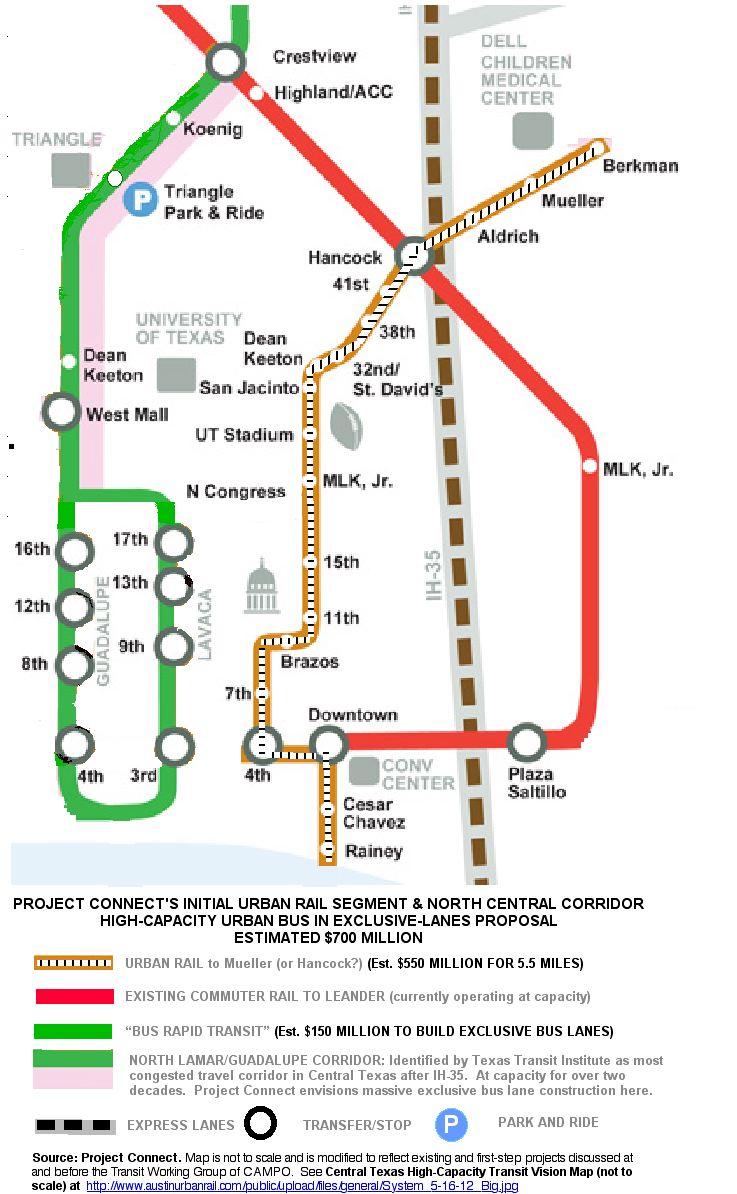
This presentation and commentary addressed the issue of RapidBus (aka “Bus Rapid Transit”) as the City of Austin’s longer-term alternative to rail transit in the Lamar-Guadalupe corridor. The commentary argued that RapidBus (which, it emphasized, is not “rapid transit”) should be considered not a replacement, but a precursor to electric light rail transit (LRT) in the corridor, and indicated a number of considerations for ensuring this:
♦ RapidBus (“MetroRapid”) in Lamar-Guadalupe should be precursor to light rail
• Design for conversion to rail — make sure location and design of facilities are compatible
• Keep investment minimal — heavy bus facility investment is obstacle to rail conversion
• Modular, movable stations — bus and rail station placement and platforms may differ
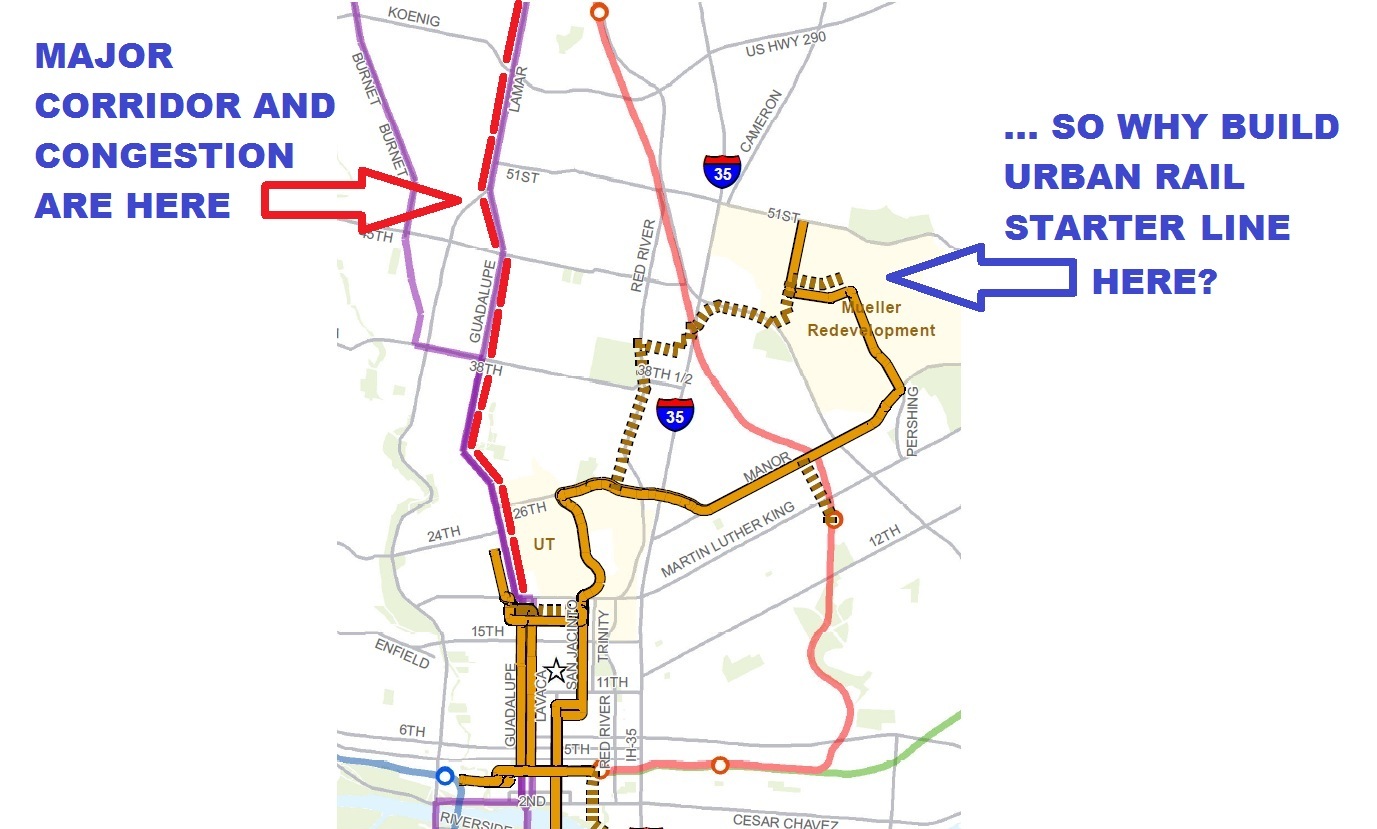
• Plan relocation to serve Mueller and San Jacinto corridor — RapidBus can then become precursor to rail in these alignments
The commentary then focused on the drawbacks of RapidBus (or “BRT”) in comparison with LRT, emphasizing that even these high-quality bus service fail to provide the service and performance capabilities of rail:
♦ Limitations of RapidBus vs. electric light rail
• Not “BRT” — RapidBus is not “bus rapid transit” … but even “BRT” would have problems
• Lower ridership — nowhere nearly as attractive to public, resulting in much lower ridership
• Minimal to no TOD — bus facilities have very little attraction to developers
• Less capacity — even articulated buses have much less capacity and can’t be entrained
• Lower speed — lower acceleration means slower schedules, more buses needed
• Higher unit operating cost — more buses, slower schedules, drivers for every bus = high cost
• Street crowding — many more buses (than railcars) mean more vehicles crowding streets
• Slower passenger boarding — constricted doors and aisles mean slower boarding/deboarding
• Less space — buses provide less space per passenger, thus more crowded conditions
• Rougher, less reliable ride — poor ride quality, plus less perceived reliability and safety for public
• Problems for ADA passengers — buses (not railcars) have boarding problems and need tiedowns
• Petroleum fuel — less efficient and versatile, and more costly than electric propulsion (for rail)
• Higher fuel costs — diesel fuel costs will skyrocket as supply dwindles from Peak Oil syndrome
• Emissions — unlike electric rail, diesel or gas buses directly emit fumes with GHGs
The original handout, in Word .DOC format, can be accessed via this link: Urban Light Rail vs. Limitations of RapidBus.


 _______________Austin Rail Now