Posts Tagged ‘austin urban rail’

h1

Austin Business Journal guru slams Highland-Riverside urban rail proposal as “a very small plan benefiting a limited group of people”

6 June 2014
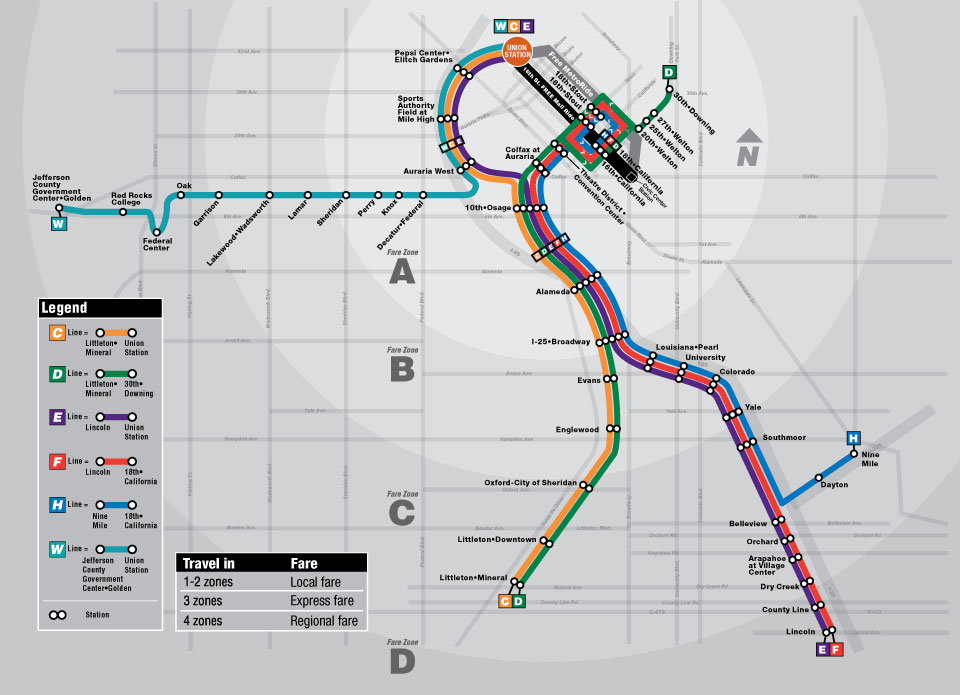
Because design and implementation dollars have been invested wisely, Denver’s light rail system increasingly resembles a network that’s expanding to serve more crucial corridors in the region. High ridership has also attracted transit oriented development (TOD) near stations, helping influence urban growth patterns. Map: RTD.

Because design and implementation dollars have been invested wisely, Denver’s light rail system increasingly resembles a network that’s expanding to serve more crucial corridors in the region. High ridership has also attracted transit oriented development (TOD) near stations, helping influence urban growth patterns. Map: RTD.

For the most part, Austin’s business and civic elite seem to have closed ranks around Mayor Lee Leffiingwell (“The Lee Team”) and his administration’s efforts to promote a very pricey 9.5-mile, $1.4-billion urban rail project widely suspected to be concocted more as a giveaway to the development ambitions of the University of Texas and a faction of private developers, and less as a remedy for alleviating Austin’s most serious mobility deficits. Included in this “business and civic elite” is virtually the entirety of the local media establishment.

Jan Buchholz. Photo: Austin Business Journal.

Jan Buchholz. Photo: Austin Business Journal.

But occasionally there are fractures in this ostensibly solid consensus, and one of these is represented by Jan Buchholz, an Austin Business Journal staff writer who seems to have the professional role of a de facto guru specializing in real estate market happenings. In a May 7th column, comparing urban development and transportation in Denver and Austin, she seems very favorably impressed with Denver, a model from which Austin, in her estimation, falls far short.

“Rejuvenated neighborhoods are cropping up across Denver and development is being defined in many instances by the evolution of public transit” she writes. But unfortunately, “This dynamic does not exist in Austin to any great degree, and there’s little evidence that transit will play a significant role here any time soon.”

The reason? Mainly that Project Connect’s urban rail plan is pretty crummy:

The latest rail plan rolled out … is a $1.4 billion project that will run from Highland Mall to East Riverside Drive. Already, folks are decrying its high cost, but I don’t think it’s the cost that’s the real issue. It’s the fact that it’s a very small plan benefiting a limited group of people. That makes this price tag hard to swallow.

One of Buchholz’s gripes is that the proposal, which runs a short way southeast, ends way short of the region’s ABIA airport. And while local politicians are talking about “sweetening” the urban rail ballot measure with some dollops of highway projects, Buchholz doesn’t feel the highway capacity element is enough. (For the record, Austin Rail Now believes the Austin area’s emphasis on highway expansion is excessive, and should be ended.)

In regard to Denver’s urban rail development, Buchholz admires how the Mile-High City has prudently and energetically installed and expanded its system:

During the past 20 years, the Denver Regional Council of Governments — with support from a wide spectrum of stakeholders from government officials to businesses and residents — has embraced a huge vision for transportation improvements across the five-county metro area. It was never an easy sell, but for the most part taxpayers have supported the expensive, time-consuming and often inconvenient plan.

… The light rail is fully built out to the south, southeast and western suburbs. Construction is in progress for the light-rail line from downtown Denver to Denver International Airport, and another line will be built to the northwest suburbs.

Rejuvenated neighborhoods are cropping up across Denver and development is being defined in many instances by the evolution of public transit.

This dynamic does not exist in Austin to any great degree, and there’s little evidence that transit will play a significant role here any time soon.

What’s critical to understand is that, from the start, Denver planners and political honchos realized that resources were scarce and that the region’s first light rail transit (LRT) — i.e., urban rail — starter line had to be located where it would get the proverbial “best bang for the buck”. And they also realized that, to influence developers’ decisions and encourage transit-oriented development (TOD), rail lines would need to be routed to maximize ridership.

Yes, most rail stations often do attract some adjacent development. But it’s the potential volume of ridership — i.e. the traffic on the line — that carries the most influence on private developers’ decisions. The more people, the more residents and customers at your development, which in turn becomes more attractive in the real estate market.
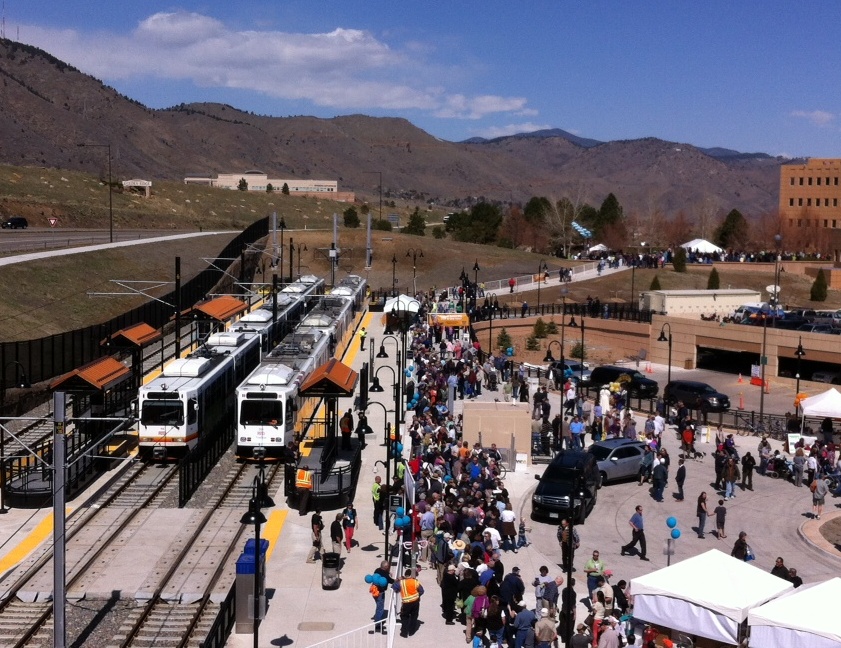
Opening day of Denver's West Line light rail extension to Golden, Colorado, April 2013. Photo: David Warner.

Opening day of Denver’s West Line light rail extension to Golden, Colorado, April 2013. Photo: David Warner.

Key to urban rail expansion is conserving financial resources and deploying them wisely. Relatively lower outlays in the initial installation and operation of a new system means more funding available for expansion. So Denver started with a minimalist, 5.3-mile route from a northeastern neighborhood, proceeding down a busy corridor, via both street-running and a railway alignment, through a major commercial district, into the CBD, including a multi-institution university complex.

In 1994, they did that for $115 million. In 2014 dollars, about $37 million a mile. Compare that with Project Connect’s extravagant plan, including a tunnel and below-ground station, plus a “signature” bridge, at $119 million a mile. And Project Connect’s plan doesn’t even serve a major travel corridor!

Partly because they’d conserved financial resources, and partly because of the “big bang for the buck” effect that galvanized popular support, Denver’s Regional Transportation District (RTD) was able to embark on the vigorous urban rail expansion and TOD development program that so impresses Jan Buchholz. As a result, Denver’s light rail ridership mushroomed from 15,000 in 1994 to 86,900 a day by the end of 2013 — a nearly five-fold increase.

But Denver’s approach to urban rail has been virtually the polar opposite of Austin’s. Project Connect’s extravagantly wasteful billion-dollar starter line, with its peculiar, head-scratching route structure and high-dollar infrastructure, has divided potential urban rail supporters, pitting pro-rail community members and neighborhoods against one another in a way the pro-highway, anti-transit Road Warriors never could.

And the results are apparent in potential ridership. An alternative route for urban rail, long proposed for the heavily traveled, busy, dense Guadalupe-Lamar corridor, serving the high-density West Campus of the University of Texas, has been forecast to attract six times as much ridership as Project Connect’s meandering, peripheral line — at about 20% lower capital cost.

The prospects for voter approval of municipal bonds to finance Project Connect’s project are not sanguine. As Buchholz points out,

No one wants to be nickel and dimed to death for a mediocre and limited public transit system. Add to that the public perception that the MetroRail from Leander to downtown has been only marginally effective and has been fraught with issues from the get-go. Combine those two factors and this latest plan doesn’t have a chance for ever leaving the station.

If Austin has any hope of matching urban development and public transport successes like Denver’s it needs to start with an affordable urban rail starter line that makes sense. This notion seems to have “Lamar-Guadalupe-West Campus” written all over it.

h1

Project Connect’s Austin urban rail would be 3rd-most-pricey LRT starter line in U.S. history

8 May 2014

0_ARN_money-flying-away

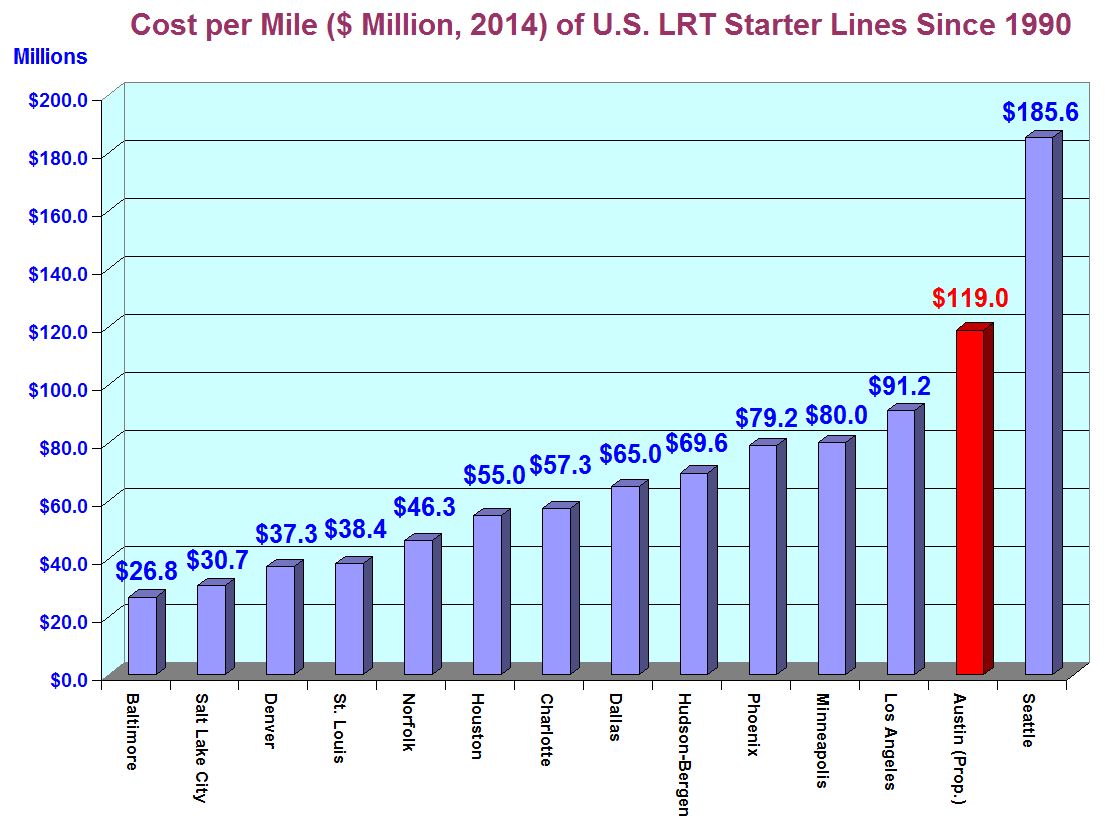
Project Connect’s urban rail plan for Austin, if implemented, at $119 million per mile in current dollars, would be the third most costly light rail transit (LRT) starter line in U.S. history, in terms of cost per mile.

That’s a conclusion Austin Rail Now draws from results emerging from a recent study posted on the Light Rail Now blog, plus other available data. The LRN study, reported in an article titled New U.S. light rail transit starter systems — Comparative total costs per mile, researched the cost per mile of a dozen new “heavy-duty” (as opposed to streetcar-type) LRT starter lines installed since 1990. In 2014 dollars, these range in investment cost from $26.8 million per mile (Baltimore, opened 1992) to $185.6 million per mile (Seattle, opened 2009).

Project Connect’s urban rail proposal

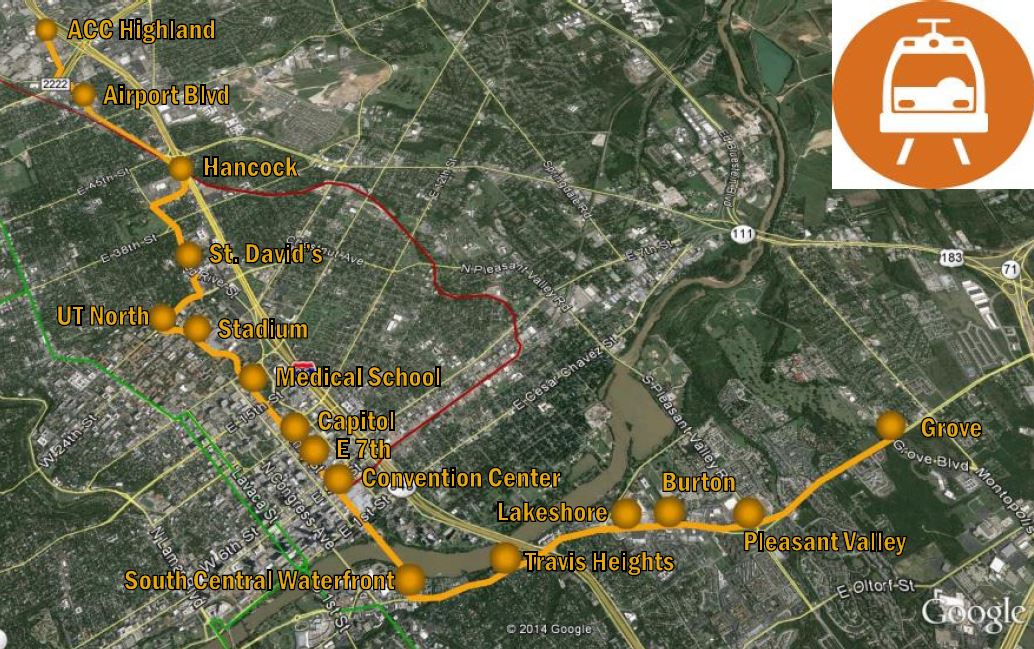
Project Connect revealed their proposal for urban rail (see map below) at a meeting of the Central Corridor Advisory Group (CCAG) on May 2nd. The 9.5-mile project comes with a pricetag of $1.13 billion in current dollars, escalating to $1.38 billion in Year of Expenditure (YOE) dollars by 2020, for a projected ridership in the range of 16,000-20,000 per day.

Project Connect's proposed line, criticized for avoiding Austin's central axis and most serious mobility needs, would run 9.5 miles from the Highland site (north) to a terminus on East Riverside (southeast). Map: Project Connect.

Project Connect’s proposed line, criticized for avoiding Austin’s central axis and most serious mobility needs, would run 9.5 miles from the Highland site (north) to a terminus on East Riverside (southeast). Map: Project Connect.

The proposal invites comparison with the plan for light rail in the Guadalupe-Lamar corridor (see Austin’s 2000 light rail plan — Key documents detail costs, ridership of Lamar-Guadalupe-SoCo route). When compared, Project Connect’s $1.4 billion plan can be seen to cost 29% more than the previous Guadalupe-Lamar line would cost today, yet provide 35% less route length, and 47% fewer riders.

To finance such a plan through general obligation bonds, according to an April 29th Austin American Statesman report, Austin homeowners would face a substantial increase in property tax, estimated to range between $77 to $153 per year for a “typical” $200,000 home. That estimate was based on financing a $965 million project, about 85% of the actual size of the project now on the table.

Even if the Federal Transit Administration agrees to fund half the project cost, city officials and civic leaders are considering “bundling” the rail proposal with several hundred million dollars for additional road projects. The result could be a substantial 67% increase in Austin’s debt load per capita.

Urban rail cost comparison

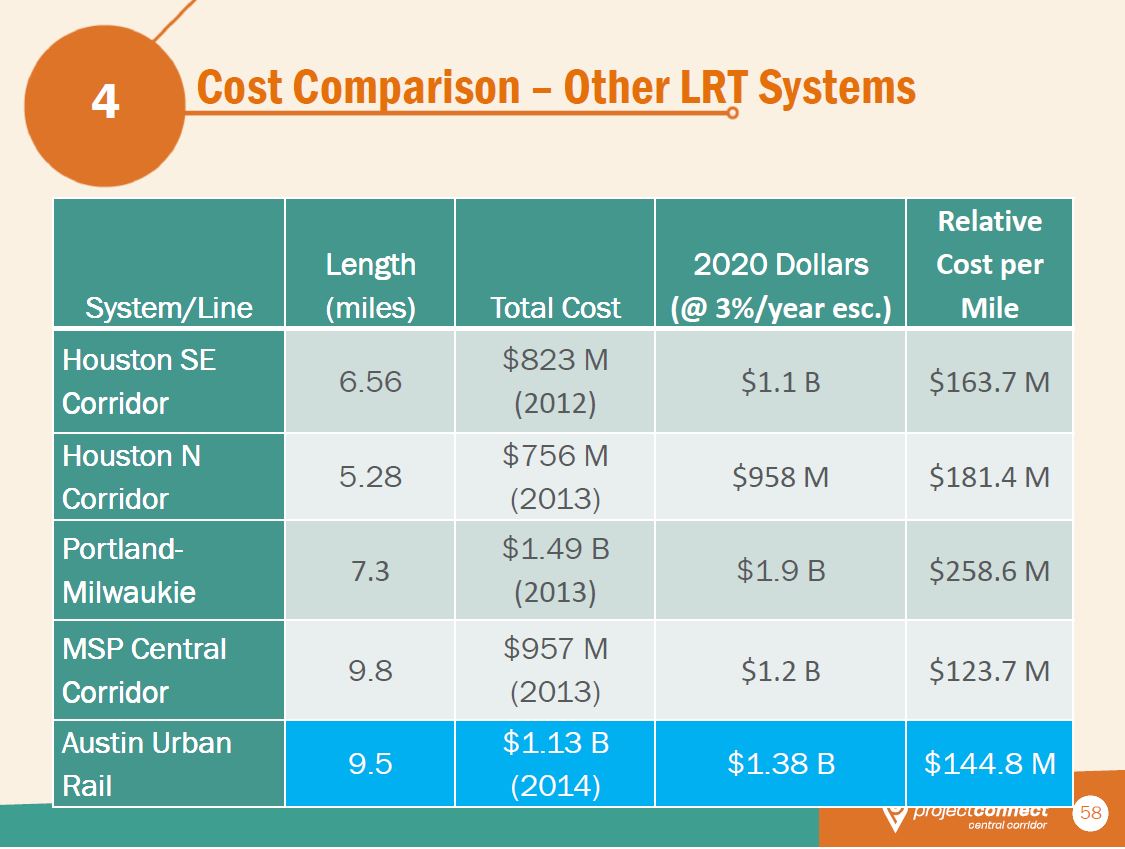
At the May 2nd CCAG meeting, Project Connect’s Urban Rail Lead Kyle Keahey assured his audience that the investment cost of the 9.5-mile proposal was quite comparable with recent similar projects, particularly in cost per mile, with the chart shown below as evidence:

3_ARN_ProCon_LRT-cost-comparison

However, there’s a serious problem with this comparison — it compares the proposed starter line for Austin with extensions of these several well-established LRT systems, each of them contending with the much more difficult urban and terrain conditions that are typically avoided and deferred in the process of selecting routes for original starter systems. A far more valid cost comparison would evaluate the cost of starter system projects, thus offering better “apples-to-apples” cost equivalence.

That’s because, in designing a starter line — the first line of a brand-new system for a city — the usual practice is to maximize ridership while minimizing costs through avoiding more difficult design and construction challenges, often deferring these other corridors for later extensions. In this way, the new system can demonstrate sufficient ridership and other measures of performance sufficient to convince both local officials and the public that it’s a success from the standpoint of being a worthwhile investment. Thus, comparing the cost of Project Connect’s 9.5-mile project with that of similar U.S. starter lines enables a better evaluation of the Project Connect project in terms of transit industry Best Practices.

Placing the per-mile cost of Project Connect’s proposed line in the cost listing from the recent LRN study affords such a comparison, as shown in the chart below (click to enlarge).

4_ARN_Chart_US-LRT-starter-lines-cost-per-mi_rev2

It’s evident from this comparison that Project Connect’s proposed project for Austin would rank as the second most costly U.S. starter line, in cost per mile, since 1990.

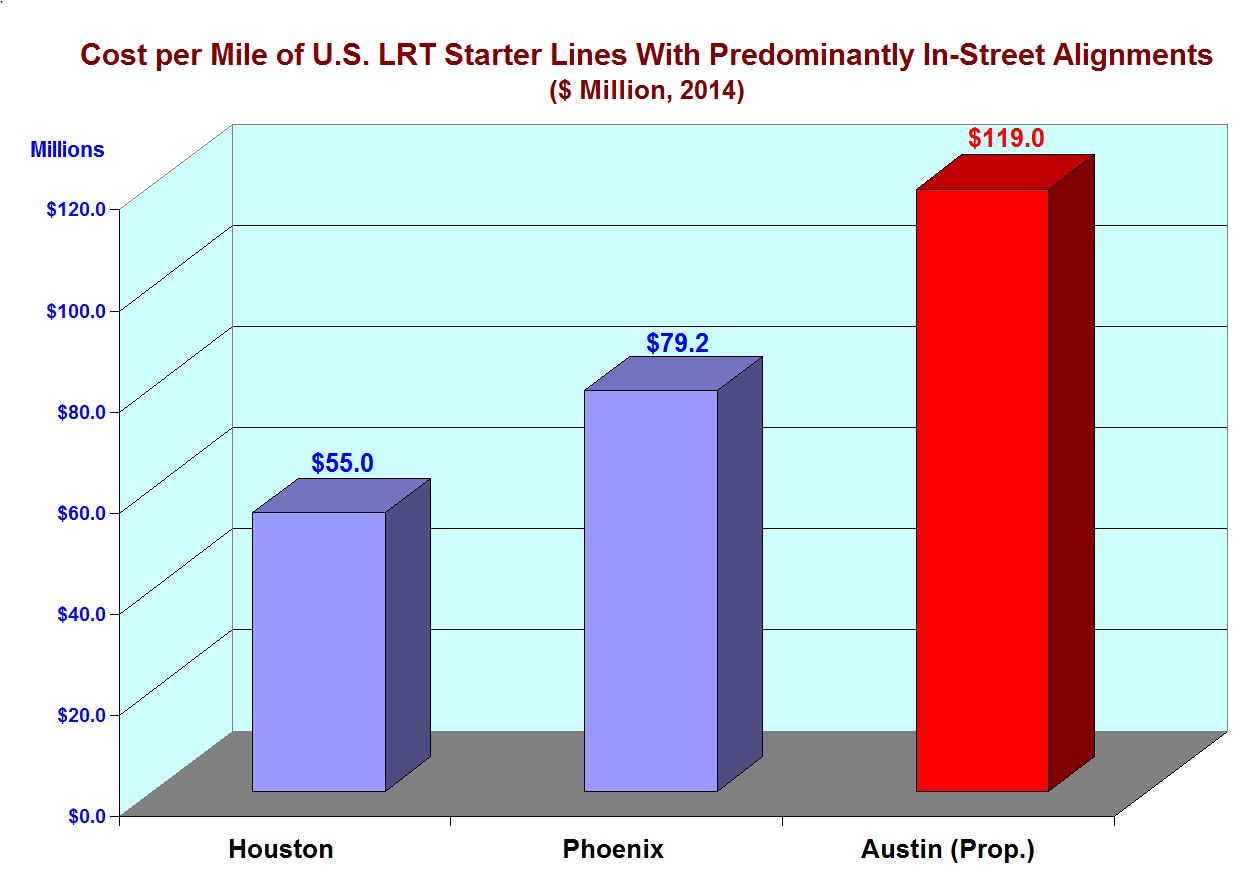
But several of these starter lines benefited from the less challenging, lower-cost advantage of being installed in existing railway rights-of-way. Project Connect’s 9.5-mile line would use predominantly paved trackage embedded in existing streets and arterials. Of the new systems tabulated since 1990, only Houston and Phoenix feature comparable in-street alignments.

To evaluate cost in terms of type of type of alignment, Austin Rail Now has compared Project Connect’s proposed line with these other two systems. The results are displayed in the chart below (click to enlarge).

5_ARN_Chart_US-LRT-starter-lines-in-street-cost-per-mi

It’s clear that Project Connect’s proposed line is significantly more expensive, in cost per mile, than either of these similarly constructed in-street starter lines in considerably larger urban areas than Austin.

Finally, how would Project Connect’s urban rail plan rank among all U.S. LRT starter lines for totally new systems in the modern rail transit era? By far, the most expensive LRT project has been Buffalo’s 6.4-mile Metrorail line, constructed 81% in subway and opened in 1985. Based on a cost analysis prepared by Alan Hoback for the 2008 Annual Meeting of the Transportation Research Board, the cost of Buffalo’s starter line can be calculated as $228.9 million per mile in 2014 dollars.

Thus, Project Connect’s proposed line, in cost per mile among modern systems, would rank as the third most expensive light rail transit starter line in U.S. history. ■

h1

Austin urban rail: Unfortunate revelations from Project Connect’s April 12th “workshop”

14 April 2014
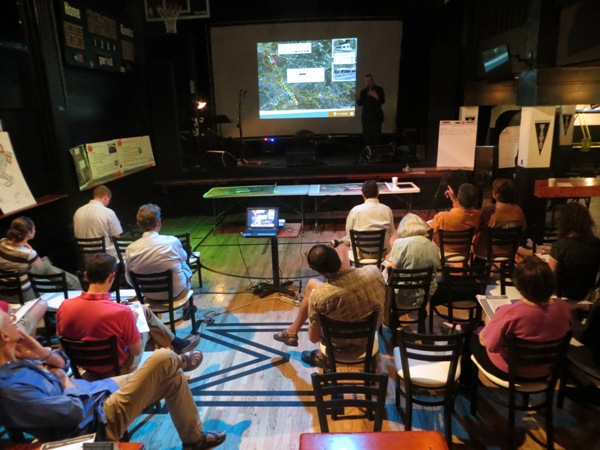
At April 12th "public workshop", attendees watch presentation from Project Connect Urban rail Lead Kyle Keahey. Photo: L. Henry.

At April 12th “public workshop”, attendees watch presentation from Project Connect Urban Rail Lead Kyle Keahey. Photo: L. Henry.

By Lyndon Henry

On Saturday, April 12th, Project Connect held an event they described as a “Central Corridor Public Workshop” at a location on East Riverside Drive. The notice for the event stated that Project Connect team members would be available “to provide an overview of the issues under study, gather input on maps and final alternatives and answer questions. Input gathered from the workshop will help develop potential transit projects for further study.”

Prior to the event, I prepared a number of questions I would like to have answered. I also disseminated these among other Austin public transit activists.

My questions are presented below, followed by feedback — some of it troubling — that I was able to receive from Project Connect personnel.


• Why are the public (who are expected to vote ultimate approval) being allowed only these rare, occasional, highly constrained opportunities to review and select from a narrow assortment of choices determined by the Project Connect team and officials? Why aren’t the public, through an inclusive community-wide technical committee, being given the opportunity to be involved in reviewing the basic data, interacting with the consultants, and formulating the choices themselves?

One Project Connect representative seemed to recognize the value of “an inclusive community-wide technical committee” in broadening the pool of possible alternative solutions to challenging issues. He suggested that names of possible candidates for such a group could be forwarded to him.

• Why is Project Connect still going through the motions of a purported high-capacity transit “study” to determine alignment and mode, and seek CCAG and Council approval for an LPA (Locally Preferred Alternative), when it’s already submitted $1.6 billion of URBAN RAIL projects for inclusion in CAMPO’s 2040 plan — including $275mn already projected for an initial route to Hancock to open in 2020? If URBAN RAIL and its details are already a foregone conclusion, why is taxpayers’ money and the time and effort of CCAG, the City Council, and other bodies being wasted on this?

A Project Connect representative’s explanation (consistent with arguments already reported in a newspaper account) was that the “urban rail” data were submitted as “placeholders” in CAMPO’s preparatory process for its 2040 regional transportation plan. However, since Project Connect has supposedly “zeroed out” its previous urban rail plans for central Austin, and within the current “high-capacity transit” study process no mode or specific alignment has yet been formally determined, why were specific “urban rail” projects inserted as “placeholders”, and not a more generic “high-capacity transit” designation? “That’s a good question” was the response.

The dollar amounts were described as mere “updates” of previous Project Connect cost estimates from approximately 2012. But at that time, no “Hancock-Highland” route was planned, so where did the $91.4 million cost for this segment come from? This was “another good question”.

• Why is $190mn in “BRT” infrastructure being proposed for Guadalupe-Lamar? Won’t this be a barrier to future urban rail?

Including $12.9 million allocated to “BRT” infrastructure on Guadalupe and Lavaca, the total for Guadalupe-Lamar “BRT” amounts to $202.9 million. A Project Connect representative was unable to say what specific infrastructure items this included, nor whether these would present a physical barrier to future urban rail.

• Why is a Guadalupe-Lamar route omitted from the $1.6bn urban rail submission to CAMPO’s 2040 plan?

I didn’t have a chance to raise this question directly, but a Project Connect representative insisted that urban rail as well as “BRT” and possibly other modes would be evaluated for future needs in this corridor.

• Why is this plan proposing a slow, tortuous, meandering route from downtown, the least active part of the UT campus, and Hancock Center, to ultimately reach Highland/ACC? Where’s evidence of the travel demand in this route? Does this route carry as much travel as the Guadalupe-Lamar corridor?

The basic responses from a couple of Project Connect personnel at this event seemed to be that the situation has changed since the original “straight and simple” urban rail route in the Lamar-Guadalupe-South Congress corridor was proposed in 2000. Issues of comparative travel demand and ridership weren’t addressed by the personnel. However, several Project Connect representatives seemed to regret that official attitudes no longer favor shifting existing street (and bridge) space from motor vehicle traffic capacity to urban rail.

• What’s the ridership projected for this route? (Wouldn’t that be considered in the decision to submit this to CAMPO?) How can Project Connect claim that this route would have more ridership than the 30,000+ daily ridership previously forecast for the Guadalupe-Lamar route?

A Project Connect representative emphasized that ridership figures for the current proposed line will be forthcoming. But Project Connect representatives seemed to regard previous assessments of the potential of urban rail in the Guadalupe-Lamar corridor as a moot issue.

• Why is a new $75mn bridge proposed to cross Lady Bird Lake, when either the Congress or S. First St. bridge could be retrofitted for urban rail at half the cost or less ($23-36mn)?

Project Connect Urban Rail Lead Kyle Keahey indicated that the option of retrofitting one of the existing bridges was presented to the Central Corridor Advisory Group (CCAG) but was rejected by the group. Accordingly, it has not been pursued further, so the only option has been to propose constructing a totally new bridge.

I pointed out that current officials and selected civic leaders in the CCAG and Transit Working Group (TWG) seem to have adopted a position that retrogresses from the general consensus of 2000 that traffic lanes in streets, arterials, and bridges should and would be reallocated from general traffic to rail transit. Thus, Austin’s leaders appear to have taken a big step backward in their mindset.

• Is a grade separation considered necessary for urban rail to cross the MetroRail line? Why? Dispatching is entirely under the control of CapMetro. Light rail already crosses heavy rail lines in Philadelphia and Tampa. (This issue would also be involved in the case of urban rail on N. Lamar and the MetroRail line.)

According to a couple of Project Connect personnel, because Capital Metro is converting MetroRail to full compliance with Federal Railroad Administration (FRA) heavy rail standards, the unfortunate (and disputable) assessment of Project Connect planners is that urban rail can no longer cross this line at grade, unlike general traffic. This has not specifically been discussed with either FRA or the Federal Transit Administration (FTA), but Project Connect doesn’t want to get involved with the FRA over this. This also means that, according to Project Connect, urban rail will not cross the MetroRail line at grade either downtown or on North Lamar.

I pointed out that this now encumbers any urban rail plan with an extra liability of tens of millions of dollars for constructing grade separations at any future crossing, but Project Connect and civic leaders now seem to exhibit an unfortunate willingness to accept this. The “Highland” urban rail route plan now includes options for tunnels with a cost range of $230 to $290 million for urban rail to access the north side of the MetroRail line and reach Airport Blvd. This would seem to push the total cost of just the downtown-Hancock-Highland/ACC segment close to $600 million (roughly $275 million + $90 million + $250 million).

As I pointed out to several Project Connect representatives, this entire “study” process (post-2004 through the creation of the Project Connect consortium) has resulted in morphing from a simple, relatively straight, affordable surface urban rail route through central Austin’s major activity centers and highest residential densities, with no need for any major civil works, into a meandering, convoluted, complicated route serving more marginal activity centers and less density, and requiring vast expense to build bridges and tunnels.

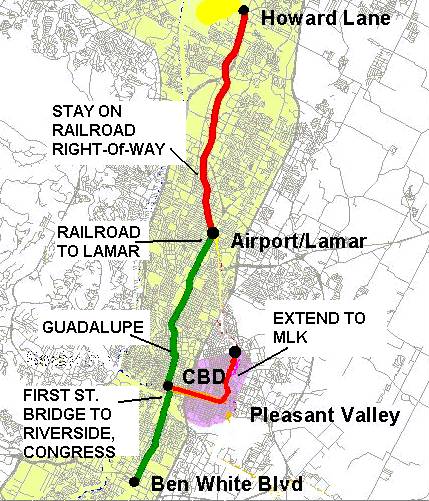
Urban rail (light rail transit) route proposed in 2000 was much straighter, simpler, cost-effective, and affordable, will no major civil works. Project was approved by majority of City of Austin voters, but failed in Capital Metro service area as a whole. Map: Light Rail Now library.

Urban rail (light rail transit) route proposed in 2000 was much straighter, simpler, cost-effective, and affordable, with no major civil works — and it served central Austin’s heaviest travel needs and highest population density. Project was approved by majority of City of Austin voters, but ballot measure very narrowly (<1%) failed in Capital Metro service area as a whole. Map: Light Rail Now library.

This seems to be the result of errors that are built upon previous errors — in a sense, a process whereby Project Connect is simply digging itself (and the Austin community) into a deeper and deeper hole. Perhaps they’ll begin to understand why I and so many other advocates of public transportation expansion in Austin have become so disgusted not only with Project Connect and its process, but also with the proposals that are emerging from it.

Apparently under pressure from City officials and various civic leaders, the Project Connect process unfortunately also seems to have departed from the goal of seeking a cost-effective, affordable urban rail network for metro Austin. In addition to the other revelations, this was indeed very disturbing. Ideally, the entire Project Connect process would be “reset” back to zero, and a totally new process, embracing once again this goal, would be re-launched.

Possibly, a rejection of Project Connect’s plan and quest for bond funding in November by voters would lead to such a “re-boot” of the urban rail planning process. Otherwise, if this approach to rail development goes forward, it would certainly seem that future rail transit infrastructure expansion in Austin would be severely constrained by the legacy of bad past decisions and design criteria that impose very heavy cost encumbrances.

h1

Northfield Neighborhood Association: “First investment of light rail” should be Guadalupe-Lamar!

11 March 2014
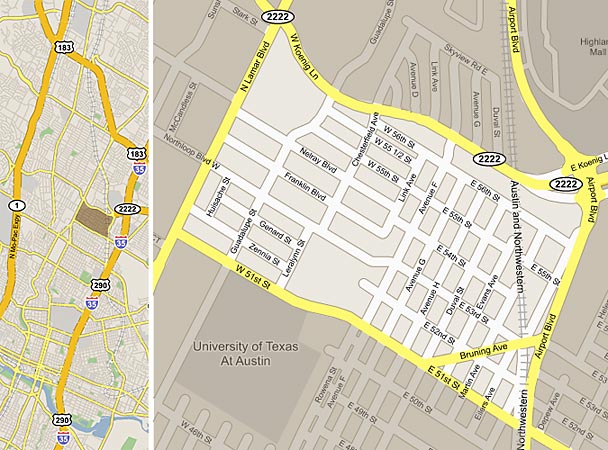
Left map shows Northfield Neighborhood Association (shaded brown) in central-city context, between North Lamar and I-35. Right map zooms in on the association's boundaries, with the MetroRail Red Line (labeled as "Austin and Northwestern"), albeit with no stations, cutting through its easten side. "University of Texas" section just southwest of Northfield is UT's Intramural Fields property, which has been used for athletics and a park & ride facility for UT shuttlebuses. Maps: Northfield NA.

Left map shows Northfield Neighborhood Association (shaded brown) in central-city context, between North Lamar and I-35. Right map zooms in on the association’s boundaries, with the MetroRail Red Line (labeled as “Austin and Northwestern”), albeit with no stations, cutting through its easten side. “University of Texas” section just southwest of Northfield is UT’s Intramural Fields property, which has been used for athletics and a park & ride facility for UT shuttlebuses. Maps: Northfield NA.

They just keep piling up — community and neighborhood endorsements of urban rail (light rail transit, LRT) for the Guadalupe-Lamar (G-L) corridor as a key public transport “backbone” for the heart of the central core city.

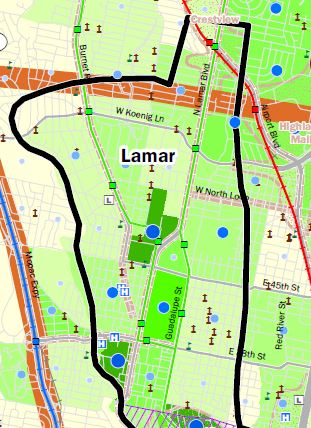
This time it’s a resolution passed unanimously late last month by the Northfield Neighborhood Association (NA), basically located along the east side of North Lamar just south of the Highland NA. According to the association’s website, the boundaries of Northfield Neighborhood Association are defined by 51st, Lamar, Airport, and Koenig (see map at top).

There are approximately 1,400 households in the neighborhood. … There is also a thriving local business scene on North Loop Blvd and two of our border streets: Airport Blvd and Lamar Blvd.

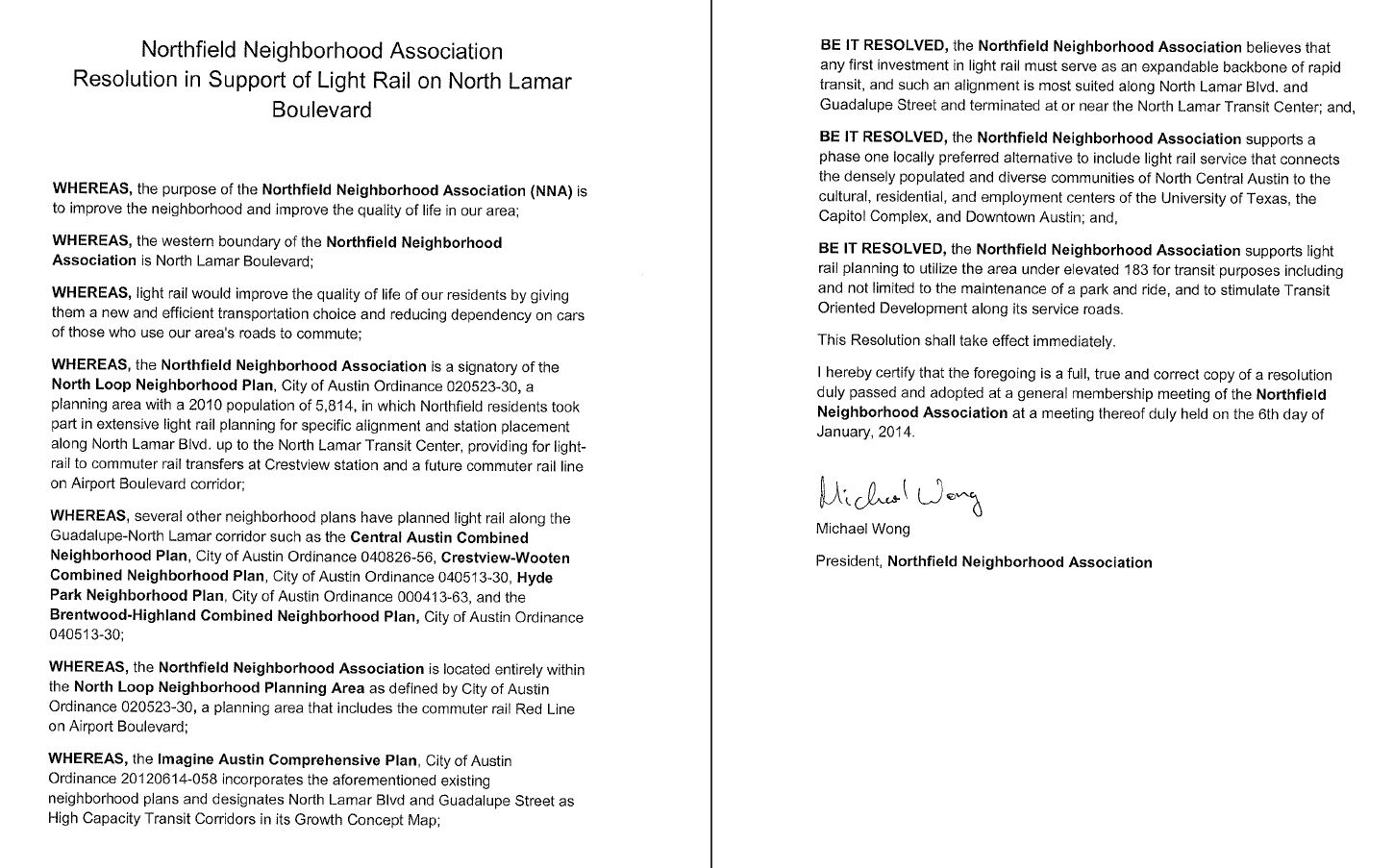
Screenshot of Northfield NA resolution supporting light rail transit on Guadalupe-Lamar corridor. (Click to enlarge.)

Screenshot of Northfield NA resolution supporting light rail transit on Guadalupe-Lamar corridor. (Click to enlarge.)

Emphasizing that “light rail would improve the quality of life of our residents by giving them a new and efficient transportation choice and reducing dependency on cars of those of those who use our area’s roads to commute …,” the resolution proceeds to note that

…the Northfield Neighborhood Association is a signatory of the North Loop Neighborhood Plan, City of Austin Ordinance 020523-30, a planning area with a 2010 population of 5,814, in which Northfield residents took part in extensive light rail planning for specific alignment and station placement along North Lamar Blvd. up to the North Lamar Transit Center, providing for light-rail to commuter rail transfers at Crestview station, and a future commuter rail line on Airport Boulevard corridor ….

As the resolution also points out,

…several other neighborhood plans have planned light rail along the Guadalupe-North Lamar corridor such as the Central Austin Combined Neighborhood Plan, City of Austin Ordinance 040826-56, Crestview-Wooten Combined Neighborhood Plan, City of Austin Ordinance 040513-30, Hyde Park Neighborhood Plan, City of Austin Ordinance 000413-63, and the Brentwood-Highland Combined Neighborhood Plan, City of Austin Ordinance 040513-30 ….

This underscores the long record of cooperation by Austin’s core central neighborhoods with the planning objectives and assurances given to them by the City of Austin — now basically being shredded by Project Connect and the current city council, which are proceeding to forsake these commitments and discard rational, data-supported planning in preference for fabricating a rigged “high-capacity transit” plan aimed at fulfilling the needs of private developers and pushing Austin’s center of gravity away from the core city and further eastward. (See: City Council to Central Austin: Drop Dead.)

In contrast, the Northfield resolution focuses squarely on the clear and obvious public transportation priority for the city, affirming that

…the Northfield Neighborhood Association believes that any first investment in light rail must serve as an expandable backbone of rapid transit, and such an alignment is most suited along North Lamar Blvd. and Guadalupe Street and terminated at or near the North Lamar Transit Center; [and]

…the Northfield Neighborhood Association supports a phase one locally preferred alternative to include light rail service that connects the densely populated and diverse communities of North Central Austin to the cultural, residential, and employment centers of the University of Texas, the Capitol Complex, and Downtown Austin….

This strong endorsement of central Austin’s top-priority local travel corridor as a potential urban rail starter line, provided by another of Austin’s most important central-neighborhood associations, has political implications that should send a pointed message to local officials and decisionmakers. As Scott Morris — head of the Central Austin Community Development Corporation and leader of the Our Rail coalition — has observed, this action by Northfield “is a major milestone.”

Not only is Northfield “a dual-alignment neighborhood” (i.e., served both by North Lamar and the MetroRail Red Line), Morris points out, but the association’s constituency “have had tremendous exposure to the Red Line operations, and have participated directly in the Airport Corridor Initiative.”

Of particular significance, Morris notes, is that the resolution action “came weeks after council action” — emphasizing that, despite the pretense of planning “derived from the Project Connect process”, the momentum in favor of Guadalupe-North Lamar “is not going away.” With Northfield’s formal support through its resolution endorsing the G-L corridor, Morris emphasizes, “it is now possible to walk from MLK to 183 by only passing through communities that support rail on Guadalupe-North Lamar.”

h1

Project Connect data in 2012 showed urban rail beats “BRT” in cost-effectiveness

1 March 2014
xxxxxx

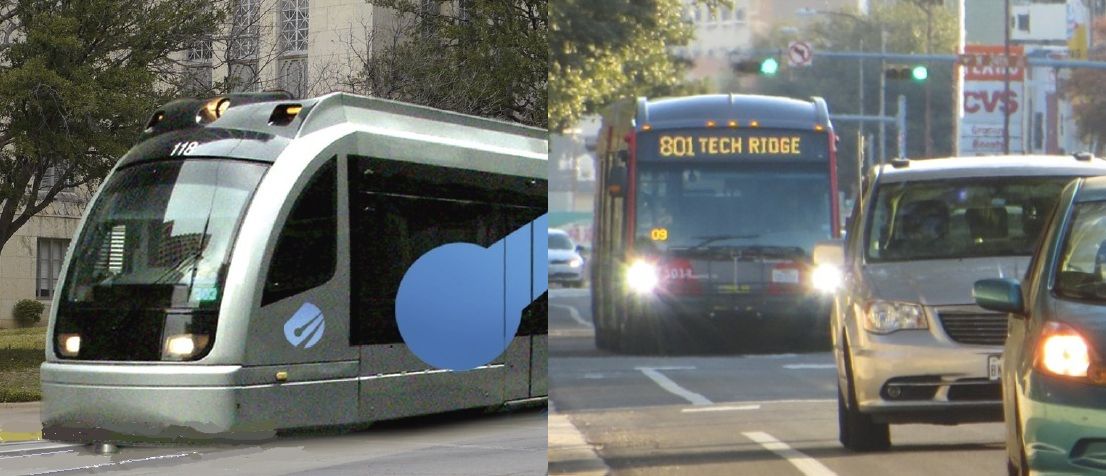
Left: Urban rail simulation (Graphic: COA rev. ARN). Right: MetroRapid bus on the Drag (Photo: L. Henry).

As this blog has noted, it’s curious how, in recent months, Project Connect — at least in official statements — has been somewhat distancing itself from explicitly advocating “urban rail” (Mayor Leffingwell’s recent “rail or fail” rhetoric is an exception, but, then, he’s not officially a Project Connect official) and increasingly portraying its focus to be “high-capacity transit“, a generic term that seems to apply to virtually all surface public transport modes approximately above the capacity of a van.

Moreover, this “high-capacity” concept seems to consider just about everything somehow equal in function. Thus, bus routes and urban rail lines could, in this rather dubious schema, be interchanged or substituted in planning.

This, of course, is nonsense — there are huge differences between rail and bus in performance, attractiveness to the public, operational capabilities, environmental implications, longterm cost-effectiveness, and other attributes, with rail tending to lead. But Project Connect’s approach treating these modes as generally interchangeable seems to accord the agency at least two advantages:

(1) It gives Project Connect and other public officials some flexibility to put urban rail where they want it, MetroRapid (faux “bus rapid transit” or BRT) where they want it … and it helps alibi why some areas supposedly due for “high-capacity transit” end up getting just a fancy bus route (MetroRapid). With money tight, Project Connect can install perhaps a few miles of rail (or perhaps none), cover the rest with bus service, and claim they’re offering a vast “rapid transit” system to the Austin-area public (and voters).

(2) It has allowed City and Capital Metro officials, as well as Project Connect’s leadership, to designate the modest, minimal MetroRapid bus service in the Guadalupe-Lamar corridor as “high-capacity transit” and even “rapid transit” — for which, it’s implied, this key section of the central city should be profoundly grateful. And in any case, it’s all the “high-capacity transit” these core neighborhoods can expect to get for the foreseeable future — so be content with what you’ve got, while we all move on.

But Project Connect’s championing of generic “high-capacity transit” and the alleged marvels of MetroRapid stands in glaring contrast to the agency’s narrative and course of argument of the recent past. Just two years ago, and for the past six or so years before that, City planners and then Project Connect were hammering away incessantly about the need for Urban Rail — urban rail was absolutely essential, it was a must-have, it was the linchpin of the regional transit plan …

Of course, local officials and their planners insisted it had to run from downtown, through the relatively empty East Campus, to Mueller.

So … why not run just a good bus service?

Well, official planners have gone to great lengths to justify the need for rail. Rail, it’s argued, has an exceptional tendency to attract adjacent development, especially transit-oriented development. That’s true. Also true is their insistence that urban rail, particularly as ridership grows, is far more cost-effective than bus service over the longer term.

And that’s precisely the point succinctly made, for example, in a couple of neatly rendered data-visualization slides included in a presentation from Project Connect to the Transit Working Group (TWG) on 1 June 2012.

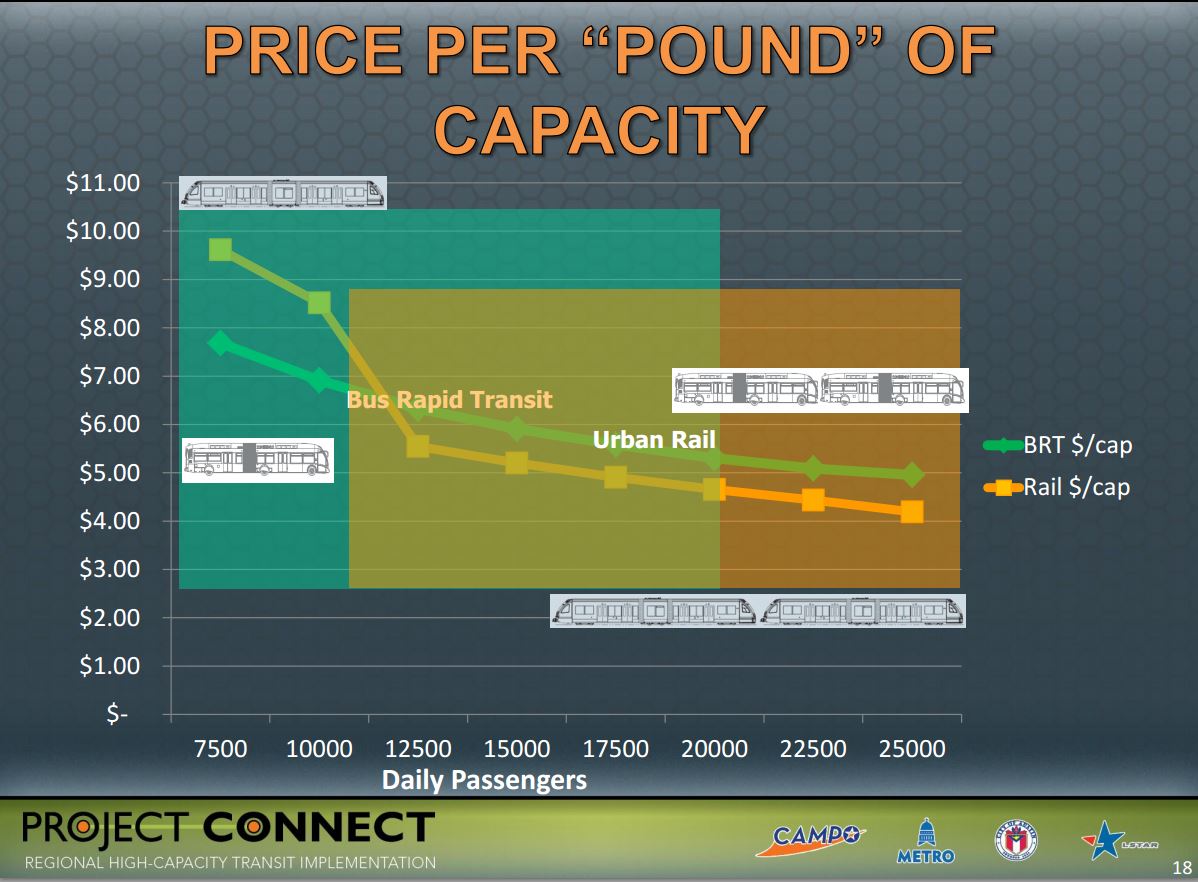
This first slide compares urban rail and “bus rapid transit” (i.e., bus upgraded transit of some kind) in total cost per passenger. The graph indicates that rail and bus become equal in total cost per passenger (presumably, rider-trip) at a ridership level of around 10,000 daily passengers. After that, urban rail becomes significantly lower.

Total cost per passenger of urban rail becomes lower than "bus rapid transit" as ridership rises above about 10,000 per day. Graph: Project Connect.

Total cost per passenger of urban rail becomes lower than “bus rapid transit” as ridership rises above about 10,000 per day. Graph: Project Connect.

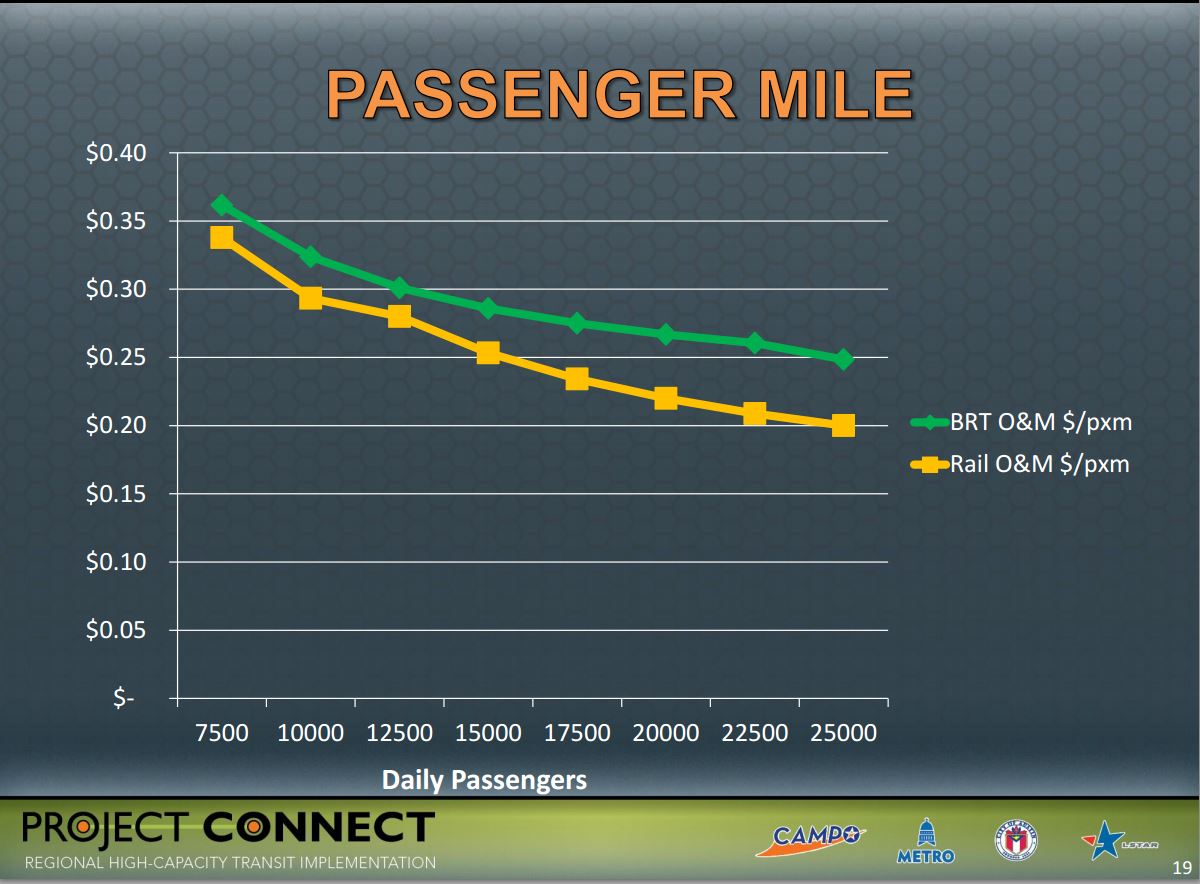
In this second slide (below), Project Connect displays that the operating and maintenance (O&M) cost of urban rail is projected to be consistently less than that of “BRT”.

Operating & maintenance (O&M) cost per passenger-mile of urban rail is projected to be consistently lower than "bus rapid transit". Graph: Project Connect.

Operating & maintenance (O&M) cost per passenger-mile of urban rail is projected to be consistently lower than “bus rapid transit”. Graph: Project Connect.

So these projections from Project Connect raise intriguing questions:

• If urban rail is so much more cost-effective than “BRT”, doesn’t this mean that it would be more cost-effective than MetroRapid, which various Project connect, City, and Capital Metro spokesmen have repeatedly characterized as “BRT”?

• If urban rail is indeed so much more cost-effective than MetroRapid, why is the Guadalupe-Lamar corridor being consigned MetroRapid as its “high-capacity transit” solution — especially when ridership projections have forecast this corridor as having the highest ridership potential in the entire region?

• Put another way — Why is Guadalupe-Lamar — Austin’s heaviest center-city local traffic corridor, and its densest and most promising core neighborhoods and commercial districts — being saddled with a more costly MetroRapid service, less appropriate for needed capacity, while the heavy resources to install urban rail are being focused on a convoluted Rube Goldberg-style route scheme to serve the East Campus, Hancock Center, and (purportedly) an eastern access to the Highland/ACC site?

h1

Subway cost per mile nearly 9 times higher than for light rail, says study

15 February 2014
Chart showing median cost results from Light Rail Now subway vs, LRT study. Graphic: Light Rail Now blog.

Chart showing median cost results from Light Rail Now subway vs, LRT study. Graphic: Light Rail Now blog.

For years, Austin’s civic leaders and official urban rail planners have been trying to figure out how to raise more than $500 million in local and federal funding for a new-start surface urban rail project — 5-6 miles of light rail transit (LRT) running in relatively lower-cost surface alignments. Suddenly, at least some official interest has turned to ….building a subway instead?

This seems to be influenced mainly by two factors:

• An aversion or reluctance to shift urban public thoroughfare space away from apparently precious motor vehicle traffic and re-allocate it to public transit (rail in this case), and

• Insistent claims by several subway proponents (disputed by professionals and advocates of LRT) that subway construction costs are nearly the same as, or only slightly more than, surface LRT.

Recent study results of subway-LRT investment costs posted on the Light Rail Now (LRN) blog site provide a sobering reality check on the cost issue. As portrayed graphically in the chart at the top of this post, LRN found median investment cost to be nearly 9 times higher for subway construction projects than for in-street LRT.

Projects examined were an assortment of “recent urban rail projects (all from the 2000s), either completed or well under construction and fully budgeted.” The report lists 24 subway and 13 LRT projects included in the analysis.

• Only “full subway projects (entirely or nearly totally underground)” were examined in the study, including subway portions of LRT projects.

• Only surface LRT projects exclusively, or nearly totally, in street alignments were included (“to compare the most difficult, highest-cost type of surface construction with subway construction”).

Summarizing the study results, LRN underscores the huge cost disparity between subway and in-street LRT construction, and the implications for a long-term rail expansion policy:

…for recent U.S. projects, subway construction has a median cost nearly seven times that of in-street LRT construction. Worldwide, the differential is nearly 9:1. And thats only comparing in-street LRT construction, not accounting for the possibility of, say, transitioning into an available railway alignment outside the city center, with far lower installation cost.

What this means is that, even if your community can somehow afford the initial financial commitment (even with federal assistance), expansion of your system will be severely attenuated. Basically, for a given amount of available funding, you can construct 7 to 9 times as much surface LRT as subway. Put another way: For available resources, you can have a far more comprehensive rail system with surface LRT, many times the size of a system relying on subway construction.

Buffalo's 6.4-mile LRT line, with 5.2 miles (81%) in subway, has never been expanded since its opening in 1985. On the whole, the heavy cost of subway (and elevated) construction has been a powerful deterrent that has delayed or prevented the expansion of totally grade-separated urban rail systems.

Buffalo’s 6.4-mile LRT line, with 5.2 miles (81%) in subway, has never been expanded since its opening in 1985. On the whole, the heavy cost of subway (and elevated) construction has been a powerful deterrent that has delayed or prevented the expansion of totally grade-separated urban rail systems. Photo: Buffalo Tourism.

(LRN’s results — which tabulate subway construction costs ranging from $114 million to well over $1 billion per mile — appear generally consistent with information provided at Project Connect’s Feb. 8th “interactive workshop”. Official consultants at this event described “tunnel” construction as costing in the range of $220 to $350 million per mile. However, it’s unclear whether this included the costs of underground stations, access portals and ramps, and major system costs such as rolling stock and storage-maintenance-operations facilities.)

Noting examples of appropriate subway deployment in Dallas and Portland, LRN emphasizes that, for these mature systems, some underground construction may be needed “to keep pace with ridership growth and the need for fast, more frequent service going beyond in-street capacity.” However, the article points out that “both cities relied primarily on surface construction to start and develop their initial systems….”

LRN’s report ends by cautioning that, in the face of evidence from this study, any commitment to launch a new urban rail startup system “should not be made on the supposition that a subway would cost ‘just a little bit more’ than constructing LRT in the street.”

h1

Memo to CCAG: “Pause” study or include “Lamar” sector

5 December 2013

0_ARN_Pause Button

By Lyndon Henry

This Email was sent on December 5th to members of the Central Corridor Advisory Group (CCAG). While the memo indicates an assumption that Citizens Communications would be allowed at the end of the CCAG meeting, the posted agenda, in a departure from past practice, now indicates that Citizens Communications will take place in the middle of the meeting, prior to “Discussion & Action”.

To Members of the Central Corridor Advisory Group:

I am writing to urge you either to hold off voting on a recommendation on the Phase 1 urban rail project, or to recommend including the “Lamar” sector (“sub-corridor”) for further evaluation in the next phase of Project Connect’s study.

"Lamar" sector ("sub-corridor") includes a portion of Guadalupe-Lamar corridor. Map: Project Connect.

“Lamar” sector (“sub-corridor”) includes a portion of Guadalupe-Lamar corridor. Map: Project Connect.

As the Project Connect team has started releasing some of their methodology and basic data, an ever-widening array of problems has become evident, and questions from the community continue to multiply.

From the outset, this urban rail study (now a “High-Capacity Transit” study) has been inexplicably rushed, in clear violation of Best Practices within the transit industry and cities across the country. Even Kyle Keahey has repeatedly admitted that, ordinarily, this kind of study would require 12 to 18 months. Yet Project Connect has raced to a decision in less than five months of actual study.

This is not a sound or propitious basis for rallying community and voter support behind such a major public transportation investment. This project should preferably be put on Pause; barring that, the “Lamar” sector should at least be added for further consideration.

As I’ve mentioned, the list of problems and anomalies identified in this study is sizable, and continues to grow. Here are just a few of the most egregious that I’ve identified:

• The basic methodology of focusing on sectors (so-called”sub-corridors”) meant that the study failed to study a single actual potential travel corridor in the study area.

• This methodology also segmented an otherwise viable corridor such as Guadalupe-Lamar into nonsensical pieces, severing the corridor from its most logical destination (West Campus and core area), and thus creating an arbitrary “rump” route (29th St. to south of U.S. 183) that goes from nowhere to nowhere.

• As a measure of “Travel Demand” from each sector to the core, non-work trips such as UT student trips and recreational trips (e.g., to restaurants, bars, etc.) have been EXCLUDED — dismissing not only the enormous importance of non-work trips (which are heavy in the off-peak) for more cost-effective transit service, but especially the huge significance of student and recreational trips in a city with the largest university in the state (and located in its core).

• Rather than developing conservative, reliable, and plausible projections, Project Connect has produced bizarrely exaggerated and highly implausible projections that are heavily skewed toward certain geographical areas such as East Riverside and the so-called “Highland” sector.

• When these same projections are plugged into the Transit Orientation Index (TOI), the results are extremely implausible — e.g., for the “ERC” (East Riverside) sector, Project Connect calculates high total daily transit ridership of 2.9 million, about equal to the total citywide daily ridership of Chicago and Philadelphia combined. (Their “low estimate” for that single sector is higher than the total citywide ridership of entire cities like Denver and Seattle.) This strongly tends to corroborate other evidence that Project Connect’s projections have been seriously exaggerated and are utterly implausible.

• The study has assigned an extremely high “Constrained Right-of-Way” penalty to the “Lamar” sector, but not to the “Highland”, “Mueller”, “ERC” sectors — apparently implying that Project Connect considers there to be no “Constrained Right-of-Way” problems for “Highland”, “Mueller”, and “ERC”. This also is implausible, and this penalty seems to be arbitrarily applied to sectors (“sub-corridors”) that the Project Connect team dislikes (e.g., “Lamar”), but withheld from sectors they seem to prefer (e.g., “ERC”, “Highland”, “Mueller”).

In reality, “Highland”, “Mueller”, and “ERC” not only face serious problems of constrained ROW, but daunting problems of major civil works (e.g., a river bridge, grade-separations with I-35, etc.). In contrast, the Guadalupe-Lamar corridor would encounter no necessity for major civil works.

For Project Connect’s recent “Data Dig” meeting, I submitted a longer and more detailed list of problems and anomalies which is available online here:

Questions for Project Connect

The following article from the Austin Rail Now blog discusses even more problems, and includes links to a number of online posts from several other researchers, analysts, and transit advocates in the community:

TILT! Project Connect’s gerrymandering and data fiddling ignite public skepticism, pushback

The Austin public is certainly not stupid, yet Project Connect’s peculiar methods and rationales have made many in the community feel as if they’re being treated like fools. Contrary to Project Connect’s claims that their public participation process has been “robust” and “open”, it’s a serious departure from past democratic norms.

This is exemplified by the fact that public communications to CCAG were opened only in the very final stages of the study process, and just the last meeting before Project Connect made its decision. And now, since Citizens Communications comes at the conclusion of your Dec. 6th meeting, speakers will not even have a chance to address your meeting until after the recommendation issue has been dealt with.

Further problems with Project Connect’s community involvement are discussed in detail here:

From community participation then … to community exclusion today

Persuading the public to understand the need for urban rail in Austin, and to vote approval of bonds to fund it, will be an enormous challenge. This will be an even more difficult challenge if Project Connect persists in alienating the core neighborhoods in the heart of the central city — and West Campus and student population — by rushing to decisions based on implausible and dubious analyses, and a cavalier attitude toward bona fide community involvement.

Please give your strongest consideration to either pausing this process, or including the “Lamar” sector in Phase 2 of the study process so that it can be more adequately and fairly evaluated.

Lyndon Henry
Technical consultant
Light Rail Now Project
Texas Association for Public Transportation

h1

City’s 2010 urban rail study actually examined corridors! But botched the analysis…

26 November 2013
Closeup of City's Central Austin Transit Study map, showing core, potential rail corridors, and City's version of route to "North Central Austin" (Hyde Park via Speedway). Guadalupe-Lamar was avoided. Map: Snip from COA document.

Closeup of City’s Central Austin Transit Study map, showing core, potential rail corridors, and City’s version of route to “North Central Austin” (Hyde Park via Speedway). Guadalupe-Lamar was avoided. Map: Snip from COA document.

By Lyndon Henry

In this blog and other forums, for months I’ve been making the case that Project Connect’s urban rail study has not been considering actual travel corridors, but rather large tracts of urban land more aptly described as sectors. Actual travel corridors haven’t just been ignored, they’ve been severed and segmented, so that effective evaluation of them for rail transit routes has been impossible. (The best example is Guadalupe-Lamar, for which Project Connect cut off the head — the core area — and then severed the legs — any extensions north of Crestview.)

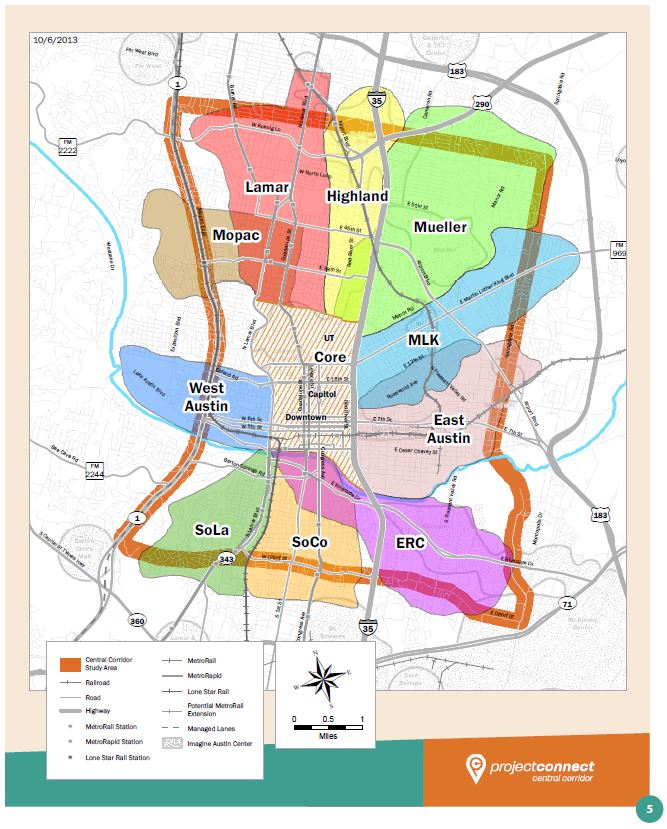
Project Connect has supposedly been focusing on possible urban rail routes in the center of the city, so it designated a huge central-city study area — implausibly calling it the “Central Corridor”, although it had none of the characteristics of an actual urban travel corridor. (See Project Connect’s “corridor” study ­ without corridors!)

Project Connect's "Central Corridor" (study area) with "sub-corridors" (i.e., sectors). (Click to enlarge.)

Project Connect’s “Central Corridor” (study area) with “sub-corridors” (i.e., sectors). (Click to enlarge.)

As one can see in the map above, within this huge central study area, Project Connect then carved up a number of major study districts — which it then labeled “sub-corridors” (since the entire center of the city was now labeled a “corridor”). Rather than actual travel corridors — which are what you’d need to study fixed transit facilities like urban rail — these subdivisions are, in effect, huge, sprawling sectors of the center-city, mostly comprising several square miles. “Mueller”, for example, reaches out of the Mueller development site to reach central neighborhoods west of I-35, and north to gulp up most of Northeast Austin.

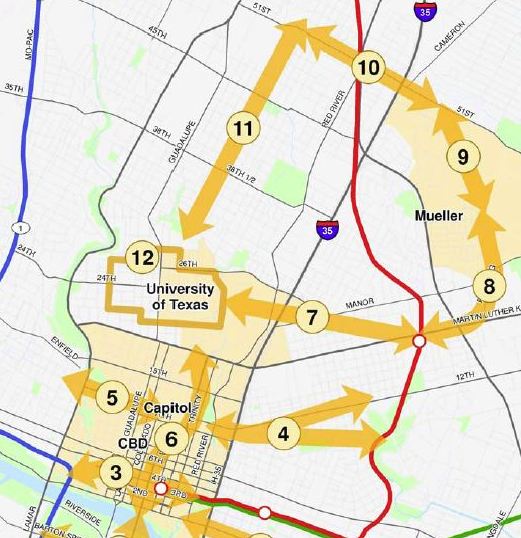
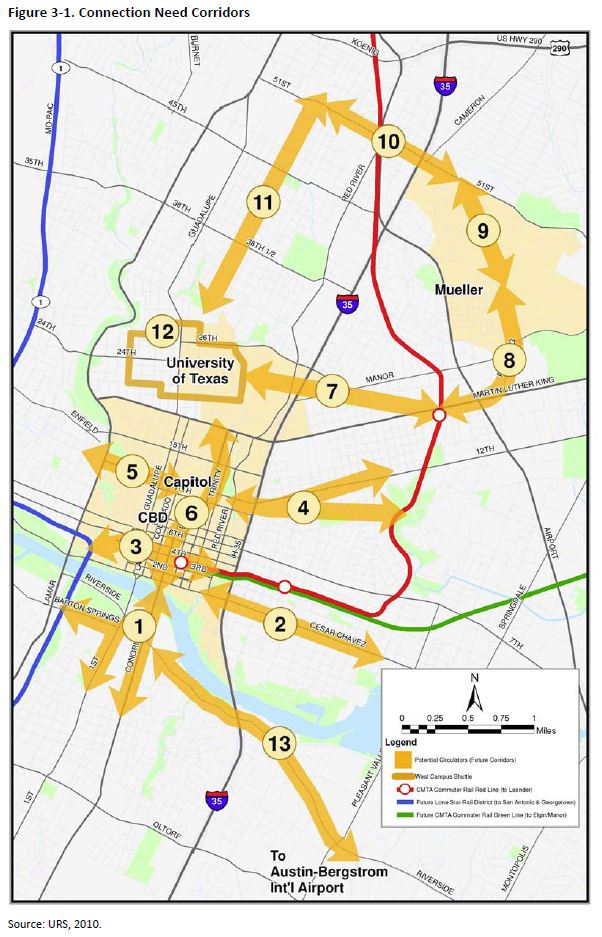
But local officials definitely know what real corridors are. As recently as 2010, the City of Austin, in collaboration with its consultant URS Corporation, produced the Central Austin Transit Study (CATS) — the pre-eminent initial feasibility study for a central Austin urban rail system. And, as the map below shows, they didn’t dither around with huge, arbitrary, misnamed blobs of urban land … they examined actual corridors:

CATS map of actual potential rail corridors studied. Map: COA and URS.

CATS map of actual potential rail corridors studied. Map: COA and URS.

However, then, as now, the basic aim was to justify a Phase 1 urban rail route through the east side of the UT campus and on out to the Mueller redevelopment site. So the study and the map of selected corridors were cleverly contrived to confine and steer the study in the “proper” direction.

In particular, notice how the City planning team studiously avoided the most obvious route going north from the campus — up Guadalupe and North Lamar. Instead, Corridor #11 is fashioned as “University of Texas (UT) to North Central Austin (Hyde Park)”, and directed up Speedway (a minor arterial that’s almost a neighborhood street) as far as 51st St. And of course, it’s purpose is to make a connection to … Mueller!

But manipulating the routes was only half the game. The other half was manipulating the evaluatory methodology.

For the 2010 study, that was a lot simpler than now. Instead of “gerrymandering” data, playing with projections and hypothetical growth rates, and assigning heavy freeway traffic to relatively quiet neighborhoods, the City and URS team in 2010 just devised a simple, subjective 1-2-3 rating system that allowed them to assign a subjective “score” at whim to the various corridors. And whaddaya know … Mueller won!

But the point is that more or less real travel corridors were studied in 2010, although they were shaped and located to fit the outcome desired by top officials. So local planners do know what real corridors should look like.

And it’s real travel corridors that Project Connect’s urban rail study should have been scrutinizing and evaluating all along. That’s what the Austin community deserves. Instead, what Austin has gotten so far is another exercise in smoke-and-mirrors “planning” intended again to achieve a desired outcome.

h1

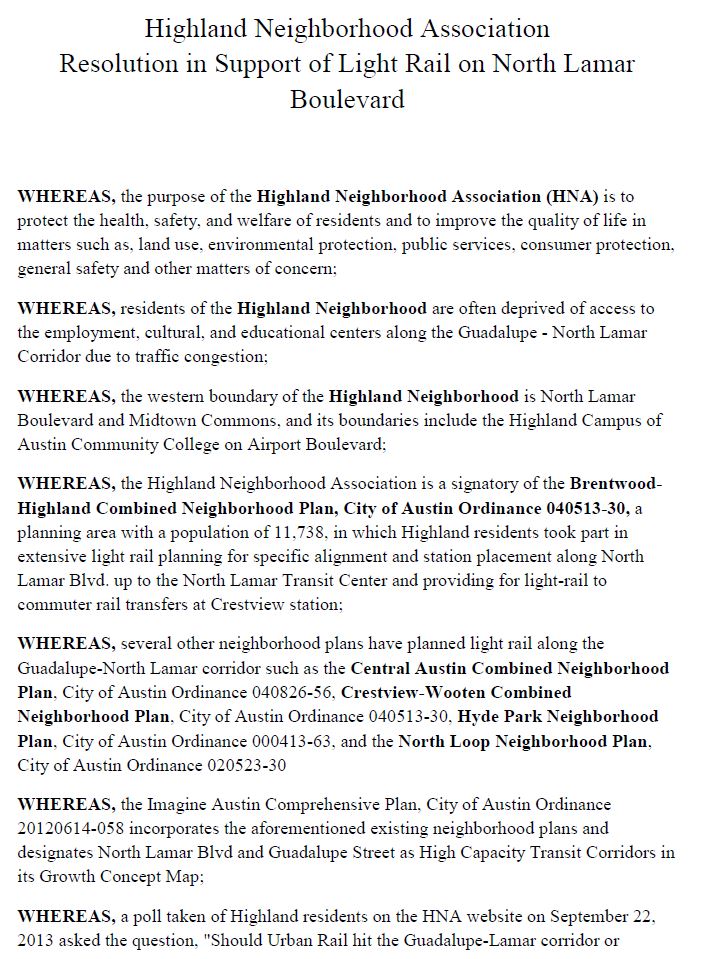
Highland Neighborhood Association endorses Guadalupe-Lamar for urban rail

15 November 2013
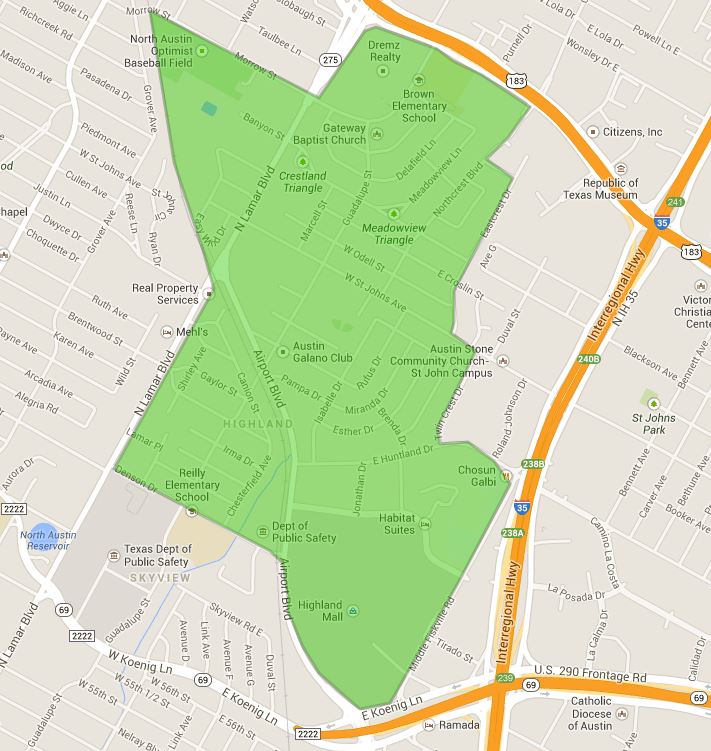
Highland Neighborhood Association bundaries. Map: HNA.

Highland Neighborhood Association bundaries. Map: HNA.

On November 4th, the effort to designate the Guadalupe-Lamar (G-L) corridor as the preferred route for urban rail (light rail transit, LRT) received yet another powerful surge of support with the endorsement of the Highland Neighborhood Association (HNA). As the map at top shows, the western boundary of the Highland Neighborhood is mostly North Lamar Boulevard and Midtown Commons; its northern boundary is U.S. 183; and its southern boundary includes both Denson Drive and a segment of Airport Boulevard encompassing the Highland campus of Austin Community College.

Highland is an important component of the ridership “watershed” for public transportation on the east side of North Lamar, and this would include the Guadalupe-Lamar (G-L) route proposed for urban rail (light rail transit). The Highland neighborhood should not be confused with Project Connect’s “Highland” sector (“sub-corridor”), which usurps the name but has only a very minimal geographical relationship.


1_ARN_Highland-NA-G-L-endorsement-p1

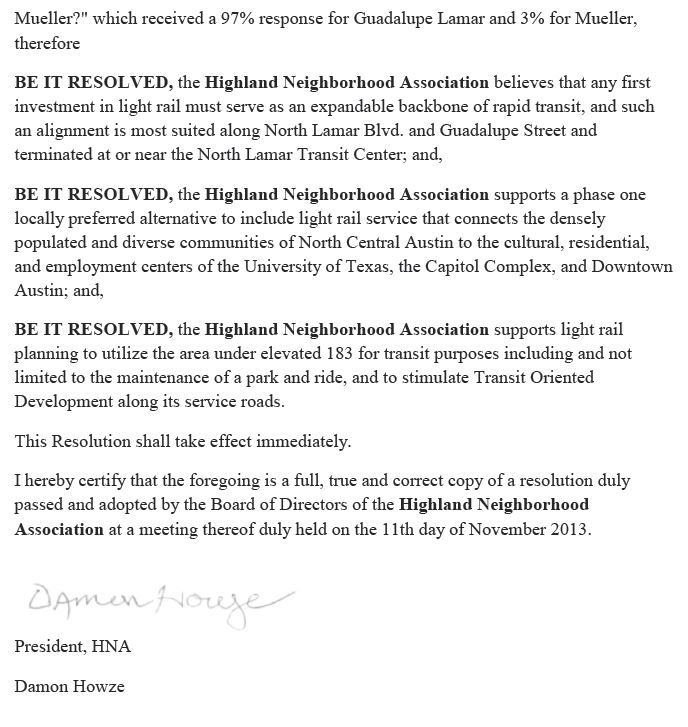
Images of HNA resolution endorsing Guadalupe-Lamar corridor for urban rail.

Images of HNA resolution endorsing Guadalupe-Lamar corridor for urban rail.


The HNA’s endorsement resolution includes a number of “whereas” clauses that spell out the case for endorsing the G-L corridor as the priority route for urban rail. For example, it states, “residents of the Highland Neighborhood are often deprived of access to the employment, cultural, and educational centers along the Guadalupe – North Lamar Corridor due to traffic congestion ….”

The resolution goes on to document the HNA’s legal and regulatory authority for taking its position on urban rail:

… the Highland Neighborhood Association is a signatory of the Brentwood-Highland Combined Neighborhood Plan, City of Austin Ordinance 040513-30, a planning area with a population of 11,738, in which Highland residents took part in extensive light rail planning for specific alignment and station placement along North Lamar Blvd. up to the North Lamar Transit Center and providing for light-rail to commuter rail transfers at Crestview station;

… several other neighborhood plans have planned light rail along the Guadalupe-North Lamar corridor such as the Central Austin Combined Neighborhood Plan, City of Austin Ordinance 040826-56, Crestview-Wooten Combined Neighborhood Plan, City of Austin Ordinance 040513-30, Hyde Park Neighborhood Plan, City of Austin Ordinance 000413-63, and the North Loop Neighborhood Plan,
City of Austin Ordinance 020523-30

… the Imagine Austin Comprehensive Plan, City of Austin Ordinance 20120614-058 incorporates the aforementioned existing neighborhood plans and designates North Lamar Blvd and Guadalupe Street as High Capacity Transit Corridors in its Growth Concept Map …

HNA presents as its justification for officially endorsing Guadalupe-Lamar “a poll taken of Highland residents on the HNA website on September 22…” posing the question, “Should Urban Rail hit the Guadalupe-Lamar corridor or Mueller?” The resolution notes that the results were “a 97% response for Guadalupe Lamar and 3% for Mueller ….”

With this background of procedural and factual substantiation, the HNA board comes down irmly on the side of a “first investment in light rail” that “must serve as an expandable backbone of rapid transit”, which means “an alignment is most suited along North Lamar Blvd. and Guadalupe Street” with a northern terminus “terminated at or near the North Lamar Transit Center….” This, the resolution makes clear, definitely means “a phase one locally preferred alternative” with light rail service connecting “the densely populated and diverse communities of North Central Austin to the cultural, residential, and employment centers of the University of Texas, the Capitol Complex, and Downtown Austin”:

BE IT RESOLVED, the Highland Neighborhood Association believes that any first investment in light rail must serve as an expandable backbone of rapid transit, and such an alignment is most suited along North Lamar Blvd. and Guadalupe Street and terminated at or near the North Lamar Transit Center; and,

BE IT RESOLVED, the Highland Neighborhood Association supports a phase one locally preferred alternative to include light rail service that connects the densely populated and diverse communities of North Central Austin to the cultural, residential, and employment centers of the University of Texas, the Capitol Complex, and Downtown Austin; and,

BE IT RESOLVED, the Highland Neighborhood Association supports light rail planning to utilize the area under elevated 183 for transit purposes including and not limited to the maintenance of a park and ride, and to stimulate Transit Oriented Development along its service roads.

This extremely significant endorsement of central Austin’s most important potential corridor for urban rail by one of the city’s most important neighborhood associations also has political implications that hopefully will not go unnoticed by local officials and decisionmakers.

The full resolution can be found here:

Highland Neighborhood Association Resolution in Support of Light Rail on North Lamar Boulevard

Related endorsements:

Central Austin Combined Neighborhoods Planning Team endorses Guadalupe-Lamar for urban rail

UT Student Government backs West Campus, Guadalupe-Lamar route for first phase of urban rail

h1

Guadalupe-Lamar is highest-density corridor in Austin — according to Project Connect’s own data!

9 November 2013
Closeup of Project Connect's central Austin map of population density for 2010 shows intense clusters of density in West Campus, along Guadalupe above W. 29th St., and in Triangle area. Map: Rev. by LH from Project Connect.

Closeup of Project Connect’s central Austin map of population density for 2010 shows intense clusters of density in West Campus, along Guadalupe above W. 29th St., and in Triangle area. Map: Rev. by LH from Project Connect.

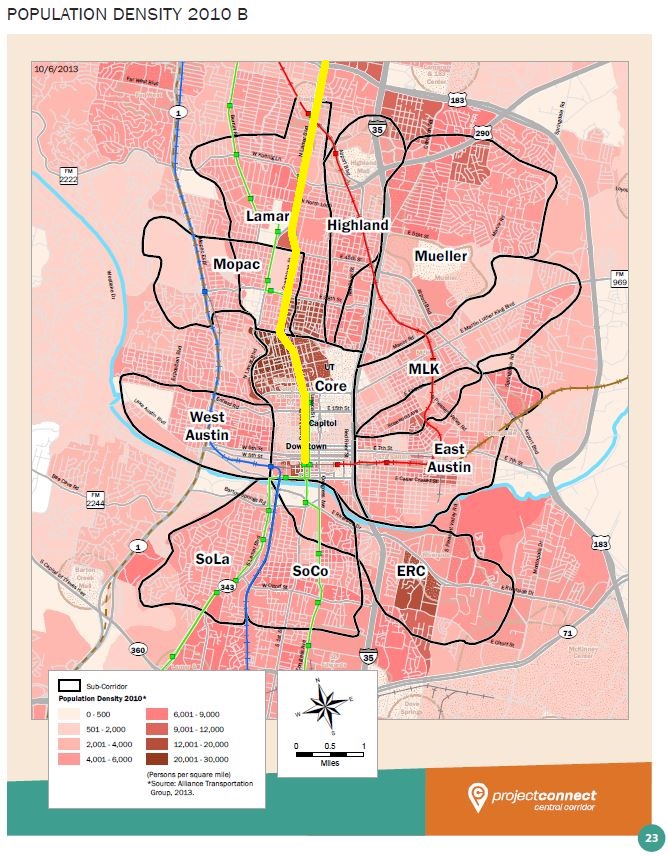
Even from the peculiarly selective and distorted data exhibited visually in Project Connect’s Map Books, it’s clear that the Guadalupe-Lamar (G-L) corridor currently has by far the highest concentration of population density within Austin central study area (and almost certainly the highest in the entire metro area). And this density appears predicted to persist in ProCon’s projection for 2030!

This density (pointed out decades ago by Lyndon Henry and Dave Dobbs as a pre-eminent justification for rail transit in this corridor) is shown in the following map graphics excerpted from the latest version (v. 5) of ProCon’s Map Book.


Central study area view

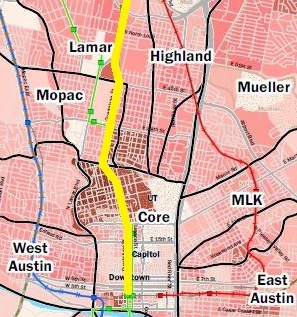
Population density in 2010 (G-L corridor spine in yellow). Map: Rev. by LH from Project Connect.

Population density in 2010 (G-L corridor spine in yellow). Map: Rev. by LH from Project Connect.

The map above shows the central-city study area (mislabeled by ProCon as a “Central Corridor”) with various sectors (mislabeled as “sub-corridors”) in 2010. The arterial spine of the G-L corridor (the most likely alignment for urban rail) is shown by a yellow line. Notice that heavy concentrations of high population density are clustered around the G-L corridor, particularly in the West Campus area, and just north of the campus, bordered by Guadalupe on the west and W. 29th St. on the south.


Population density projected for 2030 (G-L corridor spine in yellow). Map: Rev. by LH from Project Connect.

Population density projected for 2030 (G-L corridor spine in yellow). Map: Rev. by LH from Project Connect.

The map above shows the same study area and sectors, with population density concentrations projected for 2030. While these projections are far more subjective and tentative than actual current reality-based data, they do reflect speculation that extremely high density will not only intensify in 2030 in the same areas as it was located in 2010, but is expected to expand to other segments of the G-L corridor.


Guadalupe-Lamar focus

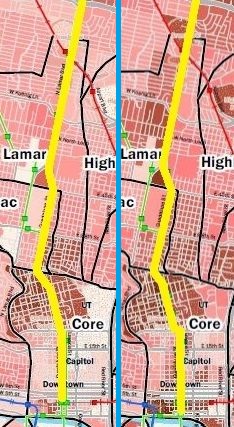
Composite of zoomed-in snips of Project Connect maps of population density. LEFT: 2010. RIGHT: 2030. Rev. by LH from Project Connect.

Composite of zoomed-in snips of Project Connect maps of population density. LEFT: 2010. RIGHT: 2030. Rev. by LH from Project Connect.

This composite focuses on population density the G-L corridor, showing density concentrations in 2010 on the left, and in 2030 on the right. Again, the probable alignment for urban rail is shown by a yellow line. This makes both the existing density and its projected intensification in the future even more obvious.


Conclusion

These data visualization maps clearly indicate that not only does the Guadalupe-Lamar corridor currently have extremely high levels of population density (as much as 30,000 persons per square mile in the West Campus) sufficient to support urban rail, but it surpasses all other corridors in the city! Furthermore, even in ProCon’s flawed analysis, this density is projected to intensify by 2030.

But this kind of bona fide corridor analysis counts for absolutely nothing in Project Connect’s “study”, because they’re not evaluating travel corridors such as Guadalupe-Lamar! They’ve been wasting taxpayer money on largely irrelevant studies of demographics and other conditions in isolated sectors while largely ignoring actual travel patterns in corridors into the core area, along with the demographics and other critical features along these actual corridors, such as G-L.

On Nov. 15th, the ProCon team are due to announce their “recommendation” for a sector (“sub-corridor”) as the location for urban rail … and it’s anybody’s guess as to what is the basis for their evaluation. But this small analysis we’ve just presented illustrates the actual kind of analysis of a travel corridor that official planners should be performing, and we suggest it as a far more effective model for the type of urban rail study this community actually should be supporting.