Posts Tagged ‘austin urban rail’

h1

Let’s Go Austin — Tea-baiting from an awfully glass house

30 October 2014
Tea Party activist. Photo: Alternet.org.

Tea Party activist. Photo: Alternet.org.

They’re at it again — Let’s Go Austin, the heavily funded elite outfit established to campaign for the official Highland-Riverside urban rail plan and $600 million in City bonds to fund it, are continuing their preferred tactic of trying to smear tar over their opposition to make them seem like something they aren’t. And in this case, the tar is made from Tea.

As Austin Rail Now explained in our post of Oct. 27th,

It’s become clear that a prominent, desperate tactic of the “Let’s Go Austin” campaign to promote the urban rail bonds ballot measure is to “Tea-bait” the opposition — to try to smear all of us, “progressives”, liberals, leftists, rail transit advocates, transit critics, moderates, conservatives, neighborhood associations, and other opponents of this misguided proposal — as homogeneous minions of the rightwing Tea Party. …

Project Connect leaders and the Let’s Go Austin campaign know very well that this is not only a fraud, it’s an absurd fraud. Ironically, what’s made this light rail ballot battle especially newsworthy — even on a national scale — is that rail supporters and “progressive” community leaders and neighborhoods have been in the forefront of criticizing and opposing the official planning process and its ultimately selected route plan since the beginning.

Reality and truth be damned — Let’s Go Austin plows ahead with this same theme in their latest mailer (“Which Will It Be?”), claiming “The Austin Tea Party and a millionaire road maintenance contractor are behind the misleading campaign against Prop. 1.” (Actually, it’s not “Prop. 1” anymore; on the ballot, it’s “Proposition, City of Austin“. But anyway…)

Obviously driving this “fear & smear” propaganda is the need to obfuscate the inconvenient truth that Austin’s strongest rail supporters have spearheaded the opposition to this corrupt, misguided rail proposal from the get-go. These have included eminently pro-transit groups like the Light Rail Now Project, AURA (Austinites for Urban Rail Action), the nonprofit Central Austin Community Development Corporation (CACDC), Our Rail, and important core-city neighborhood groups that have a firmly established record of supporting urban rail, and yet have also been at the forefront of the criticism of, and eventual opposition to, the whole thrust of Austin’s urban rail planning since its inception the mid-2000s. And it’s been these groups in particular that have continued to spearhead opposition ever since the Highland-Riverside proposal was solidified late last year.


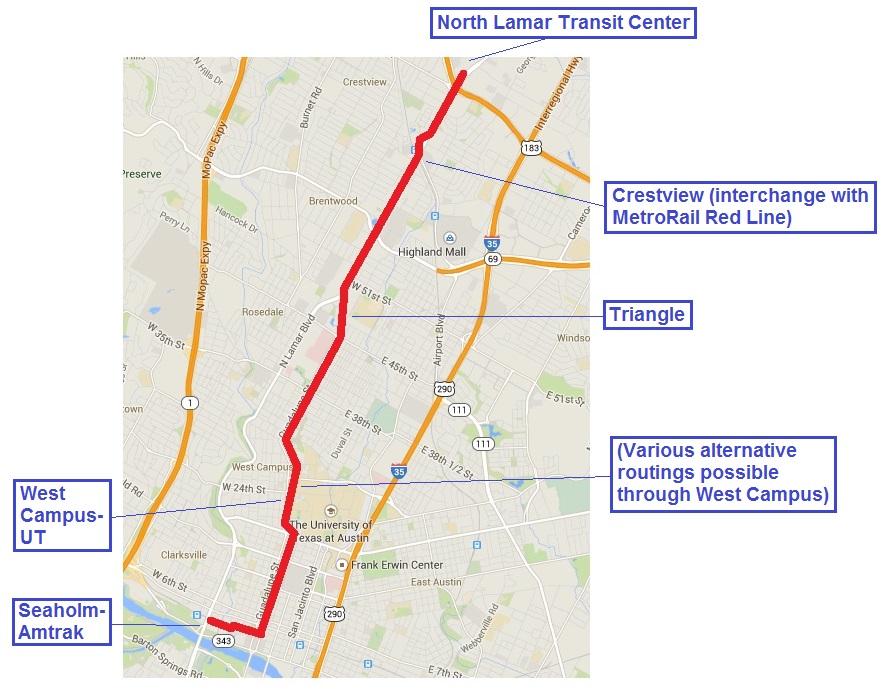
Proposed 6.8-mile "Plan B" light rail transit line in Guadalupe-Lamar corridor would have 17 stations and connect  the North Lamar Transit Center at U.S> 183 with Crestview, the Triangle, UT and the West Campus, the Capitol Complex, the CBD, and the Seaholm-Amtrak area. It's projected to serve 3 times the ridership of the Prop. 1 Highland-Riverside rail line at slightly over half the capital cost.

Light Rail Now, CACDC, Our Rail PAC, and other groups strongly support urban rail in the Guadalupe-Lamar corridor.


And the anti-rail opposition? Of course, highway proponents, anti-taxation activists, and, yes, some Tea Party sympathizers have emerged to oppose this rail bonds proposition — but wouldn’t they do so in any case? What’s surely revved them up, and encouraged them to pour exceptionally heavy resources into this fracas, is undoubtedly the leading role of rail supporters disgusted and outraged at the corruption and distortion of the rail transit planning process and de facto disenfranchisement of the wider community from involvement.

But, in a Democratic Party-leaning city with a substantial base of “progressive” voters, Let’s Go Austin clearly deems it useful to try to paint the opposition as a monolithic Tea Party chimera. And, by strong-arming a preponderant chunk of the local business community, the local civic leadership have managed to lead much of the major local media to buy into this contrived portrayal of the urban rail controversy and the bonds debate as merely a faceoff between conservative roads and anti-tax partisans, hostile to rail transit, versus future-looking, rational “progressives” favoring the official urban rail proposition.

This deception is pretty brazen. But it gets worse — how about some real chutzpah?

Recent research by AURA, with results posted Oct. 21st on their website, seems to have caught Let’s Go Austin (LGA) with some very embarrassing underwear exposed. AURA summarizes what it describes as “an important finding” about LGA’s campaign for the bonds proposition (which, like LGA, AURA refers to as “Prop 1”):

a review of the LGA PAC’s latest campaign finance report reveals that much of its funding comes from major donors to Republican Party candidates and causes. The LGA PAC’s portrayal of Prop 1 as a progressive choice thus appears to be another in its series of deliberate efforts to distract and mislead Austin voters. Frankly, it would be fairer to describe Prop 1 as a plan for “Republican Rail.”

Citing LGA’s campaign funding of nearly half a million dollars, with an average donation of over $6,000 (“A grassroots campaign this is not”), AURA’s study found that some of LGA’s largest donors were also major donors to the Texas Republican Party. You know, the one controlled for much of the past decade by the … Tea Party?

For example, the Downtown Austin Alliance contributed over a quarter-million dollars to LGA; its own treasurer, “also an individual donor to the LGA PAC”, happens to be “managing partner of McCall, Parkhurst & Horton, L.L.P., a law firm with an extensive history of large donations to statewide Republicans, including more than $75,000 to Greg Abbott.”

AURA’s study also focuses on LGA’s third largest donor, the Real Estate Council of Austin (RECA),

which contributed $25,000. RECA also has a long history of contributing to Republicans, including $50,000 to Rick Perry and more than $63,000 to David Dewhurst. A quick search of RECA’s history in the Texas Tribune’s campaign finance database finds at least $180,000 in contributions to major Republicans.

AURA also discovered that, even lower on the food chain, the bankrolling of the Tea Party-connected GOP was in full swing:

The Republican donor trend continues with individuals, corporations, and PACs that donated to the LGA PAC in the $1,000–$5,000 range. A set of eight donors who gave $36,500 to the LGA PAC (almost 30% of the funds we have not yet detailed here) also contributed more than $700,000 to a veritable Who’s Who of the Texas Republican Party.

All told, the LGA PAC’s donors and DAA board members have contributed more than a million dollars to Republican campaigns. If you were to apply the Let’s Go Austin PAC’s preferred campaign strategy, you’d say that a vote for Prop 1 is a vote for Dan Patrick!

Summarizing all this, AURA delivers a stinging assessment:

Given this funding base, perhaps it’s no wonder Prop 1 sacrifices the rest of Austin’s transit system to benefit a handful of private business owners and real estate developers. Funneling taxpayer money into private hands is the very essence of the Texas Republican Party’s ‘business friendly’ agenda, and a similar agenda is at the center of the Let’s Go Austin PAC’s campaign. Just follow the money.

There’s nothing particularly reprehensible in major donors to a rail transit campaign also having contributed to the Republican Party. But in this case, some of Let’s Go Austin’s most generous funders have been pumping huge amounts of money to a Texas GOP that not only has staunchly resisted state funding for mass transit and instead favored highway expansion, but is dominated by the Tea Party. You know — the same Tea Party that LGA is using as a bogeyman to frighten Austin voters against listening to the “progressives”, liberals, leftists, and transit advocates telling them to oppose this urban rail bonds proposition.

Now, that’s chutzpah. On steroids.

And you know the saying, “People living in glass houses shouldn’t throw stones”? AURA’s investigation suggests that Let’s Go Austin is inhabiting a very fragile glass house. ■

h1

Who are those guys? Real estate development interests and Austin’s urban rail boondoggle

28 October 2014
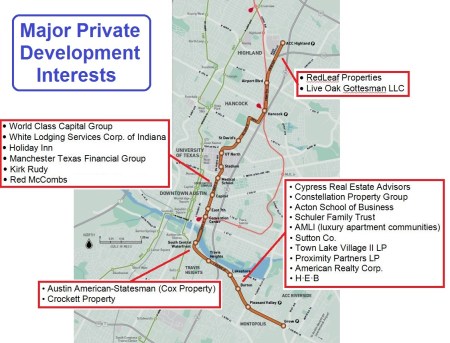
Map of urban rail line proposed for bond funding in November shows major private development interests and property owners that stand to benefit from selected route. Graphic: ARN.

Map of urban rail line proposed for bond funding in November shows major private development interests and property owners that stand to benefit from selected route. Graphic: ARN. (Click to enlarge.)

For years, the Light Rail Now Project, public transport advocates such as Dave Dobbs, Lyndon Henry, and Andrew Clements, and researchers and journalists such as Roger Baker have been criticizing Austin’s official urban rail planning process. In particular, they’ve been calling attention to the distortion of planning to avoid addressing bona fide mobility needs and instead defer to the needs and interests of real estate development.

In his analysis Connecting some dots on Austin’s urban rail planning, Baker revealed how planning for urban electric light rail was shifted away from a focus on crucial travel patterns in the heart of the city, and remade to promote development goals in more peripheral areas: “The dots in this case were partly the political momentum behind a new hospital district, combined with a new Opportunity Austin/Chamber-of-Commerce-recommended Austin growth policy.” Thus, “… in 2008, a city consultant, ROMA, recommended that the proposed light rail corridor be moved east to the San Jacinto Corridor (ultimately connecting several years later to the Red River corridor), as opposed to the previously-assumed Lamar Corridor alignment.”

Similarly, in their commentary Project Connect’s urban rail plan is “worse than nothing”, Dobbs and Henry explain how the official urban rail plan ignores the travel problems of the city’s core Lamar-Guadalupe axis in preference for catering to real estate and economic development development objectives. Now on the November ballot to seek voter authorization for General Obligation bonds to fund a 9.5-mile, $1.4 billion line strangely wandering from East Riverside Drive over a series of disparate, otherwise disconnected roadways to the former Highland Mall site, the proposed project, they say, is “primarily aimed at bolstering development plans and centered on the interests of private developers and the East Campus expansion appetites of the University of Texas administration.”

Rail transit and economic development

There’s certainly nothing wrong with efforts to site or cluster new development around or near rail transit stations. On the contrary, transit agencies, modern planning policy, and the transit industry all encourage and seek such development, often in the form of transit-oriented development (TOD) or transit-adjacent development – typically, synergistic residential development and activity center patterns that promote transit ridership, reduce dependency on personal motor vehicles, and help minimize urban-area sprawl.

But as the current controversy illustrates, a huge problem arises when rail planning forsakes serious mobility needs in deference to a predominant quest by political officials and civic leaders for obsessively desired real estate and economic development. Neglecting mobility function in favor of embellishing or promoting real estate development not only is a disservice to overall community needs, but also can be harmful to cost-effectiveness and other critical performance characteristics of good rail transit. Furthermore, rail transit can be a magnet for development, but this happens more or less in direct correlation with mobility effectiveness – i.e., rail transit in a heavily traveled, high-ridership corridor will tend to attract much more land and economic development than lower ridership in a weaker corridor.

But it’s precisely this faulty course of focusing overwhelmingly on coveted real estate and economic development possibilities, rather than crucial mobility priorities, that Austin’s political and civic leadership have taken. While private development interests obviously perceive that rail transit can bolster their real estate ventures, City of Austin planners and officials are clearly consumed by the prospect of higher property valuations and property tax revenues.

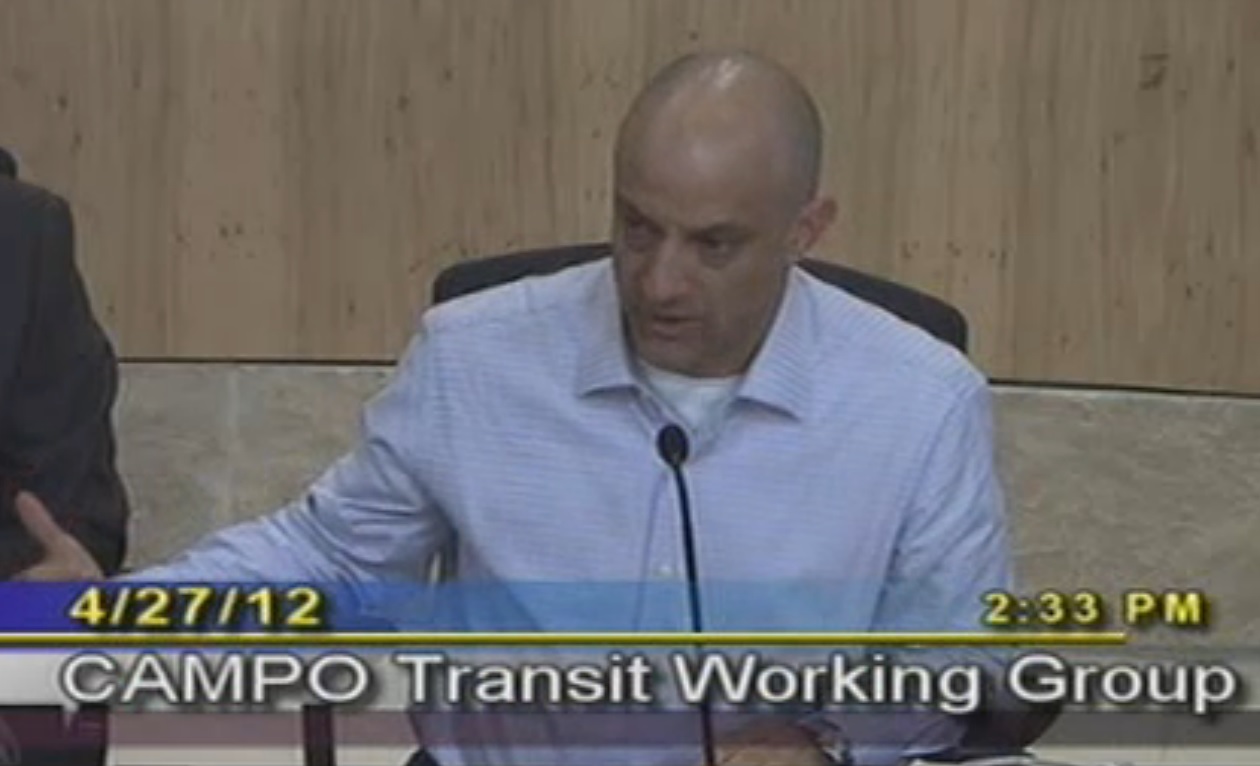
This was underscored at a 27 April 2012 meeting of the Transit Working Group (TWG) — the hand-picked “blue ribbon” circle of civic leaders then chaired by Austin’s Mayor Lee Leffingwell — that was dedicated almost totally to examining the prospects for real estate and economic development along what was then envisioned as an East Riverside-to-Mueller route for urban rail. (See video of meeting.)

Kevin Johns, director of the City’s Economic Growth and Redevelopment Services office, moderated a panel of key players in property development and development planning that extolled the potential for lucrative “return on investment” from the ripening urban rail plan. Significantly, the interaction of such development possibilities with actual mobility patterns and needs was not on their radar.

A major portion of this event included a PowerPoint presentation by Scott Polikov, principal of Gateway Planning, a development consultancy based in Ft. Worth and evidently under contract to the City of Austin. Polikov focused on several projects his firm was involved in, detailing other major players, future projects, projected valuations and tax revenues, and other aspects.


Scott Polikov of urban planning and development firm Gateway Planning gives presentation to TWG, 27 April 2012. Screenshot from COA video.

Scott Polikov of urban planning and development firm Gateway Planning gives presentation to TWG, 27 April 2012. Screenshot from COA video.


And what about the role of the University of Texas? As Lyndon Henry’s commentary UT should pay for East Campus urban rail — not Austin taxpayers points out, the UT administration has played its own role in distorting Austin’s planning process – mainly by demanding an eastside rail alignment, forsaking the high-density West Campus and major commercial activity on the Drag in favor of embellishing UT’s ongoing East Campus expansion program (and most recently, the development of a relatively small medical teaching facility just south of the main campus).

But UT’s influence is primarily political — the influence of being the proverbial “800-pound gorilla” that happens to sit on well over 40 acres of prime central Austin real estate (tax-exempt, nonetheless), and also happens to hold powerful connections to the Texas state government (and let’s not neglect to mention the UT system’s vast oil & gas holdings). Leaving UT aside, evidence is substantial that private business interests — property development interests in particular — have represented a major economic influence swaying the urban rail planning and decisionmaking of City officials.

Earlier planning for East Riverside and Mueller

For years, City planners and various public officials have repeatedly referred to the economic development potential and taxbase implications of their urban rail plans. An entire project — the City’s East Riverside Corridor Project — has focused on encouraging development and “revitalization” of the East Riverside area, historically a haven of medium to high-density, lower-cost, more affordable housing for both students and a segment of Austin’s lower and lower-middle-income workers and their families.

These development plans and policies, and their impact on East Riverside residents, were chronicled as early as 2007 by a landmark Austin American-Statesman in-depth examination. Dated 6 Aug. of that year, the story, titled “Banking on Riverside”, carried the ominous sub-ledes “Neighborhood in Transition” and “As explosive growth nears, where will longtime residents go?”

Statesman reporter Susannah Gonzales described the area as “one of the city’s largest concentrations of apartment complexes … home to thousands of immigrants and college students drawn by the lower rents and public transportation.” However, she noted, massive change was on the way. “Several plans for new development are under way in the vicinity.” Gonzales portrayed a determined effort by the City administration to expunge cheaper, affordable residential facilities and replace them with upscale condos, offices and retail outlets in a process of densification and gentrification.

Those early signals of East Riverside development, and subsequently the official corridor project, provide critical clues as to the thrust of City of Austin policy. And urban rail planning has been molded to support this policy, not just in East Riverside but in other areas deemed lucrative for both private development interests and City taxbase enhancement goals.

The Mueller development site also fits into this pattern. Since the early 2000s, the private development giant Catellus has proceeded, under City authority, to replace this former primary airport site with a 700-acre, mixed-use development envisioned to include 4,900 residences, over 650,000 square feet of retail space, and some 4.2 million square feet of office/commercial space. Until insider desires shifted in the course of the Project Connect urban rail “study” a year ago — reflecting development appetites eyeing the Highland ACC site — urban rail was planned to be routed into the Mueller project area. And Catellus has been assured that the current Red River-Hancock Center alignment will facilitate an eventual urban rail connection if the proposal on the November ballot is approved by voters. Indeed, “urban rail” planning actually began (c. 2005) as a streetcar “circulator” plan aimed at linking Mueller to UT’s East Campus and the Core Area.

Private interests that stand to gain

From a variety of reliable sources, Austin Rail Now has been able to compile a fascinating listing of many of these private property and economic development interests that stand to gain from the proposed Highland-Riverside urban rail proposal — ranging from property owners that might benefit from upward valuations to major development firms with projects already completed or under way. While some of these business interests undoubtedly have contributed to election campaigns of some councilmembers, our assessment is that City policy has been dominated by expectations of increased economic development and elevated property values, leading to expansion of taxbase and increases in property tax revenues. (The pitfalls of basing urban rail planning on such expectations have already been noted, above.) In any case, a number of these interests can be considered major players in the evolution of City urban rail planning and policy decisions. (Also see infographic at top of this post.)

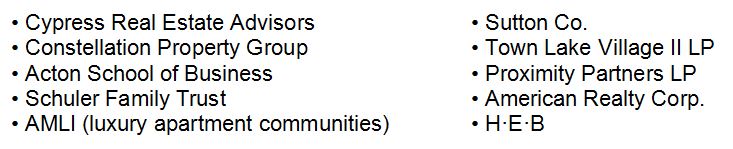
East Riverside corridor — The Statesman article of 6 August 2007 listed ten specific developer or property-holder interests with projects either planned, under construction, or completed in this area. These included:
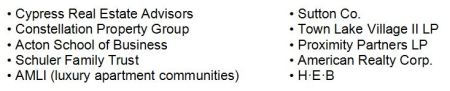

Development interests in East Riverside area as of 2007. From Austin American-Statesman report, 2007/08/06.

Development interests in East Riverside area as of 2007. From Austin American-Statesman report, 2007/08/06.


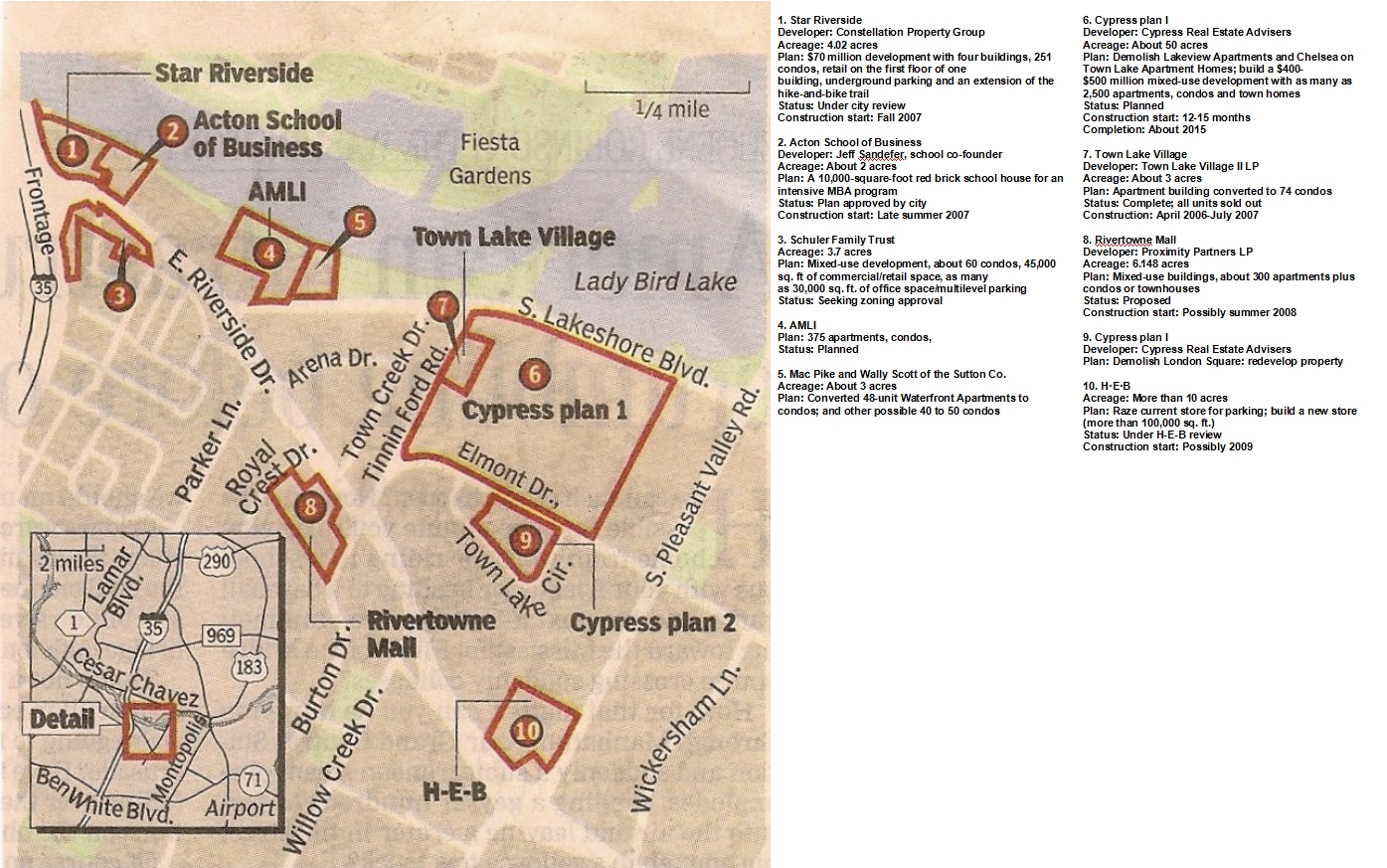
The 2007 article included a map and key of the specific developments:
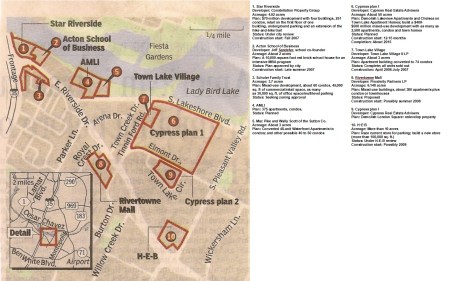

Map and key of East Riverside developments as of August 2007. Screenshot of scan of Statesman map by Dave Dobbs.

Map and key of East Riverside developments as of August 2007. Screenshot of scan of Statesman map by Dave Dobbs. (Click to enlarge.)


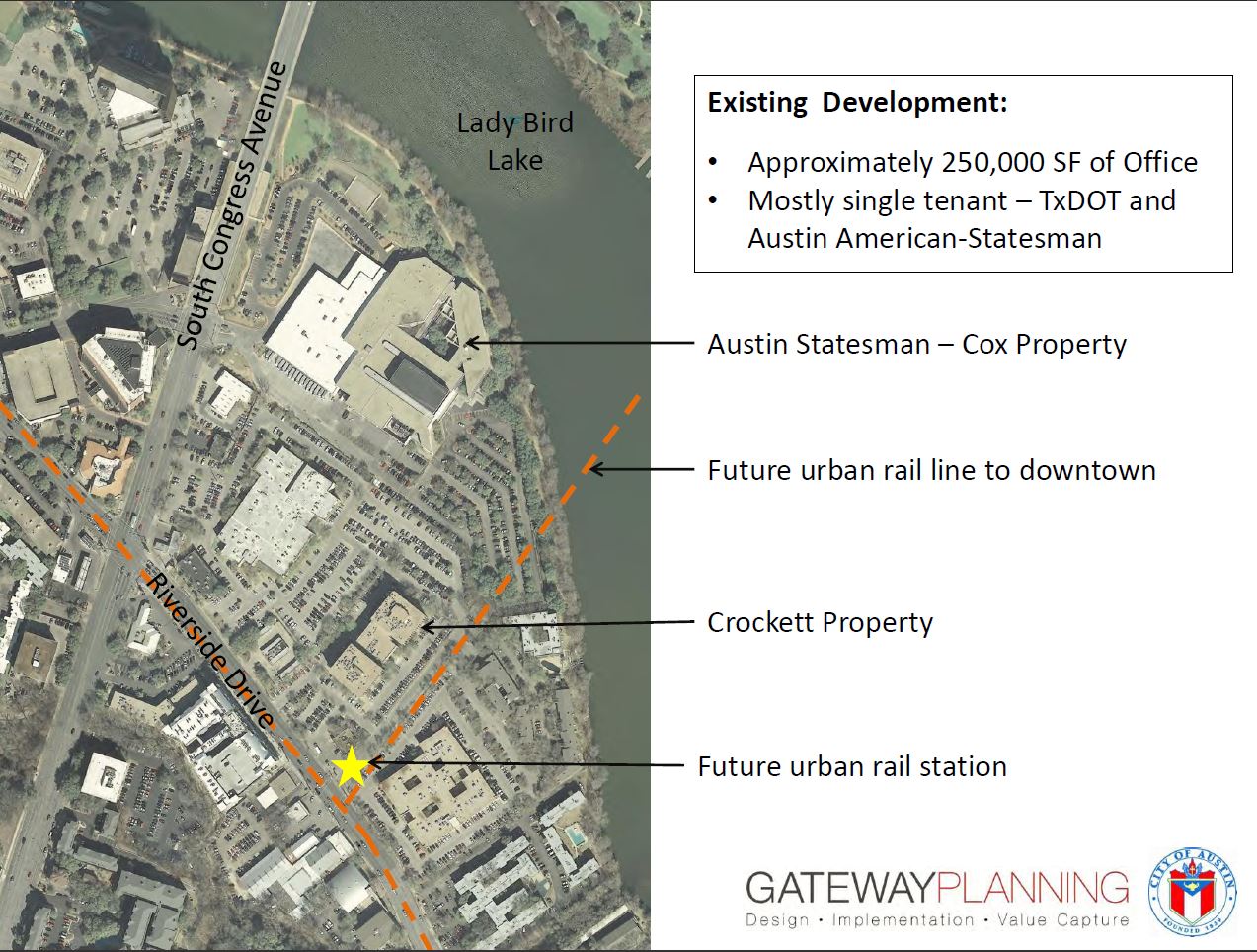
South Shore — This area, also called the South Bank, just across the river (Lady Bird Lake) from Austin’s CBD, seems to be regarded as especially lucrative because of the availability of high-dollar river views for office buildings and condominiums. It was featured in Scott Polikov’s 2012 presentation to the TWG, which indicated how a new urban rail bridge across the river would benefit existing property owners, and help open up the area for a future development boom:


Slide from 2012 Gateway presentation to TWG showed adjacent South Shore property owners that stood to benefit.

Slide from 2012 Gateway presentation to TWG showed adjacent South Shore property owners that stood to benefit.


Slide from 2012 Gateway presentation to TWG showed possible future South Shore development boom.

Slide from 2012 Gateway presentation to TWG showed possible future South Shore development boom.


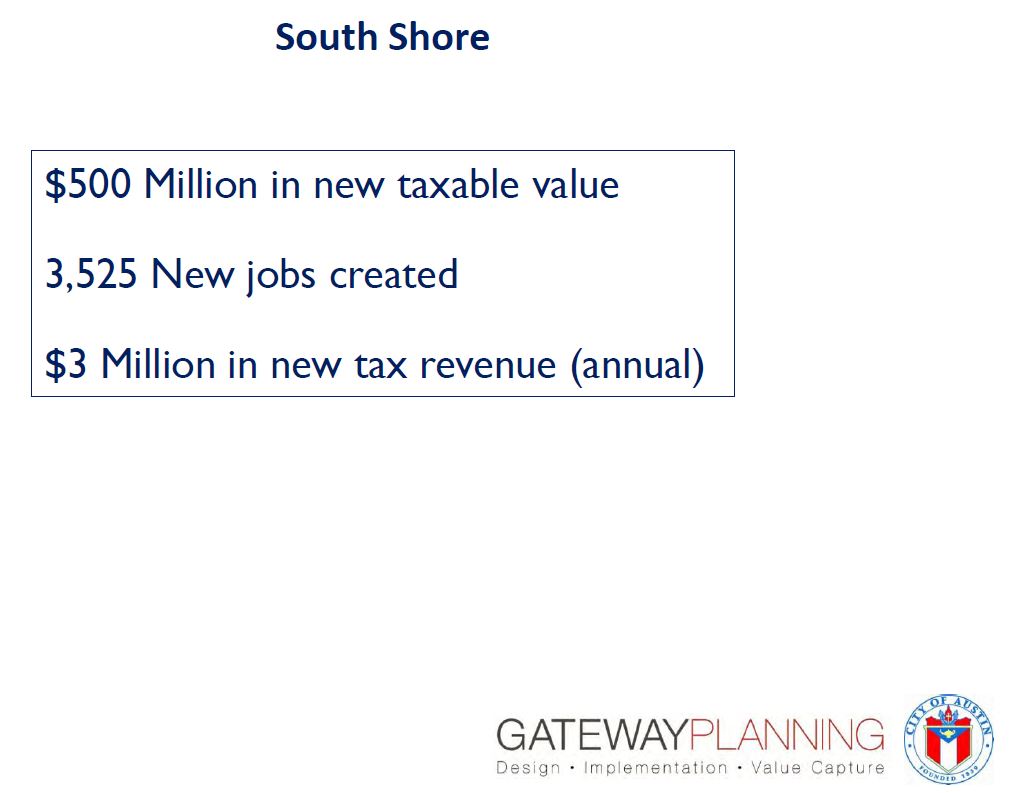
The Gateway presentation also described the possible economic payoff from South Shore development stimulated by urban rail:


Slide from 2012 Gateway presentation to TWG showed possible economic and tax benefits of urban rail plan in South Shore area.

Slide from 2012 Gateway presentation to TWG showed possible economic and tax benefits of urban rail plan in South Shore area.


In summary, major current beneficiaries of the proposed urban rail project through the South Shore area would include:


Development interests in South Shore area.

Development interests in South Shore area.


Eastside CBD — This area lies generally between Congress and I-35, from the river north to the UT campus. Information on development interests has been compiled from the Downtown Austin Alliance Emerging Projects listing, the Gateway 2012 TWG presentation, and a knowledgeable political consultant speaking on background. According to this last source, several major developers and speculators are acquiring large property holdings (entire blocks in some cases) along and near the East 6th St. area in anticipation of the valuation effects of urban rail as well as the Waller Creek project.

Based on these sources, some major beneficiaries of the proposed urban rail project through the east side of the CBD include:
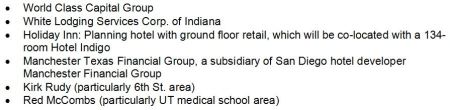

Development interests in east side of CBD.

Development interests in east side of CBD.


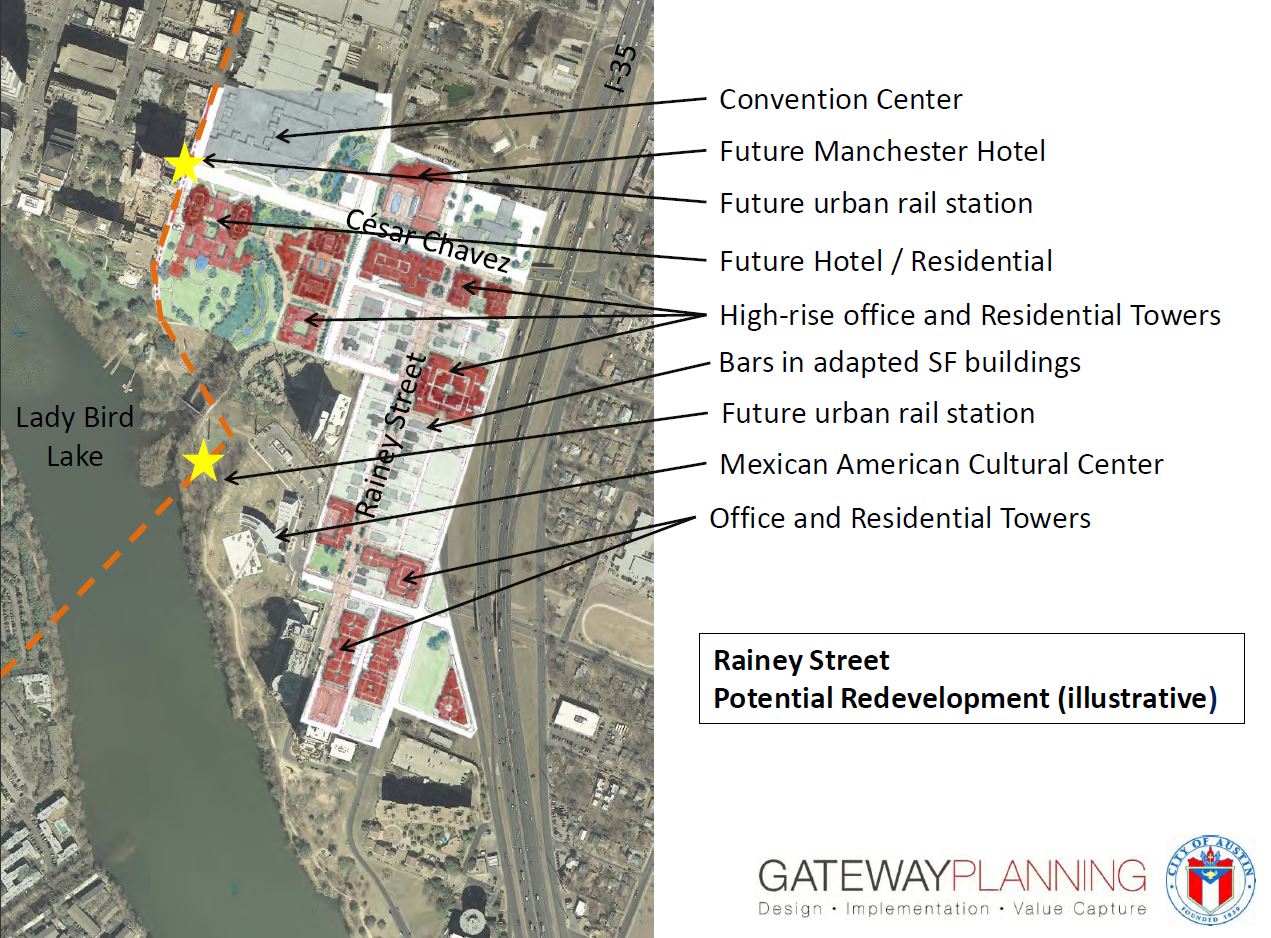
The Gateway 2012 TWG presentation also zeroed in on a possible development boom, bolstered by the proposed urban rail alignment, engulfing the Rainey St. neighborhood, in the southeast corner of the CBD:
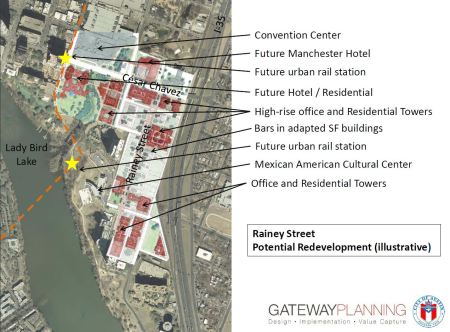

Slide from 2012 Gateway presentation to TWG showed possible future Rainey St. development boom.

Slide from 2012 Gateway presentation to TWG showed possible future Rainey St. development boom.


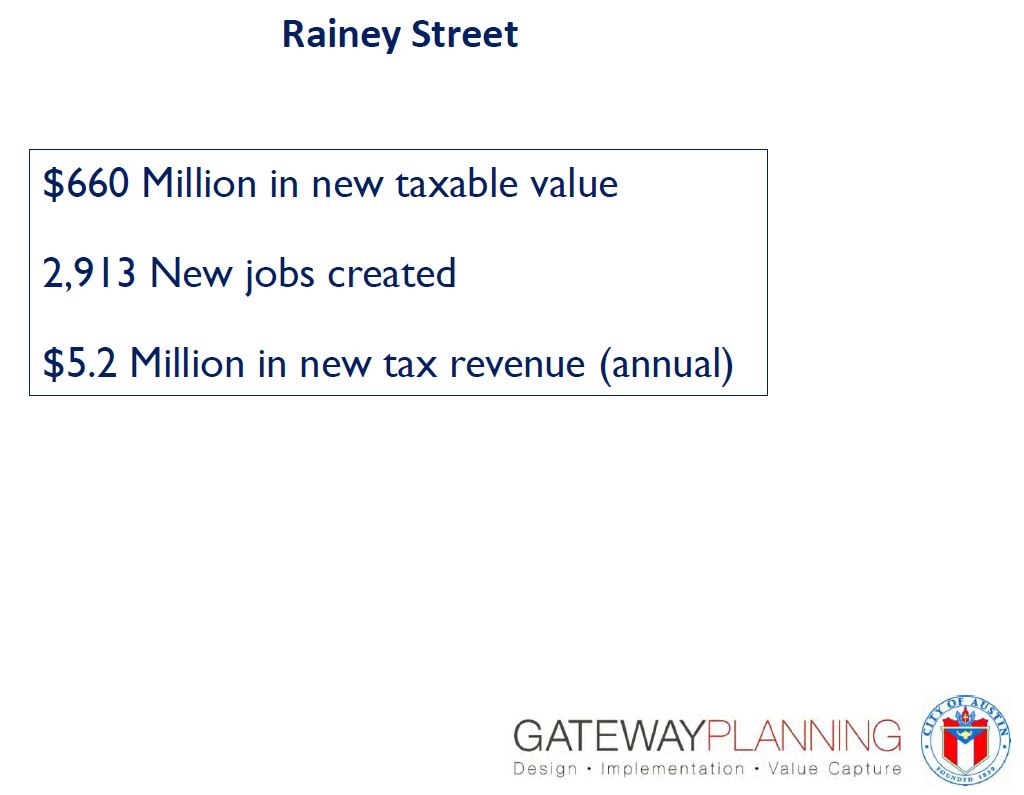
Hypothetical economic benefits were also listed:
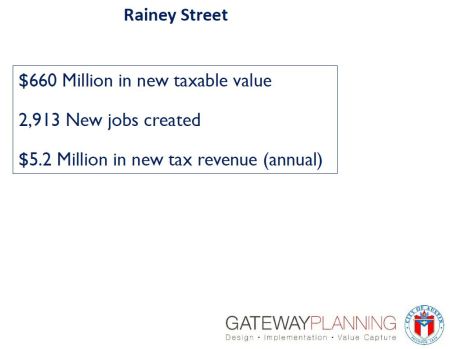

Slide from 2012 Gateway presentation to TWG showed possible economic and tax benefits of urban rail plan in Rainey St. neighborhood.

Slide from 2012 Gateway presentation to TWG showed possible economic and tax benefits of urban rail plan in Rainey St. neighborhood.


Airport Blvd. corridor and Highland ACC area — Information on development interests in these segments of the City’s proposed urban rail route has been derived from a 28 Aug. 2011 article in the Austin American-Statesman, the 2012 TWG presentation by Gateway Planning (which has been involved in recommending and projecting economic and real estate development for the Airport Blvd. corridor), and a 2 Nov. 2012 article from the Austin Business Journal.

Reportedly, planners and officials envision a “new urbanist” redevelopment with classroom facilities, administrative offices, “and a mix of residential, retail and other commercial development.” (Statesman) The RedLeaf development is aimed to be “a thriving public-private complex with perhaps 1,250 residential units”. Major private development players cited in these sources include:


Development interests in Highland ACC and Airport Blvd. area.

Development interests in Highland ACC and Airport Blvd. area.


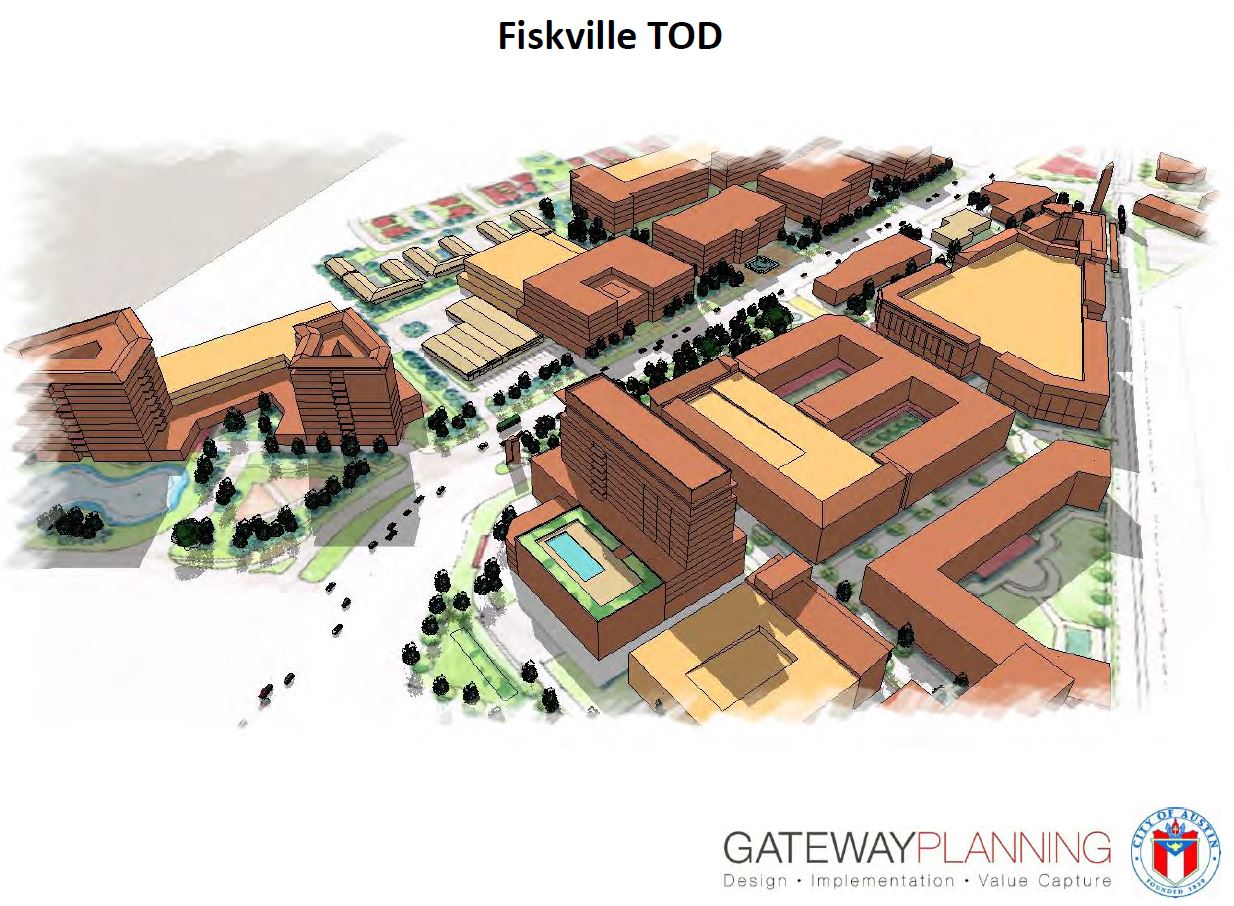
Along and east of the Highland site, the Airport Blvd. corridor is proposed for a massive overhaul. Giving some visualization of what the character of development along this corridor could look like, the Gateway 2012 TWG presentation provides a slide showing a proposed transit-oriented development (TOD) project in the Fiskville neighborhood along the corridor:


Slide from 2012 Gateway presentation to TWG showed rendering of possible TOD in Fiskville corridor near Airport Blvd.

Slide from 2012 Gateway presentation to TWG showed rendering of possible TOD in Fiskville corridor near Airport Blvd.


As this post has already emphasized, there’s nothing illicit or irregular with private development interests seeking opportunities to locate new projects near rail transit stations. But in the case of the urban rail plan now proposed for bond funding via a proposition on this November’s ballot, considerations of economic and real estate development potential — and expectations of increased property valuations and tax flows for local government budgets — seem to have trumped essential mobility priorities and thoroughly distorted the planning process and the proposed rail plan.

Likewise, it should be noted that there’s no assumption that interests listed in this post that stand to benefit from the routing of urban rail have directly intervened to influence urban rail planning. However, it is known that some real estate and development interests have been listed as contributors to the semi-official Let’s Go Austin campaign leading the effort to advocate passage of the bond funding measure. ■


h1

Lloyd Doggett — Dupe, or accomplice in rail bonds campaign’s “Tea-baiting”?

27 October 2014
Campaign mailer from Let's Go Austin publicizes Rep. Lloyd Doggett's backing of urban rail bonds proposition in Nov. 4th election. Was Rep. Doggett duped or "strong-armed" into supporting this seriously flawed proposition?

Campaign mailer from Let’s Go Austin publicizes Rep. Lloyd Doggett’s backing of urban rail bonds proposition in Nov. 4th election. Was Rep. Doggett duped or “strong-armed” into supporting this seriously flawed proposition?

It’s become clear that a prominent, desperate tactic of the “Let’s Go Austin” campaign to promote the urban rail bonds ballot measure is to “Tea-bait” the opposition — to try to smear all of us, “progressives”, liberals, leftists, rail transit advocates, transit critics, moderates, conservatives, neighborhood associations, and other opponents of this misguided proposal — as homogeneous minions of the rightwing Tea Party. Most recently, apparently in an effort to drop a late-campaign “bombshell”, they’ve managed to enlist liberal Democratic U.S. Representative Lloyd Doggett in this smear campaign.

Project Connect leaders and the Let’s Go Austin campaign know very well that this is not only a fraud, it’s an absurd fraud. Ironically, what’s made this light rail ballot battle especially newsworthy — even on a national scale — is that rail supporters and “progressive” community leaders and neighborhoods have been in the forefront of criticizing and opposing the official planning process and its ultimately selected route plan since the beginning.

Whether Rep. Doggett was aware of any of this is dubious. In any case, it’s apparent that, to corral both political and business support into (at least nominally) backing their lemon of an urban rail plan, supporters of the urban rail plan and ballot proposition have been engaging in a whole lot of strong-arming. Businesses, for example, are vulnerable to this because they need City of Austin permits for expansion or other commercial needs, or perhaps they’re angling for a public contract. Not only has there been a kind of “bandwagon” effect, but top officials and civic leaders have seemed to require allegiance to the Highland-Riverside rail plan as virtually an article of faith, akin to “kissing the royal ring”.

Similarly intense has been the political pressure from the local Democratic Party elite to extract lockstep fealty to the urban rail bonds proposition from the Democratic fold — both elected officials as well as wanna-bes. This now has apparently included the “bombshell” of Lloyd Doggett’s endorsement — first with his participation in a Let’s Go Austin rally on Oct. 19th (the day before the start of early voting), and now by being featured in a Let’s Go Austin campaign mailer (see graphic at top of this post).

Is a Congressional representative really vulnerable to being “strong-armed” by mere local and state-level party officials? It’s certainly plausible, since U.S. elected representatives depend on strong local party support in their home districts to help them at re-election time. And with Texas state GOP gerrymandering that has been moving the boundaries of his district, Rep. Doggett probably feels especially vulnerable. Keeping good relations with the local elite is a must.

In any event, whether this is a case of being duped or being a willing accomplice, for Rep. Doggett — and a large segment of his “progressive-liberal” supporters who are dismayed by his alliance with the Let’s Go Austin forces — his emergence into public support of this widely unpopular ballot proposition is very unfortunate. And eroding a major segment of voter support is surely not helpful to Rep. Doggett’s political security.

Neutrality probably was an option, and definitely would have been a choice preferred by many of Rep. Doggett’s most ardent supporters in the community. ■

h1

Urban rail bonds proposal is not Prop. 1 anymore — it’s just “Proposition”

22 October 2014
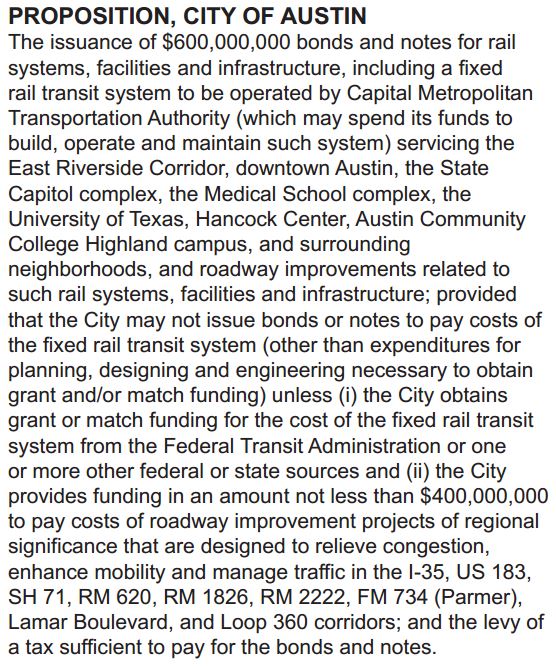
Excerpt from Travis County's sample ballot for Nov. 4th shows that the urban rail bonds measure will be titled just "Proposition, City of Austin". Screenshot by L. Henry.

Excerpt from Travis County’s sample ballot for Nov. 4th shows that the urban rail bonds measure will be titled just “Proposition, City of Austin”. Screenshot by L. Henry.

For months, the City of Austin’s urban rail bonds proposal has been designated “Proposition 1”, and that’s how it’s been referred to by all sides in this dispute. Apparently on the basis of information from city representatives, media reporters have been referring to it that way since about the first week of August.

But heads up — on the ballot, it’s designated somewhat differently: “Proposition, City of Austin“. (See excerpt from sample ballot at top of this post.)

A copy of the full sample ballot can be accessed via the following link:

http://www.traviscountyclerk.org/eclerk/content/images/sample_ballots/2014.11.04/2014.11.04_G14_CITY.pdf

As this sample shows, on the ballot the urban rail bonds proposition is presented after all the choices for mayor and council.

It’s important that this new designation, and the position of the “Proposition, City of Austin” measure, is made clear to voters. Anecdotal evidence suggests that anti-rail bonds voters are more motivated in this election, so confusion works to the benefit of the Let’s Go Austin campaign to support the urban rail bonds and the seriously flawed Highland-Riverside line they’re intended to finance.

h1

Latest TTI data confirm — Guadalupe-Lamar is central local arterial corridor with heaviest travel

13 October 2014
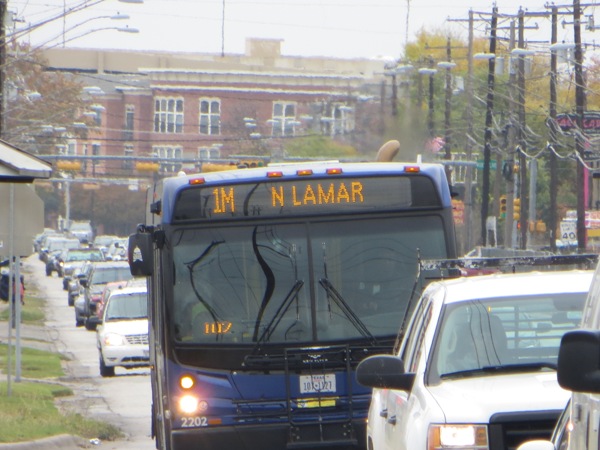
Heavy peak-hour traffic on North Lamar. Guadalupe-Lamar is Austin's most heavily travelled inner-city central corridor, long seen as top priority for urban rail. Photo: L. Henry.

Heavy peak-hour traffic on North Lamar. Guadalupe-Lamar is Austin’s most heavily travelled inner-city central corridor, long seen as top priority for urban rail. Photo: L. Henry.

For years, many Austin public transit activists have been insisting that the Guadalupe-Lamar corridor is the central inner city’s most heavily travelled local travel route, and should be the first priority for installing urban rail. In this blog’s first posting, in the spring of 2013, we described how City of Austin planners were proposing an urban rail starter line to connect downtown and the east side of the University of Texas with the Mueller development site, but “Lamar-Guadalupe is the ‘Missing Link’ in their plan.”

Ironically, COA has also been emphasizing that Lamar-Guadalupe is the primary local traffic corridor in central-city Austin, and even identified this corridor in the NEPA (National Environmental Policy Act) scoping meetings, held throughout Austin in spring 2012, as being at maximum capacity for over the past 2 decades.

In a posting just this past August, we summarized the case for Guadalupe-Lamar (G-L) in a single sentence:

Guadalupe-Lamar is the outstanding corridor to start urban rail — among the top heavy travel corridors in Texas, a long-established commercial district, with major activity centers, the city’s core neighborhoods, and the West Campus, having the 3rd-highest residential density in Texas.

By far, the heavy travel flow in this corridor one of that most compelling features that cry out for the capacity, public attractiveness, and cost-effectiveness of urban rail (light rail transit, LRT). Study after study has documented the fact that this is the most intensely traveled inner-city local corridor — the only major corridor serving the city’s central axis between I-35 and Loop 1 (MoPac).

Now, the latest annual report of the Texas Transportation Institute (TTI), endorsed by the Texas Department of Transportation (TxDOT) not only strongly corroborates these assessments, but provides data that further emphasize the key importance of the G-L corridor. The report tabulates both vehicular traffic (measured as daily vehicle-miles travelled, or VMT) and congestion (measured as annual person-hours of delay) for each major roadway included in the list.

TTI’s complete statewide listing of major roadways, in an Excel XLSX spreadsheet, can be downloaded from this link:
http://tti.tamu.edu/documents/umi/most-congested-in-texas-final.xlsx
Selected data from Austin (Travis County) is summarized (webpage text) at this link:
http://mobility.tamu.edu/most-congested-texas/austin/

Certainly, as north-south highways, I-35 and Loop 1 (MoPac) remain at the top of the list in terms of traffic flow and congestion (person-hours of delay). But these are primarily intercity-regional highways, flanked by frontage roads and sprawling, motor-vehicle-oriented development, mostly commercial. As potential transit corridors, they are physically inappropriate as alignments for regional passenger rail, and definitely unsuitable for urban-suburban light rail, which is ideal for interconnecting points along an inner-city corridor.

Guadalupe-Lamar is ideal for urban rail, since it channels incoming suburban travel from both I-35 and Loop 1 and distributes it to inner-city destinations. And it interconnects those same activity centers as well as many of Austin’s most established central-city neighborhoods.

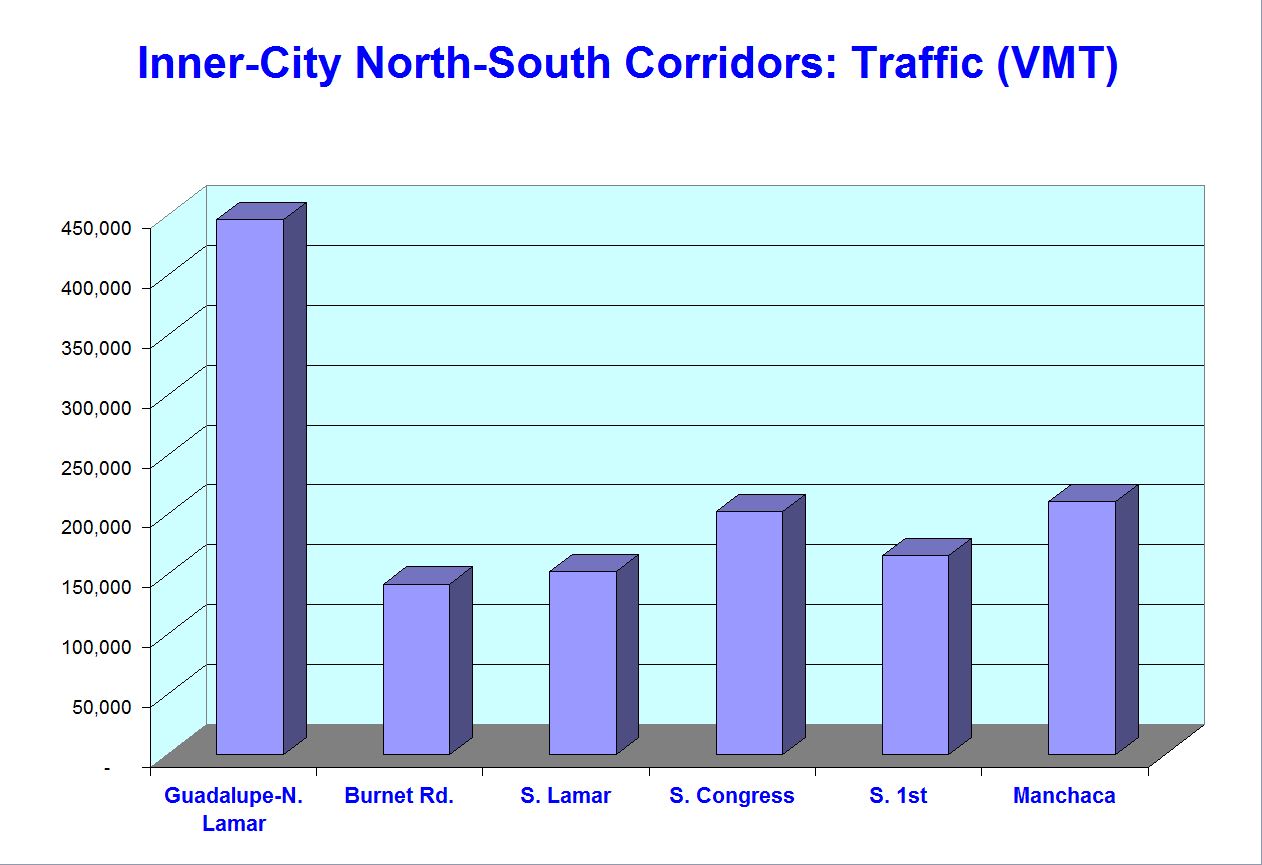
The TTI data underscore the high-traffic primacy of Guadalupe-Lamar. Since these data a presented for segments of the total corridor, we’ve consolidated these segments to show flow in the entire corridor.

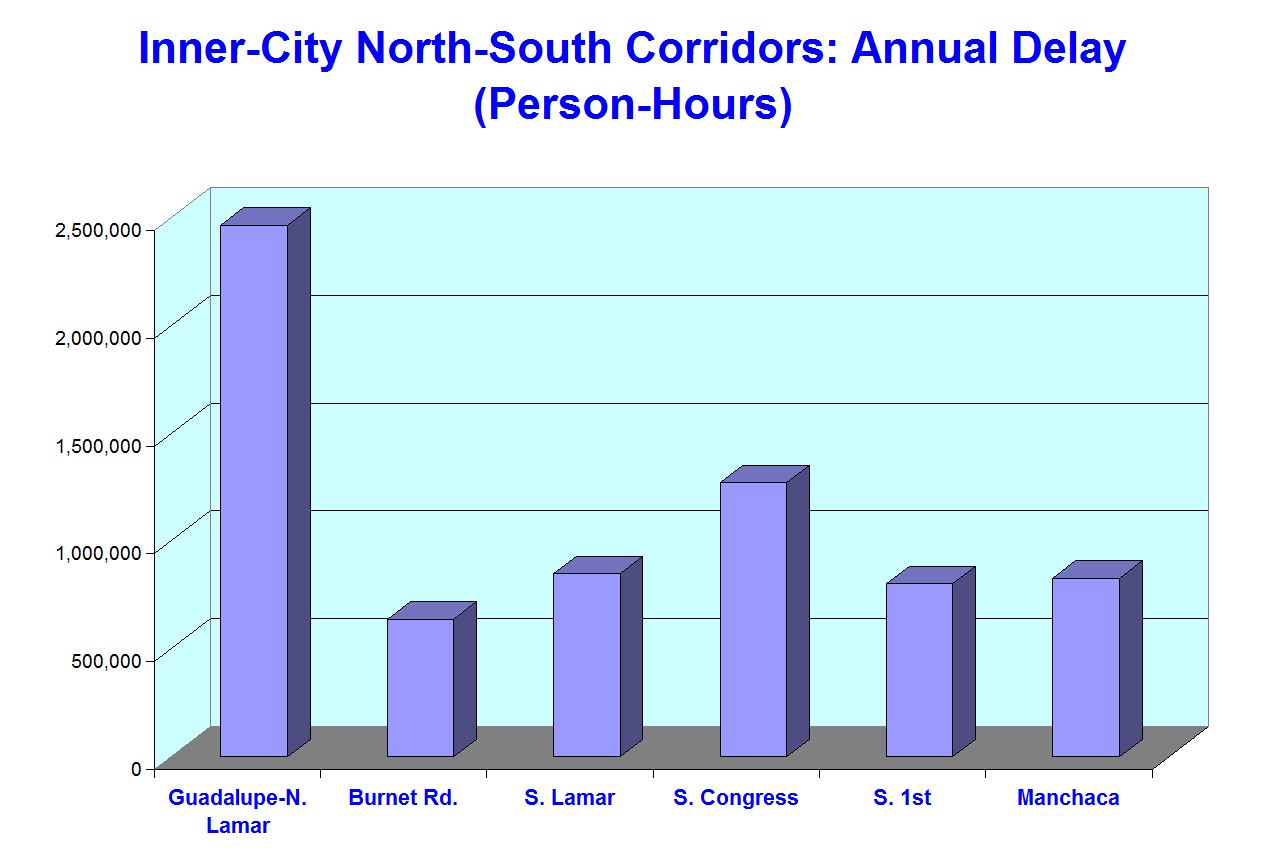
We’ve created graphic comparisons to contrast Guadalupe-Lamar with other major inner-city north-south corridors, both in terms of traffic flow (daily VMT) and congestion (annual person-hours of delay). Data for South Congress, South First, and Manchaca have similarly been consolidated to highlight each of these corridors in its entirety. (Data for South Lamar and Burnet Road were not similarly segmented in the TTI report.)

Graph illustrates that traffic flow in Guadalupe-Lamar is more than twice that of any other inner-city north-south corridor.

Graph illustrates that traffic flow in Guadalupe-Lamar is more than twice that of any other inner-city north-south corridor.

Graph illustrates that congestion (person-hours of delay) in Guadalupe-Lamar is nearly twice that of the next highest inner-city north-south corridor, South Congress.

Graph illustrates that congestion (person-hours of delay) in Guadalupe-Lamar is nearly twice that of the next highest inner-city north-south corridor, South Congress.

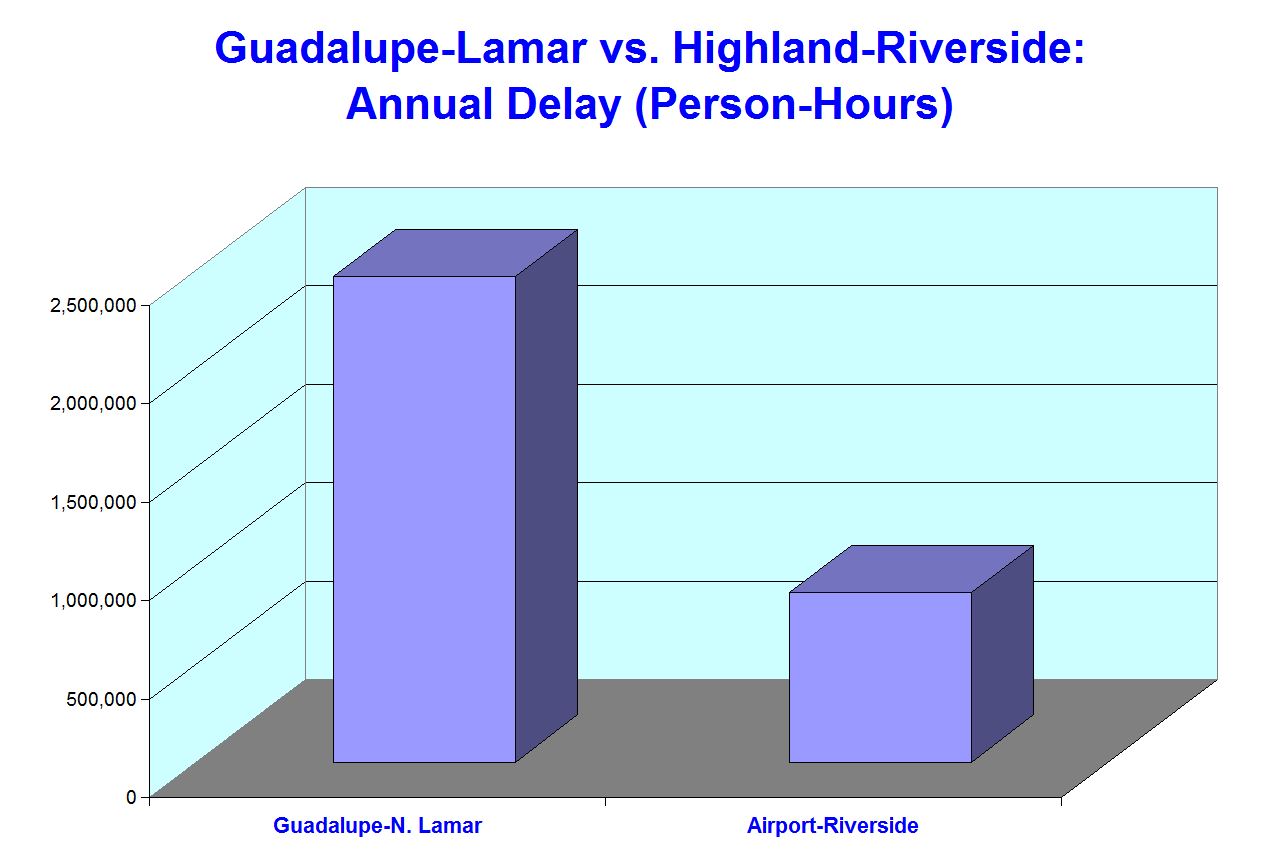
We also compared the Guadalupe-Lamar data with TTI data for the officially proposed Highland-Riverside (H-R) urban rail route. H-R data were consolidated from available arterial data provided in the TTI report, which included the entire Riverside Drive alignment from South Lamar to S.H. 71, plus Airport Blvd. from North Lamar to I-35. (Other arterials in the Highland-Riverside route, such as Trinity, San Jacinto, and Red River, apparently register too little traffic and congestion to even qualify for inclusion on TTI’s listing.)

Graph illustrates that traffic flow in Guadalupe-Lamar is at a volume about 2.4 times that of arterials in the Highland-Riverside route.

Graph illustrates that traffic flow in Guadalupe-Lamar is at a volume about 2.4 times that of arterials in the Highland-Riverside route.

Graph illustrates that congestion (person-hours of delay) in Guadalupe-Lamar is nearly three times that of arterials in the Highland-Riverside route.

Graph illustrates that congestion (person-hours of delay) in Guadalupe-Lamar is nearly three times that of arterials in the Highland-Riverside route.

This comparison suggests that, in terms of both traffic flow and congestion (which can be interpreted as a proxy for travel density), the Guadalupe-Lamar corridor far outpaces the H-R corridor proposed for urban rail by Project Connect, and offered for public endorsement (i.e., bond funding authorization) in Proposition 1 on November 4th. (It’s worth noting that Project Connect’s much-vaunted “scientific” and “data-based” exercise a year ago, portrayed as a “study”, failed to evaluate a single actual travel corridor, let alone with this kind of data comparison.)

The logical conclusion: Overwhelmingly, in both traffic and mobility congestion, Guadalupe-Lamar trumps not only the official Highland-Riverside line, but every other alternative corridor as well. Good sense suggests that Guadalupe-Lamar remains the top-priority corridor for an urban rail starter line. ■
h1

How soon to get Austin’s urban rail on track after Nov. 4th?

11 October 2014
Graphic: LifeHacker.com

Either the Highland-Riverside urban rail plan or a Guadalupe-Lamar plan will need several years to be ready for federal approval. Graphic: LifeHacker.com

By Dave Dobbs

How quickly can Austin get another rail proposal on the ballot if Proposition One fails on Nov. 4th? Pass or fail, I think any rail proposition that would be ready for federal funding is at least three years out — i.e., 2018, considering that the new 10-1 council gets up and running early in 2015.

If Proposition One passes, the new council would have to deal with the political mandate of $400 million of road funding — most likely, in Certificates of Obligation (COs). And given the nature of COs, meant for emergencies, not for general obligation (GO) situations, the oxygen in council chambers is going to be consumed as new council members (a) hear from the public pro and con and (b) recognize that large city indebtedness limits their ability to expend funds for many other needed things (particularly their own priorities and campaign promises), while at the same time setting the stage for even more debt for a controversial rail project that will surely necessitate giving up a quarter cent of Capital Metro’s sales tax they now collect.

Assuming that the issue of COs could be settled in a year’s time and the city could begin selling bonds to fund the detailed planning necessary to qualify for federal funding, it will still take two to three years for the federally mandated steps necessary to get back into line for federal funding. Remember, when Project Connect switched the destination from Mueller to Highland, the current project on the ballot lost its place in line. (Council members knew this when they placed Proposition One on the ballot.) Considering that federal funding is highly competitive, with something like 50 U.S. cities doing some kind of urban rail planning in pursuit of federal dollars, Austin’s current project (supposedly with 18,000 daily riders) for $1.4 billion is simply not cost-effective or cost-competitive.

Now if Project Connect still has some funds left from the $5 million allocated from CAMPO’s SMP-MM grant and what the Council provided in 2013, and Prop. One passes, then rail planning for Highland/Riverside could go on while council thrashes about trying to deal with the $400 million in COs. Nonetheless, it would still be 2018 before any Project Connect plan would be ready for federal consideration and the ridership and the project won’t be any better.

If Proposition One fails, then the new 10-1 council will be able to get organized and set its own priorities, one of which would be to disconnect Project Connect, along with its funding, and then assess where the community goes with Capital Metro, transit priorities, rail planning, and what role the city, itself, has in all this. Hopefully, any funding that is left from Project Connect could be held in abeyance until Council agrees to set up a new public study process that has real public input and gives public stakeholders ownership. Right now, Capital Metro has been so poorly used by politicians and the private political agendas the politicians represent, that we need to have a community discussion about what transit’s role is in the future and who does what.

The city and the transit authority, after all, have to agree upon how to use the limited assets we call the public streets. We have to decide whether streets are for people (pedestrians, bikes, and transit) or sewers for cars. While some of our elected officials piously claim we can’t give up automobile travel lanes for rail on Guadalupe and Lamar, the CAMPO plan (its Capital Metro elements) projects dedicated bidirectional busways for MetroRapid on all of the best potential rail routes in the city by 2025.

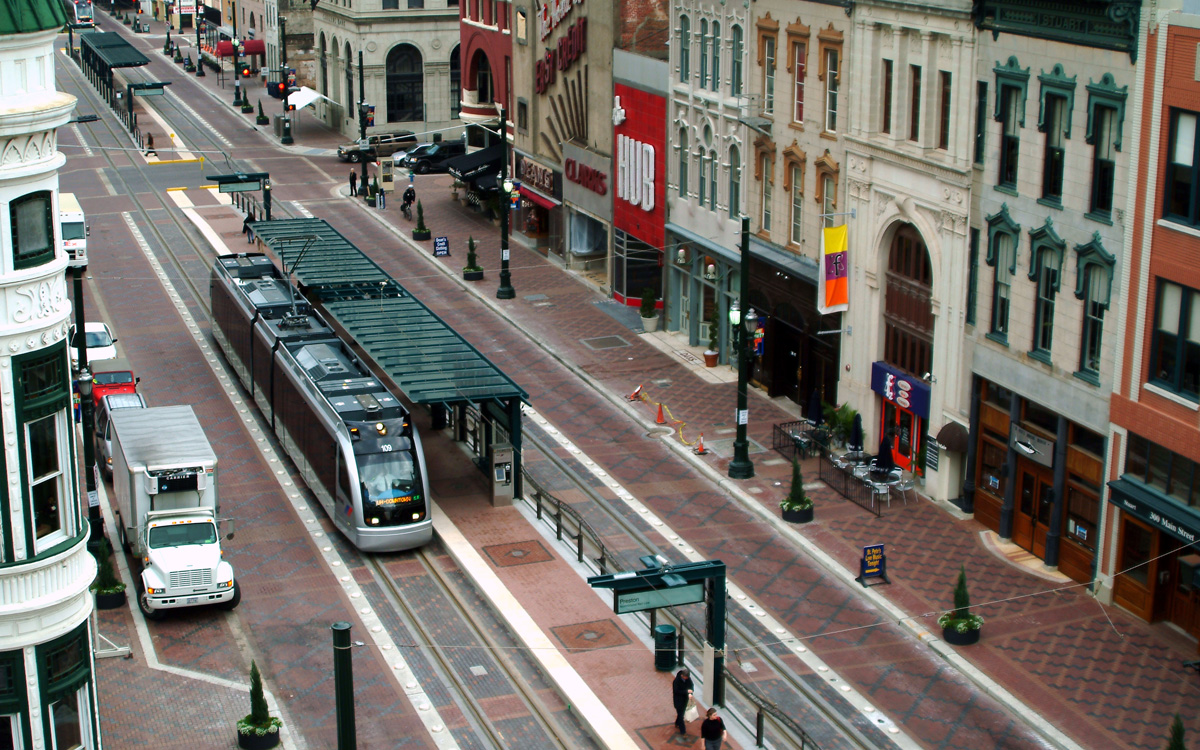
Overhead view of MetroRail on Main St. at Preston. Photo: Houston Metro.

Houston’s MetroRail light rail transit system runs on dedicated tracks on Main St., re-allocated from traffic lanes. Photo: Houston Metro.

Given the undeniable need, now becoming patently obvious to most of the attentive public, that something must be done in the core along the Guadalupe/North Lamar corridor, the new Council will be under enormous pressure from most of the Project Connect supporters and the loyal opposition pro-rail supporters to begin anew looking at a rail proposal that has the right combination of route, ridership, capital cost, and O&M numbers that gets the most bang for the buck. Again, we’re looking at 2018 before any plan could be completed and eligible for Federal Transit Administration funding.

The difference between passing and failing is, of course, funding — i.e., Austin’s local match for a federal grant. While both Proposition One proponents and the loyal opposition pro-rail supporters agree that a local match is essential, the contention that a November bond failure means “another 14 years” before we can visit the issue again, or that a 10-1 council will be unable to agree on where to begin, are arguments for people with an agenda and those who are flying backward to see where we’ve been. ■
h1

A “Plan B” proposal for a Guadalupe-Lamar alternative urban rail starter line

5 October 2014
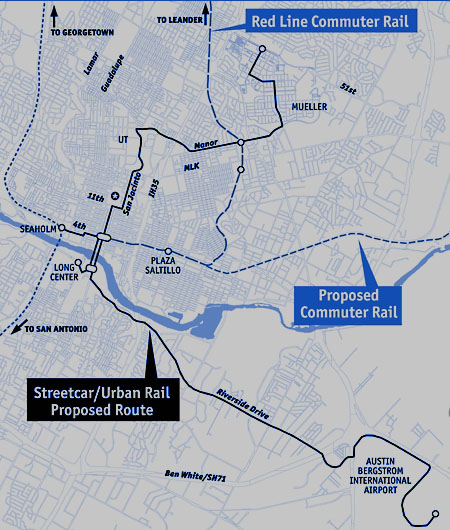
Proposed 6.8-mile "Plan B" light rail transit line in Guadalupe-Lamar corridor would have 17 stations and connect  the North Lamar Transit Center at U.S> 183 with Crestview, the Triangle, UT and the West Campus, the Capitol Complex, the CBD, and the Seaholm-Amtrak area. It's projected to serve 3 times the ridership of the Prop. 1 Highland-Riverside rail line at slightly over half the capital cost.

Proposed 6.8-mile “Plan B” light rail transit line in Guadalupe-Lamar corridor would have 17 stations and connect the North Lamar Transit Center at U.S. 183 with Crestview, the Triangle, UT and the West Campus, the Capitol Complex, the CBD, and the Seaholm-Amtrak area. It’s projected to serve 3 times the ridership of the Prop. 1 Highland-Riverside rail line at slightly over half the capital cost. (Click to enlarge.)

Supporters of the Proposition 1 urban rail proposal have been issuing dire warnings that “there’s no Plan B” if Prop. 1 — with its Highland-Riverside rail line — is rejected by voters on Nov. 4th.

Apparently, they’re willfully ignoring that there definitely is a “Plan B”. All along, there’s been an alternative urban rail project on the table … and it’s ready to replace the Project Connect/Prop. 1 plan if it fails.

Light rail transit (LRT, a.k.a. urban rail) for the Guadalupe-Lamar (G-L) corridor has been in various stages of planning since the late 1980s. The ridership potential has been assessed in the range of 30,000-40,000 a day (see Austin’s 2000 light rail plan — Key documents detail costs, ridership of Lamar-Guadalupe-SoCo route).

There are various design alternatives (see, for example An alternative Urban Rail plan and Another alternative urban rail plan for Guadalupe-Lamar corridor.)

In this particular proposal, including elements in both alternative G-L plans listed above, we present a plausible and fairly simple option for an LRT starter line aimed at minimizing design and cost while providing an attractive service with adequate capacity. Like the Prop. 1 plan, this would require re-allocation of some traffic lanes to dedicated rail transit use, some intermittent property acquisition, and streetscape amenities including pedestrian and bicycle provisions. Our plan would route LRT entirely on the surface; thus there are no major civil works (although there is a bridge included over Shoal Creek and rebuilding of the pedestrian interface).

We assume a 6.8-mile line starting at the North Lamar Transit Center (NLTC, Lamar and U.S. 183) on the north, running south down North Lamar and Guadalupe, then Guadalupe and Lavaca to the CBD, then west on 4th and 3rd Streets to a terminus to serve the Seaholm development and Amtrak station at Lamar. (See map at top of post.) We’ve assumed 17 stations, but have not proposed specific locations except for the termini at NLTC and Seaholm-Amtrak.

As a starter line for urban rail, this plan would serve Austin’s most heavily traveled inner-city corridor (North Lamar Blvd. and Guadalupe St.) plus the West Campus, Texas’s third-densest residential neighborhood — both totally ignored by the seriously flawed Prop. 1 plan. Our plan would also serve the Seaholm-Amtrak area. All these crucial residential and activity areas are missed by Prop. 1’s proposed line.

At Crestview, we’ve assumed a track diversion into and through the mixed-use development to facilitate interchange with the MetroRail Red Line; the tracks would return into N. Lamar at each end of the development. There are other options for achieving this transit interface, including a major overhaul of the entire intersection of N. Lamar, Airport Blvd, and the Red Line.

Through the West Campus area, to serve this dense neighborhood and the University of Texas campus, we’ve assumed a simple route on Guadalupe. However, several other options are possible, such as a split-directional alignment with one track on Guadalupe and another on Nueces.

We assume 30,000 to 40,000 as a plausible potential ridership range for this proposal, based on previous forecasts for this corridor plus factors such as the interconnection with MetroRail service at Crestview, and extensions both to U.S. 183 and to the Seaholm-Amtrak site. Our “horseback” design and cost assessment (generally similar to a typical “systems-level” engineering estimate) envisions sufficient rolling stock to accommodate this volume of daily passenger-trips in 3-car trains at 10-minute headways. We’ve estimated average schedule speed at 16 mph and a round trip of roughly an hour.

On this basis, we’ve assumed a fleet of 30 LRT railcars, including spares. Storage, maintenance, and operations facilities would be located at the NLTC, which would also provide expanded park & ride facilities.

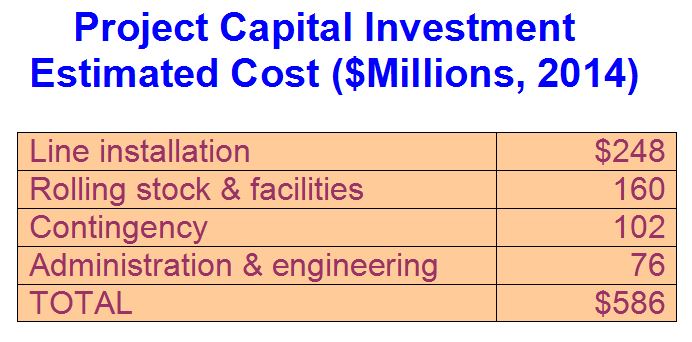
As presented in the table below, we’ve estimated the capital investment cost of this project at $586 million. We believe this is a far more affordable investment for an initial LRT starter line than the daunting $1.1 billion ($1.4 billion in year of completion) estimated for the Highland-Riverside proposal in Prop. 1. With 50% Federal Transit Administration funding assumed, this would mean a local share of $293 million, most likely financed from local City of Austin bonds and possibly other sources.

Line installation includes right-of-way acquisition, trackwork and running way construction, minor civil works, electric power supply and distribution, signal and communications system, stations and facilities, and streetscape amenities, including sidewalks and bicycle lanes. Rolling stock is assumed as “short” low-floor LRT cars similar to those recently procured in Salt Lake City and Atlanta; a storage, maintenance, and operations facility is included. Total cost includes a 25% contingency and a 15% administrative/engineering allowance.

2_ARN_PlanB-G-L-urban-rail-altv-est-cost

Unit capital cost of this “Plan B” project calculates to about $87 million per mile — roughly 73% of the cost per mile of the Prop. 1 proposal. Total cost is 52% of the Prop. 1 Highland-Riverside plan. Thus, for just over half the cost of the Prop. 1 plan, this proposal would render about three times the ridership. We’d expect this high ridership (as well as high passenger-mileage) to translate to signficantly lower operating & maintenance (O&M) unit costs compared with the Prop. 1 rail proposal, as well as lower unit subsidies.

In addition, it would serve Austin’s most heavily travelled inner-city arterial corridor, one of the state’s densest neighborhoods, the city’s highest-density corridor, and a number of Austin’s most established center-city neighborhoods — neighborhoods that have anticipated and planned for light rail for well over a decade. It would also serve centers of development such as the Triangle area, clusters of major new development emerging in various segments along the corridor, and much of the very high-density residential and commercial development booming in the western section of the CBD.

Hopefully, by investing dollars wisely and conservatively in an affordable initial starter line project, Austin will be in a position to budget for a vigorous expansion of LRT lines in other potential corridors citywide, such as:

• South Congress
• North Lamar to Parmer Lane
• Northwest to Lakeline Transit Center
• South Lamar
• East Riverside to ABIA
• Mueller development and northeast Austin
• Lake Austin Blvd.
• West 38th St.

Plan B — possibly this design or something similar to it — is definitely ready and waiting. Hopefully, it will move forward vigorously if Proposition 1 is rejected on Nov. 4th. ■
Portland's light rail transit line on 4-lane Interstate Avenue gives an idea of how urban rail could operate in reservation in G-L corridor. (Photo: Peter Ehrlich)

Portland’s Yellow Line LRT on Interstate Avenue serves a corridor similar to Austin’s Guadalupe-Lamar. (Photo: Peter Ehrlich)

h1

Dobbs: Density, travel corridor density, and implications for Guadalupe-Lamar urban rail

24 September 2014
Aerial view (looking north) of "Drag" section of Guadalupe St. (wide arterial running from bottom middle of photo to upper right). Western edge of UT campus is at far right, and extremely dense West Campus neighborhood occupies middle left of photo. In upper right corner, Guadalupe jogs northwest, then north again; main travel corridor eventually merges with North Lamar further north. Photo: Romil, posted in forum.skyscraperpage.com.

Aerial view (looking north) of “Drag” section of Guadalupe St. (wide arterial running from bottom middle of photo to upper right). Western edge of UT campus is at far right, and extremely dense West Campus neighborhood occupies middle left of photo. In upper right corner, Guadalupe jogs northwest, then north again; main travel corridor eventually merges with North Lamar further north. Photo: Romil, posted in forum.skyscraperpage.com. (Click to enlarge.)

By Dave Dobbs

This commentary has been adapted from the author’s Sep. 17th posting to an online rail transit discussion list.

How dense does a city need to be to justify a rail transit system?

One of things that the hard-core rail transit opponents like to do is to confuse a city’s overall population density with travel corridor density. Los Angeles, for example, because it grew up around 1100 miles of electric urban rail, has some very dense travel corridors, notably the Wilshire Blvd. corridor where currently they are about to begin construction on the “subway to the sea” (extension of the MetroRail rapid transit subway line to Santa Monica) The Wilshire corridor has densities comparable with those in New York City.

In my 35+ years as a transit advocate, I’ve heard the “Austin doesn’t have the density to support rail” argument hauled out time and time again. But Austin has a very congested core where 50% of the region’s employment is located within a half-mile of a six-mile-long travel corridor, Guadalupe-North Lamar. Austin is unique in that a 50-block-long segment of that corridor contains downtown, the Capital complex, the University of Texas (UT), and two residential areas, West Campus and Hyde Park with densities of more than 12,000 per square mile. And lots of people who don’t live there are traveling up and down this corridor trying to get to these places.

To serve this and similar travel corridors adequately with affordable urban rail transit will require re-allocating available street space from motor vehicles to higher-capacity transit. In other words, giving priority to rail transit because of its higher capacity and ability to ensure essential mobility. Instead of regarding the Guadalupe-Lamar corridor as a disaster because the solution means giving up two of the vehicle travel lanes for trains, politicians need to see the situation in Chinese terms, where the word “crisis” merges two concepts: “danger” and “opportunity”. ■
h1

UT should pay for East Campus urban rail — not Austin taxpayers

2 September 2014
Project Connect map showing half-mile radius from proposed urban rail stations. Except for a mainly commercial and retail sliver along the Drag, most of high-density West Campus residential neighborhood is beyond station access radius.

Project Connect map (annotated by ARN) showing half-mile radius from proposed urban rail stations. Except for a mainly commercial and retail sliver along the Drag, most of high-density West Campus residential neighborhood is beyond station access radius.

By Lyndon Henry

The following comments were made during Citizen Communications to Project Comnnect’s Central Corridor Advisory Group (CCAG) on 13 June 2014 regarding Project Connect’s proposed 9.5-mile, $1.4 billion urban rail starter line connecting East Riverside (southeast) with the Highland ACC site now under development (north). Ultimately, the group voted to recommend Project Connect’s proposal to the City Council.

Since 2006, UT has insisted on a San Jacinto route that would bolster its development aims for the East Campus. However, the West Campus is where the people are, with the third-highest residential density in Texas. It’s where the heavy travel flow is, and where most activity is clustered. And the FTA-required half-mile demographic “watershed” around proposed urban rail stations on San Jacinto barely touches the eastern edge of the West Campus. (See map at top of this post.)

Meanwhile, although insisting that its East Campus development program must be served by Austin’s urban rail, the UT administration has not offered a dime to fund it. Instead, they’ve happily assumed that Austin taxpayers can obligingly be squeezed with higher property taxes to pay for this amenity.

There’s a “reverse-Robin-Hood” aspect to this. Because of shale oil extraction on Permanent University Fund lands, according to a San Antonio Express-News report last year, “The University of Texas System is rich. … Oil is the reason why.”

The UT system is awash in money to the tune of a billion dollars a year, boosting UT Austin’s share to a total of nearly $200 million. Profits from football and other athletic entertainment bring in another $78 million a year.

While there are certainly various needs for this money — particularly the need to keep tuition costs affordable — and some constraints on how it’s used, it would seem logical and fair that, if UT desperately wants urban rail in the relatively less dense, less active San Jacinto route, UT should dip into its own resources to pay for it.

An East Campus-Medical School alignment could be installed as a branch from the Guadalupe-Lamar alignment proposed as an alternative to Project Connect’s plan. UT could cover the $45 million local cost in five years by modest annual dollops of $9 million from its abundant revenues.

This compromise alternative could buttress the feasibility of urban rail and increase the benefit to the entire Austin community. But UT’s administration needs to stop trying to soak Austin taxpayers, and take responsibility for funding its fair share of what it wants.

h1

Reality Check: How plausible are Project Connect’s time/speed claims for Highland-Riverside urban rail plan?

24 August 2014
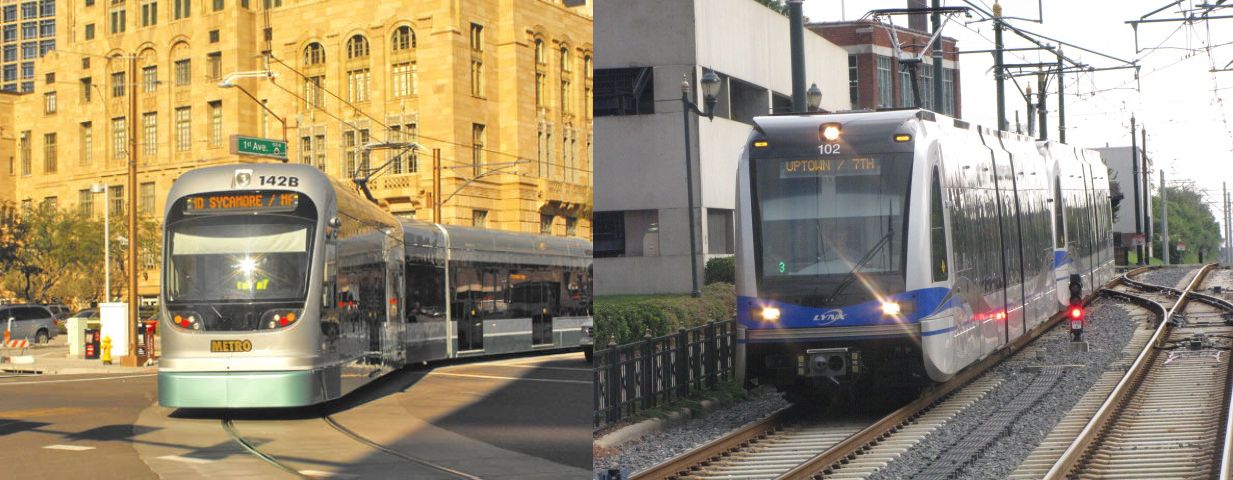
LEFT: Phoenix's Metro LRT — similar to Project Connect's proposed Highland-Riverside line — runs almost entirely in street and arterial alignments, with maximum speed limits, traffic signal interruptions, and sharp turning movements that slow running speed. Average schedule speed: 18.0 mph. (Photo: OldTrails.com)  RIGHT: Charlotte's Lynx LRT runs entirely in an exclusive alignment following a former railway right-of-way. Average schedule speed: 23.0 mph. (Photo: RailFanGuides.us)

LEFT: Phoenix’s Metro LRT — similar to Project Connect’s proposed Highland-Riverside line — runs almost entirely in street and arterial alignments, with maximum speed limits, traffic signal interruptions, and sharp turning movements that slow running speed. Average schedule speed: 18.0 mph. (Photo: OldTrails.com) RIGHT: Charlotte’s Lynx LRT runs entirely in an exclusive alignment following a former railway right-of-way. Average schedule speed: 23.0 mph. (Photo: RailFanGuides.us)

In a Blitzkrieg of promotional presentations over the past several months, Project Connect leaders and team members have been touting ambitious travel time and average speed projections for their urban rail project proposed to connect the Highland ACC site with the East Riverside development area. In various presentations, the agency’s Urban Rail Lead, Kyle Keahey, has claimed that the line would provide an average speed of “21 to 22 miles per hour” (impressive, compared to an average of about 25 mph for motor vehicles in urban traffic, and typical local bus transit averages of about 12 mph generally and 4-8 mph running through a in a CBD).

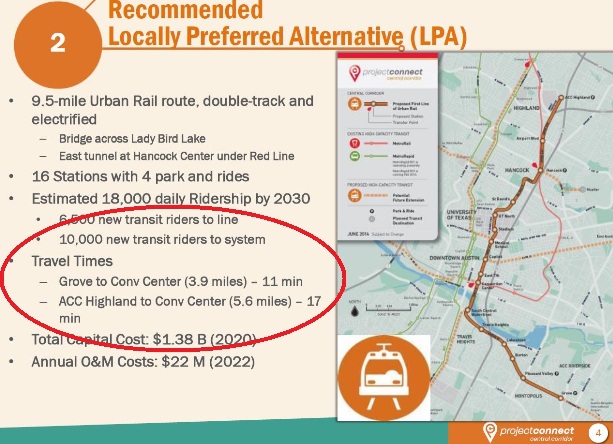
In terms of travel time on Project Connect’s proposed line, the agency has detailed the following:

• From the East Riverside terminus at Grove to the Convention Center downtown (3.9 miles) — 11 minutes

• From the Convention Center to the ACC Highland campus (5.6 miles) — 17 minutes


Screenshot from Project Connect's June 23rd presentation to Capital Metro board, showing travel time claims for proposed urban rail project.

Screenshot from Project Connect’s June 23rd presentation to Capital Metro board, showing travel time claims for proposed urban rail project. (Click to enlarge.)


However, several anomalies immediately leap out to experienced public transit analysts. First, the distance and time projections provided by the agency — totaling 9.5 miles in 28 minutes — imply an average speed of 20.4 mph, not the “21-22” claimed by Kyle Keahey and other representatives. Second, even an average speed of 20.4 for this type of light rail transit (LRT) service in this kind of application raises professional eyebrows (and considerable skepticism) — mainly because it’s significantly higher than what is commonly characteristic of peer systems.

Light rail transit planners commonly know that lines routes in street and arterial alignments, even reservations, face substantially more constraints to speed than do systems routed in exclusive, private right-of-way (ROW) alignments such as railway corridors, tunnels, viaducts, etc. (This is illustrated in the photo composite at the top of this post.) Some major constraints include: maximum speed limited to traffic maximum speed; operation constrained by traffic signals and cross-traffic; sharper curves and turning movements as route follows street grid. Compared with routes in exclusive alignments, the differentials usually aren’t tremendous, but enough to make a difference in schedule speeds, travel times, and other performance factors.

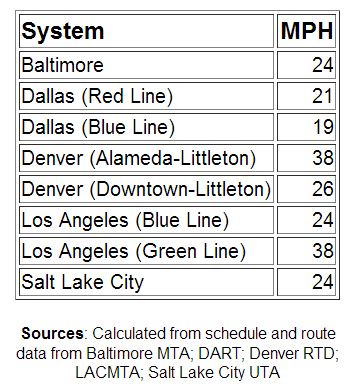
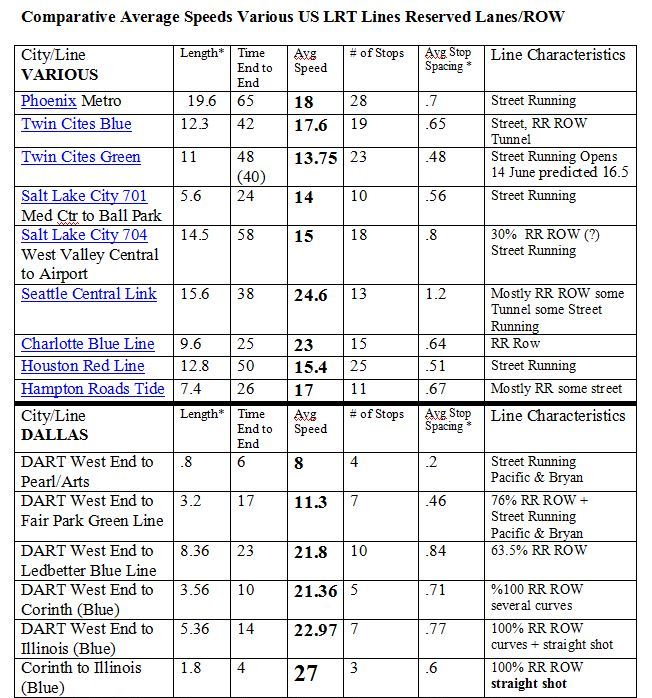
To illustrate this, and perform a rough comparative analysis, we’ve compiled average speeds from two sources. The first is a comparison on the Light Rail Now website, in an article titled Light Rail Schedule Speed – Faster Than Bus, Competitive With Car, with speeds summarized in the following table:


Table of LRT average schedule speeds from Light Rail Now website.

Table of LRT average schedule speeds from Light Rail Now website.


The second source is a recent compilation by Light Rail Now publisher Dave Dobbs, summarized with route lengths, average stop spacing, travel times, and average speeds, in the table below:


Table of LRT average schedule speeds and other data compiled by Dave Dobbs.

Table of LRT average schedule speeds and other data compiled by Dave Dobbs. (Click to enlarge.)


Dave notes that he included the lines he did “because they were examples from Project Connect slides.” He also points out that Project Connect’s East Riverside-to-Highland line “is virtually all street running save for the tunnels and the bridge and I don’t see that much time saving there.”

Indeed, Project Connect’s proposed line is far more of a winding, meandering route, with more traffic speed constraints and sharper turning movements, than any of the comparative peer street-running systems. It includes running in mixed traffic (Red River St.) as well as a segment through the UT campus (San Jacinto Blvd.) with heavy student pedestrian traffic crossing the alignment.

LRT systems are identified with the following designations:

BAL — Baltimore
CHA — Charlotte Lynx
DAL — Dallas DART
HOU — Houston MetroRail Red Line
LA — Los Angeles
MIN — Minneapolis-St. Paul Metro
NFK — Norfolk Tide (Hampton Roads Transit)
PHX — Phoenix Metro
SEA — Seattle Link
SLC — Salt Lake City TRAX

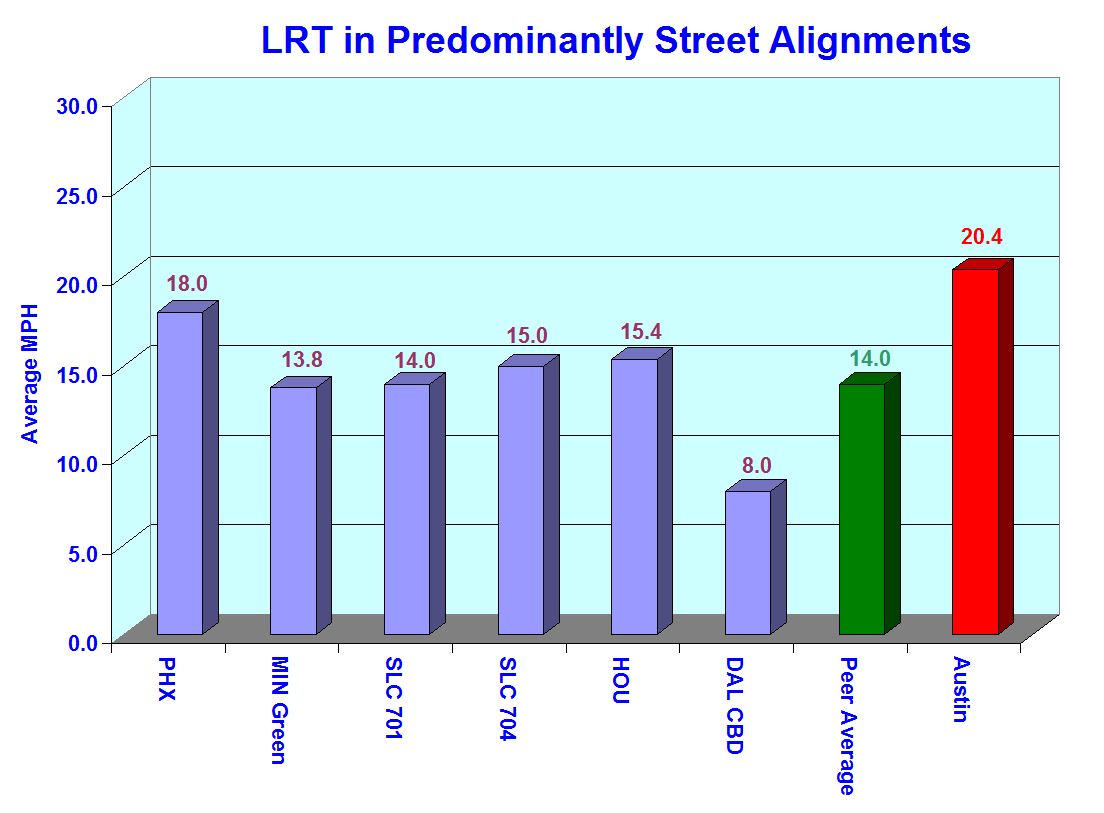
To simplify this comparison, we’ve included clearly identifiable route segments from both table sources, and differentiated them into Predominately Street Alignment and Predominantly Exclusive Alignment categories. For several individual systems, segments are identified in our charts as follow:

Dallas
CBD — West End to Pearl/Arts
Green Line A — West End to Fair Park
Blue Line A — West End to Ledbetter
Blue Line B — West End to Corinth
Blue Line C — Corinth to Illinois
Red Line A — CBD to Plano

Denver
Littleton — CBD to suburb of Littleton

Houston
Red — Red Line

Los Angeles
Blue — Blue Line, CBD to Long Beach

Minneapolis
Blue — Blue Line, Hiawatha
Green — Green Line, Minneapolis-St. Paul

Salt Lake City
701 — Medical Center to Ball Park
704 — West Valley Central to Airport
Sandy — CBD to suburb of Sandy

Using the data from these tabular compilations, we’ve presented a comparative summary of average schedule speeds in the following two graphs. Speed data values (mph) have been rounded to a single decimal point. The first graph presents a comparison of various predominantly street-running lines, similar to Project Connect’s proposed project. This includes an average for the actual, operating peer systems. The second graph presents average speeds for various lines and line segments in exclusive (mostly railway right-of-way) alignments. (Click either graph to enlarge.)


5_ARN_Chart-LRT-mph-street


6_ARN_Chart-LRT-mph-exclusive-rev


From this comparison, it can be seen that the average speed for Project Connect’s Highland-Riverside line, based on the projected travel time presented by the agency, is significantly above all of the peer systems running predominantly in street right-of-way. Not only does Project Connect’s line show a higher average schedule speed than any of its peer systems, but it’s a full 6.4 mph — nearly 46% — above the peer average. This seems highly implausible, particularly in view of the more convoluted, tortuous profile of the proposed alignment and the other encumbrances we’ve cited. Indeed, the travel time (and implicitly schedule speed) assumptions of Project Connect planners seem more appropriate for the operating characteristics of a route in predominantly exclusive right-of-way rather than running on streets and arterials, as they’ve designed it.

Projecting reasonably accurate travel times and speeds is important to planning any rail transit project, and not just because of plausibility with respect to public scrutiny. Travel time constitutes one of the key inputs into the ridership modeling process. Underestimating travel time, by reducing what’s called the “impedance” to the process of calculating trip generation and modal split, can readily lead to overestimation of ridership. In addition, slow travel speeds also raise the possible need for additional rolling stock to fulfill train frequency and passenger capacity requirements.

Bottom line: Project Connect planners may be estimating faster train travel speeds and shorter travel times than is realistically plausible, and the implications may be lower ridership, greater rolling stock requirements, and possibly higher operating costs than they’ve originally projected.

h1

Baker: Connecting some dots on Austin’s urban rail planning

24 August 2014
Graphic by ARN.

Graphic by ARN.

By Roger Baker

Roger Baker is a longtime Austin transportation, energy, and urban issues researcher and community activist. The following commentary has been adapted and slightly edited from his comments posted by E-mail to multiple recipients in June.

How did Project Connect come up with their $1.4 billion rail plan? Let’s take some known facts, and connect the dots. The dots in this case were partly the political momentum behind a new hospital district, combined with a new Opportunity Austin/Chamber-of-Commerce-recommended Austin growth policy.

We know that in 2008, a city consultant, ROMA, recommended that the proposed light rail corridor be moved east to the San Jacinto Corridor (ultimately connecting several years later to the Red River corridor), as opposed to the previously-assumed Lamar Corridor alignment. See, for example:

http://www.austinchronicle.com/news/2008-04-25/616178/


Original urban rail "circulator" system in 2008 map of ROMA consulting team plan, contracted by City of Austin.

ROMA streetcar circulator map from 2008, precursor of urban rail (light rail transit) plan. Map: ROMA, via Austin Chronicle. (Click to enlarge.)


Next, we know that State Sen. Kirk Watson in 2012 announced a plan to develop about $4 billion of future medical facilities and training in the area of Brackenridge and the newly announced Dell medical training center, which would be along this same San Jacinto-Red River corridor. It is pretty obvious that to meet this ambitious goal, to handle this scale of future anticipated development, the existing roads along this corridor could not meet the projected travel demand. I pointed that out in an earlier article here:

http://www.theragblog.com/metro-roger-baker-the-proposed-austin-light-rail-plan-as-i-see-it/

How did the urban rail plan get to Riverside? Here is a downloadable audio clip with Project Connect personnel pointing out that the city sees itself as having an unfunded mandate to provide rail on the Riverside alignment in order to meet the city’s future growth goals in that area:

https://docs.google.com/file/d/0B9kg5NdhKh8RYTM0dzQ4ampmeWs/edit


East Riverside development plan, promoted by City, is a bonanza for powerful real estate development interests. Gentrification is replacing lower-cost affordable apartments with expensive condos and upscale commercial and office developments, many with premium river views. Map: City of Austin via Goodlife Realty.

East Riverside development plan, promoted by City, is a bonanza for powerful real estate development interests. Gentrification is replacing lower-cost affordable apartments with expensive condos and upscale commercial and office developments, many with premium river views. Map: City of Austin via Goodlife Realty. (Click to enlarge.)


Another problem for the medical district was that Texas state funding could not pay for the medical center without a big boost from local Travis taxpayers. This demanded the promotion of a hospital district tax. See, for example:

http://www.kirkwatson.com/the-med-school-solution/

…Ever since Austin state Sen. Kirk Wat­son first unveiled the idea at a Real Estate Council of Austin event last September, regional agencies and governments have scrambled to find funding possibilities for the massive project, which could run the involved parties (all told) as much as $4.1 billion over 12 years. At last check, the University of Texas is on board for at least a $25 million annual contribution that would climb to $30 million over the first eight years of the school’s existence. Central Health, according to the Statesman, would cough up about $35 million annually over 12 years – or a total of $420 million. The Seton Healthcare Family expects to provide nearly $2 billion, including $250 million that would ultimately result in a replacement of its aging but centrally located Brackenridge hospital facility…

But to make it all work, Central Health is asking for a tax increase, to be placed before voters on Nov. 6. Watson asked for a raise of five cents per $100 of property valuation; Central Health’s board obliged, endorsing that increase, which would bring the district’s rate to just over 12 cents for every $100 of property valuation. In dollar figures, that would mean (if voters approve) that someone who lives in a home valued at $200,000 would see an increase of $100 on their annual tax bill…


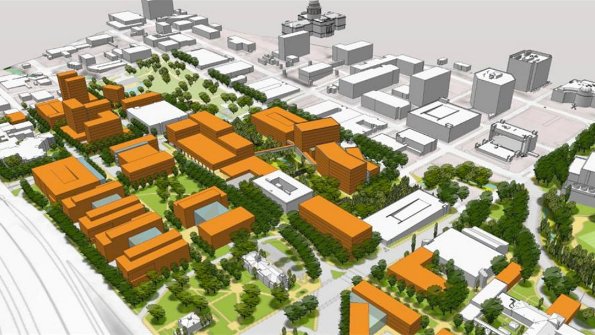
Simulation of future UT medical school development, providing expansion opportunities for University of Texas, Seton medical interests, and other real estate development investors. Graphic via KUT.org.

Simulation of future UT medical school development, providing expansion opportunities for University of Texas, Seton medical interests, and other real estate development investors. Graphic via KUT.org. (Click to enlarge.)


We know from the following document that the city of Austin is bending over backwards to maximize Austin area growth through relocation, and jobs recruitment to the Austin area.

http://www.austintexas.gov/news/city-releases-report-economic-incentives

As we can see, the City has a very well-developed industrial recruitment policy outlined in this document, which coordinates with the Chamber of Commerce, targets key industries to recruit, and gives tax breaks when certain criteria are met. The city takes its lead from the “Council Special Committee on Economic Incentives”, which in turn takes its lead from Opportunity Austin, and the Austin Chamber of Commerce, as we see in this lengthy presentation. It begins by lamenting Austin’s slow growth!

http://austintx.swagit.com/play/08272012-504

We now see unsigned blogs promoting the same maximum Austin growth recruitment as official policy:

http://www.austintexas.gov/department/about-imagine-austin

What are the specifics of Austin growth recruitment policy? The policy is to prefer that at least 25% of the jobs recruited into this area go to Austin residents, but if not, it is no deal breaker. Jobs that pay at least $11 an hour would be nice, but this too is considered optional. This is taken from page 9.

http://www.austintexas.gov/sites/default/files/files/EGRSO/EGRSO_Report_on_ED_Policy_Final.pdf

REPORT AND RECOMMENDATIONS ON THE COA ECONOMIC DEVELOPMENT POLICY

Motion #5:

Change the Threshold for Extraordinary Economic Impact within the Firm-Based Matrix to include other items

The Threshold for Extraordinary Economic Impact has been used within the Firm-Based Incentive Matrix as a means for providing additional economic incentives for significant economic development projects.

Currently, if a company meets one of the four criteria within this section of the matrix, then the company is eligible for an economic incentive of up to 100% of the property tax generated by the project (see Exhibit A, Section 3 and Section 4).

Current threshold criteria include these four items:

• The firm is in a targeted industry;
• The firm is involved in leading edge technology;
• State economic development funds are available for the firm; or
• The firm will generate 500 jobs or more.

The threshold criteria allow flexibility for various economic incentive options to be considered for projects that have an extraordinary economic impact. The flexibility allows Austin to remain competitive for highly sought after projects. Examples of prior significant economic development projects include Samsung and Apple. In both cases, the Austin City Council approved 100% property tax rebates for a prescribed number of initial years…

This is all predicated on the perpetuation of the Austin tech bubble, which is really a regional manifestation of a national tech bubble. Continuing Federal Reserve stimulus is leading to asset bubbles, which are reflected in the NASDAQ’s mostly-tech growth in particular. How long before the tech bubble driving Austin’s current feverish growth and gentrification deflates is anyone’s guess, as Fortune recently pointed out:

http://fortune.com/2014/05/08/yes-were-in-a-tech-bubble-heres-how-i-know-it/

I have recently pointed out and discussed in detail the unsustainable nature of Austin’s currently-booming growth here:

http://www.theragblog.com/metro-roger-baker-the-rise-and-rise-of-austin/

This accumulation of material may help to provide a plausible political basis behind Project Connect’s rail plan. I personally have little doubt that Austin is in the midst of an unsustainable high tech growth bubble, and that the future travel demand numbers that Capital Area Metropolitan Planning Organization (CAMPO) feeds Project Connect to justify its rail corridors are largely wishful thinking. Demographic forecasting, like economic forecasting, exists to make astrology look good by comparison. ■

h1

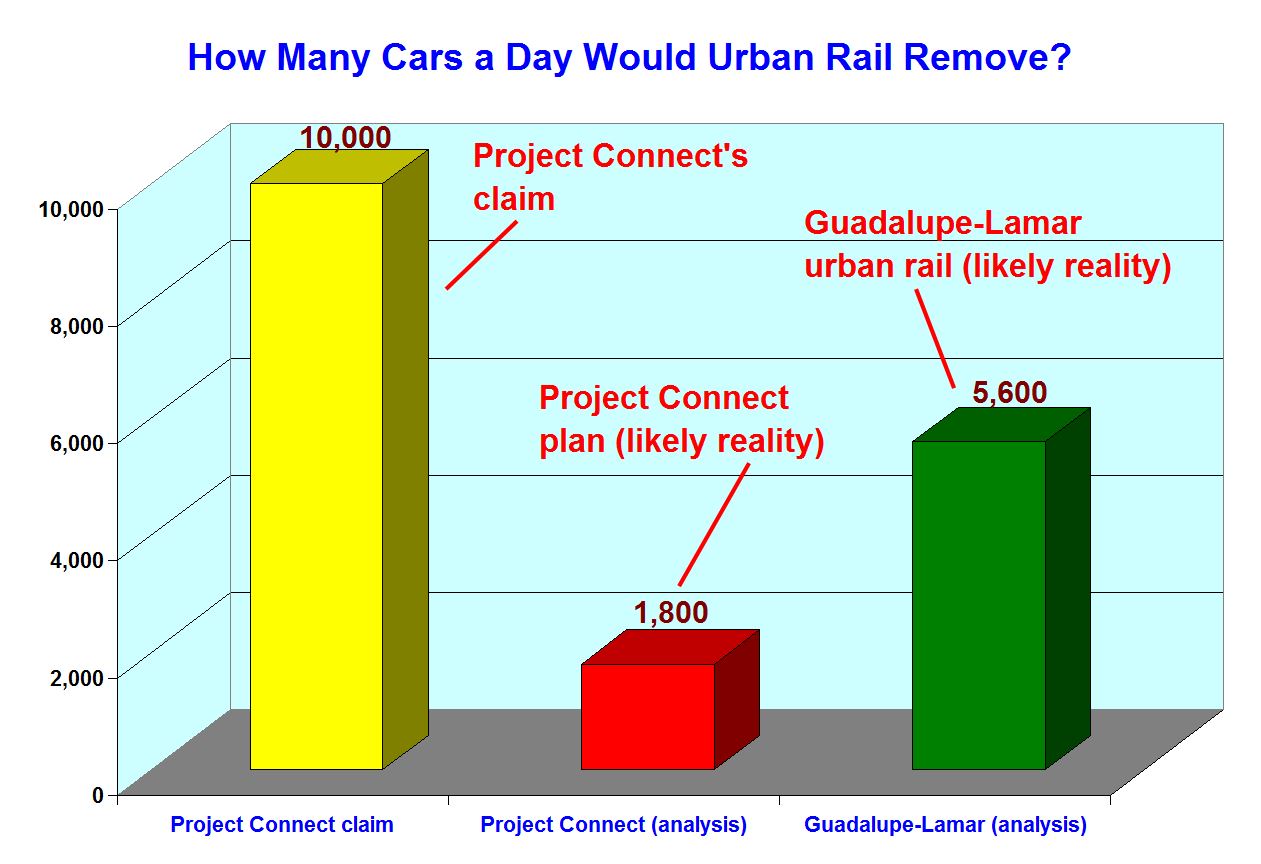
Why Project Connect’s urban rail plan would remove just 1,800 cars a day — not 10,000

22 August 2014
Project Connect's Highland-Riverside alignment would have negligible impact on I-35 congestion. Photo via Austin.CultureMap.com.

Congested I-35 traffic has Austinites desperate for a solution, but Project Connect’s Highland-Riverside alignment would have negligible impact. Photo via Austin.CultureMap.com.

Project Connect representatives have been claiming an array of hypothetical benefits they say would result from their proposed Highland-Riverside urban rail project. Among these is “congestion relief”.

For the most part, this sweeping claim has been blurry, undefined, unquantified, and widely dismissed as ridiculous. (See Why Project Connect’s “Highland” urban rail would do nothing for I-35 congestion.)

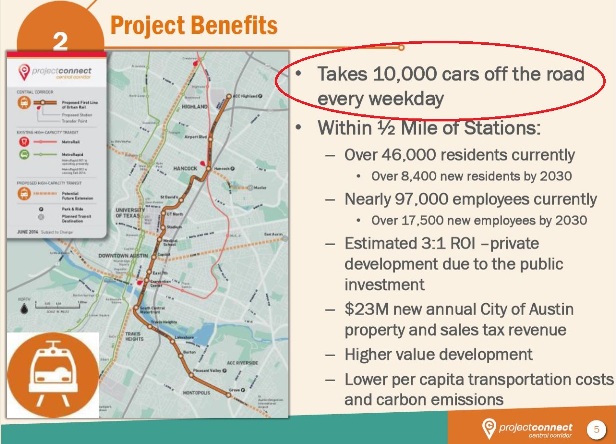
But in promotional presentations, Project Connect personnel and supporters have repeatedly touted one specific, numerically quantified purported benefit — the claim that their urban rail project “takes 10,000 cars off the road every weekday”.


Screenshot from Project Connect slide presentation claiming Highland-Riverside rail plan would remove "10,000 cars" a day.

Screenshot from Project Connect slide presentation claiming Highland-Riverside rail plan would remove “10,000 cars” a day. (Click to enlarge.)


This figure invites scrutiny. Project Connect has also been touting a 2030 ridership projection of “18,000 a day” — although this appears to rely on flawed methodology. (See our recent analysis Project Connect’s urban rail forecasting methodology — Inflating ridership with “fudge factor”? which, adjusting for apparent methodological errors, suggests that total ridership of 12,000 per weekday is more plausible.)

In any case, of its projected total weekday ridership, Project Connect also claims that only 6,500 are “new transit riders” for the urban rail line. (Project Connect also claims “10,000 new transit riders to system” — but typically these new “system” boardings represent the combination of the new rail rider-trips plus the same passengers using feeder bus routes to access the rail.) This is consistent with industry experience, since a sizable proportion of the ridership of new rail services consists of passengers that had previously been bus transit riders.

But this “new transit riders” figure, while plausible, immediately diminishes the plausibility of the claim of “taking 10,000 cars off the road”. How could 6,500 riders, boarding trains, eliminate 10,000 cars from the road?

Furthermore, the estimate of 6,500 rider-trips (i.e., boarding passengers) actually doesn’t equal 6,500 individual passengers, i.e., persons. Why? Because (as is commonly known and accepted in the industry) a very large percentage of those trips are made by the same, individual passengers — mainly round trips, or extra trips during lunch hour, and so on.

The count of daily “boardings”, or rider trips — i.e., ridership — is actually a tally, in U.S. industry parlance, of unlinked trips. These are the string of trips on transit made over a day by the same individual person; they might include trips on a feeder or connector bus to a rail transit train, possibly other trips during the day by transit, and perhaps that person’s return trips back home by the same modes.

So, how to figure how many individual passengers (persons) are actually involved in a given ridership figure? The American Public Transportation Association (APTA) suggests a conversion factor: “APTA estimates that the number of people riding transit on an average weekday is 45% of the number of unlinked transit passenger trips.”

Thus, applying that 45% factor to those 6,500 “new rider” trips, we realize that figure represents roughly 2,925 actual passengers projected to ride the proposed urban rail line, new to the transit system.

However, we cannot assume that every one of those new passengers would have used a motor vehicle rather than riding transit. On average, about 75% have access to a car. So 2,925 passengers X 75% = 2,194 passengers that could be assumed to leave their cars off the road to ride transit. (It’s pretty much a cinch that these hypothetical transit passengers wouldn’t be driving, on average, more than four cars a day!)

To estimate more realistically how many cars would be affected, we need to factor in average car occupancy of 1.2 persons per car (to account for some carpooling). That final calculation yields 1,828 — or (by rounding for level of confidence) roughly 1,800 cars removed from the road by Project Connect’s proposed urban rail plan.

That 1,800 is an all-day figure. Using an industry rule-of-thumb of 20%, about 400 of those cars would be operated during a peak period, or roughly 100, on average, during each peak hour. As our article on I-35 congestion, cited above, indicates, the impact on I-35 traffic would be very minimal. Most of the effect of that vehicle traffic elimination would be spread among a number of major arterials — particularly Airport Blvd., Red River St., San Jacinto Blvd., Trinity St., and Riverside Drive. This impact on local arterial congestion would be small — but every little bit helps.

While the removal of 1,800 cars from central Austin roads is a far cry from 10,000, once again, every incremental bit helps. And there’s also the decreased demand for 1,800 parking spaces in the city center.

But the point is that $1.4 billion (about $1.2 billion in 2014 dollars) is a huge investment to achieve so little. For many cities, ridership at the level of 12,000 a day typically isn’t so bad, but when you’re missing the potential of 35,000-45,000 a day, plus incurring such a high cost for this level of payoff, you need to reconsider the deal. (For example, see Austin’s 2000 light rail plan — Key documents detail costs, ridership of Lamar-Guadalupe-SoCo route.)

For less than half of Project Connect’s urban rail investment cost, a “backbone” urban rail line on Guadalupe-Lamar (with a branch to the Seaholm-Amtrak area) could plausibly be expected to generate at least three times as much ridership — and eliminate roughly 5,600 cars a day from central-city streets and arterials.


Summary chart compares Project Connect's claim of taking "10,000 cars off the road every weekday" vs. (1) ARN's analysis of probable actual number of cars removed by Highland-Riverside line and (2) projected number of cars that would be removed from Austin's roadways by alternative Guadalupe-Lamar urban rail plan.

Summary chart compares Project Connect’s claim of taking “10,000 cars off the road every weekday” vs. (1) ARN’s analysis of probable actual number of cars removed by Highland-Riverside line and (2) projected number of cars that would be removed from Austin’s roadways by alternative Guadalupe-Lamar urban rail plan. (Click to enlarge.)


Now, that’s some “congestion relief” worth paying for.

h1

Project Connect’s gold-plated Austin urban rail plan shows planning process way off course

15 August 2014
Graphic: GG2.net

Graphic: GG2.net

By Lyndon Henry

The following comments were made during Citizen Communications to the City of Austin’s Urban Transportation Commission on 10 June 2014 regarding Project Connect’s proposed 9.5-mile, $1.4 billion urban rail starter line connecting East Riverside (southeast) with the Highland ACC site now under development (north). In the end, the commission voted, with minor amendments, to recommend Project Connect’s proposal to the City Council.

There are three huge problems with Project Connect’s proposal:

(1) It spends $1.4 billion to put urban rail in the wrong place.

(2) It will hinder and constrain future rail development.

(3) A vote for this flawed plan is also a vote to permanentize lower-capacity MetroRapid bus service in our strongest, densest travel corridor, Guadalupe-Lamar.

Guadalupe-Lamar is the outstanding corridor to start urban rail — among the top heavy travel corridors in Texas, a long-established commercial district, with major activity centers, the city’s core neighborhoods, and the West Campus, having the 3rd-highest residential density in Texas.

In contrast, Project Connect proposes to forsake the central city’s heaviest and densest local corridor and instead connect a weak corridor, East Riverside, with a non-existent travel corridor through the East Campus, Hancock, and Highland. By wasting over a billion dollars on urban rail in this meandering, misguided route, Project Connect will divert scarce funds from future rail development.

Project Connect’s Riverside-East Campus-Hancock-Highland plan comes “gold-plated” with a new $130 million “signature bridge” over the river and a $230 million tunnel at Hancock. But it runs in mixed street traffic from UT to Hancock. This is a proposal that costs too way much for too little value.

And it’s the third most pricey urban rail starter line, by cost per mile, in U.S. history. City officials now routinely propose a major property tax increase to finance the local share of Project Connect’s plan.


Per mile of route, proposed Highland-Riverside urban rail plan would be second most expensive light rail starter line since 1990, and third most expensive in U.S. history.

Per mile of route, proposed Highland-Riverside urban rail plan would be second most expensive light rail starter line since 1990, and third most expensive in U.S. history. Graph: ARN. (Click to enlarge.)


Voting for Project Connect’s urban rail plan for East Riverside to Highland also means voting to pour concrete for bus lanes and other bus facilities on Guadalupe and Lamar that will prevent an urban rail alternative in our heaviest, neediest corridor for decades. The current MetroRapid bus service on Guadalupe, Lamar and South Congress carries 6,000 daily riders, less than one-eighth of the 51,000 forecast for light rail in that same corridor.

According to a report yesterday from a private meeting of urban rail “stakeholders” at Capital Metro, representatives of both Project Connect and Capital Metro admitted that Phase 1 of this project, which conjured up Looney-Tunes voodoo and passed it off as “scientific” projections, was “too fast and not at a pace they would typically have proceeded.”

In contrast to major rail planning in the past, the public has basically been cut out of this process. Now Mayor Leffingwell and his administration announce they’re tossing in a dollop of road projects that even some councilmembers criticize as failing to fit into the Imagine Austin concept of a walkable, dense city. In effect, they’re packaging a dubious, wasteful rail project with questionable road projects, and wrapping a “congestion relief” ribbon around it.

This is a planning process that’s gone off course and out of control. This commission needs to do the right thing, and say as much to the city council. ■

Related links:
Project Connect’s $500 million plan for bus infrastructure — The Elephant in the Road on Guadalupe-Lamar that could block urban rail
Project Connect’s Austin urban rail would be 3rd-most-pricey LRT starter line in U.S. history
Roger Baker: Austin’s ‘Strategic Mobility Plan’ — smart planning or a billion dollar boondoggle?
h1

Project Connect gets it wrong — Urban rail starter lines are much cheaper than extensions

14 August 2014
LEFT: Denver's starter LRT line, a 5.3-mile line opened in 1994, was routed and designed as a simple, surface-routed project to minimize construction time and cost. All-surface alignment avoided heavy, expensive civil works and kept design as simple as possible. Photo: Peter Ehrlich. RIGHT: Subsequent extensions, such as this West line opened in 2013, have required bridges, grade separations, and other major civil works, resulting in a unit cost 61% higher than that of the starter line. Photo: WUNC.org.

LEFT: Denver’s starter LRT line, a 5.3-mile line opened in 1994, was routed and designed as a simple, surface-routed project to minimize construction time and cost. All-surface alignment avoided heavy, expensive civil works and kept design as simple as possible. Photo: Peter Ehrlich. RIGHT: Subsequent extensions, such as this West line opened in 2013, have required bridges, grade separations, and other major civil works, resulting in a unit cost 61% higher than that of the starter line. Photo: WUNC.org.

Since Project Connect released the cost estimates for their proposed 9.5-mile Highland-Riverside urban rail starter line last spring, agency representatives have tried to argue that the line’s projected cost of $144.8 per mile (2020 dollars) is comparable to that of other recent light rail transit (LRT) projects, citing new extensions in Houston, Portland, and Minneapolis.

Project Connect's chart comparing their proposed Highland-Riverside "Austin Urban Rail" starter line cost to costs of extensions of several other mature light rail transit systems.

Project Connect’s chart comparing their proposed Highland-Riverside “Austin Urban Rail” starter line cost to costs of extensions of several other mature light rail transit systems. (Click to enlarge.)

Austin Rail Now challenged this comparison In our recent analysis, Project Connect’s Austin urban rail would be 3rd-most-pricey LRT starter line in U.S. history. We argued that comparing the high cost of extensions of other, mature systems, was invalid, because urban rail starter lines tend to be much lower in cost than subsequent extension projects.

That’s because, in designing a starter line — the first line of a brand-new system for a city — the usual practice is to maximize ridership while minimizing costs through avoiding more difficult design and construction challenges, often deferring these other corridors for later extensions. In this way, the new system can demonstrate sufficient ridership and other measures of performance sufficient to convince both local officials and the public that it’s a success from the standpoint of being a worthwhile investment.

In contrast with starter lines, where officials and planners usually strive to keep design minimal and hold costs down in order to get an initial system up and running with the least demand on resources (and public tolerance), extension projects more often are deferred to later opportunities, mainly because they frequently contend with “the much more difficult urban and terrain conditions that are typically avoided and deferred in the process of selecting routes for original starter systems.” Deferring more difficult and expensive alignments till later also allows time for public acceptance, and even enthusiasm, for the new rail transit system to take root and grow.

Austin’s case provides an illustration. As our article, Austin’s 2000 light rail plan — Key documents detail costs, ridership of Lamar-Guadalupe-SoCo route, describes, Capital Metro’s original 2000 LRT plan envisioned a “Phase 1” 20-mile system consisting of a 14.6-mile line from McNeil to downtown, plus a short branch to East Austin and a longer extension down South Congress to Ben White Blvd. In Year of Expenditure (YOE) 2010 dollars, that full system was projected to cost $1,085.8 million (about $1,198 million in today’s dollars). But a billion-dollar project was deemed too hefty a bite for the city’s first foray into rail, so decisionmakers and planners designated the shorter 14.6-mile northern section as a Minimum Operable Segment (MOS), with a more affordable (and, hopefully, more politically palatable)pricetag of $739.0 million in 2007 YOE dollars (roughly $878 million in current dollars).

After an initial starter line is established, for most subsequent extension projects the unit cost — per mile — tends to increase because, as previously indicated, officials and designers are willing to tackle more daunting corridors and alignments. Denver is a useful example.

In 1994 Denver established basic LRT service with a comparatively simple 5.3-mile starter line, running entirely on the surface in both dedicated street lanes and an available, abandoned center-city railway alignment, with an installation cost of $37.3 million per mile (2014 dollars). From that beginning, the system has been gradually expanded with increasingly more ambitious and more costly extensions. In 2013, Denver opened its West Line (the W line) to Golden; constructed over much more daunting terrain and obstacles, with multiple grade separations, bridges, and long elevated sections, plus more complex signal and communications systems and more elaborate station facilities. The West line was finished at a cost in 2014 dollars of about $59.9 million per mile — a unit cost about 61% higher than that of the original starter line.

Despite such evidence, at an Aug. 5th urban rail forum sponsored by the Highland Neighborhood Association, Project Connect’s Urban Rail Lead, Kyle Keahey, dismissed the assertion that starter lines were lower in cost per mile than extensions. Instead, he insisted, “the reverse is true.”

Really? But this claim is refuted even by the same cases that Project Connect has presented as peer projects for comparing the estimated $144.8-million-per-mile cost (2020) of its Highland-Riverside proposal.

In the following comparative analysis, we use Project Connect’s own year-2020 cost-per-mile figures for their selected “peer” projects. For each of those we use the starter line cost-per-mile data from our earlier May 8th article (cited above), plus data for Portland’s original starter line (a 15.1-mile line opened in 1986 from central Portland to the suburb of Gresham). These unit costs, in 2014 dollars, were then escalated to year-2020 values via the 3% annual factor specified by Project connect for their own table data.

The resulting comparison is shown below:

Using Project Connect's selected LRT systems, this comparison shows that the cost per mile of new starter lines tends to be significantly less than the cost of later extensions. Graph: ARN.

Using Project Connect’s selected LRT systems, this comparison shows that the cost per mile of new starter lines tends to be significantly less than the cost of later extensions. Graph: ARN. (Click to enlarge.)

Clearly, this analysis corroborates our original assertion — based on these cases, the unit costs of LRT starter lines tend to be considerably lower than the unit cost of later extensions when these have developed into more mature systems. And, at $144.8 million per mile, the unit cost of Project Connect’s proposed 9.5-mile Highland-Riverside urban rail starter line is certainly far higher than the cost of any of the original starter lines of these selected systems — all using Project Connect’s own cases and criteria.

Q.E.D., perhaps? ■

h1

Legal, ethical questions persist over Project Connect’s ad blitz for urban rail plan

6 August 2014
Project Connect campaign ad as seen on a Yahoo.com news page in July 2014. Screenshot by ARN.

Project Connect campaign ad as seen on a Yahoo.com news page in July 2014. Screenshot by ARN.

More questions continue to be raised about Project Connect’s tax-funded ad blitz promoting its urban rail plan, almost certainly destined to be placed on the ballot for a vote this November. While this media campaign has intensified into a vigorous television barrage in recent weeks, Project Connect’s online ads — such as the example from a Yahoo.com News page at the top of this post — have been peppering webpages on the Internet for months

As we’ve noted in our previous article on this controversy (Project Connect’s tax-funded urban-rail-campaign ad blitz raises red flags), on July 11th, the pro-rail group Austinites for Urban Rail Action (AURA) issued a public statement, addressed to the board of Capital Metro (Austin’s public transportation authority), that questioned the agency’s “aggressive marketing campaign”. The stated noted that “While some advertisements seem intended to convey basic information, others (such as the radio campaign) seem like political advocacy on behalf of the Regional Mobility Plan’s controversial recommendations.”

As taxpayers and transit advocates, we are concerned about the expenditure of public money for this campaign-related advertising. While the words “vote for the bond package” are not included in any of the advertisements, this sort of technicality prioritizes form over substance: since the rest of the content makes no mention of opposing viewpoints or data, this advertising campaign is public relations, not genuine engagement.

Kyle Keahey, Project Lead for Project Connect’s “Central Corridor”, responded that the ads were ” educational materials” that “are fully compliant with election laws”. He also disclosed that the ads were supported by a budget of more than $157,000. Perhaps small by the mega-million standards of a public transport project, but far more than is available to community organizations questioning Project Connect’s program. And it’s money derived from public tax revenues.

In response, AURA, in a letter from the co-chair officers of its Urban Rail Working Group, reiterated its criticism and concern, particularly “the ethics of spending taxpayer dollars on the political campaign for Project Connect’s urban rail proposal.” AURA focused on the rather suspicious timing for the ad campaign to end:

You also note that the ad buy will conclude on August 5th, two days before City Council is expected to place Project Connect’s road-rail bond measure on the November ballot, at which point the ads would presumably become subject to Texas law regulating the use of public funds for political advertising (Tex. Election Code § 255.003). This information appears to confirm our impression that this is a political advertising campaign, not an “educational and project awareness effort.”

AURA’s letter concludes with a stinging rebuke that seems to convey much of the anger simmering in the Austin community:

You explain that your legal counsel has verified that the advertising campaign is “fully compliant with election laws.” We are confident in your attorneys’ legal opinion on this matter. Unfortunately, we are much less confident that you understand that spending taxpayer dollars promoting a controversial urban rail proposal is unethical and erodes public trust.

We appreciate that Project Connect is “committed to conducting an open, transparent, and legally compliant process.” In the future, we hope you will commit to an ethical one as well.

At least one major media outlet has taken note of the controversy. Time-Warner Cable News, in an Aug. 2nd story titled Urban Rail Ad Campaign Under Fire, noted that, after two months on “Austin airwaves”, the ads promoting urban rail were “wrapping up” … “just as city leaders are about to ask voters to support a tax increase that would help pay for the billion-dollar rail.”

And the reporter turned to AURA for comment:

“It’s very clear that this is a political campaign,” AURA’s Marcus Denton said.

Denton questions the timing of the ads, which all end Wednesday.

“The fact that they are pulling the ads off the air immediately before they’d be subject to election law about ballot measures is very suspicious,” he said.

Denton is with a group that supports urban rail, but not the route leaders chose. He said going to Austin Community College’s Highland Campus will not guarantee the riders needed to support the system.

The report further noted that “Capital Metro and the city of Austin are paying for a combined 20 percent, while the other 80 percent is coming from a federal grant.” It also quoted a representative of the rightwing Texas Public Policy Foundation (TPPF), criticizing the channeling of public funds for the “media blitz”.

“Taxpayers are paying money to the federal government, which is then turning around and lobbying Austinites to support more taxpayer spending” said the TPPF spokesman. “That’s not appropriate.”

In effect, in what seems a somewhat desperate attempt to push the envelope of what’s permissible “educational” activity by a public transit agency, Project Connect may be poisoning the well, so to speak, for more legitimate informational and educational efforts on behalf of more worthy urban rail projects in the future.

h1

Project Connect’s urban rail plan is “worse than nothing”

21 July 2014
Project Connect's "urban rail" plan would not only absorb vast local financial resources, but would install "dedicated bus lanes" as an obstacle to urban rail where it's actually most needed — in Guadalupe-Lamar. Graphic: Adaptation by ARN from Project Connect map.

Project Connect’s “urban rail” plan would not only absorb vast local financial resources, but would install “dedicated bus lanes” as an obstacle to urban rail where it’s actually most needed — in Guadalupe-Lamar. Graphic: Adaptation by ARN from Project Connect map. (Click to enlarge.)

By Dave Dobbs and Lyndon Henry

For weeks now, Project Connect (with public tax money) has been carrying out a “saturation bombing” ad campaign promoting its $1.4 billion urban rail plan, primarily aimed at bolstering development plans and centered on the interests of private developers and the East Campus expansion appetites of the University of Texas administration.

It’s a “Pinocchio-style” campaign (and plan) packed with exaggerations contrived to try to sucker voter support. Perhaps the worst problem is the “city-wide system” deception that Project Connect is pushing in its ad blitz — the make-believe that an urban rail line on East Riverside through the East Campus to Highland will lead to rail in other parts of the city.

In fact, just the opposite will happen. The staggering cost will soak up available local funding for years to come — and that in itself will impede future rail transit development.

Not only will future voters see the resulting Highland-Riverside ridership as not worth the cost — a future political challenge — but, even worse, Project Connect’s plans to convert automobile travel lanes on the MetroRapid routes to dedicated bus lanes by 2025 will essentially block any expansion of rail in the crucial, high-travel, dense Guadalupe-Lamar corridor. (See our recent article Project Connect’s $500 million plan for bus infrastructure — The Elephant in the Road on Guadalupe-Lamar that could block urban rail.)

Graphic: Panoramio.com

The “Elephant in the Road” — a vote for Project Connect’s Highland-Riverside “urban rail” project is also a vote for a bus project on Guadalupe-Lamar that will block urban rail where it’s most needed. Image: ARN library.

Once they spend $28 million a mile for bus lanes using 80% federal grants (as stated in official plans) we’ll have to live with that investment for two to three decades. Essentially Guadalupe-Lamar, South Congress, and South Lamar, streets that need rail to handle the potential passenger volumes, will end up with MetroRapid in dedicated right-of-way with an automobile lane and perhaps a bike lane in each direction. Instead of buses being seen as shuttles to good city-wide train service, buses will continue to be seen, as former State Highway Engineer DeWitt Greer once expressed it, as suitable only for “a certain class of people” and a nuisance “in the way of my car.”

Austin has waited a long time for an urban rail system — but it’s far better to wait a bit longer to do it right than to rush into a plan (which includes flawed roadway projects as well) just because it’s “rail”. A plan that impedes good transit development and future system expansion is worse than nothing. ■

h1

Project Connect’s tax-funded urban-rail-campaign ad blitz raises red flags

14 July 2014
Graphic excerpted from Project Connect's ad blitz currently running on local TV outlets. Graphic: Screenshot.

Graphic excerpted from Project Connect’s ad blitz currently running on local TV outlets. Graphic: Screenshot.

For months, Project Connect (with public tax-based funding largely funneled through Capital Metro) has been conducting an ad blitz with the clear de facto objective of soliciting voters’ support for the widely discussed urban rail bond funding measure expected to be placed on the ballot this coming November.

Within the last couple of weeks, this political ad campaign has been expanded to include television advertising and, this past Friday (July 11th), a front-page ad in the Austin American Statesman. For example, here’s one of Project Connect’s 30-second TV commercials, titled Learn more about Project Connect: Urban Rail.

Here’s the text of this obviously promotional TV pitch:

110 people a day move to Central Texas, making Austin traffic even worse.

But urban rail could help. The newest proposal from Project Connect, urban rail will arrive every 10 to 15 minutes, seven days a week and feature 16 stations and four park & rides.

It will connect the Convention Center, downtown businesses, entertainment areas, the new medical school, UT, and lots of neighborhoods, and would be part of a growing system with connections to bus and commuter rail.

Urban rail could expand to serve even more of Austin in the future. Learn more at Project Connect dot com

As usual, Project Connect blithely bulldozes forward, willing to discard the decades of work and tens of millions of dollars that have been invested in identifying the Guadalupe-Lamar corridor as the pre-eminent candidate for Austin’s urban rail starter line. They continue to ignore the widespread barrage of community bafflement, criticism, and anger provoked by their arrogant, “damn-the-torpedoes” Blitzkrieg, aimed at rewarding real estate developer interests and the UT administration’s East Campus expansion aims, instead of addressing the true mobility needs of the Austin community.

With this ad initiative, Project Connect, Capital Metro, and possibly other members of the Project Connect consortium seem to be skating very close to the edge of what may be legally permissible (and definitely over the edge of what could be construed as political abuse of public tax funding). Here’s an excerpt relevant to “Unlawful Use Of Public Funds for Political Advertising”, quoted from the Texas Election Code, Title 15. Regulating Political Funds and Campaigns, Chapter 255. Regulating Political Advertising and Campaign Communications:

Sec. 255.003. UNLAWFUL USE OF PUBLIC FUNDS FOR POLITICAL ADVERTISING. (a) An officer or employee of a political subdivision may not knowingly spend or authorize the spending of public funds for political advertising.
(b) Subsection (a) does not apply to a communication that factually describes the purposes of a measure if the communication does not advocate passage or defeat of the measure.
(b-1) An officer or employee of a political subdivision may not spend or authorize the spending of public funds for a communication describing a measure if the communication contains information that:
(1) the officer or employee knows is false; and
(2) is sufficiently substantial and important as to be reasonably likely to influence a voter to vote for or against the measure.
(c) A person who violates Subsection (a) or (b-1) commits an offense. An offense under this section is a Class A misdemeanor.
(d) It is an affirmative defense to prosecution for an offense under this section or the imposition of a civil penalty for conduct under this section that an officer or employee of a political subdivision reasonably relied on a court order or an interpretation of this section in a written opinion issued by:
(1) a court of record;
(2) the attorney general; or
(3) the commission.
(e) On written request of the governing body of a political subdivision that has ordered an election on a measure, the commission shall prepare an advance written advisory opinion as to whether a particular communication relating to the measure does or does not comply with this section.

Project Connect’s aggressive political campaigning — using taxpayers’ money to try to persuade voters to approve more taxpayer money to finance the highly controversial (and, in the view of many, flawed and wasteful) urban rail proposal — has disturbed and outraged many citizens within the Austin community. On July 11th, Austinites for United Rail Action (AURA) — a group mainly composed of young professionals that support urban rail but dislike Project Connect’s proposal — issued a public statement, addressed to the the Capital Metro board and titled “AURA Questions the Project Connect Marketing Campaign“.

Here’s the basic content of that statement:

As you know, Project Connect has been running — and continues to run — an aggressive marketing campaign on behalf of your policy efforts. While some advertisements seem intended to convey basic information, others (such as the radio campaign) seem like political advocacy on behalf of the Regional Mobility Plan’s controversial recommendations.

As taxpayers and transit advocates, we are concerned about the expenditure of public money for this campaign-related advertising. While the words “vote for the bond package” are not included in any of the advertisements, this sort of technicality prioritizes form over substance: since the rest of the content makes no mention of opposing viewpoints or data, this advertising campaign is public relations, not genuine engagement.

It is possible that we are misunderstanding these efforts. We are hoping that your body can answer the following questions:

1. What entity is paying for existing Project Connect-related advertising?
2. How large is the purchase and how long will it last?
3. Who determines the content and themes featured in the advertising?
4. What standards has the Board provided to ensure that advertisements do not cross over into advocacy and remain firmly within the engagement realm?

Thank you for your attention to the matter. While Austinites may disagree on the best path forward for transit, we all agree that using taxpayer funds for political campaigning is unethical.

While these questions deserve answers, Austin Rail Now fully expects that AURA’s objections will be met with claims by Capital Metro and Project Connect that, by their own interpretation, no laws are being violated by the ad campaign. But it’s one thing to split legal hairs over legal violations, and quite another to commit a breach of faith and violate public trust over such a fractious and contentious issue. The alibi that this is merely an “educational” campaign is evidently intended for (1) the Project Connect faithful and (2) the hopelessly stupid.

And, by heavily investing tax dollars in commercial media advertising buys to advance this ballot measure, is Project Connect attempting to cultivate friendly media attention and treatment?

Pouring tax dollars into this ad blitz, aimed at subsidizing the dreams of a small assortment of private developers and the UT administration, discredits Project Connect and legitimate public transport planning as well. Community leaders and activists concerned with the future of democratic and fair process in this city should demand a stop to it — now.

h1

Why Project Connect’s “Highland” urban rail would do nothing for I-35 congestion

9 July 2014
I-35 is the most congested roadway in Texas. But is this really the main travel corridor for commuters from "Highland-Riverside" neighborhoods to the Core Area? And would Project Connect's proposed urban rail line have any perceptible impact? Photo source: KVUE-TV.

I-35 is the most congested roadway in Texas. But is this really the main travel corridor for commuters from “Highland-Riverside” neighborhoods to the Core Area? And would Project Connect’s proposed urban rail line have any perceptible impact? Photo source: KVUE-TV.

By Dave Dobbs and Lyndon Henry

Lately, Project Connect representatives have been trying to claim that their meandering urban rail route proposed from Highland, through Red River and San Jacinto, to East Riverside, somehow addresses the problem of congestion on … I-35.

Really?

Leaving I-35 at the Highland site to ride a slow train to downtown doesn’t make any sense when, at Highland ACC, you are almost at the Core Area. By the time you leave the freeway, park your car, walk to the station, wait for the train, and ride downtown, you might as well have stayed on the freeway.

The I-35 traffic jam actually begins way north of Highland — at the confluence of Howard Lane, North Lamar, and I-35 — and that’s where people would park and ride a train if it were there. But first we have to build urban rail in the right place — up Guadalupe and North Lamar.

You have to put your transit station, with park & ride (P&R) access, near the outer end of the traffic jam. You don’t have to be a transportation savant to figure this out.

After all, as the public transit planning profession knows very well, P&R facilities need to be provided well upstream of the heavy congestion on a highway facility. There’s very little hope of attracting travelers off the highway if they already have to travel through severe congestion to access the transit station.

Project Connect’s claim of “congestion relief” is especially implausible when you further consider that they’re expecting prospective urban rail passengers to slog their way through the I-35 congestion, then, just a few minutes from their destination, to exit the freeway, hassle with parking, wait for a train, and then take a long, slow, sinuous train ride into the Core Area — a route that includes entering Airport Blvd., navigating through mixed traffic on Red River St., then winding through San Jacinto Blvd. and other streets comprising this tortuous “Highland” route.

What about the the hints from Project Connect that I-35 may be a major artery that neighborhood commuters themselves, along the proposed “Highland” rail route, supposedly use to reach the Core Area? To believe this speculation, you’d have to accept a vision of about 260 commuters per peak hour from these neighborhoods, currently driving, on average, about 6 blocks to then pack themselves onto a severely congested I-35 (#1 on TxDOT’s list of the state’s most congested roads) to then travel an average 28 blocks into the Core. And doing this when they have at least four other important but much less congested local arterials, including Guadalupe-Lamar, to use instead.

Commuters on I-35 would need to drive through miles of heavy congestion to reach Project Connect's proposed urban rail P&R at Highland ACC  — thus, little potential for "congestion relief". In contrast, Capital Metro's Tech Ridge P&R is located upstream of I-35 congestion. Alternative Guadalupe-Lamar urban rail plan would have North Lamar Transit Center P&R at US 183, upstream of congestion. Future urban rail extension up North Lamar to Howard Lane could provide another P&R upstream of I-35 congestion. Infographic map by ARN based on Google Maps.

Commuters on I-35 would need to drive through miles of heavy congestion to reach Project Connect’s proposed urban rail P&R at Highland ACC — thus, little potential for “congestion relief”. In contrast, Capital Metro’s Tech Ridge P&R is located upstream of I-35 congestion. Alternative Guadalupe-Lamar urban rail plan would have North Lamar Transit Center P&R at US 183, upstream of congestion. Future urban rail extension up North Lamar to Howard Lane could provide another P&R upstream of I-35 congestion. Infographic map by ARN based on Google Maps. (Click to enlarge.)

Maybe, but this is a scenario that similarly invites powerful skepticism. And is it worth over a billion dollars for an urban rail alignment that would lure perhaps about 65 motorists off I-35 in a peak hour (assuming about 25% modal split for Project Connect’s urban rail)?

Instead, as an authentic urban rail alternative to either I-35 or MoPac into the Core Area, you have to travel through the actual heart of the central city and its core neighborhoods on an actual travel corridor where you actually travel to and get off close to your destination. And a lot more of those destinations are within walking distance of Guadalupe-Lamar. That’s why there are 23,000 bus riders daily in this corridor today.

Some transit planner a quarter century ago put it something like this at an Austin public meeting: “All transit studies show that people will climb high mountains and/or swim deep rivers to access good rail service if it’s far enough out and is easily accessible by another mode (i.e., beyond the traffic jam), providing that their final destinations are within a quarter mile of a stop.”

The MetroRail Red Line demonstrates this wisdom; after Howard Lane, for passengers riding inbound AM peak trains, it’s standing-room only. And don’t expect a seat outbound in the evening rush until Howard Lane.

However, the Red Line’s biggest fault is that while it’s quite long enough, it fails to “connect the dots”. It misses serving the heavy-traffic Guadalupe-Lamar corridor, and bypasses core central-city neighborhoods, the UT campus, the Capitol Complex, and most of downtown (while providing virtually useless service for East Austin en route).

MetroRail Red Line (red) skirts entire heart of central Austin, illustrated by "Missing Link" through Guadalupe-Lamar corridor. Urban rail would provide the crucial connections to core neighborhoods, UT West Campus, and Capitol Complex missed by MetroRail. Infographic Map by Light Rail Now.

MetroRail Red Line (red) skirts entire heart of central Austin, illustrated by “Missing Link” through Guadalupe-Lamar corridor. Urban rail would provide the crucial connections to core neighborhoods, UT West Campus, and Capitol Complex missed by MetroRail. Infographic Map by Light Rail Now.

In bypassing the heart of the city and the Core Area, the Red Line does indeed miss the big dots, but people hate US 183. Before the freeway to Lakeway and beyond, the bumper sticker read: “Pray for me, I drive 183!” Nothing has changed except that we have a much bigger road, even more traffic, more stress. longer drive times, and only a glimmer of a solution around it.

And by far the biggest part of any solution is urban rail on Guadalupe-Lamar.

Summing up: Most I-35 travelers are not going to get off the freeway at the proposed Highland station when the real traffic jam starts to form at Howard Lane. The current bus park & ride, Tech Ridge Transfer Center, for AM commuters to the Core, is located where it makes most sense — much further north (upstream) from Highland, at Howard near I-35.

Again, it comes back to the real alternative: Urban rail on Guadalupe-Lamar, which could serve a P&R station at the North Lamar Transit Center (upstream of the congestion on North Lamar) — with a clear path for further extension north — and interface with train service to the northwest (initially MetroRail, eventually an extension of electric urban rail) serving outlying P&R facilities such as Howard and Lakeline.

We think that’s a “congestion relief” plan that actually makes sense. ■

h1

City Council to Austin community: Shut Up

1 July 2014
After squelching public input, Austin City Council votes unanimously on June 26th to endorse Project Connect's Highland-Riverside urban rail plan as Locally Preferred Alternative. Photo: L. Henry.

After squelching public input, Austin City Council votes unanimously on June 26th to endorse Project Connect’s Highland-Riverside urban rail plan as Locally Preferred Alternative. Photo: L. Henry.

The Austin City Council really doesn’t want to hear from you. They’re tired of having to listen to you at all, and want you to just keep your thoughts to yourself, and shut up.

They’re exhausted, they’re bored, they’re busy, and besides, they know what’s best for the city, and for the movers and shakers they deal with, and you’re just getting in the way.

This is the message that came across loud and clear at the last Council meeting on Thursday, June 26th, when the Council voted to cut off dozens of speakers prepared to criticize Project Connect’s Highland-Riverside urban rail proposal, allowing only a relative few from “each side”.

Trouble is, the side opposing Project Connect’s plan is not a single “side”, but factions representing several major, different viewpoints, from virulent opponents of rail transit altogether, to strong urban rail supporters (such as the sponsors of this blog) who just think the Project Connect plan is a bad idea. No matter — Off With All Their Heads. Time to move on.

And “move on” they did, voting unanimously on June 26th to embrace the seriously corrupt and flawed Project Connect plan as the Locally Preferred Alternative (LPA) as a prerequisite for federal funding being sought. (In so doing, they actually re-designated the LPA from the Guadalupe-Lamar corridor to the current Highland-Riverside alignment.)

Prior to the final vote, several opponents of the measure among the handful allowed to speak ditched their prepared remarks and assailed the suppression of democratic speech.

Scott Morris, representing the Our Rail Political Action Committee (OurRail PAC), angrily noted that “This plan is opposed by groups that represent or serve over a hundred thousand Austinites, and you’re giving them 30 minutes of time.”

We have patiently waited through numerous — through scores — of work sessions where Project Connect has been given unfettered access to your attention. We have patiently waited through scores of briefings that have no citizen communication. And now we’re ready to say: Enough of this. We’re fed up. This plan does not fly. … You need to listen to the citizens of Austin ….

OurRail PAC leader Scott Morris denounces Council's action to constrict debate. Photo: COA video screenshot.

OurRail PAC leader Scott Morris denounces Council’s action to constrict debate. Photo: COA video screenshot.

Longtime rail transit supporter Mike Dahmus likewise expressed outrage at the Council’s squelching of citizen input:

You’ve chosen … to eliminate all meaningful opportunities for public input, as has Project Connect before you. We will make sure the FTA [Federal Transit Administration] is aware of this”

Also discarding his prepared comments, Lyndon Henry (a contributing editor to this blog) denounced the Council meeting as “a travesty”, adding:

This issue cries out for a public hearing. Instead, you subvert the democratic process and proceed with the agenda of special interests. … You should be ashamed.

Far from unique, the Council’s stifling of democratic process continues a pattern among various Austin public agencies in recent years of excluding community participation in planning major public projects. Public hearings have almost totally disappeared from the scene for at least a decade or more.

For over a decade, Austin public agencies have shut out and gagged the community from authentic participation in planning major projects.

For over a decade, Austin public agencies have shut out and gagged the community from authentic participation in planning major projects.

And not just the Austin City Council, but Capital Metro and Project Connect itself have been leading offenders. As this blog observed last December, in our post Will Project Connect continue to gag the public?

In response to community prodding, going into the recent “high-capacity transit” study process, Project Connect representatives gave seemingly earnest assurances of much greater “transparency” and “openness” in their “study” process. Instead, the Project Connect team made their closed-door activities more opaque and insulated from community interaction than ever. …

Instead of public participation, it’s been more like public prohibition — exclusion of the community at large from any real role in the process, with Project Connect instead delivering decisions as faits accomplis for public acquiescence rather than an authentic process of involving community members in a bona fide process of actually studying, analyzing, evaluating, and participating in decisions.

To present a semblance of “public input”, Project Connect has staged “open houses” (where individuals are allowed to view posters, maps, and other presentations of official decisions) and so-called “workshops” (where small groups clustered at tables are asked to approve predetermined choices via electronic “clickers”). Authentic community meetings, with discussions and comments from the public in a large-group setting, have been avoided like the threat of an infectious disease.

Following the Council’s action ramrodding of the urban rail plan on July 26th (strong-armed by Austin Mayor Lee Leffingwell), longtime local community affairs activist Bill Oakey warned:

The level of insensitivity and lack of respect for the citizen speakers displayed by Mayor Leffingwell marks the darkest day for this lame duck Council. His actions essentially guarantee the defeat of the bond proposition. Austin is a community that places high value on citizen involvement. The Council should have held a public hearing soon after Project Connect announced their final proposal. Today the promise of no limit on the number of speakers was broken, after two days of planning by several groups to come and speak. The resulting lack of trust will contribute to the failure of the bonds. We will look to the new Council with a spirit of hope for respect, transparency and inclusiveness.

Changing the LPA to identify the Highland-Riverside alignment is just one of the steps the Project Connect consortium must follow in moving the official urban rail project forward. In August, the Council is expected to consider — and likely approve — placing approximately $600 million of bond funding on the November ballot for a public vote. How Austin voters will weigh in on this issue remains to be seen.

h1

Austin pro-rail group declares war on Project Connect urban rail plan

15 June 2014
Julie Montgomery, AURA leader, was sole member of Central Corridor Advisory Group (CCAG) to vote against Project Connect's urban rail plan. Photo: L. Henry.

Julie Montgomery, AURA leader, was sole member of Central Corridor Advisory Group (CCAG) to vote against Project Connect’s urban rail plan. Photo: L. Henry.

In a 13-1 vote this past Friday (June 13th), a key mayor-appointed review committee, the Central Corridor Advisory Group (CCAG), approved recommending Project Connect’s urban rail proposal to the Austin City Council. If (as expected) the council endorses the plan as the city’s Locally Preferred Alternative (LPA) for urban rail, it could set the basis for approving, perhaps in August, a ballot measure for bond funding in the November 4th election.

The CCAG vote context on this controversial project was far from placid, with public comments criticizing the plan as well as supporting it (the usual speakers’ limit of five was obligingly expanded to allow two extra supporters, while an opponent was turned away). The first speaker, Marcus Denton, representing a major pro-rail group, Austinites for Urban Rail Action (AURA), announced the organization’s opposition. AURA’s constituency includes a significant segment of particularly influential and technologically savvy young professionals in the Austin community.

Lyndon Henry, a transportation planning consultant and former Capital Metro board member (and currently a contributing editor for Austin Rail Now), noted that the Project Connect plan fell short of serving the University of Texas West Campus, one of the densest neighborhoods in Texas. He suggested that a rail line in the Guadalupe-Lamar corridor — backed by many community groups and individuals — could include branches serving both the West and East Campuses, but called for UT’s administration to take “responsibility for funding its fair share of what it wants.”

CCAG member Julie Montgomery, one of AURA’s top leaders (see photo at top), was the sole member of CCAG to vote against endorsing Project Connect’s urban rail plan, particularly questioning the validity of the data, methodology, and projections on which it’s based.

AURA immediately issued a media release (below), now posted on the AURA website.

Marcus Denton announces AURA's opposition to Project Connect plan at CCAG meeting. Screenshot from City of Austin video.

Marcus Denton announces AURA’s opposition to Project Connect plan at CCAG meeting. Screenshot from City of Austin video.

Following today’s vote by the Central Corridor Advisory Group (CCAG) recommending a $1.4 billion Riverside-to-Highland urban rail line, AURA announced the route would act as a long-term barrier to a comprehensive, efficient transportation system and urged Austin City Council not to put it on the November ballot.

“We’ve worked for months – some of us years – trying to get an urban rail route we could support, but unfortunately this is worse than no rail,” AURA board member Steven Yarak said. “Squandering scarce funds on a second low-ridership rail line would set back public support for more effective public transit investments for decades.”

AURA’s Project Connect Central Corridor Committee co-chair Brad Absalom noted that, “While we’re supportive of the more cost-effective Riverside segment, we’re very worried the northern section will block rail on Guadalupe-Lamar, our most productive corridor, indefinitely, even as it drains funds from buses.”

AURA urged City Council not to place a Riverside-Highland urban rail bond proposition on the November ballot. Susan Somers, AURA board member, described AURA’s transportation agenda going forward: “Step one in building a better transportation system is preventing this urban rail bond from making the ballot, and defeating it if it does. As we continue lobbying for an urban rail line we can support, we’ll be pushing hard for improvements to Austin’s bus, cycling, and pedestrian infrastructure.”

AURA is a grassroots urbanist organization focused on building an Austin for everyone by improving land use and transportation through policy analysis, public involvement, and political engagement.

AURA leaders indicated they would actively campaign to defeat a bond measure for Project Connect’s rail plan, while striving to substitute a new urban rail plan, more effectively meeting community needs, together with broader public transport and other alternative mobility initiatives. ■

Majority of CCAG votes to endorse Project Connect urban rail plan. AURA leader Julie Montgomery, at table at left in photo, voted No. Photo: L. Henry. (Click to enlarge.)

Majority of CCAG votes to endorse Project Connect urban rail plan. AURA leader Julie Montgomery, at table at left in photo, voted No. Photo: L. Henry. (Click to enlarge.)