
Cover of Project Connect’s Map Book version 4. Screen capture: L. Henry.
♦
One of the most serious flaws in Project connect’s urban rail study process — in which top-level officials and planners are trying to rush to a selection of an Austin city sector for an urban rail starter line on or about November 15th — is problems with data inaccuracy and outright omissions. Focused on designated alternative city sectors (misnamed “sub-corridors”), the study team has been compiling purported data on demographic and transportation features of each sector (such as population, density, transit ridership, etc.) in a series of data-visualization “Map Books” (each new one an update of the previous one).
Map Books rife with data problems
Meanwhile, as this blog reported in a previous posting, Scott Morris, head of the Central Austin Community Development Corporation (CACDC) has been relentlessly and tediously scrutinizing each volume of Map Book data. As we’ve noted “Scott has performed amazingly detailed and well-supported research into these data issues, and he has found and pointed to a lengthy array of dozens of mostly serious errors. A handful of these have been quietly rectified.”
By far, as the Oct. 27th article Project Connect admits major data error in Guadalupe-Lamar corridor study highlighted, “One of the most serious data anomalies that Scott has recently detected is the “disappearance” of virtually all the ridership for Capital Metro’s routes #1M/L and #101, the heaviest-ridership transit routes in the system, serving the G-L corridor as well as South Congress.” As the article reports, Project Connect has publicly admitted that error and corrected it in the next Map Book edition.
Map Book errors go uncorrected
However, an unacceptable large number of similar errors — predominantly erroneous data or outright omissions — remain. The following are just some of the most egregious problems in Map Book v. 2, still carried into v. 4, that Scott has found and cited in a listing submitted by CACDC to the Project Connect urban rail study team:
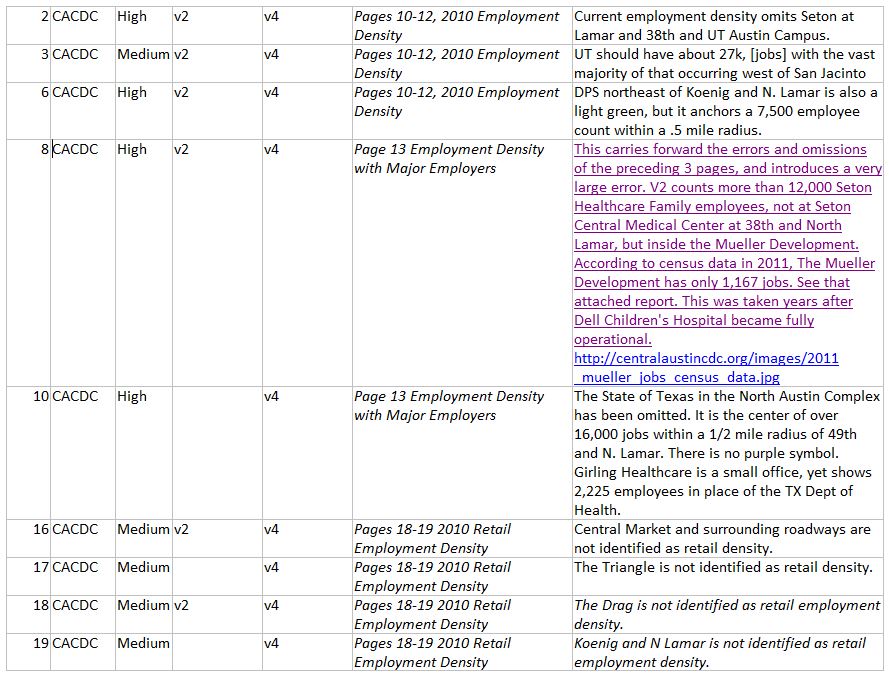
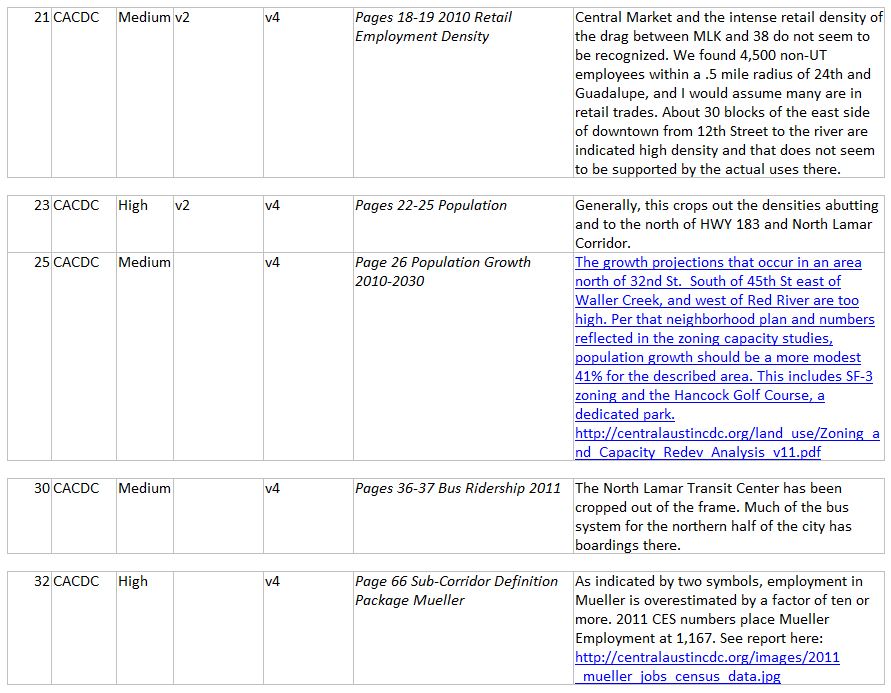
Partial listing of major errors in Project Connect Map Book and other material identified by CACDC. Screen image: L. Henry.
New error problems with Map Book 4
Scott has appended a listing of major new problems appearing in Map Book Version 4; here’s a summary:
• All “B” Pages and Definition Packages
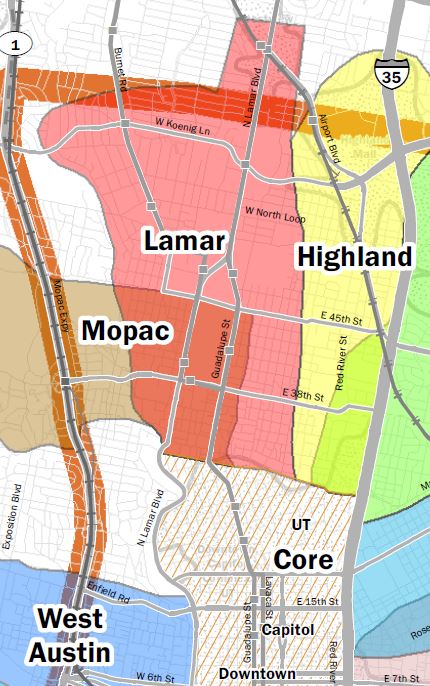
West University NPA/University Neighborhood Overlay Removed From Defined Sub-Corridors A large, dense city area to the west of the UT campus and Guadalupe Street was moved out of the North Lamar and Mopac Sub-Corridors by the Project Team in response to a request to include UT in the core. This change was made in the current map. We understand the reasoning in placing UT in the core, however the manner in which surrounding non-UT areas were moved with it will create large, unintended impacts on the sub-corridor evaluation process. That area is not a part of UT, nor in the opinion of West Campus residents, can it be adequately served by a San Jacinto alignment on the UT Campus. West University is the densest planning area of our city that also employs over 5,000 people (Non-UT). The area west of Guadalupe anchors the Guadalupe-North Lamar Sub-Corridor and includes the University Neighborhood Overlay and 3 residential neighborhoods that are components of a City of Austin Central Austin Combined Neighborhood Planning Area. West Campus is the largest population differentiator in our city for the purposes of sub-corridor analysis. In our opinion, it should not be considered a common element to the core joining the CBD, UT, and the Capitol Complex, unless it receives a similar commitment to service. In the end, if it is desired to count West Campus as part of the core, we should also count on serving it directly as part of the definition of the core.• Page 13 Employment Density with Major Employers
The State of Texas in the North Austin Complex has been omitted. It is the center of over 16,000 jobs within a 1/2 mile radius of 49th and N. Lamar. There is no purple symbol. Girling Healthcare is a small office, yet shows 2,225 employees in place of the TX Dept of Health.• Page 28 Poverty, Vehicles, Affordable Housing
Hundreds of units of affordable housing in West Campus is not identified with the correctly-sized circle.• Pages 36-37 Bus Ridership 2011
The North Lamar Transit Center has been cropped out of the frame. Much of the bus system for the northern half of the city has boardings there.• Pages 55-59 Sub-Corridor Definition Package Lamar
Population Studies are not provided for North Lamar sub-corridor definition package.• Pages 15-16. Employment Growth
Austin State Hospital should show >100% Growth. This is an identified P3.• Pages 18-19 2010 Retail Employment Density
The Triangle is not identified as retail density.• Pages 18-19 2010 Retail Employment Density
Koenig and N Lamar is not identified as retail employment density.• Page 26 Population Growth 2010-2030
The growth projections that occur in an area north of 32nd St. South of 45th St east of Waller Creek, and west of Red River are too high. Per that neighborhood plan and numbers reflected in the zoning capacity studies, population growth should be a more modest 41% for the described area. This includes SF-3 zoning and the Hancock Golf Course, a dedicated park. http://centralaustincdc.org/land_use/Zoning_and_Capacity_Redev_Analysis_v11.pdf• Page 30 Selected Land Use 2010
Adams Hemphill Park straddling 30th not identified as open space.
CACDC also provides data references as the basis for these corrections.
Summary
It’s understandable that some data problems will be encountered in almost any major study of this kind. What’s astounding, however, is the high number of problems in Project Connect’s urban rail study. Even worse is that almost all of them — even when identified — seem to be going uncorrected!
This seriously compromises the competency of this entire study process (and there are even more fundamental issues involved, as this blog will address). The data problem is especially threatening because data analysis is supposedly the foundation for decisionmaking to select an urban rail corridor; the Central Corridor Advisory Group (CCAG, whose recommendation is a key part of the process) is being led through a process of data scrutiny and analysis by Project Connect staff. Yet the Project Connect team — under duress from high-level local officials eager to force a quick decision on urban rail, and apparently overwhelmed by the need to rush to an imminent recommendation for the Austin City Council — seem merely to be “dumping” volumes of data with little regard for its reliability or relevance to the basic goal of selecting an urban rail route.
All of this calls into question just how “fair and balanced” — and accurate, reliable, and truly data-based — the process of comparatively evaluating alternative urban rail corridors and plans actually is.
What the final outcome will be, and whether its integrity will be accepted by the Austin public and voters in particular, remains to be seen.




 _______________Austin Rail Now