Posts Tagged ‘austin light rail’

h1

Texas Tribune op-ed urges support for “Plan B” light rail in Guadalupe-Lamar

27 July 2015
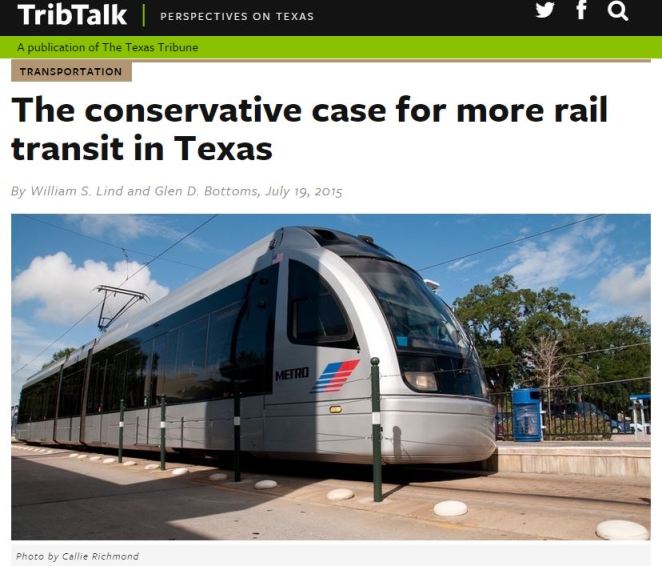
TribTalk op-ed headline with photo of Houston light rail train. (Screenshot: ARN)

TribTalk op-ed headline with photo of Houston light rail train. (Screenshot: ARN)

The case for light rail transit (LRT) in Austin’s Guadalupe-Lamar corridor just received a huge boost with the publication of an op-ed in TribTalk, the op-ed web page of the widely respected Texas Tribune.

“It may seem unlikely in Texas, but across the state, people are benefiting from rail transit” say William S. Lind and Glen D. Bottoms in their commentary (ARN emphasis added here and subsequently).

In Dallas, which now has the country’s largest light rail system, more than 100,000 Texans escape traffic congestion each day by riding Dallas Area Rapid Transit rail. In Houston, the light rail Red Line draws about 3,500 weekday boardings per mile, more than any other modern light rail operation in the country.

“Critics, many of whom call themselves conservatives (though most are really libertarians), predicted that both systems would fail because no one would ride them” they add.

Both writers are venerable, renowned veterans of the U.S. public transportation industry. Lind was also a close associate of the late conservative leader Paul Weyrich, a well-known advocate of rail transit among conservative circles.

In their op-ed, Lind and Bottoms note that “As conservatives, we find it odd that many people expect us to oppose public transportation, especially rail.”

In fact, high-quality transit, which usually means rail, benefits conservatives in a number of important ways. It spurs development, something conservatives generally favor, especially in Texas. It saves people, including conservatives, precious time, because those who ride rail transit can work or read on the train instead of wasting hours stuck in traffic. Transit of all kinds helps poor people get to jobs, which conservatives prefer over paying welfare. And rail transit, especially streetcars, helps support retail in downtowns by increasing the number of middle-class people on sidewalks.

Libertarians’ arguments against rail transit mostly boil down to one criticism: It’s subsidized. Yes, it is. So is all other transportation. Highway user fees now cover only 47.5 percent of the cost of highways. Nationally, rail transit of all types covers 50 percent of its operating costs from fares. It’s a veritable wash. In contrast, bus systems, which libertarians often favor over rail, cover only 28 percent of their operating costs from the farebox.

“Regrettably,” the writers caution, “conservatives’ tendency to accept libertarians’ arguments against rail transit (without checking their numbers) may deprive Texas conservatives of more chances to escape traffic congestion.”

As a case in point, they turn to Austin, explaining that it “may be different from other Texas cities in many ways, but not when it comes to traffic.”

The city’s rapidly growing population has packed its freeways at rush hours. And as other cities have found, building more freeways is not the answer. New lanes fill up as soon as they’re opened, and limited-access freeways in urban areas slice up and kill surrounding communities.

While they recount that “Austin voters last year rejected a poorly conceived light rail proposal that supporters said would help alleviate that congestion”, Lind and Bottoms argues that the failure of that plan nevertheless

…could be a good thing because it opened the door to a “Plan B” rail line that would serve the city better. A basic rule of rail transit planning is to “build it where people want to go,” and the alternative plan proposes a rail line that would run along Guadalupe Street and North Lamar Boulevard, Austin’s most heavily traveled urban corridor. We hope Austin conservatives will support “Plan B.”

Included in their commentary is a hyperlink to our own article from last October, «A “Plan B” proposal for a Guadalupe-Lamar alternative urban rail starter line». (Also see our recent article «Plan for galvanizing Austin’s public transport development: Light rail starter line in Guadalupe-Lamar», which links to our series of articles for this alternative plan with “what, where, how, and how soon” details about the proposed project.

Lind and Bottoms also point to other opportunities for rail, such as the streetcar project in El Paso and the Texas Central Railway highspeed rail system proposed to connect Dallas and Houston. “A combination of high-speed rail connecting Texas cities and good light rail and streetcar systems in those cities would make Texas a national leader…” they say in their conclusion. ■

h1

Plan Now for Light Rail in South Lamar!

29 April 2015
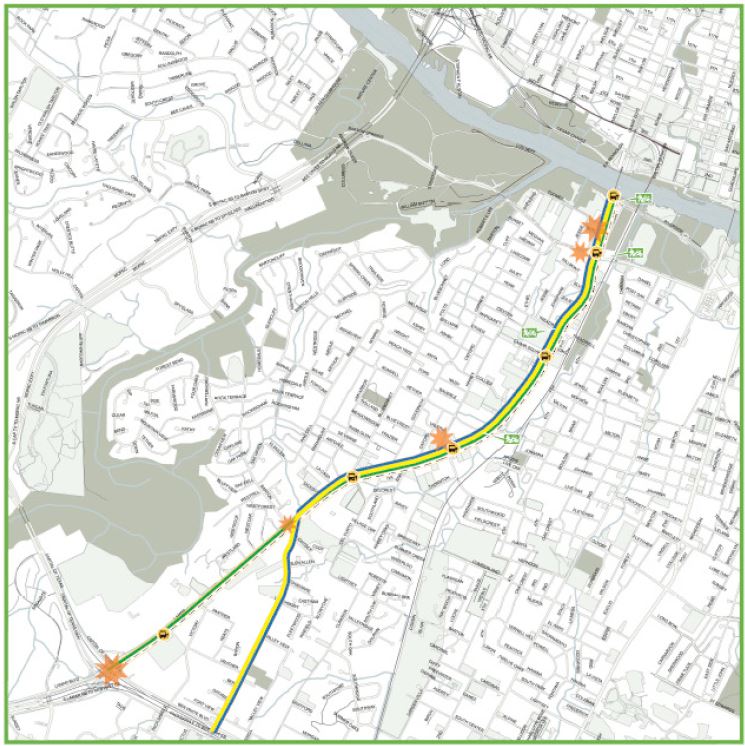
South Lamar corridor. Map: City of Austin.

South Lamar corridor. Map: City of Austin.

By Lyndon Henry

The following comments, adapted here to webpage format, were distributed to attendees at a public event sponsored by the City of Austin’s South Lamar Boulevard Corridor Study project on 10 December 2014. Lyndon Henry is a transportation planning consultant, a technical consultant to the Light Rail Now Project, and a contributing editor to Austin Rail Now. His comments highlight the vision of Austin Rail Now and other transit advocates that light rail is justified in, and needs to be planned for, a number of the Austin area’s major travel corridors.

► South Lamar light rail transit line makes sense

• In terms of both travel density and traffic congestion, South Lamar Blvd. ranks high among Austin’s major travel corridors (see Latest TTI data confirm — Guadalupe-Lamar is central local arterial corridor with heaviest travel). Current travel density plus rapidly increasing population density plus commercial growth in this corridor all indicate that planning for light rail transit (LRT) should long since have been under way.

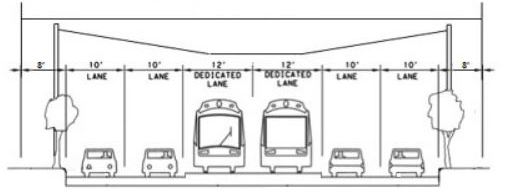
• A South Lamar surface LRT line, possibly using an alignment design such as is illustrated below, needs to be a major part of an eventual citywide system branching north, south, east, and west throughout our region from an initial central spine in the Guadalupe-North Lamar corridor.


Cross-sectional diagram showing how center LRT reservation could be inserted in South Lamar, maintaining traffic lanes and sidwalks. Design would use side-mounted traction electrification system poles for suspending the overhead contact system for LRT electric propulsion. Graphic: ARN. (Click to enlarge.)

Cross-sectional diagram showing how center LRT reservation could be inserted in South Lamar, maintaining traffic lanes and sidwalks. Design would use side-mounted traction electrification system poles for suspending the overhead contact system for LRT electric propulsion. Graphic: ARN. (Click to enlarge.)


• The South Lamar Corridor Improvement Program should be reconfigured to include planning for LRT as a crucial focus of this project. Planners and traffic engineers need to ensure that any “improvements” in this corridor facilitate dedicated transit lanes for future light rail, and certainly should not impose obstacles to it. It’s way past time to scrap the practice of proceeding with major projects with little if any thought to the future.

► Form a Community Policy & Technical Oversight Committee

• Planning should involve the Austin community as a whole, and this means forming a broad, inclusive community committee to oversee policy and technical decisions, including a comprehensive transit-focused mobility plan for Austin and its surrounding region. No more secretive project teams meeting in a virtual “bunker”, then emerging to tell us what they’ve decided for us! Authentic public participation means including representatives of neighborhood and other community groups, plus others with applicable expertise within the Austin community at large.


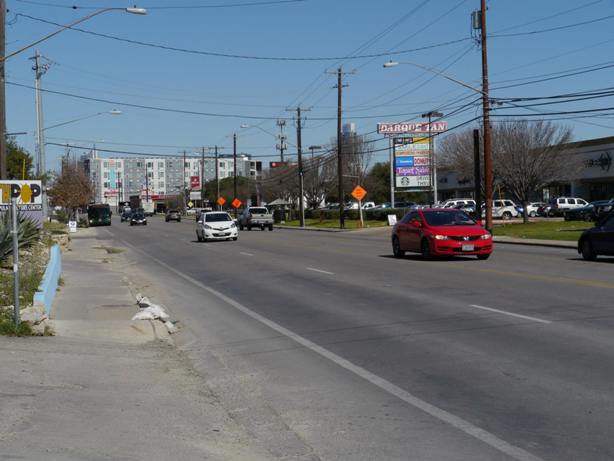
Current view of traffic on South Lamar. Photo: Austin Mobility.

Current view of traffic and urban development on South Lamar. Photo: Austin Mobility.


► Dedicate street lanes for light rail transit

Light rail can carry many more peak passengers than private cars, and attract many more riders than buses (both “regular” and MetroRapid). Austin needs to start re-allocating street space from traffic lanes to transit lanes, and the South Lamar corridor must be included. Smart design could install LRT in this corridor while retaining at least 4 lanes of traffic (see diagram in first section, above). ■

h1

Austin’s urban transport planning seems struck by catastrophic case of amnesia and confusion

29 March 2015
Graphic: Rich's Management Blog

Graphic: Rich’s Management Blog

The devastating befuddlement of Austin’s official-level urban transportation planning over the past five months has been nothing short of jaw-dropping. Especially when you consider this in context.

For two and a half decades, local officials and planners have explained why urban rail — affordable light rail transit (LRT), in Austin’s case — has been an absolutely essential component of the metro area’s mobility future. As our recent article «Long saga of Guadalupe-Lamar light rail planning told in maps» describes, the logical starting point for an initial LRT route has been the central city’s heaviest-traveled central corridor, Guadalupe-Lamar.

Year after year, planning proceeded in some way for LRT. Even after 2003, while official planning was distracted and mis-directed toward potential routes more to the east of the central core city, the need for rail transit was still proclaimed. Austin had to have rail to maintain an adequate level of mobility into the future.

Beginning about 2006, an original streetcar “connector” rail transit concept emerged that gradually morphed into more ambitious “urban rail” — a full LRT system. An official blue-ribbon committee of civic leaders, the Transit Working Group (TWG), was hand-picked (first by State Sen. Kirk Watson, then by Austin Mayor Lee Leffingwell) to guide rail planning. Extensive planning documents were finalized for a route scheme linking the Core Area with Seaholm, East Riverside, the East Campus, and Mueller — a rather deranged route, in our view, but rail nonetheless. The City then launched a full-fledged NEPA (National Environmental Policy Act) process (required for federal funding), with a series of “open houses” and other public events.

Activities of the TWG continued to heat up, primarily focused on planning for the urban rail line to Mueller. Route alternatives, cost issues, funding issues, organizational and management arrangements, and all kinds of associated issues were discussed exhaustively. A new consortium of public agencies, called Project Connect, was formed, mainly to coordinate rail planning and to produce a massive regional plan criss-crossed with proposed rail lines. Remember all this?

By 2013, the official establishment apparently felt urban rail needed the scrutiny of a special High-Capacity Transit study. So a special Project Connect team, headed by consultant Kyle Keahey, was formed, and virtually the second half of 2013 was consumed with “studying” (translation: justifying) and finalizing the need, size, and shape of an officially preferred urban rail plan. Mueller was sidelined, replaced by a desperate quest for a rail line from East Riverside to the former Highland Mall site. “Gotta get to Mueller! Mueller! Mueller!” became “Gotta get to Highland! Highland! Highland!”


Urban rail has been on the official planning agenda for decades. Throughout the first 10 months of 2014, the Highland-Riverside plan (envisioned in this simulated scene) was hyped incessantly. Graphic: Project Connect.

Urban rail has been on the official planning agenda for decades. Throughout the first 10 months of 2014, the Highland-Riverside plan (envisioned in this simulated scene) was hyped incessantly. Graphic: Project Connect.


As this blog, and a sizable segment of local transit advocates, insisted, the plan was conceived for the wrong reasons and fundamentally flawed. But for about the last two months of 2013, and ten months of 2014, the City administration, plus Capital Metro, plus the prevailing faction of local civic leaders, all insisted over and over that rail was absolutely, positively essential (although it had to be the peculiar Highland-Riverside plan officials had concocted). An expensive ad campaign, much of it financed from federal funds channeled through Capital Metro, bombarded the public via the Internet and virtually all major media outlets — reiterating the message that traffic congestion was a growing threat to the metro area and rail (the official plan of course) was the essential remedy. Mayor Leffingwell’s familiar aphorism was suddenly appearing and being heard everywhere: “Rail or Fail!

And then, on Nov. 4th, it all hit a wall, as voters said No to the puzzling, nonsensical, controversial, and fabulously expensive Project Connect plan that had been offered.

And all of a sudden, rail was erased, scrubbed, from official discourse. Despite all the years, decades, of documentation of the need for a rail transit system for the city, the official vision of transit became refocused on “becoming the best bus system we can be”; after years of explanations that reliance on further highway development wasn’t a realistic solution for preserving the city’s mobility, regional highway and tollway development has suddenly received a new surge of energy in official policy.

Meanwhile, rail transit planning has basically vanished from official planning. It’s just gone “Poof”. As David Orr has reported in his recent commentary «Austin’s “shadow government” (CAMPO) disappears light rail from local planning», all reference to urban rail has been expunged from the 2040 Transportation Plan of CAMPO (Capital Area Metropolitan Planning Organization), and replaced by line items for “bus rapid transit” (i.e., expansion of the MetroRapid limited-stop bus service).

Affirmed, until last November, as an absolutely essential component of Austin’s future mobility, light rail has now disappeared from public discourse, from the mainstream media, from the lips of politicians and civic leaders. Is it some kind of collective amnesia? Have the local planning and decisionmaking establishment all been struck with a strange disability, like the global mass blindness in Day of the Triffids? Or is the obliteration of rail a calculated excision, like the Soviet Stalin regime’s air-brushing elimination of political undesirables from photos, or the “Photoshopping” of group photos by some misguided religious media to “disappear” women?


Evaporation of Austin's light rail planning resembles a catastrophe of collective affliction, like the mass blindness portrayed in Day of the Triffids. Movie poster: IMDb.com.

Evaporation of Austin’s light rail planning resembles a catastrophe of collective affliction, like the mass blindness portrayed in Day of the Triffids. Movie poster: IMDb.com.


One wonders whether any of these Austin-area leaders and planners have given a thought as to how this plays in public perceptions of their own credibility and integrity. Were all the assurances and explanations of the need for urban rail to maintain Austin’s future mobility and vitality just deceptive hype, a marketing ploy for some kind of alternative agenda?

Maybe, but we believe the fundamental case for LRT in Austin has been grounded in truth — the higher capacity, greater ridership attraction, cost-effectiveness, environmental benefits, unsurpassed magnetism to transit-oriented development and economic development, and other advantages of light rail are indeed essential for the future of this community. Mobility cannot be sustained of a continuing expansion of rivers of highways and tollways and a steadily rising flood of personal motor vehicles. Urban rail continues to be key to providing truly attractive public transit alternative, and shifting at least significant segments of the Austin metro to a sustainable alternative mobility lifestyle.


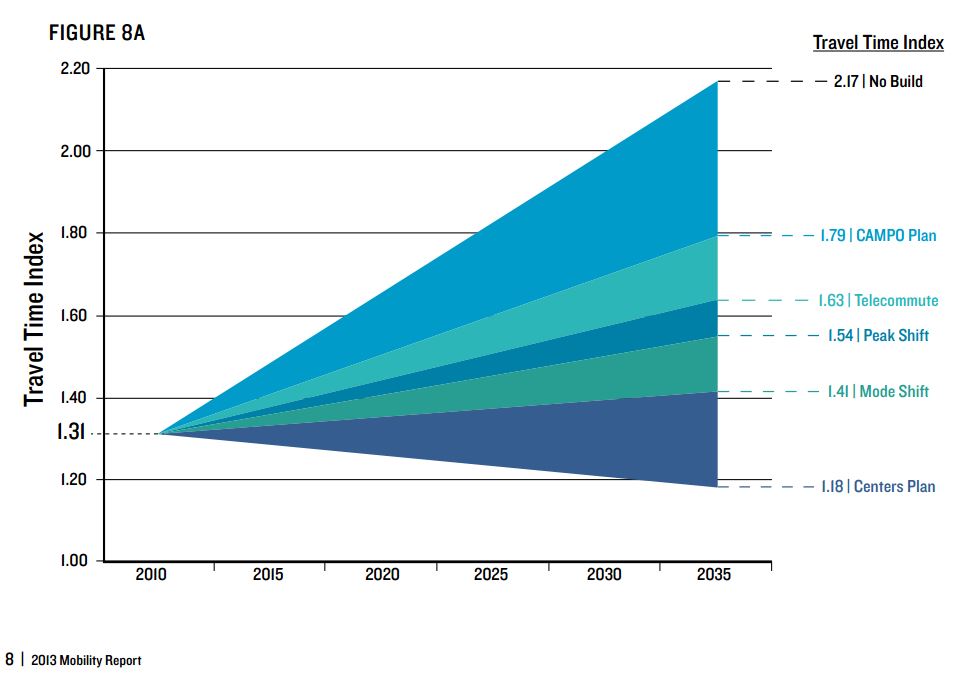
According data from Texas Transportation Institute, even with implementation of infrastructure expansion in CAMPO 2035 plan, Austin metro travel time would increase 80% due to traffic congestion. Graph: Austin Chamber of Commerce 2013 Mobility Report.

According to data from Texas Transportation Institute, even with implementation of infrastructure expansion in CAMPO 2035 plan, Austin metro travel time would increase 80% due to traffic congestion. Graph: Austin Chamber of Commerce 2013 Mobility Report. (Click to enlarge.)


And we have a strong suspicion that a preponderant number of local planners and officials actually continue to agree with this perspective. If so, they need to realize there’s a lot of community support for urban rail — from voters on both sides of last year’s debate — and they need to start stepping forward. They need to heed their sense of responsibility, find their mojo, or whatever it takes, to take the lead to get LRT planning back on track.

The groundwork, in terms of preliminary planning, is already there — and, in recent articles and other public information, Austin Rail Now along with other mass transit advocates have expanded on it.

Austin is waiting. We’re wondering who’ll take the first step. ■


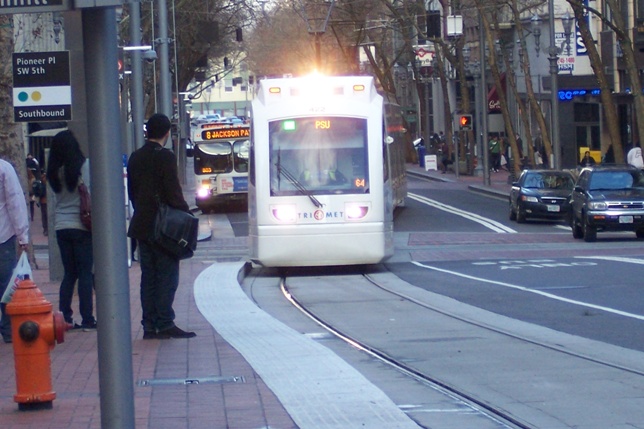
LRT train on Portland's 5th Ave. transit mall swings to the curbside station to pick up waiting passengers. Photo: L. Henry.

Portland’s light rail trains (in dedicated lanes) share 5th and 6th Avenue transit mall with buses as well as cars — a potential transit design model for Austin? Photo: L. Henry.

h1

Possible timeline for installing light rail transit in Guadalupe-Lamar corridor

17 February 2015
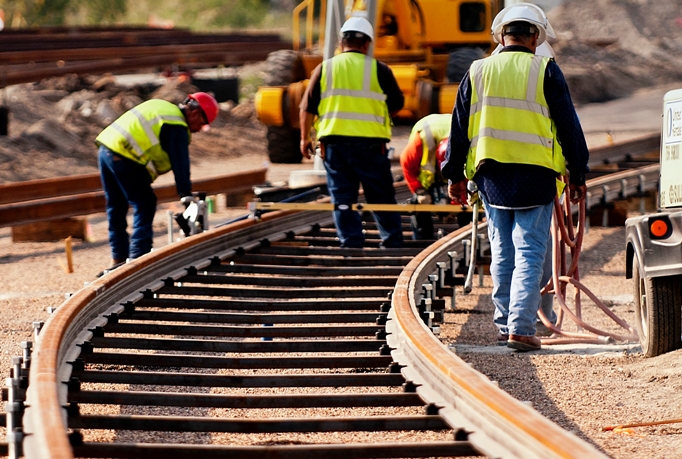
LRT construction in Houston. A similar LRT line in the Guadalupe-Lamar could potentially be completed and in service in less than a decade. Photo: Houston Metro.

LRT construction in Houston. A similar LRT line in Austin’s Guadalupe-Lamar corridor could potentially be completed and in service in less than a decade. Photo: Houston Metro.

In our Feb. 10th article «Long saga of Guadalupe-Lamar light rail planning told in maps» we provided a selective summary chronicle of the exhaustive history of planning for major infrastructure upgrades — almost all of it light rail transit (LRT) — to expand capacity, enhance urban livability and the environment, and improve and sustain mobility in Austin’s most important central local corridor, Guadalupe-Lamar (G-L). Over 40 years of LRT proposals and studies were noted and maps associated with them were presented, among them several alternatives we’ve featured on this website.

As we’ve contended in our article «Strong community support for Guadalupe-Lamar light rail continues — but officials seem oblivious», there’s abundant evidence of enduring community interest in, and support for, LRT in this crucial corridor, indicated in part by various alternative route proposals that have emerged in recent years. One of these — originally presented in a posting on this website last October as a so-called “Plan B” proposal (the name deriving from the presumption that the disastrously flawed officially sponsored Highland-Riverside urban rail plan, decisively rejected by voters in November, was “Plan A”) — has been modestly developed as a light rail transit (LRT) starter line project with suggested basic planning, route, and design concepts:

A “Plan B” proposal for a Guadalupe-Lamar alternative urban rail starter line

San Francisco’s N-Judah Muni Metro line shows design option for light rail in Austin’s Guadalupe-Lamar corridor

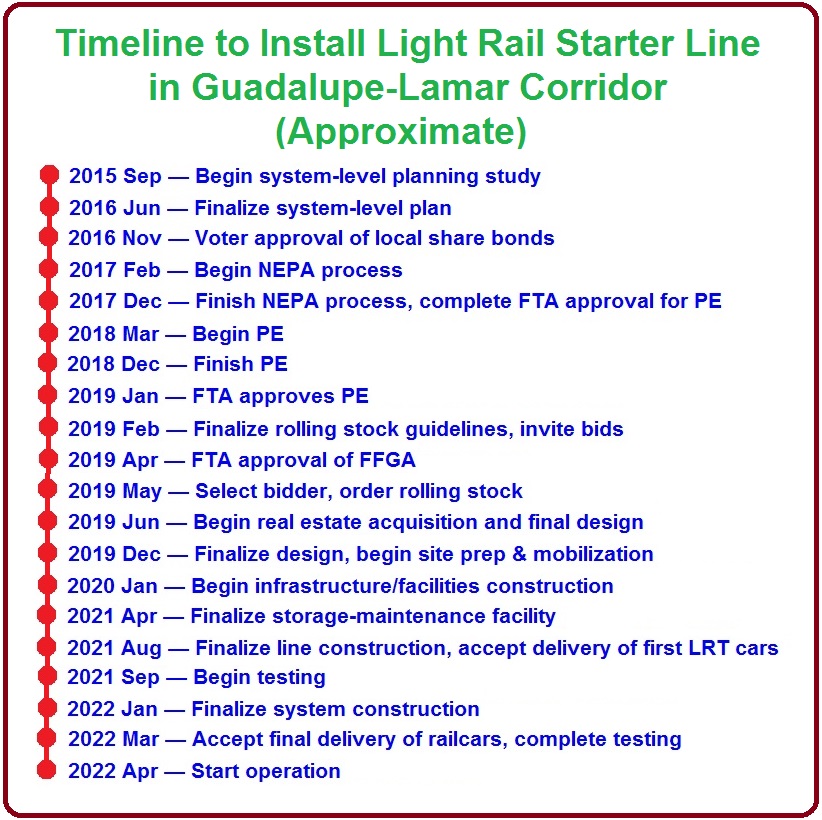
So, on the assumption that the critical mass of community and political support could be mustered to proceed, how long would it take to get an actual G-L starter line (the seminal “spine” from which extensions throughout the metro area and the region would subsequently branch) in operation? What milestones might there be along the way, and what might be typical (or at least realistic) timeframes for achieving each milestone? And could a new Project Connect-style study be initiated and concluded within about a year, in time to put a rail project funding measure on the ballot in 2016?

In response to these issues, we’re posting here a somewhat fanciful and speculative timeline (based on the proposed 6.8-mile G-L-Seaholm line described in our “Plan B” article cited above), with some modestly rosy assumptions, but based on real-world experience elsewhere. In addition, it’s been vetted by a number of transit industry professionals and savvy advocates.


Hypothetical timeline.

Hypothetical timeline (click to enlarge).


(Click to enlarge.)

(Click to enlarge.)

Our timeline assumes that some project phases could be accelerated or “telescoped” because so much previous study and analytical work has already been completed on this corridor (and some of the planning work involved in the Highland-Riverside proposal might also be applicable). Obviously, all dates (and phases) should be considered as hypothetical, and thus to have some room for adjustment.

This information is mainly intended just to provide a general idea of a possible timeline for such a project in the G-L corridor. Typically, project timelines are meticulously developed by an entire project team and are subject to ongoing revisions.

As our timeline suggests, it’s plausible to envision that a G-L LRT starter line project could be completed within about seven years from the start of conceptual system-level planning. This would lead to a possible opening of the line for service in 2022. To meet such a schedule, system-level planning (to develop a basic conceptual plan to present to the public and to voters for funding) would need to begin sometime later this year — ideally, in the early to middle autumn. Otherwise it would be difficult to finalize a plan for a public vote by November 2016.

Missing the Nov. 2016 vote deadline, as we understand current state law governing bond elections, would likely introduce two more years of delay. This would push a hypothetical vote to 2018, and service startup to the year 2024. In any event, it’s clear that a plausible case can be made that urban rail, in the form of surface LRT, could be up and running in the Guadalupe-Lamar corridor within a decade, and quite likely sooner. ■

h1

Long saga of Guadalupe-Lamar light rail planning told in maps

10 February 2015
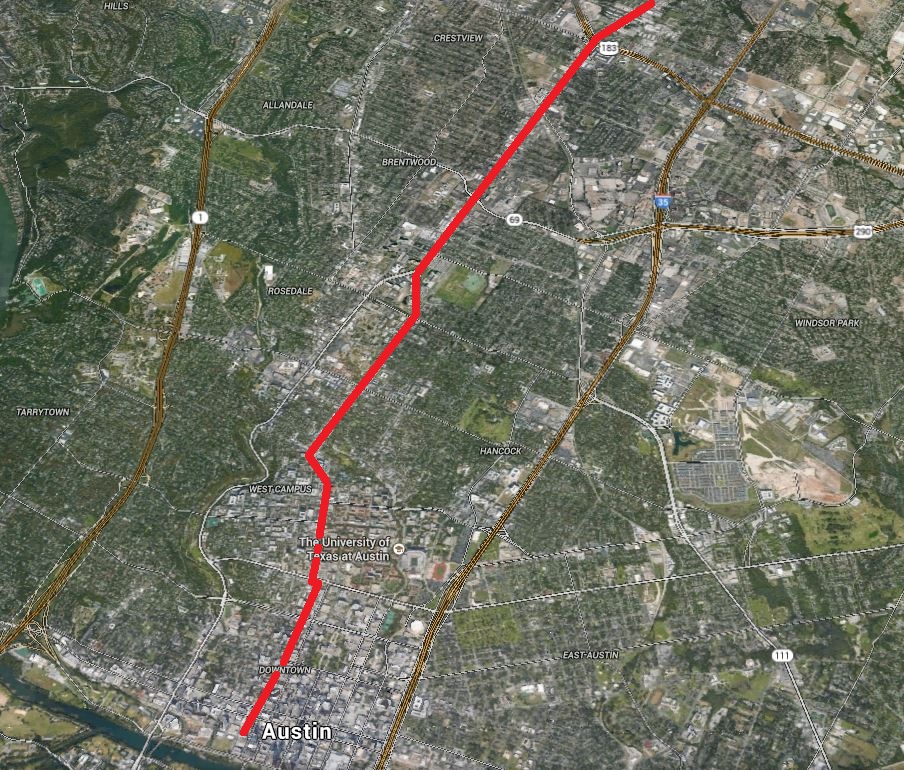
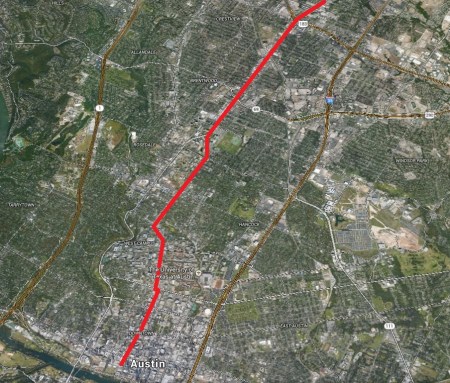
Red highlighting line demarcates North Lamar Blvd. and Guadalupe St., north-south central spine of Guadalupe-Lamar travel corridor. (Click to enlarge.)

Red highlighting line demarcates North Lamar Blvd. and Guadalupe St., north-south central spine of Guadalupe-Lamar travel corridor. (Click to enlarge.)

Last October, in our article titled «Latest TTI data confirm — Guadalupe-Lamar is central local arterial corridor with heaviest travel», this website noted that “For years, many Austin public transit activists have been insisting that the Guadalupe-Lamar (G-L) corridor is the central inner city’s most heavily traveled local travel route, and should be the first priority for installing urban rail.” As the article further explained:

By far, the heavy travel flow in this corridor one of that most compelling features that cry out for the capacity, public attractiveness, and cost-effectiveness of urban rail (light rail transit, LRT). Study after study has documented the fact that this is the most intensely traveled inner-city local corridor — the only major corridor serving the city’s central axis between I-35 and Loop 1 (MoPac).

Now, the latest annual report of the Texas Transportation Institute (TTI), endorsed by the Texas Department of Transportation (TxDOT) not only strongly corroborates these assessments, but provides data that further emphasize the key importance of the G-L corridor.

The article summarized the TxDOT data with several graphs showing that, in both traffic and mobility congestion, Guadalupe-Lamar surpasses all other major local arterial corridors in the city. Conclusion: Once again, “Good sense suggests that Guadalupe-Lamar remains the top-priority corridor for an urban rail starter line.”

This conclusion merely corroborates a reality that has changed relatively little in more than 50 years — a saga of planning for this crucial central corridor that can be more fully grasped in the following series of maps spanning over five decades.

Central Freeway plan

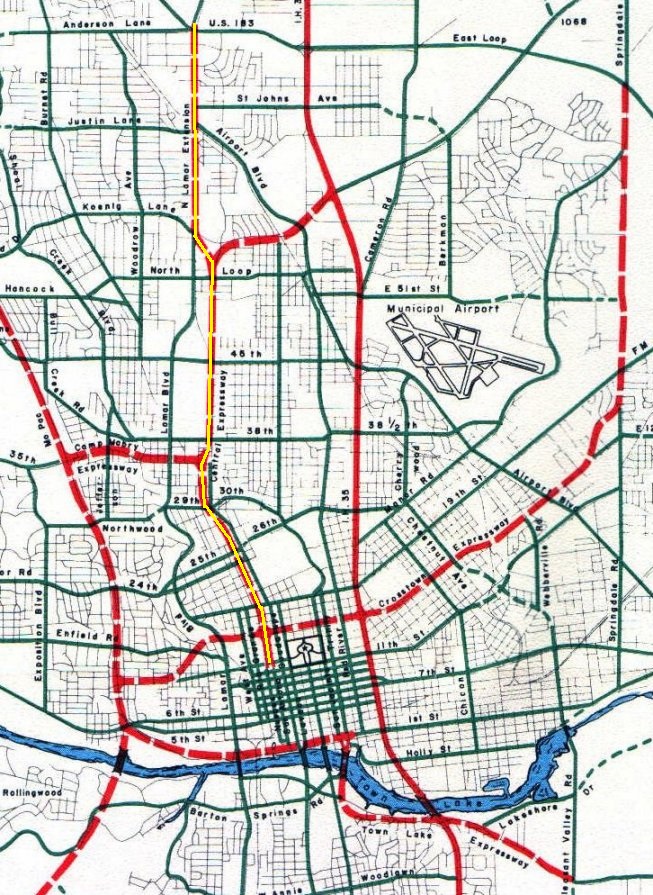
As early as 1962, the Guadalupe-Lamar corridor was proposed as the route of a Central Freeway (also designated a Central Expressway) in a regional transportation plan produced by the Texas Highway Department (predecessor of the Texas Department of Transportation, TxDOT). The map below, an excerpt from the larger 1962 regional map in the official report, zooms in on roadways planned for central Austin, with proposed freeways shown as dashed red lines. We’ve annotated the Central Freeway in the Guadalupe-Lamar corridor (running north-south just to the left of center) with an additional yellow line in the middle of the red.


Central Freeway (annotated here with yellow line in center of dashed red line). (Click to enlarge.)

Central Freeway (annotated here with yellow line in center of dashed red line). (Click to enlarge.)


The prospect of a new freeway slicing through established neighborhoods like Hancock, Hyde Park, and the West Campus eventually prompted interest in a rail transit alternative for the corridor. This is noted in the following information from the Texas Freeway website, which provides a verbal narrative of the proposed Central Freeway route:

Central Freeway Starting downtown just west of the Capitol, this freeway would have been located a block or two west of Guadalupe and proceeded northward up to the UT campus, where it would join Guadalupe and follow Guadalupe northward to Koenig lane. It then curved to follow the route of Lamar street. A light rail line was planned for this route in 2000, but was narrowly rejected by Austin voters in November 2000. In the long run, there is still a very good chance that light rail will be built on this route.

Past light rail plans

The prominence of the Guadalupe-North Lamar travel corridor, the need to effectively provide access to major core activity centers including the University of Texas campus, the Capitol Complex, and downtown, plus the looming prospect of a major freeway to cut through the heart of the city, prompted strong interest in exploring public transit alternatives. Starting in the 1970s, these began to emerge.

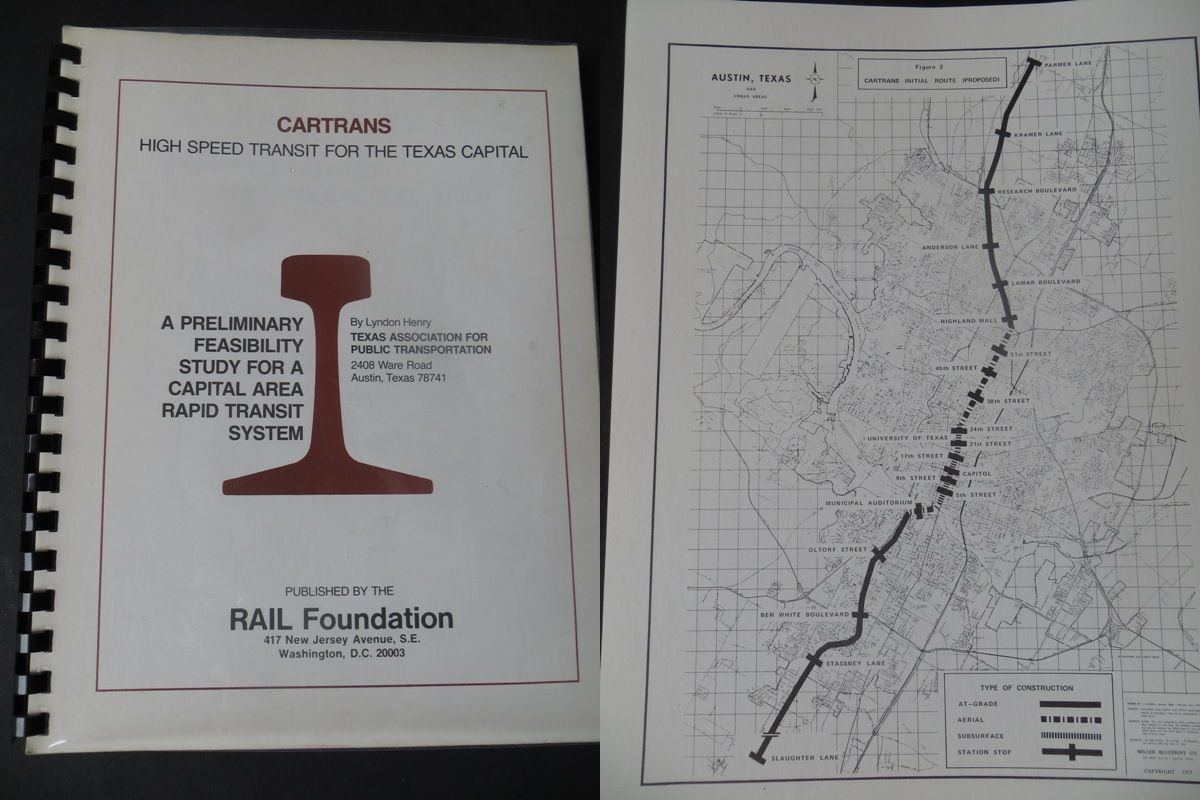
► CARTRANS proposal — The possibility of rail transit as an effective and plausible alternative to the Central Freeway for Austin’s central Guadalupe-Lamar corridor emerged decisively in 1973 via the release of A Preliminary Feasibility Study for a Capital Area Rapid Transit System (with the acronym CARTRANS). Prepared by Lyndon Henry, a leader of Texas Association for Public Transportation (TAPT), with the collaboration of Phil Sterzing, a former Austin city planner, the plan proposed a 19.2-mile electrically propelled light transit (LRT) line running in a subway and on elevated structure through the heart of the center-city, then on surface railway alignments north and south. (Lyndon Henry is currently a contributing editor to this website.)


CARTRANS report (left) proposed LRT 19.2-mile route (right) stretching from north to south Austin and paralleling major central flow of travel along North and South Lamar, South Congress, and I-35. Photos: ARN.

CARTRANS report (left) proposed LRT 19.2-mile route (right) stretching from north to south Austin and paralleling major central flow of travel along North and South Lamar, South Congress, and I-35. Photos: ARN.


Published by the Washington, DC-based RAIL Foundation, the CARTRANS report quickly garnered interest and support from the Austin City Council and much of Austin’s top civic leadership. This catapulted rail transit — previously disparaged as inappropriate for any Texas city — into a possibility under serious consideration as a realistic public transit alternative for the central city.

► Capital Metro planning in early 1990s — After approximately a decade of additional transit planning conducted mainly via the Austin Transportation Study, civic interest and public excitement over the possibility of an Austin rail transit system (particularly as an alternative to the metro area’s increasingly congested and dangerous roadways) helped facilitate creation of the Capital Metropolitan Transportation Authority (CMTA, Capital Metro) in 1985. Subsequently, the agency’s initial major planning effort, the Transitway Corridor Analysis Project (TCAP), having concluded in 1989 with robust community involvement, led to the designation of LRT as the agency’s Locally Preferred Alternative (LPA, a federally required decision).

Also emerging from the TCAP experience was the concept of connecting access to the northwest metro area, via the City of Austin’s newly acquired railway line, with the Guadalupe-Lamar corridor, serving multiple destinations, established and high-density neighborhoods, the University of Texas (UT), Capitol Complex, and downtown. In addition, most local transit advocates, including TAPT, as well as local planners and decisionmakers realized that a surface LRT system (rather than significant subway or elevated infrastructure) was best suited for Austin’s scale and financial resources.

Beginning in the early 1990s, Capital Metro contracted with a consulting team led by E.P. Hamilton & Associates to conceptually design and evaluate a surface-routed electric LRT alignment to serve primarily the Guadalupe-Lamar corridor plus a segment of Austin’s northwest corridor, served by available “opportunity assets” including the now publicly owned railway line as well as the major arterials North Lamar and Guadalupe St. Also included was a short additional spur into East Austin, using a segment of the same CMTA railway. As with all such proposals, this was envisioned as merely a “starter line”, seen as the first crucial leg of an ultimately multi-route system serving the entire metro area.

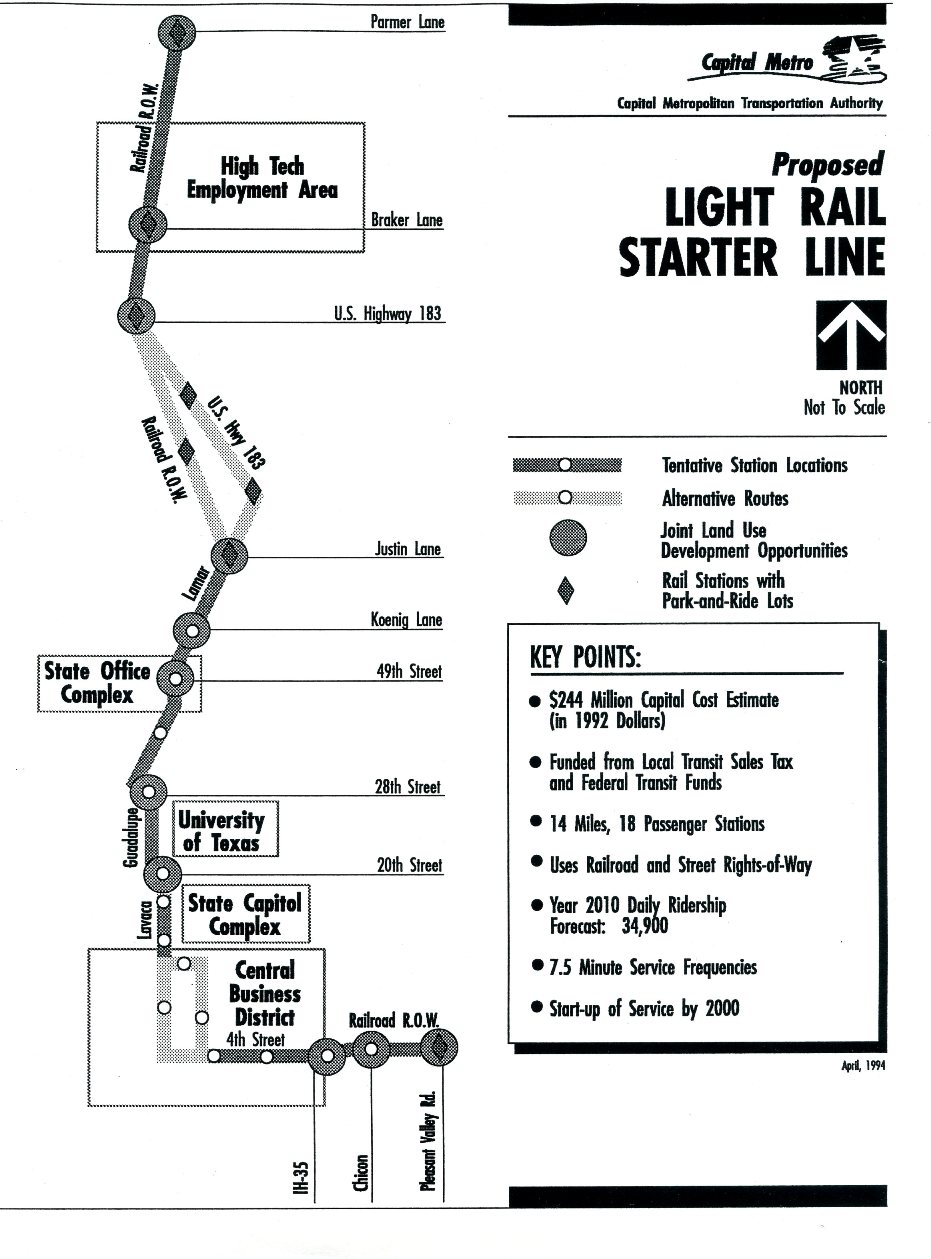
The eventual plan, finalized by a Light Rail Transit Station and Corridor Area Planning consultant team led by Carter Design Associates, in association with 6 other consulting firms, proposed a 14-mile starter line route running from Parmer Lane southward to the CBD. From Parmer to U.S. 183 the route uses the CMTA railway right-of-way; alternative routes using U.S. 183/North Lamar or the railway are proposed from there to Justin Lane; then the route follows Lamar, Guadalupe, and Lavaca into the CBD, with the already mentioned branch into East Austin. The plan was projected to have a total investment cost of $244 million (1992 dollars), with opening targeted for 2000, and daily ridership forecast as 34,900 in 2010. The route map and key features are summarized in the following informational page from Capital Metro, dated April 1994:
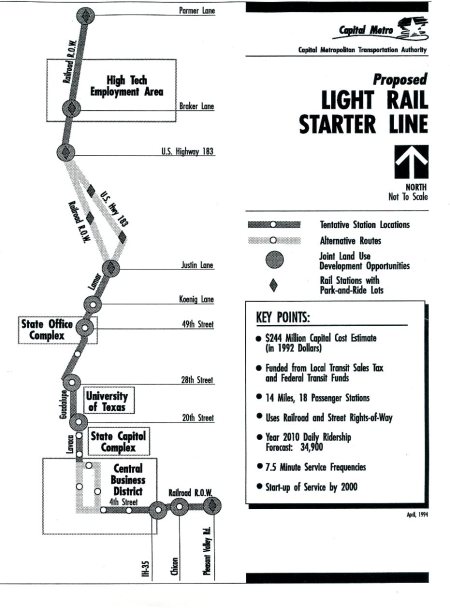

Capital Metro LRT plan for Guadalupe-Lamar and northwest, 1994. Map: CMTA. (Click to enlarge.)

Capital Metro LRT plan for Guadalupe-Lamar and northwest, 1994. Map: CMTA. (Click to enlarge.)


► Capital Metro 2000 LRT plan — During the mid-to-late 1990s, Capital Metro changed course somewhat to focus on a possible diesel-operated rail service exclusively on the agency’s railway. Mainly because of this, and political and organizational upheavals at Capital Metro, the 1994 plan was effectively shelved … only to be resurrected, almost intact, in 1999-2000 by a reorganized Capital Metro board chaired by tech industry executive Lee Walker. In a charette convened by the agency, dozens of national transit industry professionals reaffirmed the primacy of the Guadalupe-Lamar and northwest travel corridors, and endorsed the need for a line very similar to the 1994 proposal.

Assisted by the Parsons-Brinckerhoff consulting firm, Capital Metro planners devised an LRT plan intended to be funded 50% with Federal Transit Administration (FTA) grants. As described in our article «Austin’s 2000 light rail plan — Key documents detail costs, ridership of Lamar-Guadalupe-SoCo route», “Capital Metro’s proposal was sectioned into two parts — a shorter Minimum Operable Segment (MOS), running from McNeil Rd. in north Austin — using railway right of way (now used by today’s MetroRail), then Lamar-Guadalupe — to the CBD, and a full Phase 1 plan, which added a line down South Congress to Ben White, and another branch on Capital Metro’s railway right of way to Pleasant Valley Rd.”

The MOS (McNeil Rd. to CBD) consisted of a 14.6-mile initial starter line segment, with ridership for the forecast year (2025) projected at 37,400 per day. The complete Phase 1 plan — adding the South Congress (SoCo) extension, plus a branch into East Austin, comprised 20.0 miles of route. These are shown in the following map from the FTA’s New Starts report on the project:
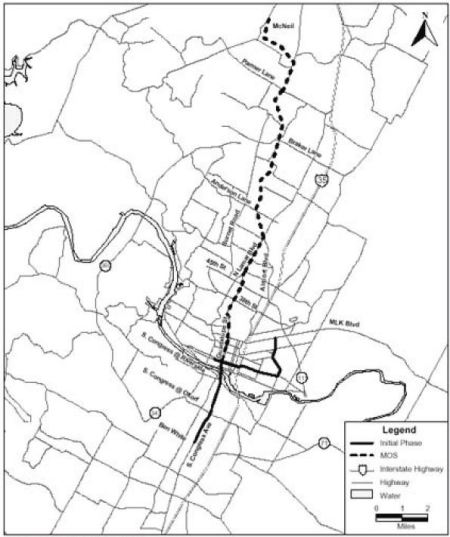

Capital Metro's 2000 MOS (dashed line) and full Phase 1 light rail plan. Map: FTA.

Capital Metro’s 2000 MOS (dashed line) and full Phase 1 light rail plan. Map: FTA. (Click to enlarge.)


While Capital Metro’s LRT initiative was rejected in a November 2000 referendum, it lost by less than one percentage point — and actually got a solid majority vote within the City of Austin itself. This thread of public support would help keep the project alive.

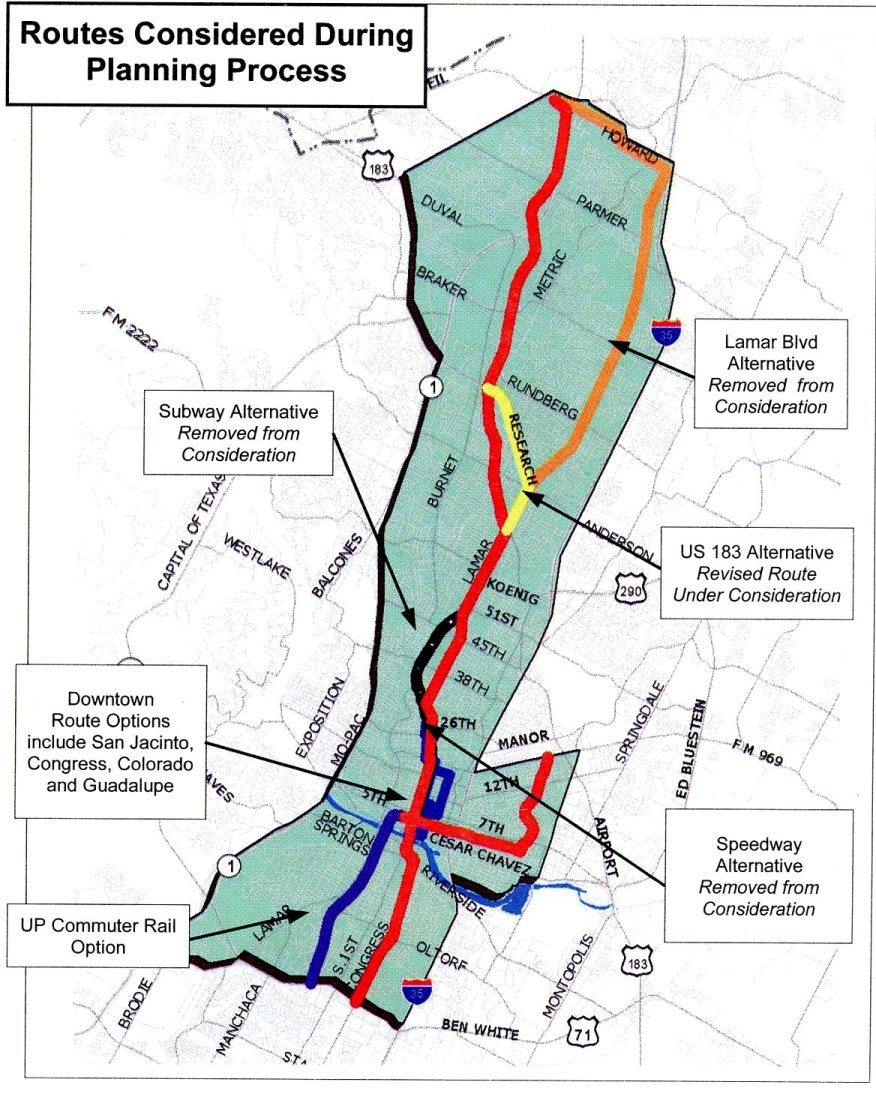
► Rapid Transit Project planning — Because of the very narrow margin of the loss in the 2000 LRT plan vote, and the clear evidence of support from City of Austin voters, following the 2000 election Capital Metro and the City of Austin established a joint Rapid Transit Project (RTP) that continued planning, with a focus on the Guadalupe-Lamar corridor as well as a potential alignment on Capital Metro’s railway to the northwest. While several alternative segments were considered (including a subway option, which was discarded), the primary route through the heart of the central city remained Guadalupe-Lamar, as indicated in the following annotated map disseminated in April 2002 by the RTP:


Route alternatives considered by the City-Capital Metro joint Rapid Transit Project, as presented in 2002. Guadalupe-Lamar remained the heart of the plan's route into the Core Area, as shown by the red line. Map: RTP. (Click to enlarge.)

Route alternatives considered by the City-Capital Metro joint Rapid Transit Project, as presented in 2002. Guadalupe-Lamar remained the heart of the plan’s route into the Core Area, as shown by the red line. Map: RTP. (Click to enlarge.)


During this period, intensive planning for LRT, particularly in the G-L corridor and downtown, continued, with vigorous public meetings and consultations. Included in these activities was the extensive involvement of community activists and residents of neighborhoods along the proposed route, much of it focused on developing and finalizing neighborhood station-area plans with the aim of effectively utilizing the anticipated resource of LRT.

These planning efforts continued until the RTP’s activities were effectively curtailed and eventually terminated as Capital Metro abruptly ended planning for LRT in the G-L corridor in mid-2003 and turned instead to developing a diesel-operated “urban commuter rail” line (in effect, a revival of a very similar concept from the mid-1990s). That effort led to voter endorsement of the plan in November 2004, and the Red Line, rebranded as MetroRail, opened in the spring of 2010.

However, as this website has related in our Nov. 2014 article «Derailing the Mueller urban rail express — Preamble to Project Connect’s 2013 “High-Capacity Transit Study”», unlike the LRT plan that would run straight to Austin’s Core Area, the new diesel-multiple-unit (DMU) operated system lacked this access: “Since the newly approved DMU line ran on a railway alignment that bypassed most of the heart of the city, ending only at the southeast corner of the CBD, officials and planners realized they needed some way to connect passengers with key activity points, including UT and the Capitol Complex.”

This led officials and planners to try to solve the problem with various schemes, including “connector” buses, then the MetroRapid bus project, and some kind of rail “circulator” that would connect the commuter-like MetroRail with key destinations. As our article cited above explains, a streetcar scheme morphed into a more robust LRT concept that included both a route on East riverside Drive and a more central line running through the east side of downtown, UT’s East Campus on San Jacinto Blvd., and on into the Mueller site, first via Manor Road, then eventually via a route using Red River St., Hancock Center, and Airport Blvd. to access Mueller. Any vestige of LRT in the city’s most heavily traveled central local arterial corridor — Guadalupe-Lamar, including access to the West Campus and the business commercial district and established neighborhoods along it — was abandoned.

Current light rail plans

But while the obsession of Austin’s local political establishment and official planners had turned to a route apparently motivated in part by a desire to bolster real estate development plans at Mueller and East Riverside, and the UT administration’s East Campus expansion plans, local community activists and public transit activists continued to call attention to the abiding need for LRT in the Guadalupe-Lamar corridor. It was clear years ago, and now, that reliable data has continued to corroborate what Austinites can themselves see and experience — that this is the most important, heavily traveled local corridor in the heart of the city. See, for example, data cited in our articles:

Demographic maps show Lamar-Guadalupe trumps Mueller route for Urban Rail

Guadalupe-Lamar urban rail line would serve 31% of all Austin jobs

Guadalupe-Lamar is highest-density corridor in Austin — according to Project Connect’s own data!

Latest TTI data confirm — Guadalupe-Lamar is central local arterial corridor with heaviest travel

This community involvement, including the efforts of TAPT and the Light Rail Now Project, has led in more recent years to a series of alternative proposals for LRT/urban rail alignments in the Guadalupe-Lamar corridor, as described below.

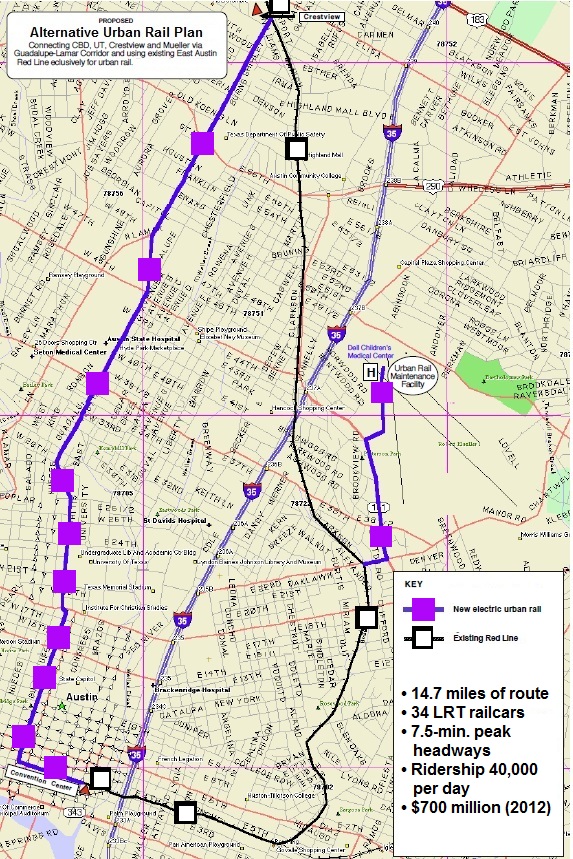
► TAPT “loop route” — In May 2012, responding to an official proposal for a 5.5-mile, $550 million “urban rail” line running from downtown, through the East Campus, to Mueller, TAPT leaders Dave Dobbs and Lyndon Henry presented an alternative $700 million plan for 14.7 miles of LRT serving both the Guadalupe-Lamar corridor and the eastside Red Line corridor. Connected at both north and south ends where the west and eastside lines would converge, the route thus formed a “loop” around the heart of the city. A branch serving the Mueller site was also included. (When an estimated $150 million was added into the official “urban rail” plan — accounting for a projected “BRT” line in the G-L corridor — the TAPT “loop” proposal matched the cost of the official concoction of rail + “BRT”.)

The route proposed in this plan, described in our March 2013 article «An alternative Urban Rail plan», is illustrated in the original map below:


TAPT "loop" plan from the early summer of 2012 proposed a 14.7-mile route "looping" around the heart of the central city, including a line in the G-L corridor, plus a branch to Mueller. Map: TAPT. (Click to enlarge.)

TAPT “loop” plan from the early summer of 2012 proposed a 14.7-mile route “looping” around the heart of the central city, including a line in the G-L corridor, plus a branch to Mueller. Map: TAPT. (Click to enlarge.)


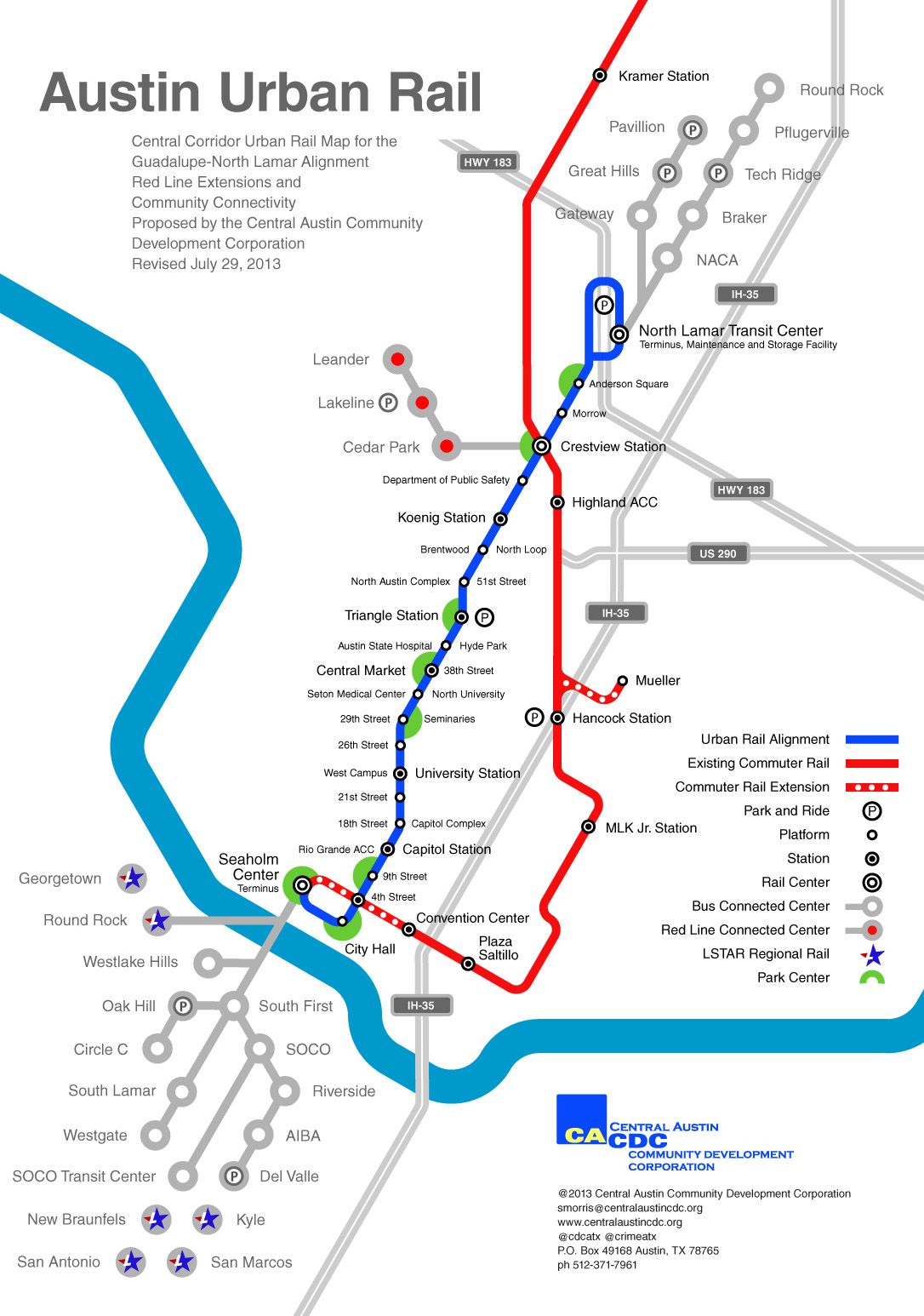
► CACDC proposal — In this general period, prior to the start of Project Connect’s “High-Capacity Transit Study” activities in the late summer of 2013, the Central Austin Community Development Corporation (CACDC), led by Scott Morris, posted maps and data for a seven-mile-long Central Corridor urban rail plan following North Lamar and then Guadalupe. As described in our article «Another alternative urban rail plan for Guadalupe-Lamar corridor»,

The CACDC route would extend from the North Lamar Transfer Center, down North Lamar past the Crestview station, through the West Campus area, to 4th St. From there, it includes an eastward spur to the Seaholm development site, and also proposes a short spur line branching from the existing MetroRail Red Line into the Mueller development site.


CACDC's Central Corridor urban rail plan (blue), with MetroRail (red) and various bus links (grey). Map: CACDC

CACDC proposed 7-mile G-L urban rail route from the North Lamar Transit Center to downtown, then to the Seaholm development site (shown in blue). Existing MetroRail line shown in red. Map: CACDC.(Click to enlarge.)


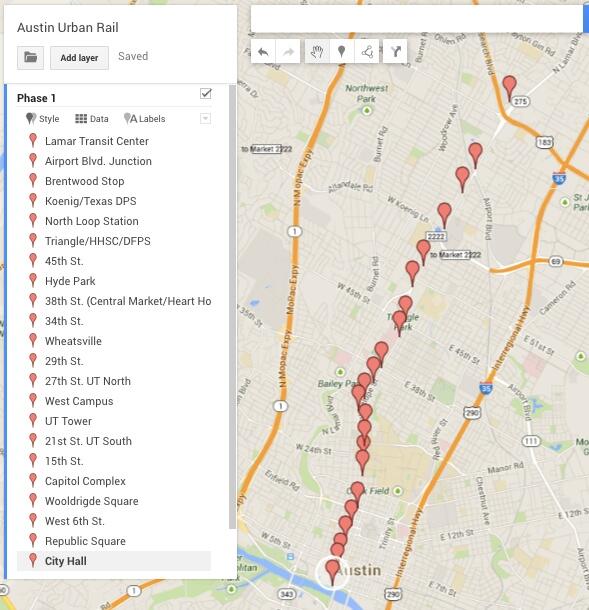
► Skinner proposal — In late November 2013, while debate raged over the Highland-Riverside route recommendation just presented by the Project Connect study team, community activist Adrian Skinner, a member of Austinites for Urban Rail Action (AURA) group, posted on Twitter a map of a proposed urban rail route along the G-L corridor. Skinner’s annotated map (below) indicates nearly two dozen significant points that would be served, from key activity centers to major neighborhoods.


Adrian Skinner map (Nov. 2013) shows important points that would be connected by urban rail in Guadalupe-Lamar corridor. Screenshot: L. Henry.

Adrian Skinner map (Nov. 2013) shows important points that would be connected by urban rail in Guadalupe-Lamar corridor. Screenshot: L. Henry.


► ARN Plan B proposal — This plan was devised last October (2014) in response to the contention (mainly articulated by supporters of the Highland-Riverside urban rail ballot measure, but also by some media personnel) that “there’s no Plan B” if the official rail proposal were to be rejected by voters (as, of course, it was on Nov. 4th). As we pointed out in our Oct. 5th article «A “Plan B” proposal for a Guadalupe-Lamar alternative urban rail starter line»,

Apparently, they’re willfully ignoring that there definitely is a “Plan B”. All along, there’s been an alternative urban rail project on the table … and it’s ready to replace the Project Connect/Prop. 1 plan if it fails.

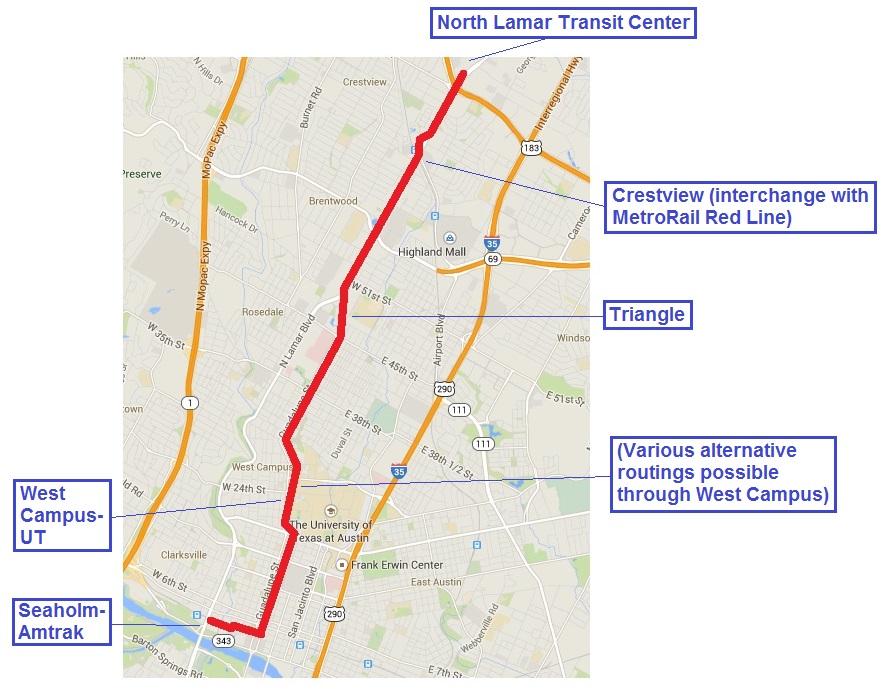
Our proposal aimed to provide an example of a “Plan B” for the Guadalupe-Lamar corridor, “a plausible and fairly simple option for an LRT starter line aimed at minimizing design and cost while providing an attractive service with adequate capacity.” As our above-cited article explains, the plan assumes “a 6.8-mile line starting at the North Lamar Transit Center (NLTC, Lamar and U.S. 183) on the north, running south down North Lamar and Guadalupe, then Guadalupe and Lavaca to the CBD, then west on 4th and 3rd Streets to a terminus to serve the Seaholm development and Amtrak station at Lamar. Capital investment cost was roughly estimated at $586 million (2014 dollars), of which it was assumed 50% (less than $300 million) would be locally funded and the other 50% funded via FTA grants.

For this proposed line, our plan also assumed “30,000 to 40,000 as a plausible potential ridership range …, based on previous forecasts for this corridor plus factors such as the interconnection with MetroRail service at Crestview, and extensions both to U.S. 183 and to the Seaholm-Amtrak site.” The route, and several of the most important activity centers served, are shown in the annotated map below.
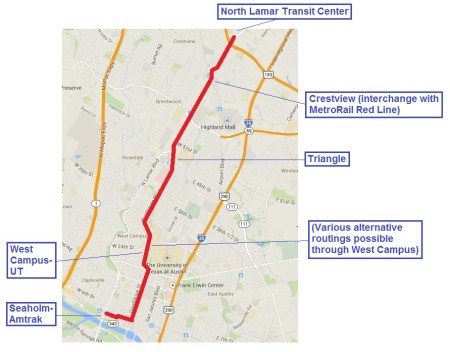

Proposed 6.8-mile "Plan B" light rail transit line in Guadalupe-Lamar corridor would have 17 stations and connect  the North Lamar Transit Center at U.S> 183 with Crestview, the Triangle, UT and the West Campus, the Capitol Complex, the CBD, and the Seaholm-Amtrak area. It's projected to serve 3 times the ridership of the Prop. 1 Highland-Riverside rail line at slightly over half the capital cost.

ARN’s “Plan B” proposed a 6.8-mile LRT line in the Guadalupe-Lamar corridor, from the North Lamar Transit Center to downtown, plus a short branch to the Seaholm-Amtrak site. Map: ARN. (Click to enlarge.)


► Parsons proposal — One of the most recent proposals for a Guadalupe-Lamar LRT route was presented in late December by Brad Parsons, a community activist involved with urban and transportation issues. As described in our article «Strong community support for Guadalupe-Lamar light rail continues — but officials seem oblivious»,

Starting at the North Lamar Transit Center at U.S. 183, this route would follow North Lamar Blvd., Guadalupe St., Nueces St., San Antonio St., and finally Guadalupe and Lavaca St. past established central Austin neighborhoods and activity centers, through the West Campus, past the Capitol Complex, and into Austin’s CBD. Brad’s proposal underscores the fact that there’s a variety of ways that LRT can be fitted into this constrained but high-volume traffic corridor.

Parsons’s map, shown below, includes markers indicating key points of interest along the route.
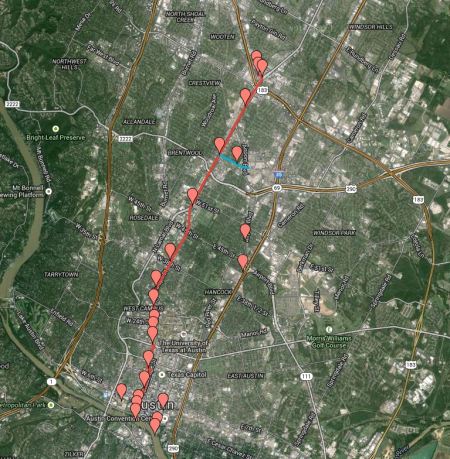

Map of Guadalupe-Lamar corridor light rail route proposed by Brad Parsons.

Guadalupe-Lamar LRT route proposed in December by community activist Brad Parsons. Screenshot: ARN. (Click to enlarge.)


Summing up

The experience of more than five decades can be summed up in several major takeaways.

• Clearly, the importance of Austin’s most central travel corridor is underscored by the long history of study and design efforts that has been concentrated on major investments to expand capacity and expedite access, and on planning for a rail line in particular.

• It should be apparent that an enormous volume of examination, evaluation, and analysis has reflected the significant attention — from both the community at large and official agencies — brought to bear on the Guadalupe-Lamar corridor. This has produced an abundance of previous federally approved documentation of the need for LRT in the corridor. In this context, the need for additional study should be minimal — mainly minor updating and evaluation of alignment and design issues.

Recommendations to “go back to Ground Zero” and “start again from scratch” amount merely to a recipe for further delay and dithering. There’s no need for further studies of the re-studies of the re-studies of the studies. It’s high time to finalize a workable, affordable, effective LRT project for this key center-city corridor, and move forward with it.

Support for LRT among Austinites has endured. This is substantiated by evidence, for example, we’ve shown in our earlier-cited article «Strong community support for Guadalupe-Lamar light rail continues — but officials seem oblivious».

Bolstering this is the support of neighborhood associations, community activists, and residents along in the corridor itself — “the extensive involvement of community activists and residents of neighborhoods along the proposed route” noted earlier has translated into a series of endorsements of G-L LRT from neighborhoods. See: Community endorsements.

The seemingly interminable saga of indecision, dithering, agonizing, despairing, dallying, official dementia, waste, and delay that has persisted for over half a century needs to come to an end. An achievable, affordable LRT starter line plan is within reach, and the resources to finalize planning for it are at hand. Let’s do it!


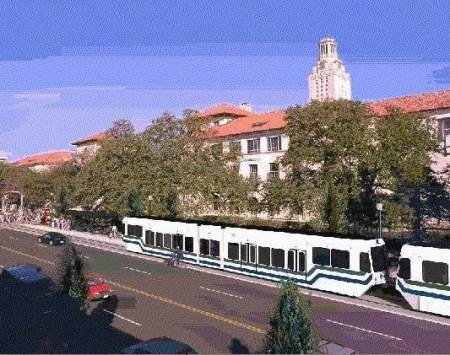
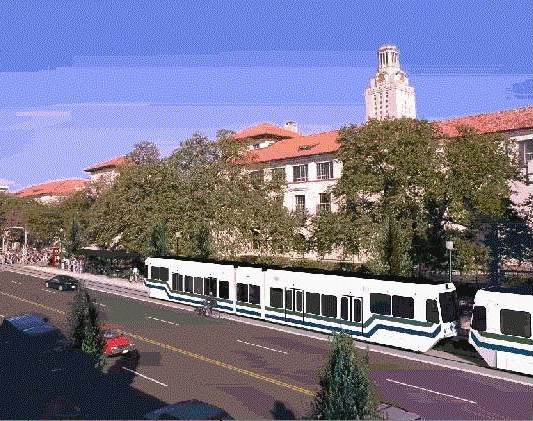
Rendition of LRT on Drag from 2000. Graphic: Capital Metro, via Light Rail Now.

Rendition of LRT on the Drag (2000). Graphic: Capital Metro, via Light Rail Now.
h1

Strong community support for Guadalupe-Lamar light rail continues — but officials seem oblivious

3 January 2015
Graphic: Midwest District Blog.

Graphic: Midwest District Blog.

While Project Connect’s disastrously flawed Highland-Riverside “urban rail” plan recedes into history — decisively rejected by voters on Nov. 4th — community support for a sensible, workable, affordable light rail transit (LRT) plan continues. For example, see:

A “Plan B” proposal for a Guadalupe-Lamar alternative urban rail starter line

Resume planning light rail in Guadalupe-Lamar!

As this website reported in a “post-mortem” analysis posted a day after the Nov. 4th rail vote, “…it’s clear that Austin is basically a very pro-rail city. Widespread community sentiment for urban rail — much of it for just about any rail line, anywhere — was palpably strong.”

The Highland-Riverside plan may be dead, but the campaign for a Guadalupe-Lamar light rail starter line is firing up. Light rail in this heavily traveled, high-density central corridor can become the basic spine of a far more effective and truly extensive urban rail system in the future for the city.

There’s already a strong constituency and base of support for light rail transit (LRT) in the Guadalupe-Lamar corridor.

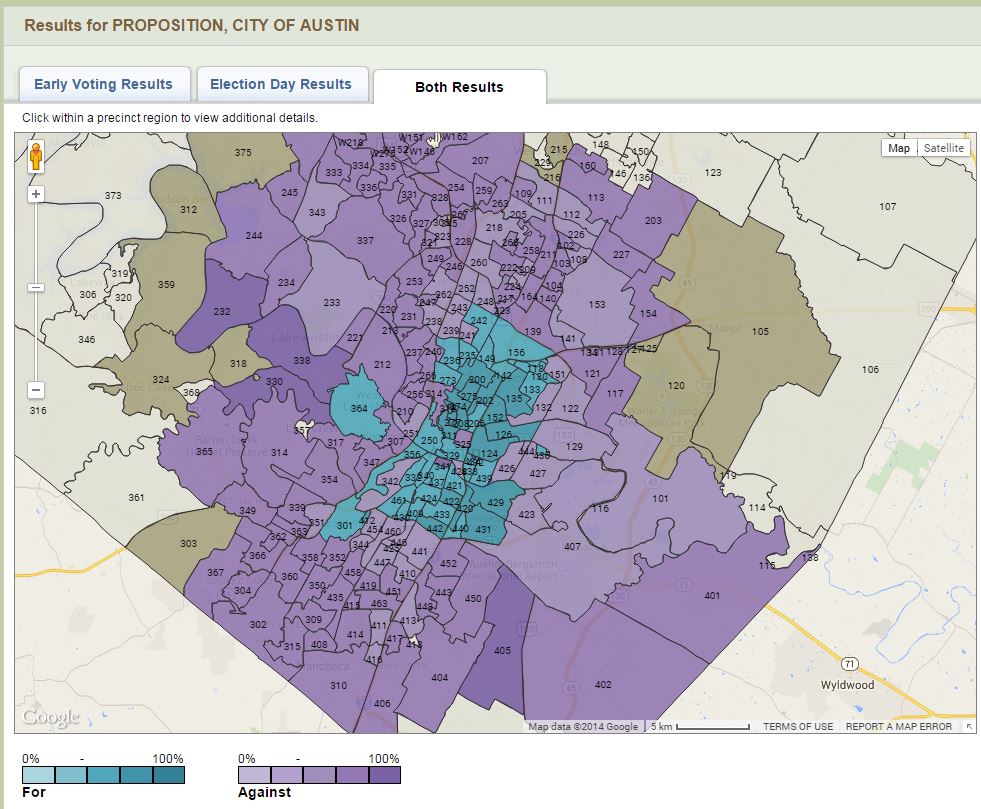
Ironically, part of the evidence of community support for rail comes from the Nov. 4th election results themselves. While a majority voted to defeat the Highland-Riverside plan on the ballot, a tally of precincts suggests strong pro-rail sentiment in the heart of the city. This is shown in an interactive election results map provided by Travis County, illustrating precinct-by-precinct vote preponderance, with pro-rail sentiment indicated as light blue (or turquoise) and opposition to the measure as lavender or purple (screenshot below).


Screenshot of interactive map of Nov. 4th "urban rail" vote by precinct. Source: Travis County. (Click to enlarge.)

Screenshot of interactive map of Nov. 4th “urban rail” vote by precinct. Source: Travis County. (Click to enlarge.)


Although the central pro-rail precincts (blue in the above map) seem surrounded by a sea of precincts against the measure, it’s important to realize that those central precincts include some of the densest and most populous in the city. An analysis by veteran Guadalupe-Lamar LRT supporter Mike Dahmus suggests that these central-city precincts that voted for the rail measure did so less enthusiastically than in the 2000 LRT referendum — tending to corroborate the hypothesis that opposition from rail transit advocates and supporters played a major role in helping defeat the official Highland-Riverside plan, perceived as flawed and even “worse than nothing”. (Stronger core-city support could have outweighed opposition in suburban precincts.)

Conversely, this tends to bolster the plausibility that a sensible, widely supported light rail (“urban rail”) proposal could muster the majority of votes needed to pass. The prospect of an LRT starter line project in the crucial, central, high-travel Guadalupe-Lamar corridor has already mustered affirmations of support from adjacent neighborhood associations, the UT student government, and other community sources, and would seem to have strong potential to succeed as a ballot measure.

Kate Harrington, in an article posted by the Building ATX.com website on Nov. 11th, just a week after the Nov. 4th vote, reminded readers of Austin Mayor Lee Leffingwell’s prediction that if the “urban rail” bond measure failed it “would mean that no new transit initiative would take shape for a decade or more.” But, Harrington observed, “Instead, it seems the issue is anything but dead. … Since voters decisively shot down the rail proposal last week, conversations about a possible ‘Plan B’ have sprung up all over the city.”

Most recently, via an interactive, annotated map (see screenshot below), the latest proposal for a Guadalupe-Lamar LRT route has been publicized by Brad Parsons, a community activist involved with urban and transportation issues. Starting at the North Lamar Transit Center at U.S. 183, this route would follow North Lamar Blvd., Guadalupe St., Nueces St., San Antonio St., and finally Guadalupe and Lavaca St. past established central Austin neighborhoods and activity centers, through the West Campus, past the Capitol Complex, and into Austin’s CBD. Brad’s proposal underscores the fact that there’s a variety of ways that LRT can be fitted into this constrained but high-volume traffic corridor.


Map of Guadalupe-Lamar corridor light rail route proposed by Brad Parsons.

Map of Guadalupe-Lamar corridor light rail route proposed by Brad Parsons. (Click to enlarge.)


Throughout last year’s ballot measure campaign, supporters of the official rail proposal (led by Let’s Go Austin) continuously depicted “urban rail” as absolutely essential to secure and sustain Austin’s future mobility and livability. With the slogan “Rail or Fail”, Mayor Leffingwell himself repeatedly warned that Austin needed an urban rail transit system to maintain its economic vitality and mobility in the face of steadily menacing traffic “gridlock”. Furthermore, news reports and competent analyses emphasized that simply building more highways or adding more buses to the roadway grid was counterproductive.

But while much of the Austin public seem to perceive and even embrace the alternative of an urban rail “Plan B” starter line routed in Guadalupe-Lamar (where the population density, major employment and activity centers, and heavy local travel are), key public officials and former leaders of the Let’s Go Austin pro-rail campaign seem to have been struck blind and deaf, oblivious to the obvious feasibility of LRT in the city’s most central and heavily used local corridor. For instance, the City’s Guadalupe Street Corridor Study, suddenly awakened from apparent dormancy to hold its first widely publicized public event on Dec. 3rd discussing “how to improve” the Drag, has explicitly ruled out consideration of rail transit, according to project manager Alan Hughes.

For Capital Metro board chairman (and outgoing City Councilmember) Mike Martinez, who had been expounding for the past year that “urban rail” was absolutely essential, further study of an alternative LRT plan now is apparently inconceivable. Martinez’s new mantra — basically a variant of “my way or the highway” — is that “the voters have spoken”, rail is off the table, and “we have to become the best bus city in America.”

Evidently at Martinez’s behest, Capital Metro has been sifting about for other ways to spend nearly $3 million in planning funds previously scheduled for further “urban rail” study (on the now-defunct Highland-Riverside proposal). Re-allocate these funds to a resumption of planning for LRT in Guadalupe-Lamar (where urban rail would actually make overwhelmingly good sense)? Certainly not.


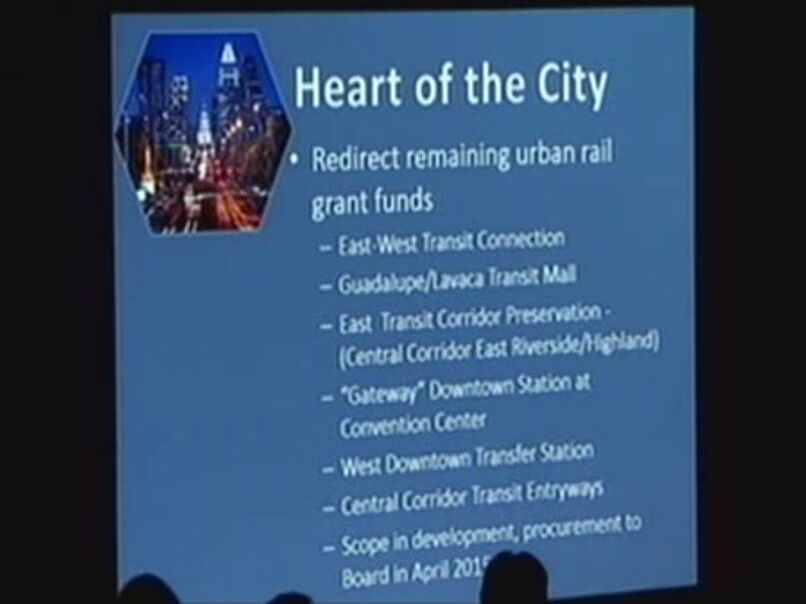
Capital Metro's "Heart of the City" latest projects propose to usurp millions in urban rail planning funds for other purposes. Screenshot from video of Dec. 15th Capital Metro board meeting.

Capital Metro’s “Heart of the City” latest projects propose to usurp millions in urban rail planning funds for other purposes. Screenshot from video of Dec. 15th Capital Metro board meeting.


Instead, at a Dec. 15th Capital Metro board meeting, Todd Hemingson, the agency’s head of strategic planning and development, outlined a “Heart of the City” list of potential study efforts (see photo of PowerPoint slide, above). Hemingson’s presentation made clear that even the two items seemingly most relevant to the central Guadalupe-Lamar corridor — “Guadalupe/Lavaca Transit Mall” and “Central Corridor Transit Entryways” — were actually focused merely on modest bus service expansion and infrastructure (including a possible tunnel for buses between the Loop 1 toll lanes and arterials leading into downtown).

Austin — supposedly the most “progressive” city in the “reddest” rightwing state of Texas — has a distinctive (read: notorious) reputation for dithering, dallying, and derailing in its public transport planning … while excluding the general public and making key decisions secretively behind closed doors. Surely the time has come to break this pattern. Will a new mayor and a new district-based 10-1 City Council provide an opportunity to scrap this modus operandi of failure and disaster, bring the community into authentic involvement in crucial decisions, and move forward with the first phase of LRT as a starter line in Guadalupe-Lamar?

We’re trying our hardest to help make that happen. ■


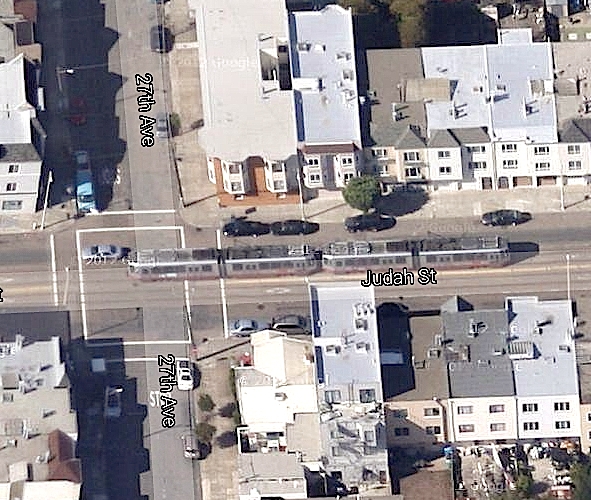
Light rail in Guadalupe and North Lamar could be modeled after San Francisco's N-Line route in Judah St., seen in this satellite view from Google Maps. Screenshot: Dave Dobbs.

Light rail in Guadalupe and North Lamar could be modeled after San Francisco’s N-Line route in Judah St., seen in this satellite view from Google Maps. Screenshot: Dave Dobbs. (Click to enlarge.)