Archive for the ‘Urban Rail’ Category

h1

MetroRapid bus service should be a precursor to urban rail, not an obstacle!

18 September 2013
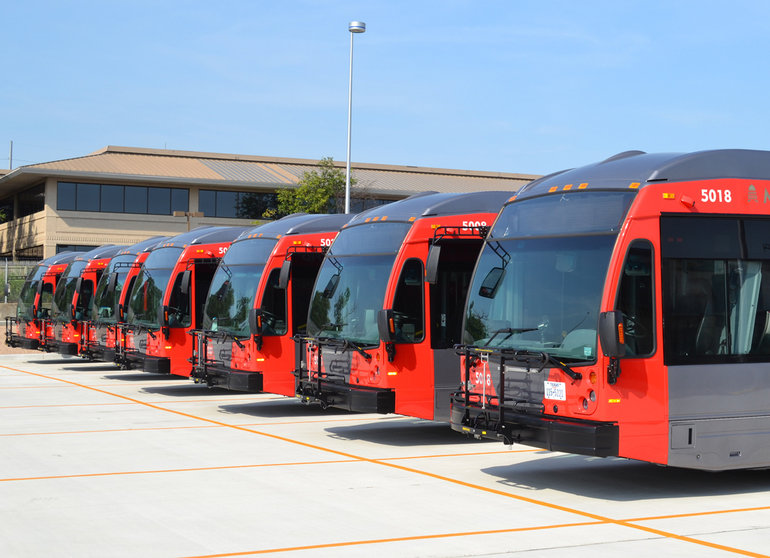
View of part of MetroRapid fleet.

View of part of MetroRapid fleet.

Some local officials, favoring the City’s long-preferred Urban Rail plan from downtown through the UT East Campus to the Mueller development site, have been presenting Capital Metro’s MetroRapid juiced-up-bus-service project as a barrier to alternative proposals for implementing urban rail in the Guadalupe-Lamar (G-L) corridor.

As Austin Rail Now will discuss in subsequent analyses, this argument is fatuous and fallacious. Instead, MetroRapid can and should be re-purposed and re-branded as a precursor to urban rail, not a competitor and obstacle.

This concept of MetroRapid as a precursor to rail was first presented in a 27 April 2012 commentary by Lyndon Henry (technical consultant for Light Rail Now) to the Transit Working Group:

Rapid Bus can be a precursor to Urban Rail in Lamar-Guadalupe corridor!

Here are excerpts (adapted for Webpage format) from that commentary that may be useful to the discussion of such a possible role for MetroRapid as a precursor to urban rail (using light rail transit technology) in the G-L corridor:


♦ Useful reference: BRT as a Precursor of LRT? (TRB conference paper, 2009)

Paper presented by Dave Dobbs and [Lyndon Henry] to 2009 Joint International Light Rail Conference sponsored by Transportation Research Board [TRB] provides research and guidelines for BRT as rail precursor:

Cover of TRB conference proceedings.

Cover of TRB conference proceedings.

Title and author lines from published paper.

Title and author lines from published paper.

[Link to proceedings]

http://onlinepubs.trb.org/onlinepubs/circulars/ec145.pdf

♦ Examples where “BRT” has been precursor to rail – including with FTA approval

Various U.S. examples exist where both technically and policy-wise, a RapidBus or BRT-type system can function as a precursor to rail transit service – and with Federal Transit Administration (FTA) approval!

• Dallas – BRT-like express bus service, operated by Dallas Area Rapid Transit (DART) on North Central Expressway, served as a precursor to DART’s LRT extension to Plano.
• Miami – Miami-Dade Busway has been serving as precursor to extensions of MetroRail rapid transit.
• Los Angeles – Wilshire Boulevard MetroRapid service, operated by Los Angeles County Metropolitan Transportation Authority (MTA), has served as precursor to extension of MTA’s rail rapid transit metro system, a project now under way.
• Seattle – In Downtown Seattle Transit Tunnel, BRT-type bus service functioned as precursor to Link light rail (now operating jointly with buses – see photos below).

♦ In 2009, Capital Metro’s MetroRapid was envisioned as precursor to rail

As recently as 2009, MetroRapid project was being designed for eventual conversion to light rail:

Excerpt from section of paper.

Excerpt from section of paper.

♦ Conclusion: BRT or RapidBus must be originally designed as light rail precursor!

Paper concludes that best-practices approach to plan for BRT or RapidBus as precursor to rail is to design it for eventual conversion from the start. This means keeping infrastructure investment minimal and designing for modularity (i.e., designing station components, communications, etc. so they can be easily relocated or reconfigured for the rail mode during conversion).
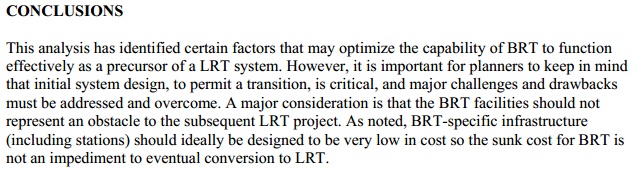
Excerpt from Conclusion of paper.

Excerpt from Conclusion of paper.

If the transit agency can demonstrate that the BRT or RapidBus investment won’t be lost, but can be upgraded into a higher and more effective use (e.g., Urban Rail), FTA has approved such conversion.
h1

If you support urban rail for Guadalupe-Lamar, attend these community meetings!

17 September 2013
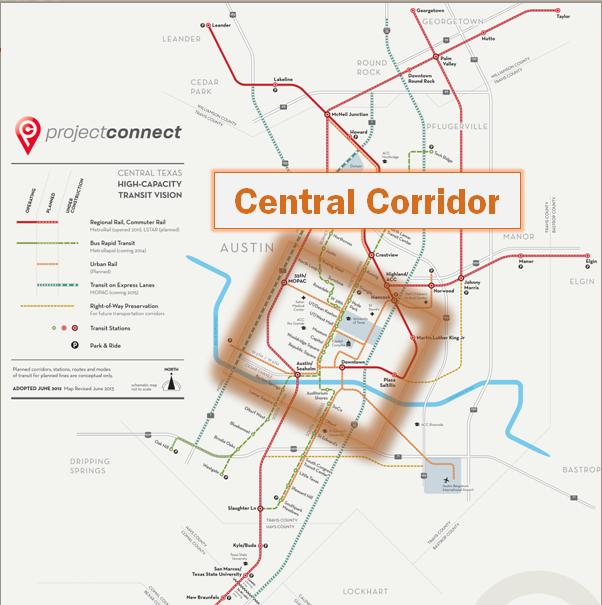
Map of so-called "Central Corridor" study area.

Map of so-called “Central Corridor” study area.


Project Connect, the consortium of the City of Austin, Capital Metro, and other public entities to pursue coordinated transit planning for Central Texas and the Austin metro region, has ostensibly pulled back somewhat from the previous emphasis on urban rail in the downtown-East Campus-Mueller corridor, and has a project under way to vigorously study (at least nominally) alternative corridors for a Phase 1 urban rail starter line — and one of those corridors is Guadalupe-Lamar (G-L).

There’s some debate over just how serious local officials and planners are about breaking from their fixation on the previous Mueller route (which would install urban rail in a very weak non-corridor), but in any case, Project Connect has scheduled some upcoming meetings (and a “webinar”) between Sep. 4th and Oct. 2nd (details below) that seem to offer a bona fide opportunity for the public to meet in a community fashion, both discussing the issues and interacting with one another.

So Austin Rail Now strongly encourages supporters of an urban rail Phase 1 starter line in the G-L corridor to attend these meetings (and participate in the “webinar”) — and voice their support for the G-L corridor.

The current project is specifically focused on a so-called “Central Corridor” — actually, a huge square study area extending as far west as Loop 1 (MoPac Expressway), east to roughly Springdale Rd., north to Crestview and the Highland/ACC area, and south to roughly Oltorf St. (see map above).

Since it’s not really a “corridor”, but an entire city sector with potential routes running in all directions, Project Connect planners have had to rename the actual travel corridors under study as “sub-corridors”. While the downtown-East Campus-Mueller route is designated as one of these “sub-corridors”, so is Guadalupe-Lamar, as well as a route out Riverside to the ABIA Airport, a route south on South Congress, and routes out Lake Austin Blvd. and West 38th St. to the Seton-Medical Center area.

While just about all these routes might make sense for urban rail at some point, obviously there must be a prioritization process that can select one for the first line to start with. Austin Rail Now believes a line in the G-L corridor makes by far the most sense in every way, and has the best chance of attracting community-wide voter support for bonds to help fund installation.

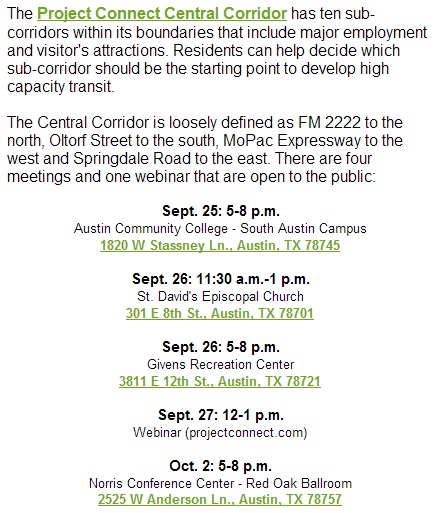
Here’s a screen capture from the City’s Austin Mobility website giving details — dates, times, locations — of the upcoming community meetings and the “webinar”:

ProCon_aus-txt-Central-Corridor-mtgs-2013-Sep-Oct_COA

If you want urban rail to go where it makes the most sense, and will have the best chance to win voter support — i.e., the Guadalupe-Lamar corridor — you have a major stake in this. Please plan to attend at least one of these meetings (or participate in the “webinar”)!

h1

Another alternative urban rail plan for Guadalupe-Lamar corridor

9 September 2013
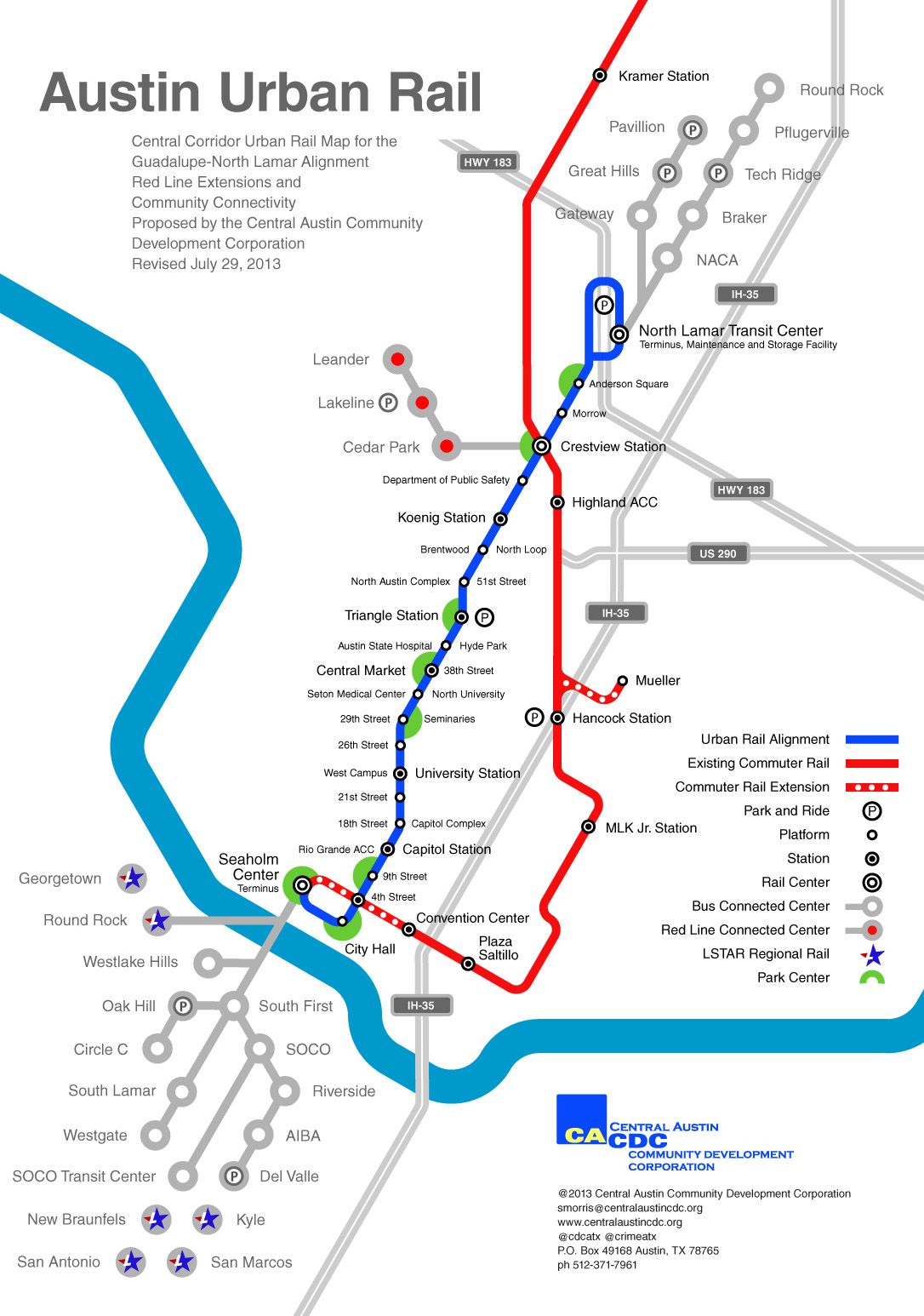
CACDC's Central Corridor urban rail plan (blue), with MetroRail (red) and various bus links (grey). Map: CACDC

CACDC’s Central Corridor urban rail plan (blue), with MetroRail (red) and various bus links (grey). Map: CACDC

Within the Austin community, momentum continues to grow to re-orient the officially promoted Urban Rail project (downtown-East Campus-Mueller) into a focus on the Guadalupe-Lamar (G-L) corridor as the primary spine for a Phase 1 (i.e., starter line) project. Much of this effort is coming from businesses, neighborhoods, and community groups within the G-L corridor itself.

Besides the “loop” proposal (one line through the G-L corridor, the other formed by converting the eastiside Red Line to electric urban rail) proposed a year ago by Texas Association for Public Transportation (TAPT), suggestions for other possible routes serving the G-L corridor are forthcoming from the community.

One of the most thoroughly developed is a 7-mile-long Central Corridor urban rail plan designed by the Central Austin Community Development Corporation (CACDC), led by Scott Morris (see map above).

From Crestview south to 4th St., the CACDC plan is virtually identical to the west branch of the TAPT “loop”, following Lamar and then Guadalupe. However, CACDC extends the line further up Lamar to the North Lamar Transfer Center, where it would provide connectivity to various bus routes at this major transit interchange, and then make a loop beneath the US 183 freeway to return south on Lamar. Also, at its southern end, it includes a spur east to the Seaholm development site.

The plan also proposes a short spur from the existing MetroRail Red Line (“commuter” light railway) into the Mueller development site. (The TAPT plan similarly includes an urban rail spur into Mueller from the eastside urban rail branch formed, as previously noted, by converting the Red Line to electric urban rail.)

Both of the CACDC urban rail extensions (the extension up Lamar and the connection to Seaholm) are similarly proposed by TAPT for a subsequent phase of urban rail development. However, if public and political sentiment can be shifted in the more rational direction of supporting an urban rail Phase 1 (starter line) route in this extremely heavy, productive G-L corridor, perhaps a “melding” of plans, incorporating the best features of these and other proposals, will be possible.

According to CACDC’s website, “This 7 mile phase one alignment serves the greatest number of riders, forms the expandable backbone of a much larger future system, and satisfies all public benefit criteria ….” The proposal also presents a long list of “communities, centers, and nodes” — almost entirely in the G-L corridor — that would be served

What the Austin-area public — especially voters — will prefer and accept can eventually be sorted out. What’s critical now is for all those who favor primary emphasis on the G-L corridor to work together to reallocate local planning focus away from the absurd downtown-East Campus-Hancock Center-Mueller non-corridor, and onto the G-L corridor — a real corridor (which also includes the fourth-highest residential density of all major Texas cities) — where it should have been in the first place, over the past 8 years of local planning.

h1

Advantages of Light Rail in Street Alignments

22 April 2013

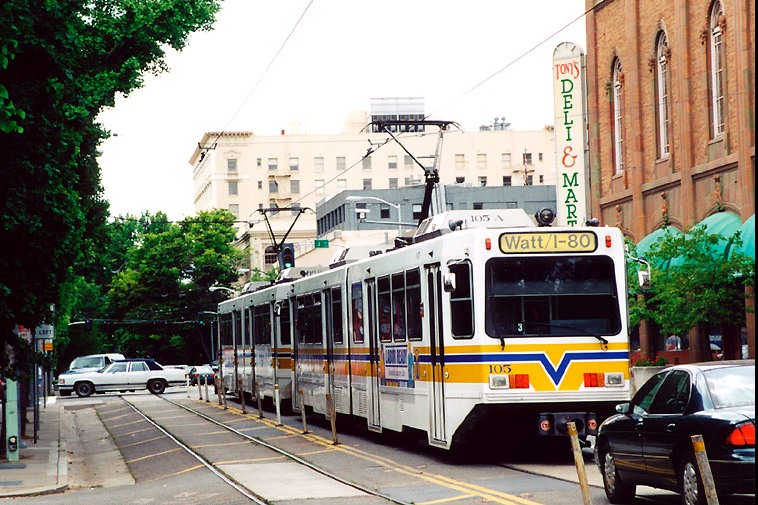
sac-lrt-12th-Str-mixed-trf-15347-20010428x_Eric-Haas
Sacramento’s light rail system shares space with general traffic in one direction on 12 th St., just north of the city’s CBD. Photo: Eric Haas.

The issue of installing reservations (e.g., reserving existing street lanes) for light rail transit (LRT) in highly constricted urban arterial corridors is a continuously recurring issue for urban public transportation discussions, and it became particularly intense in Austin’s Transit Working Group (TWG) meetings in late April/early May of 2012. Conceding some street space to transit is a wide practice in almost all major world cities, and in the last several decades has become increasingly recognized as a necessity for maintaining mobility in U.S. cities like Austin.

Surface transit, particularly surface LRT, has special advantages — ease of access for passengers, increased public visibility, for example — but it’s also the lowest-cost way to install high-quality rail transit. Of course, using exclusive alignments (which are typically abandoned or lightly used railway corridors) is one way to get lower-cost surface alignments, but these often don’t go through the heart of cities, reaching all the activity centers it’s necessary to serve. One way or another, at least some of the existing grid of urban streets needs to be used.

And they are used, to great success, in cities like Dallas, Houston, San Diego, Sacramento, Portland, Salt Lake City, Denver. Minneapolis, and other cities where some street space has been dedicated to transit. In several other cities, portions of streets are also dedicated to reserved use by buses.

But often it’s hard for public officials, accustomed to accommodating as much motor vehicle traffic as possible, to understand that (especially with urban population growth) this traffic will eventually overwhelm the street system, and that installing urban rail in streets can ultimately achieve far greater and more sustainable mobility. But (despite nominal lip service to advancing a “green” agenda and endorsing public transit conceptually) official policy often remains resistant to giving priority to public transit use of available street space.

Whatever the cause, several members of Austin’s TWG began questioning the relevance of proposed surface LRT for urban rail in key streets of central-city Austin. Instead, they suggested, Austin should shift focus to some kind of subway-elevated system. In response, Lyndon Henry presented a commentary titled Advantages of Light Rail in Street Alignments (11 May 2012) which summarized the benefits of surface construction and pointed to the success of Sacramento’s LRT line (shown in photo above), which uses a number of street alignments in the central city, and runs one of its tracks on 12th St. in shared traffic and the other in a reservation. The following is adapted from the original text of Henry’s printed commentary:

♦ Some important aspects and advantages of surface light rail transit (LRT)

Much lower capital cost — On average, 1/3 the cost of elevated guideway, 1/10 the cost of subway…

Lower operating/maintenance cost — Compared with elevated or subway, surface LRT systems and stations are easier and cheaper to operate and maintain…

Outracing private cars isn’t realistic — Central-city urban rail systems (even subway or elevated services) typically can’t “outrace” cars, because of multiple station-stops. Also, because of frequent center-city stops, <strong>LRT is almost as fast as subway or elevated services…

Rail’s special attractiveness — Faster than most bus transit; faster than some personal car trips; cheaper than private car travel; riders can read, use laptops, or otherwise use time during travel; eliminates parking hassles; eliminates stress of highway commute; more space, ride comfort, reliability, safety than bus alternative; rail routes easier to understand…

Available, publicly owned right-of-way — Typically available to a public transit operation…

Heavily developed corridors — Major established public thoroughfares typically are where much of a city’s activity is and where people want to travel to or from…

Passengers like the view — Passengers prefer to be able to see the cityscape they’re traveling through — this helps orientate them to where they are…

Surface stations are more accessible — Typically, surface stations (without stairs, elevators, etc.) are far more accessible to both the general public and passengers with ambulatory constraints…

Transit deserves priority — Public transit is the sustainable transport of the future, and cities like Austin must start re-prioritizing and re-allocating available street space to favor transit

Alignment versatility — LRT has always been a “hybrid” … able to operate in street reservations, mixed traffic, exclusive railway alignments, elevated, subway…

Design versatility — Street alignments can include a broad range of design options, depending on specific challenges, such as right-of-way width, traffic volume, etc. … including short segments of single track, gantlet (interlaced) track, both tracks in mixed traffic, one track mixed + one track reserved (see example above, Sacramento LRT in 12th St.) Often, these measures are useful for relatively short, more constricted segments of an alignment…

♦ Examples of successful street-routed light rail

All-reserved lanes — San Diego, Portland (MAX LRT), Baltimore, Denver, Dallas, Salt Lake City, Houston, Tacoma (streetcar), Tampa (streetcar), Phoenix…• Mixed-traffic segments — Sacramento (see photo above), Portland (streetcar), Seattle (streetcar)…

h1

Demographic maps show Lamar-Guadalupe trumps Mueller route for Urban Rail

30 March 2013

aus-urb-map-rte-decisions-Austin-Densities_Wood
[Map: Jeff Wood. Click to enlarge.]

In early 2012, Jeff Wood, a top planner and analyst for Reconnecting America in Oakland, California (and former Austinite and UT student), prepared and posted on his own website several maps utilizing recent demographic data to compare the City of Austin’s Urban Rail plan with an alternative Urban Rail line in the Lamar-Guadalupe corridor.

As the map above shows, the results are stunning. While the map shows the COA’s entire Urban Rail plan in orange (which includes a route out the Riverside corridor to the ABIA Airport), it’s clear that the proposed starter line from downtown to Mueller serves significantly lower density on the whole than the Lamar-Guadalupe line (shown in gold/yellow), which consistently serves much higher population densities (including the West Campus neighborhood, with the 4th-highest residential density in Texas).

We’ll have more detailed analysis of Jeff’s demographic results in subsequent postings.

h1

Why abandon Austin’s major corridor and congestion problem?

30 March 2013

aus-lrt-map-COA-Urban-Rail-central-vs-Lamar-Guad-annot-20120127_lh
[Map: L. Henry. Click to enlarge.]

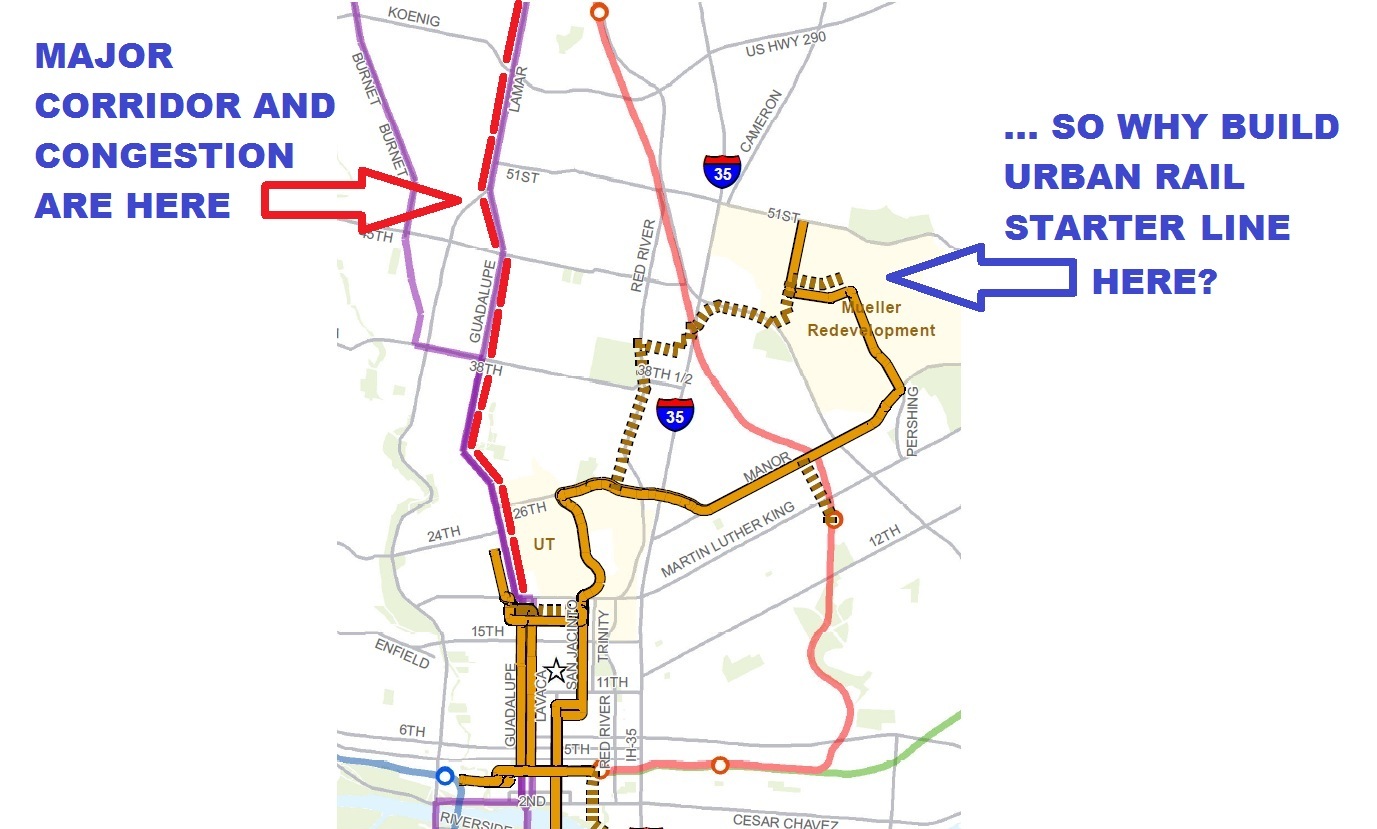
Several previous entries in this blog have already underscored the contradiction between the City of Austin’s emphasis on the severely congested condition of the Lamar-Guadalupe corridor and city planners’ astounding conclusion that building an Urban Rail line in an entirely different (and virtually non-existent) travel corridor would be some kind of remedy for this.

This glaring disparity is captured in a graphic contained in a handout prepared by Lyndon Henry for another presentation to the Transit Working Group on 27 January 2012, Urban Light Rail vs. Limitations of RapidBus.

In this map snippet, adapted from COA’s own route map, the high-traffic, congested Lamar-Guadalupe corridor is shown by a dashed red line and the annotation “Major Corridor and Congestion Are Here”, while the proposed routes to Mueller are shown (gold/ochre color, both solid and patterned — the patterned line eventually became the preferred route to Mueller).

The issue of RapidBus (aka “Bus Rapid Transit”) as the COA’s longer-term alternative to rail in the Lamar-Guadalupe corridor is addressed further in the original presentation handout, and will be discussed in a subsequent posting.

The original handout, in Word .DOC format, can be accessed via this link: Urban Light Rail vs. Limitations of RapidBus.

h1

Give priority to “Missing Link”

29 March 2013

aus-lry-lrt-map-Missing-Link-zoom_LH
[Map: L. Henry. Click to enlarge.]

Since the winter of 2011, several local advocates of rail public transportation have been laying out a case for relocating the proposed Urban Rail line to serve the Lamar-Guadalupe corridor and UT West Campus rather than the official City of Austin (COA) plan for a line through the relatively sedate East Campus and eastward to the Mueller site.

In a presentation to the Transit Working Group on 2 December 2011, including a handout, A Sensible, Workable Urban Rail Plan, Lyndon Henry emphasized the West Campus-Guadalupe-Lamar route from the central business district (CBD) to Crestview as a “Missing Link” in the official plans. This included the map excerpt shown above. The proposed Urban Rail “Missing Link” (using electric LRT) is shown in green. The red-and-white dashed line (with icons showing stations) indicates Capital Metro’s existing MetroRail DMU-operated Red Line. The Red Line, meandering through East Austin, bypasses the heart of the Core Area and the crucial Lamar-Guadalupe corridor — thus the need to install the “Missing Link” in that alignment.

The main argument for including the West Campus-Guadalupe-Lamar corridor in an Urban Rail starter system is given in the following section:

• Give priority to “Missing Link” — Lamar/Guadalupe from Crestview to downtown

Lamar-Guadalupe is the primary local traffic corridor in central-city Austin, and any rail transit investment must serve this crucial corridor. Initially, this means a connection between the Crestview Red Line MetroRail station and the West Campus – in effect, a return to the route alignment under official study until mid-2003.

In addition to serving this very heavy corridor, implementing the “Missing Link” add direct rail service between the northwest suburbs and Hyde Park, the Triangle, the UT campus, the dense West Campus area, the Capitol Complex, and downtown; provide UT with the critical connection it needs between the main central campus and the Pickle campus; eliminate the need for costly dedicated Connector bus service for MetroRail; and enable more cost-effective use of the current MetroRail DMU rolling stock (by shifting them to outlying service corridors).

In addition, installing electric LRT service in this major corridor would increase total rail system ridership dramatically. Compare the original 2000 LRT plan with the COA’s deficient Urban Rail plan: In the original plan, a single LRT line, 14.6 miles, from McNeil to downtown (using the Red Line, then Lamar and Guadalupe) was projected to carry 32,100 daily trips in its first year! COA’s entire, 5-route system, 16.5 miles, is projected to carry just 27,600 trips in 2030. Why spend the better part of $2 billion (about 80% more) to get less?

The presentation also argued for integrating both Urban Rail and MetroRail on the basis of electric LRT:

• Integrate Urban Rail and MetroRail systems

Splitting rail development between “Urban Rail” (City of Austin, COA) and MetroRail (Capital Metro, CMTA) is inefficient, wasteful, and reckless with taxpayer dollars. It’s essential for both COA and CMTA to move toward a technological integration of the two rail systems, on the basis of electric light rail transit (LRT, basically the Urban Rail technology). This would enable economies of scale, particularly in rolling stock procurement, and a number of other advantages, such as the better performance, environmental benefits, and cost advantages of electric propulsion. The current MetroRail DMUs could be deployed for service to more outlying corridors where extension of electrification would be less cost-effective.

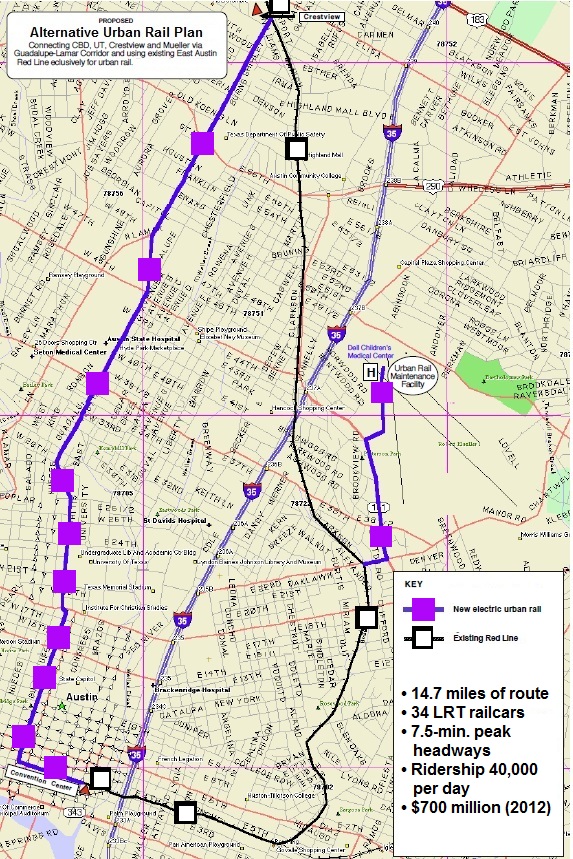
At the time, for a more immediate, affordable starter line, advocates were proposing a relatively short east-west line connecting the existing MetroRail station at the convention Center with the Seaholm development project and Amtrak station — referred to as a “No Nonsense” starter line. This alignment is still considered a viable additional route, but emphasis has shifted more to the Lamar-Guadalupe corridor and the proposed 14.7-mile Alternative Plan (including conversion of MetroRail to LRT between Crestview and downtown).

Lyndon Henry’s original handout , in Word .DOC file format, can be accessed at this link: A Sensible, Workable Urban Rail Plan

h1

City of Austin’s Urban Rail (and “BRT”) plan

29 March 2013

aus-lrt-brt-rpr-map-proposed-COA-Intial-Rail-M1_dd
[Map: Dave Dobbs. Click to enlarge.]

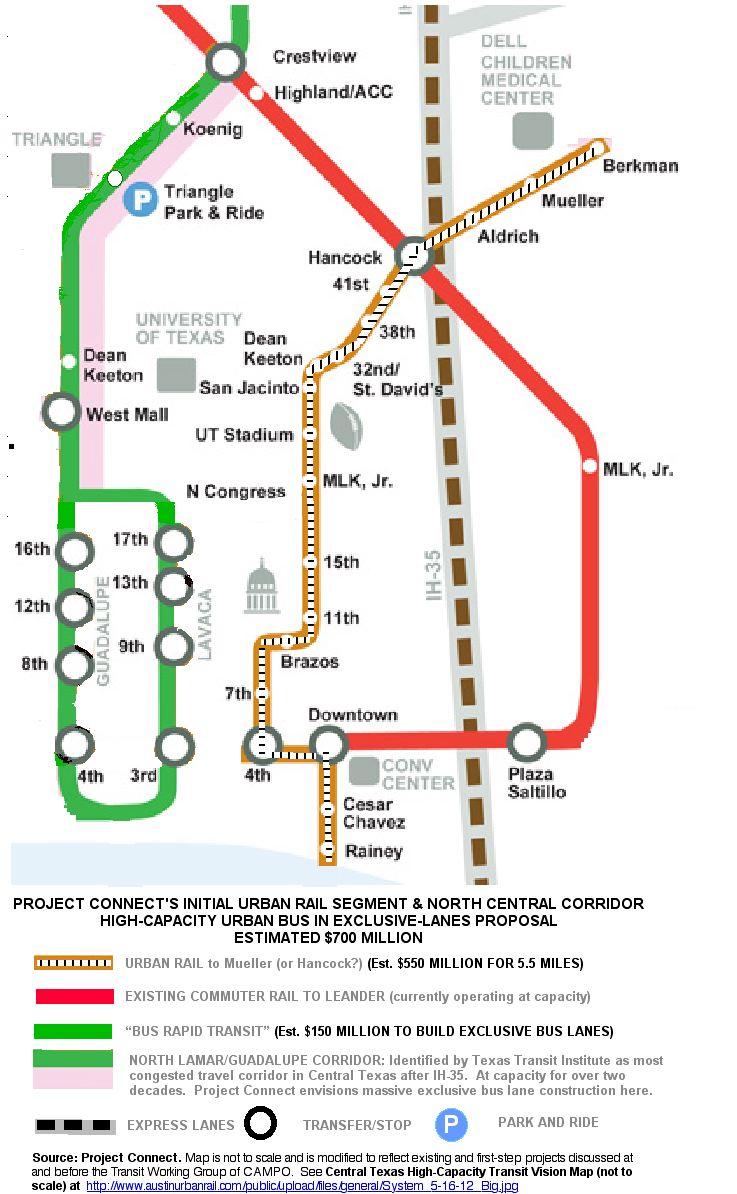
The map shown above has been rendered by Dave Dobbs from official maps, provided by the City of Austin (COA) and Project Connect, to show (as far as we can infer) what COA planners are proposing for their basic Urban Rail (using LRT) and “bus rapid transit” (BRT) starter system.

The 5.5-mile Urban Rail proposed route (downtown, through the UT East Campus, and Hancock Center into Mueller) is shown as a gold-ochre line with a pattern representing “tracks” in the center of it. The green line represents the proposed “BRT” route intended to serve the Lamar-Guadalupe corridor. The Red Line represents the currently operating MetroRail Red Line route.

This route plan can be compared with the 14.7-mile Alternative Urban Rail plan prepared by Dave Dobbs and Lyndon Henry — see map in right column. The details of the Alternative Plan are discussed in the previous article: An alternative Urban Rail plan.

h1

An alternative Urban Rail plan

29 March 2013

aus-lrt-map-proposed-alt-urban-rail-lines-stns-20121211_lh
[Map: L. Henry. Click to enlarge.]

Shown above is a map of the proposed Alternative Plan for a Phase 1 Urban Rail project, as developed by Dave Dobbs and Lyndon Henry. Note that this plan for 14.7 miles electric light rail transit (LRT) — serving both the Lamar-Guadalupe corridor and the eastside Red Line corridor — is projected to have a capital investment cost almost exactly the same as the City of Austin (COA) plan for a 5.5-mile line running from downtown, through the UT East Campus, Red River, and Hancock Center, to the Mueller site. Furthermore, the Alternative Plan also includes a branch serving Mueller.

This map was prepared in the autumn/winter of 2012 and, together with additional information, initially presented as a handout (Alternative Urban Rail Transit Plan for Austin) to a peer review group organized by the American Public Transportation Association in December. Here’s the narrative that accompanied the map:

Introduction

Peer Review needed wider scope — Should have been commissioned to evaluate route/design alternatives.

City of Austin (COA) plan deficiencies — Would “work” as transit, but fails to serve the right corridor, fails to meet the highest priority, fails to provide the best value for money, and voter support is questionable. This reflects a difference of professional opinion, but we’ve been saying this since 2006!

Summary of Alternative Urban Rail Plan

Overview — 14.7-mile electric LRT system connecting Crestview station with Convention Center via both an east and a west route.

East route — Convert current DMU-operated MetroRail to electric LRT south of Crestview. There would be a cross-platform connection between LRT and MetroRail DMUs at Crestview; DMU service would proceed north and LRT service would proceed south via either route. The eastern branch follows the current MetroRail route southward to the Convention Center.

Mueller spur — From the east line, a spur branch turns east at Manor Rd., proceeds from Manor to Airport Blvd., follows Airport north to Aldrich St., then turns east into the Mueller site to serve the northwestern area of the site and access a storage-maintenance facility.

West route — From Crestview station, proceeds southward down Lamar Blvd. and Guadalupe St., serving this busy commercial-residential corridor, major neighborhoods such as Hancock and Hyde Park, the Triangle, and the West Campus of the UT area (4th-densest residential area in Texas). Route continues southward to 4th St., turning east to connect with the east branch of the system at the Convention Center station, thus forming a loop.

Fleet & operations — System would have a fleet of 34 LRT cars, basically identical to the type of vehicle that COA’s plan envisions, operating in 1 to 2-car trains with minimum headways of 7.5 minutes. The system would be double-tracked except for the single-track east line section between Manor and Crestview. Schedule speed would average 13 mph.

Ridership — Ridership projected to be 40,000 per day by 2025 (using ridership projections from 2000 LRT proposal, plus estimates for ridership on the east line and the Mueller spur). This is several times higher than COA’s estimate of rail ridership of 9,000-12,000 per day for their 5.5-mile line.

Capital investment cost — Projected at $700 million, basically equivalent to the COA’s projected cost of $550 million for rail plus estimate of $150 million to convert the Lamar-Guadalupe MetroRapid bus route to partial “BRT” (out of total Project Connect budget of $500 million).

Alternative Urban Rail Plan vs. COA Plan

Meets highest-priority traffic need — Alternative plan addresses most critical mobility problems of central city; COA’s plan does not even serve an existing corridor!

TOD opportunities — Alternative plan serves far more opportunities for TOD (especially along Guadalupe, west downtown and West Campus, N. Lamar); COA plan taps relatively less TOD potential (Mueller site now developing without TOD). [TOD doesn’t necessarily mean mega-densities, but rather design that orients to public transport; furthermore, supporters of the Alternative Plan insist that any proposed TOD protect neighborhood livability and historic features, be consistent with neighborhood plans, and have the support of neighborhood consensus.]

Much higher ridership — Alternative plan offers potential of 2-3 times higher ridership than COA plan.

Better value for money — Alternative plan provides nearly 3 times as much rail route mileage as COA’s Urban Rail-plus-“BRT” plan, at approximately the same cost.

To access a copy of the original handout in Word .DOC format, click here:
Alternative Urban Rail Transit Plan for Austin

h1

Welcome to Austin Rail Now

28 March 2013

aus-lrt-sim-Guadalupe-10th-Str-2012-crop-rev_coa
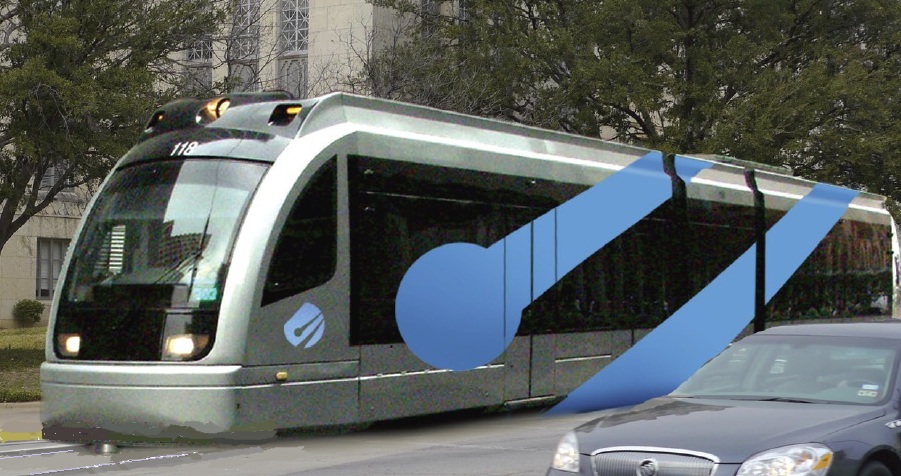
Simulation of Austin Urban Rail line with electric light rail transit train running on Guadalupe St. downtown.

Welcome to Austin Rail Now — representing the views of Austin-area public transportation advocates and professionals who envision better mobility choices for urban rail and rail passenger service in Central Texas.

Our most immediate and urgent priority is to achieve a restructuring of the current official Urban Rail plan to focus priority on Austin’s Lamar Blvd.-Guadalupe St. corridor for the starter line of an electric light rail transit (LRT) system. While the the City of Austin (COA) currently emphasizes a proposed Urban Rail route from downtown to the Mueller (old airport) development site — basically non-existent as a major travel corridor — Lamar-Guadalupe is the “Missing Link” in their plan. Ironically, COA has also been emphasizing that Lamar-Guadalupe is the primary local traffic corridor in central-city Austin, and even identified this corridor in the NEPA (National Environmental Policy Act) scoping meetings, held throughout Austin in spring 2012, as being at maximum capacity for over the past 2 decades.

Any truly adequate and justifiable rail transit investment must serve this crucial corridor. Austin’s limited resources must be invested to yield the maximum ridership — initially, a rail connection between the Crestview Red Line MetroRail station, the West Campus, and downtown. In addition, we favor a plan that technologically integrates COA’s Urban Rail and Capital Metro’s MetroRail on the basis of electric light rail transit (LRT).