h1

Did Austin’s new Smart Mobility agenda kill light rail?

28 March 2019

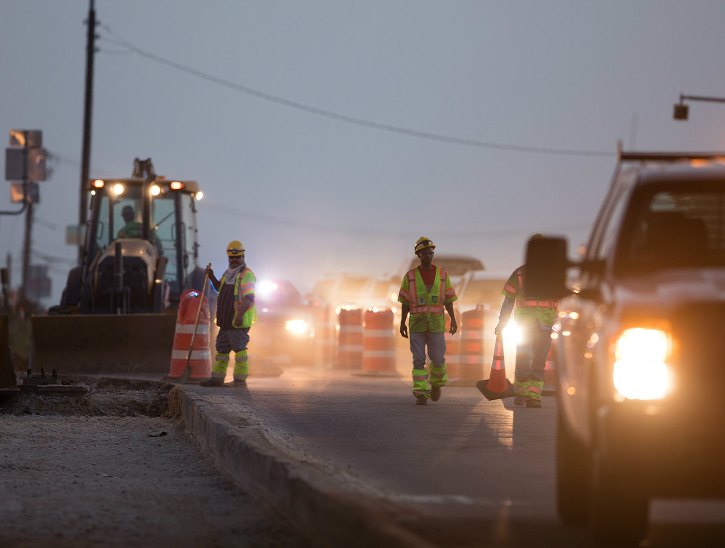
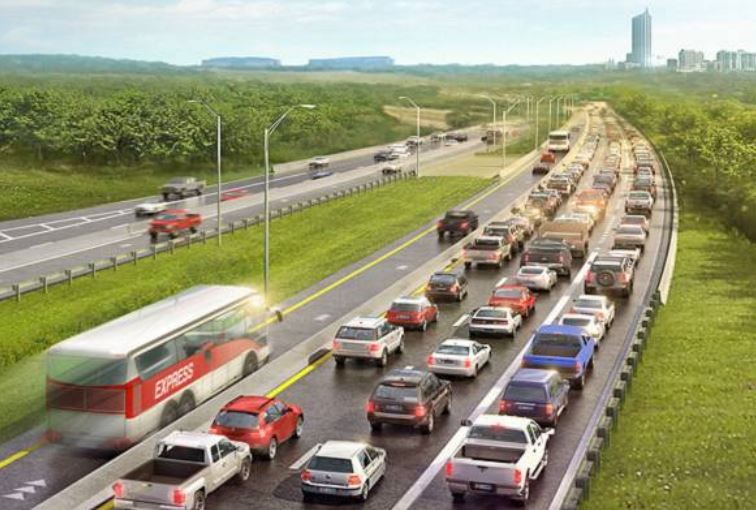
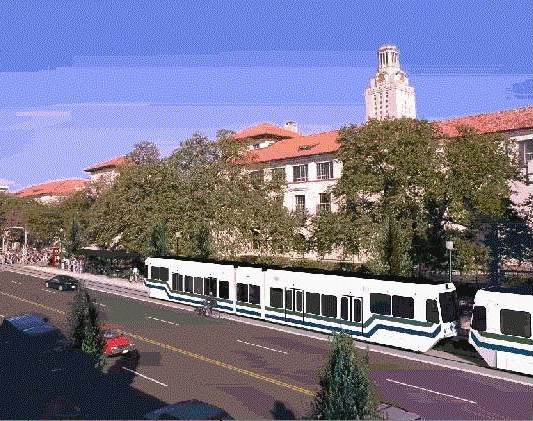
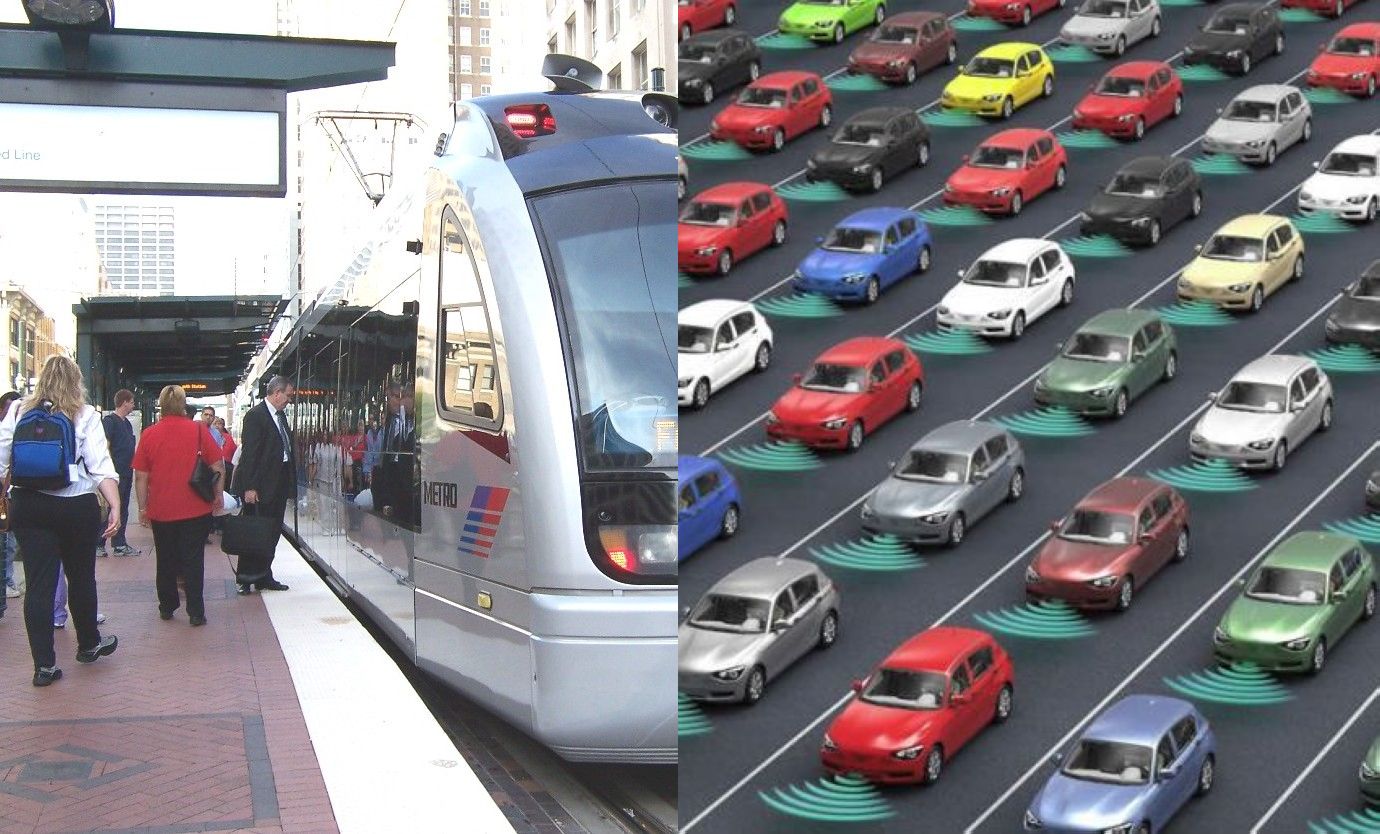
Left: Passengers preparing to board Houston’s Metro light rail. Have “Smart City” visions scuttled Austin’s hopes for urban rail? Right: Simulation of “Smart City” traffic with autonomous and “connected” vehicles. Sources: L. Henry; Propmodo.com.

Commentary by Roger Baker

Roger Baker is a longtime Austin transportation, energy, and urban issues researcher and community activist. The following commentary has been adapted and slightly edited from his comments recently posted by E-mail to multiple recipients. References for numbered citations are at end of post.

On March 2, 2017 the Austin City Council passed a resolution that called for a major policy Austin transportation policy shift toward a future of electric and automated vehicles (EV/AV) based on public-private partnerships (P3s), ride-sharing, and other factors. This effort arose out of Austin’s Smart City Challenge entry, which it had lost to Columbus, Ohio. [1]

This big shift away from business as usual obviously required a new plan with a lot of detail. The City Manager was ordered to draft a New Mobility EV/AV Plan by June 15, 2017. One part of this policy shift was to get people within the Austin Transportation Department (ATD) to help promote this shift. Two of the top ATD people responsible for this are now Karla Taylor, in charge of all ATD staff, and Jason JonMichael who knows about wiring “Smart Cities”, stuff like getting all the vehicles and street intersections and other vehicles to talk to one another, and persuading the public to accept the shift.

This new industrial development policy reportedly is meant to help generate startups and assist in the new programs developed by mobility tech leaders like Google, Tesla, Uber. And even Ford, which wants to move in the same electric and alternative transportation direction. The new wave of sharable scooters and bikes fits right into this new city perspective.

It is true that light rail transit (LRT) is electric, but currently it is only rarely autonomous. Since high-level corridor LRT service handles so many people with one driver, there is not such a great need for rail to operate autonomously.

On the other hand, autonomous vehicles like Uber cars, trucks, and buses would be a different story since the big mobility providers could maybe save money two ways. They can save on transportation fuel cost by shifting to electric, and supposedly also by possibly eliminating driver labor.

Moving urban rail off the table

In order to get everyone moving in the same direction, and shift to the new transportation agenda, Capital Metro had to be brought on board. Aside from its penny sales tax, Cap Metro can’t issue bonds using city resident’s property, but the city can do so. Without much state funding and with federal funds uncertain, a lot of the cost is probably now going to fall on local taxpayers.

This shift was also made by hiring a new transit czar, Randy Clarke, who understands that his new marching orders include things like new autonomous and electric buses. Of course this also meant making a big shift in the nearly complete Project Connect planning process, which was supposed to be finished in September 2018 after years of work. But in mid-2018 the Project Connect process, now falling under autonomous-friendly management, was extended to December 2018 for an additional $600,000. As a result, we should see a new rapidly revised version of the Project Connect plan soon, with more than just lines on map.

For its part, the City of Austin (COA) focused on creating a new Smart Mobility plan. The City Manager missed an original June 2018 deadline, but did finally come up with the City’s new 141-page Smart Mobility Roadmap on October 5, 2017. See:

https://austintexas.gov/smartmobilityroadmap

Click to access Smart_Mobility_Roadmap_-_Final.pdf

In my opinion, light rail will probably not be allowed to get in the way of “reinventing” transportation, no matter what transportation experts might think or advocate, primarily because it doesn’t have the high-tech startup potential that the City’s new marching orders require. Autonomous has already been proclaimed to be Austin’s future. You can see it from the Smart Mobility autonomous vehicle agenda, where the public-private partnerships have decided that the Austin’s transportation future is autonomous and “smart”, and as certified by the tech gurus the city hires. And don’t forget that new fleets of electric autonomous buses will supposedly help save us from global warming,

High-tech deliverance?

The executive summary from the Smart Mobility Roadmap gives an overview of what city leaders have in mind. [2] As this excerpt from the document lays out, the City of Austin and Capital Metro’s Smart Mobility Roadmap comprises five key areas:

• Shared-Use Mobility
• Electric Vehicles and Infrastructure
• Autonomous Vehicles
• Data and Technology
• Land Use and Infrastructure

City of Austin’s Smart Mobility Roadmap.


The Mobility Roadmap makes a series of recommendations for implementing, accommodating, and facilitating EV/AV vehicles in “Smart City” style:

1. Engage citizens, businesses and visitors on how this technology can meet their needs and address community issues
2. Hire an Executive level Officer of EV/AV Transportation
3. Develop a Master Plan roadmap for emerging electric-connected and autonomous vehicle (E-CAV) technologies
4. Create an interdisciplinary AV Work Group
5. Create an infrastructure task force to examine electric, technology and land use infrastructure requirements
6. Test Dedicated Short Range Communication (DSRC) technology for vehicle to infrastructure (V2I) reciprocal safety messages
7. Test 5G technology for vehicle to infrastructure (V2I) reciprocal safety messages; compare to DSRC 8. Increase public awareness of electric autonomous (E-AV) shuttles in various Austin locations through EV/AV pilots
9. Increase public awareness of last mile E-AV delivery robots
10. Establish an EV/AV Commercialization Opportunities/ Economic Development Work Group
11. Create Shared/EV/AV focused team
12. Increase public awareness of electric and autonomous vehicle benefits
13. Create a regional New Mobility Workforce Training task force for new job training and educational opportunities for those with legacy occupations

We all know, or should know by living in our high-tech city, that all kinds of automated and electric vehicles are destined for our future. Scooters, autonomous vehicles, rental “Smart Cars”, and incredible stuff like fleets of autonomous connected buses will be shuffling throughout Austin, supposedly solving our congestion problems as they go.

In addition to its rental scooters, Lime is making a foray into services with larger vehicle. Last May, Bloomberg News reported that Lime was ramping up its mobility-rental efforts by launching a car-sharing in Seattle, aiming to with ultimately 1,500 distribute Lime-branded “free-floating” rental cars around the city. Lime is also testing vehicles it calls “transit pods,” resembling “enclosed golf carts or electrified rickshaws”, according to Bloomberg, with a top speed of about 40 miles per hour. [3]

It’s not hard to foresee these “pods” adding to the mix of new modes gushing onto the streets and sidewalks of Austin. By adopting the Smart Mobility roadmap as official city policy, Austin has made it pretty clear that whatever the tech giants like Lime want to do will get a friendly reception here.

High-capacity transit vs. laboratory experiment

The strategy here is apparently to make Austin a kind of Petri dish – in effect, a laboratory experiment – to incubate and give birth to all kinds of innovative high technology startups, such as the recent invasion of rentable electric scooters (which incidentally are not permitted in Seattle due to safety considerations). Also included here is Cap Metro’s vision of autonomous, electrified bus rapid transit (so far, not operating anywhere as far as anyone knows). From this permissive support for high-tech innovation, the benefits are supposedly going to trickle down to average Austin residents, who will end up paying an unknown share of the final cost.

But how can Austin continue to manage to deny the need for a very high-capacity corridor transit system (only rail has the adequate capacity) running roughly between our highly congested road corridors of I-35 and MoPac? Even now, nearly twenty years after such a reasonable system was narrowly defeated, we still try to ignore the obvious under city-level political pressure, as usual based on using average homeowner-based property tax revenue to benefit private real estate development interests. This defies all logic, and to me is yet more evidence of the continuing special interest influence over Austin’s transportation planning.

At some point we need to bite the bullet and admit that public funding is limited and requires hard choices, not only involving mode choice but also geographical areas. CAMPO’s outlook is that we can have both “guns and butter”, that unlimited roads plus lots of transit are somehow affordable. The fact that neither the state nor federal gas taxes have been raised for 25 years is clear proof of our continuing denial of economic reality and our inability to make hard choices until something breaks.
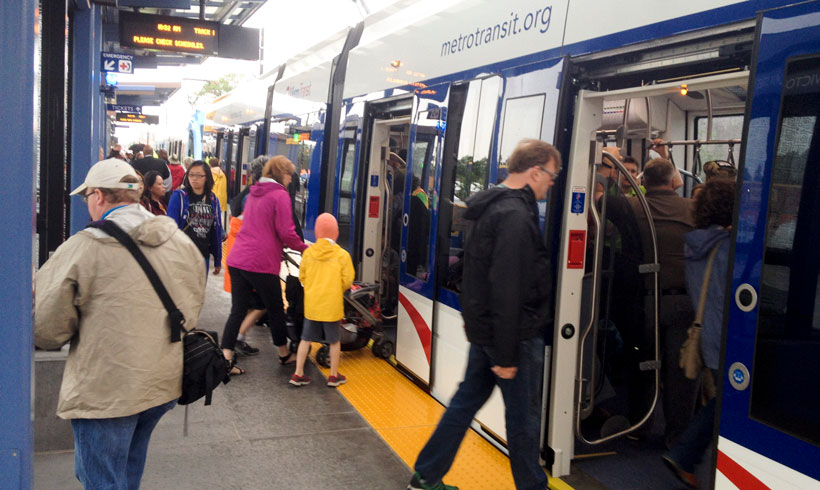

Attractive high-capacity light rail transit is changing mobility patterns, boosting economic development in cities like Minneapolis-St. Paul. Photo via Transit for Livable Communities.


Reference Notes

[1] http://www.austintexas.gov/edims/document.cfm?id=272885

[2] https://austintexas.gov/sites/default/files/files/Smart_Mobility_Roadmap_Executive_Summary_-_Final_with_Cover.pdf

[3] https://www.bloomberg.com/news/articles/2018-11-13/lime-wants-to-spread-1-500-shared-cars-around-seattle?srnd=premium

Related: Plans for Smart City could be dumb choice for Austin

h1

Road and rubber-tire transport plans thwarting urban rail? Seems to fit a pattern

30 January 2019

Construction of U.S. 183 South expressway. Source: Fluor..

As previous posts on this website have noted, for about 28 years – from 1989, when light rail transit (LRT) was identified by Capital Metro as the region’s Locally Preferred Alternative for its Major Investment public transport mode, until the first quarter of 2018 – urban rail held a central and absolutely key role in Austin-area mass transit planning, memorably exemplified by the “Rail or Fail” slogan in 2014. But just as the Project Connect planning process, in early 2018, was rendering a new proposal for LRT after more than two additional years of research, public input, and analysis, that process was thwarted and reversed by a new Capital Metro administration in consort with several local officials, all focused on rubber-tired, roadway/highway-based, and sprawl-driving alternatives to rail.

The reasons for this 180-degree change in policy remain somewhat obscure. But they do seem to fit a persistent pattern of trying to minimize public transport investments in order to divert local funding resources into major new roadway projects (such as a massive overhaul to I-35). This emphasis on vast new roadway investment has been documented in a series of our previous posts:

• Why spending $4.7 billion trying to improve I-35 is a waste of money [March 2016]
https://austinrailnow.com/2016/03/29/why-spending-4-7-billion-trying-to-improve-i-35-is-a-waste-of-money/

• City’s “Smart Corridor” Prop. 1 bond plan promising way more than it can deliver [Sep. 2016]
https://austinrailnow.com/2016/09/29/citys-smart-corridor-prop-1-bond-plan-promising-way-more-than-it-can-deliver/

• Austin — National model for how roads are strangling transit development [Oct. 2016]
https://austinrailnow.com/2016/10/31/austin-national-model-for-how-roads-are-strangling-transit-development/

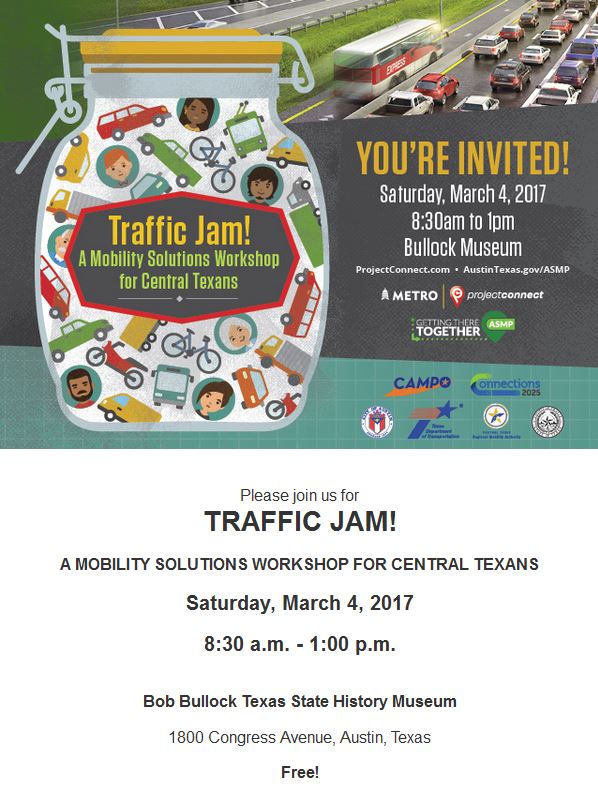
• “Traffic Jam” to discuss “high capacity transit” becomes “bait & switch” push for road plans [March 2017]
https://austinrailnow.com/2017/03/26/traffic-jam-to-discuss-high-capacity-transit-becomes-bait-switch-push-for-road-plans/

• Urban Rail on Guadalupe-Lamar, Not I-35 “BRT” [July 2017]
https://austinrailnow.com/2017/07/31/urban-rail-on-guadalupe-lamar-not-i-35-brt/

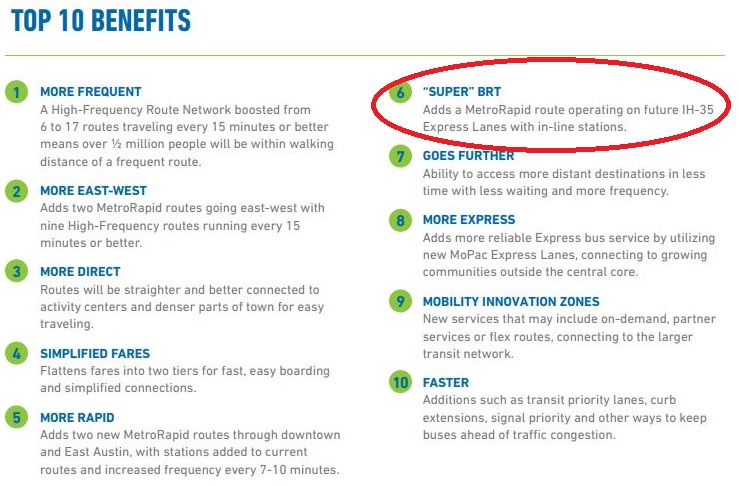
• Officials boost roads and “Super BRT”, put urban rail on side track [Aug. 2017]
https://austinrailnow.com/2017/08/31/officials-boost-roads-and-super-brt-put-urban-rail-on-side-track/

• Why TxDOT-Capital Metro “BRT” plan for I-35 is a massive boondoggle [Oct. 2017]
https://austinrailnow.com/2017/10/01/why-txdot-capital-metro-brt-plan-for-i-35-is-a-massive-boondoggle/

• Why “Super BRT” in I-35 would betray Capital Metro’s member cities [Oct. 2017]
https://austinrailnow.com/2017/10/31/why-super-brt-in-i-35-would-betray-capital-metros-member-cities/

• Plans for Smart City could be dumb choice for Austin [Jan. 2018]
https://austinrailnow.com/2018/01/31/plans-for-smart-city-could-be-dumb-choice-for-austin/

• Capital Metro strikes three blows against Lamar-Guadalupe light rail [May 2018]
https://austinrailnow.com/2018/05/31/capital-metro-strikes-three-blows-against-lamar-guadalupe-light-rail/

• Reinstate Urban Rail in Austin’s Planning [Sep.2018]
https://austinrailnow.com/2018/09/19/reinstate-urban-rail-in-austins-planning/

Basically attempting to reboot the “derailed” Project Connect planning process, Capital Metro has has just issued a solicitation for engineering/planning services, to include performance of an Alternative Analysis of transit mode options. But this comes in the context of about seven months of aggressive top-level hyping of the supposed advantages of “bus rapid transit” (BRT) and a chimerical mode (currently “under development”) described as “autonomous rapid transit” (ART) – autonomous (robotic) buses theoretically capable of emulating the operation of LRT trains.

Capital Metro’s recent solicitation appears to focus on the proposed “Orange Line” corridor (basically the Tech Ridge-to-Slaughter Lane alignment that consists of the N. Lamar-Guadalupe and South Congress corridors), intended for implementation of “high-capacity transit” in “dedicated pathways”. Under pressure and criticism from various community leaders and Austin councilmembers, the solicitation specifies inclusion of “Dedicated Pathways Light Rail Transit (LRT)” in the mix of modes to be considered in the Alternatives Analysis.

Unfortunately, over many previous months several local officials favoring highways and buses have, in public statesments, claimed exaggerated costs for LRT and implied that this “high cost” makes such a system unaffordable for Austin. In occasionally similar major investment planning situations in other communities, it’s been suspected that key public officials have influenced their planning teams to skew “analysis” results toward their preferred results.

Light rail can have a broad range of costs and performance results depending on key design decisions and the competence of the planning team. Will evaluation of LRT be handled fairly in the forthcoming “high-capacity transit” study for the Orange Line corridor? Transit advocates would be well-advised to do their best to help ensure that it will be.

h1

Let’s Fast-track a Plan for Urban Light Rail — and Make It Happen

31 December 2018

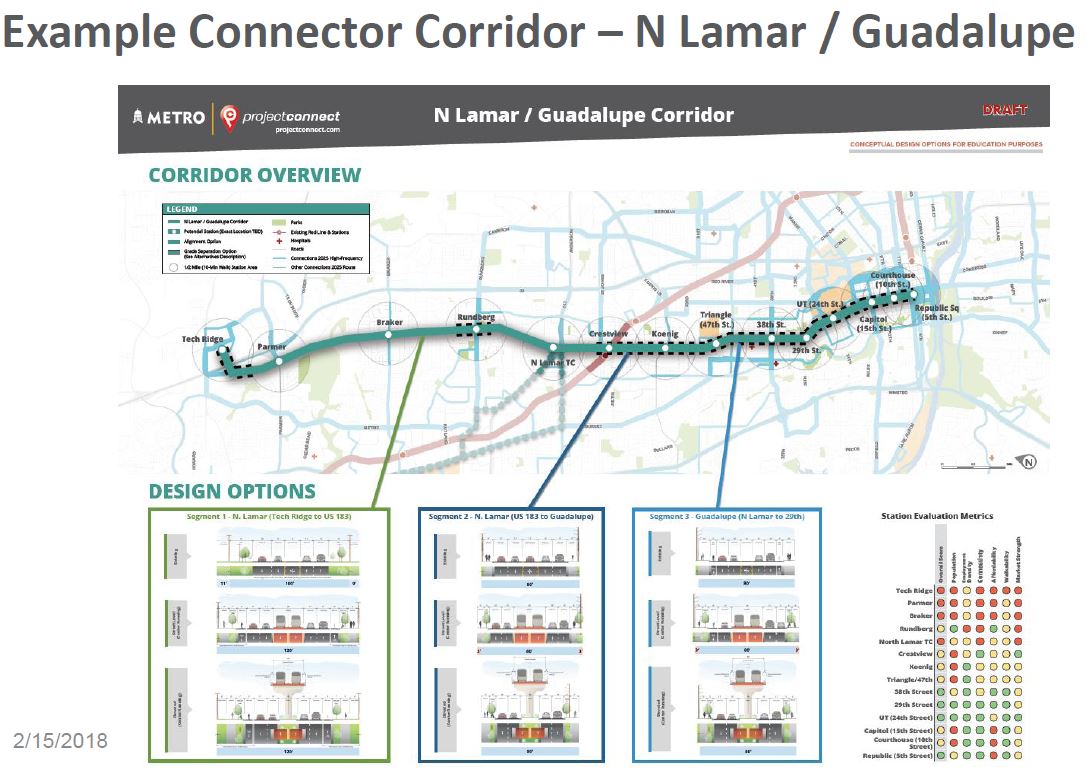
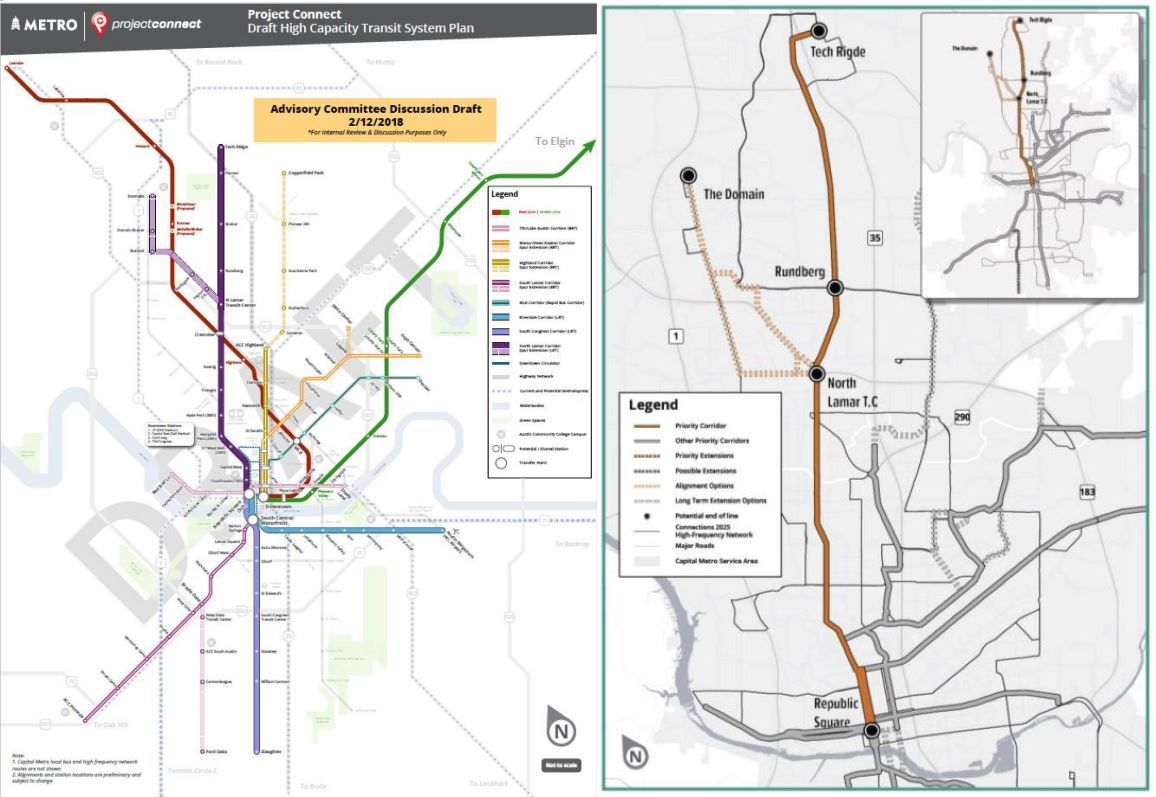
Map and graphics from Project Connect’s Feb. 2018 proposal illustrates possible 12-mile initial light rail line from Tech Ridge (at left end of map) routed south down N. Lamar-Guadalupe corridor to Republic Square in CBD (map is rotated 90°, with north to left and south at right). Other graphics show alignment design options and station attributes. Yet Capital Metro leadership has now withdrawn plan and restarted study process for another two years. Graphics: Project Connect.

by Lyndon Henry

This post is a publication of comments made by Lyndon Henry to the Austin City Council on 13 December 2018. Henry is a technical consultant to the Light Rail Now Project and a contributing editor to the Austin Rail Now website.

For decades, Austinites have been suffering the agonies of a worsening mobility crisis. Help has never been far away – over the past 30 years, no less than six official studies have come to the same conclusion: light rail transit, interconnected with an extensive bus network, is what’s needed.

But time after time, Austin’s leadership has failed to bring a single one of these plans to successful fruition. Austin has become the national poster child of analysis paralysis.

And now Capital Metro and its Project Connect planning program have restarted us on another re-iteration of this same exhausting process for a seventh time and another two years.

Transit advocates appreciate that Capital Metro has revised its Vision concept by restoring light rail and some additional corridors. But much more is needed.

Instead of backsliding to zero again, Capital Metro and the City of Austin need to fast-track this process by building on the data, analysis, community input, and other resources that have already recommended a light rail system and enhanced bus network as the way out of our mobility quagmire.

The Vision plan needs to become a lot more visionary. It needs to preserve a lot more corridors for future dedicated transit lanes. It needs to envision more and longer routes reaching out to serve other parts of the urban area.

Light rail can make this possible. It’s an affordable, cost-effective, off-the-shelf electric transport mode that’s well-proven in hundreds of cities and, best of all, it’s here today – we don’t have to wait for some science fiction technology. Austin needs a solution that’s available now.

Urban light rail is the crucial linchpin of a mobility plan because it has the power to make the whole system work effectively. It’s shown it has the true capacity to cost-effectively handle and grow Austin’s heaviest trunk routes, freeing up buses and resources to expand service into many more neighborhoods citywide. This advantage is validated by solid evidence – in average ridership and cost-effectiveness, cities with urban rail have significantly outpaced cities offering bus service only.

Yet even before Study No. 7 has begun, some Capital Metro and other local officials have been hinting they favor bus rapid transit (BRT) – basically a repackaging of bus service with minimalist capital improvements and lots of fanfare. But it’s unlikely BRT will provide the breakthrough Austin so desperately needs.

On average, compared to BRT, new light rail systems are carrying over three times the ridership at 10% lower operating cost. They’ve shown they can spark adjacent economic development and help shape urban density and growth patterns. BRT has shown almost no such benefits. And light rail comes without the toxic pollution and other problems of rubber tires.

Let’s leave the paralysis behind, and put a light rail starter line on a fast track for a vote in 2020.


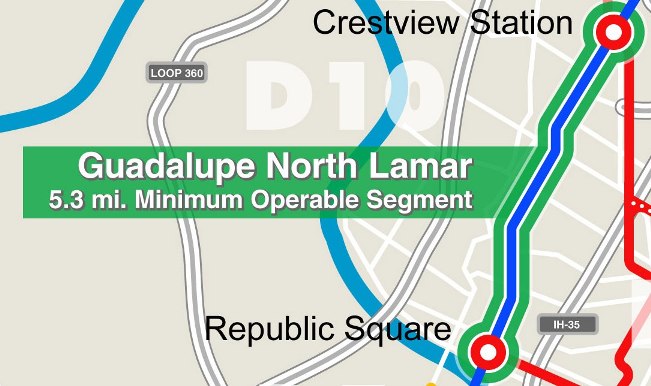
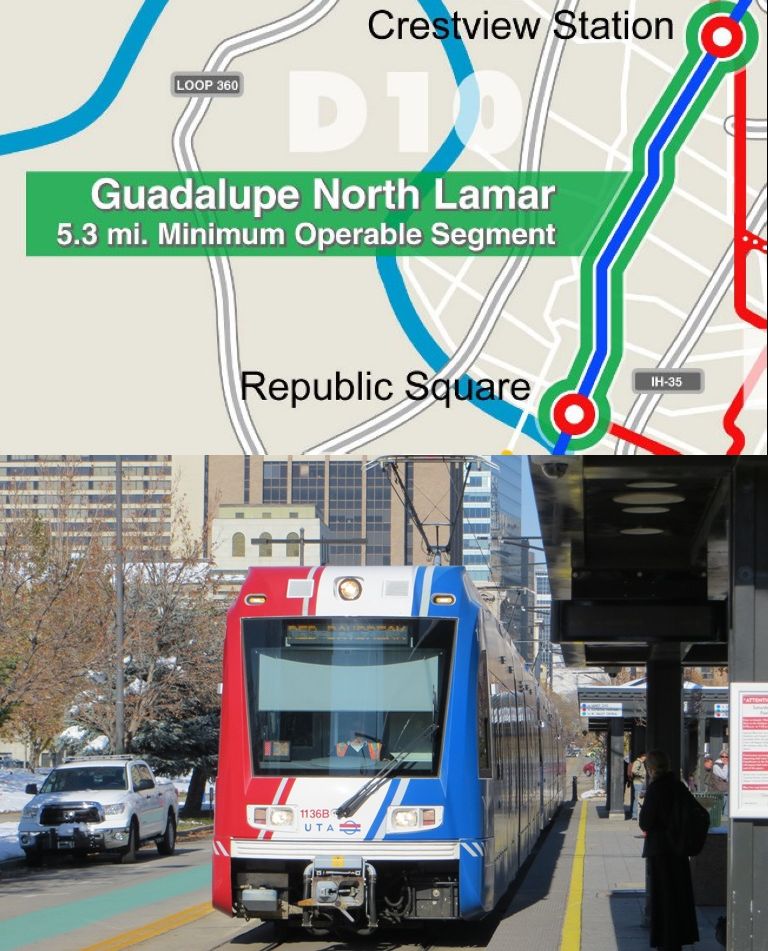
An even more affordable light rail starter line project has been proposed by Central Austin Community Development Corporation as a 5.3-mile Minimum Operable System extending from the Crestview MetroRail station (at N. Lamar/Airport) to Republic Square. For a surface alignment with no major civil works, estimated cost in 2016 was less than $400 million. Graphic: CACDC.

h1

Let’s Put Austin’s Urban Rail Planning Back on Track

29 November 2018

Light rail starter line using N. Lamar-Guadalupe corridor from Tech Ridge to downtown was key element of Project Connect comprehensive regional plan presented in February 2018. Despite a three-year data-driven process with community participation, it was subsquently overruled and aborted by Capital Metro officials – setting back planning process another two years.

This post publishes the text of a handout distributed to a “Community Conversation” meeting sponsored by Project Connect in Council District 5 on 17 November 2018.

No more backsliding – Finalize a plan!

Last February (2018), Capital Metro’s Project Connect planning program, with public input, was finally nearing the end of a two-year process to devise a regional public transport proposal with urban rail and other “high-capacity” transit. On the table was a widely acclaimed, tentative plan for a viable, attractive public transport system, centered on a north-south light rail line from Tech Ridge to Slaughter Lane to link the city’s heaviest local travel corridors and provide a spine for ultimate rail extensions to other sections of the city. It was conceivable that details could be finalized to place a starter line on the November ballot for bond funding.

But that wouldn’t happen. Just over a month later, CapMetro’s new incoming CEO, with the blessing of the board, discarded the plan and reset the whole process back to zero – thus adding another two years to the seemingly endless effort to forge a transit remedy to Austin’s worsening mobility crisis.

While this destructive action was unprecedented and outrageous, for Austin it nevertheless fit a pattern of transit system plans aborted, botched, or abandoned by top leaders of CapMetro and the city’s political power elite, persisting over the past three decades. That’s a graveyard of at least six – count ‘em, 6 – urban rail planning efforts, totaling tens of millions of dollars, that have died because of official disinterest or misleadership, prolonging Austin’s mobility crisis pain and misery by 30 years. This delay needs to end – Austin needs to finalize and implement an urban rail system ASAP!

Real-world light rail, not science fiction dreams

In official studies from 1989 to 2018, light rail transit (LRT) has repeatedly been validated as Austin’s best choice for an attractive, cost-effective high-capacity transit system and the centerpiece of a regional system.

In recent decades, at least 19 North American cities have opened brand-new, affordable light rail systems that have typically excelled in attracting passengers, provided essential capacity and cost-effectiveness, and stimulated economic development that has more than repaid the public investment. Yet Austin’s official planning has recently been re-focused on visions of a totally untested, speculative technology (a “Smart Mobility roadmap” and ”Autonomous Rapid Transit”) – i.e., substituting science fiction for realistic, workable planning.

This seems basically a cover for dumping bona fide rapid transit and embracing a rebranded buses-only operation – bus rapid transit (BRT) – contradicting not only the recently aborted Project Connect process, but at least three official comparative studies over the past 28 years that have selected LRT as superior to BRT, particularly in key features such as capacity, ridership, cost, and economic development impacts. Disappeared from planning now are critical goals such as creating livable, transit-friendly, pedestrian-friendly streets and neighborhoods, and shaping public transit to guide growth and create economic investment.

Plans for urban rail should be fast-tracked

Austinites have long been suffering the pain of this region’s prolonged and worsening mobility crisis. We need real-world, proven, effective solutions nownot speculative visions of the possibilities of high-tech toys and autonomous vehicles. For sure, while prudently assessing new technology, we must not let our city be turned into a “Smart Mobility” Petri dish in lieu of installing a well-proven mass transit system such as LRT.

Austin’s mobility planning needs to be re-focused on developing an extensive, attractive, affordable, accessible, cost-effective public transport system with urban rail that can enhance livability, reduce total mobility cost, help guide growth, and encourage economic development that can recoup the public investment. To make up for time lost through delays and top-level debacles, rail planning should be fast-tracked, particularly by reinstating the results and community-participated planning decisions already achieved.

h1

Reinstate Urban Rail in Austin’s Planning

19 September 2018

Project Connect slide illustrating “Autonomous Rapid Transit” technology at joint Capital Metro/City of Austin work session Sep. 14th represents currently hypothetical, undeveloped technology as question mark, yet proposes it for inclusion in new “Vision Plan”. Meanwhile, plan with proven, available modes including light rail transit (LRT), presented in February 2018, has been withdrawn. Graphic: Project Connect.

by Lyndon Henry

This post is a publication of comments made by Lyndon Henry to a public hearing held by the board of directors of Capital Metropolitan Transportation Authority on 17 September 2018. (The remarks refer to a “presentation this past Friday” – made by Capital Metro’s Project Connect planning team to a Joint Capital Metro Board/City of Austin City Council Work Session on Friday 14 September.) Henry is a technical consultant to the Light Rail Now Project and a contributing editor to the Austin Rail Now website.

I’m Lyndon Henry, a transportation planning consultant, former Capital Metro Board member, and currently a writer for Railway Age magazine.

Seven months ago, Project Connect at last presented a viable, attractive public transport plan, centered on a central light rail line from Tech Ridge to Slaughter Lane that would connect the city’s heaviest local travel corridors – Lamar-Guadalupe and South Congress. It was a plan that won substantial acclaim from the community and reflected what was already supported in public surveys.


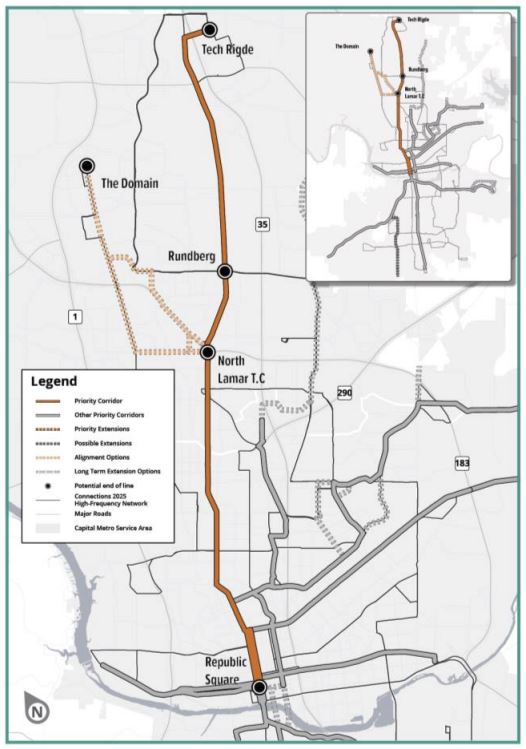
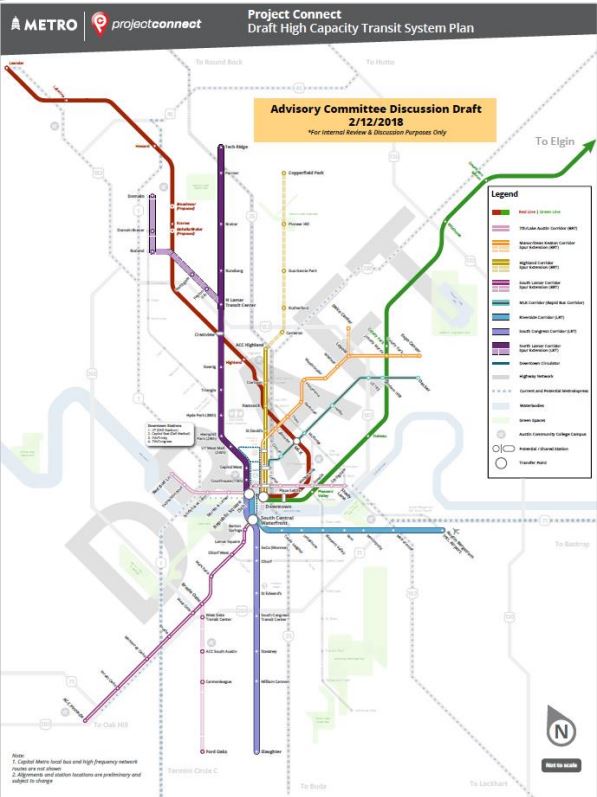
Left: Project Connect draft system plan (presented in Feb. 2018) proposed multiple bus and rail routes, including long north-south light rail line (shown in purple north of the river and lavender to the south) stretching from Tech Ridge to Slaughter Lane. Right: Initial phase of LRT project (proposed Feb. 2018) would run from Tech Ridge to downtown at Republic Square, mainly following the North Lamar-Guadalupe corridor. Maps: Project Connect. (Click to enlarge.)


Astoundingly, within a month that plan was taken off the table, and apparently discarded. To judge from the presentation this past Friday, that realistic, workable plan has now been replaced by a question mark – literally. While Austin is facing a painful and mounting mobility crisis, we’re now informed that official planning is expunging rail from consideration, and has been re-focused on a buses-only operation predicated on visions of a totally untested, effectively imaginary technology (identified with a question mark in presentation slides).

This recent abrupt about-face in the direction of Austin’s public transport planning is extremely bad news – for urban public transport and the future mobility and livability of this entire metro area. Besides the trashing of the orderly planning process, the implications for Austin’s public transport are potentially far more seriously damaging.


Slide from Feb. 14th Project Connect presentation shows hypothetical “Autonomous Rapid Transit (ART)” as question mark. Since mode is currently imaginary, characteristics and performance claims for it in chart are apparently based on pure speculation. Does a currently fictional technology merit inclusion in a presentation of critical public transport options? Graphic: Project Connect.


It says a lot that, since the late 1970s, at least 19 North American cities have opened brand-new light rail systems, almost every one of which has decisively reversed previously declining ridership, increased public attraction to transit, improved urban livability, sparked economic development, and attracted real estate development to cluster near the rail stations. In contrast, the results for the handful of new BRT [bus rapid transit] and quasi-BRT operations have been spotty, and at best a pale shadow of light rail’s success.

In Austin, over the past 28 years, at least three multimillion-dollar publicly sponsored comparative studies have selected light rail as the superior mode to BRT, particularly in key features such as capacity, cost, and various community impacts.

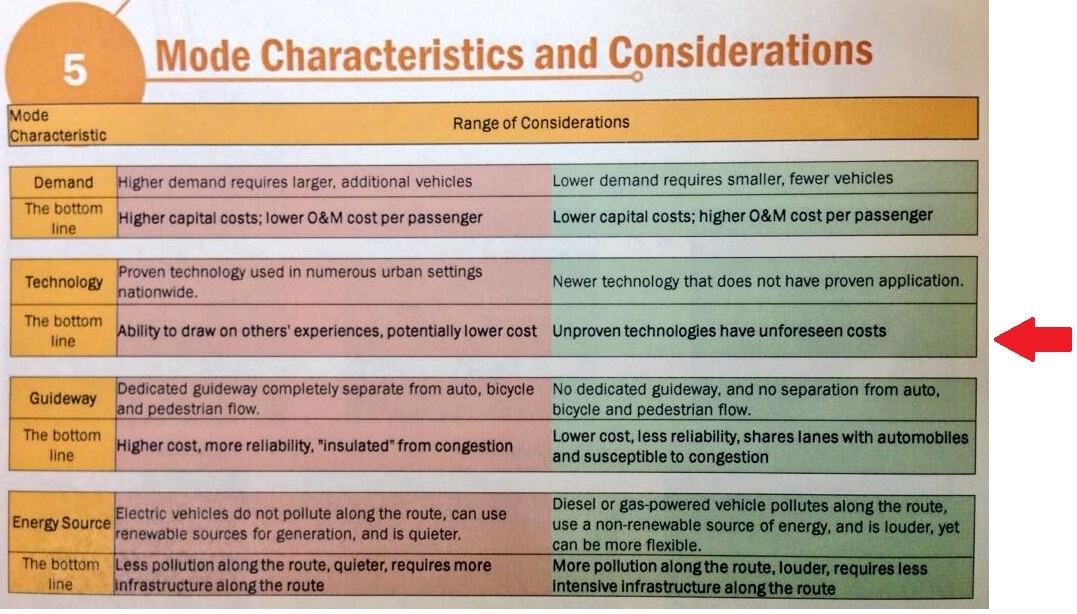
While new technology can improve transit, it must be rigorously tested and proven. But in terms of demonstrated workability and performance, the latest “transit vision” of “a regional system of autonomous, electric-powered buses moving in platoons” is little more than a fantasy, and quite possibly a fraud. Four years ago, the Project Connect team rejected reliance on “Newer technology that does not have proven application”, and warned that “Unproven technologies have unforeseen costs”. Now those caveats have disappeared, replaced by assurances and hype.


Project Connect chart from 2014 includes warnings (annotated with red arrow) against “Unproven technologies”. Graphic: Project Connect.


But what proponents seem to be actually committing Austin to, in reality, is BRT for the region’s major “high-capacity” transit system. The idea seems to be to place all our hopes on an unproven hypothetical technology that will emerge – and be satisfied with BRT in the meantime.

Yet while the Austin region’s mobility crisis continues to worsen as I speak, light rail is available now, a well-proven mode with a long record of success. It’s out-performed BRT and proven far more affordable than subway-elevated alternatives. I urge you to reinstate that February plan with a central light rail spine so Austin can continue to move forward with a real-world solution to our mobility crisis.

Thank you for the opportunity to put these observations and warnings in the public record.

h1

Capital Metro strikes three blows against Lamar-Guadalupe light rail

31 May 2018

Graphic: Grace in the city

In a post this past February 28th, we reported on a surprising development coming from Capital Metro’s Project Connect planning process – the “conceptual” proposal of a 21-mile predominantly linear north-south light rail transit (LRT) corridor, running from Tech Ridge in North Austin, through the central heart of the city, to Slaughter Lane, near the Southpark Meadows area, in South Austin. The proposal particularly extolled the merits of a 12-mile-long segment, through the Lamar-Guadalupe corridor, from Tech Ridge to downtown.

After over four decades of indecision, missteps, and delay, it seemed like the transit agency (and city leadership) might, amazingly, have turned a corner. Could this actually mean that, at long last, Capital Metro and Austin’s top leadership were prepared to move ahead with a plausible, workable light rail plan – implementing a long-awaited leap forward in urban mobility – for the city’s most important central corridor?

Unfortunately, no. Slightly over a month later, Capital Metro reversed itself, withdrew the LRT proposal, and reverted to the familiar decades-long pattern of indecision, confusion, dithering, and delay that has gripped Austin like a curse.

Instead of an actual, specific project for a new light rail system, with a starter line from Tech Ridge to Republic Square downtown, the proposal had dissolved into the clouds, becoming just another line on a map of “perhaps something, some day”. To explain the retreat, planning was now described as “mode agnostic” – in other words, reverting back to a kind of official daydreaming, without any modes (the things that people would actually ride) identified to define a real-world project.

Almost exactly a month later, Capital Metro’s board made another fateful decision. Whereas mode-specific recommendations from the Project Connect study were scheduled for June, the board delayed that back to late in the fall (or perhaps winter) – far too late to put any kind of actual, mode-specific project (such as the previous LRT proposal) on the November ballot for possible voter approval of bond funding. (At best, this would now delay voter approval of any hypothetical project until the 2020 election cycle.)

A third blow against LRT in the Lamar-Guadalupe corridor was struck on May 8th, when the Capital Area Mobility Planning Organization (CAMPO) approved a Capital Metro-sponsored plan (originally submitted Jan. 19th) to overhaul the N. Lamar Blvd.-Airport Blvd.-MetroRail intersection (adjacent to the Crestview MetroRail station) with a design – exclusively focused on accommodating and facilitating motor vehicle traffic, rather than public transport – that would impose enormous obstacles to LRT on North Lamar. Currently, community activists and urban rail advocates are endeavoring to prompt a redesign of this project.

For decade after decade, the Austin community has agonized, writhed, and wailed over its steadily mounting mobility crisis. Hundreds of miles of lanes and roads have been built and rebuilt, and even more vigorous roadbuilding is currently underway. Yet the mobility crisis continues to worsen – for many motorists, driving around the urban area increasingly feels like trying to swim through solidifying mud. Or, alternatively, slogging through a battlefield ….

Repeatedly, the need for light rail has been affirmed. (See «Long saga of Guadalupe-Lamar light rail planning told in maps».) As we pointed out in a March 2015 post, “For two and a half decades, local officials and planners have explained why urban rail — affordable light rail transit (LRT), in Austin’s case — has been an absolutely essential component of the metro area’s mobility future.” («Austin’s urban transport planning seems struck by catastrophic case of amnesia and confusion».)

Capital Metro designated LRT in the Lamar-Guadalupe corridor as the region’s Locally Preferred Alternative in 1989. In 2000, Capital Metro hastily placed LRT on the ballot – but, in a poorly organized election campaign, it was defeated in the overall service area by a tiny margin (although it was approved by Austin voters). In 2014, another LRT plan was presented to Austin voters under the slogan “Rail or Fail” – but, proposed for the ridiculously weak Highland-Riverside corridor, the plan was resoundingly rejected. (See «Austin: Flawed urban rail plan defeated — Campaign for Guadalupe-Lamar light rail moves ahead».)

Time and time again, Austin has demonstrated that it’s the national poster child for chronically muddled urban mobility planning. In a January 2015 post, we warned that “Austin – supposedly the most ‘progressive’ city in the ‘reddest’ rightwing state of Texas – has a distinctive (read: notorious) reputation for dithering, dallying, and derailing in its public transport planning ….” («Strong community support for Guadalupe-Lamar light rail continues — but officials seem oblivious».) As our previously-cited March 2015 post went on to observe: “The devastating befuddlement of Austin’s official-level urban transportation planning … has been nothing short of jaw-dropping.”

Will Austin, and Capital Metro, ever manage to break out of this pattern of failure? Does hope still spring eternal?

h1

North Lamar-Guadalupe-South Congress light rail plan seems back on the table

28 February 2018

Project Connect’s latest draft system plan envisions multiple bus and rail routes, including the long, linear north-south light rail line (shown in purple north of the river and lavender to the south) stretching from Tech Ridge to Slaughter. Map: Project Connect.

The stream of Twitter posts on Feb. 12th from Steven Knapp, attending a meeting of the Multimodal Community Advisory Committee (MCAC), came like a bombshell – forwarding snapshots of an apparent conceptual proposal, by Capital Metro’s Project Connect planning body, for a light rail line not merely in the Guadalupe-Lamar corridor, but stretching all the way from Tech Ridge in North Austin, southward down North Lamar, and Guadalupe, through the Core Area, and on down South Congress to the Southpark Meadows area in far South Austin.

The route, originally proposed by local transportation activist Dave Dobbs in 2014, incorporates sections initially proposed by transportation planner and local activist Lyndon Henry in 1989, plus the portion of Capital Metro’s 2000 plan taking light rail transit (LRT) from the Crestview area (N. Lamar/Airport Blvd.) as far south as the Ben White freeway. Dave’s extensions north to Tech Ridge and south to Southpark Meadows have created a highly plausible north-south linear alignment, offering a central alternative to both I-35 and the MoPac (Loop 1) freeway, that has caught the public’s imagination and attention.


Initial phase of LRT project would run from Tech Ridge to downtown at Republic Square, mainly following the North Lamar-Guadalupe travel/development corridor. Map: Project Connect.


While Capital Metro insists that the idea at this stage is just “a draft for internal review”, LRT in the city’s most important central corridor – North Lamar-Guadalupe – plus South Austin’s most venerable central corridor – South Congress Avenue – does seem to be garnering particularly serious interest. According to Project Connect’s Feb. 12th MCAC presentation,

The North Lamar/Guadalupe Corridor has been one of the most critical transportation arteries in Austin for over a century. Phase 2 of Project Connect considered the 12 miles of the corridor stretching from Tech Ridge in North Austin to Republic Square in Downtown. The corridor connects many of Austin’s most important destinations, including Downtown, the State Capitol, University of Texas, and several major state agency offices between 38th and Crestview.

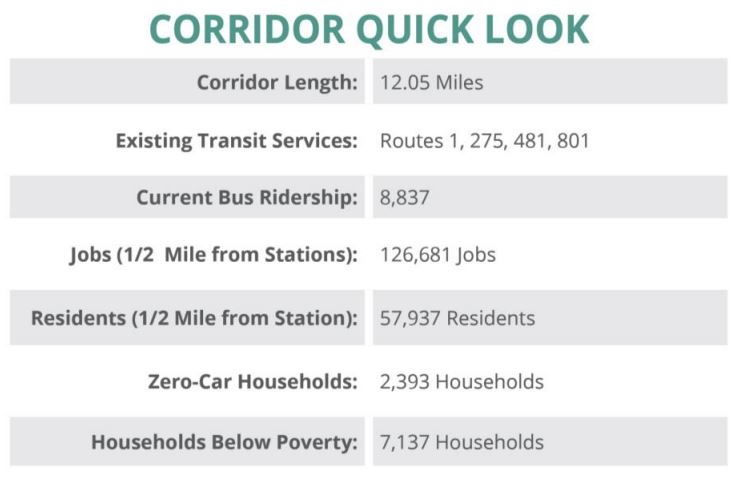
A graphic emphasizes this corridor’s potential even more:


Table shows demographic and other data bolstering potential of LRT in Guadalupe-Lamar corridor. Graphic: Project Connect.


It should be noted that these improved prospects for Guadalupe-Lamar LRT come into ascendancy just as the alternative scheme for an I-35 “Super BRT” – buses running in future toll lanes in the Interstate highway – have been placed “on hold”. (See «Why TxDOT-Capital Metro “BRT” plan for I-35 is a massive boondoggle».) Reportedly, toll-based highways are being rejected by top Texas officials, particularly in light of prohibitions by Texas voters against using relatively new road revenue streams to finance them.

Yet even if LRT is suddenly, truly on the official table, moving forward with an an actual project is not without challenges. First, Project Connect’s planning methodology is still encumbered with unfortunate flaws, a few of them somewhat similar to several within the 2013 planning process. These include dubious and implausibly rigid “corridor” criteria, as well as questionable evaluation criteria. (See «The fraudulent “study” behind the misguided Highland-Riverside urban rail plan».)

But by far the biggest challenge will be how to pay for such an ambitious plan, especially in view of the Trump administration’s evidently skeptical and parsimonious attitude toward public transport funding. But there’s a saying worth keeping in mind: “Who wills the end, wills the means.” Austin could, like Houston, rely on local bonds to fund its own LRT starter line project – if it’s designed (and kept) sufficiently modest and affordable. And some level of federal funding is not necessarily totally out of the question.

In any case, Project Connect appears at least to have taken an official step toward putting LRT back on a sound path for planning and, hopefully, implementation. And that may signal real progress. ■

h1

Plans for Smart City could be dumb choice for Austin

31 January 2018

Austin’s “Smart City” vision is still mainly about cars and buses and roads. Graphic: Austin Tech Alliance.

Commentary by Roger Baker

Roger Baker is a longtime Austin transportation, energy, and urban issues researcher and community activist. The following commentary has been adapted and slightly edited from his comments recently posted by E-mail to multiple recipients.

Austin Transportation Dept. Director Robert Spillar has a vision of the city’s transportation future, and how high tech can solve Austin’s notorious transportation congestion, working along the lines of the Smart City Challenge Austin was trying to win last year. As a recent Governing article discloses, this Smart City vision is still mainly about cars and buses and roads and Austin becoming a “Smart City”, with driverless electric cars steadily displacing gas vehicles.

Another major component of Austin’s Smart City application will be put into place thanks to a voter-approved bond measure from November that included $482 million for up to nine “smart corridors” in the city. The improvements along those arterial roads will include a mix of old and new technology: turn lanes, bus bays and sidewalks will go in along with traffic and weather sensors and connected traffic lights.

The sensors will help traffic engineers better respond to changing conditions, as well help motorists and improve road networks. Texas universities, for instance, will use the information to improve traffic projections and troubleshoot the road network. The city has already done something similar using Bluetooth signals, which led officials to change a downtown street from one-way to two-way during major events to reduce traffic.

There are other components of the Smart City concept which may introduce other drawbacks. As local public transit advocate David Orr has pointed out, “one extremely problematic aspect of the auto-dependent Smart City craze is the proliferation of ride-hailing vehicles which increase congestion and VMT [vehicle miles traveled].”

So far as I know, the latest (2017) Austin city marching orders on transportation are publicized in its Smart Mobility Roadmap. The large PDF document gives the barest of mentions of the terms “light rail” on page 40 and “light rails” on page 71 of this 141 page document!!

The rest of this document is about how driverless electric cars and data collection everywhere are going to change our lives as part of the Smart City of the future – pure distilled essence of Robert Spillar, reading like science fiction, but expressed as certainty. Since Austin outranks Capital Metro in every political sense, the new Director at Metro had better get friendly with this new Austin-cratic transportation policy agenda. Since the Greater Austin Chamber of Commerce just hired two road transportation enthusiasts, Phil Wilson and Brian Cassidy, as top leaders, I imagine that things can only get worse.

A major financing notion being floated in connection with these Smart Mobility plans are PPPs, or Public-Private-Partnerships. But PPPs commonly depend on assuming decades of speculative municipal (or other governmental) bond indebtedness. In this category, the toll roads already built, using high-yield bonds being promoted by the Central Texas Regional Mobility Authority (CTRMA), and then unsuccessfully promoted on IH-35, would be some leading examples.

Now that the top legal architect behind the local CTRMA toll roads, Brian Cassidy, is working for the Greater Austin Chamber of Commerce, could he be convinced to shift his legal focus to transit? Maybe toward promoting PPP-financed rail on Guadalupe, and as the only way short of a much costlier subway to unclog this important corridor between UT and the Capitol?

Unfortunately, the Wall Street needs be sold on at least the possibility for good returns. Rocky Mountain Institute seems to have sold Rob Spillar on the startup potential for Smart Car technologies, which is the hook there. Uber is for occasional use or for tech guys with money, but of little interest for the average commuters that jam up our big roads at peak.

Whereas toll roads can be profitable, especially under conditions of rapid sprawl growth and while fuel is cheap, transit is almost never profitable. I think Capital Metro only gets about 8% return from the fare box (i.e., operating revenues cover only 8% of costs). Where does the profit to attract private investment then come from?

Why would anyone expect “unprofitable” light rail to attract PPP investment money? Any more than our totally “unprofitable” and poorly maintained sidewalks would do?

The strong increased driving trend that took off with the 2014 oil price collapse may be starting to weaken. Low-wage service workers don’t drive as much as they used to do unless they need to commute for work.

In my opinion, this nationally weakening driving trend, plus rising global fuel costs yet to come, are likely to create a swing in public sentiment, if not actual dollars, toward transit. A need when buses can no longer be scaled up adequately to do the job on Guadalupe, nor serve the suburbs adequately either. We have forgotten how to make hard but realistic choices, or come up with compassionate solutions.

The public needs to experience and see basic civic needs for libraries, sidewalks, and roads as being appropriate when applied to transit. Modest solutions scaled to solving current problems rather than big-bond-package urbanist visions should be the rule. I like the Strong Towns approach which basically says we need to concentrate on solving our current problems in a modest way, as opposed to grand and expensive bond debt lasting decades to deal with future hypothetical growth problems. See, for example, the following articles:

https://www.strongtowns.org/journal/2017/1/9/the-real-reason-your-city-has-no-money

https://www.strongtowns.org/journal/2016/6/14/greatest-hits-the-growth-ponzi-scheme

We could do wonders with a half-billion-dollar light rail line down the Lamar-Guadalupe corridor, but it may be some time until the stars line up right. That should have a much higher priority in a world that makes sense. As compared with TxDOT’s crazy obsession with widening I-35 in a futile battle against congestion – reality-denial which only delays doing the really smart stuff like running light rail past UT. ■

h1

How Capital Metro’s planning keeps falling short

31 December 2017

Capital Metro’s proposed Connections 2025 map. Graphic: CMTA.

Commentary by Roger Baker

Roger Baker is a longtime Austin transportation, energy, and urban issues researcher and community activist. The following commentary has been adapted and slightly edited from his comments recently posted by E-mail to multiple recipients.

Capital Metro says it has a major renovation in its bus network underway. Perhaps, but in my opinion, Cap Metro is trying to do too much on too little money. In addition, the agency is politically manipulated, held on a tight city leash by long tradition, with top-down political forces in charge.

Being a big institutional cookie jar has become a practical barrier to developing really smart, compassionate policy, one that riders can depend on from year to year. For example, good Cap Metro planners should understand and hedge against the fact that Cap Metro sales tax revenues can fall as well as rise, depending on the quirky volatility of Austin’s tech-based economy.

This latest transit policy is the result of being forced to choose between two groups and types of service: trying to accommodate the scattered captive riders on the cheaper living-cost fringes, versus the more time-sensitive discretionary riders near the core.

One of the kinder, more compassionate resolutions of this dilemma would be a compromise. The most needy or most bus dependent nearby areas would have bus service that at least wouldn’t get any worse for the next five years, come hell or high water. That way it would be possible for these folks to often hold service jobs in Austin, and the transit service could motivate people who struggle to meet tight family budgets to migrate to these same transit-friendlier areas. At the same time, in the spirit of compromise, Cap Metro could offer a few less 15-minute bus routes serving the core area, but this promise of improved, higher-frequency core service would be equally firm.

But here’s another problem with that. Cap Metro suffers from an acute lack of transit planning that can stay on track for a time that exceeds the current management’s longevity and influence.

Overall, the core problem facing Austin transportation is getting from cheap suburban living to living-wage jobs via existing highways like I-35. Roads like this will never be able to affordably handle this level of peak mobility demand. We should learn to regard congestion as self-limiting in nature.

Insofar as this daily peak traffic is partly related to core retail commerce, will these jobs still be there in predicted numbers, after another five years of Amazon killing local retail? How did the planners at Cap Metro get in such trouble with their sales tax projections? Has that budgetary over-optimism been fixed?

In my opinion, focusing on short-term planning and compassionate meeting of current transit needs in the next few years should get top priority. Included in this category is a $400 million light rail starter line segment down the Lamar-Guadalupe corridor, which is clearly needed today to unclog that corridor.

h1

Gentrification syndrome hurts transit

27 November 2017

Passenger using bicycle rack on front of Capital Metro bus, c. 2015. Photo: CMTA.

Commentary by Roger Baker

Roger Baker is a longtime Austin transportation, energy, and urban issues researcher and community activist. The following commentary has been adapted and slightly edited from his comments recently posted by E-mail to multiple recipients.

Fast growth over decades, together with a lack of Texas land use planning, leads to intractable peak-hour congestion, as we can readily see in Austin. Service workers try to commute from the cheaper-living suburbs to get to good core city jobs. If good transit were there, many would use it. How could things be otherwise, given a big difference in living costs inside and outside the core city, mediated by crowded highways?

Austin, as the most expensive major city in Texas nowadays, is a good example of the urban gentrification syndrome described in a recent Streetsblog story. As the author Angie Schmitt points out,

Bus ridership is declining in almost every U.S. city. Some reasons are fairly obvious: Lower gas prices combined with higher transit fares and service cuts make transit less appealing.

However, says Schmitt, other factors may also be involved – “rising housing costs, with higher-income residents displacing lower-income residents in neighborhoods that traditionally have had robust transit ridership” – and the article cites an analysis of Portland’s problems published in TransitCenter by two planners, Tom Mills and Madeline Steele, at Tri-Met (Portland’s transit agency). As the StreetsBlog article summarizes,

In surveys, many people told Tri-Met that they ride transit less because of a change of home or work address. This led Mills and Steele to take a closer look at the interplay of ridership changes and the housing market.

According to these analysts’ TransitCenter report,

We found substantial overlap between areas where real market home value increased and transit ridership decreased the most. These areas are concentrated in the same traditionally low-income, inner eastside neighborhoods that have experienced significant economic displacement. Correspondingly, transit ridership grew in areas that saw minimal increases in real market home values. These areas tended to be in the first ring suburbs where many low to moderate-income earners relocated after leaving the inner city.

These economic and demographic dynamics put our most loyal transit riders farther away from our best transit service, and strengthen the market for travel modes that are favored by high-income earning residents who may only use transit to commute.

In her conclusion, Schmitt emphasizes that “For transit agencies, any effective response requires coordination with the cities they serve.”

If transit-friendly Portland is losing bus ridership due to gentrification, what chance does Austin have here, where Capital Metro is treated like a reserve cash cookie jar? Austin takes a big part of Cap Metro’s tax money. For example, see page 33 of this link for the agency’s 2015 budget, describing “City of Austin mobility programs” which transferred $26 million out of Cap Metro’s funds to the City of Austin:

https://www.capmetro.org/uploadedFiles/Capmetroorg/About_Us/Finance_and_Audit/Approved%20FY%202016%20Budget.pdf

Recently TxDOT tried to charge Cap Metro a lot (about $18 million) to make I-35 a supposedly “BRT”-friendly highway, presuming it could be used that way a decade from now, if and when it gets widened. Since nobody can accurately predict population growth, or travel demand, or transit demand, even two years from now, let alone in 2045 as CAMPO is presuming to do, shouldn’t we focus on things that we can measure and see? Like vital transit needs right now. Like current bus problems, including the need to maintain useful service in the fringes, a lifeline as vital as Social Security (and other public assistance) for many old and low-income folks.

If we had a genuinely compassionate and liberal Austin City Council, I think they would say this: You know it is unfair to the voters who approved the full cent for Cap Metro transit in the first place for the City to then divert that money, for decades, and for their own projects. As if bus riders have a permanent obligation to make their personal sacrifice to fund weird city transportation projects. Like the focus on driverless cars which we already know will not improve congestion. Let’s urge the city to give back five or ten million a year of this big unfair mordida to improve fringe city lifeline bus service. It is the right thing to do in these hard times.

The core problem facing Austin transportation is getting people from cheap suburban living to livable-wage jobs using existing highways like I-35 – roads that will never be able to affordably handle this level peak mobility demand. We should learn to regard congestion as self-limiting in nature.

Insofar as this daily peak traffic is partly related to core retail commerce, will these jobs still be there in predicted numbers, after another five years of Amazon killing local retail? How did the planners at Cap Metro get in such trouble with their sales tax projections? Has that budgetary over-optimism been fixed?

In my opinion, focusing on short-term planning and compassionate meeting of current transit needs in the next few years should get top priority. Included in this category is a $400 million light rail segment down the Lamar-Guadalupe corridor, which is clearly needed today to unclog that corridor. The fact that the City needs a fancy study like Project Connect to arrive at that conclusion is to me a major symptom of our core planning problem. If we could find some way to infuse Austin’s city leadership with more pro-transit leaders (such as those in cities like San Antonio and Nashville), maybe that would help significantly with this problem.

h1

Why “Super BRT” in I-35 would betray Capital Metro’s member cities

31 October 2017

Project Connect rendition illustrates how “SuperBRT” might use high-occupancy toll (HOT) lanes alongside a highway such as I-35. But where are the stations? Graphic: CMTA online.

Commentary by Dave Dobbs

Dave Dobbs is publisher of LightRailNow.com. This commentary has been adapted and expanded from original private Email comments.

This website’s recent articles «Officials boost roads and “Super BRT”, put urban rail on side track» (Aug. 31) and «Why TxDOT-Capital Metro ‘BRT’ plan for I-35 is a massive boondoggle» (Oct. 1) explained how (under pressure from TxDOT) Capital Metro has been proposing to designate I-35 as Austin’s primary transit corridor, and to install a 21-mile express bus facility (“Super BRT”) in what is to be an overhauled freeway-tollway. “Politically aware” members of Capital Metro’s board ought to understand that providing scarce Capital Metro dollars for this “Super BRT” project – designed mainly to serve non-member cities like Round Rock (voted not to join the transit agency in 1985) and Pflugerville (withdrew in 2000) – is a betrayal of the original sales-tax-paying members of Leander, Jonestown, Lago Vista, Point Venture, Anderson Mill, Volente, San Leanna and Manor, all of which (except Manor and San Leanna) are located northwest, on the US 183 corridor.

Most importantly, with over 95% of Capital Metro’s local tax revenues coming from Austin sale taxes, I-35 Super BRT is a very poor use of limited resources from the benefit principle perspective. This is bad public policy and bad public finance with a negative ROI.

Capital Metro board members, other local officials, Austin’s civic leadership, and the metro area public at large need to consider: What does expending scarce transit agency funds on “Super BRT” to run in I-35 – i.e., funding a transit facility that primarily benefits non-member citizens – say to Capital Metro’s taxpayers?

In contrast, a Guadalupe-Lamar corridor light rail connection to MetroRail at Crestview would be highly advantageous to those who pay the Capital Metropolitan Transportation Authority (CMTA) 1¢ sales tax. In lieu of this, where’s the benefit to the citizens of Austin and six of the eight member cities who’ve the sales taxes for CMTA transit service from the start?

This is a serious public finance question. Jonestown, Lago Vista, Leander, Point Venture, Volente, Anderson Mill and vast areas in Austin’s northwest ETJ are entitled to any major transit fixed quideway investment on a first-priority basis over entities who never were or aren’t now Capital Metro members. Spending Capital Metro money on an IH35 “busway” is a complete rejection of the Benefit Principle.

h1

Why TxDOT-Capital Metro “BRT” plan for I-35 is a massive boondoggle

1 October 2017

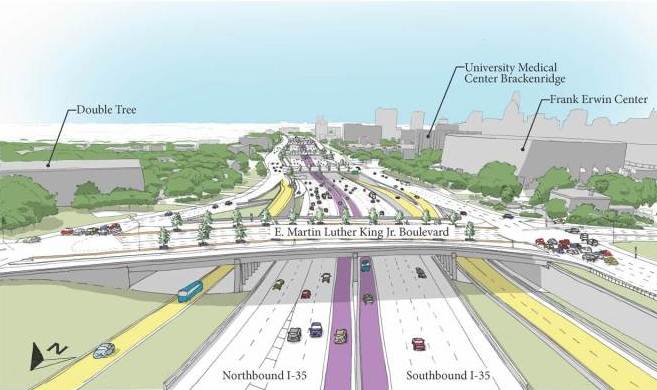
Rendering of rebuilt I-35 at MLK Blvd. with HOT lanes for use by “Super BRT” (shown in purple and yellow). Graphic: TxDOT.

The leadership of Austin’s Capital Metropolitan Transportation Authority (CMTA, aka Capital Metro) seems to be rolling forward full-throttle to implement a dubiously described “bus rapid transit” (BRT) plan for Interstate Highway 35 pushed by by the Texas Department of Transportation (TxDOT) to bolster the highway agency’s massive over-$4 billion I-35 upgrade project. This mammoth project was the focus of a March 2016 posting on this website by Roger Baker and Dave Dobbs headlined «Why spending $4.7 billion trying to improve I-35 is a waste of money» (with the secondary headline «Trying to widen Austin’s most congested road will only make congestion worse»).

As that article warned,

TxDOT is far short of sufficient funds to widen I-35 with its own resources, having identified only $300 million in-house out of $4.5 billion needed. That leaves TxDOT $4.2 billion short — over 90% deficient. In fact, the Travis County section of TxDOT’s My35 redesign is still $1.8 to $2.1 billion short, which should raise red flags for local property owners who could well be targeted for big tax increases.

During this period, Capital Metro resuscitated Project Connect – its major planning effort ostensibly tasked with evaluating possible rail and other forms of “high-capacity transit” – to supposedly sift through various corridors, types of service, and alternative transit modes, and develop recommendations for a package of major new “high-capacity transit” investments. The process has been performed nominally with the oversight of the Multimodal Community Advisory Committee (MCAC).

Mysterious new “Super BRT” project appears

For a while the Project Connect study appeared to stay mostly on track, still focused on corridors, and just starting an evaluation of transit modes. But then it seemingly began to take a detour this past summer, when reports began to reveal TxDOT’s sudden interest in obtaining Capital Metro’s commitment to a very specific transit decision: a mysterious new “bus rapid transit” project on I-35, proposed to use High-Occupancy Toll (HOT) lanes planned for the huge reconstruction of the freeway. (See graphic rendering above.) In a June 27th article Austin Monitor reporter Caleb Pritchard noted some details about the BRT plan discussed at a Capital Metro board meeting the previous evening, including TxDOT’s efforts to muscle the transit agency “to fork over $123.5 million to cover the entire cost of the [bus project] transit infrastructure.” At this, reported Pritchard, Capital Metro had “balked”, but was negotiating with TxDOT on a “counter-offer” to “cough up approximately $18 million” toward such a project and to seek other agencies (such as the City of Austin) as partners.

According to the article, Capital Metro’s vice president of strategic planning and development, Todd Hemingson, revealed that the transit agency had “been talking with TxDOT for five years about the I-35 bus rapid transit plan.”

The department is planning a $4 billion overhaul of the highway and appears to be open to the agency’s insistence that the project include some dedicated allowance for transit. The formative vision for the bus rapid transit system includes a handful of stations built on bus-only lanes in the median of the interstate. Those stations, Hemingson said, would be paired with frequent-service bus routes on intersecting east-west corridors.

The initial ridership projects for the proposed route between Tech Ridge Boulevard in North Austin to State Highway 45 in South Austin is between 4,000 to 6,000 trips per day.

At the meeting, Multimodal Community Advisory Committee member Susan Somers (president of the AURA urban issues community group) “raised concerns about moves that appear to make a proposed bus rapid transit system on I-35 a predetermined outcome of the Project Connect process.”

TxDOT’s arm-twisting intensified. Within weeks, the highway agency was insisting that Capital Metro had better speed up and get with the BRT program to contribute its share to the big I-35 rebuild project. Pritchard captured the situation in a subsequent July 13th Austin Monitor report headlined: «TxDOT pressures Capital Metro to act fast on I-35 transit».

As Pritchard’s report elaborated, the BRT plan emerging from the shadows already had quite a bit of detail. TxDOT wanted money to cover the cost of right-of-way “for three bus rapid transit stations to be built in the middle of the highway.”

Those three stations would be near Tech Ridge Center, at Rundberg Lane and at Slaughter Lane. The bus line that would service those stations would operate in new express lanes that TxDOT is planning to add to the freeway. The stations would allow the buses to pull out of the travel lane to allow boarding and deboarding without interrupting traffic flow. The buses would also enter and exit the highway in downtown Austin, perhaps via dedicated transit ramps, and terminate in the south at a park-and-ride off State Highway 45 Southeast.

Capital Metro VP Hemingson had also revealed that the original plan for “BRT” had been even more extensive, but had to be scaled back because of funding limitations.

Hemingson told the board that his team originally proposed to TxDOT a “super bus rapid transit” model that would have included inline stations at 51st Street, Oltorf Street and William Cannon Drive, three roads whose intersections have seen recent infrastructure investments by the state agency.

“It was kind of met with a thud, that idea,” he reported, citing its estimated cost of $400 million, or 10 percent of the roughly $4 billion that TxDOT is planning to spend on the entire I-35 project.

TxDOT’s mounting pressure on Capital Metro was corroborated on July 24th by the Austin American-Statesman. In a news report with the headline «TxDOT: Cap Metro must pay to put buses on future I-35 toll lanes», the paper’s transportation reporter Ben Wear cited the $123 million cost for the “rapid bus stations” and noted that “The agency is pressing Capital Metro for $18 million now to buy land needed for those stations.” However, reported Wear, a “Cap Metro official says the full $123 million cost is beyond its means to pay in the coming years.”

But the benefits of that $123 million investment seemed to be steadily diminishing. An August 11th Austin Monitor news update by Caleb Pritchard aptly titled «TxDOT document reveals limp projections for I-35 bus plan» reported that TxDOT had “projected less than stellar ridership numbers” for the proposed “BRT” service – at most, 3,400 boardings a day. In ridership, that would place the “rapid transit” bus line ninth among the transit agency’s other routes, well behind an assortment of more ordinary and somewhat less spectacular street-based services without heavy investment.

This tends to reflect the major disadvantages of trying to install a viable, higher-quality transit operation within a freeway. Passenger access to and from the stations – especially pedestrian access – is a distinct problem. Transit-oriented development (TOD) – particularly residential development – ranges from poor to actively discouraged. Economic development goals are unfulfilled. Yet, because of the difficulties of construction and the high land values around a freeway or tollway, capital costs are inordinately extremely high.

Yet abruptly, after months of a supposedly impartial, rigorous process of laboriously pursuing data-led solutions … Project Connect and its parent agency Capital Metro were suddenly abandoning that rigorously defined exercise, bypassing the whole process, and embracing a plan for an approximately 20-mile, $123.5-million, 3-station “BRT” line in I-35 that had actually been in Capital Metro’s planning process, albeit at a very low profile, for the past five years.

Curiously, our website (ARN) had already reported hints of such a pre-planned outcome last November. In an article titled «Capital Metro — Back to 1986?» we observed that “Austin’s Capital Metro seems determined to return to the thrilling days of yesteryear – at least in its longrange transit system planning.” A key basis for our suspicion consisted of reports from longtime Austin-area transportation activist Mike Dahmus, together with “with confirmation from other participants”, making it “clear” that “”some implementation of ‘bus rapid transit’ (BRT) on I-35 is (in the words of one observer) a ‘foregone conclusion’.” ARN had noted that this was a “revival” of a nearly identical but “faulty 1986 plan from the agency’s past.”

And additional evidence that a “BRT solution” has actually long been slated for implementation (despite an ostensible “study” process) has continued to emerge. A commentary by David Orr in ARN’s posting of Aug. 31st revealed that a Connections 2025 brochure disseminated by Capital Metro listed the I-35 “Super BRT” plan as if it were already approved as a project in line for implementation.

Minneapolis “Orange Line BRT” — a faulty model

Much of Capital Metro’s case for the I-35 “Super BRT’ plan appears to use a somewhat similar HOV-lane nominally “BRT” operation in Minneapolis as a model. Dubbed the Orange Line, the 17-mile express-bus-on-highway project is currently under development for the metro area’s I-35W corridor. However, the Minneapolis Metro Orange Line project is significantly different from what TxDOT and Austin’s Capital Metro and Project Connect are proposing. (Information regarding the Orange Line project has been obtained via discussion with former Metro planner Aaron Isaacs as well as online material from the Minneapolis Star-Tribune and Metropolitan Council.)

First, it would seem that the status of I-35 in Austin (with almost imperceptible bus service) is nothing remotely like Minneapolis’s 45-year-old, mature, heavily used I-35W transit corridor, with 25 bus routes, 14,000 daily rider-trips, and substantial existing transit investment, proposed for upgrading into the Orange Line (including one in-line station)
.
Minneapolis’s I-35W bus transit system dates from the early 1970s, when the administration of President Richard Nixon was encouraging investment in enhanced bus operations as an alternative to planning what it perceived as more expensive rail transit. In Minneapolis, this started with metered freeway ramps (controlling access to the freeway); beginning in 1972, HOV bypasses to the metered ramps were implemented, with more being added over the subsequent years. Metro also implemented bus-only shoulders on portions of I-35W and feeder highways 62 and 77.

Eventually this operation included HOV lanes (opened in 2009) used by buses. One “in-line” bus station is already in operation in the middle of I-35W.


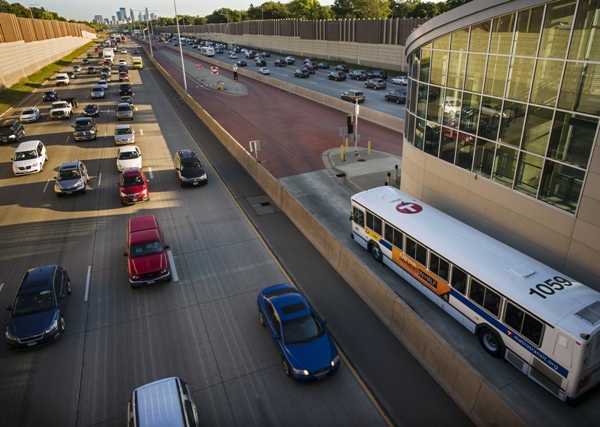
Minneapolis Metro express-bus operation (slated for upgrade to Orange Line) has a single station in median of I-35W. Photo: Metro.


This program never produced ridership and benefit results anything close to what would be expected of a major rapid transit (or light rail) investment – a drawback that became a major factor persuading Minneapolis decisionmakers to proceed with the Hiawatha Avenue light rail transit (LRT) project (now the Blue Line) which opened in 2004. This raises the question whether it is prudent for Austin to follow a similar course of heavy bus transit investment in the I-35 corridor as its major transit option.

Secondly, the Orange Line is not intended to be Minneapolis’s heaviest major transit corridor. That role is already performed by the region’s two LRT routes – the Blue Line with 31,000 daily ridership and the Green Line with 37,000.

Third, in addition to the already-established heavy infrastructure involved in the Orange Line project, it’s relevant to note all the additional infrastructure in terms of surface dedicated lanes that exists and is being expanded with this project. Downtown Minneapolis already has an entire bus mall. This infrastructure is essential to support the heavy volumes of buses the transit agency channels through downtown Minneapolis. (Fortunately, LRT absorbs a huge portion of the total transit volume and handles this more efficiently with trains.) Are the City of Austin and Capital Metro prepared to include this level of downtown infrastructure investment in the project package in addition to the proposed “super BRT” on I-35?

Finally, it’s important to realize that a “BRT” project nearly identical to what Project Connect is now proposing was proposed and rejected in the late 1980s, in favor of LRT on a somewhat parallel route (including Guadalupe-Lamar). The main reason: the high capital cost of inserting this heavy infrastructure into the narrow I-35 freeway corridor. The proposed high volume of buses (with traffic implications for the Core Area) was also a factor in the elimination of this alternative.

Fake “BRT”, “Super” or otherwise

As one takes a broader view of this entire issue, it is legitimate to question whether it is valid to consider buses running in HOV or HOT (high-occupancy toll) lanes as “bus rapid transit” (BRT) at all.

One of the key criteria specified for “true” BRT has been having a right-of-way or alignment clearly designated as exclusive for the bus-only operation. The basic argument behind this has been that to emulate rail systems, all of which have a defined trackway that passengers know identifies the rail line (especially surface LRT), the BRT operation must have a correspondingly uniquely identified alignment reserved for its exclusive use. This is important in order to (supposedly) impart a comparable sense to passengers and the general public of the presence of the route and where it goes – i.e., a crucial factor in orienting passengers and the general public to this service. An HOV tollway open to general mixed-use traffic does not provide this characteristic.

Furthermore, the TxDOT/CMTA proposal for I-35 “BRT” would have the “rapid transit” buses leave the freeway entirely to serve most stations off the “highspeed” facility. That certainly would seem to violate the concept of a readily understandable, visually clear “rapid transit” route. Not to mention putting a big dent in travel time.

And some final considerations: With three proposed “inline” stations over about 20 miles, the I-35 “BRT” would have an average station spacing of about 10 miles. What “rapid transit” line in the world has station spacing averaging 10 miles? BART (which has some of the function of a commuter rail as well as rapid transit) has an averaging spacing of about 2.8 miles, and that’s unusually long. The next in line, the Washington Metro, averages 1.4 miles.

Our own conclusion: What’s being promoted as “BRT” – bus-style “rapid transit” – on Austin’s I-35 would be basically just a commuter bus operation, with some added amenities.

LRT makes more sense

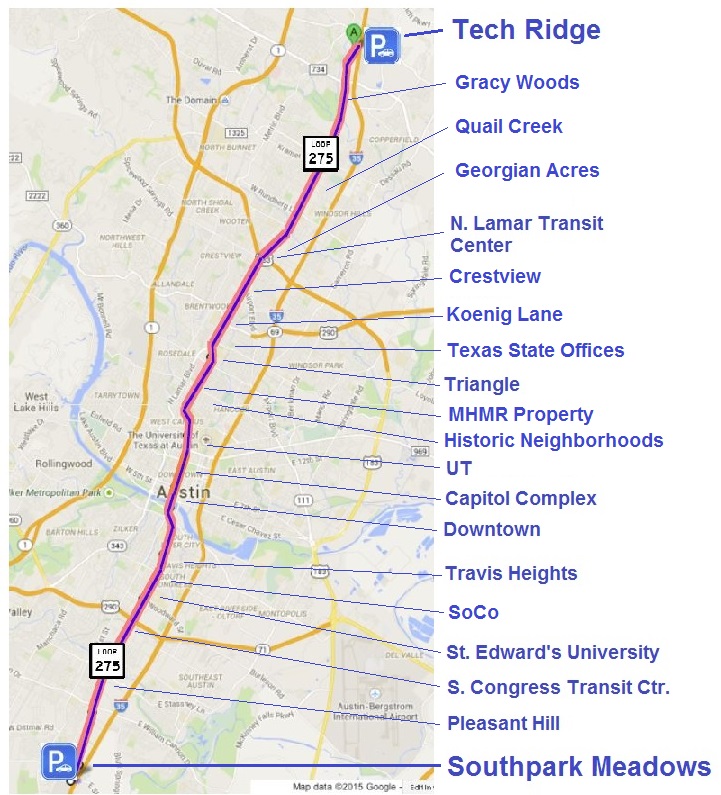
There’s a far more attractive, effective, workable, beneficial, and ultimately affordable public transport alternative to the TxDOT-Capital Metro-Project Connect express-bus plan packaged as “Super BRT”. This alternative is LRT – specifically, as ARN proposed in our July 31st article «Urban Rail on Guadalupe-Lamar, Not I-35 “BRT”» – a 21-mile LRT line paralleling I-35 but serving the center of Austin.

Running from Tech Ridge in the north to Southpark Meadows in the south, mainly via North Lamar, Guadalupe, and South Congress, such a line would offer dozens of stations and immensely greater accessibility, available mobility, attractiveness, ridership, and benefits to the community.


Proposed LRT running in Guadalupe-Lamar and South Congress corridors from Tech Ridge to Southpark Meadows, paralleling I-35. Graphic: ARN.


As our July 31st article indicated, the first segment should be a “starter line” in the Guadalupe-Lamar corridor:

Guadalupe-Lamar (G-L) is the center city’s 3rd-heaviest north-south corridor. In addition to major activity centers, the corridor serves a variety of dense, established neighborhoods, including the West Campus with the 3rd-highest population density in Texas. With Austin’s highest total employment density on Guadalupe-Lamar, an urban rail line could serve 31% of all Austin jobs.

An initial 6 or 7 mile LRT starter line from U.S. 183 or Crestview to downtown could serve as the initial spine of an eventual metrowide system, with branches north and south, northwest, northeast, east, southeast, west, and southwest.

This kind of investment in LRT would appear to represent a far greater value for money, with potential for a much higher ROI (return on investment), than even a lower-cost express-bus project such as that proposed by TxDOT and Capital Metro, and it surely deserves a fair and impartial evaluation through the legitimate Project Connect study process. The attempt to ram through a “rush to judgement” for TxDOT’s “Super BRT” plan (evidently aimed in part to obtain Capital Metro’s buy-in for the I-35 mega-project) deserves to be jettisoned.

h1

Officials boost roads and “Super BRT”, put urban rail on side track

31 August 2017

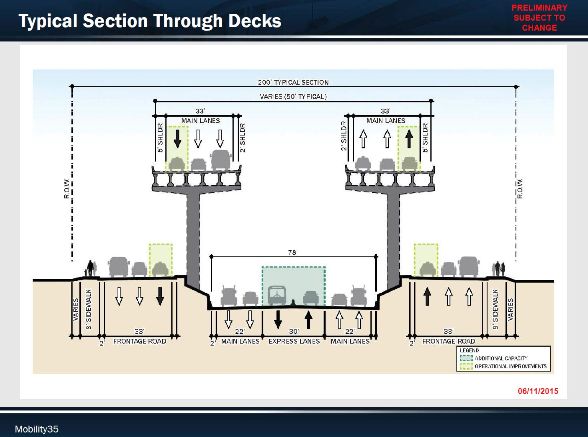
Cross-section of one version of TxDOT’s plan for massive rebuild and expansion of I-35. Center tolled “express” lanes (at bottom center of diagram) are proposed for use by “Super BRT” project to be funded and operated by Capital Metro. Graphic: Mobility35. (Click to enlarge.)

Commentary by David Orr

David Orr, an Austin community activist involved with transportation issues, is a longtime environmental justice and transportation advocate.

Last month, on July 26th, Capital Metro’s Project Connect, together with several other regional agencies, sponsored another of their “Traffic Jam” community meetings to discuss possible options in the planning process. This mainly consisted of a panel of professionals and officials, some local, and some from elsewhere in the country, sitting on a stage in a chapel at Huston-Tillotson University explaining different transit issues to the audience.

I attended this event, but was extremely disappointed in what I saw for a number of reasons. For one, the talking heads were allowed to go over their allotted time (typical for politicians and agency officials), leaving only a half-hour of the two and a half hours of the originally scheduled event time for audience participation. This common practice is designed to minimize public input and maximize officials’ output (i.e., a PR effort).


Project Connect-sponsored “Traffic Jam” meeting on July 26th at Huston-Tillotson University. Opportunity for audience participation was truncated. Photo: L. Henry.


More importantly to our concerns, as was the case with the April “Traffic Jam”, the politicians never got specific about mass transit and talked instead mostly about how expensive transit is and how little money they have. At the same time they have been touting how much good they’re doing building new road capacity with the 2016 bond issue.

Capital Metro’s blog post on the recent “Traffic Jam” added little of substance, but in truth there was little offered by the consultants and local officials, so not much to report on. This event could have been much more effective had there been discussion of Austin’s specific needs, rather than dwelling on reports of what worked in other cities. There was no mention from the stage of what kind of new transit should be built here – and where. That was a glaring omission in the program agenda. It seemed a clear message that they’re seeking public (written) comment of the kind where officials will not be required to respond with any specificity, much less take a stand for or against. I hope I’m wrong, but to date the only messages we’ve received indicating openness to specific forms of new transit initiatives relate to what they’re calling “Super BRT” as if it were a done deal.

The “Super BRT” idea has been brought to public attention only within the last couple of months, bypassing Project Connect’s ongoing “high-capacity transit” study. A June 27th article by Caleb Pritchard in the Austin Monitor cited information from Capital Metro’s vice president of strategic planning and development, Todd Hemingson:

… Hemingson told reporters that the agency has been talking with TxDOT for five years about the I-35 bus rapid transit plan. The department is planning a $4 billion overhaul of the highway and appears to be open to the agency’s insistence that the project include some dedicated allowance for transit. The formative vision for the bus rapid transit system includes a handful of stations built on bus-only lanes in the median of the interstate. Those stations, Hemingson said, would be paired with frequent-service bus routes on intersecting east-west corridors.

This “Super BRT” is really a “pseudo BRT” plan, since the buses would run with mixed traffic in HOV toll lanes (“HOT lanes”). Basically, it seems like just another express bus system with some added improvements.

At the July 26th “Traffic Jam” I was particularly disturbed by a glossy brochure being distributed from Capital Metro titled Connections 2025, which laid out in very concrete terms the agency’s “vision” for the next five years. Nowhere in this document was any rail expansion even mentioned as a possibility. In contrast, the I-35 “Super BRT” plan was mentioned twice, in both places identifying it as if it’s already approved as a project in line for implementation.


Capital Metro’s Connections 2025 brochure includes “Super BRT” as an assumed project. Graphic: CMTA. (Click to enlarge.)


There was no discussion at all of this “Super BRT” project on I-35 during any of the many presentations and speeches during the program, and the very abbreviated public Q&A at the meeting did not permit me to ask for clarification. The only mention in this document of the Guadalupe-Lamar corridor was the continued development and expansion of MetroRapid 801 as well as 803 and additional routes. If they intend to continue to dump cash on the “rapid bus” projects in this corridor, that would effectively preclude serious discussion of a light rail transit (LRT) project in that corridor within the next decade at least.

In the Connections 2025 brochure, the “Super BRT” project was listed on the agency timeline for completion by 2023. Needless to say, it looks like the fix is in, at least as far as Capital Metro is concerned. However, I did ask a Project Connect staffer whether this was now a foregone conclusion, and he insisted it’s not. He also said that LRT is still on the table, but admitted that no one at the agency is really discussing it. That was an eye-opener.

Clearly this is a major challenge to those of us – transit advocates and a large contingent of neighborhoods and other community members – who have been backing LRT in Guadalupe-Lamar (G-L). Perhaps It’s time to request Capital Metro’s board for clarification on their plans for “Super BRT” and how their public input supports this major investment. Especially in view of the fact that this carries a huge opportunity cost for alternatives that might include LRT anywhere else in the city, much less on the G-L route. It’s clear that Capital Metro has been intentionally avoiding responding to the continuing public input they’re receiving in support of LRT and the lack of public support for this “Super BRT” notion.

It may also be necessary at some point to bypass Capital Metro and take this directly to the City Council. Council can make this happen even if they have to drag the transit agency off the “Super BRT” express bus.

However, there are other factors in play that may take the air out of the tires of this scheme. A July 24th article by Ben Wear in the American-Statesman quotes a TxDOT spokesperson regarding the request for money from Capital Metro for in-line stations on I-35. The TxDOT representative insists that “as far as financing goes, none of our funding sources will cover transit.”

Based on my reading of this news report, it seems TxDOT has given Capital Metro a clear signal that “Super BRT” will only happen if the transit agency pays for it. In the current situation, that’s actually very good news from the standpoint of proper planning and what kind of major transit improvement Austin truly needs – LRT.

If Capital Metro can’t raise the funds on its own to build this “Super BRT” – or even some scaled-back version of it – that will likely be the end of that bad dream. Presumably its proponents would have to get some bond money to fund it, but if that had to go before the voters it could turn out like the Prop 1 debacle which failed because the public support just wasn’t there. Capital Metro’s credibility would be pretty much destroyed. So maybe there is hope for a G-L LRT after all. From a politics standpoint, it’s usually easier to kill something controversial than it is to approve it.

A small but vocal opposition armed with facts could probably sink “Super BRT” if it came to a bond election. I suspect that politically aware members of Capital Metro’s board would be sensitive to sustained expressions of support for G-L LRT, and if there’s no evident support for Super BRT they may respond accordingly, if reluctantly.

We have every reason to doubt that Capital Metro will even be able to come close to providing the money demanded by TxDOT to build the “Super BRT” line, at least to whatever standards Capital Metro may determine will have a ghost of a chance in reaching reasonable ridership numbers. This would be a situation where the lack of agency funding could actually work to the benefit of truly effective transit – i.e., an urban rail alternative.

In any case, approval of G-L LRT will itself require a public vote. Nevertheless, supporters of this long-overdue project have good reason to believe it will pass if we can bring strong public support to the cause. We’ll have to win an election, and we need to start strategizing now.

My hunch is that funding “Super BRT” will kill off LRT for the next decade. Conversely LRT could do in this pseudo-BRT project. It’s a zero-sum game. So long as BRT is getting all the official attention our side is side-lined in the public’s eyes.

It’s been pointed out here that the likelihood of funding I-35 “Super BRT” through a public bond vote would be much less likely than is the case with LRT, which would run where people actually live and work. One of our most potent arguments is that high ridership depends on convenience and flexibility in options for future build-out/expansion. Yet “Super BRT” on I-35 is just a one-trick route, with few options for east-west routes. In contrast, LRT of course has many possibilities for eventual expansion.


Rendition of LRT on Drag from 2000. Graphic: Capital Metro, via Light Rail Now.

Rendition of LRT passing UT campus on Guadalupe St. An initial starter line in Guadalupe-Lamar corridor would provide basic urban rail backbone for expansion into a citywide system. Graphic: Capital Metro, via Light Rail Now.


This is the sort of discussion that Capital Metro should be facilitating as part of the Project Connect planning process. One bright spot I have seen recently in the process is the agency’s stated intention to respond on their website to written comments. This is an opportunity to find out how responsive the agency is to public interest and demands for specific proposals. At least Capital Metro has not so far ruled out anything.

Thus it is up to pro-rail transit advocates to submit written comments. It’s critical that the written public record reflect the breadth and depth of support for options on the table for consideration. Strong and persistent demonstrations of support for a G-L LRT starter line project may persuade Capital Metro to rethink some of their assumptions and give supporters of this plan a fair hearing, and a detailed response.

This would also be helpful in familiarizing more Austinites with the G-L LRT plan and the case that can be made on its behalf. Advocates of LRT – including the starter line LRT project in the Guadalupe-Lamar corridor – have sufficient expertise and numbers behind this proposal to present a credible and persuasive concept that will be difficult to dismiss.

So long as positive expressions of support are received the transit agency must recognize the breadth and depth of support for urban rail. Hopefully some official heads can be persuaded.

h1

Urban Rail on Guadalupe-Lamar, Not I-35 “BRT”

31 July 2017

Map from Austin Rail Now/Our Rail leaflet distributed at July 26th “Traffic Jam” shows 21-mile light rail transit line proposed as a “high-capacity transit” alternative to the “BRT” line in I-35 advocated by TxDOT and other road proponents.

As our April 30th article «Reorganized Project Connect 2.0 opens up, reaches out» explained, Project Connect – the major planning effort -sponsored by Capital Metro, has been re-evaluating Austin-area corridors as possible candidates for rail and other forms of “high-capacity transit”. In recent months, the Texas Department of Transportation (seeking funding participation for its planned overhaul of Interstate Highway 35 through Austin) has been prodding the transit agency to allocate funding for a so-called “bus rapid transit” (BRT) service to be installed in the proposed reconstructed highway. This has become one of the de facto “high-capacity transit” alternatives competing with urban rail in the Guadalupe-Lamar corridor for major local funding.

On July 26th, Project Connect, Capital Metro, and several other collaborating agencies sponsored a “Traffic Jam” community meeting, with invited panelists, to discuss possible options in the planning process. The following article is adapted from a leaflet published and distributed by Austin Rail Now, together with the Our Rail political action committee, at the “Traffic Jam” meeting, focusing on a proposed central 21-mile light rail transit (LRT) project, paralleling I-35 and Loop 1 (“MoPac”, Austin’s other north-south freeway), as an alternative to the I-35 “BRT” proposal.


Why not a true mobility option?

Alternative to I-35 and Loop 1 — A 21-mile urban rail line, running from Tech Ridge in the north to Southpark Meadows in the south, following the Loop 275 (North Lamar to South Congress) corridor, could provide alternative traffic relief to Austin’s major north-south freeways (I-35 and Loop1/MoPac).

Map at left illustrates the major neighborhoods and activity centers that would be served. Such a route could plausibly have a potential of attracting ridership of 100,000 a day.

Better option than I-35 “BRT” — Urban rail is a far better public transit option than a dubious, seriously handicapped “bus rapid transit” (BRT) line in I-35. Urban rail lines have demonstrated significantly greater potential to attract riders, guide adjacent development, improve commercial taxbase, and stimulate economic activity. It’s unlikely that buses running in an I-35 HOV toll lane would yield any of these benefits.

Affordable — Light rail transit (LRT), predominantly surface-routed, can most easily and affordably be installed to serve people where they live, work, and need to go. Decades of experience in other major U.S. cities demonstrates that light rail is substantially less costly to operate per passenger-mile than buses, and tends to create high-value taxbase around stops. This can significantly enhance public revenue for better city services, while at the same time helping stabilize or even lower property taxes.

Guadalupe-Lamar starter line — Guadalupe-Lamar (G-L) is the center city’s 3rd-heaviest north-south corridor. In addition to major activity centers, the corridor serves a variety of dense, established neighborhoods, including the West Campus with the 3rd-highest population density in Texas. With Austin’s highest total employment density on Guadalupe-Lamar, an urban rail line could serve 31% of all Austin jobs.

An initial 6 or 7 mile LRT starter line from U.S. 183 or Crestview to downtown could serve as the initial spine of an eventual metrowide system, with branches north and south, northwest, northeast, east, southeast, west, and southwest.

BRT Reality Check — So-called “BRT” operations in other cities like Minneapolis and Cleveland typically fail to meet the ridership and urban benefit claims of their promoters. Minneapolis’s Orange Line, an upgrade of the city’s heaviest bus transit corridor in I-35W, with just 14,000 daily ridership on 25 routes after 45 years’ worth of facility investment, is no model for Austin. (In contrast, Minneapolis’s 2 LRT lines attract ridership of 68,000.) Cleveland’s Health Line carries ridership of 16,000 in the city’s historically busiest local corridor. Running both in reserved lanes and in mixed traffic, this line is more akin to Austin’s MetroRapid bus services than a “BRT” operation in I-35.

Community benefits — Compared with buses, LRT systems are more user-friendly, more comfortable to access and ride, and more reliable. G-L LRT would provide higher passenger capacity than the proposed I-35 “BRT”, while being more energy efficient, encouraging denser development and safer, more livable urban environments, and emitting less greenhouse gases.

h1

East Austin: Upscale gentrification worsens affordable housing crisis, avoids bona fide TOD

29 June 2017

Rendition of southeast portion of Plaza Saltillo development, now under construction. Higher-density gentrification is replacing affordable housing and business locations under guise of “TOD”. (Graphic: Plaza Saltillo project via Austin Chronicle.)

Commentary by David Orr

David Orr, an Austin community activist involved with transportation issues, is a longtime environmental justice and transportation advocate.

Appropriate increases in density can be beneficial, but in the case of East Austin increasing density has become a major contributor to the expanding economic (and racial) segregation recognized by the Census Bureau and others as the worst in the U.S. Notably, the primary locus of the new construction is along the city’s only light railway commuter route (MetroRail), which uses abandoned the abandoned right-of-way (ROW) of a freight-rail spur into downtown.

Rapid changes in certain neighborhoods today are accelerated by rapid growth and massive investment in upscale development in and near downtown. What’s been billed as the tallest residential skyscraper between the east and west coasts is going up in downtown right now. East Austin is separated from downtown by I-35 which was built in that location to keep the black and Latino populations on “their” side of town. But downtown is hemmed in, and the real estate values are through the penthouse roof, so the Eastside is obviously the prime target for massive development.

The biggest redevelopment project in the city’s history is centered around a rail station (Plaza Saltillo) in a former railroad marshaling yard that for many decades has been surrounded by public housing, homes built in the 1920s and 30s, and funky old bars and auto mechanic shops. These are systematically being razed – entire city blocks every month or two – to make way for newly arrived, millennial code warriors who work downtown and want the dense urban streetlife environment. Small groceries, trendy bars and restaurants, and lots of parking garages for those shiny BMWs (“transit-oriented development”!) are going in block by block. From an environmental policy standpoint this is progress, as it will reduce auto commutes (not necessarily the number of trips) … but it’s mostly aimed at new residents moving in from places like Silicon Valley, with all that cash, and does little to address the need to increase densities in other areas near major employment centers.

For example, Apple’s huge complex is out in the boonies and not even on a bus route. But they have a huge parking garage that serves only their own staff. So much for Apple’s commitment to environmental concerns. There’s plenty of space around Apple’s complex for high-density development that could support transit, but so long as their well-paid staff drives in to work (and parks for free) and lives miles away in gated communities, there’s little incentive to the company to “think different” about their transportation situation.

In other parts of the city, especially in older neighborhoods, there is resistance to more density because folks want to maintain the quiet and quaint character of their ‘hoods. I appreciate that, especially in the case of Austin being one of the fastest-growing urban areas in the U.S., and the desire of folks to stay in their (often historic and) well-maintained homes.

Meanwhile there are large swaths of lower-cost, low-density land in the “old” sprawl zones that should be targeted for high-density redevelopment, but were leapfrogged by developers building upscale projects in the fast-disappearing ranch lands in nearby rural areas. These older urban fringe areas are disdained in part because they’re near lower-income neighborhoods that were middle-class subdivisions only 20 years ago, and in part because the employment centers were allowed to build in the hinterlands, leaving these low-density, affordable areas largely bereft of investor interest. At least there are still some areas where low-income people can still afford housing, even if it is half their monthly income.

Property taxes in Texas are high, especially in high-income counties like ours, as the state has no income tax and deals with funding for poor counties’ schools by taking from the rich counties (i.e. forcing them to raise property taxes to support other counties) and redistributing the wealth to those counties with low tax bases. Thus property taxes in our (relatively “wealthy”) county are high – even for poor people – exacerbating economic pressures to sell private homes (many of which are paid off and/or rented to low-income residents) for big redevelopment. We might call this a Texas-Style 21st-century Urban Renewal program (a.k.a. “Negro Removal,” as the old urban removal programs were known to activists of the mid-20th century).

What does all this mean for transit development? It means real estate interests aren’t interested in it because they’re focused on adding Lexus Lanes to area freeways to accommodate (in their minds) wealthy commuters and tourists going downtown.

In addition to auto-oriented development, the state and anti-transit activists have made it difficult to build light rail at all, much less in areas where it’s needed most, but where redevelopment investment is low. Dallas now has more miles of light rail than any urban area in the U.S., and the so-called “green” city of Austin has only one piddling DMU two-car commuter line that can carry only a few hundred riders per hour at peak time, often leaving riders standing at the station to wait for the next train (headway around 1/2 hour). Bus routes offer infrequent service in most areas if they’re served at all, and provide few direct connections to two new express routes billed as “bus rapid transit” (BRT) but which operate almost entirely in congested auto traffic lanes. The city just passed a $750 million bond issue that will benefit road projects but provides near-zero funding for transit improvements.

Bottom line: Austin’s reputation as an “innovative” city is belied by its failure to implement effective, bona fide transit-oriented development (TOD) projects in areas that are ripe for redevelopment and that don’t negatively impact the limited supply of affordable housing stock (disproportionately occupied by people of color). The injustice is not only economic and social, it’s environmental.

It’s a joke to think of Austin as progressive when you see developers dictating land use to the city, and the city addressing the affordability crisis by allowing these developers to avoid incorporating affordability into new projects even as they demolish existing affordable neighborhoods. The powers that be control the transit agency’s board, dictating policy to Capital Metro, ensuring the agency won’t put up a fuss or make “unreasonable” demands – such as pushing the city to require redevelopment of the older sprawl zones before permitting new sprawl. Austin lags far behind many other cities in terms of equitable, environmentally sensible transportation services, and it doesn’t look as if that’s going to change any time soon.

h1

The case for urban rail on Guadalupe-Lamar

30 May 2017

Top: Map of Guadalupe-Lamar light rail starter line minimal operable segment (MOS), proposed in 2016. (Map: CACDC.) Bottom: Salt Lake City light rail line at downtown station could resemble system proposed for Austin. (Photo: L. Henry.)

by Lyndon Henry

This post has been adapted from comments distributed to members of the Multimodal Community Advisory Committee (MCAC) at its meeting of 26 April 2017. Lyndon Henry is a technical consultant to the Light Rail Now Project and a contributing editor to the Austin Rail Now website.

Why light rail transit (LRT)?

Ridership — On average, light rail systems have excelled in attracting passengers, especially new riders who have access to a car but choose to ride LRT. Compared with buses, LRT systems are more user-friendly, more comfortable to access and ride, and perceived as safer and more reliable.
http://www.lightrailnow.org/industry_issues.htm#ridership
http://www.lightrailnow.org/industry_issues.htm#mode-preference

Affordable — Especially for cities of Austin’s size, light rail has typically demonstrated an affordable capital cost and the lowest operating + maintenance cost per passenger-mile of typical urban transit modes.
http://www.vtpi.org/bus_rail.pdf

Environment & energy — Evidence shows light rail systems have the lowest air pollution and noise impacts, preserve neighborhoods and urban quality of life, and reduce energy usage per passenger-mile compared with cars and buses.
http://www.lightrailnow.org/industry_issues.htm#environmental-impacts
http://onlinepubs.trb.org/onlinepubs/circulars/ec145.pdf

Urban benefits — In contrast to bus operations, light rail systems have demonstrated a consistent, significant propensity to attract adjacent development, stimulate economic prosperity, and help shape and guide a changing urban landscape.
http://www.lightrailnow.org/industry_issues.htm#urban

Capacity — Compared to both buses and “gadget” modes like gondolas, LRT has far higher capacity in normal service scenarios and greater capability to accommodate future demand. Unlike many “gadget” alternatives, LRT is well-proven in public service, a readily available technology, and non-proprietary.
https://www.thoughtco.com/passenger-capacity-of-transit-2798765

Expandable — The lower capital cost of a predominantly surface LRT system makes it the ideal affordable mode for future expansion of a rail transit network throughout the Austin metro area.

Why the Guadalupe-Lamar corridor?

Travel density — Guadalupe-Lamar (G-L) is center city’s 3rd-heaviest north-south corridor. The City of Austin (COA) has repeatedly emphasized that G-L is the primary local traffic corridor in central-city Austin, with exceptionally heavy traffic at maximum capacity for over the past 2 decades. Texas Transportation Institute ranks North Lamar as one of the most congested arterials in Texas. Urban rail is essential to maintaining mobility in this crucial corridor. It’s the most logical location for an urban rail starter line.
https://austinrailnow.com/2014/10/13/latest-tti-data-confirm-guadalupe-lamar-is-central-local-arterial-corridor-with-heaviest-travel/

Employment & population density — With Austin’s highest total employment density on Guadalupe-Lamar, an urban rail line could serve 31% of all Austin jobs. Since, this corridor also has Austin’s highest population density, an urban rail line would serve the highest-density residential concentrations in the city – including the West Campus, ranking as the 3rd-highest neighborhood in residential density among major Texas cities.
http://centralaustincdc.org/transportation/austin_urban_rail.htm

Future expansion — As Austin’s primary central arterial access corridor, Guadalupe-Lamar is ideally positioned to become the spine and anchor for future expansion of LRT into an eventual citywide system.

h1

Reorganized Project Connect 2.0 opens up, reaches out

30 April 2017

Guadalupe-Lamar corridor places at top of Project Connect’s table of corridor rankings shown in slide at April 26th MCAC meeting. Photo: L. Henry. (Click to enlarge.)

Has Austin’s public transportation planning and decisionmaking establishment turned a new leaf?

That’s yet to be fully determined. But … if Project Connect – the Capital Metro-sponsored major planning effort in charge of evaluating possible rail and other forms of “high-capacity transit” – offers any indication … there may be signs of a changed focus.

The original Project Connect earned intense distrust from Austin’s most ardent transit advocates because of its role leading the 2013-2014 High-Capacity Transit study that produced the disastrously flawed $600 million Highland-Riverside urban rail proposal (defeated by voters in November 2014). In contrast, the current planning agency (“Project Connect 2.0”) appears to have actually undergone a makeover in some important respects.

Personnel — A totally new planning team, with completely different personnel from the original Project Connect.

Consultants — A new consultant team led by AECOM.

Methodology — A focus on actual travel corridors rather than the original Project Connect study’s method of slicing up central Austin into districts and sectors and mislabeling them “corridors” and “subcorridors” … plus analytics that seem more accurate in evaluating and prioritizing corridors for a comprehensive plan.

Public involvement — What seems to be a much more sincere effort than in the past to solicit and engage actual involvement by key members of the community in the nuts and bolts of the planning process.

Included in this outreach have been strong advocates of urban rail for the Guadalupe-Lamar corridor. Invited to an April 17th consultory meeting, representatives of the Texas Association for Public Transportation (TAPT, sponsor of the Light Rail Now Project and this website) and the Central Austin Community Development Corporation (CACDC) were presented an overview of Project Connect’s planning process and its current status, which appeared to represent a new direction in goals and methodology and a somewhat new approach to public involvement.

Currently Project Connect is completing what it designates as Phase 1 of its overall analysis – concentrating mainly on evaluating and selecting corridors as candidates for possible “high-capacity transit”. Phase 2, according to the agency, about to begin, will focus on selecting modes (i.e., types of “vehicle” systems), identifying funding mechanisms, determining “the best set of solutions”, and recommending Locally Preferred Alternatives (LPAs).

At the April 17th meeting, the attendees were told that the Guadalupe-Lamar corridor was ranking quite high in the evaluation. They were encouraged to attend a public meeting of the Multimodal Community Advisory Committee (MCAC), set for April 26th, where the major results of Phase 1 would be presented.

And indeed, at the April 26th MCAC meeting, Project Connect team members, via a slide presentation led by the project’s Director of Long Range Planning Javier Argüello, revealed the study’s conclusion: Guadalupe-Lamar had emerged as the study’s top-ranked corridor. (At top of this post, see closeup of slide of ranking table.)


Project Connect’s table of corridor rankings shown in slide at April 26th MCAC meeting. Photo: L. Henry. (Click to enlarge.)


From here, according to the study timetable, the focus will narrow on possible modes (rail modes, buses, others) and comparative costs. Obviously, there’s no guarantee that light rail transit (LRT) on Guadalupe-Lamar – the center of substantial community interest for decades – will make the final cut.

Unfortunately, it’s possible that an evaluation could be impaired or skewed by false assumptions. For example: Buses in dedicated lanes may rate as a “high-capacity” mode, but they have not shown that they can attract passengers to utilize that capacity at a rate or level comparable to LRT. Also, LRT has shown a much higher propensity to attract adjacent development – particularly transit-oriented development, or TOD – than “high-capacity” bus services such as MetroRapid. And there are other significant performance and operational issues to consider.*

*See:
New light rail projects in study beat BRT
LRT or BRT? It depends on the potential of the corridor

Nevertheless, despite an array of critical differences, study methodologies and planning models frequently treat rail and bus modes as if they’re totally interchangeable in key features such as attracting ridership, accommodating future ridership growth, and stimulating economic development.

So will an adequate, fair, accurate comparison be conducted? Are local public transport planners actually starting to move in a new direction? The jury’s still out. But Austin’s staunchest transit advocates are watching … and hoping.

h1

“Traffic Jam” to discuss “high capacity transit” becomes “bait & switch” push for road plans

26 March 2017

Graphic: Neonlink.com

By David Orr

David Orr, an Austin community activist involved with transportation issues, is a longtime environmental justice and transportation advocate.

Last year, during Austin’s prolonged community debate over the $720 million mainly roads-focused “Go Big” bond measure, supporters of an urban rail starer line in the Guadalupe-Lamar corridor rallied behind a plan put forward by the Central Austin Community Development Corporation (CACDC). Unfortunately, Mayor Steve Adler (together with several city council members) insisted that the community wasn’t “ready” for such a plan – so a rail vote would have to wait. Many in the community are now wondering: Is there a current initiative to get rail back on the ballot?

Judging from recent events and statements by leading public officials, leadership for rail continues to appear close to nonexistent.

Take for example, the “workshop” at the Bullock Museum on Saturday March 4th sponsored by the reincarnated Project Connect and billed as a “Traffic Jam”. Supposedly a kickoff for a new planning process for “high capacity transit” systems, this event (which turned out to be a sort of “bait & switch” escapade) featured a panel consisting of Mayor Adler, Senator Kirk Watson, Rep. Celia Israel, Capital Metro Board chairman Wade Cooper, and CAMPO (Capital Area Metropolitan Planning Organization) Executive Committee member Terry Mitchell.

At no time was “high capacity transit” even mentioned, let alone covered in any substantive way. The happy talk was all about how hard they worked at the legislature and all the compromises they gladly made only to see their efforts come to naught. The only specific comment Rep. Israel made was that we shouldn’t let the “perfect be the enemy of the good”, presumably by pushing high capacity transit, and that “tires” were what sells to local governments. As opposed to … rails?

Watson & Co. were all smiles about the more than $700 million allocated for facilities for cars – but no mention of funding for transit at all, except that it would be very difficult to get and it would be sought only at some point in the future.

Traffic Jam, indeed.


Promotional notice for “Traffic Jam” event at Bullock Museum, 4 March 2017.


Given this latest iteration of Project Connect, especially as revealed in this recent workshop at the Bullock Museum, I’d say that a rail ballot issue is farthest from the minds of Steve Adler as well as Celia Israel and Kirk Watson, all of whom spoke at some length on the virtues of more “tires” (as Israel put it)​ and of their pride and excitement at moving forward with road building following the bond passage last November.

Never mind that this meeting was supposed to be about planning for “high capacity transit” – there was near-ZERO discussion by these elected officials of any desire for, much less commitment to, building up Capital Metro infrastructure. Also on the stage, as noted above, were members of CapMetro’s board and of CAMPO’s board. The closest any of them came to discussing “high capacity transit” was to bemoan the lack of funding, as if to pre-empt any further talk of building high capacity transit – unless “you” (apparently meaning we the people in the audience and/or those in the general public at large who care about the matter) can find the big bucks required to do anything.

The only mention of expanding CapMetro service was Rep. Israel’s expressed desire to expand into Pflugerville, but this was in the context of her expressing that city’s desire to see service in their city. Her comment about “tires” was made in response to a point she was making about satisfying the demands of Pflugerville city council for action to implement fixed-route service. There were vague references to expanding farther, but they carefully avoided mentioning any other currently unserved/underserved outlying cities or counties, involving either urban or rural areas.

The only mention of actual plans for improved service was their agreement with CTRMA (Central Texas Regional Mobility Authority, primarily a tollroad development agency) for allowing buses to use the high-occupancy/tolled “Lexus lanes” on Mopac (i.e., Loop 1, as well as perhaps on the TBA expanded I-35). Speakers touted their hard-bargaining negotiation with CTRMA, carefully couched in terms that made CTRMA look magnanimous rather than cold-hearted.

So to answer directly that question from the first paragraph, as posed by many in the community: I have huge skepticism whether Mayor Adler would ever commit to supporting rail. “BRT” perhaps, but I’d be surprised by even that.

h1

Transit planning cabal-style

28 February 2017
Graphic: Marvel Database.

Graphic: Marvel Database.

In recent weeks, within Austin’s transit advocacy community, rumors have been circulating of some kind of “package” of major transit projects possibly being compiled, perhaps for the November 2018 election cycle. While details are murky – concocted behind the veil of a resuscitated Project Connect and the tightly shuttered enclaves of the high-level leadership consortium of Capital Metro, City of Austin, plus some Travis County and state officials – it is whispered that such a plan might include a “Guadalupe-Lamar project” as well as an expansion of the MetroRail regional railway, a highway-routed bus “rapid transit” (BRT) line, and other possible projects.

A “Guadalupe-Lamar project” sounds great – a starter light rail transit (LRT) line in the Guadalupe-Lamar (G-L) corridor would represent the crucial linchpin of an eventual LRT (urban rail) network for the entire metro area. But there’s no guarantee that LRT is the “project” behind the dark curtain. Whatever concrete details of these wisps of plans may exist seem to be closely guarded secrets. For the G-L corridor, officials, planners, and their consultants may be envisioning urban rail, or they might just as plausibly be concocting more investment in the pathetic MetroRapid faux-“BRT” operation … or a cable-gondola line … or some other scheme.

The problem is that this top-level methodology of secrecy is now the routine modus operandi of most of Austin’s major public transport planning. And this, in an era of so-called “transparency”.

In fact, a lot of this methodology comes close to the definition of a cabal: “the contrived schemes of a group of persons secretly united in a plot ….” While it doesn’t have the cohesiveness of a bona fide cabal – and it certainly isn’t motivated by evil intent – today’s transport planning process nevertheless feels enough like a behind-the-scenes cabal to merit this unfortunate comparison. (And that’s why we’ve dubbed it “cabal-style”.)

Local planning wasn’t always this Machiavellian. Back in the early days of the Austin Transportation Study (predecessor of CAMPO) and Capital Metro, particularly in the 1970s and 1980s, planning was upfront; plans were on the table for public review, discussion, and debate. Community activists were intimately involved in the planning process; public participation was vigorous and vibrant. Meetings of advisory bodies such as Capital Metro’s Citizens Advisory Committee and Transitway Corridor Analysis Project Advisory Committee were frequent and well-attended, often by participants in the dozens. Plan proposals were not only clearly on view, but were shaped and fine-tuned by direct community input.

That process has, in recent years, been squelched. Interactive public meetings have been replaced by “open houses” and “workshops” where actual full discussion among all participants is excluded. Austin Rail Now has analyzed and criticized this deleterious process in considerable detail – see the numerous articles collected in the category Public involvement process.

Bona fide, free-speaking, freely attended, full public meetings are a critical component of democratic process. That’s how ideas are raised, shaped, tweaked, finalized – via discussion within groups of participants with a diversity of expertise, backgrounds, viewpoints, insights.

You can be sure that these occult, mysterious transit plans we’ve been referring to have been hatched by vigorous interactive meetings … not of the public, but of a relatively tiny, cabal-like huddle of officials, planners, and consultants sheltered from public view and involvement. A carefully assembled community body like the Multimodal Community Advisory Committee is allowed an occasional glimpse of what’s already been decided elsewhere … and then, only every few months or so. Back in the days of the directly involved and intensely active public advisory committees, meetings were held several times a month (especially in the final stages of formulating plans).

Even through this dark, distorted process, perhaps acceptable plans will emerge that will be embraced by the Austin community. But don’t hold your breath. The absence of direct, intimate, ongoing, adequately engaged, fully democratic public participation seriously increases the risk of flawed outcomes and political problems.

h1

Austin’s shaky economic growth presents challenge to “strategic mobility plan” remake

31 January 2017
Austin Strategic Mobility Plan (title slide from official presentation)

Austin Strategic Mobility Plan (title slide from official presentation)

By Roger Baker

Roger Baker is a longtime Austin transportation, energy, and urban issues researcher and community activist. The following commentary has been adapted and slightly edited from his comments recently posted by E-mail to multiple recipients.

Once more, Austin officials are floating the idea of producing another “Austin Strategic Mobility Plan”. As a Jan. 30th article titled «Economic forecast puts focus on transit, housing, jobs for 2017» reports, this effort is being resurrected by Austin Mayor Steve Adler: “Adler said City Council will work this year on a ‘regional strategic mobility plan’ that will eventually lead to an ambitious region-wide transit plan that could include rail”

Austin’s previous most ambitious effort at a Strategic Mobility Plan was soundly defeated in the Nov. 2014 bond package, but few know that.

One problem that Mayor Adler now faces, as a real estate lawyer dedicated to promoting maximum Austin and regional growth as policy, is a sharp decline in our regional economic growth due to the related factors of gentrification, decreasing mobility, and a correspondingly sharp decline in venture capital startups, since it locally peaked in early 2015.

Low job growth is bound to be a big story this year. According to a Jan. 5th report from the Dallas Federal Reserve Bank, we now see an annual job growth rate of only 0.6% in the whole Austin region, according to the most recent Dallas Fed data. As the bank states in its report,

Austin jobs grew 0.6 percent annualized over the three months through November. Jobs in goods-producing sectors saw sharp decreases as manufacturing and construction have continued to shed jobs since the summer. Retail trade jobs continued to decline moderately, while wholesale trade fell sharply.

Austin faces another unique state economic problem due to lower state sales tax revenue needed to fund state workers, as compared to the previous biennial state budgets. A 2.9% revenue decline doesn’t sound like a lot until you add in two years of inflation.

A stagnant state budget and decline in tech job creation, too, put a big burden on the tourism sector to maintain the Austin economy. It seems to me that the Hotel Occupancy Tax increase is being primarily driven by hotels that want to expand the Convention Center again. They probably represent more than a billion dollars of local private hotel investments, so they have a lot of skin in the game.

A lot of total current US growth is now happening because of high-technology-related job creation. Depending on high tech job growth is a risky industrial policy because this sector is especially prone to booms and busts, as the 2001 Dotcom bubble showed in the Austin area. There is a lot of national tech job competition involved. Even Nashville is seriously competing with Austin for venture capital startups, a category of speculative asset bubbles that have been stimulated by nearly a decade of the Fed’s near-zero interest rates. Cheap money encourages risk.

Tech growth can often pay high wages, but over time it leads to gentrification and transportation problems. That is because major highways like Austin’s I-35 fill up with traffic comprised of lower-pay service workers trying to commute out to the cheaper suburbs to live affordably. Austin residents could use good rail and bus transit inside the city. More difficult is the fact that providing high-quality transit service is not very compatible with the doubling Austin MSA (metro area) population, and the low-density suburban development being planned by CAMPO.

These problems associated with a booming tech industry are discussed in a Jan. 26th Washington Post article:

https://www.washingtonpost.com/realestate/fast-growing-technology-sector-is-fueling-a-housing-boom-in-cities-across-america/2017/01/26/5c72c276-a5d8-11e6-8042-f4d111c862d1_story.html

As the WaPo article reports,

Silicon Valley isn’t the only place a tech boom is fueling rising home prices. From Nashville to Raleigh, N.C., Austin to Cambridge, Mass., thousands of high-paying technology jobs are lifting home prices and fueling a boom in construction…

Dwindling housing supply and an affordable housing crunch are perhaps the biggest challenges in many markets seeing rising tech growth.

Also relevant is a Jan. 28th article in Austin’s Community Impact paper, which reports that …

… if Adler had it his way, those using public transportation in the future will be heading to new jobs. “Our neighbors, fellow Austinites, need mid-income jobs,” said Adler. “We know who needs the jobs in our community. We know the kinds of jobs that employers most need to fill. Which, by the way are information technology, healthcare and skilled trades.”

Adler’s goal over the next five years will be to move 10,000 Austin residents out of poverty by getting them qualified for jobs in those targeted industries. “If we’re going to focus our efforts at bringing the right jobs to town, we need to do more to make sure people who live here and need these jobs are qualified to take them. That’s where the Community Workforce Master Plan comes in.”

One important thing to focus on now is CAMPO, because they have formal control of the regional state and federal money, and because they had planned extreme suburban sprawl in the CAMPO 2040 Plan, bankrolled by a hypothetical $35 billion in future funds, envisioned for Lone Star Rail, and from other sources.

CAMPO is now doing their new 2045 plan. But our regional growth is slowing, because of side effects of prolonged growth discussed above, led by real estate interests attracted to fast regional growth. The new CAMPO 2045 regional population growth distribution will help reveal the political picture. Lone Star rail was taken out, so how can they handle the numbers of commuters they anticipate from the tech job growth that they anticipate along the I-35 corridor to San Antonio?

It is getting hard to maintain that there will be as much money as CAMPO had claimed last time. I think it is impossible to predict toll road revenues decades in the future, as TxDOT and the CTRMA claim to be able to hire consultants to do. It is likely necessary to use bond money to widen I-35, so they find private consultants with proprietary travel demand models that we are not allowed to see or to question. The public can’t see the CAMPO models, either.

TxDOT is still $23 billion in debt, because Texas politicians haven’t raised the gas tax for a quarter-century, and neither has Congress. Denial has its limits – and that should make this year very interesting. ■